Of late several startups are innovating business model by adopting web as an enabler. These online innovations are increasingly becoming bigger & better and loved by today’s mobile consumer. At times several such innovations take an indefinite amount of time to catch consumer fancy. Such innovations are ahead of their time. What can a startup or marketer do to achieve Diffusion of Online Innovation. In this article I will revisit some of the time tested tips to achieve the fancy of your prospective consumer.
But in today’s fast-moving digital world, simply launching a new product or service is not enough. Whether an idea succeeds depends on how quickly a group of people accepts, shares, and trusts it, a process explained by the diffusion of innovation theory.
For businesses, understanding the rate of adoption, the role of opinion leaders, and the dynamics of adopter categories can make the difference between breakthrough growth and slow uptake.
And this matters deeply for every marketer and business owner. You could launch the most innovative product in your industry, but if you don’t understand how the consumer adoption model works, you’ll struggle to communicate its value, build trust, or drive early traction.
Knowing how consumers adopt new ideas helps you position your product better, set realistic expectations, and create marketing strategies that actually move people from curiosity to action.
First proposed by Everett Rogers, this theory highlights how innovations spread through a social system, starting with innovators and early adopters, and eventually reaching the early majority once the concept gains critical mass. Many innovative products don’t fail due to a lack of value; they fail because consumers don’t immediately understand how they work, trust their benefits, or see why they matter in their daily lives, as seen with Google Glass, Segway, 3D TVs, the Amazon Fire Phone, and even early QR codes.
In this article, BrandLoom, as a top leading digital marketing agency, will explore how you can strategically guide users from curiosity to confident adoption.
What is Diffusion of Innovation?
Over decades, marketers have trusted a framework to accelerate the consumer acceptance of a product/service. This framework is called DIFFUSION OF INNOVATION. Over the years marketers have taken advantage of this framework and its five product characteristics that seem to influence consumer acceptance of new products/service.
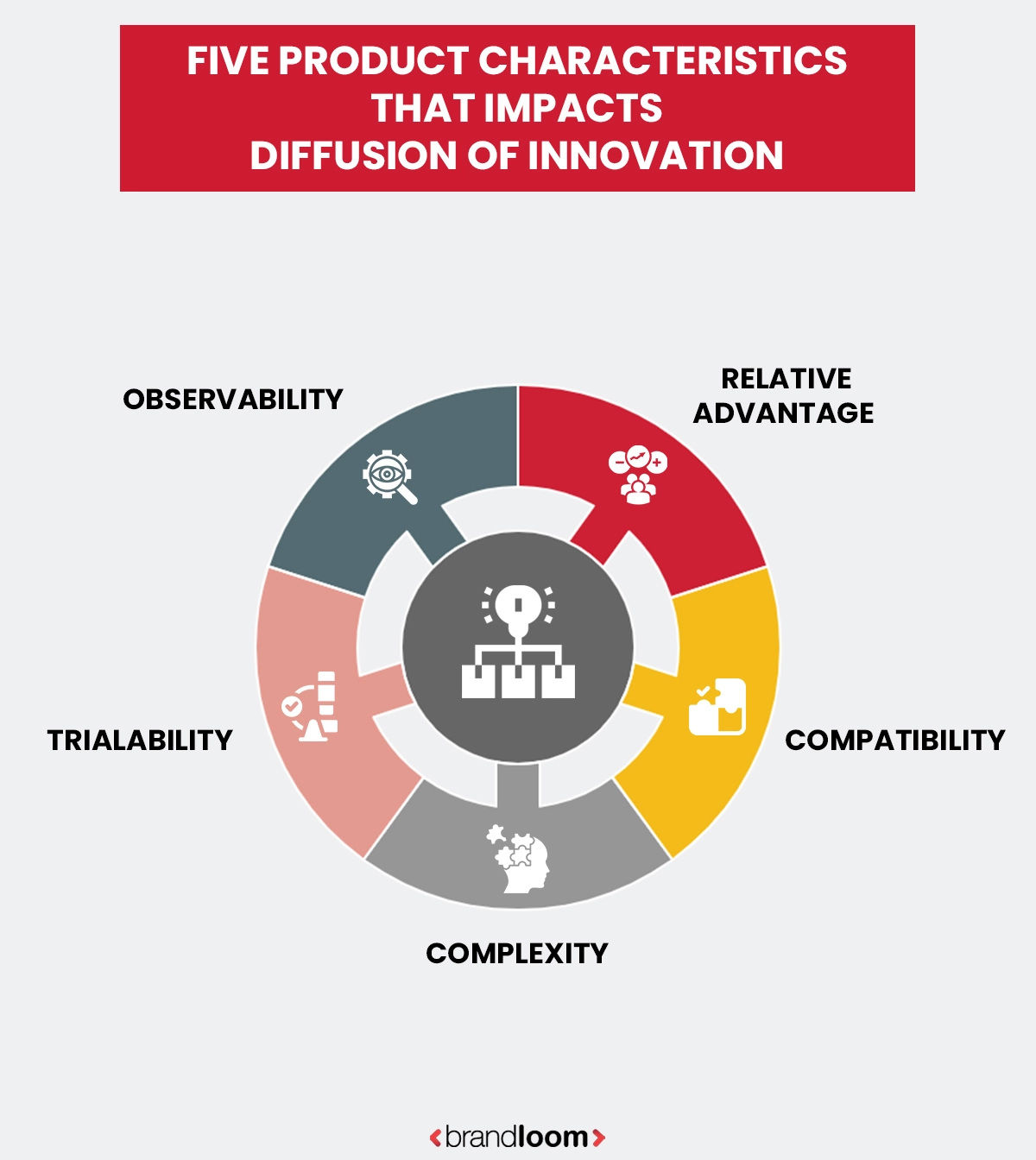
Relative Advantage: The degree to which potential customers perceive a new product as superior to an existing product.
Compatibility: The degree to which potential consumers feel a new product is consistent with their needs, values and practices.
Complexity: The degree to which a new product is difficult to understand or use.
Trialability: The degree to which a new product is capable of being tried on a limited basis.
Observability: The ease with which a product’s benefits or attributes can be observed, imagined or described to potential consumers.
Even today, these factors have not lost their value, and CPG marketers consistently adopt them at different stages of the product lifecycle. However with the evolution of web a lot of this has evolved.
In modern marketing, the Diffusion of Innovation theory shows how new ideas and technologies move through five adopter groups from innovators to laggards. It’s the same pattern we saw with smartphones: first picked up by tech geeks, then embraced by early adopters, and eventually becoming an everyday essential for the masses.
The theory helps marketers understand why some consumers adopt an innovation early while others resist until the product gains critical mass. It also clarifies how communication channels, cultural norms, and opinion leaders influence the rate of adoption.
Today, digital platforms, online communities, user reviews, and social media have transformed how quickly innovations diffuse. Marketers must therefore combine traditional diffusion principles with web-driven strategies to ensure their product or service is discovered, trusted, and widely adopted.
Why Innovation is Critical for the Business Ecosystem
Introduction of new products and services is vital to the consumer, marketer and the world economy. For the consumer, new products and services represent increased opportunities to satisfy personal, social, and environmental needs. For the marketer, it provides an important mechanism to keep the firm competitive and profitable. For the world, it represents potential improvement in the quality of life for people.
Innovation sits at the heart of every thriving business ecosystem because it fuels progress, differentiation, and long-term sustainability. As markets evolve and consumer expectations shift rapidly, businesses must continuously explore new ideas, technologies, and models to remain relevant. Without innovation, companies risk stagnation, falling behind competitors who better anticipate user needs or leverage emerging trends.
1. Consumers
For consumers, innovation not only brings variety but also introduces smarter, safer, and more efficient solutions that enhance daily life. Whether it’s digital services, sustainable products, or advanced healthcare technologies, innovative offerings expand the choices available within a social system and set new standards for convenience and empowerment.
2. Marketers and Businesses
For marketers and businesses, innovation unlocks strategic advantages. It enables firms to enter new categories, attract new segments, and strengthen brand loyalty. It also helps organisations respond to economic, technological, or cultural changes by adapting their value proposition faster than the competition.
3. Economical Level
At the macro level, continuous innovation drives national and global economic growth. It encourages job creation, technological advancement, and improved public services. In a world increasingly shaped by digital transformation, innovation is not simply an option; it is an essential engine that keeps the entire business ecosystem dynamic, resilient, and future-ready.
Why Online Marketers Need to Worry About Diffusion of Online Innovation
“If you fail to plan, you are planning to fail!” — Benjamin Franklin
Young, blue-eyed young professionals are incubating startups and innovating business model by adopting web as an enabler. These online innovations are increasingly becoming bigger & better and loved by today’s mobile consumer.
At times such online innovative ideas take indefinite amount of time to catch consumer fancy. Such ideas are ahead of their time. Such Startups or marketers can base their marketing strategy on the evolved factors of Diffusion of Online Innovation to achieve the fancy of their prospective consumer.
The five product characteristics that seem to influence consumer acceptance of online innovation have also evolved to:
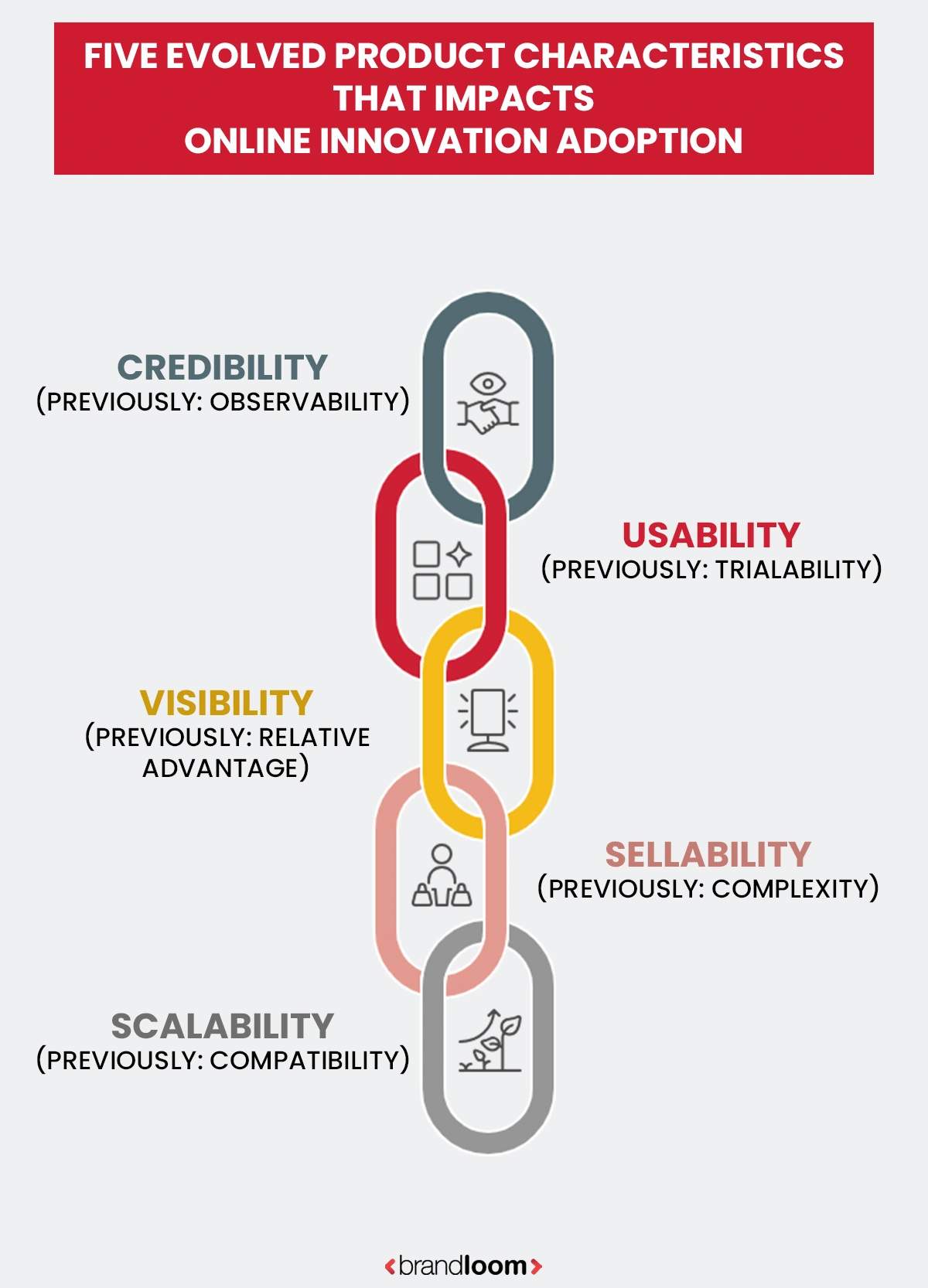
Credibility (evolved form of Observability):
Credibility is exuded in websites, blogs, through our content, videos, PR, social media, or reviews. You never have a second chance to make a great first impression. Building trust is an online marketing must and first.
Usability (evolved form of Trialability):
Usability comes from appropriate and professional design, site architecture, clear navigation, call to actions, e-mails, content, and even social media.
Visibility (evolved from Relative Advantage):
Visibility is critical as we build our online marketing plans. We can offer the best products and services, but if nobody knows about the product and why it is better, what’s the point? Visibility comes from a number of marketing channels, including advertising, natural search, social media marketing, online PR, or e-mail. These visibility options may require space on your Web pages, may be integrated into design, require additional budgeting, or take some technological setup.
Sellability (evolved from Complexity):
Sellability is a critical online marketing planning piece, as this is how well you show, and tell, and sell the value of your organization, products, and services. People need to understand why you or your organization are worth working with. This can come through in videos, testimonials, press releases, taglines, and photos.
Scalability (evolved from Compatibility):
When we employ credibility, usability, visibility, and sellability, we reap the benefits of scalability. Online marketing efforts last a lifetime on the Web, building and compounding over time. Scalable ideas are like ELSS (equity-linked saving schemes). Small investments made consistently over time can grow to support your organization’s overall Web presence and marketing.
In today’s digital-first ecosystem, these evolved factors matter more than ever. With consumers empowered by reviews, social proof, and constant information, the diffusion of online innovation depends on how well brands build trust, simplify experiences, and communicate value. Startups that master these dynamics accelerate adoption, outperform competitors, and establish long-term digital advantage.
Understanding the Diffusion of Innovation Theory by Everett Rogers
The diffusion of innovation theory, developed by Everett Rogers, remains one of the most powerful models for understanding how new ideas spread across a social system. For online marketers, this framework provides a clear lens into why some digital innovations, such as Reels, chatbots, or AI tools, achieve rapid adoption, while others struggle.
Rogers’ innovation model breaks down the diffusion process into four foundational elements: the innovation, communication channels, time, and the social system. Each plays a crucial role in shaping how effectively an idea or technology permeates the market.
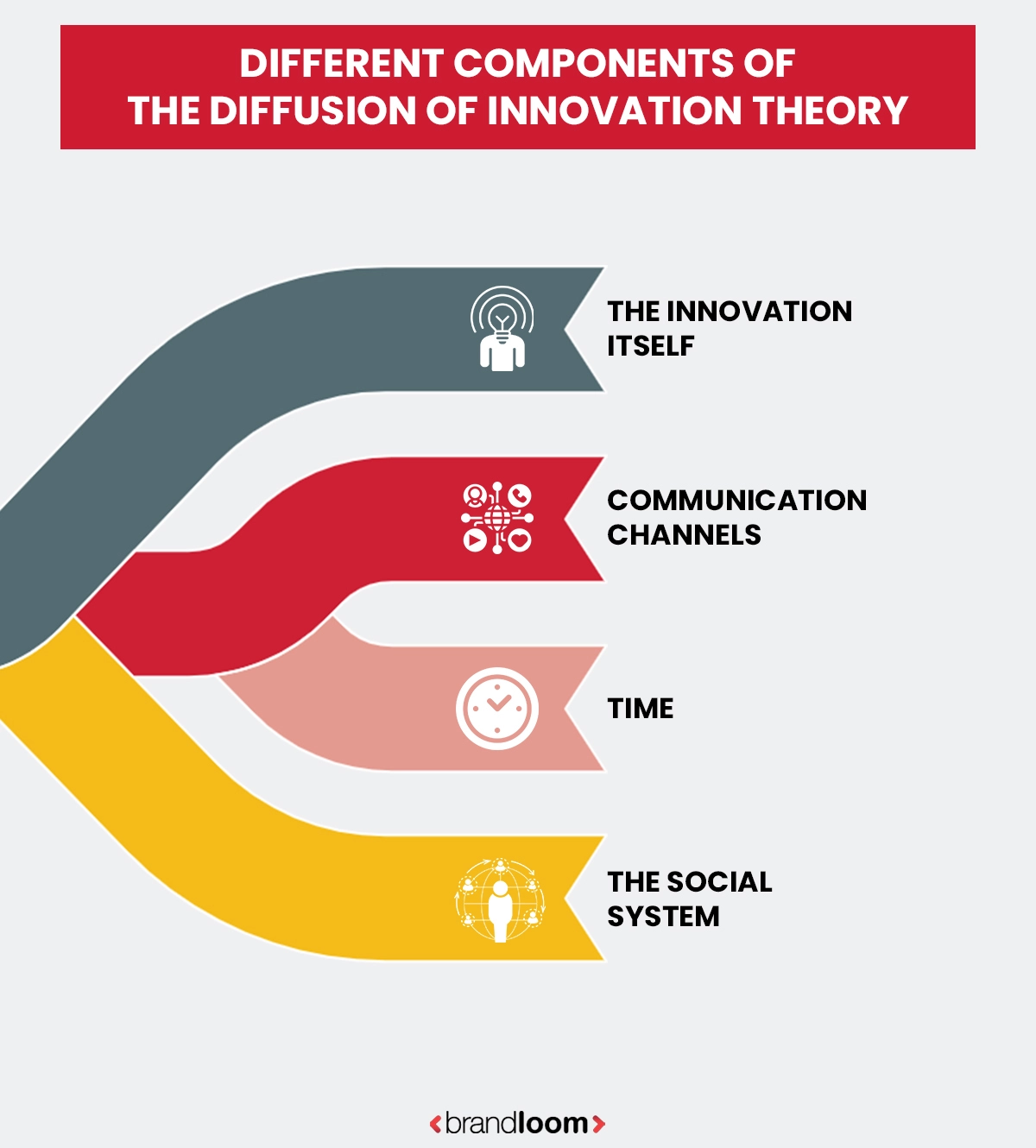
1. The Innovation Itself
Rogers emphasizes that the intrinsic qualities of an innovation significantly influence its adoption rate. Factors like perceived value, relevance, ease of use, and clarity determine whether audiences feel motivated to try it.
For online marketers, this means the product or idea must clearly communicate its relative advantage, how it solves a problem better than existing solutions. Digital audiences respond strongly to innovations that reduce effort, save time, or improve convenience. If your innovation fails to demonstrate this quickly, adoption slows regardless of how aggressively it is marketed.
2. Communication Channels
The diffusion of innovation theory highlights communication as the lifeline of adoption. In Rogers’ model, effective communication channels reduce uncertainty and spread awareness.
In digital ecosystems, communication channels have evolved far beyond word-of-mouth and mass media. Search engines, influencers, niche communities, social media algorithms, personalized emails, AI assistants, and even product-led onboarding journeys act as communication touchpoints.
For marketers, selecting the right communication channels matters as much as the message itself. A new innovation aimed at early adopters may perform better on platforms like X, Discord, LinkedIn groups, or specialized Reddit threads than on broad-reach channels. The faster and clearer the communication, the smoother the diffusion process.
3. Time
Rogers’ innovation model outlines five adopter categories: innovators, early adopters, early majority, late majority, and laggards, each with distinct motivations and risk tolerance.
Online marketers must recognize that these groups don’t adopt simultaneously. Innovators and early adopters want novelty, speed, and exclusivity. The early majority seeks proof and credibility. The late majority prioritizes social validation.
By sequencing messaging and product features according to these adoption stages, marketers can remove friction and accelerate the natural diffusion process.
4. The Social System
Every innovation spreads within a specific social system, influenced by norms, culture, peer behavior, and opinion leaders. In the online world, social systems are shaped by micro-communities, creator ecosystems, platform subcultures, and algorithmic biases.
If an innovation aligns with the values and behavior patterns of the social system, adoption accelerates. If it conflicts with them, resistance intensifies even if the innovation is objectively beneficial.
Together, these elements help marketers understand not just how innovations spread, but why people decide to adopt or ignore them. In the context of online marketing, this theory becomes even more relevant because digital innovations from AI-driven content engines to e-commerce features spread faster, face more competition, and rely heavily on visibility and trust.
By grounding your marketing strategy in Everett Rogers’ diffusion of innovation theory, you gain the ability to predict adoption patterns, craft better communication frameworks, and position your innovation effectively within the social system you aim to serve. In a world where online trends shift rapidly, this structured understanding can be the difference between a breakthrough success and an overlooked idea.
Who Adopts Innovation and When?
One of the most important contributions of the diffusion framework is the classification of adopter categories, groups of consumers who adopt an innovation at different stages, based on their psychology, risk tolerance, and decision-making patterns. Understanding these categories helps marketers predict the adoption rate, craft tailored communication strategies, and position their product effectively along the product adoption curve.
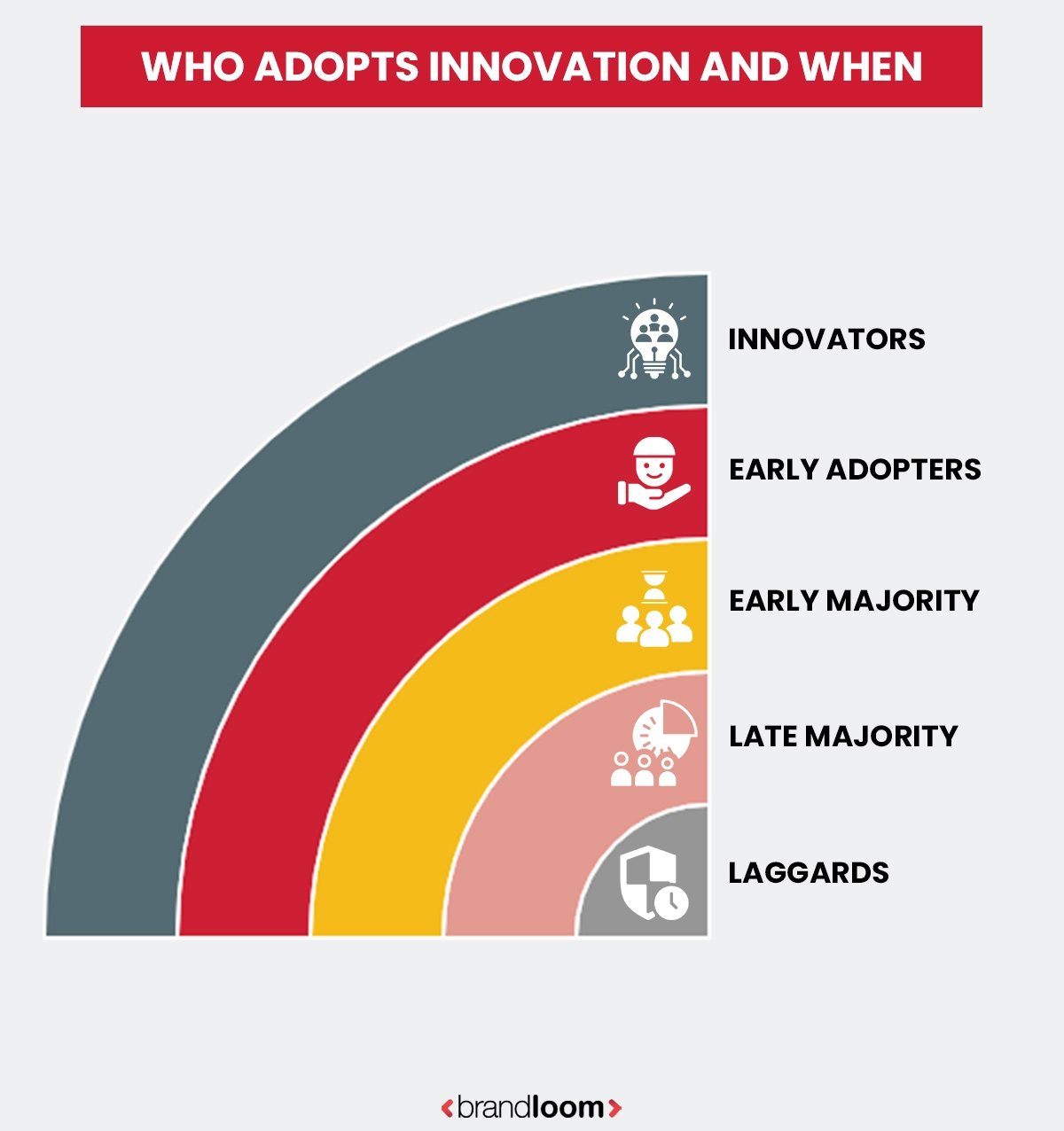
1. Innovators (2.5%)
Innovators sit at the very beginning of the product adoption curve. They are adventurous, curious, and willing to take risks. Their motivation comes from the thrill of discovering something new before the rest of the world.
In the online ecosystem, innovators are often tech bloggers, beta testers, early-stage founders, or power users who voluntarily experiment with new tools and platforms. Their feedback is invaluable because it helps refine the innovation before it reaches larger audiences.
However, marketers must remember that innovators are small in number. They help kickstart momentum, but cannot drive mass adoption alone.
2. Early Adopters (13.5%)
Often seen as opinion leaders, early adopters are more socially influential than innovators. They are selective but enthusiastic about adopting new ideas that align with their goals. Their endorsement creates strong social proof, making them critical to improving the adoption rate.
In digital markets, early adopters may be creators, industry experts, consultants, or trend-sensitive consumers who shape discussions on LinkedIn, YouTube, Instagram, or niche online communities. Their positive reviews, case studies, and testimonials help legitimize an innovation for skeptical users.
3. Early Majority (34%)
The early majority represents the tipping point on the product adoption curve. They are pragmatic, value-driven, and motivated by tangible benefits rather than novelty. This group waits until an innovation demonstrates reliability and sees widespread acceptance.
Convincing the early majority requires strong credibility signals, reviews, ratings, comparisons, success stories, and visible product advantages. If marketers cannot reach this category effectively, mass adoption becomes challenging.
4. Late Majority (34%)
The late majority is cautious and skeptical. They adopt an innovation only after it has become mainstream and proven. Their hesitation often stems from perceived complexity, unfamiliarity, or budget concerns.
Marketers must focus on reducing barriers, simplifying messaging, offering competitive pricing, and showcasing widespread social validation. By this stage, the innovation must appear “safe” and unavoidable to attract the late majority.
5. Laggards (16%)
Laggards are the last to adopt. They resist innovation due to deep-rooted habits, risk aversion, or limited exposure to new technologies. Their decisions are influenced by necessity rather than desire.
Reaching laggards typically requires mass awareness, price drops, and clear demonstrations of indispensability. Although they contribute minimally to early growth, they help complete the full adoption cycle.
How the Diffusion Of Innovation Process Works in an Online Environment
The traditional diffusion model explains how innovations spread over time, but the online environment has transformed every stage of this process. Today, digital products and online services diffuse faster, reach wider audiences, and benefit from real-time feedback loops that did not exist when the theory was first introduced.
Understanding how the diffusion process works online helps marketers design better launch strategies, accelerate adoption, and reduce friction across the user journey.
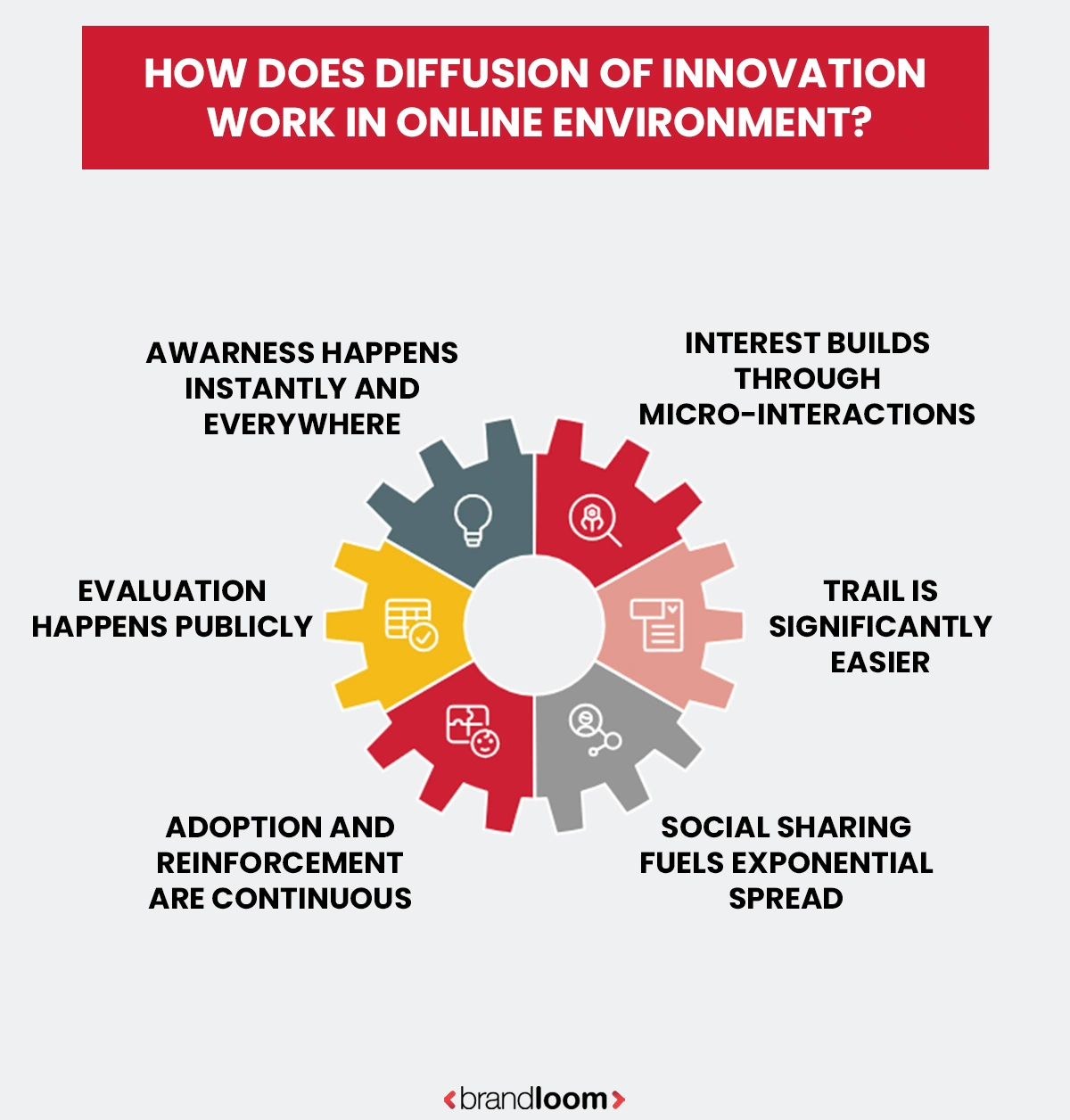
1. Awareness Happens Instantly and Everywhere
In the offline world, awareness depended on mass media, limited distribution, and slow word-of-mouth.
Online, awareness is immediate and multi-directional. Social media algorithms, influencer shoutouts, Google Search, short-form videos, email newsletters, podcasts, online communities, and even AI-driven content recommendations can expose an innovation to thousands within minutes.
This instantaneous visibility means marketers must ensure the first impression is strong because digital audiences decide within seconds whether they care about a new product.
2. Interest Builds Through Micro-Interactions
Instead of brochures or TV ads, online interest is nurtured through micro-touchpoints:
- scrolling through a landing page
- watching a 10-second product demo
- reading user reviews
- seeing a creator tutorial
- interacting with a chatbot
These touchpoints collectively shape perceptions and determine whether users move closer to adoption. Digital users don’t commit immediately; they research, compare, and observe social proof before deciding.
3. Evaluation Happens Publicly
In the digital world, users evaluate innovations openly. They Tweet opinions, publish YouTube reviews, compare screenshots on Reddit, or share pros and cons on Instagram Stories.
The evaluation phase is no longer private it is broadcast, amplified, and permanent. This means marketers must monitor online sentiment, respond quickly, and build transparent communication that addresses concerns proactively.
4. Trial is Significantly Easier
One of the biggest advantages of online innovation is a frictionless trial. Users can:
- sign up for a free trial
- Download an app instantly
- explore a freemium plan
- test an AI tool in seconds
- experiment with features via interactive demos
This ease of trial dramatically accelerates the diffusion process. The faster the user can experience value, the sooner they move toward adoption.
5. Adoption and Reinforcement Are Continuous
In online environments, adoption is not a one-time event. It’s reinforced through updates, new features, notifications, gamification, retargeting, onboarding flows, and personalized content. Even after adopting, users continuously decide whether to stay, upgrade, or advocate for the product.
6. Social Sharing Fuels Exponential Spread
The online world removes geographical boundaries. When early adopters share feedback, tutorials, case studies, or unboxings, the innovation spreads across networks instantly. This network-driven amplification compresses the diffusion timeline and makes viral growth possible.
The Role of Perceived Value and Risk in Online Innovation Adoption
In the digital world, two forces determine whether an innovation takes off or fails silently: perceived value and perceived risk. Even the most groundbreaking online product will struggle with adoption if users do not clearly see its benefits or feel uncertain about its safety, complexity, or credibility.
Understanding how consumers weigh value against risk helps marketers design better onboarding, messaging, and user experiences that support faster diffusion.
1. Perceived Value: “Is this worth my time, money, or attention?”
Digital consumers move fast. They evaluate value in seconds, not minutes. To them, perceived value means immediate usefulness, clear outcomes, and low effort.
Users ask questions like:
- Will this save me time?
- Is it easier than what I’m already using?
- Will it improve how I work or live today?
- Does it solve a painful problem?
Online tools that highlight value instantly through short demos, explainer videos, crisp landing pages, and strong visual storytelling move users faster through the product adoption curve. When the value is obvious upfront, users are more willing to try, adopt, and recommend.
Marketers can enhance perceived value by:
- showcasing results through testimonials or case studies
- comparing against existing solutions
- offering interactive product tours
- highlighting unique features early in the user journey
- demonstrating ROI or efficiency gains
The clearer the value, the higher the adoption rate.
2. Perceived Risk: “What could go wrong if I try this?”
In online environments, perceived risk is amplified. Users worry about data privacy, payment security, platform reliability, scam-like experiences, or overly complex onboarding processes.
The most common types of perceived risk include:
- Security risk: “Will my data be misused?”
- Performance risk: “Will this product work as promised?”
- Financial risk: “Is this worth paying for?”
- Social risk: “What will others think if I use this?”
- Time risk: “Will this waste my time?”
Reducing perceived risk is essential for attracting the early majority and late majority, naturally cautious groups.
Marketers can minimize risk by:
- showcasing certifications, compliance badges, and secure payment gateways
- offering free trials or freemium models
- highlighting user ratings and social proof
- providing transparent refund or cancellation policies
- simplifying onboarding with guided setup
- being honest about limitations
When risk feels low, users are more confident trying something new.
3. Balancing Value and Risk to Accelerate Adoption
The true art lies in striking a balance between the two. High perceived value with low perceived risk creates the ideal environment for rapid digital diffusion. This balance is why platforms like Canva, Zoom, and ChatGPT achieved explosive growth; they promised immediate value while eliminating friction and uncertainty.
By systematically increasing value and reducing risk, marketers can dramatically speed up the adoption rate and help innovations move smoothly across all adopter categories.
The Law of Diffusion of Innovation: Why Some Ideas Stick and Others Fail
The law of diffusion of innovation explains why some ideas spread effortlessly across a social system while others, sometimes even better ones, fail to take off. Rooted in Everett Rogers’ work and reinforced by modern thinkers like Simon Sinek, this principle shows that the adoption rate of any innovation depends on how it travels across different adopter categories. For marketers driving digital or online innovation, mastering this law is essential.
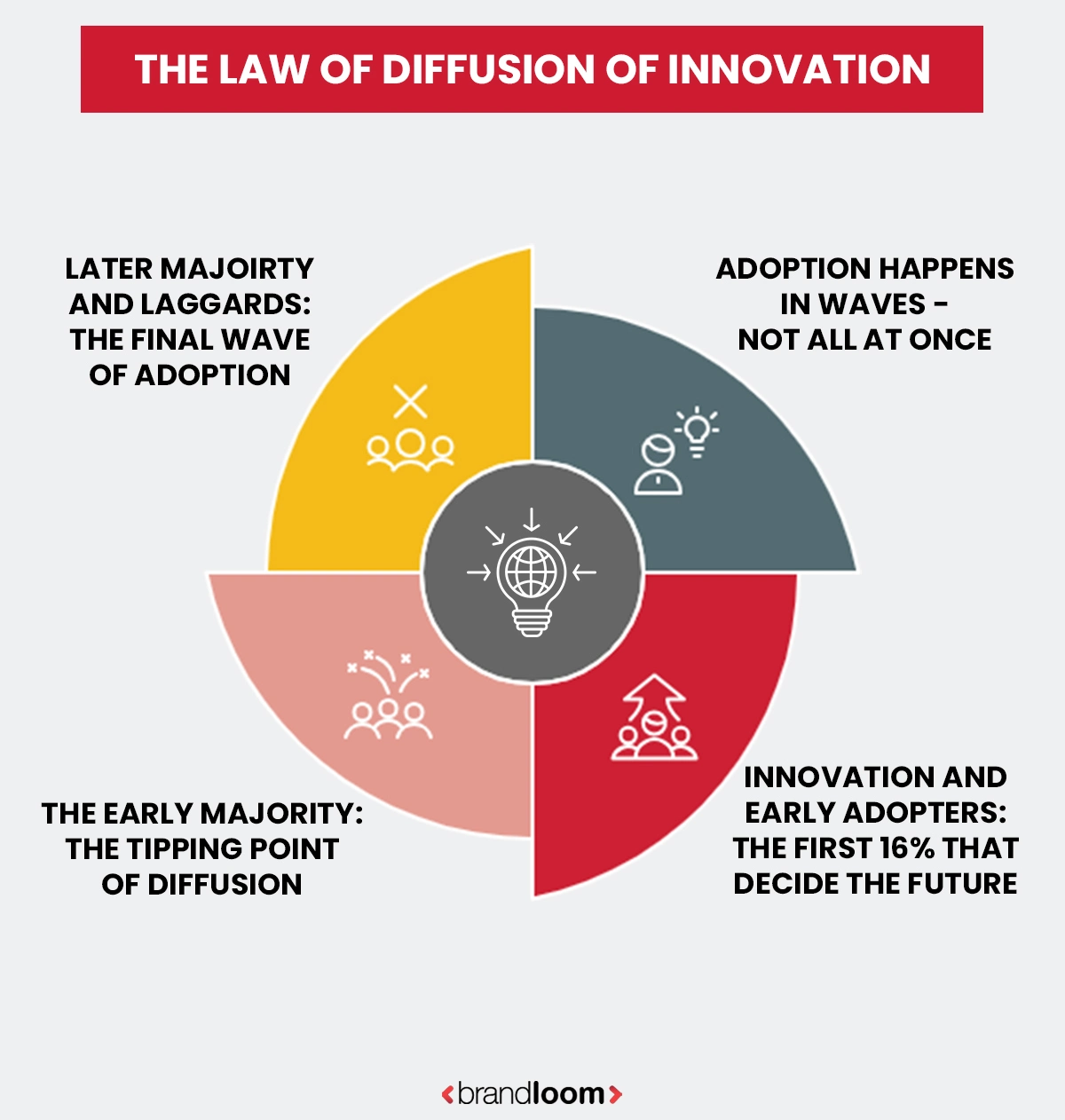
1. Adoption Happens in Waves — Not All at Once
A core insight of the diffusion of innovation model is that people adopt innovations at different times. Adoption does not occur uniformly. Instead, it spreads in predictable waves:
- Innovators (2.5%)
- Early Adopters (13.5%)
- Early Majority (34%)
- Late Majority (34%)
- Laggards (16%)
Each category behaves differently, and each plays a unique role in pushing an idea from niche to mainstream.
2. Innovators & Early Adopters: The First 16% That Decide the Future
The first two groups, Innovators and Early Adopters, are crucial for any product or service.
They are willing to:
- try untested solutions
- accept risk
- provide early feedback
- influence others in the social system
Together, they form the critical 16%. If they adopt and advocate for an innovation, the idea stands a strong chance of entering the mainstream. If they don’t, diffusion usually stalls.
3. The Early Majority: The Tipping Point of Diffusion
The Early Majority is cautious, evidence-driven, and influenced by social proof.
This group will only adopt an innovation when:
- the value is proven
- the risk feels low
- the credibility is high
- opinion leaders endorse it
Crossing from Early Adopters to the Early Majority is often referred to as “crossing the chasm.” This transition determines whether an innovation becomes a movement or dies early.
4. Late Majority & Laggards: The Final Wave of Adoption
The Late Majority adopts once a product becomes standard. They need reassurance, wide acceptance, and low complexity.
Laggards, on the other hand, resist change until the innovation becomes unavoidable. For online innovations, laggards often worry about:
- privacy
- digital competence
- reliability
- security
Their slow adoption further stretches the diffusion curve in digital markets.
5. Why This Law Matters for Online Marketers
The law of diffusion of innovation shows that ideas don’t spread because they are innovative they spread because marketers understand how people adopt innovation.
To accelerate diffusion, marketers must:
- tailor communication for each adopter category
- leverage opinion leaders
- build credibility
- reduce perceived risk
- enhance usability
- Highlight a clear value
When brands align their strategies with the diffusion curve, they increase their chances of reaching critical mass, accelerating adoption, and winning in competitive digital markets.
The Importance of Communication Channels in the Diffusion of Innovation Process
In Everett Rogers’ diffusion of innovation theory, communication channels act as the engine that moves an idea through a social system. Even the most innovative product or service cannot achieve adoption unless people hear about it, understand it, trust it, and see its relevance.
Communication channels are what transform an innovation from a new idea into a shared idea, and that shared understanding is what drives the entire diffusion of innovation process forward.
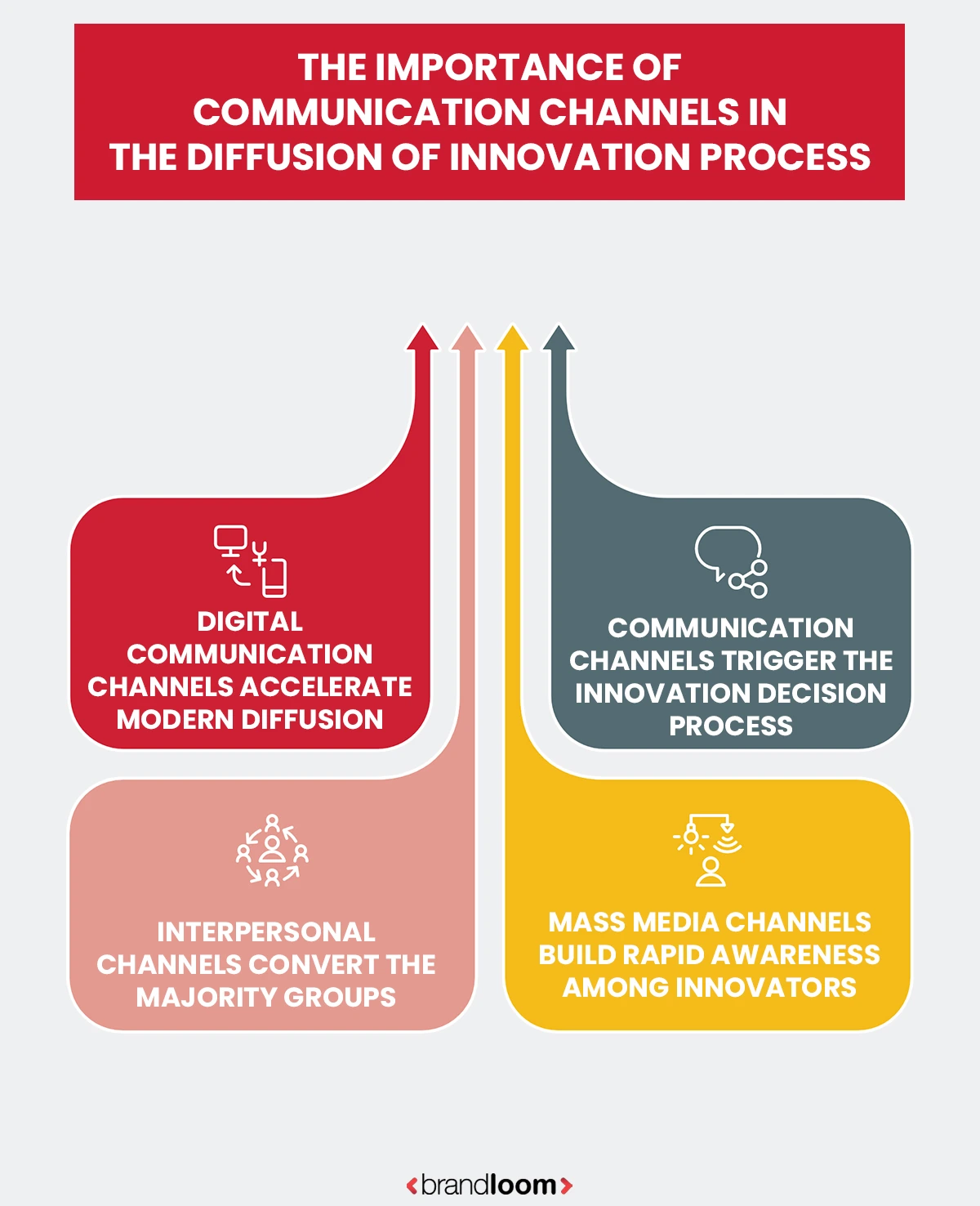
1. Communication Channels Trigger the Innovation Decision Process
Every adoption journey begins with knowledge. If consumers do not know an innovation exists, they never enter the innovation decision process, which includes:
- Knowledge
- Persuasion
- Decision
- Implementation
- Confirmation
Communication channels guide users through each stage of this journey.
For example:
- Mass media accelerates knowledge
- Social proof and reviews influence persuasion
- Peer recommendations shape the decision
- Digital demos or trials support implementation
- Online communities reinforce confirmation
Thus, the right communication channel at the right moment determines whether a user chooses to adopt or reject an innovation.
2. Mass Media Channels Build Rapid Awareness Among Innovators
Mass media channels, including advertising, online articles, PR coverage, paid social campaigns, YouTube content, and influencer collaborations, are especially effective for reaching Innovators and Early Adopters. These groups constantly look for what’s new and are more receptive to broad messaging.
Mass media helps:
- create initial visibility
- position the innovation as credible
- spark early curiosity
- build the foundation for market momentum
Without quick awareness, no diffusion process can begin.
3. Interpersonal Channels Convert the Majority Groups
As the innovation moves beyond early adopters, interpersonal channels become far more persuasive. These include:
- personal recommendations
- communities and forums
- user testimonials
- ratings and reviews
- word-of-mouth referrals
- micro-influencers and niche advocates
The Early Majority and Late Majority rely heavily on trusted opinions to reduce uncertainty. They adopt only when:
- risk feels low
- value feels proven
- others in the social system endorse the idea
This makes interpersonal communication the primary driver of mainstream adoption.
4. Digital Communication Channels Accelerate Modern Diffusion
Today, digital platforms compress the diffusion timeline by enabling:
- instant information access
- real-time demonstrations
- rapid comparison
- seamless evaluation
- social amplification
Search engines, social media, email marketing, webinars, interactive product tours, and online communities now serve as multi-layered communication channels that guide consumers from discovery to adoption. For online innovations, digital channels often determine:
- adoption rate
- trust-building speed
- market reach
- long-term retention
Digital ecosystems make the diffusion process measurable, repeatable, and scalable.
5. Choosing the Right Channel Determines Whether an Innovation Succeeds
An innovation succeeds when the brand strategically aligns communication channels with each adopter category. Mass media create awareness. Interpersonal communication builds trust. Digital platforms accelerate scale.
Together, they enable an innovation to move smoothly across the diffusion curve, reach critical mass, and establish long-term acceptance within the social system.
When communication channels are misaligned, even significant innovations fail to diffuse. When they are optimized, adoption becomes inevitable.
How Social Systems Influence the Spread of Innovation
In Everett Rogers’ diffusion of innovation theory, the social system is one of the most influential components shaping the speed, direction, and success of the diffusion process. While product features and communication channels matter, innovations ultimately spread or fail based on how social groups think, behave, and influence each other.
Below are the key ways social systems determine the adoption journey across different adopter categories within the innovation model.
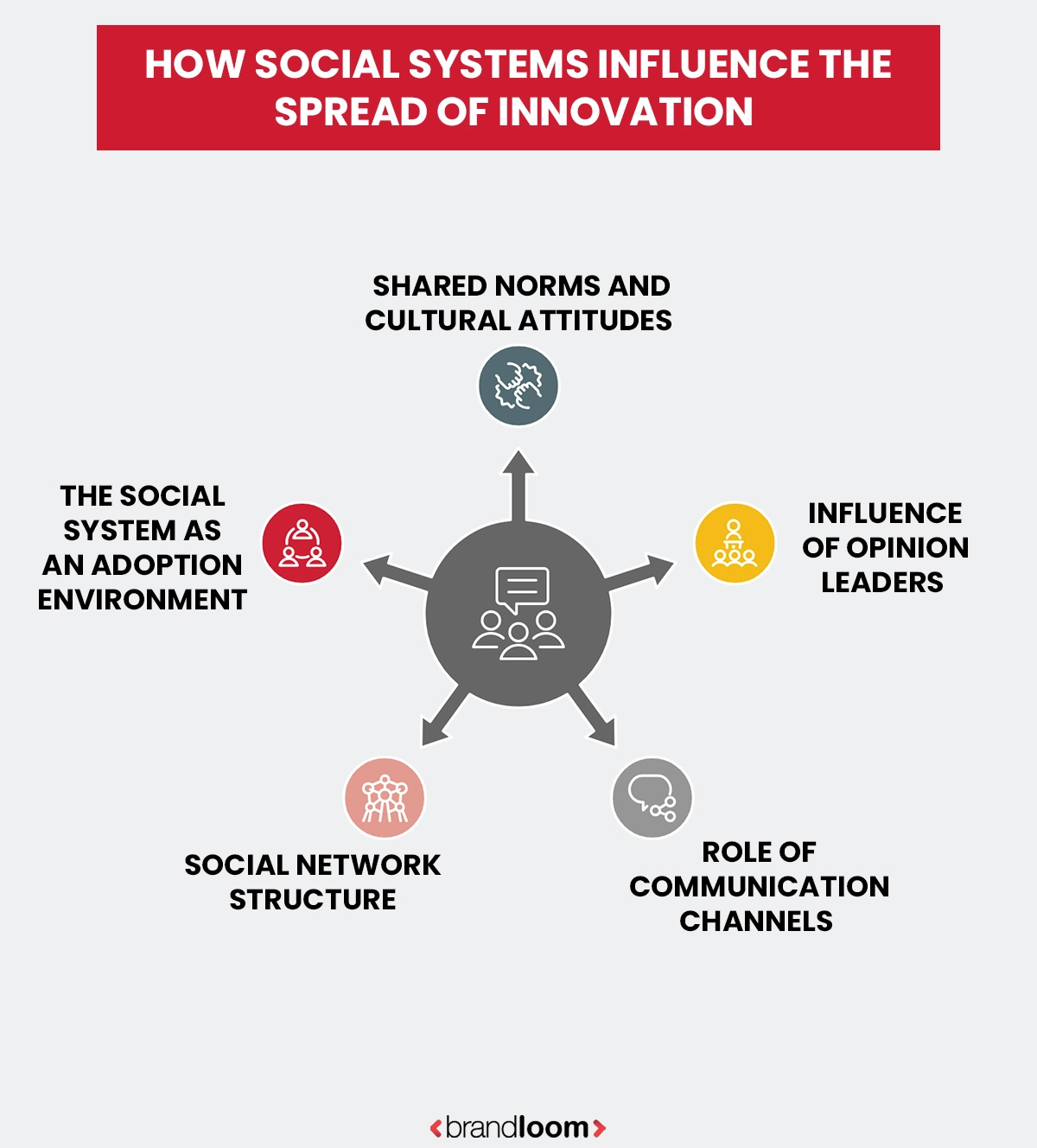
1. Shared Norms and Cultural Attitudes
Shared norms guide every social system—unwritten rules that define what is acceptable, aspirational, or risky.
- Progressive, future-oriented systems tend to adopt innovations faster because risk-taking is encouraged.
- Conservative or risk-averse groups often resist change, slowing down adoption even when the innovation offers clear benefits.
These cultural attitudes significantly influence how innovations are adopted by innovators, early
2. Influence of Opinion Leaders
Opinion leaders are central to Rogers’ diffusion of innovation theory. They shape perceptions, reduce uncertainty, and legitimize new ideas.
- They can be industry experts, digital creators, community leaders, or trusted peers.
- Their endorsement helps innovations transition smoothly across adopter categories, especially among groups that depend heavily on social validation (early majority and late majority).
When these leaders support a new idea, the social system becomes more receptive, accelerating the diffusion process.
3. Role of Communication Channels
Communication channels determine how fast information flows within a social system.
- Mass media channels (ads, PR, online content) help create initial awareness among innovators and early adopters.
- Interpersonal channels (conversations, recommendations, reviews) are far more persuasive for later adopters, who rely heavily on social proof.
The blend of these channels influences the adoption rate and helps innovations penetrate deeper into the system
4. Social Network Structure
The structure of the social system—how tightly or loosely connected people are—plays a direct role in the diffusion process.
- Dense, highly connected networks (like online communities) spread innovations quickly due to frequent interactions.
- Fragmented or hierarchical networks slow down diffusion because information doesn’t travel smoothly between groups.
Understanding network structure helps marketers predict how quickly an innovation can move across the product adoption curve.
5. The Social System as an Adoption Environment
Ultimately, the social system functions as the environment where individuals form judgments, validate ideas, and make adoption decisions. Its norms, leaders, networks, and communication patterns collectively determine:
- how an innovation is perceived,
- how fast it spreads, and
- how successfully it moves across the innovation model.
Marketers who understand their audience’s social system can design strategies that minimize resistance and accelerate adoption.
Conclusion
The landscape of innovation has never been more exciting or more competitive. As digital-first products, platforms, and services multiply, the real challenge is no longer just creating something new, but ensuring it reaches the right people at the right time. This is where understanding the diffusion of innovation becomes indispensable for marketers, founders, and product teams.
Everett Rogers’ timeless innovation model provides a clear lens to decode how consumers think, behave, and make adoption decisions. Whether it’s identifying which adopter category you should target first, optimizing your communication channels, or shaping the perception of your product’s value, each element of the diffusion process gives you a strategic edge.
In today’s online ecosystem, where visibility is fragmented, attention spans are short, and competition is relentless, mastering diffusion principles becomes even more critical. Modern digital factors, including credibility, usability, visibility, sellability, and scalability, redefine how online innovations gain traction. When a startup understands these levers, it becomes far easier to inspire early adopters, accelerate the adoption rate, and move confidently toward mass-market acceptance.
Ultimately, the success of any innovation, whether offline or online, depends on more than just the idea. It depends on how effectively the idea spreads.
By combining timeless diffusion frameworks with modern digital strategies, businesses can reduce uncertainty, build trust more quickly, and ensure their innovations not only exist but also thrive in the social systems they aim to serve. Moreover, as one of the best digital marketing agencies in India, we can help you achieve this most effectively.
Frequently Asked Questions
The diffusion of innovation is a theory that explains how new ideas, products, or technologies spread across a social system over time. It highlights why some innovations gain quick acceptance while others take years to become mainstream.
Understanding diffusion of innovation is important because it helps marketers and businesses predict adoption patterns, identify early audiences, and design strategies that accelerate acceptance. The theory also explains the psychological, social, and cultural factors that shape adoption decisions.
For brands, this knowledge helps reduce uncertainty and improve go-to-market planning. As one of the leading strategy-driven marketing companies in India, BrandLoom utilizes insights from the diffusion of innovation to help businesses effectively position their offerings, select the right communication channels, and shape consumer perception.
Overall, diffusion of innovation is essential for understanding how people respond to change and how innovations evolve from niche use to widespread acceptance.
Everett Rogers introduced the diffusion of innovation theory to describe how new ideas spread through a population. He proposed that diffusion is a social process influenced by communication channels, time, and the social system. Rogers also identified five key adopter categories that represent how different groups embrace innovation.
These include innovators, who take the earliest risks; early adopters, who influence others; the early majority, who adopt after seeing proof; the late majority, who follow only when the idea becomes standard; and laggards, who resist change until the end. Each category has unique behavioural traits that influence the speed and pattern of adoption.
At BrandLoom, we apply Rogers’ framework to help brands identify which adopter group to target first, align messaging with consumer psychology, and accelerate market penetration. Rogers’ theory remains foundational in understanding how innovations move from introduction to mass acceptance.
The rate of adoption in the diffusion of innovation process depends on several key factors identified by Everett Rogers. These include relative advantage (how much better the innovation is compared to existing options), compatibility (how well it fits users’ needs and values), complexity (how easy it is to understand), trialability (whether people can test it before committing), and observability (how visible the benefits are).
Together, these factors shape user perception and reduce uncertainty, influencing how quickly an innovation spreads. In the digital age, these have evolved into credibility, usability, visibility, sellability, and scalability.
The stronger these attributes are, the faster the adoption curve moves from innovators to the early and late majority. At BrandLoom, we use diffusion of innovation principles to evaluate product readiness, refine marketing communication, and increase consumer trust—ultimately boosting adoption speed and long-term market growth.
In the diffusion of innovation model, early adopters and the early majority play essential roles in shaping the path from novelty to mainstream acceptance. Early adopters are influential, socially connected individuals who embrace new ideas soon after innovators. They value thought leadership, appreciate innovation benefits, and act as opinion leaders within their social systems.
Their approval reduces risk for others. The early majority follows once they see evidence of success and social proof. They are more cautious but represent a large portion of the population, making them critical for achieving widespread adoption.
The transition from early adopters to the early majority marks the moment when an innovation gains momentum. At BrandLoom, we help brands identify and communicate effectively with these groups, using targeted messaging, credibility-building content, and influencer endorsements to accelerate the adoption rate and move innovations closer to mass-market success.
The innovation decision process, as described in Everett Rogers’ diffusion of innovation theory, consists of five stages: knowledge, persuasion, decision, implementation, and confirmation. In the knowledge stage, individuals first become aware of the innovation. During persuasion, they form opinions based on perceived benefits, risks, and social influence. The decision stage involves choosing to adopt or reject the innovation.
Implementation happens when users actively use the innovation, while confirmation occurs when they evaluate their choice and integrate it into long-term behaviour. Understanding these stages helps marketers design communication strategies that guide consumers smoothly through the adoption journey.
At BrandLoom, we use these decision stages to structure digital campaigns, reduce friction in user experience, and increase adoption probability. By aligning messaging with each stage, businesses can influence perception, address concerns, and support users through the entire diffusion process.
The diffusion of innovation applies directly to consumer behaviour by explaining how people evaluate and adopt new products based on perceived value, social influence, and risk tolerance. Understanding adopter categories such as innovators, early adopters, and the early majority helps marketers tailor strategies for each group.
For example, innovators respond to cutting-edge features, while later groups require evidence, reviews, and social proof. The theory also guides marketers in refining product positioning, designing communication channels, building credibility, and simplifying user experience to reduce uncertainty.
For digital businesses, diffusion of innovation supports strategic decisions around visibility, usability, and online reputation. At BrandLoom, we integrate diffusion frameworks into marketing plans to shape consumer perception, accelerate adoption rates, and strengthen brand loyalty. By applying these insights, brands can craft campaigns that meet users where they are in the adoption journey and drive consistent market growth.
Laggards are the final adopter category in the diffusion of innovation curve. They represent individuals who resist new ideas until the last possible moment. Laggards are typically skeptical of change, rely on traditional solutions, and prefer familiarity over risk. Their adoption decisions are influenced heavily by personal experience rather than external persuasion.
They often require overwhelming evidence, widespread acceptance, and complete market stability before considering an innovation. While laggards are not usually the primary target for early marketing strategies, understanding them helps brands plan long-term communication and product support.
In digital markets, laggards often adopt innovations only after they become unavoidable, such as shifting from feature phones to smartphones. At BrandLoom, we study adoption behaviour across all categories to help brands design comprehensive marketing strategies that move innovations from early adopters to the late majority, eventually reaching laggards as the category matures.
In public health, the diffusion of innovation theory plays a crucial role in promoting new technologies, behaviours, and health interventions. Public health campaigns use diffusion principles to understand how communities adopt preventive practices such as vaccinations, digital health tools, telemedicine, or hygiene interventions.
Strategies often begin by engaging innovators and early adopters such as healthcare workers, community leaders, and early users who help legitimize the innovation for others. As awareness grows, communication channels shift toward interpersonal influence, social networks, and mass outreach to reach the early and late majority.
This structured approach increases acceptance and accelerates behavioural change. Public health organizations also analyse compatibility, complexity, and observability to design effective interventions. At BrandLoom, we apply diffusion insights to develop communication strategies that build trust, address resistance, and promote the adoption of health-related innovations, ensuring messages spread across diverse social systems more effectively.
Examples of the diffusion of innovation can be seen in many modern products and technologies. Smartphones, for instance, began with innovators and early adopters purchasing expensive devices before widespread acceptance by the early and late majority. Electric vehicles followed a similar pattern, gaining traction as visibility, credibility, and infrastructure improved.
Social media platforms like Instagram and TikTok spread rapidly through influencer-driven early adoption. In digital services, UPI payments in India showcase how compatibility, simplicity, and government support accelerate adoption. Even everyday products like smart home devices, wearables, and streaming platforms reflect diffusion patterns.
These examples demonstrate how innovations spread based on perceived value, usability, and social influence. At BrandLoom, we study such real-world trends to help businesses forecast adoption rates, refine product strategy, and communicate benefits effectively, ensuring innovations move confidently from niche acceptance to mainstream success.
Opinion leaders play a critical role in accelerating the diffusion of innovation by influencing how others perceive and evaluate new ideas. Positioned between early adopters and the early majority, they act as trusted voices who reduce uncertainty and validate the innovation’s benefits.
Their endorsements through reviews, content, testimonials, or social interactions create confidence and social proof, encouraging hesitant groups to adopt. Opinion leaders also bridge communication gaps between marketers and consumers, helping translate technical features into relatable value.
In digital environments, influencers, industry experts, creators, and thought leaders significantly shape momentum across social systems. Brands that engage opinion leaders early often see faster adoption curves.
At BrandLoom, we design influencer and communication strategies anchored in the diffusion of innovation framework, ensuring opinion leaders help drive awareness, build credibility, and trigger faster adoption across diverse consumer groups.