Hi there,
Over the last decade, marketing has become remarkably measurable.
Most business owners today know exactly how many people visited their website, clicked on an advertisement, watched a video, opened an email, or completed a purchase.
In many ways, this is a remarkable improvement from the past.
Yet despite having more visibility than ever before, many businesses are struggling with a question that should be getting easier to answer.
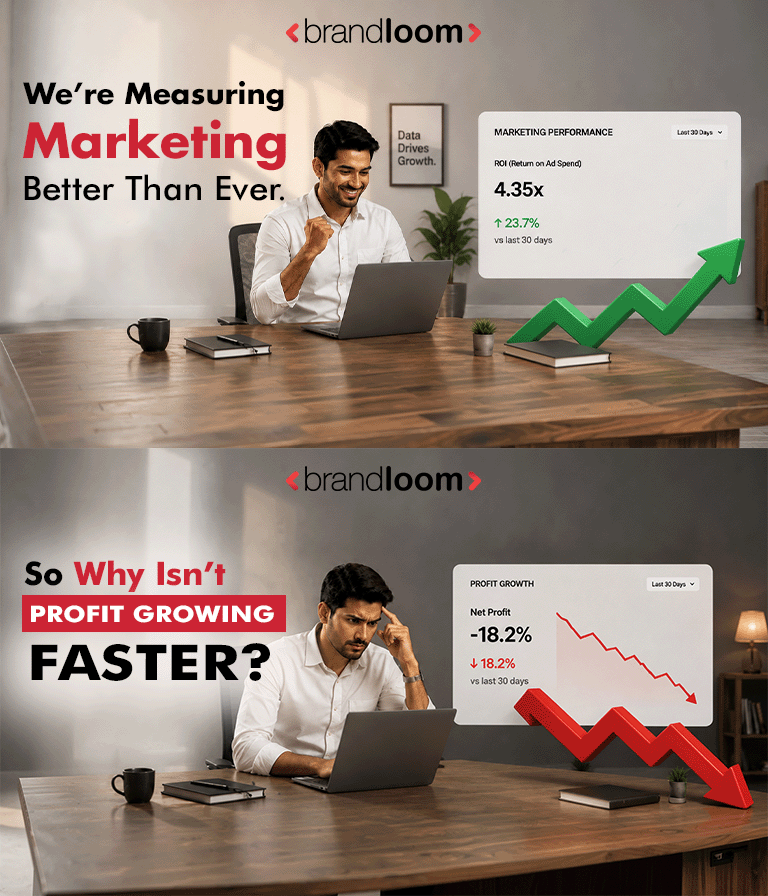
If our marketing is performing so well, why isn’t profitability improving at the same pace?
The numbers often look encouraging. Revenue is growing. Customer acquisition appears efficient. Campaigns are generating positive returns.
But beneath those numbers, margins are under pressure, customer retention is inconsistent, and cash flow remains tighter than expected.
The problem is not that businesses are measuring too little; rather, many are measuring the wrong things.
The Rise of Efficiency Thinking
The modern marketing world is built around efficiency metrics.
- How much did it cost to acquire a customer?
- What was the return on ad spend?
- Which campaign delivered the highest conversion rate?
These are essential questions. However, they are only part of the story.
Over time, many organizations have become so focused on measuring marketing efficiency that they have lost sight of business profitability. As a result, growth discussions often revolve around campaign performance rather than customer value.
This distinction may seem subtle, but it changes everything.
Customer Lifetime Value Is a Better KPI Than Customer Acquisition Cost
Customer Acquisition Cost tells you what it takes to win a customer. Customer Lifetime Value tells you whether that customer is actually worth winning.
Consider two customer groups.
The first costs very little to acquire. They respond to discounts, make one purchase, and never return.
The second costs more to acquire. But they buy repeatedly, stay loyal, and generate significantly more profit over time.
If you only look at acquisition cost, the first group appears to be the better result.
Look at Customer Lifetime Value, and the picture changes.
This is why CLV is such an important KPI for sustainable growth. It shifts the focus from how cheaply you can acquire customers to how much value those customers create over the entire relationship.
A lower CAC is useful. But a healthy CLV-to-CAC ratio tells you much more about the quality and sustainability of your growth.
The goal is not simply to acquire more customers. It is to acquire customers who are worth keeping.
The Metrics That Rarely Get Enough Attention
When leadership teams review performance, the conversation often begins with traffic, leads, conversions, and revenue.
There is nothing wrong with that. The challenge is that these numbers do not necessarily reveal whether growth is creating value.
Key business health metrics include:
- Retention Rate – How well you retain customers over time.
- Customer Lifetime Value (CLV) – The total value a customer generates throughout the relationship.
- Contribution Margin – How much revenue remains after variable costs.
- Payback Period – How long it takes to recover customer acquisition costs.
- Net Revenue Retention (NRR) – How much recurring revenue you retain and expand from existing customers.
These measures may not receive as much attention as ROAS or CPA, but they indicate whether growth is sustainable.
Branding vs. Performance: Which One Drives Growth?
Branding and performance marketing are often treated as competing priorities, especially when marketing budgets are under pressure.
Businesses may prioritize performance because it delivers measurable clicks, leads, and conversions, while branding is seen as a longer-term investment.
The problem is that performance marketing does not operate in isolation. Customers are more likely to click, consider, and convert when they already recognize and trust the brand behind the message.
Branding builds familiarity, trust, and preference. Performance marketing turns that demand into measurable action.
When branding is neglected, performance campaigns often have to work harder to generate the same results, which can push acquisition costs higher over time.
The strongest growth does not come from choosing between branding and performance marketing. It comes from understanding how the two work together.
A Different Way To Think About Growth
For many years, growth was largely viewed as a marketing challenge.
- Generate more awareness.
- Drive more traffic.
- Acquire more customers.
- Increase revenue.
But as markets become more competitive and acquisition costs continue to rise, growth increasingly becomes an economic challenge.
The businesses that outperform their competitors are not necessarily the ones generating the most activity.
They are the ones creating the most value from every customer relationship.
And they recognize that profitability is not the outcome of a single campaign.
It is the result of thousands of decisions made consistently over time.
The next time you review a marketing dashboard, it may be worth asking a different question.
Not “Is our marketing working?” But rather:
“Is our marketing helping us build a more profitable business?”
The answer to that question is often far more revealing.
👉 If your marketing dashboard is full of positive numbers but profitability is not keeping pace, it may be time to look beyond campaign performance and examine the economics behind your growth.
Book a strategy session with BrandLoom to identify where marketing activity is creating value, where it is quietly eroding margins, and how brand, acquisition, retention, and customer value can work together to build more profitable growth.
P.S. If you missed the last edition, feel free to check it out here: #103 – Everyone Has AI. Why Are So Few Companies Growing Faster?.
Yours sincerely,

Avinash Chandra
Founder, BrandLoom Consulting
🌐 https://www.brandloom.com/
☎︎ +91-7669647020
📩 care@brandloom.com
💻 https://team.brandloom.com/book-a-meeting
1. Note: If you feel like talking, just hit reply on this mail.
2. Fun Fact: 82% of BrandLoom clients see an uptick of at least 20% in their revenue after the implementation of BrandLoom’s strategies.
BrandLoom Is Regularly Featured In :

Meet Us At:
Gurgaon. Mumbai. Pune. New Delhi. Bangalore. Texas. New York. London.