Hi there,
A marketer discovers a better way to analyse competitors using AI. Someone in sales develops a useful method for handling objections. Another team member finds a faster way to turn customer research into campaign ideas.
Individually, these are small productivity gains. Multiply them across a company, and the potential becomes significant.
But there is a catch. The competitor analysis may remain in one person’s chat history. The sales insight may never reach marketing. The campaign method may be used once and forgotten.
The people become more productive. The organisation may not become much smarter.
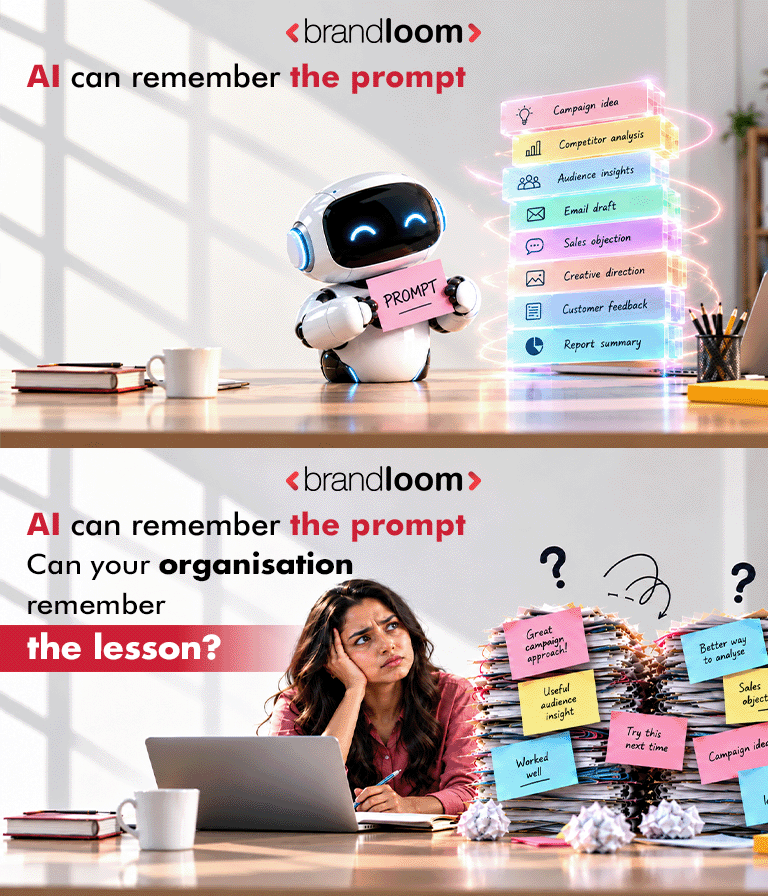
The AI productivity gap is becoming a management problem
In July 2026, MKT1’s Emily Kramer wrote about a problem many marketing teams are likely to recognise. People were finding useful ways to work with AI, but those learnings weren’t always making their way to the rest of the team. Everyone was experimenting, yet the benefits often stayed with the person who made the discovery.
Think about an employee who figures out a better way to analyse campaign results or create content using AI. If that process stays buried in their chat history, colleagues may spend time figuring out the same thing all over again. The team learns something useful, but the organisation doesn’t necessarily benefit.
That’s where the bigger challenge lies. AI can help people work faster, but what happens when someone discovers a better way to do the job? If that knowledge isn’t shared and used, the rest of the team keeps starting from scratch. The real opportunity is to make each useful discovery count beyond the person who made it.
What we saw in the Ashley Stewart case
At BrandLoom, our work with Ashley Stewart offers a practical illustration of why the system around AI matters.
The retailer’s paid campaigns faced rising costs, imprecise targeting, inconsistent campaign structures and creative compliance challenges. Simply adding more automation wouldn’t have solved all these problems.
We restructured the campaign ecosystem, enriched audience signals, combined broad-match keywords with smart bidding, redesigned creatives to address compliance issues and introduced an ongoing creative refresh process.
The published case study reports a 400% increase in return on ad spend, a $2.94 reduction in cost per conversion, more than 13,800 additional purchase events and a $1.16 million increase in total purchase value.
These results came from a combination of campaign restructuring, data, creative decisions and AI-supported optimisation. They should not be attributed to AI alone.
The lesson for this discussion is narrower but important: technology works within a system. The information it receives, the decisions people make around it and the feedback used to refine performance all influence what it can achieve.
The next question for any organisation is whether it can carry learning from those decisions into the next campaign, the next team, and the next business challenge.
Three questions leaders should ask
- What are we learning repeatedly?
Identify tasks where teams repeatedly conduct similar research, solve similar problems or correct similar mistakes. Repetition may be necessary, but rediscovering existing knowledge is a signal worth investigating.
- Are we storing answers or preserving reasoning?
A final recommendation rarely tells the whole story. Record the evidence considered, the alternatives rejected, the assumptions made and the conditions under which the decision might change.
- Does the next decision benefit from the previous one?
A documented lesson has little value if nobody uses it. Build a review process that checks whether earlier findings inform new work, and whether those findings still hold.
Try this before investing in another AI system
Choose five recurring tasks across your team. For each one, record the original objective, the context supplied to AI, the human decisions and corrections, the outcome, and what was retained for future use.
Then look at the next time a similar task is performed.
Did the team start with better information? Was a previous mistake avoided? Could another colleague reproduce the result? Or did everyone start again?
The answers will tell you more about your organisation’s AI maturity than the number of licences it has purchased.
Of course, not every insight needs to become permanent organisational knowledge. Some decisions are situational, and excessive documentation can slow work down. The goal is not to remember everything. It is to retain what improves future judgement.
AI can help people work faster. The harder management challenge is building an organisation that gets wiser from its work.
The competitive advantage may not belong to the company that uses AI the most. It may belong to the one that learns the most from using it.
👉 If your team is already using AI, now is the time to examine whether those individual experiments are helping your organisation make better decisions, retain valuable insights, and improve the work it does next.
Book a strategy session with BrandLoom to identify where AI can create greater value across your business and how your team can turn individual workflows into repeatable, organisation-wide improvements.
P.S. If you missed the last edition, you can catch up here: 107 – Your Best Ad Worked Last Quarter. So Why Isn’t It Working Now?
That’s all for now. Stay curious. Stay credible.
Yours Sincerely,

Avinash Chandra
Founder, BrandLoom Consulting
🌐 https://www.brandloom.com/
☎︎ +91-7669647020
📩 care@brandloom.com
💻 https://team.brandloom.com/book-a-meeting
1. Note: If you feel like talking, just hit reply on this mail.
2. Fun Fact: 82% of BrandLoom clients see an uptick of at least 20% in their revenue after the implementation of BrandLoom’s strategies.
BrandLoom Is Regularly Featured In :
Meet Us At:
Gurgaon. Mumbai. Pune. New Delhi. Bangalore. Texas. New York. London.