Hi there,
Imagine it is the start of a new quarter.
Last quarter, one of your ads was doing exceptionally well. It had the strongest CTR, the lowest CAC, and became the creative everyone wanted to keep running.
So you continue using it. The targeting stays the same. The offer stays the same. The budget increases.
But a few weeks later, CAC is 20% higher.
Nothing obvious has changed. The ad simply isn’t getting the same response from the audience anymore. This happens more often than most performance teams expect.
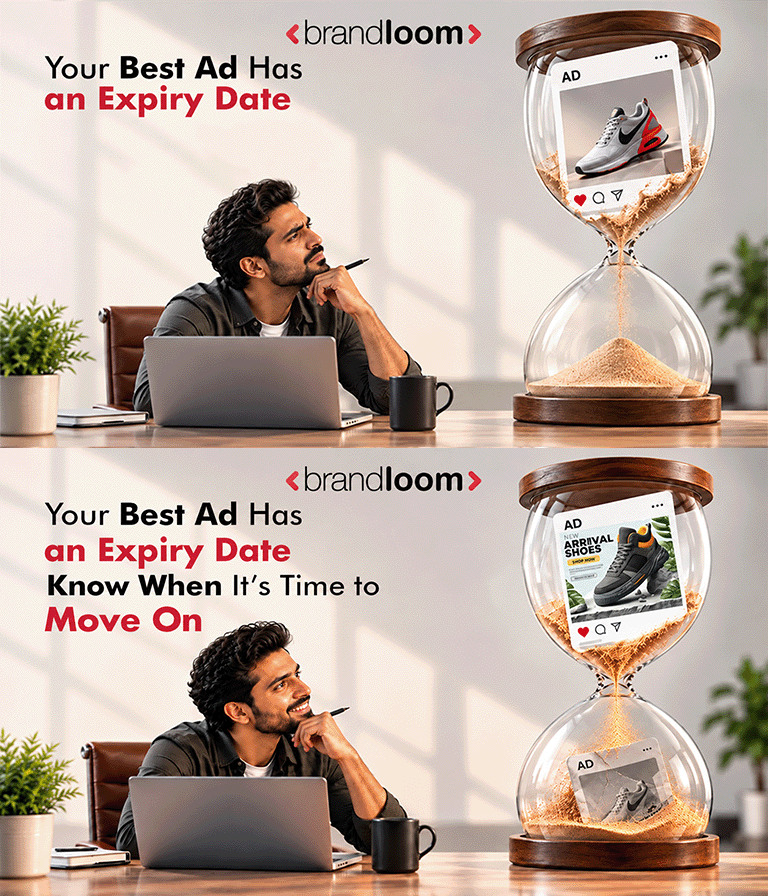
A winning ad has a lifecycle. The longer an audience sees it, the less new information it gives them. Eventually, something that once captured attention becomes something they recognize and scroll past.
And that creates an important question:
Are you managing your winning ads, or simply waiting for them to stop working?
Your Best Ad Is Not a Permanent Asset
When an ad performs well, the natural response is to increase its budget.
That makes sense, but at some point, increasing spend starts exposing the same creative to the same audience too often.
The early signs are usually easy to miss.
CTR starts softening. Frequency begins to rise. CPM may gradually increase. CAC or CPA eventually follows.
By the time the last number gets your attention, the creative may already have been losing momentum for some time.
That is why we don’t think creative refresh should be based on a fixed rule like “replace every 14 days.”
Different audiences, offers and campaigns have different creative lifecycles.
A better approach is to understand the signals and prepare for what comes next.
A Few Things We’ve Learned at BrandLoom
We use a simple Bank-Bench-Burn approach to manage creative lifecycles.
1. BANK: Save the Insight, Not Just the Ad
When an ad works, most teams save the final creative and move on.
There is much more to learn from it.
What was the core idea? Which customer problem did it address? What did the first three seconds communicate? Which objection did the ad overcome? How long did it remain efficient before performance started changing?
These details become useful inputs for the next round of creative.
BrandLoom Tip: Create a simple creative library that records the angle, hook, format, audience, performance, and signs of decay for every major winning ad.
2. BENCH: Always Have the Next Idea Ready
Creative production often starts after performance has already declined.
That creates a problem. The team now needs to find an idea, produce it, launch it, test it and wait for enough data to decide whether it works.
Instead, keep the next concept moving while your current winner is still healthy.
It could be a founder-led video, a customer story, a product demonstration, a comparison, or a completely different way of presenting the same offer.
BrandLoom Tip: Keep at least one new concept in active testing instead of waiting for your current winner to fail before creating its replacement.
3. BURN: Retire on Signals, Not Instinct
There is no universal number of days after which you should switch off every ad.
Instead, look at what is happening inside your own account.
Is CTR consistently weakening against its recent baseline? Is frequency climbing? Are multiple signals moving in the wrong direction at the same time?
When those changes appear together, it may be time to reduce that creative’s role.
The important thing is to make that decision before CAC becomes the problem everyone is discussing.
BrandLoom Tip: Establish your own warning signals using historical account data rather than relying entirely on generic industry benchmarks.
We Saw This With Ashley Stewart
Ashley Stewart had a similar challenge.
A large share of the budget was concentrated in retargeting, static creative had limited format variety, and returns were beginning to flatten despite an established audience.
Instead of simply creating more versions of the same ad, we looked for opportunities to bring new audiences, categories, and creative formats into the account.
Bridal and seasonal categories became dedicated campaign opportunities. Carousels, lifestyle videos, and seasonal promotions added more creative variety. We also shifted budget toward prospecting, lookalikes, and competitor conquesting.
Within six months, retargeting delivered 8.72 ROAS, prospecting delivered 6.52 ROAS, lookalike campaigns reached up to 8.38 ROAS, and competitor conquesting delivered 7.7 ROAS.
The lesson was not that one new creative solved the problem.
It was that the account stopped depending on the same audience and creative to keep producing the same result.
Don’t Wait for Your Best Ad to Fail
Your best ad has already given you something valuable.
It has shown you what message, angle or customer insight can work.
Now the job is to learn from it before asking it to do the same thing forever.
Bank what worked. Keep the next idea on the bench. Burn the creative when the signals tell you it has done its job.
That is how you move from constantly reacting to creative fatigue to building a system that is ready for the next winner.
Because the goal isn’t to find one ad that works forever.
The goal is to know what to do when it stops working.
👉 If your paid campaigns are becoming increasingly dependent on a few winning creatives, now is a good time to review their lifecycle, identify early signs of decay, and build a stronger creative pipeline.
Book a strategy session with BrandLoom to identify where creative fatigue may be affecting your performance and how to build a more sustainable testing and refresh system.
P.S. If you missed the last edition, you can catch up here:
#106 – Your Website Looks Premium. So Why Doesn’t It Feel Trustworthy?
That’s all for now. Stay curious. Stay credible.
Yours Sincerely,

Avinash Chandra
Founder, BrandLoom Consulting
🌐 https://www.brandloom.com/
☎︎ +91-7669647020
📩 care@brandloom.com
💻 https://team.brandloom.com/book-a-meeting
1. Note: If you feel like talking, just hit reply on this mail.
2. Fun Fact: 82% of BrandLoom clients see an uptick of at least 20% in their revenue after the implementation of BrandLoom’s strategies.
BrandLoom Is Regularly Featured In :
Meet Us At:
Gurgaon. Mumbai. Pune. New Delhi. Bangalore. Texas. New York. London.