Hi there,
Your website looks great. The photography is polished, the typography feels premium, and every section looks carefully designed.
But people are visiting without engaging, enquiring, booking calls, or buying as often as you expected.
We have seen this with businesses that invested heavily in redesigning their websites. The problem wasn’t the design, because the website often looked better than most competitors.
It simply wasn’t giving visitors enough reasons to trust the business and take the next step.
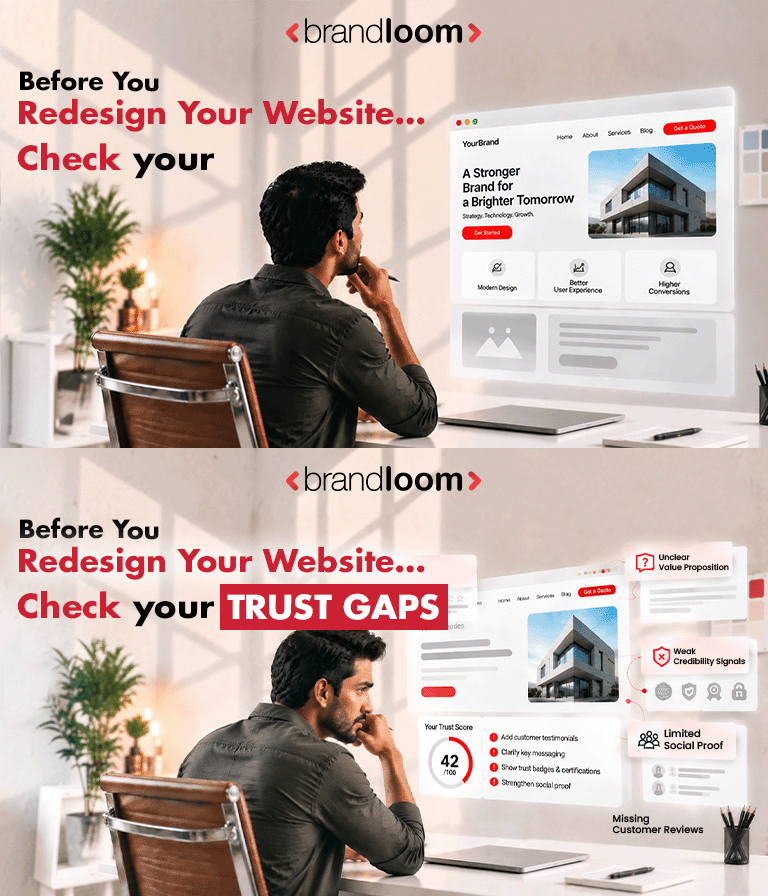
Your website may be doing a great job of saying, “We are professional,” while failing to answer, “Why should I choose you?” Good design gets attention, but trust, proof, clarity, and a strong reason to act are what turn that attention into business.
A Few Things We’ve Learned at BrandLoom
After working across brands and digital experiences, we have found that the websites that build confidence are rarely the ones that simply look the most impressive. They are the ones that make it easier for customers to understand the business, evaluate its credibility and feel comfortable taking the next step.
Here are a few areas worth looking at before investing in another redesign.
1. Start With Clarity
During a redesign, it is easy to become focused on how the website should look while overlooking whether the message is immediately understandable.
A visitor should be able to understand what the company does, who it helps and why its offering matters without having to decode clever headlines or scroll through several sections.
If the proposition is unclear, adding more animation or a more sophisticated visual identity will not solve the real problem.
Try this: Show your homepage to someone who does not know your business and ask them to explain what you do. Their answer can reveal more about your clarity than another internal review.
2. Put Evidence Behind Your Claims
Most companies are comfortable saying they are experienced, reliable, innovative or results-driven. Customers are naturally more interested in seeing evidence.
If you claim to have extensive experience, show the work. If you talk about results, demonstrate them. If you say customers trust you, let those customers explain why.
Case studies, reviews, customer stories and measurable outcomes turn a statement made by the brand into something a prospective customer can actually evaluate.
Try this: Whenever you make an important claim, check whether there is relevant evidence nearby to support it.
3. Let People See the Business Behind the Brand
There is a tendency for premium websites to become almost too polished. Stock photography replaces real people, generic language replaces genuine perspectives, and carefully constructed statements make the company sound impressive without telling visitors much about who they will actually be dealing with.
Professional does not have to mean distant.
For service businesses especially, customers are often buying expertise and judgement as much as they are buying the service itself. Showing the people and thinking behind the business can make that expertise much more tangible.
Try this: Use specific experiences, observations and examples from your team instead of relying entirely on broad claims about being the best.
4. Design Around Customer Uncertainty
Good UX is often reduced to navigation, page speed and ease of use. Those things matter, but there is another dimension that deserves attention: how much uncertainty does the website leave behind?
A prospective customer may want to understand how the process works, who will be involved, how long it takes, what happens after they enquire and what they can expect from the engagement.
These are not simply content questions. They are part of the user experience.
Try this: The more uncertainty your website removes before the sales conversation, the easier it becomes for the customer to take the next step.
5. Make Every Touchpoint Tell the Same Story
Trust is rarely built through one webpage.
A customer might discover your company through Google, visit your website, look at your LinkedIn profile, read reviews and then search for your leadership team before finally making contact.
If every touchpoint tells a different story, confidence can weaken even when each individual channel looks professional.
Try this: Your positioning, visual identity, brand voice, customer proof and claims should feel connected wherever people encounter you.
Your Website Should Do More Than Look Good
This is why we believe a website audit should go beyond design. It should also be a trust audit.
Look at the customer journey and identify where people are being asked to believe something without enough evidence to support it. A business may have an excellent visual identity but weak customer proof.
Another may have dozens of impressive case studies but make them almost impossible to find. A third may have a clear proposition but create unnecessary uncertainty around its process.
These are different problems, and they require different solutions. A website does not become trustworthy simply because it looks expensive.
It becomes trustworthy when the design, message, experience and proof reinforce the same story.
When those three work together, your website stops being a digital brochure and starts becoming part of your sales conversation.
👉 If your website looks polished but isn’t creating the confidence you expect, book a strategy session with BrandLoom to identify where design, content, positioning and proof may be creating unnecessary friction.
P.S. If you missed the last edition, catch up here: #105 – Your Festive Sale Could Be Lost Before Customers Reach Your Website.
That’s all for now. Stay curious. Stay credible.
Yours Sincerely,

Avinash Chandra
Founder, BrandLoom Consulting
🌐 https://www.brandloom.com/
☎︎ +91-7669647020
📩 care@brandloom.com
💻 https://team.brandloom.com/book-a-meeting
1. Note: If you feel like talking, just hit reply on this mail.
2. Fun Fact: 82% of BrandLoom clients see an uptick of at least 20% in their revenue after the implementation of BrandLoom’s strategies.
BrandLoom Is Regularly Featured In :

Meet Us At:
Gurgaon. Mumbai. Pune. New Delhi. Bangalore. Texas. New York. London.