You can build hundreds of links and still not show up where it matters.
That is the reality many brands are facing today. Their backlink profile looks strong on paper. Their anchor text is optimized. They continue to build links through familiar link-building tactics. Yet when it comes to AI-driven results across Google AI Overviews, ChatGPT, or Perplexity- they are missing.
This is where the real problem begins.
Traditional link-building strategies were designed for a different kind of search engine. One that relied heavily on link volume and keyword signals. But AI systems do not just rank pages. They evaluate credibility. They interpret context. They prioritize brands that demonstrate consistent authority through high-quality, relevant links, strong brand mentions, and clear topical relevance.
So when brands continue to focus solely on link building, they miss what actually drives visibility today.
And the gap is only getting wider.
Because in AI search, links are no longer just ranking signals. They are trust signals. Every relevant link, every editorial mention, every well-placed resource page inclusion contributes to how a search engine understands your authority. Without that, even the most aggressive link-building outreach will struggle to deliver results.
At BrandLoom, we see this shift clearly across industries. The brands that win are not the ones chasing volume. They are the ones investing in effective link building that strengthens authority. They create linkable assets, earn quality links from trusted sources, and build a presence that AI systems recognize as credible.
This guide breaks down link-building strategies for 2026 through that lens. What works, what rarely works, and how to build links in a way that supports long-term authority-building SEO in an AI-first world.
The Evolution of Link Building: From Rankings to AI Authority
Most brands did not get link building wrong. They followed what worked.
For years, success came down to scale. The more links you acquire, the stronger your visibility on a search engine. Your backlink profile became the primary indicator of performance, and link-building tactics were designed to grow that number as quickly as possible.
We have seen this play out across industries.
Teams invested heavily in optimizing anchor text, pushing guest post placements, submitting to directories, and building networks of links that looked good on reports. On the surface, it worked. Rankings improved. Traffic followed.
But the foundation was fragile. Because most of these links were built for algorithms, not for credibility. And over time, that gap became obvious. Today, many of these approaches either add little value or simply rarely work. Low-quality placements, irrelevant links, and over-optimized patterns are no longer signals of strength. They are signals of manipulation.
What Changed in 2026
This is where the shift becomes critical.
AI-driven platforms like Google AI Overviews and large language models have changed how link-building strategies function. They are not just scanning links. They are interpreting trust.
At BrandLoom, we approach this differently. We do not look at links as isolated wins. We view them as part of a broader system of authority.
A single relevant link from a trusted source now carries more weight than dozens of low-value placements. Not because of its quantity, but because of what it represents. Credibility. Context. Validation.
This is why quality links matter more than ever. They are no longer just ranking signals. They are inputs that help AI systems use multiple signals to determine visibility, cited, or recommended.
But links alone are not enough. They work in combination with brand mentions, topical authority, and the consistency with which your brand shows up across credible platforms. AI evaluates the full picture, not just individual signals.
This is where most brands fall behind. They continue to focus on building links as an activity rather than building authority as a system.
At BrandLoom, we see link building as a long-term investment in trust. Every placement, every mention, every connection is designed to strengthen how your brand is perceived across the web.
Because in 2026, winning with link-building strategies is not about scale. It is about being trusted enough to be chosen.
How AI Search Engines Evaluate Authority Signals
Understanding how AI evaluates authority is the key to building link strategies that actually drive visibility.
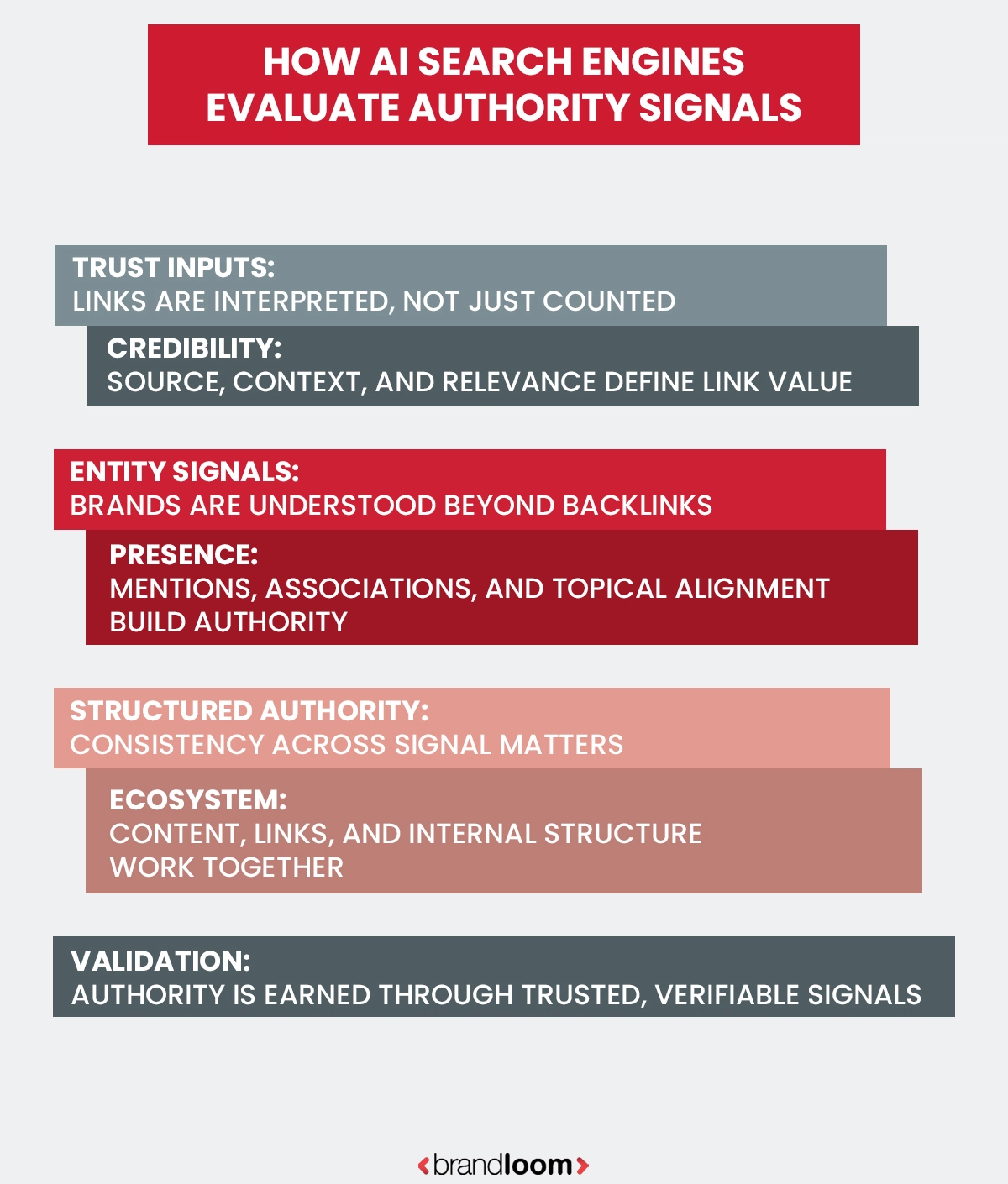
1. Links as Trust Inputs for AI Models
AI search does not treat links the way traditional SEO did. It interprets them.
Every relevant link is no longer just a pathway to your site. It is a signal of endorsement. But not all endorsements carry equal weight. AI models evaluate who is linking, why they are linking, and how contextually aligned that link is with your content.
At BrandLoom, we look at links as trust layers. A mention from a credible industry publication, a citation within a well-researched article, or inclusion in a respected resource page sends a stronger signal than dozens of disconnected links. This is what defines effective link building today.
It is not about how many links you build. It is about how much trust those links transfer.
2. Beyond Backlinks: Entity and Brand Signals
One of the biggest shifts in AI search is the rise of entity-based evaluation.
Search engines now understand brands as entities, not just websites. This means your authority is shaped not only by your backlink profile, but also by your presence across the web. Brand mentions, even without links, contribute to how your credibility is assessed.
AI systems connect these signals.
If your brand is consistently referenced alongside relevant topics, trusted sources, and industry conversations, your authority strengthens. If not, even strong link acquisition efforts may fall short.
This is why focusing solely on backlinks results in an incomplete strategy.
3. The Role of Structured Authority
Authority in AI search is built through consistency.
It comes from earning quality links, maintaining contextual relevance, and strengthening your ecosystem through internal links and interconnected content. These signals help AI systems understand not just individual pages, but your overall topical authority.
At BrandLoom, we emphasize building structured authority. That means aligning link acquisition, content strategy, and brand visibility into a single system.
Because in AI search, authority is not claimed. It is established through consistent, verifiable signals across the web.
Core Principles of Modern Link Building Strategies
Most brands do not struggle because they lack effort. They struggle because they follow the wrong principles.
Through BrandLoom’s work with scaling brands, one pattern is clear. Successful link-building strategies in 2026 are not driven by tactics alone. They are guided by a shift in how authority is built and recognized.
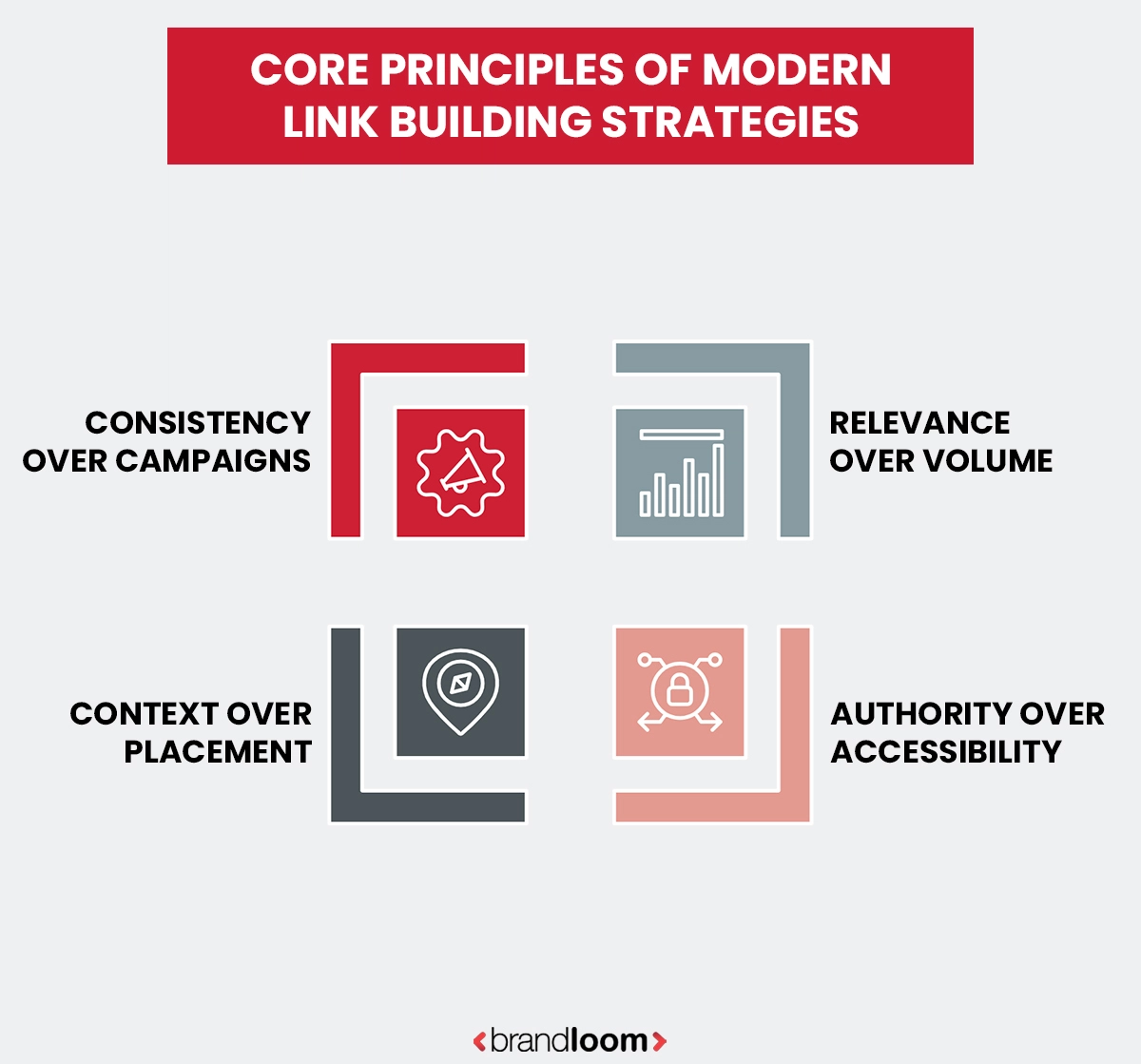
1. Relevance Over Volume
Not all links are equal. A single relevant link from a trusted, contextually aligned source carries more weight than dozens of unrelated placements.
AI systems evaluate how closely your links align with your domain, your content, and your expertise. This is why chasing scale without relevance weakens your authority instead of strengthening it.
2. Authority Over Accessibility
The easiest links to get are rarely the ones that matter.
Open directories, low-tier blogs, and generic placements may help you build links faster, but they do not contribute to high-quality authority signals. What matters is where your brand is being referenced and how credible that source is.
Strong link-building strategies prioritize earning placements that are harder to access but far more valuable.
3. Context Over Placement
A link is not just about where it appears. It is about how it appears.
Is it naturally embedded within meaningful content? Does it support the narrative? Does it add value for the reader?
These factors determine whether a link is interpreted as a quality link or ignored as noise. Context is what transforms a link into a trust signal.
4. Consistency Over Campaigns
Link building is not a one-time effort. It is an ongoing system.
Brands that rely on short bursts of activity often see inconsistent results. Those that invest in continuous, effective link building, supported by strong linkable assets and strategic internal links, build lasting authority over time.
This is the approach BrandLoom builds around.
Because in 2026, success with link-building strategies is not about doing more. It is about doing what actually builds trust.
High-Impact Link Building Tactics That Work in 2026
Once the principles are clear, the next question is execution.
Most brands are not short on link-building tactics. They are short on applying those tactics effectively in an AI-driven environment. What worked earlier can still work today, but only when it is aligned with authority, relevance, and trust.
This is where the shift becomes practical. Instead of chasing volume, the focus moves to earning credibility through how and where your brand shows up.
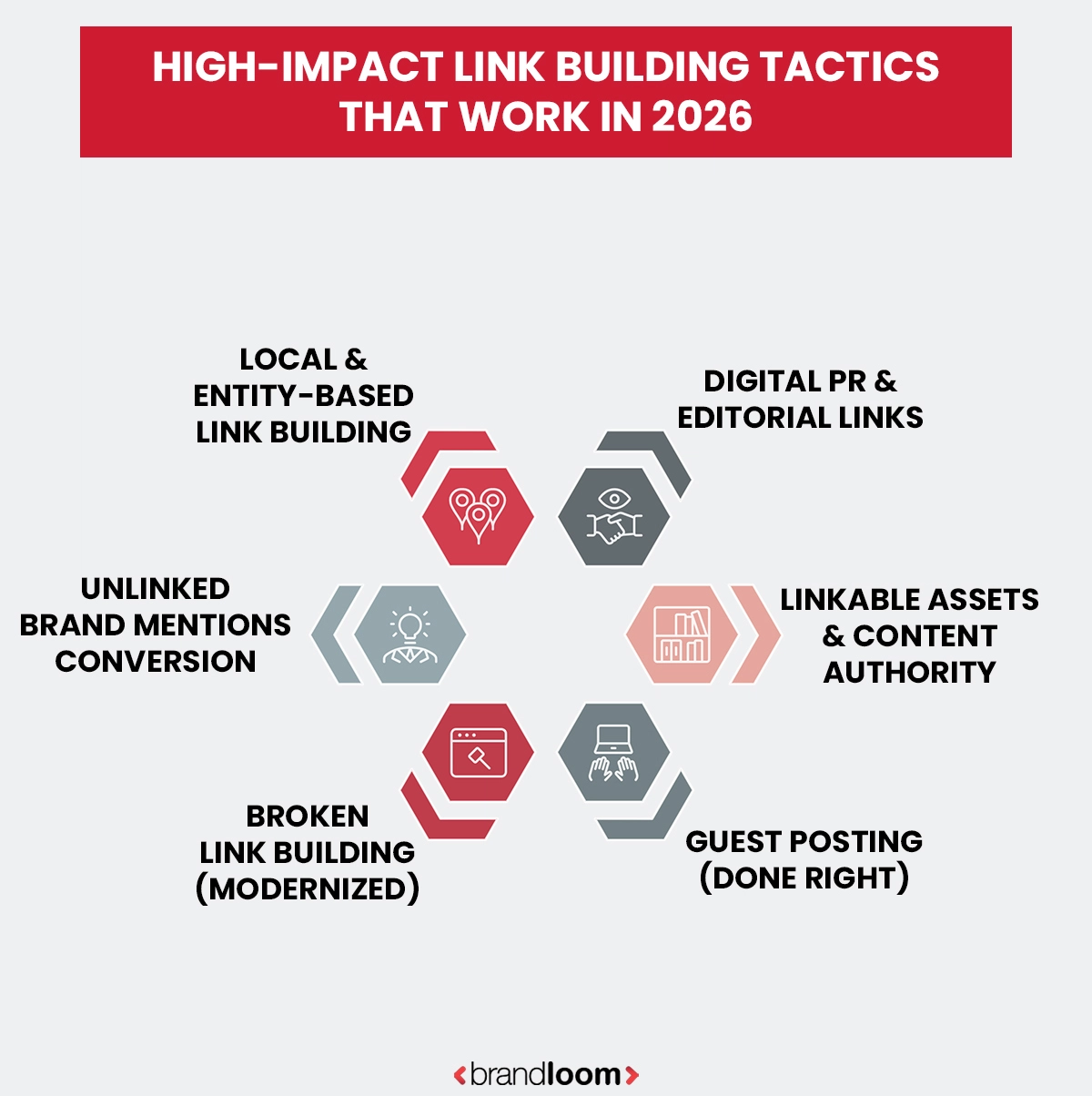
1. Digital PR and Editorial Links
This is where modern link-building strategies begin to separate.
Digital PR is no longer just about visibility. It is about earning trust from credible publications. When your brand is featured in industry articles, quoted in expert roundups, or backed by original case studies, those links carry authority that AI systems recognize.
Editorial links are powerful because they are earned, not placed. They are embedded naturally within content and supported by context.
This is also where BrandLoom sees the strongest impact. When brands invest in data-backed storytelling, they do not just earn links. They earn credibility.
2. Linkable Assets and Content Authority
If you want consistent quality links, you need something worth linking to.
Linkable assets are the foundation of scalable authority. These include original research, data reports, in-depth guides, tools, and insights that solve real problems.
When done right, they naturally attract links from blogs, publications, and even curated resource page lists.
Most brands skip this step and move directly to outreach. That limits their ability to earn links organically. Strong assets shift the dynamic. Instead of asking for links, you give people a reason to reference you.
3. Guest Posting (Done Right)
Guest post strategies still work, but only when approached with intent.
Publishing content on high-authority platforms within your niche helps you build both visibility and trust. But the focus has to shift from link placement to brand positioning.
A contextual, well-placed article that adds value to the reader creates a relevant link, strengthening your authority. On the other hand, mass guest posting on low-quality sites contributes little to your backlink profile.
The difference is not in the tactic. It is in the standard you apply.
4. Broken Link Building (Modernized)
Broken link building remains effective, but only when executed with precision.
The outdated approach was simple. Find broken links and replace them. Today, that is not enough.
You need to offer a better alternative. That means creating high quality, updated content that genuinely deserves to replace the original. When you combine this with targeted outreach, broken link building backlinks can still drive strong results.
Without that quality layer, the tactic loses impact.
5. Unlinked Brand Mentions Conversion
Your brand is already being talked about. The question is whether those mentions are working for you.
Tracking brand mentions and converting them into links is one of the most efficient forms of link-building outreach. These are warm opportunities. The site owner already recognizes your brand, which increases the chances of earning a link.
It also strengthens your overall authority by connecting existing signals across the web.
6. Local and Entity-Based Link Building
Authority is not only built globally. It is also built within specific ecosystems.
Local directories, industry bodies, and trusted institutions, such as a chamber of commerce, help strengthen your credibility. These placements support local link building and reinforce your entity’s presence.
For AI systems, this consistency matters. When your brand appears across trusted, relevant sources within your niche and geography, it builds a stronger, more complete authority profile.
The common thread across all these tactics is clear. They do not just help you build links. They help you build trust. And that is what makes them work in 2026.
Building an AI-Ready Link Building Strategy (Step-by-Step)
Knowing what works is one part. Building a system around it is what creates consistent results.
Most brands approach link building in fragments. A campaign here, some outreach there, a few link-building tactics layered on top. But in an AI-driven environment, that fragmented approach limits how authority compounds.
What works instead is a structured, repeatable system.
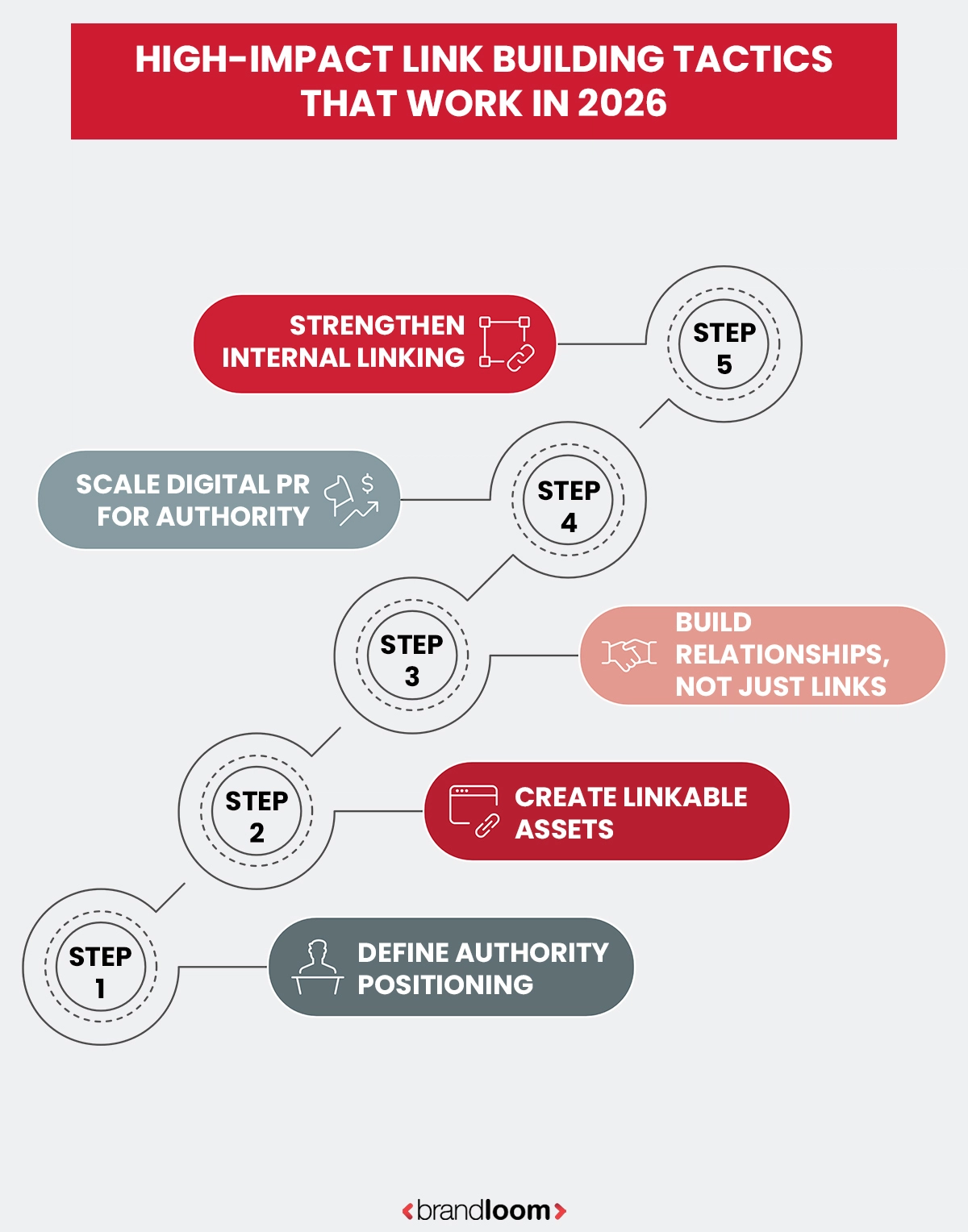
Step 1: Define Your Authority Positioning
Before you start building links, you need clarity about what you want to be known for.
AI systems evaluate topical authority. That means your link-building strategies must align with specific themes, industries, and areas of expertise. Random links to unrelated topics weaken your positioning rather than strengthen it.
The goal is to make your brand consistently associated with a defined set of topics.
Step 2: Create Linkable Assets That Deserve Attention
Without strong linkable assets, outreach becomes difficult to scale.
This is where most brands struggle. They try to acquire links without offering value. Instead, focus on creating high quality resources such as insights, research, and case studies that others naturally want to reference.
These assets become the foundation for earning quality links over time.
Step 3: Build Relationships, Not Just Links
Effective link-building outreach is not transactional.
It is built on relationships with publishers, editors, and site owners within your niche. When these relationships are strong, earning a relevant link becomes a natural outcome rather than a forced request.
This shift also improves consistency and long-term results.
Step 4: Scale Digital PR for Authority
Digital PR helps you move from isolated links to broader visibility.
By combining storytelling, data, and strategic outreach, you can secure editorial placements and brand mentions that strengthen your authority across multiple platforms.
This is a key driver of authority-building SEO in AI search.
Step 5: Strengthen Internal Linking for Context
External signals matter, but so does how your content connects internally.
Strategic internal links help search engines understand your content structure, reinforce topical relevance, and distribute authority across pages. This improves both user experience and AI interpretation.
At BrandLoom, this step is treated as essential, not optional. In 2026, strong link-building strategies are not built through isolated actions. They are built through systems that consistently reinforce authority across every touchpoint.
Conclusion
The way brands approach link-building strategies is no longer sustainable when driven by volume alone.
AI-driven search has made one thing clear. Visibility is not earned by how many links you build, but by how much trust you establish. Every relevant link, every credible placement, and every consistent brand mention contributes to how your authority is interpreted.
This is where the shift becomes non-negotiable.
Brands that continue to rely on outdated link-building tactics will struggle to stay visible. Those that focus on effective link building, backed by high-quality content, strong linkable assets, and a structured approach to authority, will lead.
BrandLoom’s perspective is simple. Link building is no longer a tactic. It is a system for building trust.
And in 2026, trust is what gets you seen, cited, and chosen.
At BrandLoom, we help brands transition from outdated link-building tactics to authority-driven SEO systems designed for AI search.
Frequently Asked Questions
In 2026, link-building strategies focus on authority, not volume. Instead of chasing backlinks, brands prioritize high-quality, relevant links, brand mentions, and linkable assets. At BrandLoom, the approach centers on building trust signals that AI search engines recognize, making authority-building SEO more effective than traditional link-building tactics.
Link-building strategies now influence how AI systems interpret trust and authority. A strong backlink profile, combined with brand mentions and relevant links, improves AI visibility. BrandLoom emphasizes effective link building that supports contextual credibility, helping brands get cited in AI-generated results rather than just ranked in a traditional search engine.
Yes, backlinks remain important, but their role has evolved. Quality links matter more than quantity. AI systems evaluate context, relevance, and source authority. BrandLoom focuses on high-quality link building and contextual link building, ensuring backlinks contribute to authority-building SEO rather than just inflating a backlink profile.
Links that improve AI visibility include editorial placements, relevant links from trusted sources, and links tied to strong linkable assets. Inclusion in a resource page, industry sites, and authoritative publications adds value. BrandLoom prioritizes effective link-building strategies that combine credibility, context, and consistency to strengthen AI search presence.
Brand mentions, even without links, act as trust signals in AI search. They help establish entity recognition and reinforce topical authority. BrandLoom integrates brand mentions into link-building strategies, ensuring consistent visibility across platforms, which strengthens authority signals and improves how AI systems interpret a brand’s credibility.
Entity-based link-building strategies focus on establishing a brand as a recognized entity across the web. This includes brand mentions, consistent citations, and relevant links tied to specific topics. BrandLoom uses entity SEO to align link-building tactics with topical authority, helping AI systems connect your brand to key industry themes.
Digital PR drives link-building strategies by earning editorial coverage, brand mentions, and quality links from trusted publications. It combines storytelling, data, and outreach to secure visibility. BrandLoom uses digital PR for SEO to create linkable assets and build authority, making it a core part of modern, effective link building.
Outdated link-building tactics like mass directory submissions, buying links, and over-optimized anchor text rarely work today. These methods fail to build trust and can harm credibility. BrandLoom avoids low-quality approaches and focuses on high-quality link-building strategies that prioritize relevance, authority, and long-term SEO impact.
Success in link-building strategies is measured by more than link count. Key metrics include backlink profile quality, brand mentions, topical authority, and AI visibility. BrandLoom tracks how quality links influence credibility and citations across platforms, ensuring effective link building contributes to both rankings and AI-driven search presence.
Brands can build authority by combining link-building strategies with consistent brand mentions, strong linkable assets, and relevant links from trusted sources. Strategic internal links and digital PR also play a role. BrandLoom helps brands create systems that support authority-building SEO, ensuring long-term visibility in AI search environments.