So can AI chatbots make mistakes? If you have spent any time talking to one while trying to resolve a billing issue or track down a late delivery, you probably already suspect the answer. They can, and they do, more often than the marketing decks would have you believe.
AI chatbots have quietly taken over a huge chunk of customer service over the past few years. Virtual assistants answer questions on retail sites before a human even sees the ticket. Banks use them for balance checks. Airlines use them to explain baggage policy at three in the morning when no agent is awake.
All of that is genuinely useful, and most of the time it works fine. But “most of the time” is the part that gets glossed over, and the gap between what these tools are supposed to do and what they actually do in the real world is where much of the customer frustration starts.
If you are weighing whether to lean further into a chatbot-driven customer experience, or you already run one and keep wondering why complaints still land in your inbox, this should help. And if you want a good strategy, BrandLoom can help you out, focusing on customer experience and digital content every day.
Why Everyone Is Suddenly Talking About AI Chatbots?
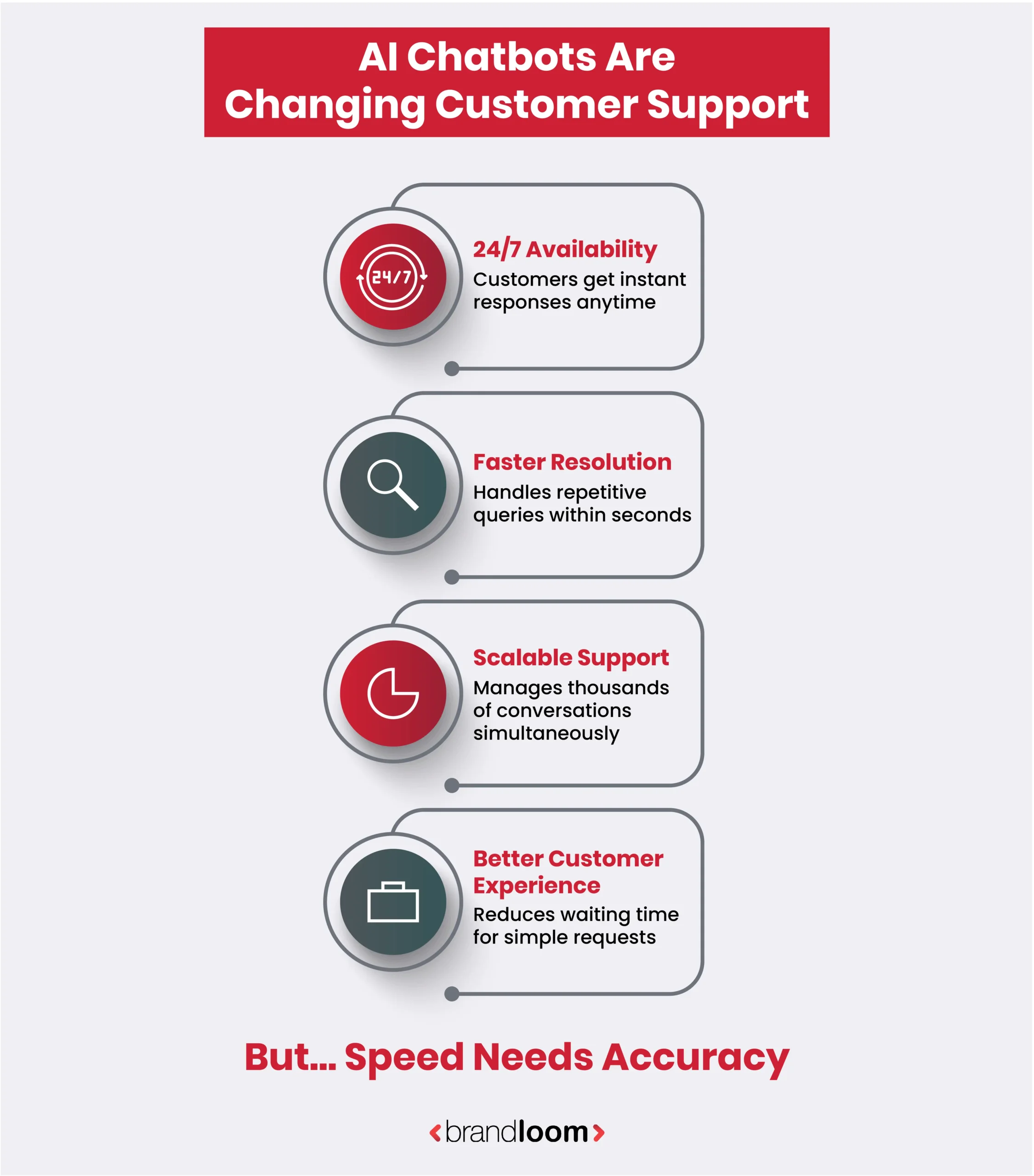
AI chatbots have become a standard part of customer service because they can answer routine questions, assist customers around the clock, and handle thousands of conversations simultaneously. As generative AI has improved, businesses across industries have adopted chatbots to improve response times and support growing customer expectations. Industry tracking now puts AI chatbot use among customer service teams at around 80 percent, up from roughly 5 percent just five years earlier.
However, widespread adoption has also made chatbot mistakes more visible. Customers now expect quick and accurate answers, which is why understanding where AI chatbots succeed and where they fall short is becoming increasingly important.
Can AI Chatbots Make Mistakes? Yes, and Here Is Why
AI chatbots can make mistakes because they do not understand information in the same way a human does. Most modern chatbots use Generative AI powered by a Large Language Model (LLM). Instead of retrieving a guaranteed correct answer, an LLM generates a response by predicting which words are most likely to follow the customer’s question.
This approach helps chatbots produce natural, conversational answers. However, it also means that a response can sound logical and confident without being factually correct.
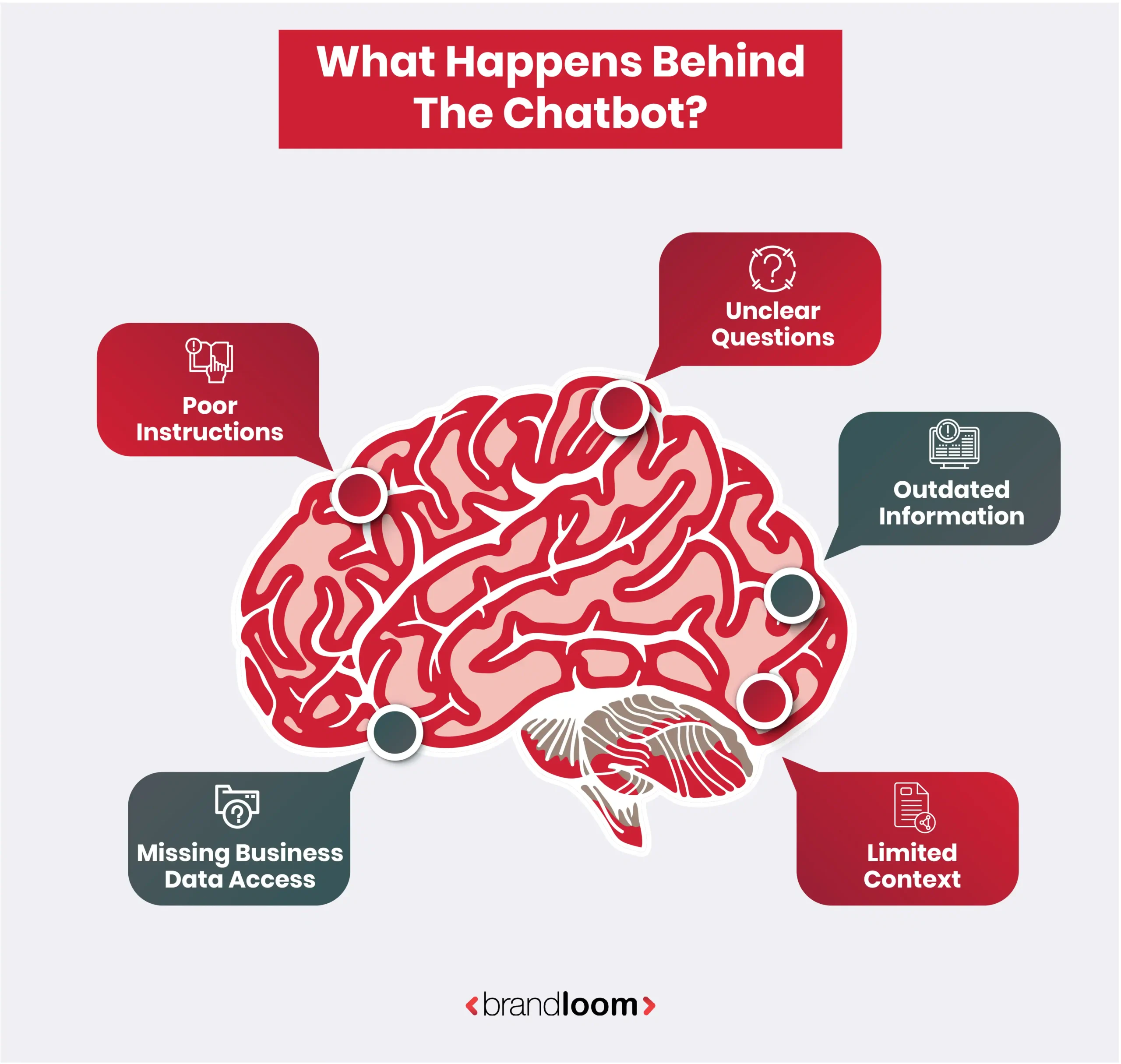
Several factors can increase the likelihood of an error:
- The customer’s question is vague or incomplete.
- The chatbot has access to outdated policies or product information.
- Important details fall outside the model’s context window.
- The chatbot cannot access verified business systems.
- Instructions provided through prompt engineering are unclear or inconsistent.
- The model tries to answer instead of admitting that it lacks sufficient information.
The context window is the amount of information an AI model can consider during a conversation. When conversations become long or contain several different issues, earlier details may receive less attention. This can cause the chatbot to forget a customer’s order number, repeat questions, or provide an answer that contradicts something it said earlier.
Poor prompt engineering can create similar problems. Prompts define how the chatbot should respond, what information it may use, and when it should escalate a conversation. If these instructions are too broad, the chatbot may improvise beyond its approved role.
What Are AI Hallucinations?
An AI hallucination occurs when a chatbot generates information that appears credible but is incorrect, outdated, unsupported, or entirely fabricated.
For example, a chatbot may:
- Invent a refund policy that does not exist.
- Provide an incorrect delivery date.
- Mention a product feature that has not been launched.
- Create a fake citation or reference.
- Give account-specific information without checking the customer’s actual record.
Hallucinations happen because a generative AI model is designed to produce a useful response, even when the required information is missing. Without clear AI guardrails, the model may fill information gaps with a plausible answer instead of saying, “I do not have enough information.”
Businesses can reduce this risk through Retrieval-Augmented Generation (RAG). A RAG system searches an approved knowledge source before the LLM generates its answer. The retrieved information is added to the model’s context so that the response is grounded in current business data.
RAG systems often use embeddings to convert documents and customer questions into numerical representations of meaning. These embeddings are stored in a vector database, which helps the chatbot identify the most relevant policy, product page, support article, or internal document.
Common AI Hallucination Examples
| Situation | Possible AI Mistake | Better Approach |
| Customer asks about delivery status | Gives an incorrect delivery date | Use system data through function calling |
| Customer asks about return policy | Shares outdated policy information | Connect chatbot with updated documents using RAG |
| Customer asks about product features | Invents unavailable features | Restrict answers to approved product data |
| Customer asks sensitive questions | Provides unsupported advice | Apply AI guardrails and human escalation |
What This Looks Like for Real Businesses
None of this is theoretical. Walk through customer reviews for almost any retailer, telecom provider, or airline, and you will find someone venting about a chatbot that misunderstood a refund request, looped them through the same three questions, or confidently gave them the wrong gate number. In the real world, these are not edge cases. They are on a Tuesday afternoon.
It is also worth noting that this is a well-known industry problem, not just something frustrated customers whisper about. Platforms like BotPenguin, Calabrio, Aisera, and ProProfs Chat have all published guidance on this topic, which suggests how persistent the issue remains even as the underlying models keep improving.
And yet customers keep using these tools, because when they work, they genuinely save time. Zendesk research has found that 74 percent of customers would rather get a quick answer from a chatbot than wait on hold for a person, at least for simple questions. The appetite for AI chatbot support is not going away. The real question is not whether to use one. It is whether the one you are using has actually earned that trust.
AI Chatbot Mistakes Across Different Industries
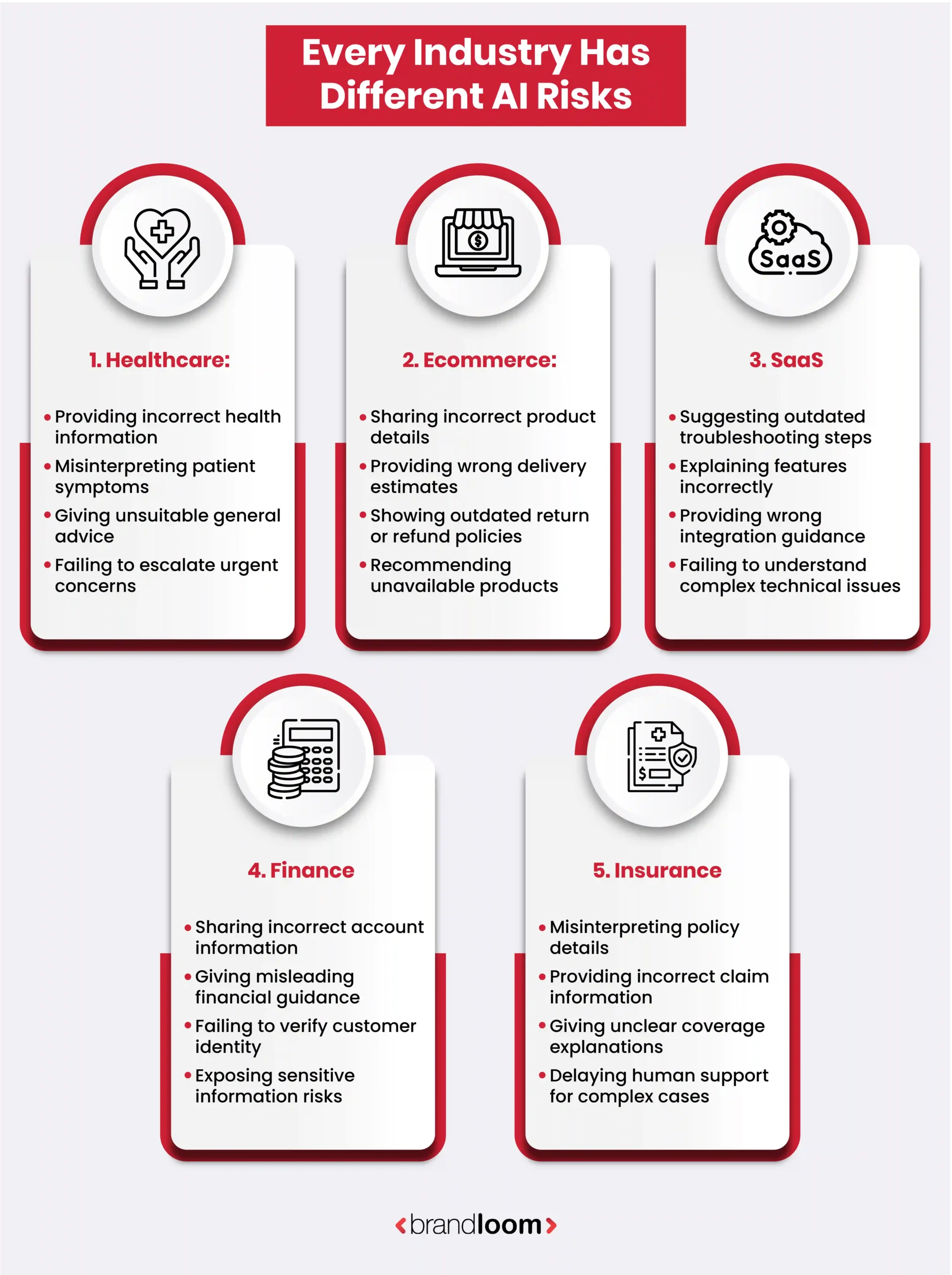
While chatbot errors follow similar patterns, their impact varies by industry.
Healthcare
Patients expect accurate information about appointments, services, and general healthcare guidance. Incorrect responses can quickly reduce trust, making human escalation especially important.
Ecommerce
Customers frequently ask about shipping, returns, refunds, product availability, and order tracking. Outdated product information or incorrect delivery estimates can directly affect customer satisfaction.
SaaS
Software companies often use chatbots for onboarding, troubleshooting, and technical support. If documentation isn’t updated regularly, chatbots may recommend outdated workflows or incorrect product features.
Finance
Banks and financial institutions rely on chatbots for common account-related queries. Because financial information is highly sensitive, chatbots need strict security controls and clear escalation procedures for complex requests.
Insurance
Insurance customers often need help understanding policy details or claim processes. A chatbot should provide general guidance while directing customers to human advisors whenever policy interpretation or claim-specific advice is required.
The Real Cost of Getting It Wrong
There is a genuine tension here. One 2025 industry benchmark report found that the average cost per customer interaction dropped 68 percent, from $4.60 to $1.45, after companies brought AI into their support mix. That is the kind of number that gets a chatbot project approved fast.
But customer experience is not just about cost per ticket. A single bad interaction, especially one where the bot was confidently wrong, can undo a lot of that goodwill in about thirty seconds. People do not usually complain loudly about an average chatbot conversation. They complain about the one where they felt unheard or stuck.
The savings only hold up if they are not quietly being eaten by customers who quit, leave a bad review, or call back angrier than they would have been if a human had just answered the question the first time. Cheaper support that drives people away is not actually cheaper.
How Businesses Can Prevent AI Chatbot Mistakes
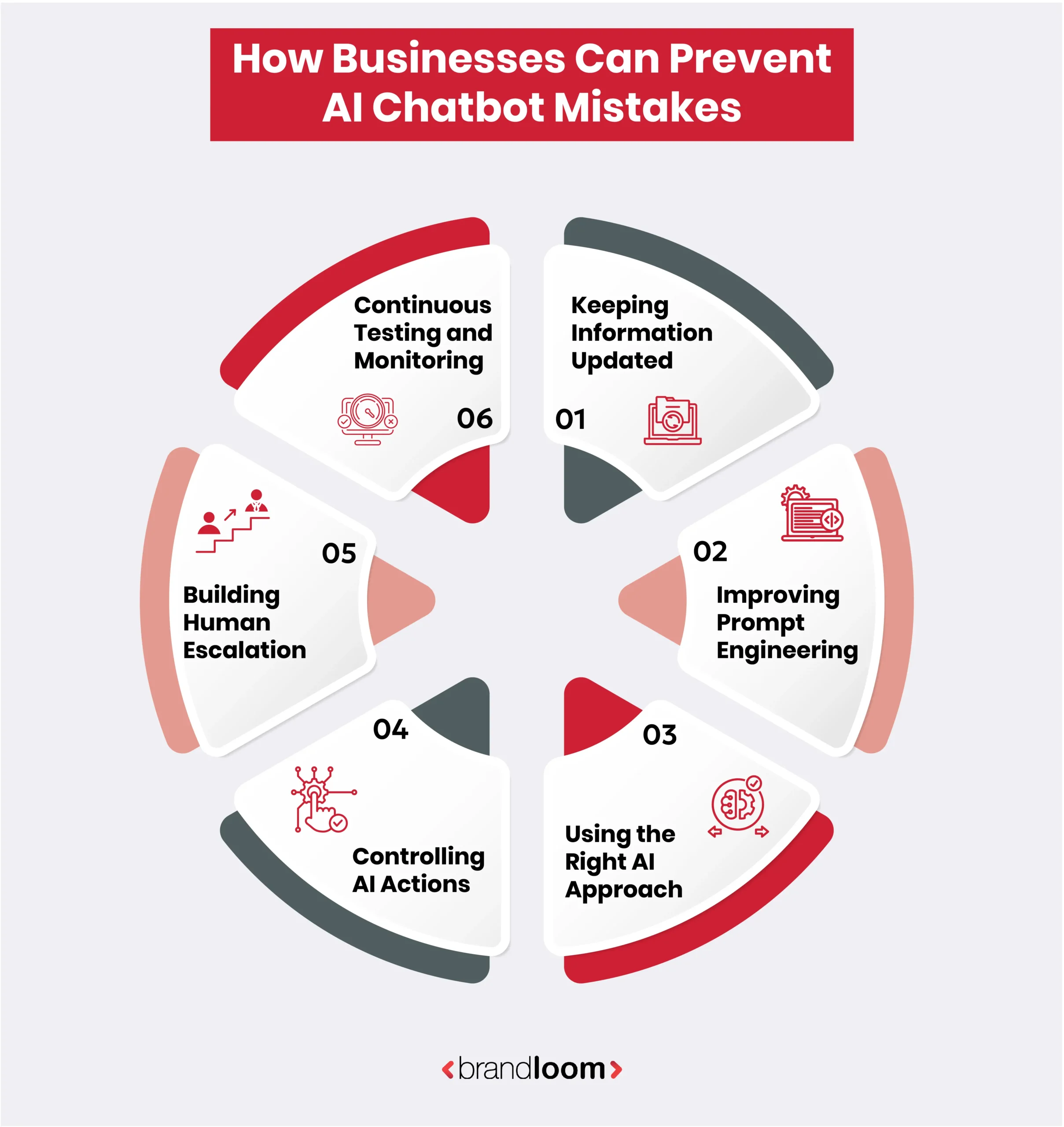
A successful chatbot requires continuous improvement, not just a one-time launch.
Businesses should focus on:
Keeping Information Updated
A chatbot is only as reliable as the information it uses. Regular reviews of FAQs, policies, product details, and support content help prevent outdated answers.
Improving Prompt Engineering
Prompt Engineering helps define how a chatbot should respond, what information it can use, and when it should escalate conversations.
Using the Right AI Approach
RAG helps provide current business information, while Fine-Tuning helps improve specialized behavior, tone, and response patterns.
Controlling AI Actions
Modern AI Agents can complete tasks like checking orders or scheduling services. These actions should happen through approved workflows using Function Calling, permissions, and monitoring.
Building Human Escalation
A chatbot should recognize when it cannot confidently help. Complex complaints, sensitive requests, and unclear situations should move quickly to human support.
Continuous Testing and Monitoring
AI chatbot performance should be reviewed regularly through real customer conversations. Businesses should monitor inaccurate responses, failed conversations, escalation patterns, and customer feedback to continuously improve prompts, knowledge sources, and workflows.
AI Governance: Keeping Chatbots Accurate and Responsible
As businesses rely more on AI chatbots, AI Governance helps ensure these systems remain accurate, secure, and aligned with business goals.
A strong governance framework includes:
- Regular chatbot testing and audits
- Clear ownership of AI performance
- Data privacy controls
- Approved sources for AI responses
- Defined human escalation rules
- Monitoring incorrect or risky responses
For advanced systems using AI Agents or Multi-Agent Systems, governance becomes even more important because multiple AI workflows and business systems may be involved.
Measuring AI Chatbot ROI
The success of an AI chatbot should not be measured only by the number of conversations it handles. Businesses need to understand whether it improves customer experience while reducing operational effort.
Key metrics include:
| Metric | Why It Matters |
|---|---|
| Resolution rate | Shows how many customer issues are solved successfully |
| Cost per resolution | Measures efficiency improvements |
| Customer satisfaction | Tracks the quality of customer experience |
| Escalation rate | Shows where human support is still required |
| Repeat contacts | Identifies unresolved customer issues |
The goal is not maximum automation. It is creating faster, more accurate, and more reliable customer experiences while improving business efficiency.
Getting Closer to the Full Potential of AI Chatbots
With the right combination of technology, governance, and continuous improvement, businesses can move beyond basic chatbot automation and unlock more advanced AI-driven customer experiences.
One widely cited market estimate puts the AI customer service industry on track to reach nearly $ 48 billion by 2030. That kind of growth tells you this technology is not going anywhere, mistakes and all.
The honest takeaway is that AI chatbots making mistakes is not really an argument against using them. It is an argument for using them better. The businesses that treat a chatbot as a real extension of their brand voice, rather than a cheap shortcut, are the ones that are actually getting close to its full potential.
That gap between what a chatbot could do and what it currently does for most companies is usually a strategy problem more than a technology problem, and it is exactly where an experienced digital partner earns its keep. BrandLoom works with businesses on the content, customer experience, and digital strategy side of this, which in plain terms means making sure your chatbot, your support pages, and your brand voice are all actually saying the same thing instead of working against each other.
Conclusion
So, can AI chatbots make mistakes? Yes. Large Language Models can misunderstand intent, lose important context, retrieve the wrong information, hallucinate an answer, or attempt a task beyond their approved role.
However, these risks do not mean businesses should avoid generative AI. They mean chatbot implementation needs stronger planning and ongoing control.
The goal should not be to automate the largest possible number of conversations. It should be to resolve the right conversations accurately, safely, and efficiently.
BrandLoom helps businesses review the content and customer experience systems surrounding their chatbots, from brand voice and knowledge-base structure to conversation design and escalation journeys. With the right strategy, an AI chatbot can become a measurable business asset rather than an unmanaged customer experience risk.
Frequently Asked Questions
Yes. Even the most advanced AI chatbots can misunderstand a question, give an outdated answer, or sound confident while being completely wrong. The technology has improved a lot, but mistakes have not disappeared. They have just become less frequent and sometimes harder to spot.
Most chatbots generate answers based on patterns rather than checking a verified source every time. When training data is outdated, incomplete, or the question is unusual, that gap often shows up as inaccurate information delivered with total confidence.
Not better, just different. Chatbots are faster for simple repetitive questions and are available at all hours. Humans are still better at nuance, empathy, and anything outside a predictable script. The strongest customer service setups use both rather than picking one.
Launching it once and never touching the content again. Customer questions, products, and policies change, and a chatbot running on year-old information starts making mistakes unrelated to the AI itself. Regular reviews and updates are essential, something BrandLoom emphasizes in its customer experience work.
It can, especially if a screenshot of a bad answer ends up on social media. One confidently wrong response can undo a lot of trust. That’s why structured customer experience reviews and proactive content audits are critical.
Regular content audits, testing with real customer phrasing instead of tidy examples, and a clear path to a human agent usually solve most of it. BrandLoom integrates these practices into an ongoing digital strategy so businesses can prevent issues before customers notice them.
Generally, yes, since virtual assistants tend to handle more context and longer conversations, but they are not immune. More capability also means more room for a wrong answer if the underlying content and training are not kept up to date.
For most businesses, yes. The efficiency gains are real, and most customers have come to expect it. The goal is not to avoid AI chatbots altogether. It is about setting one up properly so it actually reaches its full potential rather than becoming a liability, which is why BrandLoom stresses ongoing strategy and alignment with brand voice.
By working on the content, branding, and customer experience strategy that sits underneath the chatbot itself. This means reviewing scripts, tone, and support content so the bot reflects accurate, current information and sounds like the business, not a generic template.
A good starting point is straightforward content and customer experience. BrandLoom offers audits that highlight where a chatbot or broader digital customer experience is quietly losing trust, and what to fix first.