Picture this: your marketing team just wrapped up a quarter. The decks look great. Brand awareness metrics are up. Social engagement is climbing. But when the CFO asks how much marketing and revenue are actually connected, the room goes quiet.
This is the moment that separates traditional marketing from revenue-driven marketing. One tracks impressions. The other tracks income. In recent days, the CEOs, founders, and CFOs who are winning have stopped treating marketing as a cost center and started treating it as a revenue-generating marketing engine.
They are not cutting budgets. They are redirecting them, away from vanity metrics and toward measurable pipeline growth. BrandLoom works with growth-stage brands and SMEs across India and globally who are navigating exactly this shift.
Revenue marketing is a strategy that directly connects marketing activities to revenue generation, pipeline creation, and measurable business outcomes, replacing guesswork with accountability.
What Is Revenue Marketing?
The term gets used loosely. Here is a precise revenue marketing definition, a look at revenue-driven digital marketing services definition, and why it changes everything for your brand.
Revenue marketing is a discipline where every marketing effort , from content and campaigns to automation and paid media , is designed and evaluated based on its contribution to actual marketing revenue. It is not enough to generate leads. Revenue-driven marketing demands that those leads convert, that the customer acquisition cost (CAC) stays healthy, and that the lifetime value (LTV) of each customer justifies the spend.
Traditional marketing operates on the premise that visibility eventually leads to growth. Revenue-driven digital marketing rejects that “eventually.” It builds a direct, trackable line between marketing investment and revenue outcomes, using data, technology, and cross-functional alignment to close the gap between a brand impression and a closed deal.
For B2B companies, SaaS businesses, and growth-stage brands, this is not a trend. It is the operating system that modern CMOs and CEOs need to justify budget, demonstrate ROI (return on investment), and scale efficiently.
Types of Revenue Marketing
A revenue marketing strategy is not a single tactic; it is an ecosystem of connected marketing revenue models, each built around one north star: measurable revenue contribution.
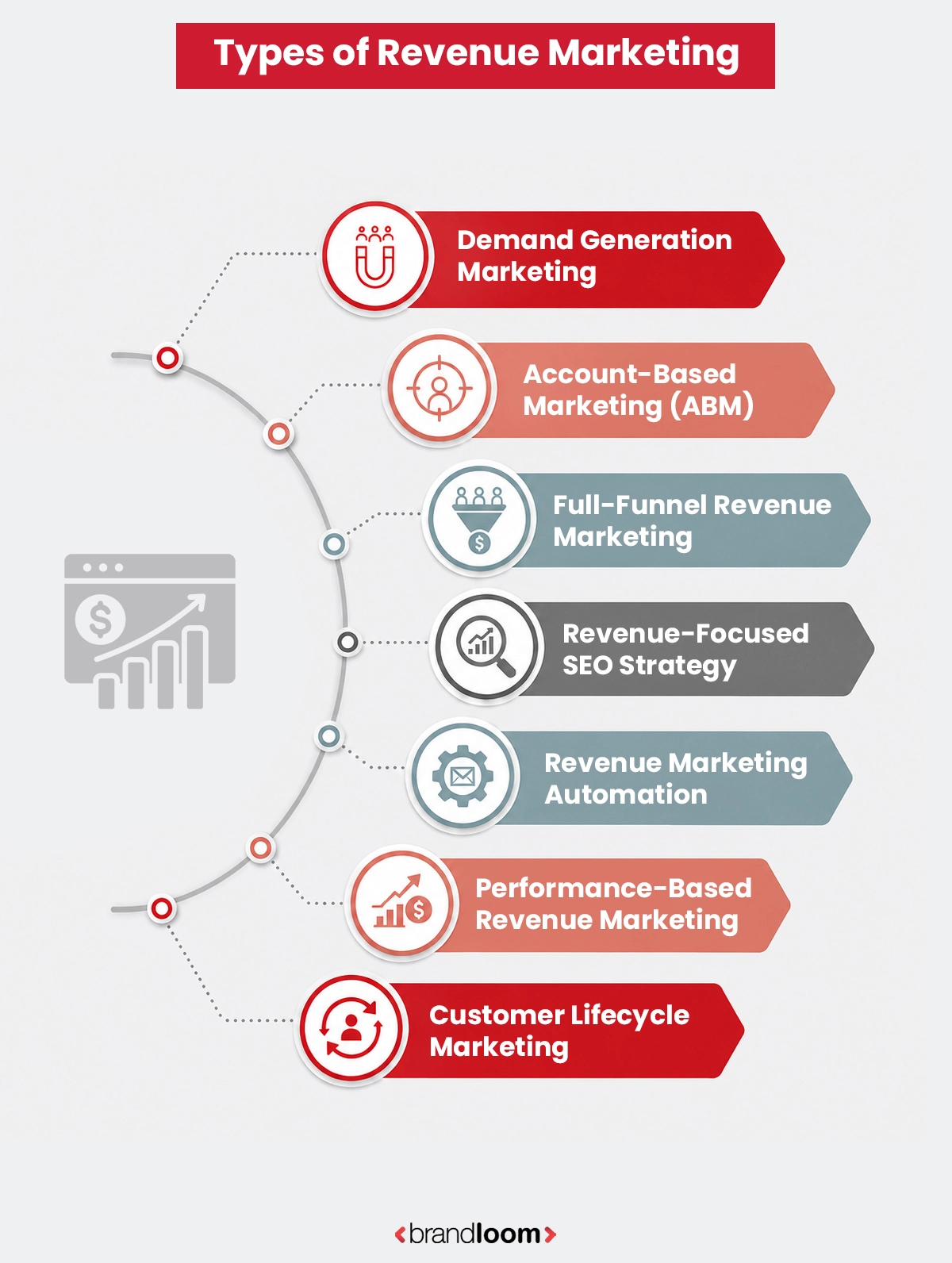
- Demand Generation Marketing: Creates awareness at the top of the funnel with a direct line to pipeline metrics, not just reach.
- Account-Based Marketing (ABM): Targets high-value accounts with personalized campaigns, aligning marketing and sales around the same prospects.
- Full-Funnel Revenue Marketing: Maps content and campaigns to every stage of the buyer journey, from awareness through to conversion and retention.
- Revenue-Focused SEO Strategy: Builds organic search around keywords that attract buyers with commercial intent, not just traffic volume.
- Revenue Marketing Automation: Uses platforms like HubSpot, Marketo, or Salesforce to nurture leads and score them on buying behavior.
- Performance-Based Revenue Marketing: Optimizes paid campaigns for pipeline contribution and CAC, not clicks or impressions.
- Customer Lifecycle Marketing: Extends the funnel beyond acquisition into retention, upsell, and LTV maximization.
Why Revenue Marketing Matters for Brands
If your marketing budget cannot prove its impact on the bottom line, it will always be the first line item cut.
Recently, boards want accountability, CFOs want attribution, and investors want every rupee traced to a revenue growth strategy, not just a campaign report. Traditional marketing, built on awareness and reach, struggles to answer that demand.
Revenue marketing alignment solves this by integrating marketing directly into the revenue funnel. When campaigns are built around what is a revenue target for marketing and treated as a business commitment, when leads are scored by buying intent, and when sales and marketing share the same KPIs, marketing stops being a support function and starts being a growth driver.
The Impact of Revenue Marketing on Brand Growth
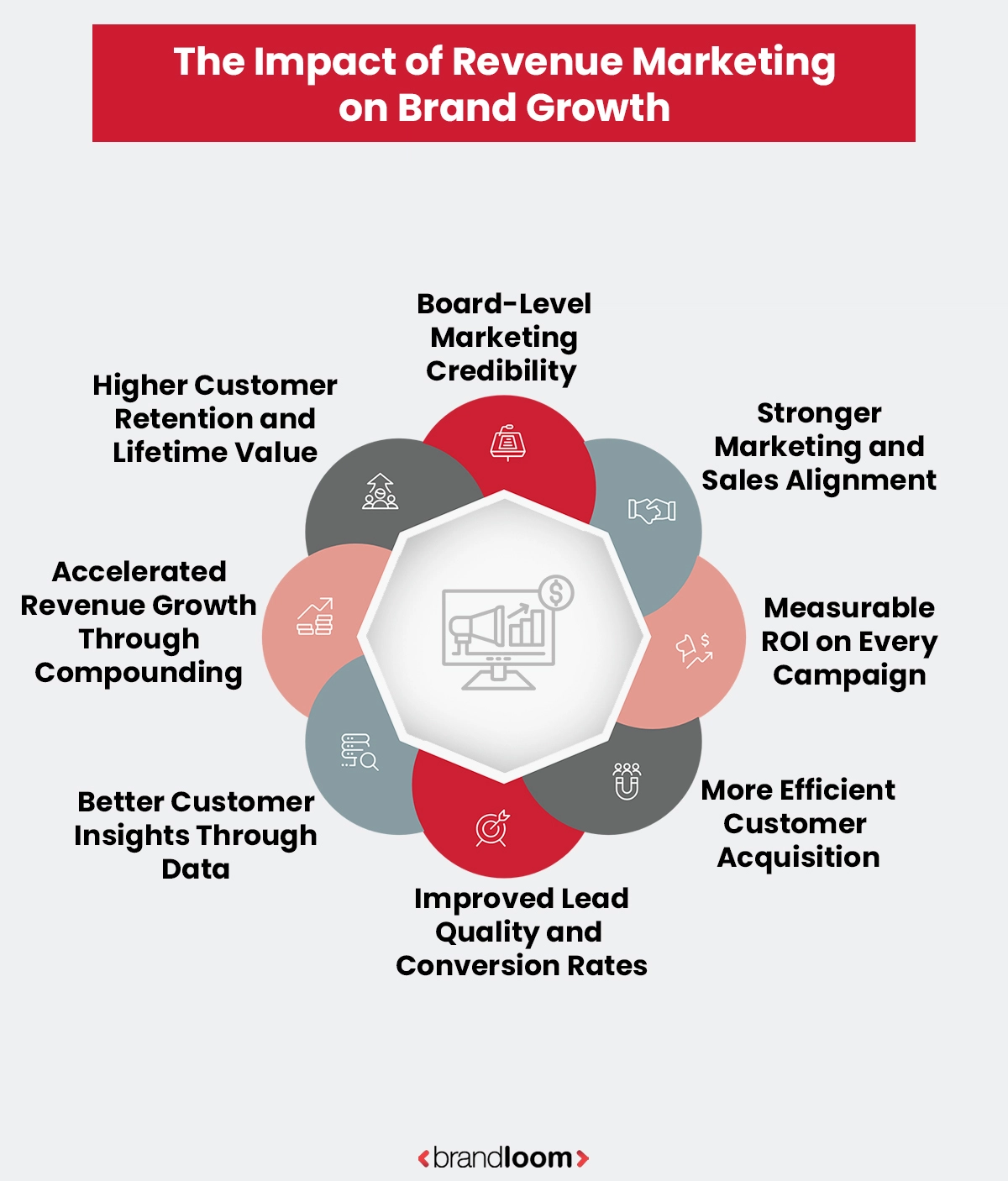
Shifting to a revenue performance framework does more than improve reporting. It fundamentally changes how your brand grows, competes, and retains customers.
1. Stronger Marketing and Sales Alignment
Revenue marketing alignment breaks down the wall between your marketing and sales teams. Traditional marketing hands off leads with little context about intent or readiness. Revenue marketing changes that. Both teams work from the same data, the same funnel, and the same revenue targets. When sales and marketing share accountability, conversion rates improve and deals close faster.
2. Measurable ROI on Every Campaign
Your team stops reporting on impressions and starts reporting on pipeline generated, deals influenced, and revenue attributed. This ROI-focused marketing strategy gives CEOs and CFOs the confidence to invest more because the return is visible. Measuring marketing revenue at the campaign level also helps you cut spend on underperforming channels and double down on what works.
3. More Efficient Customer Acquisition
When your marketing is revenue-driven, every tactic is optimized for acquisition efficiency. CAC drops because campaigns target prospects most likely to convert. Revenue marketing automation nurtures leads through the funnel without manual effort, reducing the time and cost of moving a prospect from awareness to decision.
4. Improved Lead Quality and Conversion Rates
A conversion-driven revenue strategy attracts buyers who are already in the market. By focusing on demand generation, ABM, and intent-based targeting, the leads entering your sales funnel are warmer, better qualified, and far more likely to convert. Your sales team spends time on opportunities that actually close , not cold prospects who clicked an ad.
5. Better Customer Insights Through Data
Data-driven revenue marketing runs on feedback loops. Every campaign, touchpoint, and interaction feeds back into your analytics stack, giving you a richer picture of your customers. You learn which messages resonate at which stage, which channels drive the highest LTV customers, and where prospects drop off. These insights improve your next campaign and inform your product and pricing decisions.
6. Accelerated Revenue Growth Through Compounding
A revenue marketing roadmap builds compounding returns. A well-optimized content strategy brings in organic traffic that converts. An automated nurture sequence converts leads you would otherwise lose. Each improvement raises the ceiling on what your marketing can generate. Over 12 to 24 months, a full-funnel revenue marketing system generates significantly more pipeline at a lower cost than a campaign-based approach ever could.
7. Higher Customer Retention and Lifetime Value
The customer lifetime value marketing strategy embedded in revenue marketing does not stop at acquisition. Post-purchase email sequences, personalized upsell campaigns, and loyalty programs built around data all contribute to higher retention and LTV. When you retain more customers, revenue growth becomes more predictable, and your CAC payback period shortens.
8. Board-Level Marketing Credibility
When marketing demonstrates its direct contribution to the bottom line, the CMO earns a genuine seat at the table. Marketing transforms from an overhead function into a revenue pipeline marketing engine. Budget conversations shift from “how much do we need to spend?” to “how much revenue can we generate if we invest more?”
Strategies to Leverage Revenue Marketing for Your Brand
A sound revenue marketing strategy requires more than good intentions; it requires structured execution. These eight strategies give you a practical starting point.
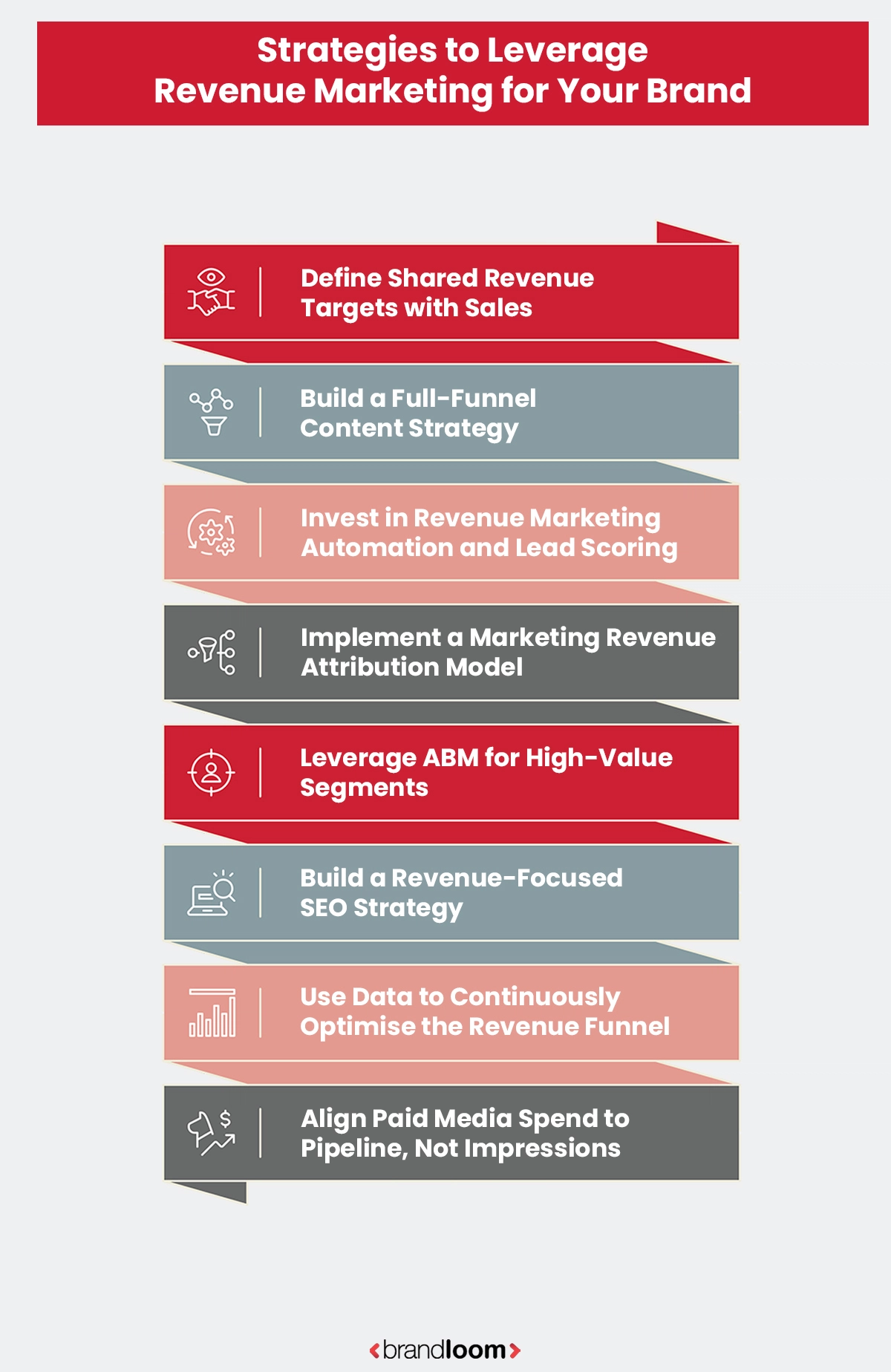
1. Define Shared Revenue Targets with Sales
Set joint revenue targets, agree on the definition of a qualified lead, and establish shared KPIs. When both functions measure success the same way, collaboration becomes natural. Weekly pipeline reviews that include both marketing and sales leads create the accountability structure that revenue-driven marketing requires.
2. Build a Full-Funnel Content Strategy
Map your content to every stage of the customer journey. Top-of-funnel content drives organic traffic. Middle-of-funnel assets, like case studies, comparison guides, and webinars, accelerate the consideration stage. Bottom-of-funnel content- ROI calculators, demos, and testimonials- reduces friction at conversion. This is the core of a revenue-driven content strategy.
3. Invest in Revenue Marketing Automation and Lead Scoring
Revenue marketing automation platforms nurture thousands of leads simultaneously with personalized, behavior-triggered communications. Pair automation with lead scoring to prioritize your highest-intent prospects. When a lead crosses a scoring threshold, your sales team receives an alert and can engage at exactly the right moment.
4. Implement a Marketing Revenue Attribution Model
You cannot optimize what you cannot measure. Build a marketing revenue attribution model that tracks which channels, campaigns, and touchpoints contribute to closed revenue. First-touch, last-touch, and multi-touch attribution models each tell a different part of the story. Most mature programs use multi-touch attribution to understand the full customer journey.
5. Leverage ABM for High-Value Segments
If your business targets enterprise clients or specific verticals, ABM is one of the most effective revenue pipeline marketing strategies available. Identify your ideal customer profile (ICP), build a target account list, and deploy coordinated campaigns across email, LinkedIn, content, and events, all personalized to the specific accounts you want to win.
6. Build a Revenue-Focused SEO Strategy
Not all organic traffic is equal. A revenue-focused SEO strategy prioritizes keywords that attract buyers, not just browsers. Target terms with commercial and transactional intent, and ensure your landing pages are optimized for conversion, not just ranking. BrandLoom, India’s leading digital marketing and brand consulting agency, can build a revenue-focused SEO strategy that drives qualified pipeline- not just traffic- for your brand.
7. Use Data to Continuously Optimize the Revenue Funnel
Data-driven revenue marketing is never static. A/B test your landing pages, email subject lines, and ad creative. Analyze drop-off points in the revenue marketing funnel and build interventions to reduce them. Use cohort analysis to understand which acquisition channels produce the best LTV customers.
8. Align Paid Media Spend to Pipeline, Not Impressions
Restructure your paid media strategy around performance-based revenue marketing. Set campaign objectives around lead generation and conversion, not reach. Shift your reporting from cost-per-click (CPC) to cost-per-pipeline-opportunity, a single metric that makes your paid media spend genuinely accountable to the business.
Revenue Marketing vs Traditional Marketing: Key Differences
Understanding the distinction between these two models helps you make a clear case for budget reallocation to leadership.
| Dimension | Traditional Marketing | Revenue Marketing |
| Primary Goal | Brand awareness and visibility | Pipeline generation and revenue growth |
| Success Metrics | Impressions, reach, engagement | CAC, pipeline value, LTV, attributed revenue |
| Sales Alignment | Siloed; leads handed off | Fully integrated; shared revenue targets |
| Budget Justification | Estimated brand lift | Traceable ROI on spend |
| Technology | Creative tools, social platforms | CRM, automation, attribution software |
| Timeframe | Long-term brand building | Short and long-term revenue outcomes |
Challenges and How to Navigate Them
Every revenue marketing roadmap runs into friction. Here are the six most common barriers and how to move past them.
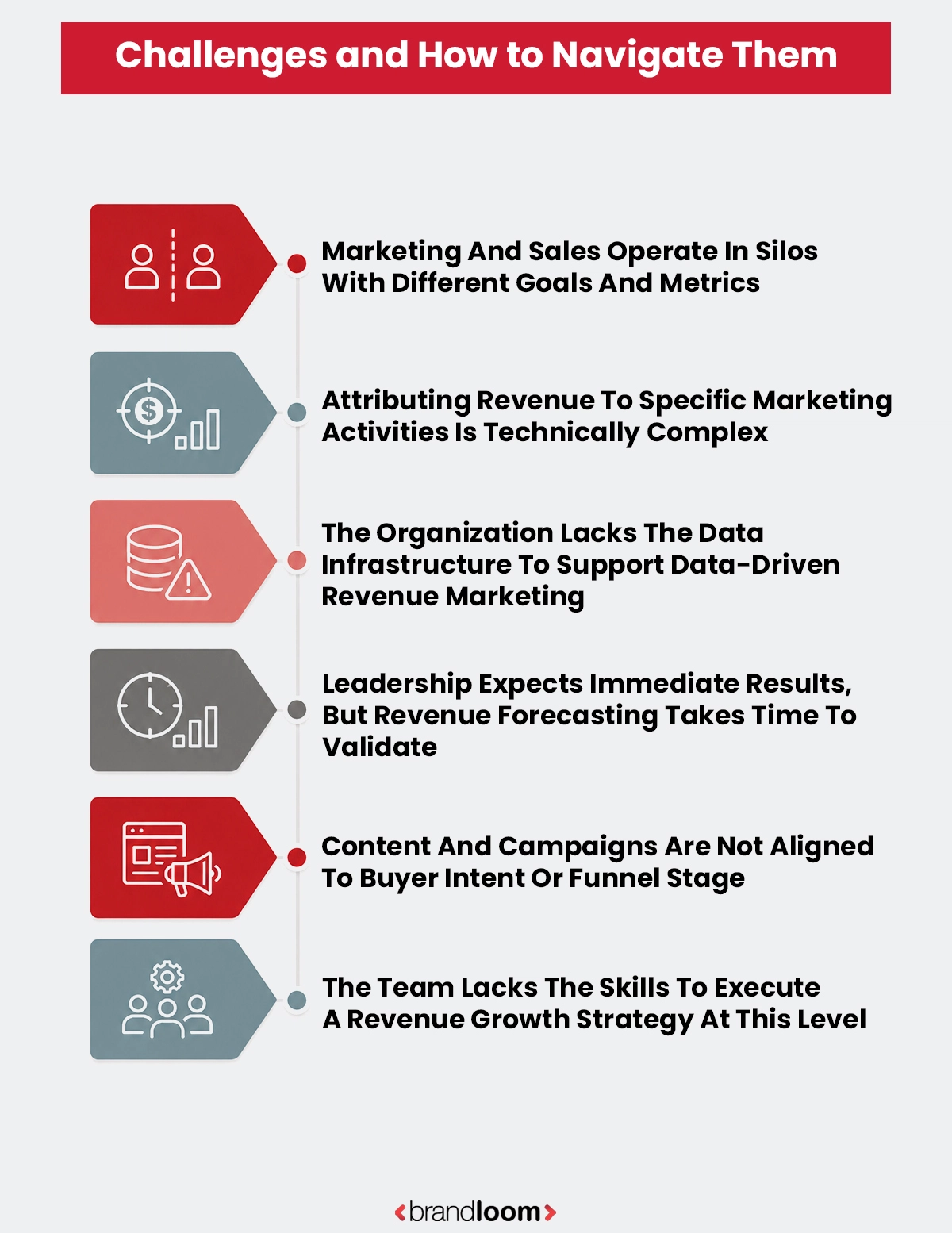
1. Challenge: Marketing and sales operate in silos with different goals and metrics. Solution: Create shared KPIs, joint planning sessions, and a single CRM that both teams use. Define what an MQL (marketing-qualified lead) and SQL (sales-qualified lead) look like together, and hold joint pipeline reviews weekly.
2. Challenge: Attributing revenue to specific marketing activities is technically complex. Solution: Start with simple first-touch and last-touch attribution before graduating to a full marketing revenue attribution model. Invest in a dedicated revenue attribution tool if your CRM does not support it natively.
3. Challenge: The organization lacks the data infrastructure to support data-driven revenue marketing. Solution: Audit your current stack and identify gaps. At a minimum, you need a CRM, a revenue marketing automation platform, and a web analytics tool connected via integrations. Build a clean data foundation before attempting advanced attribution.
4. Challenge: Leadership expects immediate results, but revenue forecasting in marketing takes time to validate. Solution: Set realistic 30-60-90 day milestones and communicate them to stakeholders. Early wins, improved lead quality, and faster sales cycles are visible before full revenue attribution is in place.
5. Challenge: Content and campaigns are not aligned to buyer intent or funnel stage. Solution: Conduct a full content audit and map every existing asset to a funnel stage. Prioritize closing gaps in the middle and bottom of the funnel, where traditional marketing tends to be weakest.
6. Challenge: The team lacks the skills to execute a revenue growth strategy for businesses at this level. Solution: Invest in training on automation, data analytics, and CRM management. Consider working with an agency that already has the capability and tools to accelerate your transition.
KPIs to Measure Revenue Marketing Success
Your revenue performance framework is only as strong as the metrics you track. Group your KPIs across four dimensions for clarity.
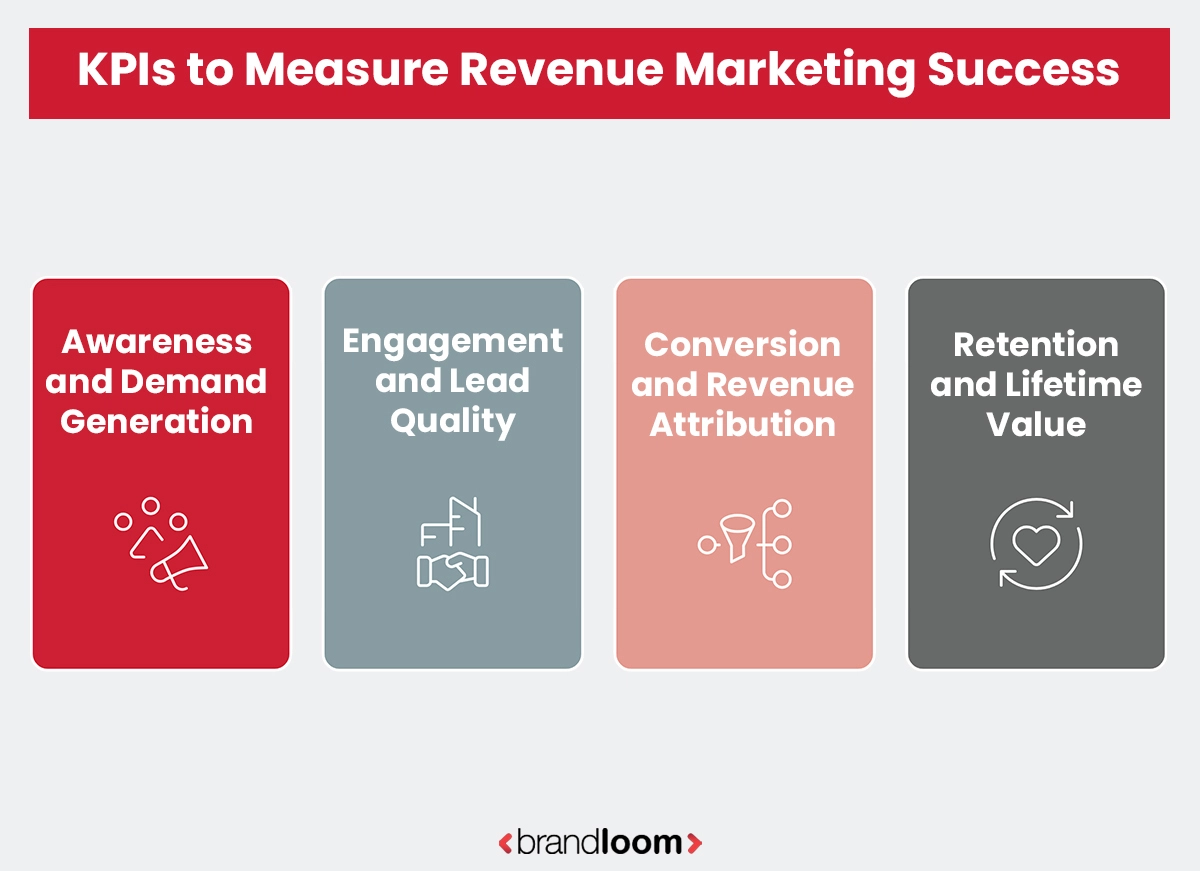
Awareness and Demand Generation
- Organic traffic from commercial-intent keywords
- Net new pipeline sourced from marketing
- Marketing-sourced opportunities as a percentage of the total pipeline
- Share of voice in target market segments
Engagement and Lead Quality
- MQL to SQL conversion rate
- Lead score distribution across the pipeline
- Content engagement rate by funnel stage
- Email open and click-through rates by segment
Conversion and Revenue Attribution
- Marketing revenue attributed (multi-touch)
- Cost per pipeline opportunity
- CAC by channel
- Revenue influenced by marketing at each deal stage
Retention and Lifetime Value
- Customer retention rate post-acquisition
- LTV by acquisition channel
- Upsell and cross-sell revenue generated by marketing
- Net revenue retention (NRR) for SaaS and subscription businesses
The BrandLoom Framework for Revenue Marketing
A structured revenue marketing roadmap reduces guesswork and builds momentum from day one. This is how BrandLoom approaches the transformation.
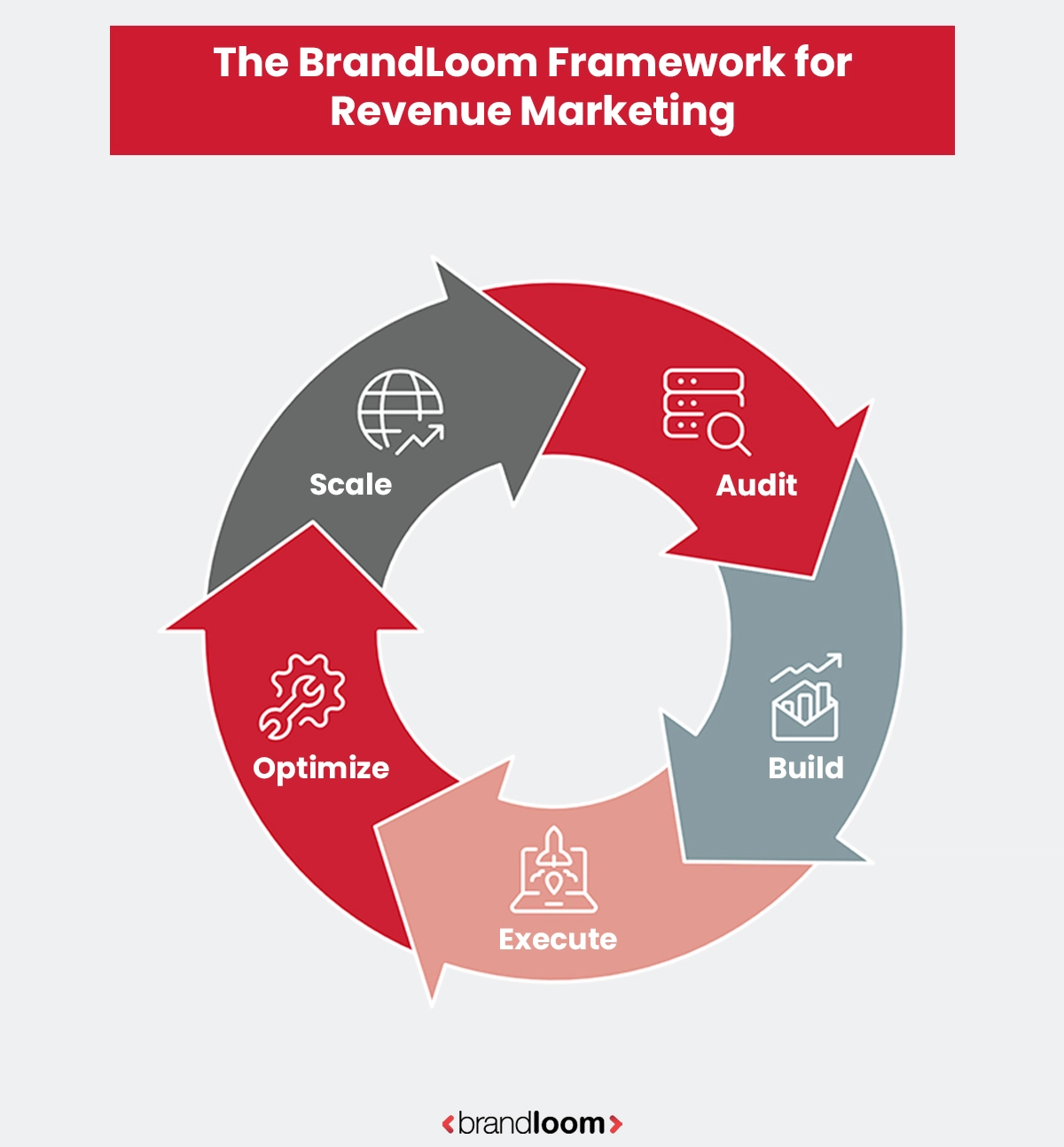
Step 1: Audit
Begin with a full diagnostic of your current marketing setup. Assess your tech stack, data quality, content assets, funnel performance, and the degree of revenue marketing alignment between your marketing and sales teams. Identify where revenue is being lost and which channels generate genuine pipeline versus vanity metrics.
Step 2: Build –
Design the revenue marketing strategy your brand needs. This includes defining your ICP, mapping the full customer journey, building lead scoring models, configuring your revenue marketing automation platform, and creating the foundational content assets that support each funnel stage.
Step 3: Execute
Launch campaigns with revenue outcomes as the primary objective. Activate demand generation, ABM, revenue-driven digital marketing, and paid media simultaneously, all coordinated through your CRM. Ensure every campaign has a clear marketing revenue attribution model before it goes live.
Step 4: Optimize
Review performance against pipeline and revenue KPIs on a regular cadence. Run structured A/B tests across landing pages, email sequences, and ad creative. Use revenue growth through digital channels data to identify friction points and act on them quickly. Optimization in revenue-driven marketing is continuous, not episodic.
Step 5: Scale
Once your system delivers consistent, attributable results, scale what works. Increase investment in your highest-performing channels, expand ABM to additional target accounts, extend your revenue-driven content strategy library, and push revenue marketing automation into retention and lifecycle stages.
Conclusion
Every CEO who has asked “What did marketing actually generate this quarter?” already understands the problem. Traditional marketing was built for a world where brand visibility and marketing revenue were loosely connected. Revenue-driven marketing exists in a world where every rupee of budget must earn its place in the P&L.
The shift to a revenue marketing strategy is not about abandoning brand building. It is about making brand building accountable. The best programs do both: they build long-term brand equity and generate short-term pipeline, with the data to prove both outcomes.
Whether you are a founder deciding where to invest your next marketing budget or a CMO making the case to your board, data-driven revenue marketing gives you the framework, the metrics, and the strategic clarity to grow with confidence. BrandLoom, India’s leading digital marketing and brand consulting agency, can build a revenue marketing strategy that connects your marketing spend directly to pipeline, profitability, and growth for your brand.
Frequently Asked Questions
Revenue marketing is a strategy where every marketing activity is designed and measured based on its contribution to actual marketing revenue , tracking pipeline, CAC, and LTV rather than impressions or reach. It treats marketing as a direct revenue driver.
Traditional marketing measures awareness and engagement. Revenue-driven marketing holds every campaign accountable to pipeline contribution, lead conversion rates, and CAC. The fundamental difference is accountability: marketing revenue is proven through attribution, not estimated through brand lift studies.
Boards demand proof that marketing drives revenue. Revenue marketing alignment gives CEOs a direct line of sight between investment and outcomes. Modern CRM and automation platforms have made attribution accessible to businesses of all sizes. BrandLoom helps brands build this infrastructure, so every marketing rupee connects back to measurable outcomes.
No. Revenue-driven marketing reframes brand marketing, not replaces it. A strong brand reduces CAC, improves conversion rates, and increases LTV, all of which are revenue marketing outcomes. In a revenue performance framework, brand investments must demonstrate their contribution to the business case, even if the timeline is longer.
Track metrics across the full revenue marketing funnel: pipeline sourced from marketing, MQL to SQL conversion rates, marketing revenue attribution model results, and LTV by channel. BrandLoom, India’s top digital marketing agency, helps brands build attribution frameworks that give leadership clear visibility into marketing’s revenue impact.
Any business with a defined sales funnel and a repeatable revenue model benefits from a revenue marketing strategy. It is especially powerful in B2B, SaaS, financial services, professional services, and e-commerce industries where pipeline generation and revenue forecasting in marketing are board-level priorities.
Yes. SMEs can begin with a CRM, a basic revenue marketing automation tool, and a clear customer journey map. Measuring marketing against revenue targets is more valuable at a smaller scale, where every rupee matters. BrandLoom, India’s leading brand consulting agency, has helped SMEs implement scalable revenue marketing strategies that deliver measurable growth.
AI-powered revenue marketing enables real-time lead scoring, predictive pipeline forecasting, and personalized content at scale. AI-driven tools support revenue forecasting in marketing, identify high-LTV prospects early, and power conversational chatbots that engage buyers at the exact moment of interest, reducing funnel drop-off significantly.
A functional stack includes a CRM, a revenue marketing automation platform, a web analytics tool, and a marketing revenue attribution model solution. Advanced programs may also need an ABM platform and a BI (business intelligence) tool. BrandLoom, India’s leading digital marketing agency, can audit your stack and recommend the right tools for your goals.
A revenue marketing funnel maps the full customer journey from awareness to closed revenue and post-sale retention, with marketing activities and metrics at each stage. Unlike a traditional sales funnel, it is jointly owned by marketing and sales. BrandLoom, India’s award-winning digital marketing agency, can design a full-funnel revenue marketing system tailored to your business.