There is a sea of apps on every app store that you can name. And people are spending more than ever through in-app purchases. But you cannot expect to get a piece of that cake unless you adapt and transform your app’s ASO strategy in 2026.
App Store Optimization is the strategy that helps an app reach more people, increase downloads, and engagement. Developers have used it to improve visibility through keyword optimization in the past.
However, visibility is just not enough anymore to keep the users engaged. While keywords still play a crucial role in app store optimisation, the real focus has shifted towards user experience.
In this crowded app marketplace, apps that build trust, provide value, and stand out in search results cross the line to success. It is time to move beyond basic metadata and rethink your approach completely to win in the new era of Store Optimisation.
With this ASO checklist, you first understand what ASO app store optimization is and then what the correct steps are to perfect your own ASO strategy in 2026. You can talk to the SEO experts at BrandLoom, who can help your app become visible to your target audiences on the app store.
The Evolution of ASO in 2026 – From Keywords to User-Centric ASO marketing strategy
For ASO app optimization – just optimizing the keywords and metadata has become an outdated tactic as App store algorithms learned to prioritize what truly matters to users and the experience post-installation.
User Intent – The days when you could rank high simply by matching keywords in app titles and descriptions are gone. Today, app stores first understand the intention behind a user’s search query.
What are they really looking for? Is your app the best solution for their needs?
ASO must consider the full context of user behavior, not just a list of targeted ASO or app store optimization keywords, to keep ranking well in the store searches. The approach to ASO has largely changed due to the shift from metadata to the user’s needs.
Behavioral Metrics – Instead of focusing on the number of downloads, app stores’ search algorithms now analyze how users interact with your app after it is downloaded. Engagement and retention are the most important ranking signals now.
If users uninstall your app shortly after downloading or if engagement drops off, the app store will interpret that as a negative signal. Adopting positive in-app experiences have become essential for user retention.
AI is also playing a crucial role in shaping the ASO landscape. AI algorithms evaluate user behavior and app quality in addition to assessing relevant keywords. Therefore, ASO is no longer just about tweaking metadata; it is optimizing the user experience.
It is important to remember that AIs analyze usage patterns and predict user preferences. This, in turn, has forced apps to incorporate an “experience-based” optimization in their ASO strategy in 2026.
The Core of ASO in 2026: User Experience Optimization
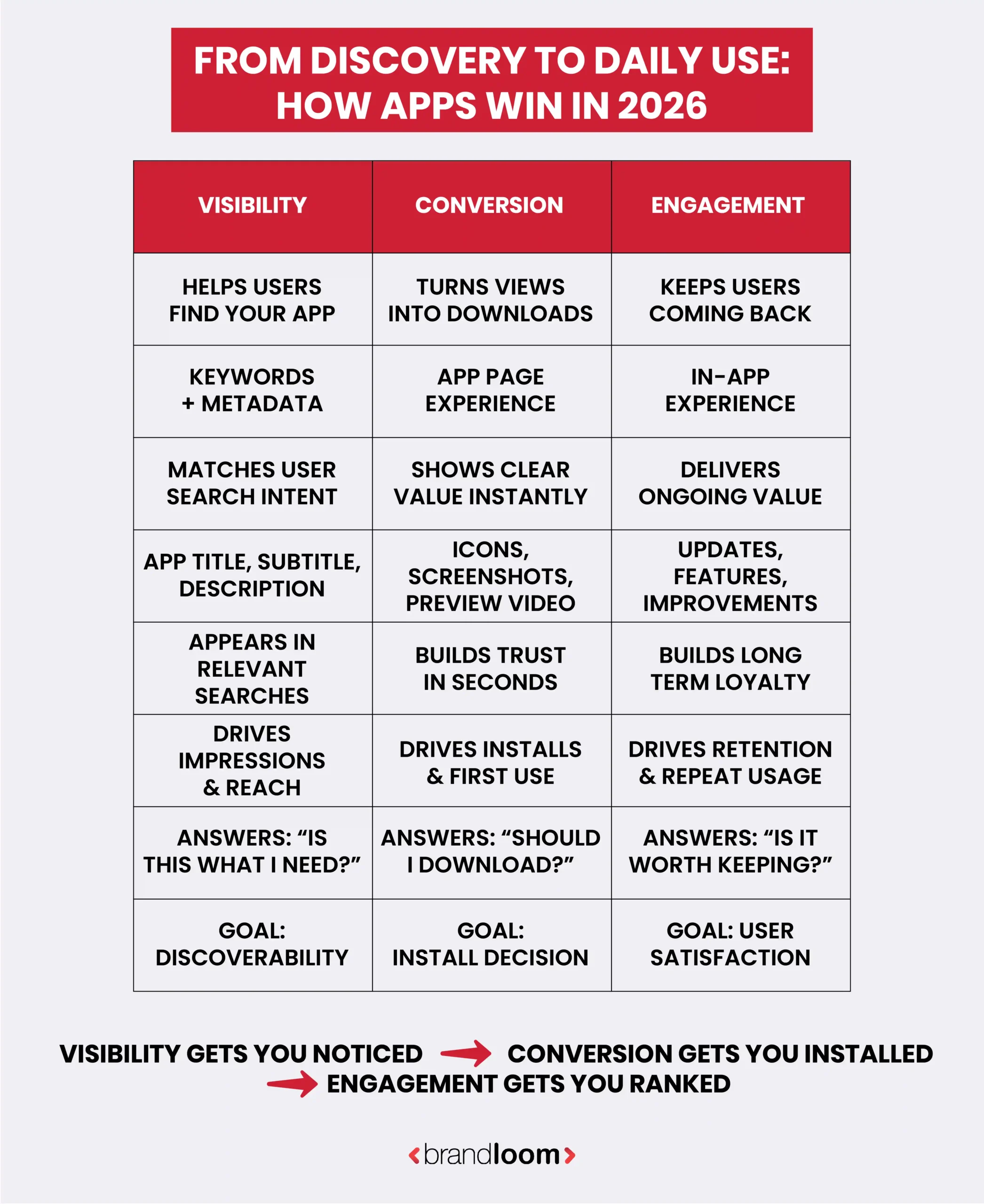
From Discovery to Daily Use: How Apps Win in 2026
| VISIBILITY | CONVERSION | ENGAGEMENT |
|---|---|---|
| Helps users find your app | Turns views into downloads | Keeps users coming back |
| Keywords + metadata | App page experience | In-app experience |
| Matches user search intent | Shows clear value instantly | Delivers ongoing value |
| App title, subtitle, description | Icons, screenshots, preview video | Updates, features, improvements |
| Appears in relevant searches | Builds trust in seconds | Builds long-term loyalty |
| Drives impressions & reach | Drives installs & first use | Drives retention & repeat usage |
| Answers: “Is this what I need?” | Answers: “Should I download?” | Answers: “Is it worth keeping?” |
| Goal: Discoverability | Goal: Install decision | Goal: User satisfaction |
Visibility gets you noticed → Conversion gets you installed → Engagement gets you ranked
Optimizing the user experience is the ultimate goal of ASO today. But what does that really mean?
It means that the traditional model of gaining visibility through keyword optimization needs to intertwine with conversion and engagement strategies.
Let’s break down how these three factors work together to deliver results.
Visibility –
The crucial piece of the ASO puzzle. ASO Keyword strategy, optimized app descriptions, and metadata determine to which audience and how many times your app will be suggested.
Search Intent –
Using the right keywords is as important, but even more is ensuring that keywords align with the user’s search intent and meet their expectations. Optimizing for search intent is making sure that your app appears when users are looking for exactly what you offer, and your metadata can convey your app’s value.
User-Friendly UI/UX –
Once users discover your app, the next challenge becomes conversion. Conversion is the art of turning an impression into an actual download. ASO enhances your app’s page with compelling visuals, clear descriptions, and authentic reviews to achieve that.
High-quality visuals such as app icons, UI screenshots and preview videos are key to convincing users of your app’s real value. Your app’s page is your store-front which needs to stand out and speak to the user’s needs.
So what now?
The most critical aspect of ASO now, however, is engagement and retention. Apps that maintain a strong relationship with their users post-download are rewarded by the algorithms. This means that your app’s success is not only getting installed. It is about keeping the users active and engaged, making them come back for more.
Personalized push notifications, ongoing updates and feature improvements help apps create a positive and long-term relationship with users. Apps that foster such a relationship are the ones that rise to the top of the app store rankings.
In short, visibility gets your app discovered, conversion turns that visibility into installs, and engagement factors make sure that users come back for more. By combining these three elements, your ASO strategy 2026 will be positioned for long-term success and beyond.
For an ROI-based and perfectly customized ASO strategy for 2026, you can rely on experts like BrandLoom, an Award-winning marketing agency. Your app’s mobile growth strategy depends on you creating valuable assets and features in your app while having an ASO strategy showcasing the same.
ASO Checklist for 2026
ASO Checklist 2026 || Actionable Steps to Rank Higher
| STEP | WHAT TO DO | HOW TO DO IT (ACTION) | OUTCOME |
|---|---|---|---|
| 1 | Integrate AI into ASO | Use AI tools to track trends, optimize metadata, and adjust keywords in real time | Future-proof visibility |
| 2 | Align keywords with user intent | Target phrases that reflect what users actually want, not just high volume terms | Better discovery + relevance |
| 3 | Analyze competitors for gaps | Study competitor keywords and identify missed opportunities | Rank without heavy competition |
| 4 | Perform deep keyword research | Use ASO tools to find high-value, low-competition long-tail keywords | Qualified traffic |
| 5 | Select primary & secondary keywords | Put primary keywords in title, secondary in description & metadata | Broader search coverage |
| 6 | Optimize app title | Include main keyword while keeping it short and clear | Strong ranking signal |
| 7 | Optimize subtitle / keyword field | Highlight core value + add supporting keywords (especially on iOS) | Increased discoverability |
| 8 | Write a benefit-driven description | Explain how the app solves user problems using natural keywords | Higher conversion |
| 9 | Use high-quality visuals | Design simple icon + feature-focused screenshots with captions | Instant understanding |
| 10 | Add app preview video | Show real app usage and key features in a short demo | Higher install rate |
| 11 | Encourage reviews & ratings | Ask for feedback after positive moments and respond to issues | Trust + ranking boost |
| 12 | Leverage influencers | Partner with niche creators to drive awareness and installs | Social proof + reach |
| 13 | Improve retention & engagement | Use notifications, rewards, and useful features to bring users back | Strong ranking signals |
| 14 | Promote in-app events | Run seasonal offers or special events and highlight them in listings | Increased visibility |
| 15 | Conduct A/B testing | Test icons, screenshots, and descriptions regularly | Optimized conversion |
| 16 | Localize metadata | Translate keywords, text, and visuals for target regions | Global growth |
| 17 | Update for seasons | Refresh visuals and messaging during high-interest periods | Timely relevance |
| 18 | Track ASO performance | Monitor rankings, installs, and engagement using ASO tools | Data-based decisions |
| 19 | Use data for improvement | Adjust strategy based on trends, gaps, and performance insights | Continuous growth |
| 20 | Consider expert support | Outsource ASO to specialists to manage strategy and execution | Scalable results |
Following are the easy steps you need to follow to customize your ASO strategy for 2026 according to your app.
Step 1: Future-Proof Your ASO Strategy with AI Integration
The first step is preparing to stay ahead of the competition by integrating AI into your ASO strategy. AI ASO optimization tools can –
- help predict trends
- adapt your app’s metadata and
- automatically adjust to evolving search patterns.
For example, AI-powered tools can generate real-time insights by identifying keyword trends and suggesting tweaks to improve visibility. You need to use AI to continuously evolve your app with the market, keeping your ASO strategy in 2026 future-proof.
As app stores continue to lean into AI, embracing it now ensures your app stays ahead of the curve and consistently ranks higher. Adapting in real-time has become essential in this AI era.
Step 2: Align your Keyword Research with User Intent
Focus on why the user searches for something. Avoid cramping high-volume keywords into the metadata. Understanding user intent will help you target the right keywords.
For example, if you are building a fitness app, instead of targeting vague terms like “workout app,” use intent-based keywords like “fitness tracker for weight loss”, “beginner home workout” or “no equipment training”
More specific phrases speak directly to what users are actively searching for. The more aligned your keywords are with user intent, the better your app will engage users and convert them into loyal customers.
Step 3: Perform Competitive Analysis for Keyword Gaps
Study your competitors. A smart way to uncover keyword opportunities is to analyze which keywords your competitors are targeting. Use tools (like MobileAction or Sensor Tower) to look for keyword gaps.
For example, if your competitor ranks high for “fitness tracker” but misses “calories burned tracker,” you’ve found a sweet spot. Targeting these gaps can help you rank higher and get more exposure without fighting for the same crowded keywords. Strategically finding untapped opportunities is the key to optimising the keyword research.
Step 4: In-Depth Keyword Research Using ASO Tools
Use ASO tools (like AppTweak and Sensor Tower) to list the keywords that are high on value but low in competition. Focus on long-tail keywords that are specific and targeted rather than chasing after the big, competitive terms. It is easier to rank for keywords that are unique but likely to be used by niche users than common, popular ones.
For example, when promoting a meditation app, instead of going for a generic term like “meditation,” go for something like “meditation for beginners”, “meditation to reduce stress” or “meditation for focus”.
These long-tail keywords are less competitive, high ranking and attract users who are more likely to download your app.
Infographic- Too many keywords leading nowhere vs unique, long tailed keywords doing the job
Step 5: Choose the Right Primary and Secondary Keywords
Make sure to use primary keywords for your title and secondary keywords for your description and metadata while choosing keywords for your app.
For example, if you have a task management app, your primary keyword in the title could be “Task Manager,” and your secondary keyword in the description could be “Productivity App.”
You can target multiple user intents by appropriately using both types of keywords. This ensures that your app gets discovered by people searching for a variety of related terms.
Step 6: Optimize Your App’s Title for SEO
Your app title is crucial. It is one of the biggest ranking factors in App Store Optimization (ASO) in SEO. You need to make sure that you include the primary keyword in the title, while keeping it concise since the App Store allows only 30 characters and Google Play gives 50 characters.
For example, you might use “Kwikly – Task & Project Manager” to incorporate the keyword “task manager” at the front and center.
A title with a blend of the right keywords with your app’s unique utility will boost your visibility in the app store search algorithm. Make every character count for SEO and try to stay creative enough to communicate your app’s value.
Step 7: Optimize the Keyword Field (iOS) and Short Description
The first thing users see after your title and logo is your app’s subtitle (iOS) or short description (Google Play) is. You need to make it count. Use this space to highlight your app’s core value proposition while strategically adding some secondary keywords.
A fitness app could use “Track Workouts & Manifest Your Fitness Goals” to include keywords like “track” and “fitness goals.”
Telling users exactly what they can expect will get you the chance to reel them in with clear, transparent benefits. Don’t forget, a great subtitle sets you apart from the crowd too, so .
If you’re on iOS the keyword field is your secret weapon. Don’t get swayed as you have 100 characters to fill with relevant keywords: make it count. Avoid repeating keywords from the title or subtitle.
For example, expand your keyword reach using terms like “workout tracker”, “fitness planner” or “session logs”. You can target even more search queries without overcrowding the rest of your metadata. It is a bonus opportunity to boost your app’s discoverability so make sure each word works strategically.
Step 8: Craft a Convincing App Description
Your app description is your chance to dive deeper into your app’s core benefits. You have 4,000 characters on Google Play, so take advantage of it. Focus on how your app solves user problems.
Take this example: A meal-planning app’s description should explain how it helps users “plan meals, track calories, and organize grocery lists” while smoothly integrating primary and secondary keywords.
A clear, benefit-driven description convinces users that your app is exactly what they need. Keep it natural while adding keywords in the description.
Step 9: Utilize High-Quality Visuals: App Icons and Screenshots
Your app’s icon and screenshots are the face of your app, and first impressions matter. Make sure that your icon translates your brand’s functionality and stays simple and recognizable.
You can highlight the app’s key features with captions in the screenshots. For instance, a budgeting app could showcase features like “Track Expenses”, “Set Budget Goals” and “Get Financial Insights”.
This helps potential users quickly understand what your app offers. High-quality visuals not only grab attention but are also essential for conversions. A sleek, well-thought-out visual allows users and AI app discovery to understand your app’s benefits
Step 10: Implement App Preview Videos
Give users a sneak peek of your app in action with an app-preview video. Whether it’s on Apple’s App Store or Google Play, this 30-second video should showcase your app’s core features and what makes it special. Your ASO checklist is incomplete without a well thought out preview.
A travel app could demonstrate how easy it is to “Book flights in under 5 minutes.” A positive idea about your app’s service gets reinforced by easily understandable features showcased in previews.
Show the user journey upfront and highlight what sets your app apart. Apps with preview videos see a higher conversion rate than those without one. This will be beneficial for both the Google Play ASO as well as the Apple App Store ASO. Previews also boost all the other mobile app ranking factors, including the chances of showing up more often.
Step 11: Leverage Social Proof: Encourage Reviews & Ratings
You can subtly prompt your users to leave positive reviews, especially after a significant experience. The key is timing when it comes to asking for a review. Right after users achieve something significant in the app, like completing their first workout or achieving a weekly milestone in a fitness app.
Making their first purchase or getting an offer in a shopping app can be another example after which reviewing can feel natural. It can encourage them to share their satisfaction.
High ratings are critical for algorithm rankings and are not just for vanity. Apps with higher ratings get more visibility and see better conversion rates. Additionally, just make sure that you quickly respond to negative feedback to keep the balance.
Step 12: Build a Network of Influencers to Increase App Visibility
Tap into the power of influencers to boost your app’s visibility. Partnering with influencers in your niche – say, fitness influencers for a workout app – can give your app a massive visibility boost.
Influencers offer social proof and encourage their followers to check out and install your app. Their endorsement can boost downloads and can lead to better rankings. Building an influencer network also keeps your app in front of the right audience, increasing credibility and generating buzz around your app. This will automatically become the core of the asos social media strategy.
Step 13: Focus on User Retention and Engagement
User engagement is about giving users reasons for coming back. So focus on metrics like session length and feature usage to measure how sticky your app is.
Apps with high retention rates signal that they have long-term value to the app store search algorithms. Add push notifications, gamify the experience and introduce loyalty rewards to keep users active.
Retention is a major ranking factor; apps that keep users engaged climb higher in search results, making your app more trustworthy and discoverable.
Step 14: Optimize Your In-App Events for Discoverability
In-app events like seasonal sales or exclusive promotions can immensely improve visibility on app stores.
By running events like a festive sale or a holiday discount within your shopping app, you can attract users and also gain favor from app store search algorithms. Push notifications on these events can boost your mobile app ranking factors.
Display these events in your app store listing to get a rise in visibility. Events can boost installs, increase engagement and provide a great opportunity to improve rankings. They signal to the app store that your app is active and relevant. AI app discovery favours these signals, keeping your app in the spotlight during high-traffic times.
Step 15: Implement a Structured A/B Testing Process
A/B testing is comparing two different versions of your app page and content. You need to A/B test regularly to find the best-performing version of your app. Experiment with different versions of app icons, screenshots and descriptions to see which one resonates more with users.
For example, test two different app descriptions to find out which one converts more installs, and compare it with similar tests of icons and previews. Analyze what works and why – to create the best version incorporating the insights.
A/B testing lets you continually optimize key elements of your app store listing to improve conversion rates. This process keeps your app always evolving to meet user preferences.
Step 16: Focus on Localizing Your App’s Metadata
Localize your app’s metadata to penetrate region specific app markets. This means translating and adapting your title, description and visuals to match the search behavior and preferences of users in different regions.
For example, if you’re targeting Spain, make sure to include Spanish keywords like “gestión de tareas” (task management) in your metadata. Penetrating in an Indian market will require hyper-specific keywords and metadata that panders to local users.
When users find your app in their native language, they’re more likely to download it. Localized ASO is a game-changer for global growth.
Step 17: Invest in Seasonal Updates for Metadata and Visuals
An easy way to keep your app at the top of users’ minds when they’re actively searching for solutions is by staying relevant with seasonal updates. Refresh your app’s visuals and metadata during key moments of high search activity, like the holidays or New Year.
For instance, a fitness app could update its visuals with New Year’s resolutions themes to attract users looking to start fitness goals. These updates make your app more appealing during peak times and stay fresh in the app store search algorithms. Plus, seasonal updates ensure your app is aligned with user intent during these busy periods..
Step 18: Track and Analyze ASO Metrics and Reports Regularly
App Store Optimization (ASO) is an ongoing process that requires tweaks regularly. It is not a set and forget strategy. Use ASO tools to monitor your keyword rankings, app engagement signals and conversion rates. Track your app’s performance to get insights on the effectivity of your app store optimization IN 2026.
For instance,you need to adjust your strategy if your ranking for a keyword like “budgeting app” starts to slip. Tweak the keywords or refresh your visuals while consulting with AI. This helps you stay ahead of competitors by ensuring your app remains visible in the app store search algorithm.
Consistently tracking gives you the data to keep your app optimized with ASO for the AI era. You can outsource the maintenance and progress tracking of your app’s metrics and reports to an expert. This is exactly where Brandloom shines. With our experienced ASO specialists, we create strategies that make sure your app downloads soar. We understand that different brands need different app store strategies, and if you’re curious about the transformation we can bring to your app, contact us!
Step 19: Use Data-Driven Insights for Continuous Improvement
Use data insights from tools to refine your strategy and AI-driven ASO to eliminate guesswork. Tools like Sensor Tower and AppTweak give you deep insights about how your app performs and which keywords are trending. If your app is ranking low for primary keywords, the data can show you the missing gaps or opportunities to target more relevant keywords.
Using real insights and making informed decisions will improve visibility and performance. By regularly analyzing your app’s keyword rankings, user engagement, and other metrics, you ensure long-term growth. Continuous improvement through data ensures your app stays relevant and competitive.
Step 20 – Outsource your App Store Optimization strategy to an Expert
App developers need to focus their efforts and time into creating unique services and features that ensure users choose their apps over other competitors. Doing that is painstaking itself, but optimizing your App Store discovery and creating a customized ASO strategy needs to be executed by an expert in the field.
Here comes BrandLoom with a solution to all your App Store Optimization problems. By focusing on user intent, visibility and conversion, Brandloom can help you create the perfect ASO strategy in 2026 for the current trends and help you maintain it too. With our ROI-based strategies, you can sit back and focus on developing your app, while an expert tailors your app-specific ASO strategy. Contact us and lets discuss strategies!
Conclusion: Building a Sustainable ASO Strategy in 2026 for Long-Term Growth
App Store Optimization is a continuous, evolving strategy that places user experience and behavior at the core. As keyword stuffing becomes more and more obsolete by the day, success depends on delivering valuable app experiences that align with what users truly want. By focusing on engagement, retention and behavioral metrics, app stores are rewarding apps that not only attract users but keep them coming back for more. AI and data analytics now play a crucial role in continuously refining your strategy and predicting trends, ensuring your app stays competitive in a constantly shifting landscape.
So, how will you ensure your app stays relevant? It’s time to move beyond traditional ASO practices and embrace a holistic, data-backed approach. Contact BrandLoom to develop a customized ASO strategy for 2026 that leverages cutting-edge tools and best practices to drive measurable, long-term success.
Frequently Asked Questions
In 2026, App Store Optimization (ASO) is no longer just about cramming in as many keywords as possible. It’s a holistic strategy that focuses on user intent, experience optimization, and engagement. In essence, the goal is to provide value at every touchpoint. This means not only making sure your app is discoverable through effective keyword use but also enhancing conversion rates through compelling visuals, reviews, and descriptions. In addition, AI-powered tools are increasingly being used to predict trends and make data-driven decisions. Success in ASO now requires a dynamic approach that blends AI, user feedback, and real-time optimization to ensure long-term growth. If you want to do it the right way, talk to an experienced digital marketing agency like BrandLoom.
AI has revolutionized App Store Optimization (ASO) by shifting the focus from just keyword density to user behavior analysis. Today, algorithms evaluate how well an app meets user intent and its ability to engage and retain users. AI-powered tools now analyze user interactions, identify which features keep users hooked, and even generate optimized metadata. This makes the optimization process more predictive and efficient, ensuring your app stays competitive in the fast-evolving marketplace. Machine learning also helps detect trends early, allowing you to adapt your strategy before competitors catch on. In short, AI helps you stay one step ahead, automating much of the guesswork.
Yes, but not the way they used to. While keywords are still a core part of your ASO strategy in 2026, it’s quality over quantity in 2026. It’s more important to choose relevant keywords that align with user intent rather than chasing after high-volume terms. Apps are ranked based on how well they match search intent, not just how many keywords they use. Instead of generic terms like “fitness app,” focus on specific, action-driven phrases like “home workout for beginners.” Keyword relevance now plays a much larger role in your app’s ability to convert users into loyal ones.
In the AI-driven world of App Store Optimization, app rankings are determined by several factors:
User Intent: How accurately your app matches user queries, based on behavioral signals.
Engagement & Retention: Apps that keep users engaged (think: longer session times, repeat visits) are rewarded.
Quality of Experience: AI evaluates your app’s usability, speed, and how it meets user needs.
Ratings & Reviews: Apps with higher ratings and frequent positive feedback rank better.
AI Behavioral Analysis: The more your app delivers value and keeps users happy, the better its chances of ranking higher. Trust signals from social proof and in-app events also play a significant role.
Reviews and ratings are extremely important in 2026. They not only serve as trust signals but also influence rankings directly. Apps with higher ratings (4 stars or more) tend to rank higher and attract more installs. Additionally, user-generated feedback offers valuable insights into user satisfaction, which can guide product improvements. Apps that actively manage reviews, respond to user concerns, and encourage positive feedback post-purchase or after a major milestone see a significant boost in rankings. Essentially, reviews aren’t just feedback—they’re part of the ASO algorithm.
Yes, AI can automatically improve your app’s discoverability by predicting trends and adjusting your metadata in real-time. AI tools analyze factors like user behavior, search trends, and engagement metrics to optimize keywords, descriptions, and even visual assets. This dynamic aso optimization process helps apps stay visible and competitive without constant manual intervention. AI-powered ASO makes it easier to adapt to changes in the marketplace, ensuring your app ranks higher for the right keywords and stays discoverable to the right audience. To know how to do it right, ask the ASO experts at BrandLoom.
User retention is a key ranking factor in 2026. Apps that consistently engage users (through push notifications, loyalty rewards, or simply delivering value) see higher rankings. App stores now use retention rates (e.g., day-7, day-30) as a major signal of app quality. If users uninstall an app quickly or don’t return after the first use, algorithms lower the app’s ranking. Strong retention signals that your app delivers lasting value, which is what both users and app stores want to see. The more loyal users your app has, the more likely it is to rank higher.
Keyword Stuffing: Using too many irrelevant keywords can hurt readability and conversion rates.
Ignoring User Experience: Focusing solely on metadata while neglecting the user experience is a huge mistake.
Neglecting Retention Metrics: Failing to monitor retention and engagement can lead to poor rankings, as app stores now prioritize these metrics.
Overlooking App Localization: Not localizing your app for international markets limits its discoverability.
Not Responding to Reviews: Ignoring reviews or failing to address user concerns can hurt both rankings and reputation.
Avoid these pitfalls by focusing on relevance, user engagement, and continuous optimization.
App Store Optimization (ASO) is a long-term strategy, and it can take anywhere from 3 to 6 months to start seeing measurable results. The time it takes depends on several factors, including competition, keywords, and how frequently you update your metadata and visuals. Immediate changes like adjusting your app description or title may lead to some initial improvements, but sustained success comes from consistent optimization. Make sure you’re in it for the long haul, as compound growth is where the true value of ASO lies.
In 2026, App Store Optimization (ASO) is experience optimization, not just metadata tweaking. Brands need to prioritize user intent over keyword volume, engage with users post-install to boost retention, and use AI-powered tools to track app performance. Optimize for user experience, ensure your visuals and descriptions tell a compelling story, and monitor engagement metrics regularly. Brands should no longer rely solely on ASO keyword optimization; holistic strategies that encompass visibility, conversion, and retention are key to staying competitive in the app stores.