Think of a SaaS startup that is launching a new product. After spending on content, paid ads, and social campaigns, the first quarterly report arrives. It’s all good with soaring website traffic, email signups, and downloads. The marketing team celebrates the results. Everything is spot-on until the CEO asks for the deals from all those activities. Then, there’s an uncomfortable silence.
Clicks do not automatically translate into conversions, and problems arise when you treat site traffic as a measure of growth. Demand generation isn’t just about capturing buyers’ attention. Your demand generation strategy for 2026 must focus on creating readiness in target customers. This ensures that when they do engage, they head to conversions.
Now, your buyers do extensive research before visiting your website. They research blogs, watch YouTube videos, read product reviews, and attend webinars, and join webinars before filling out a landing page form. To ensure the traffic leads straight to conversion, your brand needs a solid B2B demand generation strategy.
Demand generation in 2026 is about shaping buyers’ interest, trust, and understanding. Your brand must build a predictable path from awareness to revenue, not just website hits. A modern B2B demand generation strategy must span multiple digital channels and touchpoints — social media, content marketing, email, and paid advertising.
The goal is long-term pull, not short-term capture. Then leads entering sales conversations are aware, motivated, and ready to take the next step. You need a strategic partner with expertise in B2B marketing and branding. BrandLoom, with its proven expertise in digital marketing and branding solution domains, fits the bill well.
What Demand Generation Really Means in 2026?
Before you can develop a revenue-focused demand generation strategy for 2026, you must clearly understand what is demand generation. It is also important to know how that operates in a B2B scene in 2026.
Demand generation is a set of coordinated activities that build interest, authority, and desire for your product or service throughout the customer journey. Don’t think it’s just about a landing page conversion or filling a single form. It is about fostering ongoing engagement, much before a potential customer ever contacts sales.
Let’s have a closer look:
1. Demand Creation Precedes Lead Capture
Traditional lead generation focuses on converting whoever lands on your pages, either through assets or contact forms. Demand generation precedes that stage by creating demand for your product, even in people who may not be looking for it. You have to educate potential buyers about problems, trends, and solutions. That helps make your value proposition relevant.
2. It Works Across the Entire Funnel
In 2026, your brand’s B2B demand generation strategy must affect each stage of the customer journey — from awareness and consideration to intent and decision making. That includes:
- Top-of-funnel thought leadership and content marketing
- Mid-funnel engagement through webinars, email marketing
- Bottom-funnel personalization and sales enablement
Demand generation aligns with how modern B2B buyers research and evaluate solutions. Studies indicate that B2B buyers often perform a large part of their evaluation before they contact sales. Almost 75% to 80% decision process happens independently.
3. Demand Generation Paves Way to Buyer Readiness
Demand generation is about improving awareness and educating potential customers. Then they come into your pipeline with some amount of understanding, trust, and intent. Think of it as a long-term marketing strategy, not a one-time campaign.
So, what is the takeaway from demand generation vs lead generation? Lead generation pulls in contact information, and demand generation prepares the market. The leads are then better qualified and closer to revenue from the time they reach your funnel.
What is the Difference between Demand Generation and Lead Generation?
The buyer’s journey would be easier if demand generation and lead generation were the same thing, but they are not. B2B marketing teams often struggle to link marketing efforts to revenue because they confuse the two.
What Lead Generation Does?
Lead generation focuses on converting existing visitors into buyers. It relies on:
- Demo requests
- Gated content
- Landing page forms
- Paid search campaigns
- Performance ads
The goal is simple: teams have to capture contact information from potential customers who already have some interest in the services/products. The process focuses on collecting and qualifying prospective candidates for sales follow-up. This is crucial for revenue, but it works well when demand already exists.
What Does Demand Generation Do?
Demand generation marketing operates on a broader scale and takes place earlier. Its objective is:
- Increasing service/product awareness in the market
- Educating across different stages of the customer journey
- Creating demand for your product before buyers actively look for it
- Shaping perception and authority
Demand generation includes activities to develop interest and engagement before lead capture methods can be used.
In other words,
Lead generation captures demand.
Demand generation creates it.
A Detailed Comparison between the Two Methods
| Metric | Demand Generation | Lead Generation |
|---|---|---|
| Primary Goal | To create awareness and generate demand for your product or service | To acquire contact information from interested prospects |
| Funnel Focus | Top and middle stages of the customer journey | Bottom-of-funnel conversion |
| Marketing Approach | Long-term strategy focused on education and trust | Campaign-driven approach focused on conversions |
| Key Activities | Content marketing, social media, webinars, thought leadership | Landing pages, gated content, demo forms |
| Audience Targeting | A broad audience, including potential customers not yet ready to buy | Prospects already showing purchase intent |
| Success Metrics | Awareness growth, engagement, pipeline creation | MQLs, form fills, conversion rate |
| Strategic Outcome | Warms the market and improves lead quality | Converts existing interest into leads |
Without a robust B2B demand generation strategy, your lead generation will be expensive and inconsistent. You will spend time after converting audiences that don’t fully understand your product or service.
With a strong B2B demand generation roadmap in place, lead generation benefits from warmer, better-informed prospects. This helps improve sales conversations, reduces cycles, and enhances customer relationships. The nuanced guidance of veteran digital marketing and branding agencies can help you in crafting a compelling strategy.
The 2026 Demand Generation Strategy Framework- A Step-by-Step Approach
B2B demand generation strategies must move beyond campaigns to turn into a structured, revenue-aligned system. Now, it is about implementing your marketing efforts across the entire funnel- from enhancing awareness to accelerating pipeline and boosting customer relationships.
Here is a look at a practical, pipeline-focused, multi-stage framework:
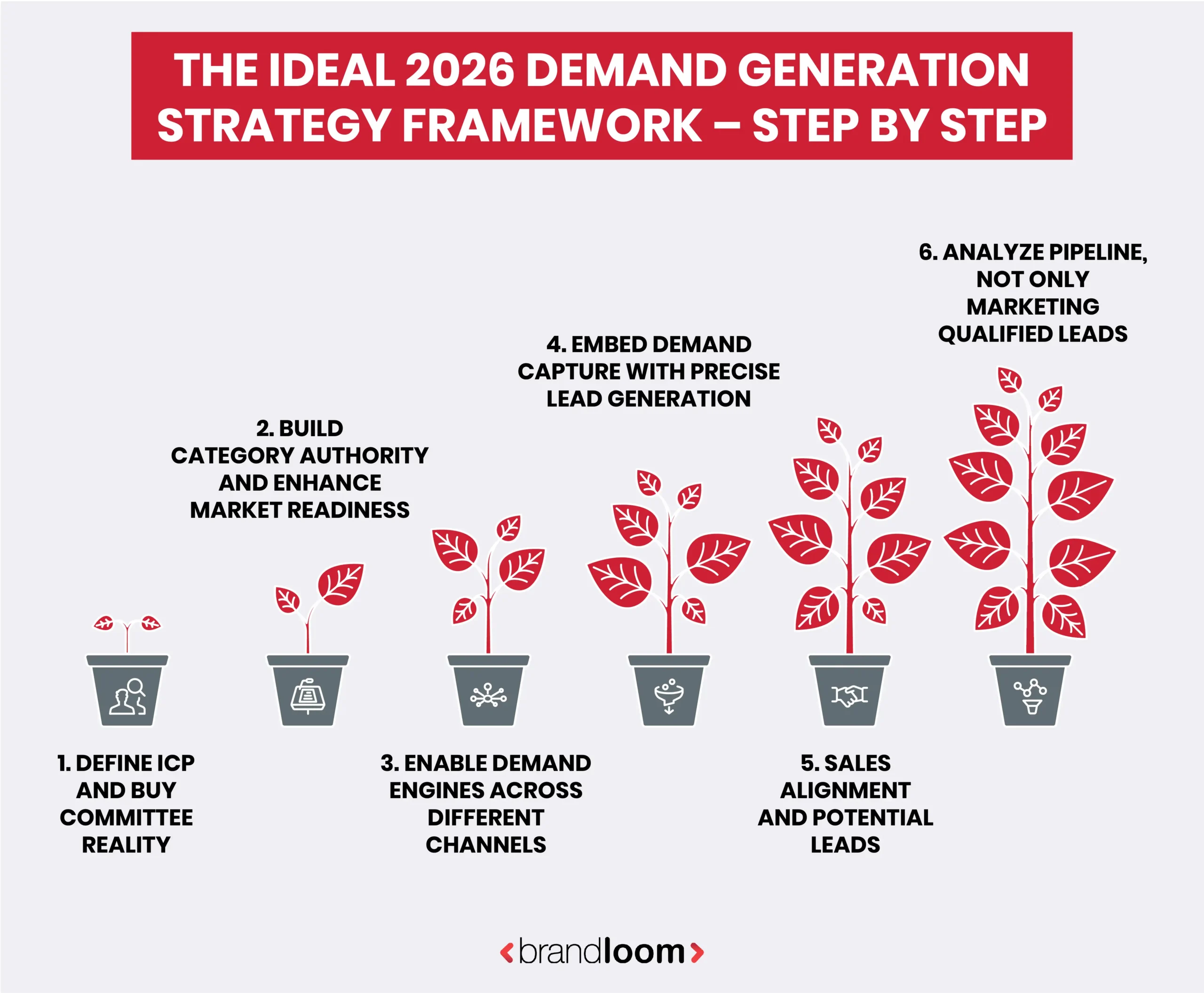
Step 1: Defining ICP and Buying Committee Reality
A successful demand generation plan must be precise and well-planned. At the beginning, you have to identify the following:
- Your Ideal Customer Profile (ICP)
- Key decision-makers and influencers
- What are the pain points at every stage of the buyer journey
- Budget authority and approval dynamics
Remember that in B2B marketing, purchases do not involve one person. Buying groups typically involve multiple stakeholders with different priorities. Your strategy must align with these dynamics. This is where lead scoring begins, at the targeting stage.
Step 2: Develop Category Authority and Increase Market Readiness
Before you can qualify leads, focus on demand generation for your brand. Here’s how you can build authority:
- Strategic content marketing efforts
- Founder-led presence in social media circles
- Sharing Industry insights
- Arranging educational webinars
- SEO optimization for discovery across top search engines and AI tools
Modern B2B buyers do extensive independent research before engaging in sales. Your content must shape perception early. This is a phase to focus on increasing awareness and positioning your product or service as a viable solution. Here, demand generation marketing is educational and not promotional.
Step 3: Activate Demand Engines across Several Channels
The reality is that demand is not created in any one channel. An effective strategy covers channels like:
- Organic search
- Email list building
- Social media engagement
- Industry alliances
- Paid awareness campaigns
- Community events
When your B2B demand generation strategy covers multiple touchpoints and channels, it improves recall and trust. Coordinated, consistent engagement across channels improves buyer journeys and conversion readiness.
Step 4: Integrate Demand Capture with Precise Lead Generation
At this stage, demand meets conversion. This is where you can use elements like:
- Optimized landing pages
- Case study downloads
- Account-based marketing
- Intent-based retargeting
Unlike standalone lead generation campaigns, demand capture is focused on converting educated prospects. Lead generation focuses on converting visitors, but demand generation ensures your site gets the right prospects.
Step 5: Sales Alignment and Qualifying Leads
Demand generation and lead generation must function in sync. Marketing qualifies leads using metrics like CRM insights, behavioral signals, content interaction data, and engagement scoring. Sales then focus on high-intent accounts.
The lack of alignment between marketing and sales remains a major drawback in B2B organizations. Clear qualification criteria lower friction and improve close rates.
Step 6: Measure Pipeline, Not Just Marketing Qualified Leads
Why do you think several marketing teams fail? They focus too much on vanity metrics like Downloads, impressions, and traffic.
The need to look into revenue metrics like Pipeline generated, Opportunity-to-close rate, and Revenue attribution is there, too.
In 2026, demand generation marketing needs multi-touch attribution and lifecycle assessment. It tracks how marketing influences opportunities, not the number of contacts captured. A successful strategy will connect customer awareness to revenue impact.
This framework works because the pipeline is not built at the landing page. It needs consistent education, structured qualifying leads, and multi-channel engagement. Traffic supports the system, and demand drives it.
To develop an effective strategy for B2B pipeline growth, your best ally is BrandLoom, the agency driving hundreds of startups and brands to success with its proven methodologies and expertise.
A Real-World B2B Pipeline Scenario – How Demand Generation Impacts Revenue?
Using frameworks can help your brand convert buyers, but pipeline impact is what matters.
Here, we will have a look at an example of a structured demand generation strategy changing the results in real-world B2B setups:
Think of a B2B SaaS Company with a stalled pipeline. They invested heavily in paid ads and gated assets and got good traffic. Their lead generation focused on demo sign-ups, but close rates remained on the lower side.
Why do you think this happens? The main reason is that prospects enter sales conversations without getting the full context. They know about the product features, but not the strategic value it brings.
When the brand switches to effective demand generation marketing, things change. Let’s see how:
- By publishing problem-led educational content
- By triggering LinkedIn thought leadership
- Creating an email list with structured nurture sequences
- Arranging for industry webinars
The result is a slight dip in demo requests but a visible hike in qualifying leads. When the buyers are more informed before contact, the sales velocity soars higher. McKinsey research data show that B2B buyers now use 10 or more interaction channels in their purchase journey and prefer independent research before sales engagement.
Demand generation aligns directly with this behaviour, and it is not meant only for inflating your traffic. The right B2B demand generation strategy, developed by veteran digital marketing agencies like BrandLoom, improves buyer readiness and lead quality. It also contributes to sales efficiency and makes pipelines predictable.
What are the Common Demand Generation Mistakes?
Unless you use your demand generation plan in the right way, it can stall your B2B pipeline growth. So, ensure you do not commit the following mistakes made by brands:
- Treating it as paid advertising – Running paid campaigns without authority building and foundational content marketing will only bring short-term spikes. Paid media without content and brand authority can’t create or sustain demand.
- Thinking of Lead Volume as Demand – Using lead generation for converting cold traffic will only bring you contacts. Without demand generation, there will be no readiness to buy.
- Overlooking the entire buyer journey – Several B2B teams focus on increasing awareness at the top-of-funnel or landing page conversions at the funnel’s end. The reality is that modern B2B buyers engage across multiple channels.
- Misalignment between Marketing and Sales – Demand generation and lead qualification should run together for better results. When these two are not aligned, marketing efforts will not add to the revenue.
To avoid the common demand generation mistakes and succeed in buyer journey mapping, choose BrandLoom,the digital marketing agency chosen by hundreds of brands in India and abroad.
How to Build a Scalable Demand Generation Strategy in 2026?
To develop a scalable demand generation strategy in 2026, you will need long-term thinking, discipline, and alignment. Think of it as an operating model- not a one-time campaign. Here’s how to approach it:
- Begin with ICP precision and define the ideal buyers. Think about the problems they face and the platforms they use to seek information. This is a must before choosing platforms or strategies.
- Your marketing efforts, like content marketing and paid campaigns, must align with pipeline outcomes. Set targets for Lead-to-opportunity conversion and Customer lifetime value.
- Integrate lead capture with demand generation by using shared awareness content and Intent-driven optimization. While Lead generation focuses on conversion, demand generation ensures those conversions are high-quality.
- Successful demand generation marketing does not bring success overnight. Authority and trust building takes time, and so does a customer relationship boost. So, focus on creating a sustainable pipeline.
To get more insight into how using apt marketing strategies brings exceptional B2B pipeline growth, check out the testimonials given by delighted BrandLoom clients.
Conclusion
In 2026, you need much more than standalone campaigns for success in B2B demand generation. You need an integrated system connecting strategy, execution, and revenue accountability seamlessly.
At BrandLoom, we offer structured, study-backed demand generation marketing for diverse clients. We start the journey with ICP clarity and buyer journey mapping. Subsequently, we use:
- Authority-driven content marketing to enhance awareness on AI platforms and search engines
- Social media positioning to consolidate brand recall
- Optimized landing page ecosystems for high-intent demand capture
- Multi-channel engagement to sync with different customer journey stages
- Lead scoring frameworks to enhance qualifying leads
We understand that demand generation and lead must function together, and sales alignment is integral to the process.
Traffic is easy to get, but Pipeline requires a solid architecture. You need demand generation strategies to build buyer readiness first, so that when your leads convert, they move closer to revenue.
FAQs
Demand generation in marketing denotes the process of creating awareness, interest, and trust in a product or service prior to customers showing willingness to buy. It does not focus only on lead capturing. It develops market readiness by educating audiences and shaping customer perception. This involves a mix of webinars, content marketing, social media, SEO, and thought leadership to help potential buyers realize their issues and available solutions. In B2B setups, demand generation aligns marketing and sales teams to nurture prospects through the customer journey stages. The target is B2B pipeline growth through awareness boost and preparing qualified buyers for engagement.
Demand generation and lead generation serve different needs, but they fall within a marketing strategy. The former focuses on creating awareness and educating the prospective buyers so that they recognize a problem and grow an interest in a solution. It works on the early stage of the buyer journey and helps develop trust and long-term interest in solutions. Lead generation focuses on capturing contact information from prospects who have already shown some interest in engaging or buying. This usually occurs through landing pages, gated content, or demo requests. In other words, demand generation creates interest and readies the market, and lead generation turns that interest into identifiable leads.
The most useful channels for B2B demand generation help educate potential buyers and develop credibility. Content marketing and SEO are a must as they help brands attract buyers actively seeking solutions. LinkedIn and other professional social media platforms are useful for targeted audience engagement and developing thought leadership. Through Webinars, podcasts, and industry events, brands can showcase expertise and engage with decision-makers. Email marketing helps them nurture prospects across the buyer journey stages. Solid demand generation strategies use multiplechannels to increase awareness, develop trust, and guide potential buyers.
Demand generation builds a pipeline by creating awareness and educating prospective buyers long before they reach the sales teams. Brands generate interest and attract buyers seeking solutions to their problems through social media engagement, targeted campaigns, content marketing, etc. When such prospects engage with educational resources and product insights, marketing teams look for signs of intent and start qualifying leads. Methods like Lead scoring, nurture campaigns, and targeted messaging help those prospects move through customer journey phases. So, when prospects reach the buying stage, they know about the usefulness of the product/service. This enhances lead conversion prospects.
The success in demand generation is assessed through metrics that indicate pipeline impact, market interest, and engagement. The major indicators are: the number of marketing-qualified leads (MQLs), pipeline value, and marketing-influenced revenue. You also have to look at factors like branded search volume, organic traffic growth, and content engagement. These signals indicate whether your marketing efforts are increasing awareness and wooing target buyers effectively. Several B2B teams also track pipeline conversion rates and deal velocity. This helps them realize how B2B demand generation tactics are working on the stages of the customer journey and adding to revenue.
Yes, demand generation is suitable for SaaS companies. This is because most SaaS purchases include research, comparison, and lengthy decision cycles. SaaS demand generation does not depend only on paid acquisition or short-term lead capture. It creates awareness and educates potential customers about the product and its advantages. Strategies include using thought leadership, educational content, webinars, product tutorials, etc., to develop trust and demonstrate expertise. This occurs before prospects begin the buying journey. This way, SaaS brands can shorten sales cycles, attract qualified prospects, and create a consistent pipeline of leads.
Demand generation is a long-term marketing strategy, so you can expect results to appear gradually. Most B2B companies spot early signs like increased awareness, website engagement, and content interaction. These may take 3 to 6 months on average. However, to experience B2B pipeline growth, you may have to wait for six to twelve months. The fact is that demand generation focuses on educating potential customers and developing trust across the customer journey. Marketing efforts cover content marketing, social media, SEO, and nurture campaigns. With time, prospects begin their journey through the funnel, moving to purchase decisions.
Content plays a major role in B2B demand generation strategies. It helps educate your target buyers and develop trust before they move to the buying stage. High-quality content helps brands explain industry challenges, present viable solutions, and guide prospects through the phases of the buyer’s journey. You can use diverse content like blogs, webinars, case studies, and educational videos to showcase brand expertise and increase service/product awareness. Content marketing also supports SEO and social media distribution. This way, brands get new audiences and can create demand. Content helps them offer useful insights consistently, leading to credibility and preparing potential buyers for engagement.
AI is transforming demand generation marketing by aiding marketing teams in data analysis, intent signal identification, and outreach customization. Modern AI tools like HubSpot, Google Analytics, 6sense, etc., can assess user behavior across websites, content, and campaigns. They can understand where prospects are in the stages of the buyer journey. This way, marketers can offer more relevant content, recommend the right product, and tweak marketing efforts. AI also enables predictive lead scoring, content optimization, and audience segmentation. These make B2B demand generation tactics more effective.
Companies should not choose one over the other, but there is no denying the significance of demand generation in the overall marketing roadmap. Demand generation helps create awareness and interest in the market. That helps target buyers understand a problem and think of available possible solutions. Lead generation focuses on converting that interest into identifiable prospects. It includes methods like landing pages, gated content, or demo requests. Investing only in lead generation without creating demand will bring your brand low-quality leads and poor conversion rates. A balanced approach will fetch your brand the desired output.