Why do several D2C brands stop growing after tasting initial success? You launch a few campaigns, tighten your targeting, and your creatives start performing well, with strong ROAS. Then, suddenly, things go downhill. The costs shoot up, performance dips, and the strategy once considered perfect starts to break down. You try tweaking creatives, hiking budgets, and new audiences – but growth seems elusive.
Your D2C brand needs a solid, customized performance branding strategy to resolve the stalemate.
With buyer acquisition costs rising across platforms and competition increasing, you can’t rely solely on paid media. According to McKinsey & Company research, brands are facing increasing challenges due to rising digital acquisition costs. The efficacy of these efforts is becoming unpredictable. Over-reliance on short-term performance metrics may weaken your brand growth prospects.
Most D2C brands continue to optimize for ROAS because it’s visible, immediate, and measurable. And that’s exactly where the problem creeps in. In a performance marketing-driven strategy, costly acquisitions, weak loyalty, and a lack of differentiation stall real-life growth. That is why performance branding for D2C companies is a must.
The next phase of D2C growth isn’t about choosing between brand and performance. Develop a system where both work in sync. Then your ads won’t just convert leads but will also create memories. Each customer interaction will enhance your brand positioning.
Solving this requires more than campaign optimization. It requires a well-planned, effective system. That’s where veteran digital marketing agencies like BrandLoom come in. Our marketing analysts and brand strategists can craft and implement the fitting integrated marketing strategy for your D2C brand.
What Performance Branding Really Means
Most D2C brands today focus mostly on performance-based marketing. Few are effective at brand marketing, and even fewer delve into performance branding. That is where the growth either compounds or stalls.
Let’s simplify it.
- Traditional branding helps create awareness, perception, and emotional connections over time. It is a long-term process, and measuring in real-time is tough.
- Performance marketing focuses on immediate results- like clicks, conversions, and ROAS. It’s meant for the short term.
- Performance branding strategy blends both. Here, every marketing activity drives measurable results while consolidating your brand identity.
According to Harvard Business Review findings, the most effective marketing strategies today combine brand building with performance marketing rather than treating them as separate methodologies.
Branding defines who you are, while brand building creates memory, user trust, and likings. Performance marketing helps capture demand, and Performance branding creates and captures demand within one digital ecosystem.
What are the Changes?
When your D2C brand switches to performance branding:
- Your marketing campaigns don’t just push offers—they strengthen positioning
- Your creatives carry a relatable identity
- Your social media marketing builds familiarity and trust
That is how modern consumer behavior works. Now, people don’t just purchase based on price or urgency alone. They buy from brands they recognize and trust. Data from Nielsen shows that a robust brand presence directly affects marketing effectiveness and conversion efficiency.
The Core Concept
Performance branding is not simply about adding branding to performance metrics. It’s about creating a marketing strategy where every conversion strengthens your brand. Over time, this strengthens your D2C brand positioning across AI search engines and paid platforms. You experience better recall and repeat purchases, and the need to rely heavily on ad spend goes down.
| Aspect | Traditional Branding | Performance Marketing | Performance Branding |
|---|---|---|---|
| Focus | Awareness & perception | Conversions & ROAS | Both brand + revenue |
| Time Horizon | Long-term | Short-term | Short + Long-term |
| Measurement | Tougher to track | Real-time metrics | Hybrid measurement |
| Messaging | Storytelling | Offer-driven | Identity + action |
| Outcome | Brand recall | Immediate sales | Sustainable growth |
The Hidden Cost of ROAS-Centric Growth
ROAS looks clean on a dashboard, but it hardly reflects the full story.
For most D2C brands, performance-based marketing becomes the default growth engine. Why? Because you get immediate feedback. Based on that data, you launch campaigns, track conversions in real time, and optimize what works. That feels efficient. Predictable. Scalable – up to a time.
Why Chasing ROAS Can Stall Growth?
Why do several D2C brands experience slower growth while chasing ROAS?
- Platforms like Meta and Google like short-term performance metrics
- Growth pressure makes teams focus on immediate results
- Dashboards reward quick wins, not long-term thinking
- Paid media becomes the preferred weapon
Such brands keep focusing on what they can measure, but it leads to a structural problem.
If your entire marketing strategy revolves around ROAS, there can be problems like:
- A creative fatigue sets in, and similar-styled ads stop working.
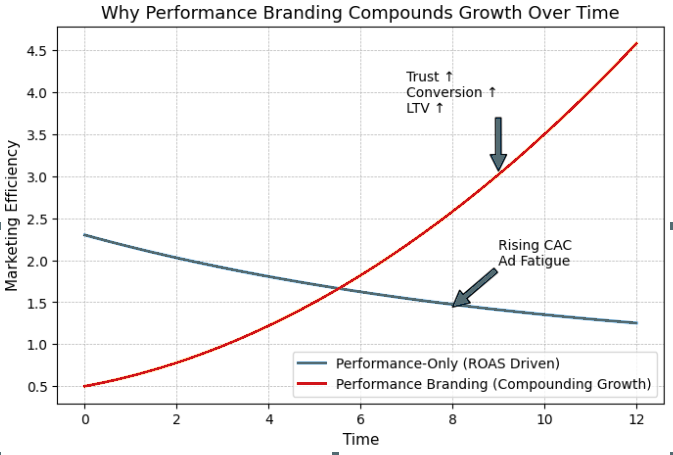
- The customer acquisition costs rise, and you spend more to get the same returns.
- Over time, your D2C brand loses its USP.
- Retaining customers can be a challenge.
The Discount Trap Effect
In a highly competitive market, D2C brands often rely heavily on discounts, limited-time offers, and freebies to retain customers. These tactics may help in short-termconversion optimization, but the downside is that buyers get habituated to incentives and lower prices.
Over time, you see your brand identity weakening and margins shrinking. The marketing campaigns do not bring desired returns anymore. It gets into a loop of diminishing returns.
The bottom line is ROAS optimization alone doesn’t build a brand. It creates a dependency cycle.
That is why you need a solid, research-backed performance branding strategy for your D2C business. Rely on BrandLoom, the agency with a consistent track record of developing killer branding strategies for high-profile clients, in India and abroad.
Brand vs Performance Is a False Choice
Most D2C brands still treat brand and performance as opposing forces. The former is seen as long-term and intangible, the latter as immediate and measurable. So budgets are split, and strategies are developed separately. However, it can be detrimental for a D2C Brand on a growth track.
You must understand that brand and performance are not competing priorities. They run on the same growth system but with different time horizons. While brand building shapes demand over the long term, performance marketing captures demand in the short term. Your D2C brand must seek brand and performance alignment in its marketing roadmap.
An HBR study indicates that when companies connect brand building and performance marketing, rather than managing them as separate functions, they achieve better results.
D2C Brands Leveraging Marketing & Branding Together
You can look at some examples of successful D2C-native brands adopting an integrated approach for brand marketing.
Gymshark is a bright example. They extend the brand identity beyond ads into events, physical stores, and community experiences. Strong community and clear positioning make performance marketing more efficient over time. They are not just selling apparel; they are creating an experience that buyers remember and cherish.
American eyewear brand Warby Parker told investors that investments in products, customer experience, and community building increase brand loyalty, expand customer lifetime value, and lower customer acquisition cost. They tasted success in using marketing & branding in an integrated manner.
When your D2C brand identity is not strong, performance marketing will struggle to deliver consistent results. With better brand and performance alignment, conversions repeat, and revenue shoots upward.
Why Do D2C Brands Need Performance Branding More in 2026?
For D2C brands, the shift is even sharper.
Earlier, you could scale by simply creating better ads. To experience growth, using powerful creatives, sharp targeting, and consistent optimization was enough. That is no longer the case now.
You will see most D2C brands relying on similar marketing campaigns across online platforms. The similarity in influencer formats and UGC-style creatives is noticeable. That leads to feed saturation and the USP gets weak.
Additionally, acquisition has become more expensive. With rising competition across social media marketing and search engines, brands are spending more for visibility. Rising acquisition costs and fragmented data signals have made digital growth less predictable and harder to scale.
Why D2C Brand Growth Stops Compounding?
When D2C brands optimize for short-term performance, the growth is limited. There are weekly campaigns, and creatives are assessed by immediate conversion.
Without a strong brand identity, every campaign has to re-earn attention, clicks cost more, and performance relies on constant spend. D2C brands must understand changing consumer behaviour to develop brand and performance marketing strategies.
Your customers don’t just respond to offers; they prefer familiarity, consistency, and perceived value. This is more applicable in segments like skincare, apparel, and supplements, where similar offerings make buyers seek emotional connections and brand recall. So, branding directly improves performance efficiency.
The D2C Advantage- Better Control Over Customer Journey
D2C brands have one major advantage in shaping the customer journey. From ad to website, and from buying to retention, they have control over the phases. As a D2C brand owner, you can access first-party data through CRM systems and customer data platforms.
Here, branding is not limited to ads. It is shaped through elements like product packaging, website/app experience, communication, etc. Every touchpoint contributes to brand building. In 2026, the most successful D2C brands are the ones seeking brand and performance alignment, not those spending the most.
To develop a powerful D2C brand performance strategy, you should seek guidance from the branding and marketing agencies with a pioneering approach. BrandLoom’s expertise in crafting effective marketing & branding solutions for clients in diverse niches is what you need.
Naturaltein Case Study Snapshot: Performance Branding as a Growth System
Naturaltein is an ideal example of how performance branding delivers results when executed as a system. The brand was struggling with static sales and a subdued digital presence and their paid campaigns did not bring much results. BrandLoom came up with an integrated strategy involving conversion-oriented website enhancements, influencer trust, social engagement, search visibility, paid acquisition, email retention, and a clear, premium brand narrative. The result was a staggering 18.6 ROAS, 5X sales, and 4X traffic – all within 10 months.
The takeaway is clear: when D2C brands align identity, acquisition, and retention, performance becomes stronger and sustainable.
The Performance Branding Strategy Framework for D2C Brands
Performance-only growth creates volatility, while performance branding helps create a structure. Your D2C brand must focus on developing a connected marketing system where every touchpoint contributes to both short-term performance and long-term brand growth.
Here’s an in-depth look at the performance branding strategy for D2C brands:
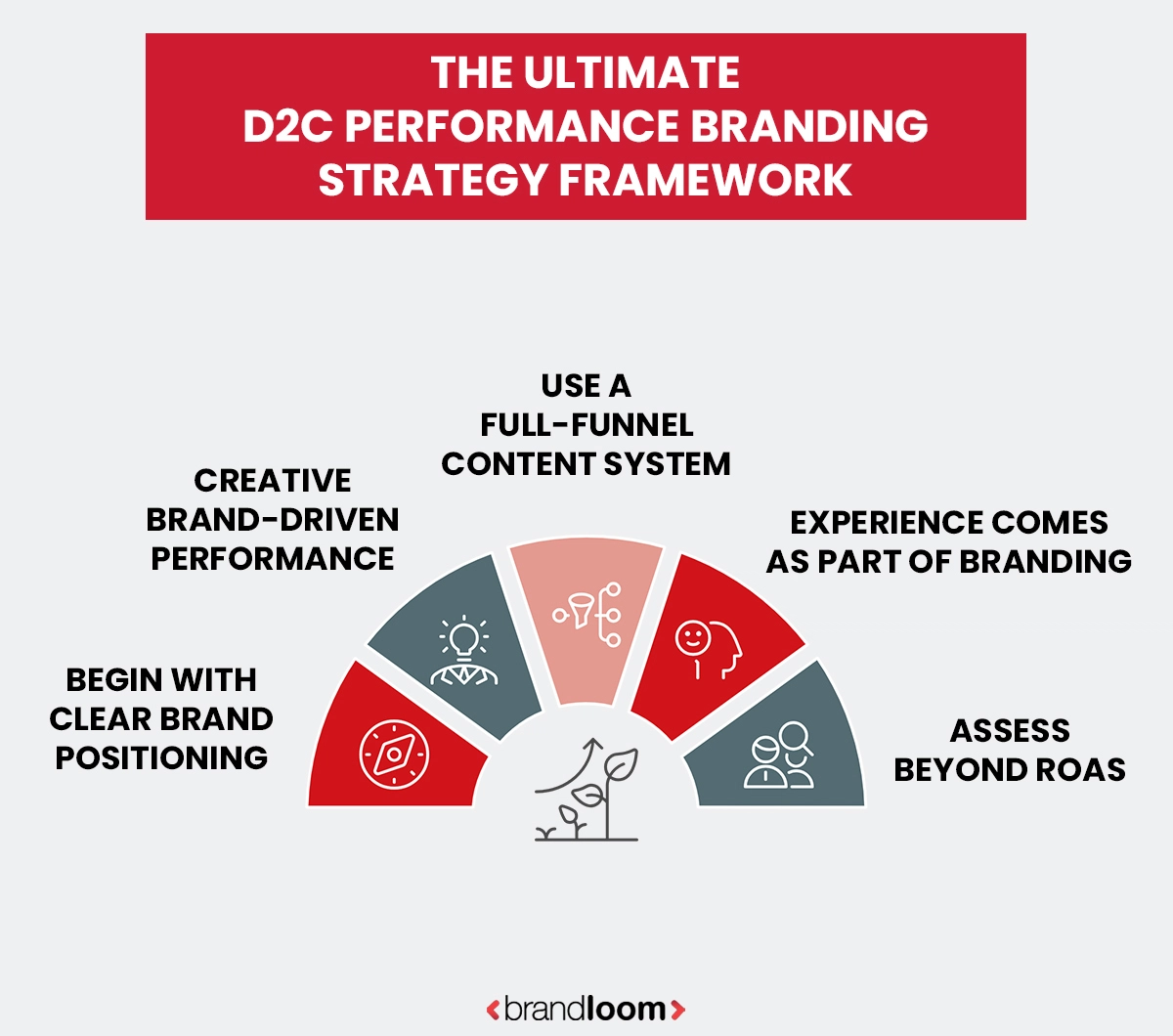
1. Start with Clear Brand Positioning
The foundation for any marketing & branding activity must be clear. You should be clear on – who you serve, what you stand for, and why you’re different.
In the crowded D2C segment, functional differences are often minimal, but brands that position themselves uniquely race ahead. A strong branding strategy ensures:
- Your brand is recognizable across channels
- Your value is clear
- Your communication is consistent
Without these, performance marketing becomes generic—and costlier.
2. Creative Brand-Led Performance
In a performance branding system, creatives are not only conversion tools. They serve as your brand-building assets. From UGC to product storytelling and founder-led content, design your ads on identity development, not just lucrative offers.
This is more applicable to social media marketing, where short-attention span users scroll fast. The first few seconds should clearly signal who you are, not just sell products. Over time, it develops familiarity, affecting conversion efficiency directly.
3. Create a Full-Funnel Content System
Several D2C brands focus much on bottom-of-funnel campaigns, but the truth is that not all customers are ready to buy immediately. A strong performance branding strategy deploys content using a full-funnel marketing roadmap:
- Top funnel → awareness and brand narrative
- Mid funnel → trust, differentiation, and education
- Bottom funnel → conversion
This way, your marketing campaigns not only capture demand but also generate it.
4. Treat Experience as Part of Branding
Brand development needs experience, apart from ads. For D2C brands, this includes:
- product packaging
- website UX and messaging
- post-purchase communication
- customer support
Since you control the full buyer journey, a single interaction becomes part of your brand. Maintain consistency across these touchpoints to develop trust and strengthen emotional bonds.
5. Measure Beyond ROAS
ROAS alone cannot define growth. So, D2C brands must mix short-term and long-term signals.
- Short term: ROAS, CAC, conversion rate
- Mid-term: branded search, direct traffic, returning users
- Long term: LTV, repeat buying rate, organic revenue share
That’s why they need a customer data platform for gathering data and enabling continuous improvement across channels. Businesses that link brand metrics to performance outcomes usually make better strategic decisions than peers who rely on isolated metrics.
So, performance branding for D2C brands is about designing a system where both brand and performance reinforce each other, bringing sustained growth.
How Do D2C Brands Balance ROAS and Branding?
A D2C marketing strategy only works when execution is aligned. Those over relying on short-term performance and treat branding as a separate strategy experience slower growth.
Successful D2C brands blend marketing & branding, always.
1. Balance Your Budget, Not Only Campaigns
Rather than focusing solely on conversion, split spending like:
- Keep ~60–70% for performance-based marketing
- Keep ~30–40% for brand marketing
This brings quick sales, and brand awareness develops gradually.
2. Make Creatives Cater to Both
Winning D2C brands don’t separate “brand” and “performance” ads. Instead, they create assets that convert, develop recall value, and stay consistent across campaigns. For instance, bOat touched success by mixing strong visual identity with high-octane performance campaigns.
3. Connect Data Across the Funnel
D2C brands have access to rich first-party data, but not all of them utilize it. When you integrate data from CRM, website, and campaigns, you can track signals like branded search, direct traffic, and repeat visits.
These show how branding can improve performance over time.
4. Build Retention into the System
Acquisition alone can cost your D2C brand a lot, so focus on improving retention. Look at how Mamaearth succeeded by blending performance acquisition with strong retention loops – content, consistency, and consumer experience. That’s how performance branding compounds growth.
Mistakes to Avoid when Framing a D2C Brand Performance Strategy
Several D2C brands fail not because they lack effort, but because of a misaligned marketing strategy. Here are the key mistakes they commit:
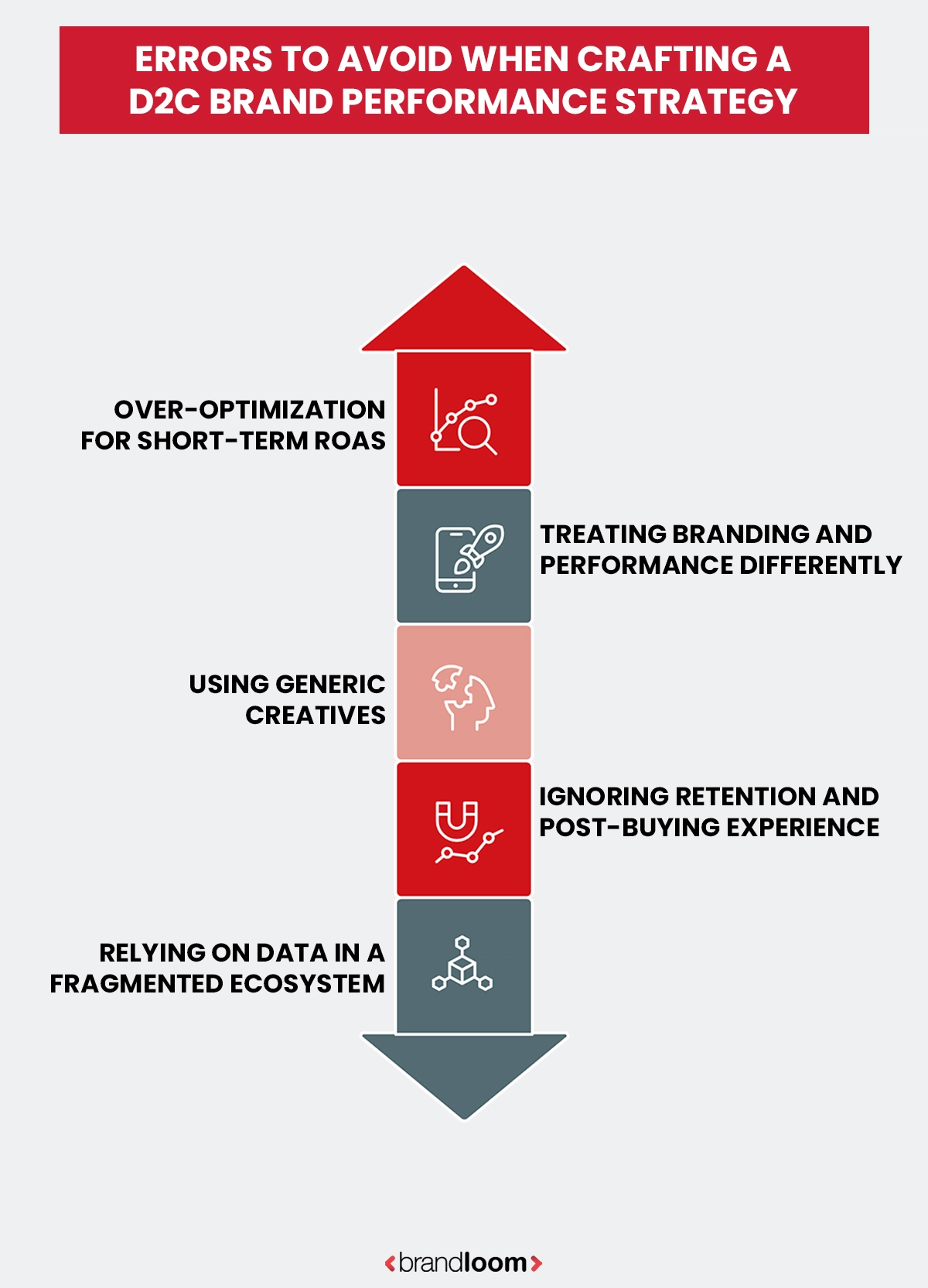
1. Over-Optimizing for Short-Term ROAS
If you treat ROAS as the only success metric and exclude things that don’t convert immediately, like storytelling and brand campaigns, it weakens long-term and sustained performance. Your D2C brand experiences stilted growth, rising CAC, and reduced recall.
2. Treating Branding and Performance Separately
Those treating brand and performance marketing strategies separately create inconsistent messaging across marketing campaigns. Then their ads can’t reinforce identity, and the impact is reduced.
3. Generic Creatives
D2C brands using generic creatives seem uninteresting and repetitive. Buyers develop ad fatigue, and the engagement rate nosedives. Without a strong brand identity, creatives can’t produce long-term impact.
4. Overlooking Retention and Post-Purchase Experience
D2C brands thatfocus only on acquisition and overlook retention deal with increased CAC pressure and struggle to achieve sustained growth. Treating post-purchase experience as part of your branding strategy is a must.
5. Using Data in a Fragmented Ecosystem
Some D2C brands rely on fragmented data and last-click attribution to make decisions. Overlooking broader indicators like branded search and repeat behavior leads to incomplete decisions.
What do all these mistakes point to? When brand and performance alignment are not right, growth and retention become inconsistent.
To avoid critical mistakes in brand and performance marketing strategy development, you need an expert ally. BrandLoom fits in with its decade-plus experience in crafting and implementing marketing & branding strategies for a myriad of clients.
Conclusion
D2C growth is no longer driven solely by ads. With growing CAC, evolving consumer behavior, and platform saturation, you can’t count only on short-term performance campaigns. Plan to compound what is scaling today.
The shift is real:
From isolated marketing campaigns → to integrated systems
From conversions → to long-term brand building
From spend-driven growth → to efficiency-driven growth
That is why your D2C brand must focus on brand and performance alignment.
At BrandLoom, we work with different D2C brands to bridge the void between brand and performance marketing. Our digital marketing experts create an apt customer retention marketing strategy for your business. We help you integrate branding with performance in a way that brings both tangible, immediate results and long-term efficiency and growth.
FAQs
Think of Performance branding as an effective and unique marketing approach that blends brand building with measurable performance outcomes. It does not treat branding and performance as separate efforts but integrates both into a single system. As a result, each marketing activity contributes to immediate results and long-term growth.
So, your ads don’t just drive clicks; they also help build a solid brand identity, recall, and trust. This eventually improves conversion rates and retention, and lowers acquisition costs. It changes the concept of performance marketing vs brand marketing into one integrated marketing & branding strategy.
Performance marketing focuses on short-term results- with metrics like clicks, conversions, and ROAS getting the spotlight. It relies a lot on targeting, optimization, and real-time campaign tweaking for immediate outcomes. While performance marketing delivers quick results, a performance branding strategy enables brands to compound those wins consistently. It aligns creative, messaging, and the customer experience for efficient, sustained growth.
In other words, performance marketing drives sales while performance branding creates a sustained system that scales the outcomes.
Brand equity directly affects the growth of a D2C brand. In crowded categories, products are often similar, making things tough for such brands. What attracts and retains the buyers is trust, recall, and perceived value. Strong brand equity makes target buyers more likely to click, convert, and return. This way, brands need to rely less on paid ads.
Brand equity also enhances the major metrics over time: lower CAC, stronger retention, and higher conversion rates. Brands with higher equity generate better long-term ROI since they have no need to “re-sell” themselves in every campaign. For D2C, brand equity becomes a core growth asset.
To balance brand building and ROAS, D2C brands need an integrated marketing & branding strategy, not separate ones. D2C brands should allocate budgets across both, usually a mix of brand-led initiatives and conversion-focused campaigns. However, they must ensure that performance campaigns also build brand image through consistent storytelling, messaging, and visuals.
Over time, these brands should track both short-term metrics (ROAS, CAC) and long-term signals like branded search, repeat orders, etc. Companies that align brand and performance measurement witness stronger, more sustainable growth. D2C brands seeking brand and performance alignment will gain from seeking the expertise of BrandLoom, the agency consistently winning accolades from clients in India and abroad.
Brand equity isn’t measured by a single metric; you need to use specific behavioral and perception signals to assess it. The major metrics are returning users, branded search volume, and direct traffic. These nuances show how often customers actively seek the brand. Also, the engagement metrics in social media marketing reflect brand recall and relevance. Strong brand equity is visible in higher conversion rates and a boost in repeat purchases. For more in-depth tracking, D2C brands can use customer sentiment analysis and brand growth reports.
Performance marketing alone can not bring your D2C brand long-term growth. It does bring quick conversions and short-term scaling. However, for long-term efficiency, it falls short. With growing competition, D2C brands relying solely on performance face growing CAC and reduced returns. Without brand equity, every campaign must re-acquire attention from scratch. On the contrary, when you mix brand marketing and Performance marketing, the result is enhanced recall, trust, and conversion efficiency. As mentioned by McKinsey & Company findings, mixing short-term and long-term strategies fetch sustainable growth.
Brand storytelling improves conversions by giving consumers reasons to care and think, not just buy a product. In the D2C segment, products are often similar. Brand storytelling helps communicate the values, relevance, and USP of the brand. This creates familiarity and trust, and at the buying stage, friction is reduced. When there is a solid brand story, customers respond to meaning and connection rather than checking only price or features.
Over time, consistent storytelling enhances brand recall. So, customers are more likely to make repeat orders in the future. Emotionally connected customers convert at higher rates. Effective storytelling can convert attention into buying intent, and that changes into action.
Performance branding works great on platforms offering both scale and storytelling. Meta and YouTube are just right for it. You get to reach with creative flexibility there. These channels are great for awareness development and conversion growth, too. Search engines help capture high-intent demand, more so when your brand recall is strong.
D2C brands must utilize owned channels like websites, email, and CRM flows to reinforce messaging and improve retention. The main thing is applying your branding strategy consistently across all touchpoints for both performance and long-term brand building.
Performance branding helps reduce CAC by improving the conversion rate. For a familiar and trusted brand, users need fewer touchpoints before making a decision. This paves the way for better CTR and conversion rates and reduced dependence on aggressive targeting.
Strong branding increases direct traffic and branded search, both serving as lower-cost acquisition channels. Campaigns that achieve brand and performance alignment often deliver stronger ROI. This is because they make future campaigns more effective. With performance branding for D2C, you don’t have to “reintroduce” your brand.
D2C brands are investing more in brand marketing because focusing only on performance is becoming less effective. Growing competition, higher ad costs, and platform saturation make using performance marketing less viable. With customer acquisition turning costlier, brands are now focusing on developing a brand awareness strategy.
Brand marketing helps your D2C brand stand tall in a crowd of competitors, build emotional connections, and increase recall. These factors directly affect conversion and retention. Industry insights indicate that companies integrating brand and performance marketing strategies achieve sustainable growth.