
Imagine if you could double your marketing ROI without having to double your own efforts.. Well, is this too good to be true? Think again. Studies found that organizations that use AI in their advertising campaigns receive an average of 76 percent ROI growth against traditional methods.
In the current fast-paced digital market, where performance marketing campaigns play a critical role in business, the use of AI is no longer a privilege but a necessity to sustain competitive advantage.
Performance marketing is a promotional strategy that is outcome-oriented towards clicks, leads, and sales. This is being redefined through artificial intelligence, which has redefined the ability of marketing teams to make faster, innovative, and data-based decisions.
AI enables performance marketing initiatives both to increase conversion rates and to drive higher ROI: through generative AI in creating engaging content and predictive AI in forecasting trends.
Learn more about the successful campaigns from our experts through BrandLoom’s performance marketing insights, the leading AI marketing firm in India.
This article will explore the advantages, technologies, and best practices of including AI in your performance marketing. You will get to know how innovative brands are leveraging AI to produce campaigns that resonate, convert, and perform with great frequency in all aspects.
What is Performance Marketing?
Performance marketing is an outcome-based strategy to online advertising. Brands only pay when they achieve a specific action, such as a click, a lead, or a sale. This model would ensure that every activity in marketing would be measurable and quantifiable in terms of ROI.
Basically, it guides decision-making through data analysis and the performance metrics of its marketing campaigns. Marketing teams monitor results, measure in real time, and optimize rapidly. Artificial intelligence optimizes performance marketing by increasing the target and conversion rates in ads.
Through this, enterprises can develop campaigns that will appeal to the target audiences. This renders performance marketing as an intelligent and cost-efficient tactic by brands that aspire to expand at optimal efficiency.
How AI Transforms Performance Marketing
AI alters the style of performance marketing campaigns by brands. It employs machine learning, enabling it to process large quantities of data quickly. AI enhances ad targeting to reach the right audiences.
AI in performance marketing makes bidding adjustments and content creation automated, resulting in improved engagement. Furthermore, Generative AI makes messages and product recommendations specific.
AI tracks the advertising campaigns online and improves conversion rates. It informs the marketing departments to make data-driven decisions to create an effective market strategy.
Artificial intelligence forecasts tendencies, so the brands stay ahead of the competition.
With the invention of AI, companies create campaigns that resonate with their target audience and give them a better ROI. AI enhances the innovative and efficient performance marketing.
Overall, with the help of AI technologies, it takes only a few seconds to process massive datasets and use this data to create more targeted ads, identify the best combination of budget items, and make any interactions with a customer more personal.
This denotes the timing, content, and delivery of the right message to the right target audiences.
Benefits of Using AI in Performance Marketing Campaigns
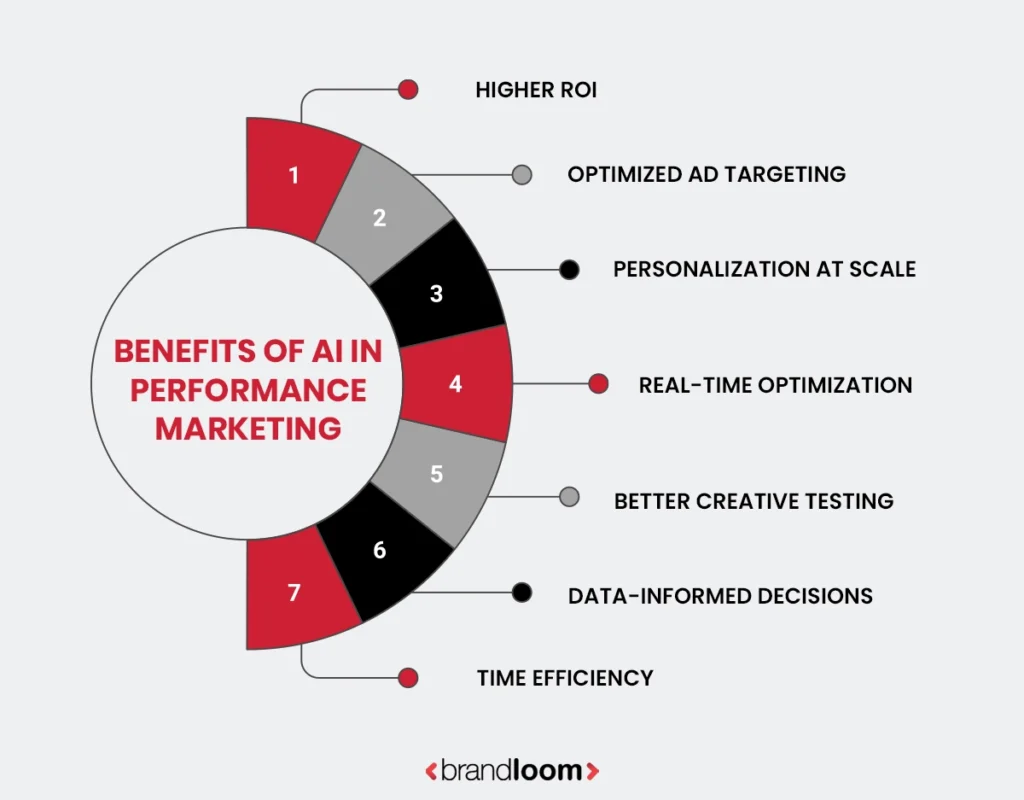
AI makes the performance marketing campaigns faster, accurate, and intelligent. It aids marketing teams in making informed decisions using data in order to maximize ROI.
AI allows enhancing ad targeting, converting more customers, and personalising the customer journey.
It enables real-time marketing adjustments. This will make marketing activities target the channels and audiences that are successful.
Through real-time learning, AI also assists in structuring campaigns that resonate with their targeted audiences and lead to ever-increasing improvements. It allows brands to stay competitive by updating their activities to appeal to consumers and market trends.
AI also reduces guesswork. Generative AI makes content that resonates with target customers. Predictive analytics estimates trends and directs future campaigns. Through AI, businesses in the competitive world will be able to overpower their competitors.
Key benefits include:
- Improved ROI – Spend on high-performing ads and channels. Do you know that big companies like Coca-Cola are using AI-powered analytics to optimize their ad placements? It saw an impressive rise in engagement.
- Optimized Ad Targeting- creates the right message to the right people at the right time.
- Personalization at Scale – Rich product recommendations and messages.
- Real-Time Optimization – Bids, creatives, and placements may be adjusted in real-time. The company that comes to mind while we talk about real-time optimization is Netflix. They use AI to enhance promotions and make relevant recommendations in real time.
- Better Creative Testing – AI analysis may assist you in determining what is most quickly performed.
- Data-Informed Decisions – Utilizing insights will help in more effective marketing strategies.
- Time Efficiency – Automate activities and focus on development.
AI helps brands develop campaigns that drive relevance with their target audiences, engagement, and maintain a competitive advantage in performance marketing.
BrandLoom actively deploys AI in performance marketing strategy. Our performance marketing experts demonstrates this in practice by showing how AI delivered a 400% increase in ROAS for Ashley Stewart.
Tools to Automate Performance Marketing Using AI
It is easy to incorporate AI in performance marketing by using appropriate tools. They are time-saving, more effective at targeting ads, and can help to increase the conversion rates.
The information is examined by AI means, the marketing is streamlined, and the interaction with the customers is individualized. Instead, they help marketing teams make data-driven decisions and streamline marketing strategies within a relatively short time.
BrandLoom highlights AI-driven eCommerce personalization that enhances campaign efficiency.
Machine learning is being utilized in many platforms to provide product recommendations, generate automated content, and track in real-time. The selection of tools will help a company make sure that marketing effortsare concentrated on what works.
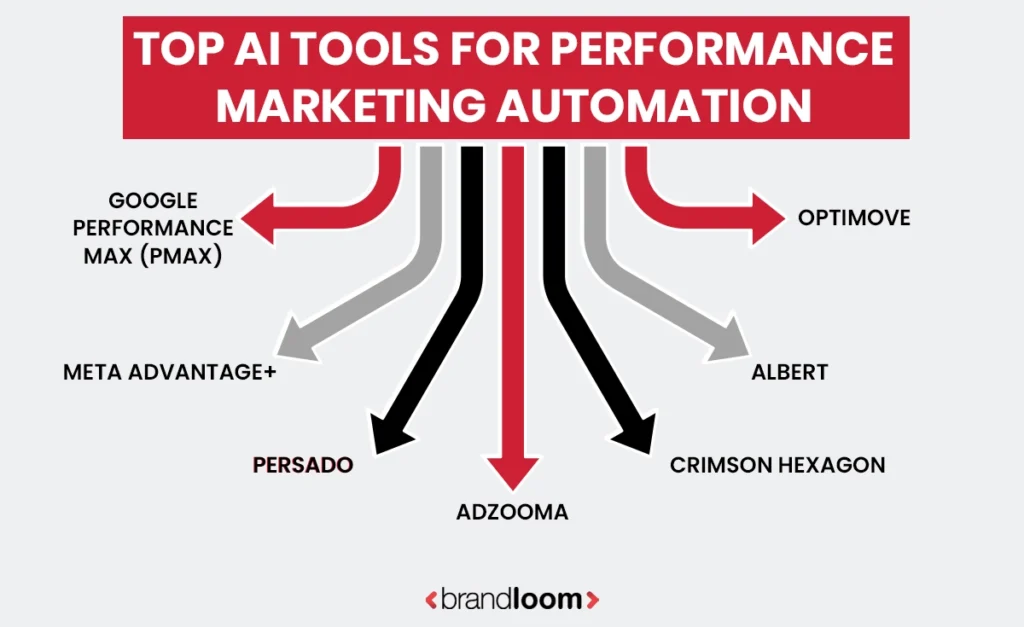
Popular AI tools include:
Google Performance Max (PMax)
A type of AI-led campaign, which automatically streamlines ads in all Google platforms, including Search, Display, YouTube, Gmail, and Discover. It applies machine learning to allocate budgets, test creatives, and target audiences based on conversion goals, ensuring the highest reach and performance with the least amount of manual effort.
Meta Advantage+
An Instagram and Facebook optimization suite powered by AI. It simplifies targeting, creative experimentation, and budget allocation by leveraging the vast user data provided by Meta.
Predictive audience insights help marketers to automatically test A/B, deliver ads to specific users, and achieve better ROI.
Persado
It uses Generative AI and natural language processing (NLP) to create emotionally and persuasively written ad copy.
It breaks down the psychology of the audience and identifies which words, tones, and emotional appeals engage them the most, so messaging becomes very focused and conversion-driven.
Adzooma
A Google, Facebook, and Microsoft Ads automation platform. It offers AI suggestions to enhance the relevance of ads, quality scores, and bidding strategies.
Adzooma also supports small businesses with an easy-to-use dashboard, an affordable campaign health check, and opportunities to save money.
Crimson Hexagon
Expert in AI-based social listening and viewer insights. It tracks discussions on social sites, trends, customer opinion, and brand perception. This allows marketers to customize campaigns in real-time and in response to competition.
Albert
A multi-channel campaign manager built on a fully autonomous AI marketing platform. It carries out its own campaigns, such as media purchases and cross-channel optimization.
It allows marketers to scale their campaigns cost-effectively, with Albert constantly learning and adapting to audience behavior.
Optimove
Improves the customer experience through data analysis to trigger a personalized engagement with customers. It predicts customer behavior, segments customers, and organizes cross-channel promotions.
Effective marketers rely on Optimove to optimize retention, customer lifetime value (CLV), and performance measures.
Combining these tools, the brands will have the chance to automate necessary processes, improve their work, and create campaigns that will attract their identified audiences without lagging behind others.
Leveraging Machine Learning in Ad Targeting
Machine learning and marketing complement one another in enhancing the performance of advertisement campaigns running on performance marketing. It analyzes vast amounts of data from customers through mathematical formulas.
It finds patterns in behavior, preferences, and purchase history. This enables the marketing teams to connect with the accurate target audience.
AI-powered targeting reduces wasted spend. ML delivers ads to people most likely to convert. It improves conversion rates and strengthens marketing strategies. It also makes sure that they market high-value customers. Our experts at BrandLoom share AI-based digital marketing insights as examples of AI in action.
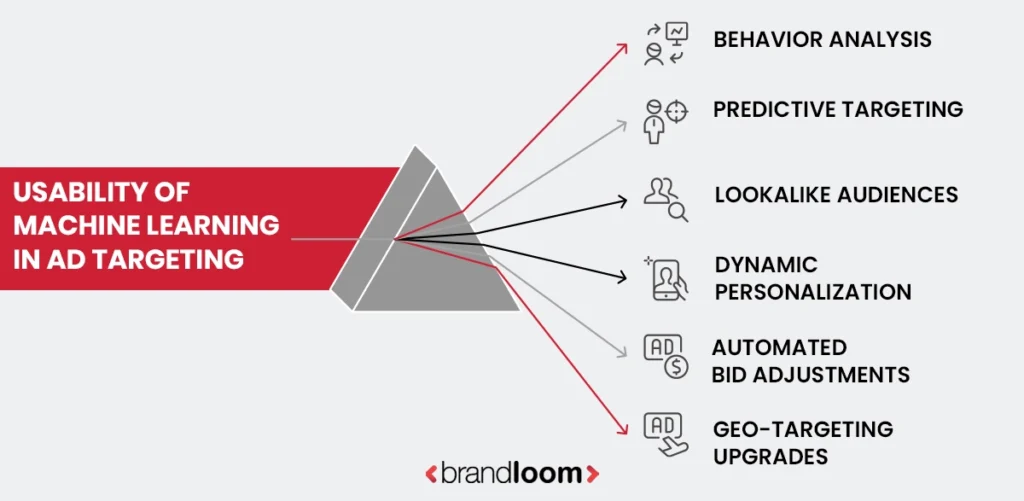
Key uses of machine learning in ad targeting include:
Behavior Analysis
- Machine learning monitors and measures customer engagement with the content, websites, and products. It assists in determining the browsing pattern, time taken on the pages, purchase intentions, and drop-off points.
- Indicatively, Amazon also relies on behavior analysis to improve its recommendation engine and displays products that align with browsing and purchase history.
Predictive Targeting
- Through the analysis of previous data and customer trends, AI can understand which audience groups are most likely to respond positively to specific campaigns. This saves on wasted advertisement expenses and boosts the conversion rates.
- An example is Netflix, which applies predictive targeting to recommend shows to users. Advertisers on the Google Ads platform also use predictive models to estimate the likelihood of a user clicking on an ad.
Lookalike Audiences
- Machine learning generates new consumer groups that are more similar to the already existing high-value customer groups. It is a way of increasing coverage and being relevant.
- The Lookalike Audience feature of Facebook Ads is a good example: when a brand has a loyal group of customers, it can target other users who are statistically more likely to be interested.
Dynamic Personalization
- AI enables real-time personalization by offering tailored recommendations, discounts, and content based on individual behavior.
- For example, Spotify provides personalized playlists like Discover Weekly, while e-commerce stores like Zalando dynamically display product recommendations aligned with each shopper’s browsing patterns.
Automated Bid Adjustments
- AI models utilize a range of factors to automatically adjust ad bids, including time of day, device type, location, and competition. This provides the best budget allocation and ROI.
- The innovative bidding feature of Google Ads is one of the most well-known applications, as bids are automatically lowered or raised based on the conversion rate or conversion value.
Geo-Targeting Upgrades
- Machine learning optimizes location-based targeting by analyzing regional demand, customer density, and customer behavior patterns. Companies can perform hyper-local campaigns with high accuracy.
- An example is Starbucks targeting mobile app advertisements at customers when they are in proximity to a store, resulting in immediate foot traffic.
All in all, brand advertising using machine learning can help customise the ads to the desired viewers through AI and machine learning in ad targeting. They can react quickly to market opportunities, make decisions based on facts, and stay competitive in the digital advertising space.
AI for Real-Time Marketing Performance Tracking
AI enables marketing teams to monitor performance marketing campaigns in real time. It collects and analyzes data instantly. This assists brands in the rapid response to fluctuations in consumers’ behaviour.
AI enhances conversions and heightens the efficiency of marketing strategieswithout any delays. As per the marketing gurus at BrandLoom, AI-enabled targeted campaigns can increase revenue by 18%.
Businesses can understand the most effective ad performances and those that need improvement through AI. Data-driven decisions at BrandLoom replace guesswork. Using AI tools helps to identify weak performance in marketing activities and propose improvements.
This will ensure that there are campaigns that will connect with their audiences and deliver a good ROI.
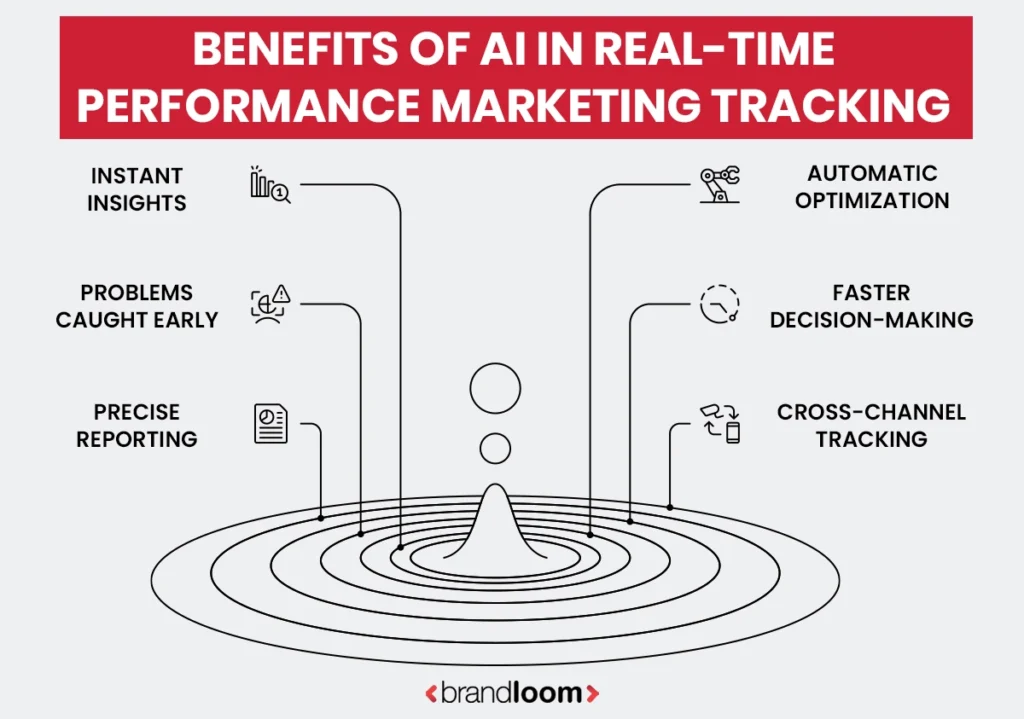
Advantages of AI in real-time tracking include:
Instant Insights
- AI gives access to real-time campaign statistics instantly. Marketers are no longer waiting until the end of the day to get reports. Instead, they will be able to check the live performance and change it instantly.
- Google Analytics 4 is an example of a tool that provides real-time analytics on user behavior across devices.
Automatic Optimization
- AI alters offers, creatives, and targeting in real time. This means that the advertisements will be delivered to the appropriate audience at the proper time.
- Consequently, this makes campaigns more effective and efficient. Google Ads Smart Bidding and similar platforms utilize this feature to maximize the number of conversions automatically.
Problems Caught Early
- Artificial intelligence can identify low-performing ads before they burn money. By identifying malpractices early, campaigns avoid spending money on useless endeavors and channel funds towards other areas that are doing well.
- For example, NERD or Adobe Sensei can identify poor-performing creatives promptly.
Faster Decision-Making
- AI can react to the market trends fast when they occur. Marketing can adjust strategies in real-time, providing a competitive advantage. This speed plays a crucial role in flash sales, seasonal promotions, and viral marketing.
Precise Reporting
- AI dashboards deliver precise business-oriented measurements. Marketers are not required to leaf through mountains of data, but they are provided with accurate information about what to do.
- AI-powered summary tools such as HubSpot and Salesforce Einstein make the reporting process easier.
Cross-Channel Tracking
- AI aggregates data from multiple platforms and presents it in a single, real-time perspective. Advertisers can see the overall picture of the work in Google, Meta, LinkedIn, and so on.
- For instance, applications such as Supermetrics or Datorama consolidate campaign-related information into a single dashboard, making it easier to analyze.
Hence, real-time tracking enabled by artificial intelligence will help brands gain efficiency and maximise their efforts to remain competitive. It makes sure that all the marketing budget is spent where it will be the most effective.
Improving Ad Performance with AI Analytics
AI analytics assists brands in accessing the complete potential of performance marketing campaigns. It works on enormous data to discover trends that people might miss.
The result of this is that data-driven decisions are made and used to enhance targeting of ads, conversion rates, and marketing strategies.
AI analytics enables marketing departments to A/B test many copies of their ads. They can know what is more convenient for their target audiences.
According to AI, trends are highlighted, future work is predicted, and guidance on the content creation and product suggestions is provided. This keeps marketing activities centered on the strategies that will yield the maximum returns.
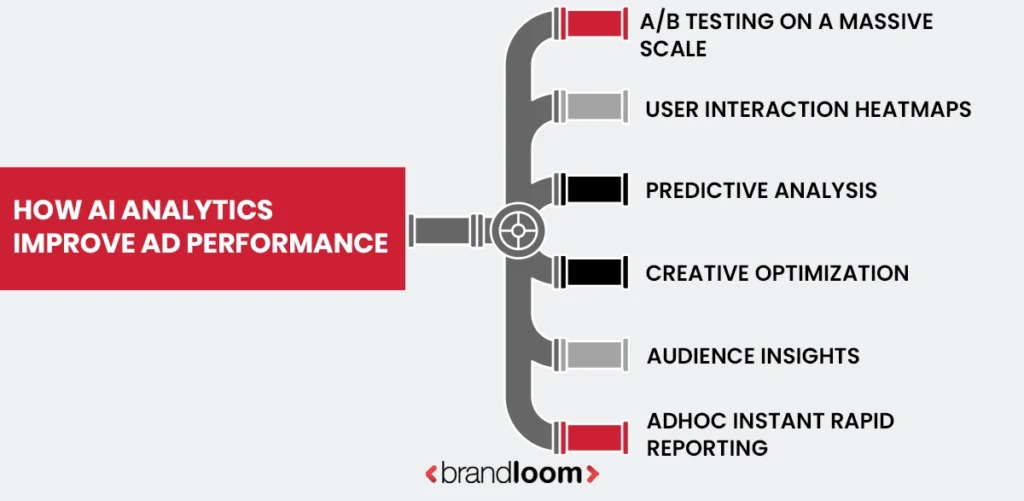
Ways AI analytics improves ad performance:
- A/B Testing on a Massive Scale – Start comparing many ad bytes and formats. As an example, an e-commerce brand can experiment with several banner ads simultaneously and identify the most successful in a few hours.
- User Interaction Heatmaps – Record interaction with ads and landing pages. Monitor user clicks, scrolls, or pause points of advertisements and landings. This can help you know more about patterns of engagement. Next, make layouts as conversion-maximizing as possible.
- Predictive Analysis – Forecast which ads will perform best. An example is when a travel company can determine which holiday package advertisements will yield the maximum bookings.
- Creative Optimization -Optimize for an impact on headlines, graphics, and CTAs. Automatically adjust headlines, graphics, and CTAs. The AI tools produce more than one creative output and optimise for more engagement. This is time-saving and improves uniformity.
- Audience Insights– ID new groups and hone the target audiences. AI divides the audience through behavioral, demographic, and purpose segments. Consequently, advertisements are shown to individuals who are more likely to make a purchase.
- Adhoc Instant Rapid Reporting – View your performance data in real time, and take action on it immediately. Ai dashboards deliver insight quickly to take action. When a campaign is not performing well, stop it and redirect to other areas immediately.
Moreover, brands can also utilize AI analytics to generate responsive online campaigns that can keep them competitive in the market by meeting the needs of their target markets.
Integrating AI into Your Marketing Strategies
You need a plan to put AI into your marketing strategies. It’s not just about using tools. It is about leveraging AI to support your interests in performance marketing campaigns.
End-to-end ad targeting by AI can boost conversion rates and conversational engagement. It helps marketing departments to inform their decisions through data and increase campaign efficacy for desired audiences.
Experts suggest that the use of AI should be small and incremental for each brand. They ought to train, track outcomes, and refine strategies. This ensures AI becomes an asset, not a complication.
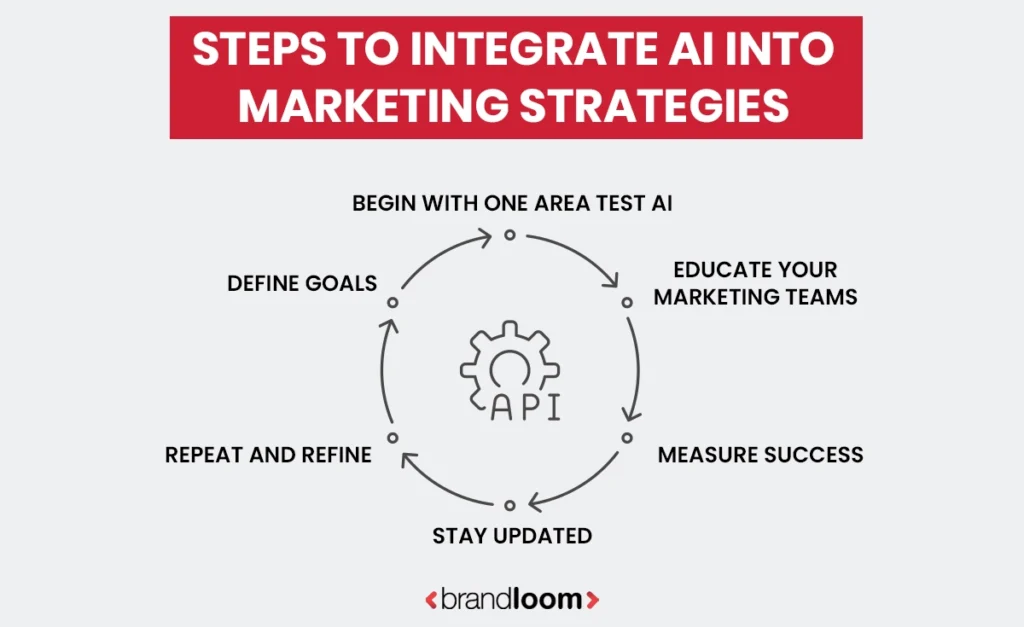
Steps to integrate AI into marketing strategies:
Stay updated
- Define Goals – Associate the use of AI with your performance marketing strategy. As a benchmark, set a goal of doubling lead conversions using AI chatbots.
- Begin with One Area: Test AI in ad targeting, content creation, or product recommendations. As an example, run AI-based ad targeting on Facebook to determine which audience reacts the most.
- Educate Your Marketing Teams – Make sure that they can utilize AI tools. Offer practice, tutorials and workshops. As your team learns about AI, they embrace AI more quickly.
- Measure Success – Measure performance to success using marketing campaign performance measures. Compare the engagement rates, click-throughs, or sales prior to the introduction of AI or after its integration. This is to guarantee that you get the actual impact.
- Repeat and Refine – Continue to upgrade AI options and strategies. Suggest refining products according to the previous purchase behavior.
- Stay updated -Keep on the cutting edge of AI, as it is continually being updated. Get AI newsletters, subscribe to tech blogs, and view industry webinars. Keeping up is a way of keeping a competitive advantage.
Therefore, the integration of AI will lead to a higher rate of efficiency, a higher ROI, and enable marketing endeavours to identify the appropriate target segments at the right time and in the proper context when it is properly implemented. Read further about how you can maintain your email lists lean and efficient with BrandLoom’s suggested tools.
Real-World AI Marketing Campaign Examples
Authentic brands leverage the performance marketing campaigns powered by Artificial Intelligence with measurable outcomes. The following examples show that AI in performance marketing can better target ads, increase conversion rates, and increase engagement with customers. They demonstrate that metrics-based decisions and AI integration can transform marketing strategies.
Generative AI text, predictive analytics, and other marketing tools ensure that organizations design campaigns that appeal to the target audiences. The AI enables them to personalize product recommendations, market their products, and stay ahead of the competition.
Notable AI marketing campaign examples include:
- Coca-Cola – They applied the use of generative AI to creative advertisement materials and personalized promotions.
- Netflix – It is an example of an AI that uses AI-based algorithms to make customized show and movie suggestions.
- Sephora – AI helps generate product recommendations and virtual try-ons, and increases sales.
- Starbucks – One of the most commonly used types of predictive analytics, targets and makes specific offers within its reward program.
- Nike – This company uses AI in digital advertising to customise online shopping.
- Amazon – Employs machine learning for cross-selling and upselling recommendations.
- Spotify – Uses AI-based recognition of personal playlists of each target audience.
The given examples demonstrate that AI-driven strategies are used to develop engaging and high-performing campaigns that reach customers and produce measurable ROI. To learn more, you can see BrandLoom’s case study on a increased ROAS for Ashley Stewart.
Challenges of Integrating AI into Marketing Workflows
There are significant benefits of incorporating AI into the marketing workflows, as well as challenges that accompany it. There are issues to be dealt with to ensure that AI in performance marketing works effectively. Marketing teams are likely to lose resources and opportunities without proper planning.
The area of AI adoption necessitates proper tools, trained personnel, and apparent marketing. Data-driven decisions rely on accurate and relevant data. Poor integration can slow campaigns instead of improving them.
Common challenges include:
- Data Quality Problems – low-quality data undermines AI.
- Extensive Implementation Costs – AI tools and training are cost-intensive.
- Skill Gaps – Marketing teams may lack AI expertise.
- Integration Complexity -AI tools may not easily match a system that has already been integrated.
- Privacy – Handling of customer data should be in compliance with the rules.
- Excessive Dependence on Automation – Automation cannot fully substitute human decision-making.
- Fast Technological changes – The technology used in the tools is changing very fast, and replenishment needs frequent updates.
To conquer these obstacles, training employees, using clean data, and updating the workflows must be undertaken. Taking a compatible approach, brands will be able to incorporate AI seamlessly and develop campaigns that resonate with their targeted audiences; Besides this, they can maintain an upper hand over competing brands.
The Future of AI in Performance Marketing
The future of AI in performance marketing is promising. Marketing teams will take the next step by integrating AI into their operations and holding even more personalized campaigns that will be highly effective.
Machine learning will enable more accurate ad targeting, product suggestions, or content creation.
Through data-driven decision-making, the brands will be capable of focusing on conversion rates and design campaigns that will be memorable among the audiences they target.
There will be predictive analytics and real-time monitoring in the marketing strategies. Businesses can also respond to changes in the market faster, particularly in overcoming the competitors..
Key trends shaping the future include:
- Hyper-Personalization – Personalised communication for every customer.
- Generative AI Content – Create ad copy, images, and video on the fly.
- Voice and Chat AI: Increasing the channel capabilities of customer engagements.
- Predictive Analytics – Forecasting buying trends with high accuracy.
- Integrated AI Systems-Synthesis of tools to create a unified workflow in marketing.
- Ethical AI Use – Safety of privacy and openness in automation.
- Cross-Channel Optimization – Coordinating ads across digital platforms.
Marketing experts claim that AI will keep evolving into making performance marketing campaigns more innovative, speedier, and more performance-driven. Digital advertising of the future will be dominated by the brands that adopt it first.
Final Say
AI is not simply a future trend; it is already transforming the landscape of performance marketing. It is here that it happens, allowing the brands to reach their target audiences and increase conversion rates. It is in advertisement, content development, or any other marketing niche that AI has given the marketing teams the power to make fact-based decisions capable of delivering quantifiable results.
The performance marketing application of AI is a way of creating campaigns that resonate with their target audiences. It allows companies to track the performance in real time, tailor customer engagement, and even makes marketing an easier task. It is also with the help of AI that brands are enabled to recommend the products accurately and tailor marketing campaigns to address any market changes..
Success comes from using AI strategically. Brands are required to manage data quality, educate the teams, and coordinate the use of AI tools in their marketing strategies. Those who follow this will be ahead of the competition and enjoy increased ROI.
BrandLoom,the leading performance marketing agency in India, can deliver spectacular performances in saturated markets by being creative or undertaking sophisticated analytics. AI is not a tool; it is a growth partner as it makes businesses move faster, work smarter, and come closer to the customers.
In performance marketing, AI-powered campaigns will be the brightest.
FAQs
AI enables brands to undertake more intelligent performance marketing using high quantities of data within a short period. It improves the personalization of advertisements, boosts conversion rates, and personalizes customer experience. Our BrandLoom performance marketing experts apply AI-applied tools that help marketing teams to make data-driven decisions and create campaigns that resonate with the target markets.
Overall, AI systematizes everything, regardless of whether it is content creation or product suggestions. It can also track the performance in real-time and lead to quick manoeuvring in the strategy. Through its incorporation of AI, companies will be able to streamline their marketing processes, reduce ad waste, and enhance the general ROI, requiring AI to be a staple of contemporary marketing strategies.
Artificial intelligence improves ROI in digital marketingas the campaigns are more appropriate and well-aimed. It applies machine learning and studies customer behavior models and purchase trends. Using AI, one can optimise bids, personalize advertising copy, and find the most suitable marketing channels.
Real-time analytical capabilities allow marketers to change the strategy instantly to achieve good outcomes. AI also eliminates repetitions, thus saving both time and expenses. Even more, our marketing specialists at BrandLoom reveal that AI reduces unnecessary spending and maximizes returns by enhancing marketing efforts and ensuring that messages reach the appropriate target audiences.
This data-based strategy will also help brands to be leaders in competition by ensuring that they have a higher-than-usual ROI.
The top performance-marketing AI tools are going to depend on what you want to do. Useful tools in that respect are Google Ads smart bidding to optimise bids automatically and Facebook Advantage+ to deliver ads to the desired audience. Also, HubSpot offers AI-powered marketing automation and analytics.
Jasper AI supports content creation with tailored messaging. AdCreative.ai helps create visuals that are appealing to your audience. Drift and Intercom enhance customer interactions through AI chatbots. Optimizely enables AI-driven A/B testing for creative assets.
BrandLoom professionals choose practical tools that align with your marketing approach, financial needs, and campaign objectives to achieve the best possible results, in terms of desired conversions and the selection of the most beneficial tool.
Firstly, AI allows more effective audience targeting since the AI will get to know the demographics, interests, and digital behaviour of its audience. It divides target audiences into specific ones. This helps the marketing professionals to introduce campaigns that will attract their target customers.
Secondly, AI understands trends in how clients interact with content, predicts their behaviours and activities, and makes recommendations on content and products they may like.
Thirdly, It also checks out the movement on the various channels, enhancing marketing strategies in the process. This can be attributed to effective targeting that reduces wastage to the ad budgets, maximises engagements, and improves the conversion rates.
Finally, Brands communicate with the proper audience at an appropriate moment when performance marketing involves AI.
Yes, AI can automate campaign optimization in real time. Using AI tools, marketing campaign performance metrics are observed, and changes in bids, budgets, and targets are automatically made. This aids in the enhancement of the conversion rates and ROI without any manual input.
Automation in real-time is one of the ways to have campaigns that adapt to market developments or customer behavior. With AI, marketing teams can experiment with various creatives, review outcomes, and make real-time adaptations to their marketing strategies.
In addition, BrandLoom’s Performance marketing campaigns remain updated, effective, and competitive using AI. It is also the type of automation that leaves teams free to work both creatively and strategically as the AI makes constant adjustments.
Predictive analytics uses AI to study the past and current data and gives some clues on what to expect. Under performance marketing, it forecasts the customer behavior, probability to buy, and market demand.
This enables marketing departments to identify information-based judgments and campaign formation that is appealing to the intended customer groups. An AI can also be used to detect valuable leads and inform the most appropriate time to launch the marketing campaigns.
Above all, machine learning will help brands optimize advertisement targeting, conversion rates and reduce wasteful spending. Predictive analytics keeps a business on top of the competition and ensures that the marketing attempts are not reactive but anticipatory.
AI speeds up and improves ad copy and test creative. It creates several variations of the ad text and graphics with generative AI. AI is then used to test them in real time and use performance data to develop the most effective versions.
This assists in the development of campaigns that will appeal to the target audience. Artificial intelligence solutions such as AdCreative.ai and Persado will allow communicators to create customized messages to various target audiences using machine learning algorithms.
As the creative testing becomes automated, the brand saves time and money and increases conversion rates. As per BrandLoom’s seasoned marketing team, AI provides the reliability to make every creative choice based not on speculation but on knowledge.
Of course, AI is suitable for small business performance marketing campaigns. Many AI tools are affordable and easy to integrate. AI can be employed by small businesses to target advertisements, generate content, and make suggestions.
Additionally, AI eliminates time consumption and reduces marketing costs by eliminating redundant tasks. Real-time analytics help small teams make data-driven decisions quickly. Additionally, Artificial intelligence enhances marketing plans and raises conversion rates even when the budgets are low.
At the top performance marketing company in India, BrandLoom, we believe that with AI, even small businesses will be able to compete with much bigger brands and remain competitive. It is all about beginning with a small scale, monitoring outcomes, and increasing AI adoption over the course.
Machine learning optimizes the performance of the marketing campaign because it learns constantly based on data. It enhances targeting of adverts, forecasting customer actions, and customisation of content.
The ML algorithms can aid in the optimization of bids, the choice of an optimal channel, and recommendations for related products. This brings about increased conversion ratesand ROI in performance marketing. Marketing campaign performance tracking is also automated in machine learning so that it can be adjusted in real-time.
Eventually, the system becomes cleverer and marketing approaches become more accurate. Such continuous optimization enables marketing teamsto present campaigns that resonate with their targeted audiences and can react swiftly to market changes.
Integrating AI into marketing workflows has challenges. Brands may face high costs for tools and training. Marketing teams might lack AI expertise. The decisions based on data should have reliable, clean data, but this is not always the case.
Integrating AI tools with existing systems can be complex. The issue of privacy has to be resolved to secure customer interactions and comply with the regulations. Then there is the danger of relying too much on automation and failing to put the human touch in marketing campaigns.
Nonetheless, the skilled marketing specialists at BrandLoom suggest that rapid tech changes require ongoing learning. Minimising these obstacles includes setting goals, education, and aligning the AI with the company’s marketing strategies to ensure its adoption.



Comments are closed.