Hi there,
Last week, we discussed why growth can feel inconsistent even when campaigns are working.
This week, let’s talk about why that inconsistency is so hard to fix.
Because most of the time, the problem isn’t the campaign. It’s the data you’re using to judge it.
And here’s what that actually means, because this is the part worth being specific about.
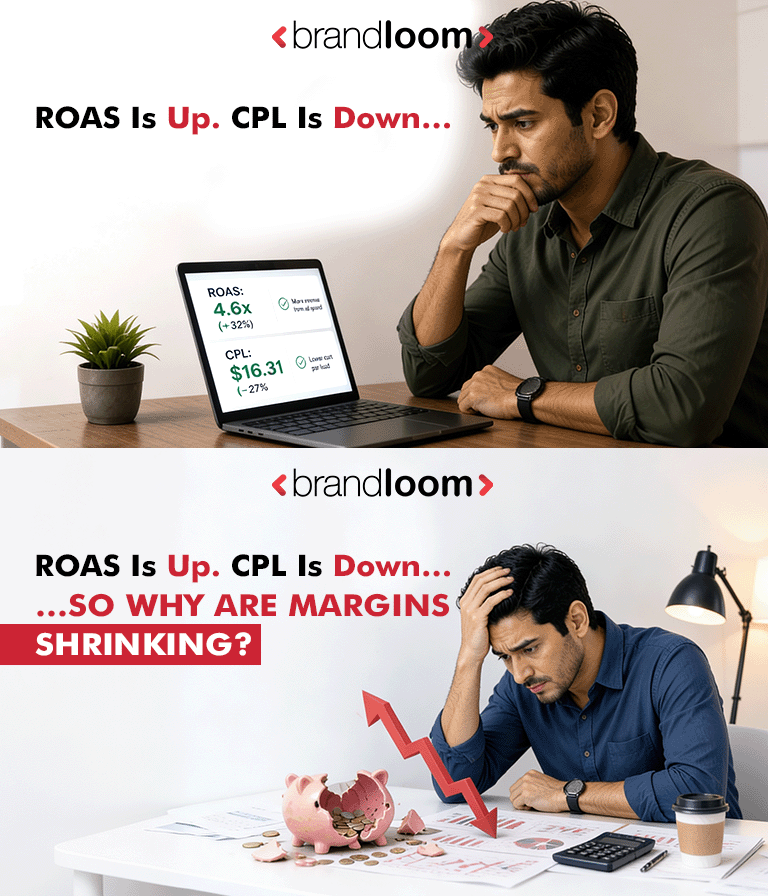
The Real Problem: Great Marketing Metrics. Shrinking Margins.
Your ROAS looks strong. CTRs are up. Cost per lead is down.
And yet, at the end of the month, revenue hasn’t moved the way it should. Profits are thinner than expected. Sometimes they’re going backward.
That’s not a coincidence. That’s a data problem.
Because the metrics your ad platforms show you, impressions, clicks, conversions, and ROAS, are optimized to make the platform look good.
They are not optimized to reflect your actual business outcome.
A “conversion” on Meta might be someone who bought once, returned the product, and never came back.
A “profitable” Google campaign might be pulling in customers whose lifetime value doesn’t justify the acquisition cost. A low CPL might be filling your pipeline with leads that never close.
The numbers look great. The business doesn’t feel it. That’s the disconnect.
Why This Keeps Happening
No one builds this problem on purpose.
It starts when different tools, your ad platform, your CRM, your analytics software, each define success slightly differently. Each reports a version of the truth that favors its own metrics.
Your ad platform counts a sale the moment someone clicks. Your CRM records it when it actually closes. Your finance team sees it when cash hits the account.
Three tools. Three numbers. None of them is wrong, exactly.
But none of them is telling the full story either.
And as you scale, you start making bigger-budget decisions based on whichever number is most accessible, not the most accurate.
That’s where growth starts bleeding quietly.
The Compounding Cost of This
The dangerous part isn’t any single bad decision. It’s the pattern.
You scale a channel because the ROAS looks strong, but the customers it brings in churn fast.
You cut a channel because leads looked expensive, but those leads were your highest-LTV customers. You optimize for volume, but margin quietly erodes.
Month after month, you’re steering using a map that’s slightly wrong. The further you go, the more off-course you get.
What You Can Actually Do About It
Here are four concrete things worth acting on.
1. Define one revenue metric that everyone agrees on
Pick one number that represents actual revenue, not platform conversions, not leads, not MQLs. Something like net revenue per cohort, or first-order profit margin.
Make it the metric by which every campaign is ultimately judged. When every team is working from the same definition of success, budget conversations stop being political.
PS- CAC: LTV may be a good start.
2. Build a 30-day lag report
Platform metrics are instant. Real business outcomes take time. Build a simple report that looks at every campaign’s performance, not at the point of conversion, but 30 days later, factoring in returns, churn, and actual cash collected.
Most brands that do this for the first time discover that their “top performing” campaign and their most profitable campaign are not the same thing.
3. Tag customers by acquisition source, not just conversions
Most CRMs tell you how many leads came in. Very few tell you what those leads were actually worth six months later. Start tagging every customer with their original acquisition source and track their revenue over time.
This one change will show you which channels are bringing in buyers and which are bringing in browsers.
4. Create a single dashboard that connects ad spend to gross profit
Not ROAS. Not revenue. Gross profit. This means pulling your ad spend, cost of goods, return rates, and revenue into one place.
It sounds basic, but very few teams actually have this. When you do, you stop optimizing for metrics that look good and start optimizing for metrics that compound.
What Decision Intelligence Actually Fixes
Most brands are excellent at collecting data. Very few are structured to connect that data to profit.
Decision intelligence isn’t about more dashboards. It’s about building a system where marketing metrics are tied directly to revenue outcomes, where a successful campaign is defined by profit contribution rather than just platform performance, and where budget decisions are made from a single trusted source rather than being reconciled across five tools.
When that system exists, the question stops being what do the numbers say.
It becomes did this actually make us money, and do we know why?
What Changes When You Get This Right
When your data layer connects marketing performance to real business outcomes, you stop scaling campaigns that look good but don’t profit.
You stop cutting campaigns that look expensive but actually work. You stop losing weeks to reconciling conflicting reports.
Decisions get faster. Confidence goes up. And growth becomes something you’re directing, not just hoping for.
A Question Worth Sitting With
Before your next budget decision, ask yourself: do we actually know which campaigns drove profitable revenue, or do we just know which ones drove conversions?
That gap is where most growth inefficiencies hide.
The Shift That Matters
From marketing metrics to profit-connected data. From platform performance to actual business outcomes. From multiple versions of the truth to one trusted system. From optimizing for conversions to optimizing for margin.
In the coming years, data won’t be a differentiator. Knowing which numbers actually connect to profit will be.
Most brands don’t have a growth problem.
They have a measurement problem.
And until that changes,
they’ll keep scaling what looks good—
not what actually works.
👉 If your growth feels harder to manage as you scale, it might not be your strategy. It might be your data. Book a strategy session to identify where clarity is breaking down.
P.S. If you missed the last edition:
#95 – Why Your Growth Feels Inconsistent (Even When Campaigns Work)
That’s all for now. Stay curious. Stay credible.
Yours Sincerely,

Avinash Chandra
Founder, BrandLoom Consulting
🌐 https://www.brandloom.com/
☎︎ +91-7669647020
📩 care@brandloom.com
💻 https://team.brandloom.com/book-a-meeting
1. Note: If you feel like talking, just hit reply on this mail.
2. Fun Fact: 82% of BrandLoom clients see an uptick of at least 20% in their revenue after the implementation of BrandLoom’s strategies.
BrandLoom Is Regularly Featured In :

Meet Us At:
Gurgaon. Mumbai. Pune. New Delhi. Bangalore. Texas. New York. London.