You search for a product online, and see a brief summary appearing at the top of the search results, with recommended product links popping up on the side. That’s E-commerce SEO in 2026 at work. Goodbye to the days of clicking dozens of search results.
Traditional SEO methods alone can’t ensure visibility for e-commerce product pages. AI-powered search engines have altered the online search and product discovery experience. E-commerce brands must adapt their SEO roadmaps to sync with evolving user expectations and zero-click results. Keywords stuffing won’t work now – it’s the age of trust, better user experience, and AI-powered recommendations.
E-commerce rules the global retail scene, and brands must adapt to the evolving digital ecosystem. University of Virginia data shows that almost 60% of consumers use AI engines to buy. Around 77% of people say AI tools help them make faster decisions. As the traditional online shopping funnel is getting obsolete, brands embracing the e-commerce SEO best practices in 2026 will only survive.
In this blog, we’ll explore why product page SEO optimization matters, the nuances of AI ecommerce SEO, and useful strategies to optimize your product pages for better AI trust and visibility.
To stay on top of the E-commerce SEO game in 2026, you need a competent and trusted partner. BrandLoom, with its proven expertise in AI SEO and e-commerce sectors, fits the bill perfectly.
How E-commerce SEO in 2026 has Evolved?
The old rules of SEO have changed drastically, and they affect E-commerce brands and websites, too. You can’t get a high product page ranking by using keywords alone. In the age of AI product discovery, aspects like user intent, trust indicators, and quality of content will fetch your pages a higher ranking.
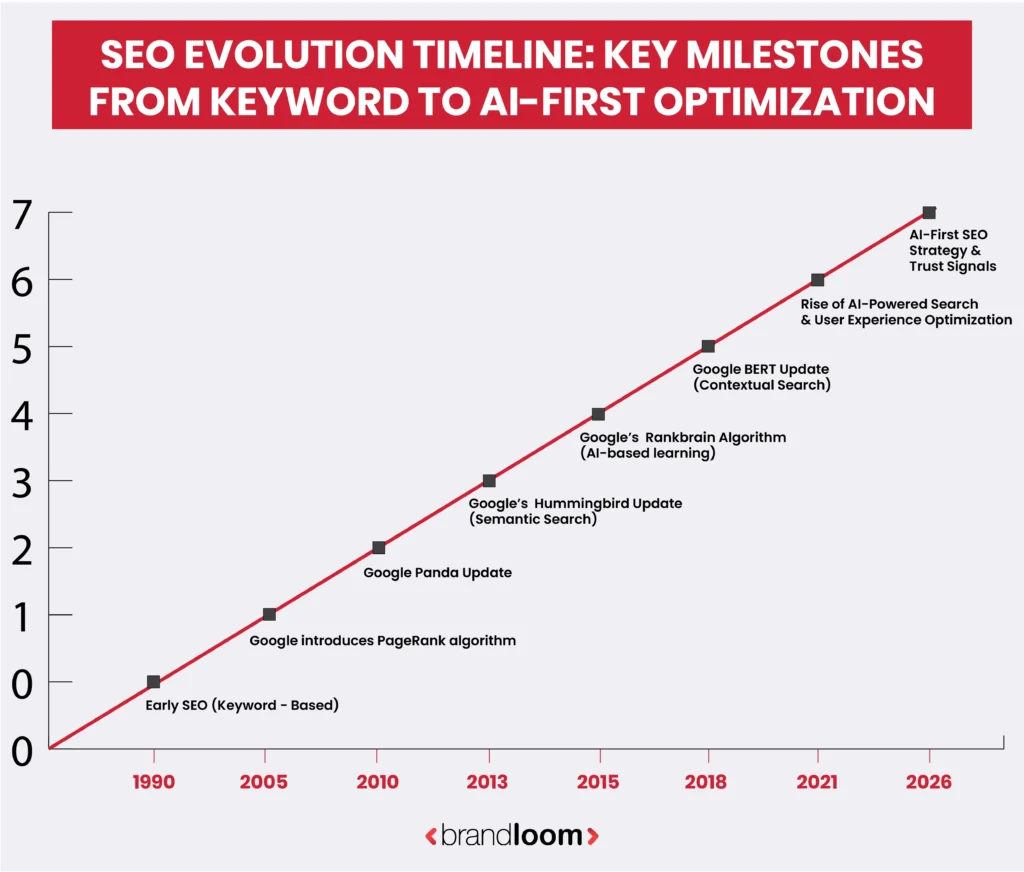
Google and leading e-commerce platforms such as Amazon now use advanced AI-powered algorithms, including RankBrain and BERT, to better understand query intent and content relevance. Google’s BERT update, for example, helps the search engine grasp natural language and semantic relationships between words. They must address holistic user intent—understanding not just what users want, but why.
The Rise of Zero-Click Product Discovery
Online shoppers are getting accustomed to zero-click results- where search engines present them the summary of the desired product along with the buying link directly. HubSpot data shows over 60% online searches now lead to zero-click results.
What does it mean for your e-commerce brand? Now, product discovery is more about having the right answers in the right places within search engine results pages. A featured snippet highlighting your product’s USP or a price comparison chart can instantly improve visibility. The target users don’t need to navigate the website to locate specific products, thanks to e-commerce product page optimization.
AI is now integral to the user search experience in 2026, not optional. Your product pages need e-commerce conversion optimization. They must meet the criteria used by AI systems to rank content – content depth,trustworthiness, and user experience.
Here’s a detailed look at the evolution of E-commerce SEO over the years:
Why Traditional Keyword-Based Optimization is Inadequate?
Earlier, most e-commerce brands stuffed pages with high-volume keywords to get a high ranking in search results. That has no place in a modern e-commerce SEO strategy. Nowadays, AI-driven search engines analyze user intent behind a search, beyond keyword matching. So, you must focus on optimizing product page content for user intent and semantic relevance.
For example, a product page optimized for the query “top neckband headphones for customer service” offers relevant information about product performance, efficiency, and user experience.
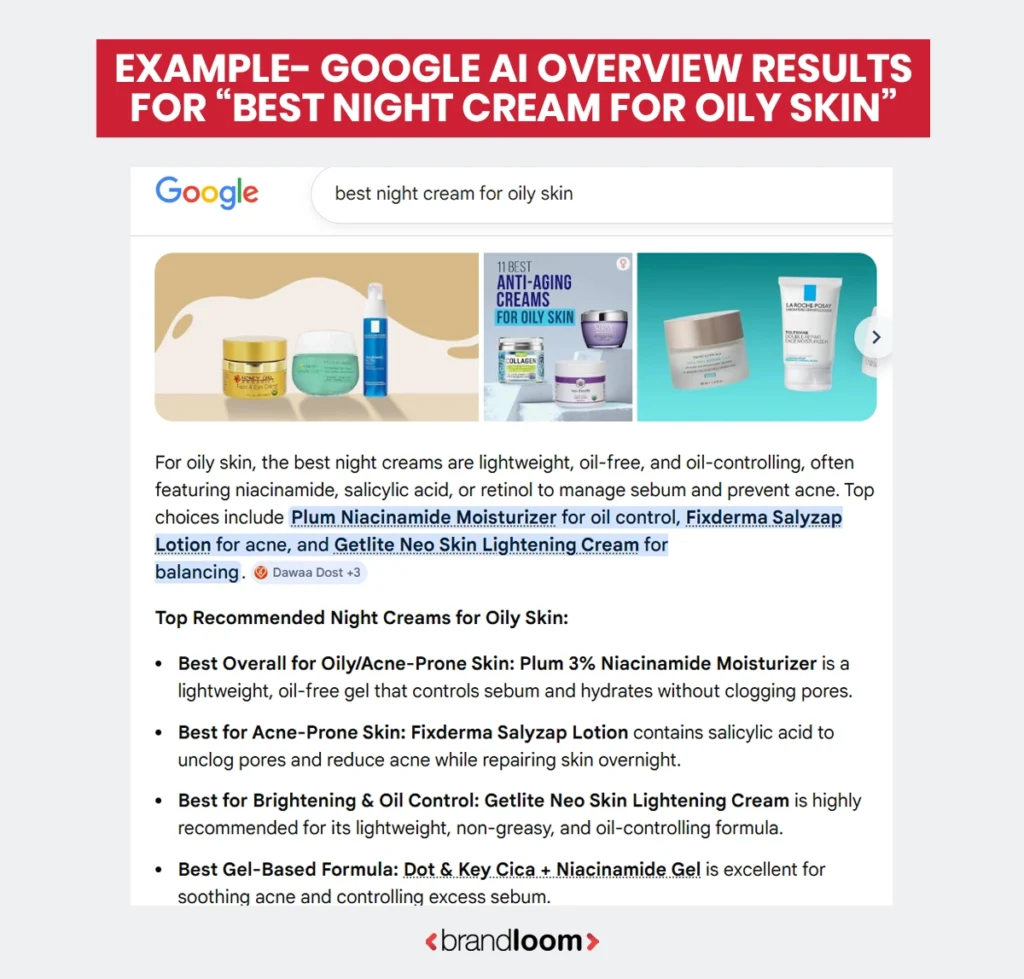
The AI systems comprehend the user’s need for specific features and then analyze and choose content accordingly. Your brand must revamp its e-commerce SEO strategy, shifting from keyword-centric optimization to a focus on relevant, comprehensive, valuable content.
How to Ensure Your Product Pages Reflect Consumer Intent?
In 2026, e-commerce product page optimization must offer more than product details. You need to focus on the target consumer’s buyer journey in its entirety. AI engine algorithms assess a product page’s ability to address the user’s needs, answer their questions, and guide them towards a buying decision.
For an AI-ready product page SEO optimization¸ your brand will need:
- In-depth product descriptions that offer clarity on common topics and include easy comparisons.
- Structured content to make things easier for AI systems, including FAQs, comparison charts, and buying guides.
- User-generated content, like reviews, ratings, and Q&A pieces, can create richer product context.
As AI technology keeps evolving, content depth and user engagement will overshadow keyword usage for higher ranking and better visibility. You need a suitable e-commerce SEO strategy to make your product pages optimized for AI systems. For such needs, you can rely on the expertise of BrandLoom. Contact our AI SEO experts and marketing consultants for an E-commerce SEO audit.
Key Elements of E-Commerce Product Page Optimization
Listed below are some effective e-commerce SEO best practices for 2026 that you can follow.
1. Using Intent-Based Headline
Your headline must match what target buyers type in Google. A headline like “Premium Ergonomic Chair” sounds so cliched and that’s what most people don’t type. So, you may use a heading like “Office Chair That Reduces Back Pain After 8-Hour Workdays” to match user intent better.
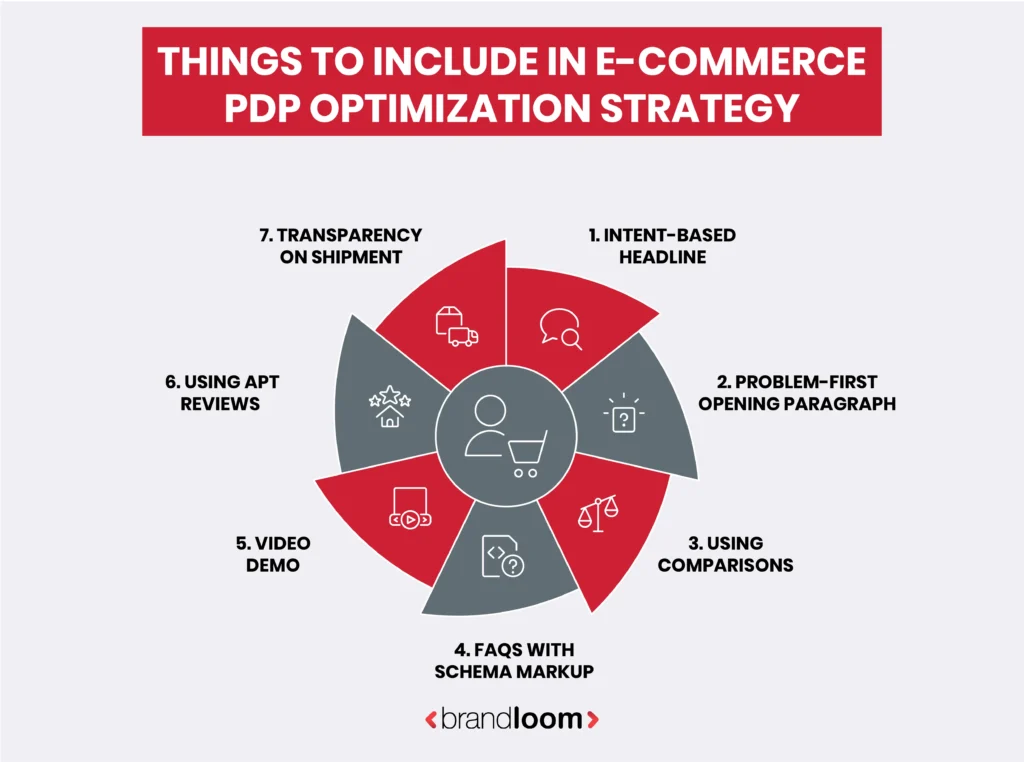
2. Problem-Focused Opening Paragraph
Buyers need solutions for their needs/problems rather than learning about your product features. When your product page begins with issuers highlighting their needs, that increases conversion scopes. For a clearer idea, go through some 1-star competitor product reviews online. Avoid using those kinds of tones and language in your product pages.
3. Using a Comparison Table
Chances are, your target buyers have seen competing websites before landing on your page. It works when you use a comparison table featuring the products of the top 2-3 rivals, alongside your offering. This offers them clarity and saves research time. Be honest and factual about products for better conversions.
4. Utilizing FAQs with Schema Markup
Don’t think FAQs are fillers. Google pulls FAQ schema directly into search results as expandable dropdowns. So, your answers can appear at the top of online searches. Include the questions buyers actually ask, and focus on aspects where they lack clarity, not obvious ones. Add FAQ schema markup so Google can read them. Offer to the point answers addressing user pain points clearly.
5. Using Video Demo
Nowadays, buyers are choosier and well-aware, and using Product photos may not be enough. You will get better results by using product pages with useful video content. A clean 60–90 second demo showing product utility may work well. Add captions for a better user experience.
6. Using Reviews Judiciously
Using a lot of reviews on product pages won’t work well. Target buyers look for authentic reviews covering aspects like durability, features, value for money, etc. So, use 3–5 of your most specific, credible reviews and place them near your headline, comparison table, and buy button. Reviews showing a specific problem and how the product solved it (with images or videos) work well.
7. Clarity on Shipment
Skip the phrases like “Ships in 3–7 business days”. It does not offer the buyers clarity. In 2026, buyers want precise updates on shipment and delivery rather than vague statements. Put the estimated delivery date range next to your buy button. Offer clarity on the return policy as well. If you can guarantee a specific delivery date, be clear about it.
To get more nuanced insights and tips on e-commerce SEO, choose BrandLoom, the agency that has aided numerous client companies in revamping their SEO strategies successfully. Take the case study of GetLitt!, a children’s digital reading platform, for example. It had near-zero visibility online, despite having a brilliant offering. Our custom SEO services fetched the platform 20,000 monthly organic visitors, within just six months, and without spending a single rupee on ads.
Technical SEO for E-commerce Product Pages
Technical SEO is a part and parcel of successful e-commerce SEO 2026 strategies. Along with content optimization and user experience, your e-commerce site needs a solid technical SEO to become AI-ready. It is a must for better conversion and ranking.
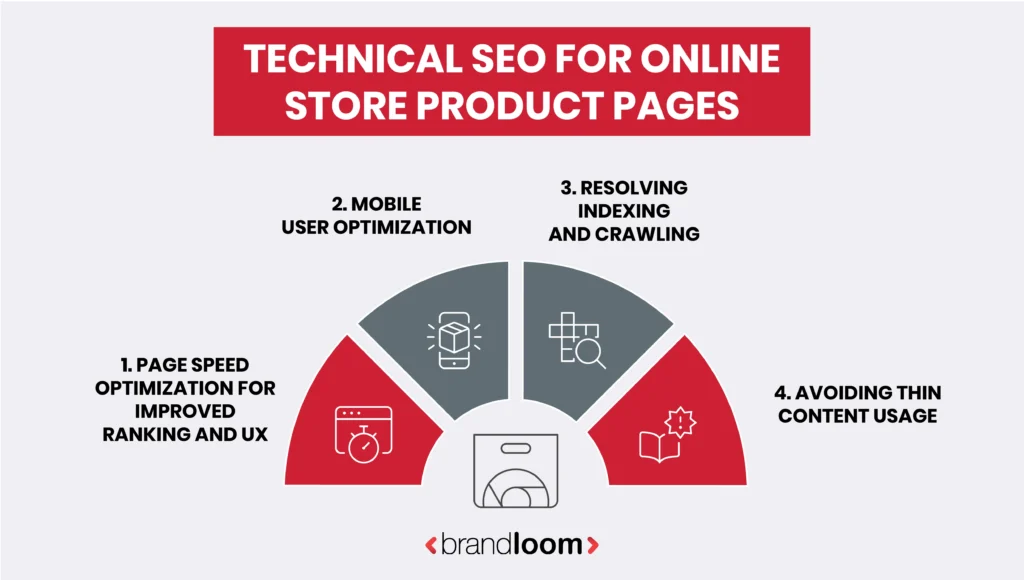
1. Page Speed Optimization for Better Ranking and User Experience
Google’s algorithm pays attention to page speed for core ranking. It is also important to improve the user experience. In 2026, a sluggish product page will not only hurt your ranking but also hike bounce rates, slowing down conversion rate. You can:
- Try for a page load time under 3 seconds, and use tools like Google PageSpeed Insights or GTMetrix.
- Compress images without cutting quality, using formats like WebP for faster loading.
- Reduce JavaScript and CSS files to reduce server requests and speed up the page.
2. Focus on Mobile Device Optimization
The latest data shows 70% of all online sales come from mobile device users. For effective e-commerce SEO for product pages, focus on mobile-first design, Core Web Vitals, and lightweight front-end frameworks.
3. Fix Crawlability and Indexation Issues
Search engines must crawl and index your product pages to rank them. For this, check these pages for any mismatches and internal issues. You can:
- Check that all product pages are included in your sitemap for easy search engine discovery.
- Cross-check that major pages aren’t blocked from indexing.
- Use Canonical Tags to eliminate duplicate content issues between product variants.
4. Avoid Using Thin Content
AI-based search engines punish websites with thin content or duplicate product pages. Your product pages must contain unique, comprehensive content, even for similar products in multiple variants. This is a prerequisite for product page optimization for sales.
You should offer unique descriptions, benefits, and reviews for each product variant. Use structured data to enrich content and improve search engine understanding.
For solid guidance on Technical SEO for your e-commerce brand, count on the expertise of BrandLoom. Our AI strategists and e-commerce SEO experts can exceed your expectations.
What are the Top AI-Driven Strategies for Product Page Visibility?
AI technologies are now integral to online product search and discovery. To stay competitive, your e-commerce brand needs a custom and powerful AI e-commerce SEO strategy for product pages
1. Optimize Pages for AI-Powered Search Engines
AI algorithms like Google BERT prioritize relevance, conversion probability, and engagement indicators. To attract AI search engines, you can:
- Focus on context and use natural language in your product descriptions to mimic user search patterns.
- Answer questions directly in product descriptions and FAQs.
- Use quick answers or product comparisons to increase AI overview visibility.
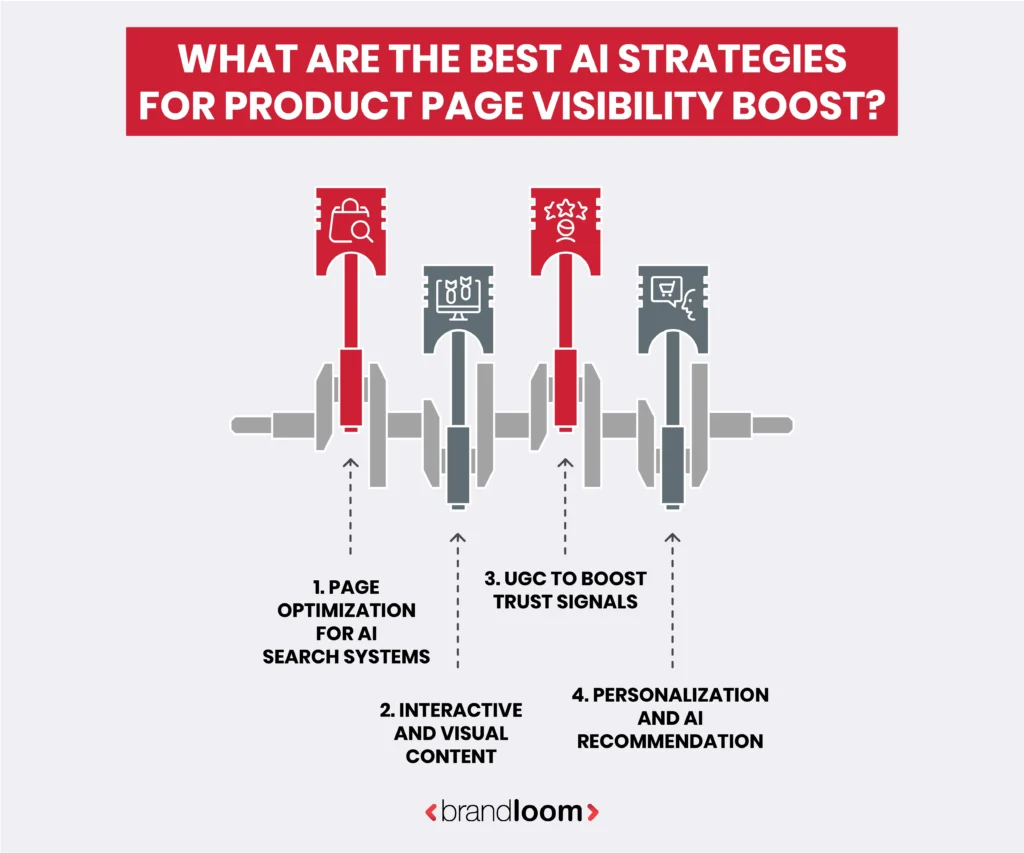
2. Use Visual and Interactive Content
AI systems now index visual content like pictures, videos, and 360° product views, and so you can do these:
- Use clear and high-quality pictures tagged with alt texts, titles, and descriptions.
- Use Augmented Reality previews where possible, especially in sectors like fashion, home decor, and beauty.
- Include product videos showing main features and usage so that AI tools can assess video content for relevance and engagement.
3. UGC for Trust Signals
AI search engines use user-generated content and social activities, including social media mentions, reviews, and ratings, to analyze credibility. So, positive buyer reviews can directly affect AI recommendations and product rankings. To heighten trust signals, you can:
- Ask and encourage customers for detailed reviews and testimonials to use on your product pages.
- Interact with these product reviews regularly. This improves user engagement and establishes brand credibility.
- Use UGC, including customer images or social media posts, as social proof.
4. AI Recommendations and Personalization
Top AI-powered platforms like Amazon and Google Shopping use personalized product recommendations. They recommend products based on aspects like purchase history, past behavior, and demographics. Your e-commerce SEO strategy must include AI tools for custom product recommendations. AI-based personalized recommendations improve user experience and conversion rate.
Are you unsure about how to use AI tech in e-commerce UX optimization? Choose BrandLoom, a frontrunner in AI innovations in marketing and SEO realms, and the winner of the Martech AI awards 2025.
How does Product Page Optimization Drive Revenue?
In 2026, e-commerce SEO is not only about bringing more visitors to your product pages. You need to focus on e-commerce conversion optimization. You should enrich the product pages with AI-driven content, improve UX, and trust indicators throughout.
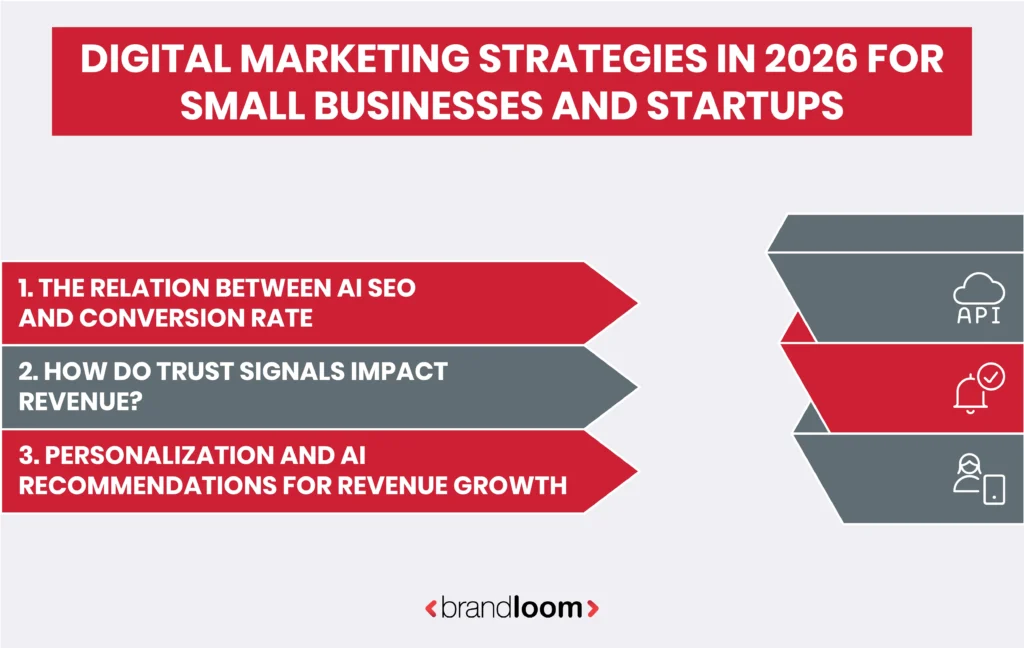
The Link between AI SEO and Conversions
SEO measures affect your conversion rates directly when you optimize product pages with methods to attract both AI engines and target users that entice high-quality traffic – people with conversion potential.
AI algorithms choose and display content answering user questions and covering pain points. So, relevant and useful content turns your visitors into customers. Optimized product pages with fast load time and engaging, useful content help reduce bounce rates, thereby improving conversion.
How Trust Signals Affect Revenue?
For AI e-commerce product page optimization, you must use trust signals. AI systems prefer strong trust indicators like user reviews, ratings, andsocial proof when recommending products. Your product pages must have positive reviews, authentic customer testimonials, and real-life images. Customers usually choose products with high ratings.
Personalization and AI Recommendations for Revenue Boost
Your e-commerce SEO strategy must include AI personalization to trigger repeat buying. Product pages with recommendations for related products based on customer browsing history help improve sales value. For example, a user buying a mobile phone may also be shown a flip cover or screen guard for cross-selling.
When you need expert guidance on product page optimization for sales, look no further than BrandLoom. Our AI SEO analysts and marketing experts will help execute an e-commerce SEO audit.
Conclusion
The e-commerce SEO landscape has changed drastically, fueled by the rapid growth of AI tools. Your e-commerce website product pages need more than keyword stuffing to improve ranking and conversion. The ideal E-commerce SEO 2026 strategy focuses on AI-optimized product pages with user intent, trust indicators, andengagement.
Your product pages must be optimized well to earn the trust of top AI search systems. Using schema structure, UGC, mobile optimization, and improving indexing will be necessary for developing a solid e-commerce SEO strategy. You must also use the best-rated SEO tool for e-commerce alongside AI tools for custom product recommendations.
At BrandLoom, we specialize in developing custom and effective AI ecommerce SEO strategies for clients of different profiles- hailing from multiple industries, in India and abroad. Our SEO strategists and AI analysts can plan and run an e-commerce SEO audit for your brand to develop a fitting AI SEO roadmap.
Are you prepared for future-proof e-commerce SEO for product pages? Let our AI SEO specialists at BrandLoom create an apt, future-proof AI SEO strategy for sustained growth.
FAQs
E-commerce SEO in 2026 is much more extensive than the older days of keyword-centric methods. It covers creating AI-driven, user-focused product pages optimized for both search engines and target customers. AI-powered algorithms, including Google’s BERT and MUM, analyze user intent, content relevance, and trust signals.
So, your e-commerce SEO strategy should prioritize semantic search and offering rich, valuable content that answers users’ questions and solves problems. You need well-structured product pages with detailed descriptions, reviews, and media content to meet AI system needs. With zero-click search results becoming common, your brand must focus on visibility and conversions.
AI technologies have redefined the way product pages get ranked in search engines. Overlooking keyword stuffing, AI algorithms now focus on factors like user intent, content depth, and trust signs. Google’s MUM and BERT algorithms check how well your product page answers user queries and also the context behind those searches.
So, the product pages must provide comprehensive answers. Moreover, AI-driven search engines choose product pages with authentic reviews, structured data, and engaging content. They prefer product pages with rich media like videos, high-quality images, and customer testimonials.
In 2026, AI-driven search engines pick product pages that showcase signs of relevance, trustworthiness, and engagement. For better ranking, your product pages must meet vital AI ecommerce SEO parameters:
– Content Quality: AI systems focus on understanding the context and intent behind user searches. Product pages with comprehensive and useful answers to queries will prevail.
– Structured Data: Proper schema markup in your product pages helps search engines understand aspects like price, availability, and reviews, leading to visibility in rich snippets.
– Trust Signals: AI engines take customer reviews, ratings, and social proof as major trust indicators. These factors affect page rankings directly.
– Engagement: Metrics like time spent on page, click-through rates, and bounce rates show how users engage with your product pages. AI systems go for pages with better user engagement.
Yes, keywords still play a big role in e-commerce SEO in 2026. However, they are not the only important thing here. Semantic search and user intent have become dominant factors for e-commerce SEO strategy. AI-powered search algorithms stress the meaning behind search queries, not exact keyword matches. So, your brand’s product pages should target long-tail keywords and natural language to match user intent better.
Structured data plays a key role in enhancing your product page visibility and search engine rankings. You can use product schema SEO to offer top search enginesclear, organized data about products. This also helps AI-driven systems understand and index the product page easily.
AI systems depend on structured data to extract and display relevant product details, including product type, manufacturer, and customer reviews. They also display those metrics in AI overviews and snippets when your target users find key details like shipping information and product variants in search results, which leads to a boost in conversion and revenue.
Yes, using the apt product page SEO optimization helps improve conversion and sales. The major tactics are:
– Enhanced User Experience – Use well-optimized product pages with quick load times, clear navigation, and engaging content to improve user satisfaction and lower bounce rates.
– Content Quality- Use optimized product descriptions with detailed information, comparisons, and answering questions for user intent matching.
– Trust Signals – AI and search engines choose pages with reviews, ratings, and social proof. These serve as major trust signs and leave a positive impact on site visitors, too.
To learn more about using product page SEO strategies, contact top SEO experts and AI analysts.
In E-commerce SEO 2026, reviews are important, more so for product pages. They serve as key trust indicators for both AI-based search engines and target customers. Google’s AI systems consider UGC, like user ratings and reviews, to assess the credibility and relevance of product pages.
Positive reviews and high ratings make your brand’s product pages come up in rich snippets and AI overviews. AI algorithms prioritize pages with authentic user feedback. Reviews provide useful social proof. When your target users find others posting positive product reviews, they feel encouraged to buy those products. So, user reviews on product pages improve ranking and drive user engagement.
User experience (UX) is a major factor for e-commerce SEO in 2026. Top search engines like e-commerce site pages, offering a seamless and intuitive experience for users.
Google’s Core Web Vitals focus on key UX aspects like page load time, interactivity, and visual stability. So, sites with clumsy UI and slower load times will get lower rankings. Search engines prefer e-commerce sites with excellent mobile optimization measures implemented.
They now use engagement signals like time on page, bounce rate, and click-through rate to assess product page quality. Well-designed product pages will keep your target users engaged, eventually leading to higher conversion.
To optimize your product pages for AI overviews, develop the pages in a way that attracts AI engines. Here’s what you can do for AI ecommerce SEO:
Use schema markup to offer structured information about product details so that AI systems can extract and display relevant data in their overviews, like Amazon’s AI recommendations.
See that your product pages include frequently asked questions, offer detailed product guides, and product comparisons.
Enrich your product page content with multimedia content like 360-degree images, product videos, and AR previews. AI systems use these elements to generate interactive, engaging overviews.
As AI prefers user-generated content for trust signals, use authentic buyer reviews on your product pages.
You must look beyond traditional metrics like site traffic to analyze SEO success. It is now more about a holistic view of user engagement and conversion-based results. Focus more on qualified traffic, such as users who are most likely to convert. From AI-driven search and zero-click results, you get such organic traffic.
Also, look at the metrics like the rate of conversion and click-through rates. User engagement metrics like time on page, bounce rate, and pages per session also matter. Finally, track the number of reviews, ratings, and social media mentions your product pages get. For planning and implementing e-commerce product page optimization, rely on top AI strategists and e-commerce SEO analysts.