Using outdated SEO tactics and tools in 2026 is a big deterrent to your brand’s visibility and growth. Don’t rely solely on keywords to stay competitive and accessible to your target audience. With AI tech permeating the SEO scene, your brand needs a fitting SEO strategy and the appropriate AI-powered SEO tools.
Google is increasingly relying on AI-powered search models (like RankBrain and BERT) for interpreting queries and analyzing content context. So, your brand must be capable of attracting AI search engines. It needs a robust EEAT model-based SEO strategy for better AI visibility and trust building. That’s why you must use the best SEO tools 2026 with built-in AI capabilities.
Over 50% of US marketers already use AI tools and technologies for content optimization and SEO, according to SurveyMonkey. Digital marketers, agencies, and brands not using AI SEO software will get overshadowed by competitors embracing the same tools. The question is not whether you should try AI tools for SEO; it is how quickly you can embed them into your SEO workflow.
Using the top SEO tools for 2026 can benefit you, but for optimal AI visibility and relevance, your brand needs a solid AI SEO Strategy. Let BrandLoom’s SEO analysts and AI experts do the needful.
In this blog, we will learn about the best SEO tools 2026- the ones that have given us the best results while working with our clients. We’ll cover the best tools for AI-driven content optimization and real-time SEO adjustments that will help your brand grow in an evolving SEO landscape.
How AI Is Transforming SEO Tools in 2026?
In 2026, the best SEO tools no longer focus solely on tracking rankings and keyword volume. AI-powered SEO tools are changing how marketers approach content creation, optimization, and search behavior analysis. AI tools focus on understanding user intent, entity relationships, and content relevance.
If you look at the top SEO optimization tools, AI’s effect on the SEO sector is obvious.
- Widely used tools like SEMrush and Google Search Console now include AI features to analyze semantic relevance, content performance, and search intent.
- Another popular SEO tool, Surfer SEO, uses AI-driven content analysis to make real-time optimization suggestions. It offers users insights into the semantic relevance of keywords. They can then optimize content better for AI algorithms.
- Frase, another AI-powered tool, uses machine learning algorithms to identify content gaps and analyze top-ranking pages in real time.
SEO tools with such advanced AI features will bring you desired results, as Google’s RankBrain and BERT now process queries in a more contextual and nuanced manner. With their AI-based suggestions, marketers can create content that meets their target audience’s intent. These AI-powered SEO tools are turning more autonomous and predictive, moving beyond just data analysis. They offer useful insights to improve ranking, relevance, and engagement.
To choose and leverage such SEO automation tools, you need an expert ally like BrandLoom. Our AI SEO experts will do the audit for your brand, develop a fitting SEO strategy, and suggest the best tools to meet your brand’s needs.
What Are AI SEO Tools and Why Do You Need Them?
AI SEO tools use natural language processing, artificial intelligence, and machine learning to improve and automate different SEO methodologies. These modern and feature-rich SEO platforms, unlike traditional tools, can:
- Create SEO-optimized content using NLP models.
- Analyze search intent over keywords.
- Adapt to evolving Google algorithms.
- Find out ranking opportunities before segment rivals.
- Offer predictive insights for next ranking topics.
In a nutshell, these AI SEO tools help marketers make data-based, better, and faster decisions.
Why SEO Strategies in 2026 Must Be AI-Driven?
AI is literally changing the ways Google analyzes and interprets content through engines like RankBrain, BERT, etc. Your SEO tools and content must adapt to be visible to these AI models.
Let’s look at the reasons why AI-powered SEO is a must for brands and marketers:
- Content Intelligence – AI checks aspects like semantic depth, keyword clustering, and readability to produce contextually richer content.
- Predictive Optimization- AI tools can figure out keywords and topics that will appear in future SERPs by analyzing historical performance and search trends.
- Real-Time Changes – AI tools automatically find out ranking changes and tweak strategies quickly, thereby reducing human delay.
- Efficiency and Scale – With AI tools, you can complete SEO tasks like backlink analysis, content audits, and keyword mapping in minutes, instead of several hours.
The Best AI-Powered SEO Tools for 2026
To know the importance of AI SEO tools, check out the industry data on AI SEO. Industry studies suggest that over 80% of SEO professionals now use AI in their strategy, and 35% of brands use AI for SEO-driven content strategies. So, you can’t overlook the significance of these tools.
These tools, leveraging advanced machine learning and NLP, are now indispensable for marketers, brand owners, and agencies. These AI-powered SEO tools can analyze data, predict trends, and fine-tune content with great speed and accuracy.
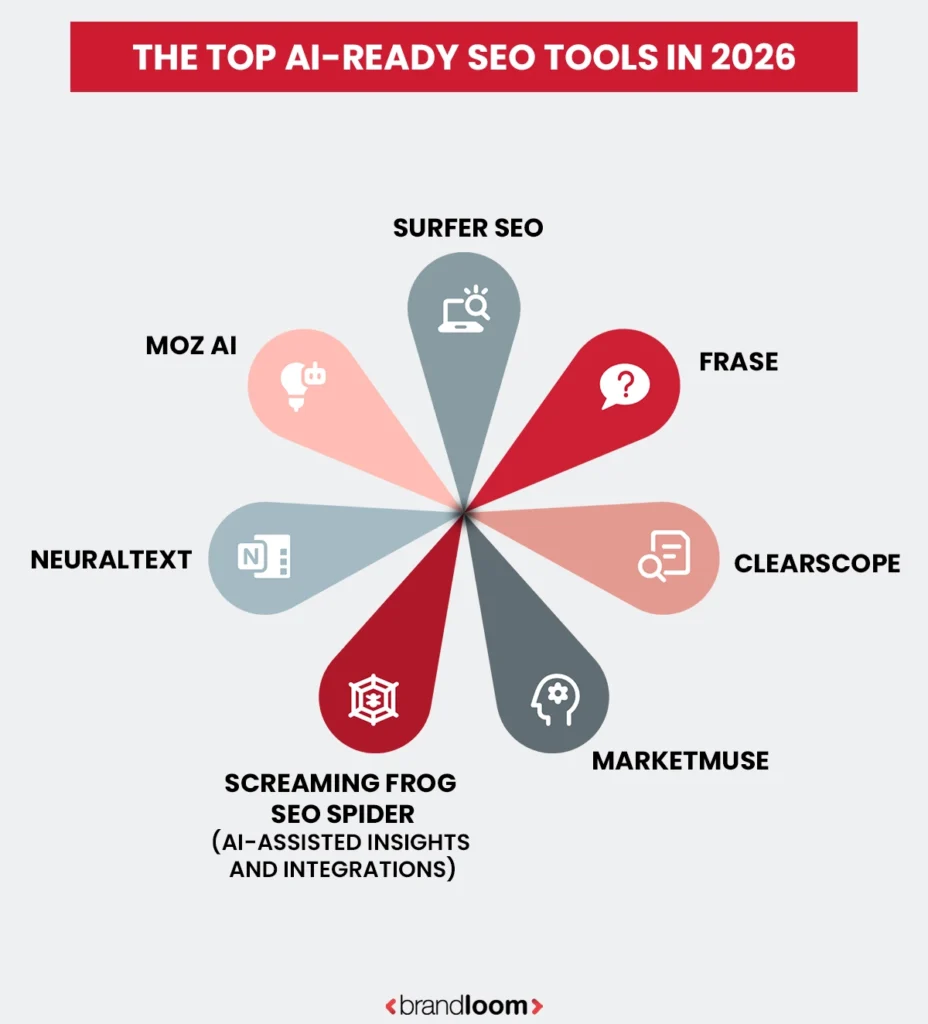
Here we will check out the AI-powered, top SEO tools for 2026 that can help your brand stay ahead of the pack:
1. Surfer SEO
A popular and versatile AI-powered tool for content optimization, Surfer SEO uses AI-driven content analysis. You get real-time optimization suggestions for aligning content better with Google’s evolving search algorithms. This tool lets you assess multiple aspects affecting content ranking and SEO, like semantic relevance, content length, and keyword density. Overall, it helps you optimize content for AI search engines.
Top features are:
- AI-powered content optimization based on semantic analysis and search intent.
- Real-time content suggestions powered by AI to improve overall SEO scores.
- SERP Analyzer offers you a thorough analysis of top-ranking pages. You get to know how AI interprets web search results.
2. Frase
Frase is a powerful AI tool that uses ML technology to develop optimized content. With it, you can automate content creation, and the tool ensures the created content is AI engine-friendly. It analyzes the top-ranking pages and offers AI-generated content briefs. This helps you understand what must be included in your content for maximum SEO impact.
Top features are:
- An AI Content Generator to let you create fully optimized articles quickly.
- Search Intent Mapping and content structure analysis to ensure your content matches the user search intent.
- Automated content gap analysis and providing recommendations on AI-based insights.
3. Clearscope
Rated among the top AI content optimization tools, Clearscope helps enhance the semantic relevance of your content. It is excellent for in-depth keyword clustering and content analysis. With these features, you can optimize content for both AI-powered search tools and human readers.
Top features are:
- AI-based keyword research to help you identify the best keywords for semantic relevance and search intent.
- Real-time recommendations for keywords, topics, and content adjustments, according to AI analysis of top-ranking pages.
- You get a content score showing your content performance compared to top-ranking pages.
4. MarketMuse
MarketMuse is an AI-powered content research platform that lets you fine-tune your content strategy. A strong SEO analysis tool, it uses advanced AI tech to perform detailed content analysis and competitive research. You get AI-driven insights on ways to address content gapsand enhancetopical authority.
Top features are:
- AI-based content analysis against competitors and recommendations for improving SEO.
- Assistance in developing topic clusters based on AI’s search intent interpretation.
- Content gap identification and suggestions for resolving those to get a better ranking.
5. Screaming Frog SEO Spider (AI-assisted insights and integrations)
Well, Screaming Frog is not a new contender, and it is a favorite tool for technical SEO. However, this powerful SEO audit tool now offers you advanced AI features. It brings in AI-powered insights into its strong site crawling and auditing capabilities. SEO analysts can better understand how search engines interpret site structure and web content.
Top features are:
- AI-powered site audit for spotting SEO issues that traditional crawlers usually miss.
- Real-time performance tracking with AI suggestions for a quick fix.
- Link building insights recommended by AI for getting quality and relevant backlinks.
6. NeuralText
A robust AI SEO software, NeuralText, is good for content creation and keyword research. It comes with advanced NLP and ML algorithms to automate tasks like content generation, optimization, and keyword discovery. SEO professionals love this tool to polish their content workflow, from ideation to optimization, with AI-based insights.
Top features are:
- AI Content Generation, including SEO-optimized articles, blog posts, and other content types.
- AI-driven keyword research, including competitor content analysis, semantic clusters, and search trends.
- AI-powered Content optimization for matching search intent and semantic relevance.
7. Moz AI
This is among the most powerful and versatile AI SEO optimization tools. The existing suite of SEO tools of Moz now features AI enhancements for better SEO audits, keyword tracking, andbacklink monitoring. It helps you optimize websites for better search intent alignment and real-time performance tracking.
Top features are:
- AI-enhanced Keyword Research to assess both search intent and volume, offering SEO analysts insights for keywords aligning with AI engine algorithms.
- Real-time website audits for analyzing your content relevance, site structure, and internal linking, with actionable optimization insights.
- Comprehensive backlink analysis and monitoring for checking relevance and quality.
- In-depth SERP Analysis to find out how AI algorithms rank different pages on user intent and contextual relevance.
Of course, you will find many more worthy AI SEO software, including AirOps, Ahrefs AI Content Helper, Ranking Raccoon, and Rankscale.ai. You may feel baffled by the abundance, and picking the right ones for your needs may be tough.
Count on the expertise of BrandLoom’s AI SEO analysts to select the apt ones and develop a fitting strategy. Our SEO experts use feature-rich and functional tools, including Semrush, Agency Analytics, Google Search Console, and Google Analytics, to benefit client companies.
A Snapshot of the top AI SEO Software You can Use
| AI SEO Tool | Key Features | Best Used For |
| 1. Surfer SEO | AI-powered content optimization based on semantic analysis. Real-time content suggestions. | Aligns content with Google’s evolving algorithms. Optimizes ranking factors. |
| 2. Frase | AI Content Generator, Search Intent Mapping, and Automated content gap analysis. | Automates content creation. Matches content with user search intent. |
| 3. Clearscope | AI keyword research for semantic relevance, Real-time content recommendations, and Performance scoring. | Optimizes content for both AI engines and human readers. |
| 4. MarketMuse | AI content analysis, Topic clustering based on search intent, and Content gap identification. | Fine-tunes content strategy with AI insights. Resolves content gaps. |
| 5. Screaming Frog SEO Spider (AI-assisted insights and integrations) | AI-based site audit, Real-time performance tracking, and AI link-building insights. | Improves technical SEO. Tracks site performance and backlinks. |
| 6. NeuralText | AI Content creation. AI keyword research. Content optimization for search intent. | Automates content creation and optimization. Offers keyword insights. |
| 7. Moz AI | AI-enhanced Keyword Research. Real-time website audits. Backlink analysis and monitoring. | Provides real-time SEO insights. Optimizes keyword tracking and backlinks. |
Choose the Right AI SEO Tool Based on Use Case
When checking out AI-powered SEO tools for your website, you must understand the nuances of your SEO strategy and how a tool aligns with the workflow. An AI SEO strategy is not a one-size-fits-all solution. The right AI tool selection will depend on your specific goal, like link building, content optimization, keyword research, etc.
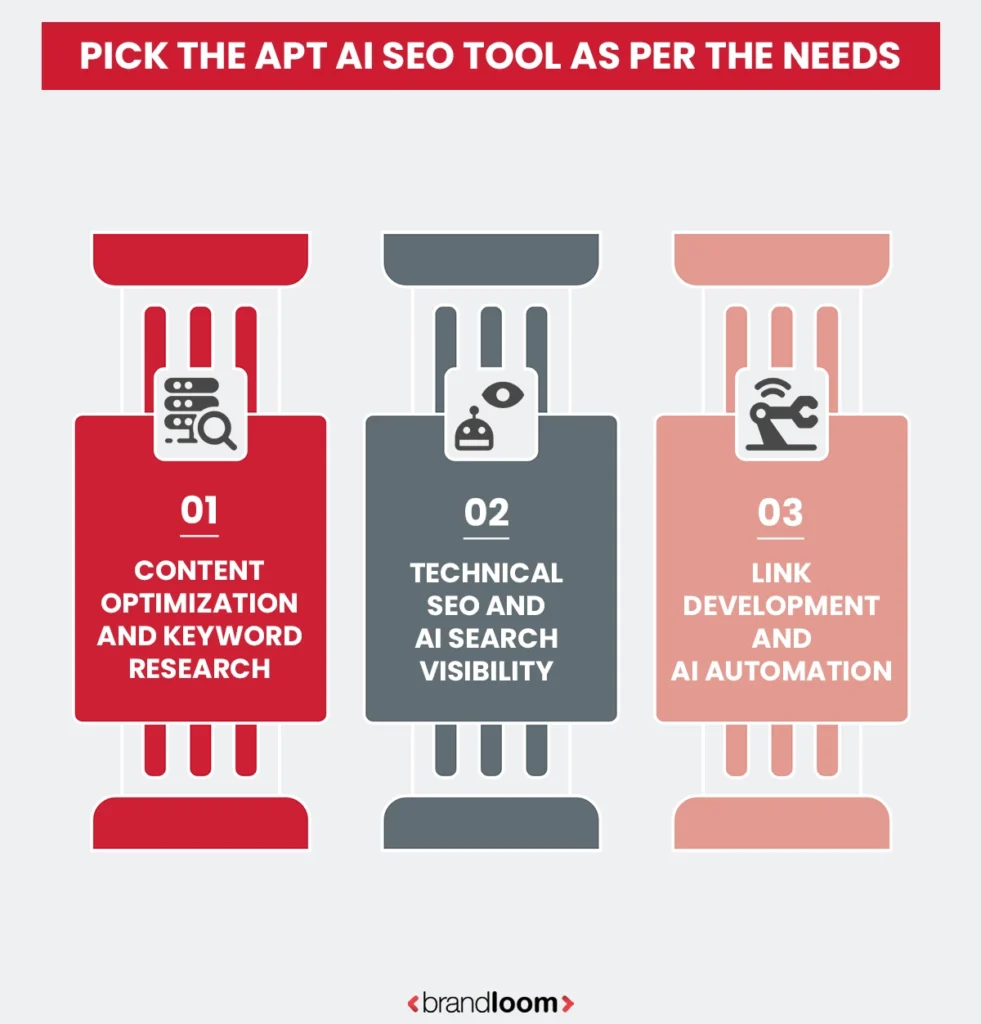
1. Content Optimization and Keyword Research
Even before the arrival of AI technologies, Content optimization and keyword research served as the pillars of SEO. The noteworthy thing is that AI is now transforming both.
Top contenders are:
1. Surfer SEO and Clearscope are ideal for real-time content optimization. These AI content optimization tools let you identify content gaps, analyze top-ranking pages, and optimize your content for search intent and semantic relevance.
2. Frase is another powerful tool for content research and creating AI-ready content. It offers AI-driven content suggestions, automated content briefs, and with it, you can create content that AI engines prefer.
3. The top SEO tools for keyword research, namely SEMrush andAhrefs, now offer AI-powered keyword research capabilities. They focus on search intent and competition analysis, letting you look beyond basic keyword queries.
2. Technical SEO and AI Search Visibility
If your brand is focusing on technical SEO, choose website SEO tools that help identify crawling issues, analyze site architecture, and track AI visibility in real time. With regular SEO tools, you will struggle to get insights into the AI models’ way of site structure analysis. With AI tools for SEO, you can overcome that hurdle.
Top contenders are:
1. Screaming Frog, a popular tool used by SEO professionals for site audits, now comes with several AI enhancements. You get more accurate, in-depth insights into how search engines interpret websites.
2. Another useful AI SEO software is BrightEdge, which scores for its AI-based insights. It lets you monitor AI search visibility and track performance in real time. You get to know how Google’s AI systems, such as BERT and RankBrain, help interpret queries and content context.
3. Link Building and AI Automation
Link building continues to be a major aspect of SEO. AI technology has made it faster. With suitable AI SEO optimization tools, marketers can now automate backlink analysis. They can also find newer link-building opportunities and analyze the quality of backlinks more efficiently.
Top contenders are:
1. CognitiveSEO offers AI-driven backlink analysis and lets you assess the relevance and quality of links with better accuracy than manual methods.
2. Frase also lets you automate backlink discovery by analyzing top-ranking pages. It also finds out the websites that are linking to your competitors.
Picking the right AI SEO tool can be tough, especially given its interlinked, overlapping functionalities. The same applies to developing the right AI SEO strategy. Let the experts in modern SEO and digital marketing handle the task. With the coveted IMFINDIA Agency Excellence Awards 2025 in its bag, BrandLoom is your best partner in AI SEO roadmap creation.
Best Practices for Using AI SEO Tools Effectively
To ensure you get expected results from AI-powered SEO tools, follow these practices:
- Feed Clean Data – AI models work well when they get clean, well-organized data. So, focus on the accuracy and relevance of keywords and content inputs.
- Combine tools tactically – Different SEO tools serve different areas of workflow, so choose them wisely. The combination must be synergistic.
- Focus on User Intent – Without a focus on user intent, ranking visibility won’t go up.
- Audit AI Output – Analyze AI-generated content for tone, accuracy, and E-E-A-T for quality output.
- Track ROI Metrics – Analyze the effect of AI SEO tools by observing engagement, rankings, and traffic. This is a must for ROI growth.
The Future of AI SEO Tools – Beyond 2026
AI-powered SEO tools offer much more than just automation; they are turning into strategic partners for future-ready SEO roadmaps. They understand nuances like context, brand voice, and user search intent.
Looking ahead to 2026, you can expect some developments in these tools:
- Advanced SEO optimization for voice and multimodal platforms, covering chatbots and augmented reality (AR), and voice search.
- Emotion-based ranking metrics focused on user experience and engagement signals.
- Real-time, continuous AI SEO audits for enhancing your SEO strategy.
- More integrated AI agents for automated SEO campaign optimization, capable of making data-based decisions.
You can expect AI SEO tools to become more integrated in your SEO workflow, requiring less manual input, saving time, and bringing better results.
How to Develop a Modern SEO Tech Stack: Key Considerations for 2026
As AI has become integral to the SEO realm, your brand needs a modern SEO tech stack that aligns with the needs of AI search models. The focus must be on real-time data analysis and content optimization. Your brand must utilize the power of AI SEO software for task automation, getting actionable insights, and aligning with evolving AI algorithms.
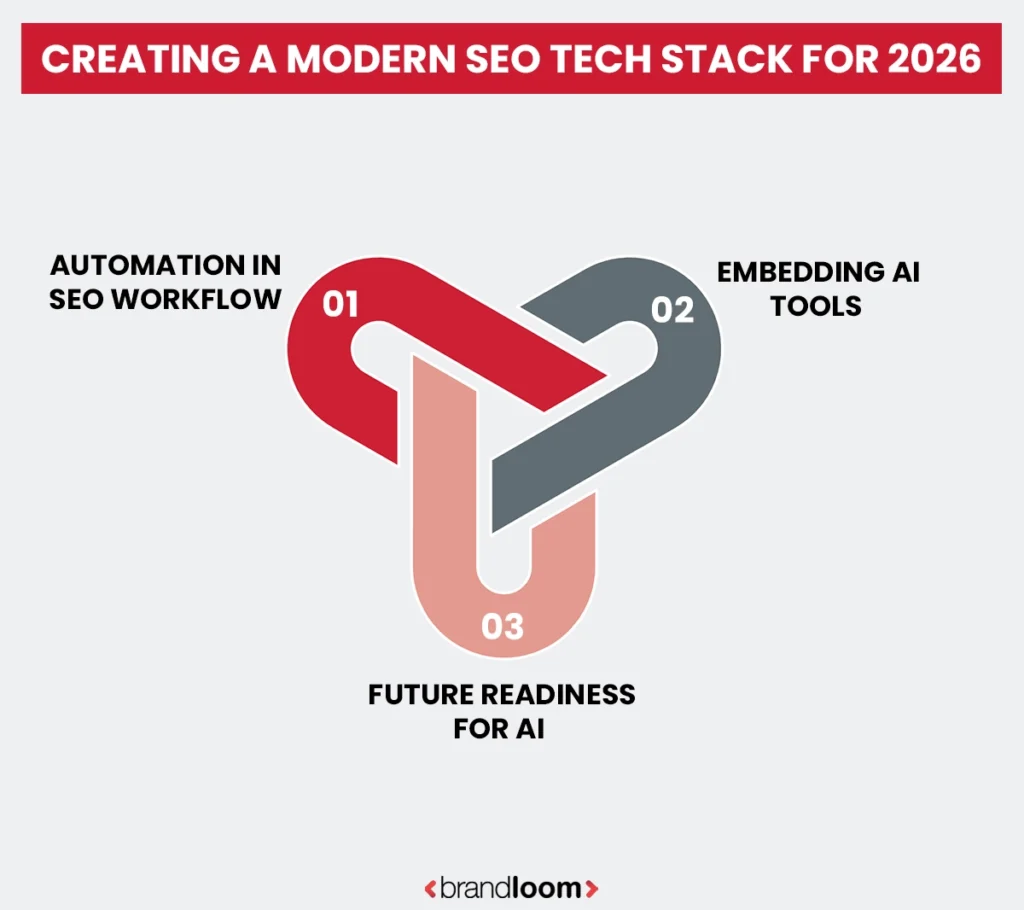
1. Focusing on Automation in SEO
One nice thing about AI SEO tools is that they let you automate and speed up several manual processes that would take hours in manual mode. AI-powered tools like Clearscope, Surfer SEO, and Frase help marketers create optimized content, analyze top-ranking pages, and observe SEO performance.
2. Integrating AI Tools
An effective SEO tech stack in 2026 needs integration of different functions- like link building, keyword research, technical SEO, content creation, etc. To facilitate this, you must combine effective AI-powered SEO tools. For example, using Screaming Frog’s AI-powered site audit with Frase’s content optimization capabilities will benefit your brand. You will get relevant and optimized content that is also AI search-friendly.
3. Scalability for Future Readiness
With AI becoming closely knit in the SEO fabric, your brand needs AI tools for SEO that offer scalability and flexibility. The tools you choose must sync with each other well, offering you multiple AI SEO benefits. This is what you need to develop a competitive, future-resilient SEO strategy.
Even with the top SEO tools in your hands, you won’t be able to utilize their AI capabilities without expert assistance. You will need expert guidance for developing a robust and customized SEO tech stack that aligns with AI search trends and needs. At BrandLoom, we have the expertise to develop a niche-specific AI SEO tech stack for clients, aligning with their growth plans.
Conclusion
As SEO continues to evolve, the tools used in the workflow will evolve too. In 2026, you must look beyond dated SEO optimization tools, focusing on keywords alone. It is time you embrace AI-powered entity SEO tools and experience better and more consistent AI search visibility.
With Google and other search engines choosing AI search models and search intent, you need an SEO strategy based on real-time adjustments and dynamic content optimization. This will make your content liked by AI engines, and that will appear more in AI overviews.
Now, you can choose from a wide range of AI SEO tools like Moz AI, Frase, Surfer SEO, Clearscope, etc. These are functional SEO optimization tools with inbuilt features for SEO audit, entity optimization, and checking keyword intent. When you use them in the right ways, your content aligns with both user intent and AI search engines.
Just picking the top SEO tools for 2026 is not enough for your brand growth. You need a robust, future-ready AI SEO strategy and nuanced guidance to optimize and produce AI-friendly content.
That is where BrandLoom steps in. Count on our proven expertise in digital marketing and SEO, covering numerous clients from different sectors. Let our AI SEO experts develop and implement your AI-ready SEO roadmap.
FAQs
The best SEO tools 2026 combine prevalent SEO features with new AI capabilities to optimize content for both AI search visibility and organic ranking. You can pick from AI SEO tools like Surfer SEO, Frase, andClearscope. These tools use NLP to assess top-ranking pages and optimize content for semantic relevance and user intent.
Semrush One offers a mix of AI visibility insights with regular keyword and backlink analytics. If you need an AI-powered SEO audit tool, Screaming Frog, with its AI-assisted insights and integrations, fits the bill. For AI-assisted analytics and keyword research, you can choose tools like BrightEdge and Moz AI. If you are confused by the abundance of SEO optimization tools, seek the expertise of leaders in digital marketing and SEO, BrandLoom.
AI-powered SEO tools differ from older SEO tools in some key aspects, like automation, speed, and functionality. Most regular website SEO tools depend largely on manual tasks like keyword lists, backlink tracking, and static site audits.
New-era AI-powered SEO tools rely more on ML and NLP to automate manual processes and make the SEO workflow faster. They can handle really large datasets, check patterns, and automatically suggest optimization choices. You will still need regular SEO to cover basics like quality content and link authority. New AI SEO tools add features like predictive analytics,real-time intelligence, and search intent analysis.
Yes, keyword tracking remains a key part of the SEO workflow in 2026, despite the changes in the scene. However, on a closer look, you will find that the way tools track and use keywords has changed.
Traditional SEO optimization tools monitor aspects like keyword positionsand search volume. However, AI-powered SEO tools can assess keyword intent, semantic relevance, and content performance in AI search features. In tools like SemrushandAhrefs, you will find new AI capabilities to make content better optimized for AI search engines.
You can use several modern AI content optimization tools that help marketers with Google AI overviews. The result is an appearance in AI-created summaries at the top of search results. If you are looking for SEO tools for Google AI Overviews, choose Semrush and Ahrefs.
They come with specific features to let you assess AI visibility of content. Additionally, you can resort to newer tools like Profound that focus on AEO. Then you can find out if your site content finds a place in Google AI summaries and other LLM-driven results. These tools mix traditional SEO metrics with AI search visibility tracking, letting you optimize content for both AI overviews and classic SERP ranking.
Entity-based optimization focuses on context and meaning over just isolated keywords. This helps AI-powered search engines better understand the link between concepts and topics. For reliable and functional entity SEO tools, InLinks will fit your bill. It can automate schema markup, entity tagging, and internal linking to boost semantic relationships on your site.
Then there are platforms like Yext, Conductor, and BrightEdge that can surface topic clusters and entity signals for semantic SEO planning. Besides, you can use structured data tools like Schema App’s Entity Hub. It lets you define, link, and assess digital entities at scale, making your content and site structure AI- ready. Contact our AI SEO experts at BrandLoom for guidance to combine these tools with apt content optimization platforms.
Yes, and the reality is that startups and brands with modest budgets look for the best free SEO tools even in 2026. Don’t dismiss free SEO tools; they can still help with core SEO tasks like indexing, performance monitoring, and basic keyword research. SEO experts still recommend using tools like Google Analytics and Google Search Console as these offer essential data on search performance, site health, indexing issues, traffic trends, etc.
There are other free SEO research tools like Ubersuggest, and you can also use performance tools like PageSpeed Insights. However, our SEO analysts at BrandLoom recommend not relying solely on free tools, as they lack advanced AI features like predictive analytics.
To measure AI search visibility, you need to look beyond just traditional rank tracking. It is necessary to monitor how your content is mentioned and shown by top generative AI models and tools like Gemini, Claude, and ChatGPT. With newer tools like Peec AI, SEO teams can track AI citations and get real-time insights into AI search visibility.
With SEMrush One, you get AI visibility metrics into traditional dashboards. There are other AI visibility tracking tools you can try, like SE Ranking’s AI Visibility Tracker,Rankability, AIclicks, etc. The insights offered by such AI SEO software help you tweak your SEO strategy for AI.
In an AI-first SEO scene, content optimization needs a tool with features like SERP understanding, machine learning, and semantic analysis. In platforms likeClearscope and Surfer SEO, you get AI-based content scoring and recommendation engines. These enable marketers to polish content for search intent and relevance. Frase blends content generation with optimization workflows, while analyzing top-ranking pages in real time.
You can also check out semantic SEO software like NeuronWriter that offers competitor insights and semantic optimization. Some top SEO tools for 2026 also integrate directly with Google Search Console. This maps optimization suggestions to real performance data, which is very effective for AI-ready content strategies.
There is no fixed number of SEO tools your business can use in 2026. Several small to large-sized businesses use more than one SEO tool, as per their workflow and growth needs. However, industry practice points to the benefits of using a purpose-driven SEO stack over choosing a lot of SEO apps.
Our SEO experts at BrandLoom suggest using 1 to 2 tools at each stage of the workflow. These include – content optimization, keyword research, technical SEO, andperformance tracking. A lean stack helps you stick to the budget, avoid redundancy, and makes it easier for the team. For a startup, using a combination of a content optimizer like Surfer SEO, a keyword research platform like Semrush, and a technical audit tool like Screaming Frog makes total sense.
To develop an effective SEO tech stack for 2026, focus on your SEO goals – like competitive insights, technical health, AI search visibility, and content performance. Find out the must-have SEO functions like analytics integration, intent tracking, AI-driven content optimization, site audit, and technical SEO.
Choose AI-powered SEO tools that complement each other and sync with your workflow. Keeping one focused SEO tool per workflow suits most brands. The stack must integrate well with your CMS and analytics system. For nuanced insights on SEO tools for enhancing AI search visibility, consult our AI SEO analysts at BrandLoom.