Hi there,
As AI agents quietly become the next interface layer of the web, many brands are scrambling to “optimize for AI” as if it’s an entirely new discipline.
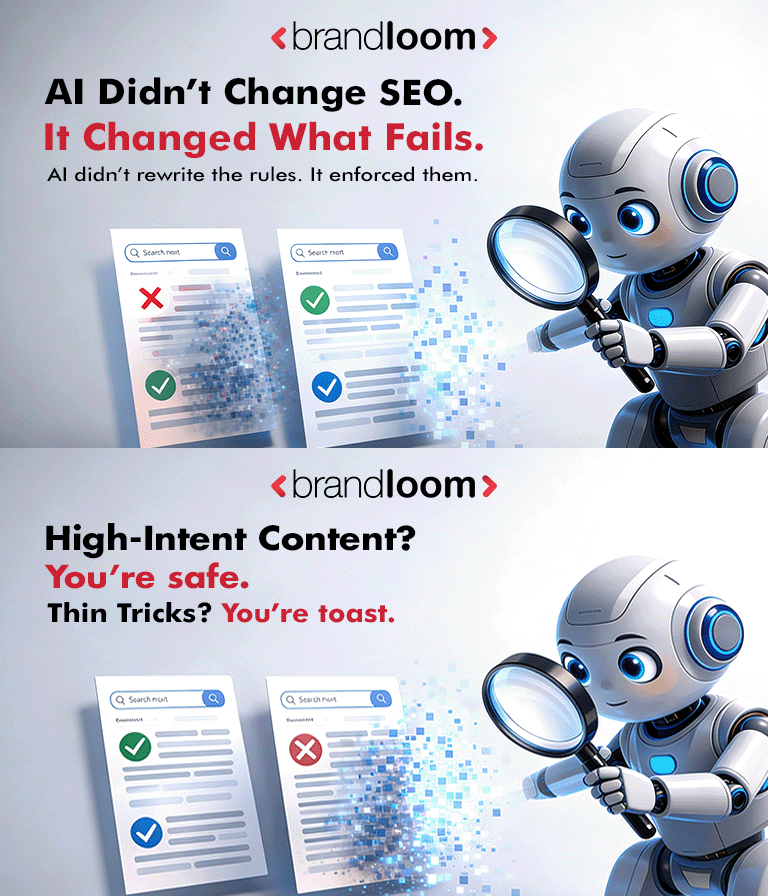
AI agents are not reinventing the web. They’re traversing it differently.
And that distinction matters more than any shiny new acronym.
Over the past year, we’ve seen billions flow into AIO, GEO, and “AI SEO” tooling often built on the assumption that traditional SEO is suddenly obsolete.
According to the people actually building AI infrastructure, that assumption is wrong.
AI Agents Are Built on Old Foundations
AI agents use the same infrastructure search engines always have.
They:
– Discover entities through search indexes
– Evaluate trust through authority signals
– Traverse the web via links
– Understand offerings through content
ChatGPT uses Bing. Claude uses Brave. Google uses Google.
The mechanics haven’t changed.
What’s changed is who’s doing the traversing.
That means the brands winning with AI agents tomorrow will be the same ones that made themselves legible, authoritative, and intentional for machines yesterday.
“AI SEO” Is Mostly Long-Tail SEO Wearing New Clothes
Much of what’s being sold as AI SEO today is simply long-tail optimization done properly.
- Schema.
- Semantic density.
- Clear interlinking.
- Accessible structure.
Not hacks. Not magic. Not model-specific tricks.
Just content that’s easy to parse, easy to contextualize, and easy to trust.
The irony? These are the exact fundamentals many publishers ignored while chasing traffic shortcuts over the last decade.
What Content Looks Like When It’s Built for Agents
Where things get interesting is how content should be structured.
We’ve observed a clear shift toward “intentional” content
Content not designed for human scrolling, but structured specifically for AI agent consumption.
That means:
– Clear hierarchy (what matters most vs. what’s supplementary)
– Progressive disclosure (summary first, depth second)
– Semantic and structured markup
– Clean relationships between pages and entities
And that’s the key shift.
AI agents don’t reward verbosity. They reward clarity of intent.
The Bigger Shift Most Brands Are Missing
Here’s where this becomes strategic, not technical.
– Content becomes separable from websites
– AI agents communicate with other AI agents
– Websites act more like data sources than destinations
In that world, design matters less than definition.
If your content can’t clearly answer:
– What is this?
– Who is it for?
– Why does it matter?
– How does it relate to everything else?
Then no amount of AI tooling will save it.
Why This Matters Right Now
There’s a dangerous misconception forming:
That AI optimization is about adapting to models.
In reality, it’s about making your brand unambiguous to systems that synthesize reality on behalf of users.
Agents don’t want clever copy. They want reliable signals.
And the brands that win won’t be the ones chasing every new AI update, but the ones that:
– Structure information intentionally
– Maintain consistent entity signals across the web
– Treat content as infrastructure, not decoration
What Smart Teams Should Be Doing Now
Instead of panicking about AI agents, focus on fundamentals that scale:
- Make your content explicit about purpose and audience
• Use structure to guide interpretation, not just ranking
• Strengthen internal linking to clarify relationships
• Treat schema and semantics as strategic assets
• Audit how your brand is represented across AI-accessible surfaces
AI agents don’t need new tricks.
They need clean inputs.
The Bigger Picture
We’re not entering a post-SEO world.
We’re entering a post-sloppy-content world.
AI agents are less forgiving than humans. They don’t infer generously. They don’t scroll patiently. And they don’t guess intent when signals are weak.
The brands that survive this transition will be the ones that stop asking: “How do we game AI?”
And start asking: “How do we make ourselves impossible to misunderstand?”
At BrandLoom, we help brands prepare for that future by structuring content, entities, and authority in ways that AI systems can reliably interpret today and as agents become more autonomous.
👉 👉 Book a free strategy session to assess how prepared your content is for AI agent consumption.
P.S. If you missed our last edition, read:
#89 – AI Answers Are Easier to Influence Than You Think
That’s all for now. Keep adapting. Keep leading.
Yours Sincerely,

Avinash Chandra
Founder, BrandLoom Consulting
🌐 https://www.brandloom.com/
☎︎ +91-7669647020
📩 care@brandloom.com
💻 https://team.brandloom.com/book-a-meeting
1. Note: If you feel like talking, just hit reply on this mail.
2. Fun Fact: 82% of BrandLoom clients see an uptick of at least 20% in their revenue after the implementation of BrandLoom’s strategies.
BrandLoom Is Regularly Featured In :

Meet Us At:
Gurgaon. Mumbai. Pune. New Delhi. Bangalore. Texas. New York. London.