Have you noticed how our web browsing experience is changing, gradually but in an obvious way? Earlier, you used to get 10-12 links per web search query, but now you see something different. An AI overview appears at the top, with required information presented neatly in a box. That is the result of AI technologies changing the internet experience. Welcome to the era of entity SEO.
Earlier, keywords were pivotal in deciding web search results, but things are changing. AI systems have taken over, and different AI agents from the stables of Google, Meta, and newbies like Perplexity are taking over. This is the beginning of AI search visibility.
With zero-click searches and AI-generated answers going mainstream, your SEO strategy needs a revamp, too. Over 60% of Google searches in the USA now end without a click, according to the latest data.
Entity-based SEO makes the aging practice of keyword-chasing less relevant. Now, the focus is on optimizing your content for entities, real-world, well-defined things that search engines and AI can understand and choose. Think about how to become a recognized and trusted authority on a subject, not just ranking for a set of keywords.
But first, you need to understand what an entity in SEO and the role it plays in your brand’s SEO strategy. For this, you need the nuanced guidance of SEO analysts and AI marketing experts. That is precisely where BrandLoom steps in.
In this blog, we will explain what are entities in SEO, how to develop an effective Entity SEO strategy, and where and how things have changed.
What is Entity SEO?
So, what is entity-based SEO? Unlike traditional SEO, which focuses on ranking specific keywords, Entity SEO focuses on optimizing content for entities. Are you unsure what an entity in SEO? An entity denotes a distinct, well-defined concept recognized by AI systems. An entity can be a person (like Sam Altman), a place (e.g., London), a product (e.g., Nothing Phone 3A), or even a concept (e.g., machine learning).
Entity SEO ensures your brand, product, or topic gets recognition by AI tools and agents as a leading authority within its domain. You may think of entities as large topics that keywords live within. A legitimate entity must be linked to a search engine knowledge graph. It represents linked information and data across the internet. Also, search engines can scan your website better with knowledge graphs.
The Move from Keywords to Entities
Earlier, SEO was focused on ranking for keywords like “SEO software” or “digital marketing tools,” etc. Entity SEO targets the wider entity associated with those phrases. The main difference is in contextual relevance. AI tools like Perplexity or Google AI will not only match user search queries with keywords. They will interpret contextual meaning through entities, setting up a semantic relationship between words and concepts.
For example, think of a person searching for Apple products. Perplexity AI, ChatGPT, and similar tools will figure out whether the person is referring to the tech brand or the fruit, based on the context. This is how entity optimization is enhancing the internet usage experience for your target users.
Why Entity SEO Matters for Modern Search?
AI systems use entities to deliver highly relevant search results to users. They also summarize topics based on analyzing the relationship between words and their wider meaning. That is why your brand website needs AI search optimization. You should try to become a well-known entity within your niche to improve AI search visibility.
For effective entity SEO, you must refine the brand’s content strategy to focus on topical authority. Also, the entities must be interconnected and properly described for ranking in AI search consistently.
Why Search Engines and AI Prefer Entities Over Keywords?
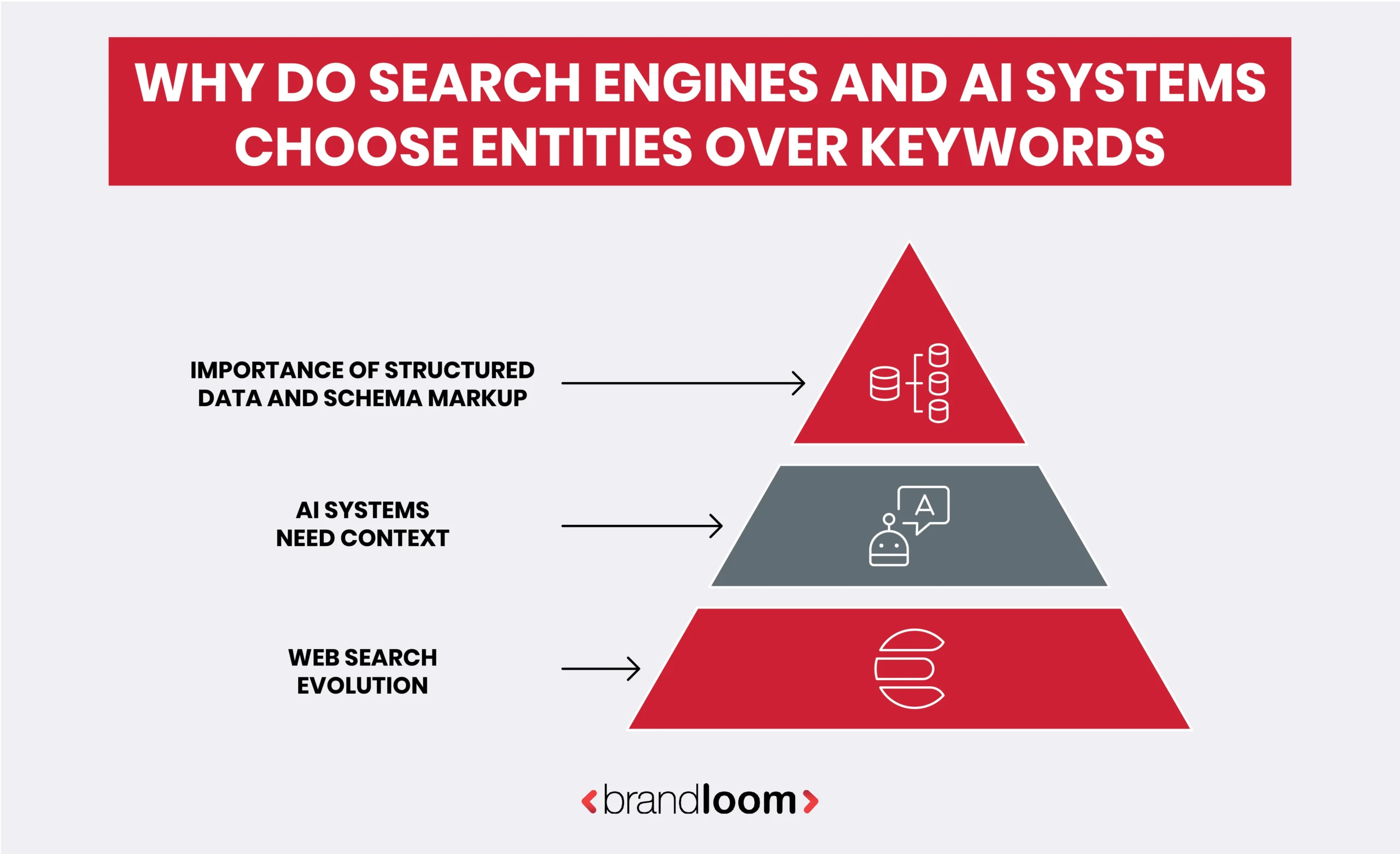
The move to entity SEO shows a fundamental change in how search engines and AI systems interpret and rank content. You will still need to use relevant keywords for SEO, but that is no longer enough. AI systems are now focusing on entities – well-defined concepts that go beyond simple web search terms.
The Evolution of Web Search
Google’s Knowledge Graph is a huge database that stores information about millions of entities and the relationships between them. This enables AI-powered search engines to focus on the context behind search queries. They analyze the contextual relationships between the entities involved beyond just keyword matching.
They analyze and interpret the search context with better accuracy. The focus is on user intent and metrics like location, timing, demographics, etc. This deeper understanding helps search engines differentiate and rank entities accurately.
Context Matters for AI Systems
AI systems analyze user intent deeply, and that makes contextual relevance so important. They interpret the meaning behind user queries. This is evident when you look into ChatGPT search optimization. Such AI systems use natural language processing to analyze the relationships between words, phrases, and entities in a better way.
You will find the dominance of zero-click searches online in an unprecedented way. Your users are getting answers directly in the search results, as featured snippets. This clearly shows the power of entity SEO for AI search.
Why Structured Data Is Essential for Entity SEO?
It is important that your brand website content is properly optimized for AI search visibility. Modern AI tools prefer websites with structured data for SEO. When your site content includes schema markup, search engines can recognize and understand entities within it. Structured data will help Google AI and other search engines to better interpret content and associate it with relevant entities. Your brand will feature more regularly in AI search results.
Building Topical Authority with Entity SEO
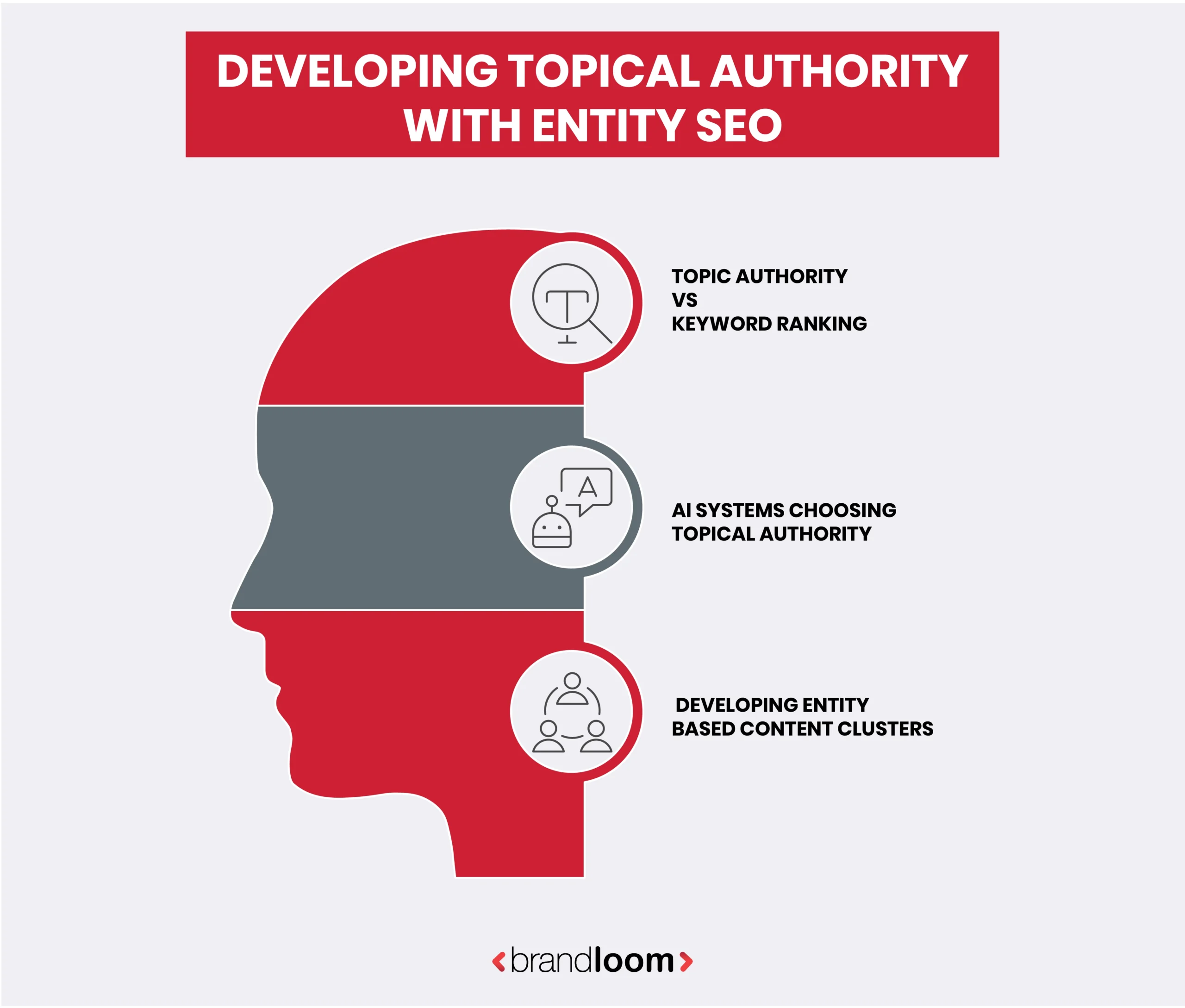
For SEO, marketers used to focus on individual keywords for better ranking. In the entity SEO era, the focus is clearly on building topical authority. That is where the concept of entities comes into the picture. Optimize your website content with a focus on entity SEO for AI search. This way, your brand will become a trusted, authoritative source.
Topic Authority vs Keyword Ranking
In an AI-driven search landscape, topical authority is far more important than keyword-based ranking. Earlier, your company could get a ranking for isolated keywords. But now, AI systems and search engines prefer a more holistic approach to content. This is the era of contextual SEO optimization, and becoming an entity in the domain is crucial for better AI result visibility.
If you have a digital marketing firm, do not aim for ranking for the keyword “digital marketing”. Your target should be to get recognized as the leading authority on digital marketing tools, SEO strategies, etc. As you develop authority around a specific entity, AI systems and modern search engines will rank your content for related queries consistently.
How AI Systems Reward Topical Authority
Leading AI systems value contextual relevance over individual keywords. You will find Search engines using Knowledge Graphs and semantic models to find out the relationships between entities. You need to offer comprehensive, in-depth content covering all angles of a core entity, like a product or service. Then search engines will show your site or products more in search results. It will also appear more in AI overviews.
AI-based systems, like ChatGPT and Google AI, look for consistent, authoritative content covering multiple aspects of a topic. So, you need to create content that is comprehensive and structured. A brand that covers a wide range of topics around “SEO”—from keyword research and on-page SEO to technical SEO — will become an authoritative entity for AI systems. It is also important to include diverse entity-related queries in your site content.
Creating Entity-Based Content Clusters
To establish topical authority for your brand, focus on making content clusters around a key entity. These are like interconnected pages that cover different aspects of a key entity. That shows search engines understand your domain expertise.
Let’s say the entity is “content marketing”. You can develop content on SEO for content marketing, tools, strategies, or even case studies on it. Each of these pieces of content must link to the main page covering the entity in detail. When you regularly publish high-quality content around a key topic and link it together, it sends a clear signal to AI systems and search engines. Your brand’s AI search visibility goes up as a result. A great real-world example is HubSpot’s topical authority on inbound marketing and related entities.
You will need expert insight and a customized entity optimization strategy for topical authority. At BrandLoom, we can make that happen. Our veteran digital marketers and AI SEO experts will do the needful for better ranking in AI answers, consistently.
How to Optimize Content for Entities
To optimize your brand content for Entity SEO, you will need a strategic approach. The focus should be on identifying, defining, and building relationships around your major entities. Here’s what you can do for entity optimization:
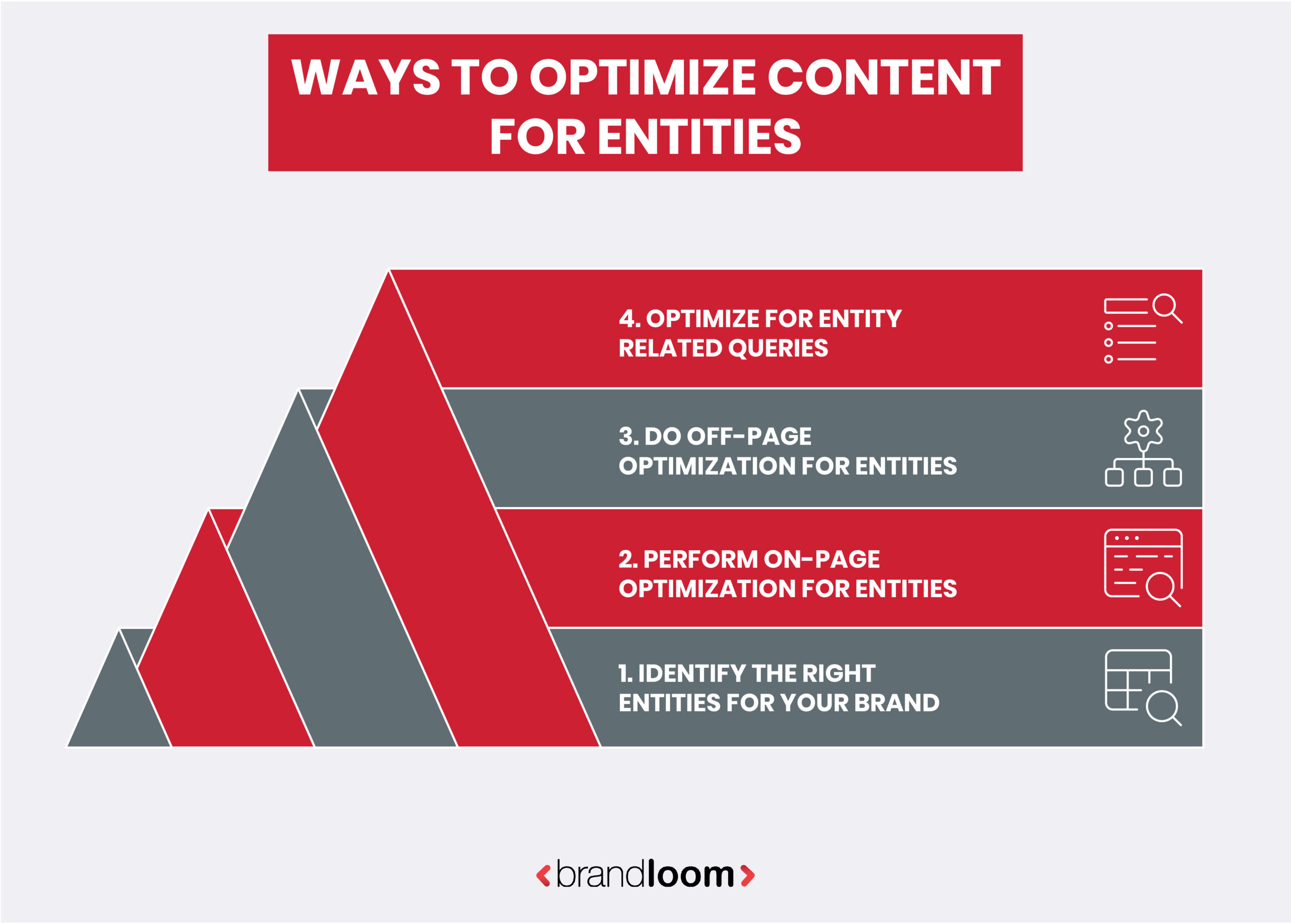
1. Identify the Right Entities for Your Brand
For effective entity optimization, you must identify the core entities central to your business and sector. These could include abrand name, a specific product, or even concepts. So, cloud computing can also be an entity. You must clearly define which entities matter most to your brand and target users.
With tools like Google Trends and Ahrefs, you can identify popular terms and entities within your industry. But then you must look beyond keywords. For example, if your brand offers digital marketing services, its core entities should cover SEO, content marketing, and PPC advertising. Then you must optimize content for these broader entities.
2. On-Page Optimization for Entities
To make search engines and AI systems understand the entities in your content, integrate them into on-page SEO. Here’s how:
- Entity Keywords & Context – You should use relevant entity-related keywords in your headings, meta descriptions, and body content. This lets search engines associate your content with the right entity. So, for the entity “digital marketing,” create content covering related sub-entities like SEO, PPC, and social media.
- Schema Markup & Structured Data – Your site content must contain schema markup to help search engines understand and identify entities. Using JSON-LD or Microdata is helpful here. Consider adding an Article schema for blog content and a Product schema for a product page, for example.
3. Off-Page Optimization for Entities
Apart from on-page efforts, focus on off-page SEO for semantic entity optimization. Here’s what you should do:
- Backlinks & Citations – Your brand site must have backlinks from trusted sources for better entity development and ranking in AI answers. The source sites must be well-known and high-authority sites.
- Entity Mentions Across the Web – Mentions of your brand or entity across the web, including social media, blogs, and forums, are crucial. A mention of your brand or site on authoritative sites leads to topical relevance and entity recognition.
- Online Reputation Management – The online reputation of your brand affects how AI systems treat your entity. When it gets positive citations and mentions across high-authority online sources, that adds to trust and authority, and ranking in AI-powered search results.
4. Optimize for Entity-Related Queries
Your entity optimization strategy must include answering entity-related questions. These may include queries like:
- “How does machine learning improve marketing strategies?”
- “What are the top content marketing tools?”
- “What is AI SEO and how does it work?”
Your aim should be to optimize your content to answer these types of questions. Then AI systems can better understand your entity’s relationship with broader topics. Your brand will get consistently high ranking in AI answers. You can see how HubSpot has built topical authority around the entity “inbound marketing” and appears a lot in AI-generated answers and snippets.
At BrandLoom, we offer the expertise and guidance to develop a powerful entity optimization strategy. Contact our AI SEO strategists and marketing experts to experience the transformation.
How Entity SEO Powers AI Search Results?
The growth of AI-driven search experiences has drastically changed how your target users see and read content. AI tools don’t only match keywords to ranked pages. Google AI Overviews, ChatGPT, Perplexity, and similar tools extract, analyze, and generate answers directly from web content. So, your brand must prioritize content for both search engines and AI systems for better online visibility. This practice is often referred to as Answer Engine Optimization.
How AI Search Systems Use Entities?
AI search tools analyze web content differently from traditional search engines.
- AI models understand user intent and search query context, probing deep into the underlying meaning, to fetch the most relevant information available.
- They parse entities (people, places, concepts, and brands) in your content. They analyze how these entities relate to one another.
- Rather than offering users links, AI tools synthesize answers using trusted sources, creating an overview or snippet.
So, entity-based SEO is more about integrating understandable signals into your content than just creating optimized pages. Then AI systems can confidently extract and cite your material when answering user queries. You must structure your brand content in the right way for a better understanding of AI models.
Why Entities Matter in AI Answers?
AI search systems look for trusted, structured, and contextually rich content. When they find content with clearly defined entities, they pick those for overviews and snippets. SEO metrics like SERP ranking are no longer enough for better online visibility.
Major AI Search Signals for Entity SEO
Focus on the following when you want to improve your brand visibility in AI-generated answers through Entity SEO:
- Offer clear, defined answers to the most common entity-related questions.
- Improve E-E-A-T (experience, expertise, authoritativeness, trustworthiness) through citations, expert authorship, and verified references.
- Implement schema markup to label entities and their relationships for better machine understanding.
- Build content that centers on key entities and links to related topics to show depth and contextual relevance.
Future-Proofing SEO for 2026 and Beyond
It is clear that AI will be more deeply embedded in the SEO landscape. As the AI tools continue to evolve, your business must adapt to AI-powered search to stay competitive. It will need entity-based SEO to sustain and grow.
The AI Evolution in Search
AI is reshaping search by focusing on semantic relevance, context, and entity recognition. Modern search engines assess user intent through natural language processing and machine learning. They offer more accurate, AI-driven answers. With voice search and conversational AI becoming common, your business must tweak its SEO strategy for better AI search visibility. Your focus must be on creating AI-friendly content that is contextually rich and entity-centric.
Readying for AI-Powered Search in 2026
To future-proof its SEO strategies, your brand must focus on:
- Entity Optimization – Use structured data and schema markup in content for entity optimization and rank well in AI-generated answers.
- AI-Optimized Content – Create keyword-rich, AI-readable content with well-defined entities.
- Adapting to Voice and Visual Search – Your brand must optimize for conversational AI and entity-based voice queries for better visibility.
It is clear that your brand needs a powerful and well-planned entity optimization strategy to stay in the race. Contact BrandLoom and let our AI SEO and digital marketing experts take charge of your SEO needs.
Conclusion
AI tools and agents have become an integral part of the internet. As ranking in AI answers becomes crucial for sustenance, your brand needs a solid SEO strategy. For better AI search optimization, it must focus on entity SEO.
You must focus on topical authorityandstructured content for better entity optimization. These are a must for ChatGPT search optimization and getting ranked by other AI tools, too. With AI-driven systems giving priority to entities in search results, your brand must establish itself as a leading authority in its domain.
You will need the assistance of an ally with in-depth expertise in entity SEO strategy and AI technologies. Count on BrandLoom, a leader in digital marketing and SEO in India and abroad, for the killer entity optimization strategy development. We have designed the perfect SEO roadmap for several brands to remain competitive both in India and abroad.
Curious about how to get started on entity SEO? Give ourDigital marketing and AI SEO specialists a call.
FAQs
1. What is Entity SEO, and how does it work?
Entity SEO is the practice of helping search engines clearly identify who/what you are or the entity. An entity also defines what you offer and how you connect to other entities. An entity can be a specific person, product, service, or topic. Entity-based SEO works by using consistent, machine-readable signals across your site and the wider web by using structured data.
It looks for authoritative mentions and consistent brand details. Google uses structured data to understand page content and gather information about the world. If the signals align, AI search systems can locate your brand, connect it to relevant topics, and show it in overviews and snippets.
Traditional keyword SEO mostly optimizes pages to match online query phrases. It does not delve much into user intent or the context of the query. Entity-based SEO optimizes for meaning and enables search engines to understand the real-world context behind words, their attributes, and relationships.
Your users are directed to accurate, specific answers to their queries, rather than a list of web pages with links. Google’s own Search documentation says it uses a number of signals from keywords to content freshness. To develop a solid entity SEO strategy for your brand, rely on BrandLoom’s proven expertise.
In AI search, the system analyzes the meaning and context of a query rather than simply matching exact phrases. Entities (people, brands, places, products, concepts) give the model a stable “thing” to anchor on.
The reality is that different web users can enter queries about the same thing, place, object, or idea in many ways. They can even write messed-up prompts. AI answers need to blend factual details, context, and relationships when finding answers to user queries. These are easier to assess and connect using entity-based knowledge.
Most AI search systems operate in a similar way to generate answers or overviews for user queries. They analyze web queries, detect key entities, and then link them to the appropriate real-world contexts. They also fetch supporting sources from a web index and, sometimes, from structured databases called knowledge graphs.
The AI engines from the stables of Microsoft, Google, and Meta use LLM to understand the query, analyze large amounts of data, and then create a cohesive response with sources. The result is a summarized output to user queries, which changes the web searching experience.
Search engines recognize several entity types like people, organizations/brands, places, events, products/services, etc. They also identify concepts and ideas as entities. Google’s Knowledge Graph models real-world entities like “people, places, and things”.
With time, more types of entities can be defined and identified by AI-powered search engines. Content creators use structured data called Schema markup to clearly label and define these entities on their websites. This makes it easy for AI engines to interpret the content and define it as entities.
In 2026, entity optimization will be an integral part of SEO for any business. You can use structured data in the website’s pages consistently to make it easy for AI tools to locate and analyze. You should also maintain consistency of NAP data across the website and all online profiles, including social media platforms.
To establish your brand as an authority within its niche, you can use proof like positive reviews, case studies, etc. Getting backlinks from top-ranking sites in the domain for your pages can also help establish your credibility as an entity. For developing a solid and custom entity SEO strategy, your best option is BrandLoom, a frontrunner in SEO niches.
Yes. Entity SEO does help with Google AI Overviews, but indirectly. Entity SEO makes it easier for systems to identify your brand, your topics/products, and how they relate to other trusted “entities” on the web. Google’s AI Overviews can show an AI snapshot with links to detailed resources.Google also publishes guidelines for site owners to make their content appear easily in AI features.
When your brand’s entity signals are consistent, and they reflect topical authority and credible mentions, they appear in AI overviews more. ChatGPT and perplexity search also return answers with links to relevant online sources. Stronger entity clarity helps your content get better AI search visibility.
Structured data is a key part of entity SEO. It tells search engines what an entity is, to begin with.It also helps define major attributes of the entities. Google clearly says it uses structured data to understand page content and to collect information about everything. That includes details about people, books, and companies in markup.
With structured data, your website pages become eligible for richer search appearances. This helps improve visibility and trust signals around your entity for AI systems. Structured data does not exactly guarantee rankings, but it reduces ambiguity, enhances entity linking, and sets the stage for AI tool access and analysis.
Businesses can build entity authority by reducing ambiguity and focusing on growing trusted connections. You can publish a well-crafted About Page to get started. Then you should check for consistent NAP/brand details on the website and across all online profiles, including GMB. Add Organization structured data on your homepage.
It is also important that your brand gets authoritative mentions from trusted sources, including industry publications, partners, and associations. Creating topic clusters and internal links linking your brand to the services it offers does work. For more insights on entity SEO and developing an apt strategy, contact our SEO analysts at BrandLoom.
You should assess Entity SEO like a visibility-and-trust program, rather than just focusing on ranking. Use tools like Google Search Console and check metrics like CTR, total clicks, and impressions. Then you can analyze performance by checking queries and pages to learn if branded queries and your major “entity” pages are growing.
You can check out the brand’s AI search visibility by checking mentions in Google AI overviews and major AI Tool search results. If the brand and its services/products are consistently mentioned in AI search queries, it means your entity SEO strategy is effective.