Ashley Stewart, a client of BrandLoom, achieved a 400% increase in ROAS, generated 13,800+ additional purchase events, and added $1.16M in purchase value after restructuring its paid marketing with AI-led automation, smarter audience signals, and continuous campaign optimization.
The takeaway is clear: AI is no longer a future advantage in marketing. It is already shaping performance.
For years, brands built growth on execution. They designed landing pages, ran campaigns, and pushed prospects through a rigid, automated sales-funnel strategy. It worked when speed and scale depended on human effort.
In 2026, AI marketing automation has changed the rules. Execution is no longer the bottleneck. Content gets created faster, campaigns launch instantly, and workflows run on autopilot.
Yet, many brands still struggle to convert. Why? Because traditional funnels are slow, reactive, and fragmented. They respond after customer intent becomes apparent, rather than predicting it.
This is where AI sales funnels redefine the game.
Instead of just capturing leads, they analyze behavior, qualify prospects, personalize journeys, and optimize decisions in real time. They don’t wait for sales teams to act; they guide them. They don’t rely on guesswork; they use data to predict outcomes.
As one of the top AI marketing agencies in India, we at BrandLoom see this shift clearly: growth no longer comes from doing more; it comes from building smarter systems.
By combining AI-powered marketing and sales funnels with human strategy, we help brands generate demand, improve conversions, and drive sustainable revenue growth.
This is the rise of lead-to-revenue automation, a system where every stage of the funnel continuously learns and improves. AI doesn’t just support your funnel; it transforms it into a self-optimizing revenue engine.
And in a landscape where execution is easy, decision intelligence is the only real advantage left.
What is an AI Sales Funnel?
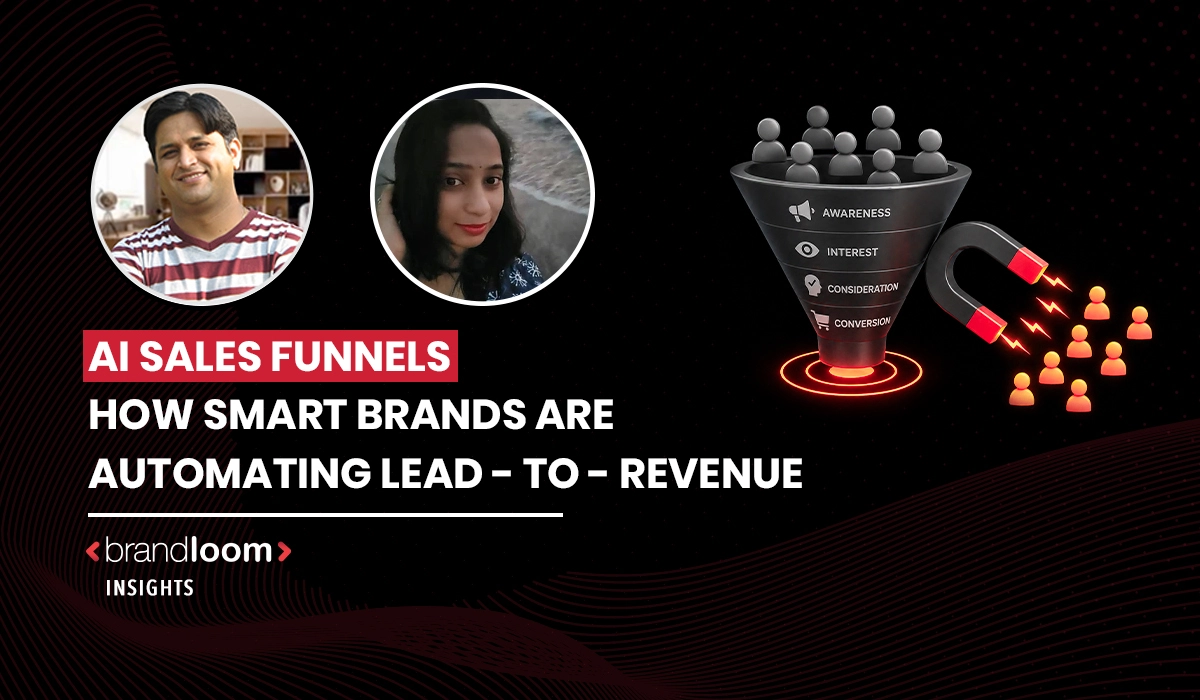
An AI sales funnel is a data-driven system that uses artificial intelligence to automate, personalize, and optimize the customer journey from lead generation to conversion in real time.
In a traditional setup, even with marketing funnel automation, you’re still defining rules upfront if a user clicks, send an email; if they download, assign a score. The funnel runs, but it doesn’t really think. It follows instructions.
An AI-powered sales funnel works differently.
It reads customer behavior as it happens. It picks up on intent, adjusts messaging, and changes the path in real time. Instead of pushing every lead through the same journey, it creates micro-journeys for each individual. That’s where most automated funnels fall short: they automate steps, but they don’t adapt.
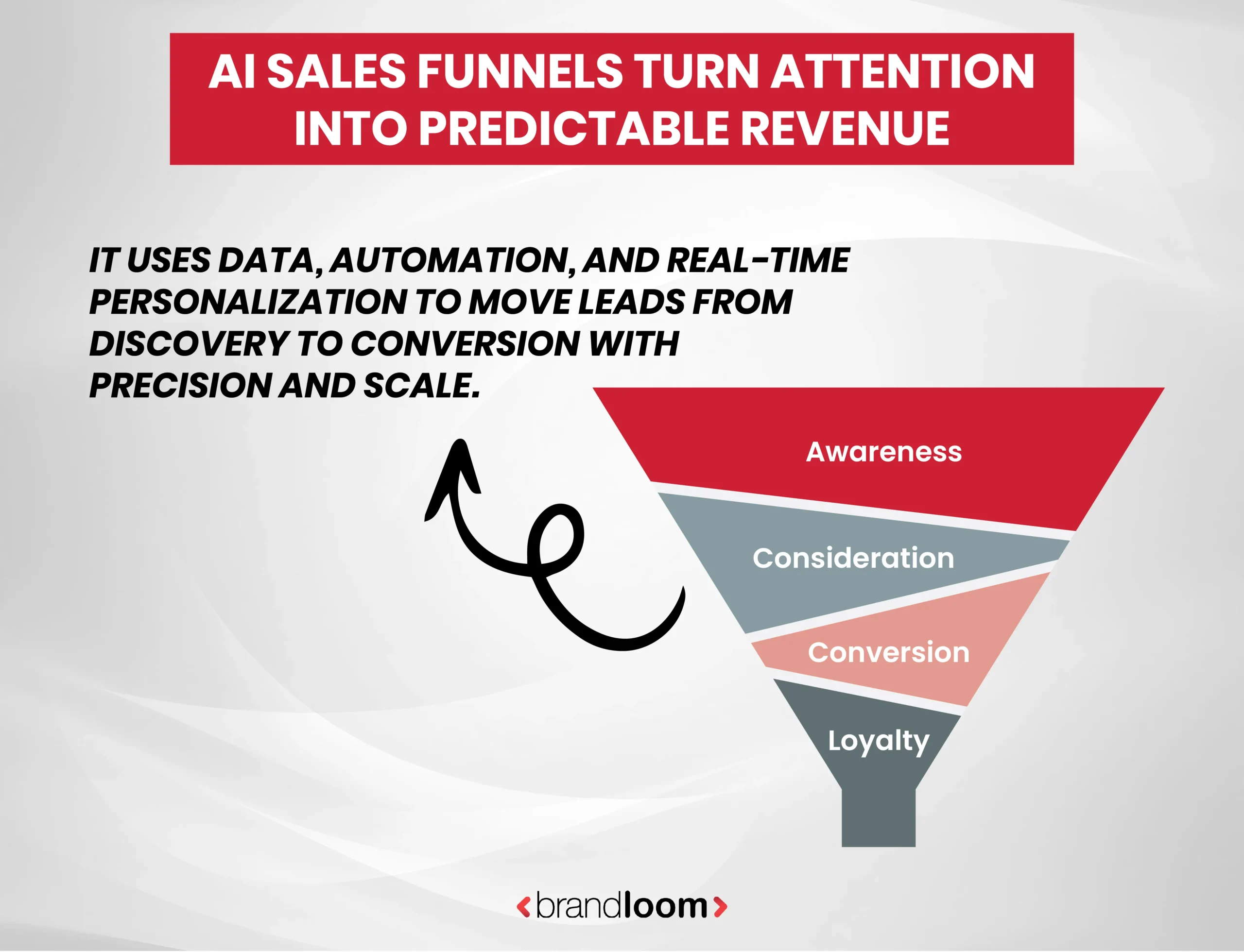
With artificial intelligence at the core, the funnel starts making decisions on its own. It identifies which prospects are worth prioritizing, how to engage them, and when to move them forward.
Across every stage of the sales funnel, this changes the game. Lead qualification becomes sharper. Nurturing becomes more relevant. Conversions become more predictable. And importantly, teams stop wasting time on low-intent leads.
Traditional Funnel vs AI Sales Funnel
| Feature | Traditional Funnel | AI Sales Funnel |
| Decision Making | Rule-based and reactive | Data-driven and predictive |
| Personalization | Limited segmentation | Real-time personalization |
| Optimization | Manual testing and updates | Automated, continuous optimization |
| Lead Scoring | Static rules and assumptions | Predictive scoring using behavioral signals |
| Customer Journey | Fixed, linear path | Dynamic and adaptive journey |
| Audience Targeting | Broad audience groups | Intent-based targeting |
| Campaign Execution | Human-dependent | AI-assisted automation |
| Response Time | Delayed follow-ups | Instant triggers and actions |
| Insights | Historical reporting | Real-time intelligence |
| Conversion Focus | Funnel progression | Revenue and outcome optimization |
At BrandLoom, we look at AI sales funnels as systems built to turn signals into revenue opportunities. Not just workflows that move people mechanically from one step to another.
Because once your funnel starts learning, you’re no longer managing it manually. You’re guiding a system that continuously improves its conversion.
How AI Transforms Every Stage of the Sales Funnel
Most funnels look clean in strategy decks: awareness, interest, consideration, decision. But real buyers do not behave that way. They explore, hesitate, compare, and often drop off before returning later.
This is where AI sales funnels create a real shift. Instead of forcing users through a fixed journey, they adapt to how people actually move.
Let’s break this down across each stage of the sales funnel.
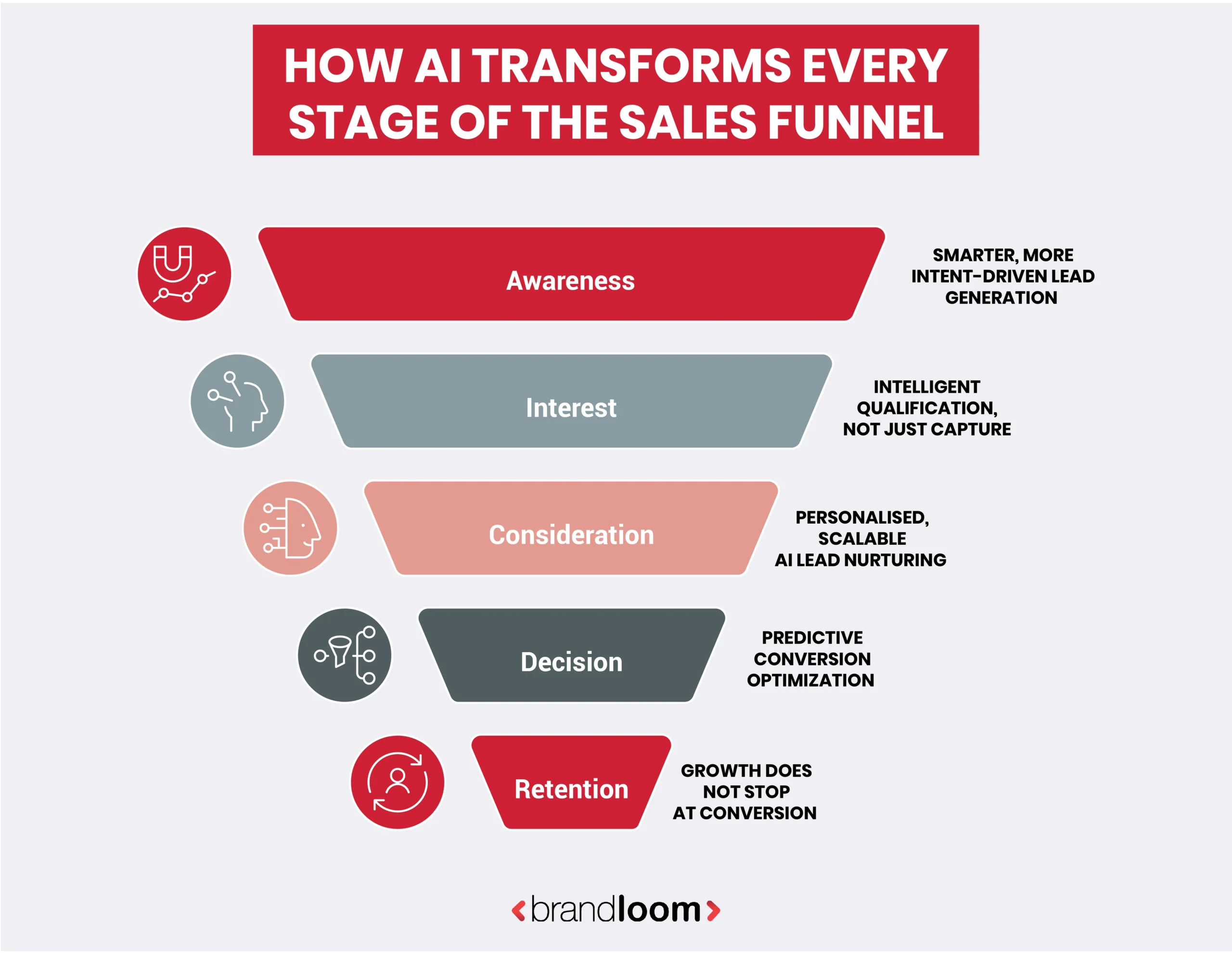
1. Awareness: Smarter, More Intent-Driven Lead Generation
At the top, AI reshapes lead generation. Instead of targeting broad audiences and hoping something works, it identifies patterns in data to find users who are more likely to convert.
With AI marketing automation, campaigns continuously refine themselves by adjusting targeting, improving creative performance, and reallocating budget across channels. The result is not just more traffic, but better-fit traffic from the start.
2. Interest: Intelligent Qualification, Not Just Capture
Capturing leads is no longer the challenge. Filtering them is.
AI improves this through advanced lead scoring. It evaluates signals like engagement depth, content interaction, and frequency to identify qualified leads. Instead of handing sales teams a long list, it surfaces prospects that actually matter.
This reduces friction between marketing and sales and improves efficiency on both sides.
3. Consideration: Personalized, Scalable AI lead nurturing
This is where traditional funnels tend to lose momentum. Static follow-ups and generic email sequences fail to reflect what the user actually needs.
With AI-led nurturing, communication becomes dynamic. Messaging evolves based on customer behavior, pain points, and interaction history. Content, timing, and channels adjust automatically, making the experience feel relevant rather than repetitive.
This level of customer journey automation keeps prospects engaged without overwhelming them.
4. Decision: Predictive Conversion Optimization
At the decision stage, small improvements drive big outcomes.
AI identifies when a prospect is most likely to act. It triggers the right message, at the right time, with the right context. This directly improves conversion rates because the system responds to intent while it is still strong, not after it fades.
5. Retention: Growth Does Not Stop at Conversion
Traditional funnels often stop once a deal is closed. AI sales funnels continue working beyond that point.
They track post-purchase signals, identify upsell opportunities, and automate re-engagement. Over time, this strengthens the customer relationship and increases lifetime value.
It becomes a system that learns, adapts, and improves its ability to drive revenue consistently.
Core Components of a High-Performing AI Sales Funnel
A high-performing AI sales funnel does not rely on one strong element. It functions as an interconnected system in which each component feeds data to the next, creating a loop of continuous improvement.
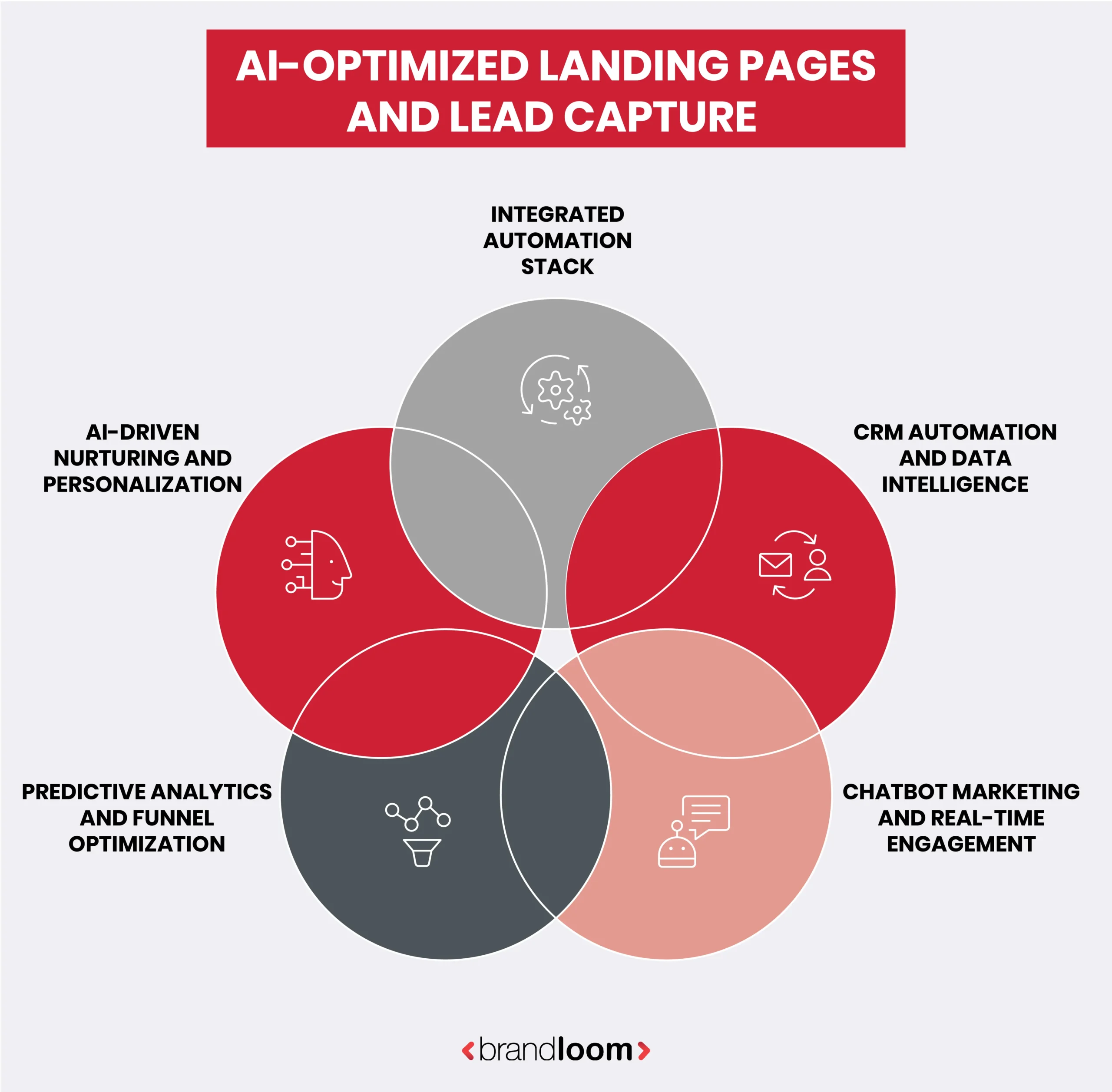
1. AI-Optimized Landing Pages and Lead Capture
The funnel begins with landing pages and a compelling lead magnet. AI enhances performance by analyzing user behavior, testing variations, and optimizing conversion paths in real time. Instead of relying on static designs, the system evolves based on how potential customers actually interact.
2. CRM Automation and Data Intelligence
Once a lead enters the funnel, CRM automation ensures that every interaction is captured and structured. From clicks to content engagement, every signal contributes to a deeper understanding of customer behavior. This data becomes the backbone for smarter targeting, nurturing, and conversion decisions.
3. Chatbot Marketing and Real-Time Engagement
Chatbot marketing introduces instant, always-on engagement. AI-powered chatbots qualify visitors, answer queries, and guide users toward the next step. This reduces drop-offs and ensures that high-intent prospects do not go unnoticed.
4. Predictive Analytics and Funnel Optimization
The real strength of an AI sales funnel lies in its ability to anticipate outcomes. Using predictive analytics, the system identifies patterns that indicate conversion likelihood, channel performance, and potential friction points. These insights allow continuous refinement without manual intervention.
5. AI-Driven Nurturing and Personalization
With AI marketing automation, brands can deliver highly personalized experiences at scale. Dynamic email sequences, content recommendations, and contextual messaging adapt to user actions in real time. This keeps communication relevant and aligned with individual pain points.
6. Integrated Automation Stack
All of this comes together within a well-connected automated marketing funnel, powered by the right automated sales funnel software. Integration ensures that data flows seamlessly across stages, enabling consistent and informed decision-making.
In our experience working with fast-growing brands, the real impact shows when these components stop operating in silos. As a leading AI digital marketing agency, we at BrandLoom approach this as a growth system, not a tool problem.
By leveraging AI-powered sales funnels, customer signals, and real-time data, we help clients improve conversions, generate revenue, and make smarter marketing decisions. When everything connects, the funnel stops merely executing tasks and starts driving measurable business outcomes.
How to Create an AI Sales Funnel: A Step-by-Step Implementation Guide
Many articles explain what an AI sales funnel is. Few explain how to actually build one.
An AI sales funnel is a combination of tools, workflows, and automations that help attract leads, qualify them, nurture them, and convert them into customers with minimal manual effort.
The key is to connect each stage of the customer journey so that data and actions flow automatically from one step to the next. Here’s how to create an AI sales funnel from scratch.
Step 1: Define Your Offer and Customer Journey
Before choosing tools or setting up automations, map out your customer journey.
Ask yourself:
- What product or service are you selling?
- Who is your ideal customer?
- What problem are they trying to solve?
- What information do they need before purchasing?
For example, a B2B software company may have the following funnel:
Blog Article → Free Guide Download → Email Nurture Sequence → Product Demo → Sales Call → Customer
Every AI workflow you build should support this journey.
Step 2: Create AI-Powered Lead Magnets
Your funnel needs a reason for visitors to share their contact information.
Use AI tools such as ChatGPT to create:
- Industry reports
- Ebooks
- Checklists
- Templates
- ROI calculators
- Webinars
Implementation Example:
A digital marketing agency creates an ebook called “25 AI Marketing Workflows That Save 10+ Hours Per Week.”
Using ChatGPT, the team drafts the ebook in a few hours instead of several days.
Visitors can download the resource by submitting their name, email address, company name, and job title through a landing page.
Step 3: Build a Landing Page and Connect It to Your CRM
Next, create a landing page using platforms such as HubSpot, Unbounce, or Instapage.
Your landing page should include:
- A clear headline
- Key benefits
- A lead capture form
- Social proof
- A strong call-to-action
Once someone submits the form, their information should automatically flow into your CRM.
Implementation Example:
A visitor downloads your AI marketing ebook.
The landing page automatically sends their details to HubSpot, where a new lead record is created without manual data entry.
This creates the foundation for future automation.
Step 4: Set Up AI Lead Scoring
Not all leads have the same level of interest.
AI lead scoring helps prioritize prospects based on behavior and engagement.
Configure your CRM to assign points for specific actions.
For example:
| Activity | Score |
| Ebook download | 10 |
| Website revisit | 15 |
| Pricing page visit | 25 |
| Webinar attendance | 30 |
| Demo request | 50 |
Implementation Example:
A lead downloads an ebook, attends a webinar, and visits the pricing page.
Their score reaches 65 points.
Once they cross a predefined threshold, the CRM automatically moves them to the sales-qualified lead stage and notifies a sales representative.
This ensures your team focuses on high-intent prospects.
Step 5: Create Automated AI Email Nurturing Sequences
Most visitors are not ready to buy immediately.
This is where AI-powered nurturing comes into play.
Use platforms such as HubSpot, ActiveCampaign, or Mailchimp to build automated email workflows.
Create a sequence like this:
Day 1: Welcome email with the requested resource
Day 3: Educational content related to the prospect’s challenge
Day 6: Customer success story
Day 10: Product comparison guide
Day 14: Demo invitation
Use AI to generate personalized subject lines, email copy, and content recommendations based on industry or user behavior.
Implementation Example:
A manufacturing company downloads a workplace safety guide.
Instead of receiving generic emails, they receive industry-specific content, case studies from manufacturing clients, and invitations to relevant webinars.
This makes the nurturing process more relevant and effective.
Step 6: Install an AI Chatbot to Qualify Leads
An AI chatbot can engage visitors while they are actively exploring your website.
Tools such as Drift, Intercom, or HubSpot Chat can:
- Answer FAQs
- Recommend solutions
- Collect lead information
- Book meetings
- Route inquiries to sales teams
Implementation Example:
A visitor spends several minutes on your pricing page.
The chatbot appears and asks:
“Would you like help choosing the right plan?”
If the visitor responds positively, the chatbot asks qualifying questions and schedules a demo directly on the sales team’s calendar.
This reduces friction and increases conversion opportunities.
Step 7: Automate Sales Outreach Based on Intent Signals
One of the most powerful uses of AI is triggering personalized outreach based on customer behavior.
Set up workflows that monitor actions such as:
- Multiple website visits
- Pricing page views
- Webinar attendance
- Proposal downloads
When these actions occur, AI can automatically launch follow-up campaigns.
Implementation Example:
A prospect visits your pricing page three times within a week.
The system automatically sends:
- A customer case study
- A product ROI calculator
- A meeting booking link
This allows sales teams to engage prospects at the right moment without manual monitoring.
Step 8: Equip Sales Teams with AI Assistance
Once leads enter the sales process, AI can help representatives work more efficiently.
Tools such as Gong, Salesforce Einstein, and HubSpot AI can:
- Summarize calls
- Identify objections
- Recommend follow-up actions
- Generate proposals
- Analyze conversation sentiment
Implementation Example:
After a discovery call, AI automatically generates meeting notes and suggests that the sales representative send a specific case study addressing the prospect’s concerns.
This helps improve response times and consistency.
Step 9: Track Funnel Performance and Optimize with AI
An AI sales funnel should continuously improve based on performance data.
Monitor metrics such as:
- Landing page conversion rate
- Email open rate
- Demo booking rate
- Lead-to-customer conversion rate
- Customer acquisition cost
- Revenue generated
AI analytics tools can identify bottlenecks and recommend optimizations.
Implementation Example:
Analytics reveal that leads who attend webinars convert 40% more often than leads who only download ebooks.
You can then increase webinar promotion and improve overall funnel performance.
Step 10: Automate Customer Retention and Upselling
The most effective AI sales funnels continue working after the initial sale.
Create post-purchase workflows that include:
- Onboarding emails
- Product training
- Usage monitoring
- Renewal reminders
- Upsell recommendations
Implementation Example:
A SaaS customer regularly uses advanced reporting features but remains on a basic plan.
AI identifies the behavior and automatically sends an upgrade recommendation highlighting the benefits of premium reporting capabilities.
This creates additional revenue opportunities while improving customer satisfaction.
Example of a Complete AI Sales Funnel
Here’s what a finished AI sales funnel might look like:
- A prospect finds your AI-optimized blog through Google.
- They download a lead magnet.
- Their details enter the CRM automatically.
- AI assigns a lead score.
- A personalized email sequence begins.
- An AI chatbot engages them on the website.
- Intent signals trigger sales outreach.
- A demo is booked automatically.
- AI assists the sales team during the buying process.
- Post-sale automations drive retention and upsell opportunities.
The result is a connected system that attracts, qualifies, nurtures, converts, and retains customers with far less manual effort than a traditional sales funnel.
How AI Sales Funnels Drive Revenue Growth
The real value of AI sales funnels is not just automation. It lies in how automation improves decisions across the funnel and translates them into consistent revenue growth.
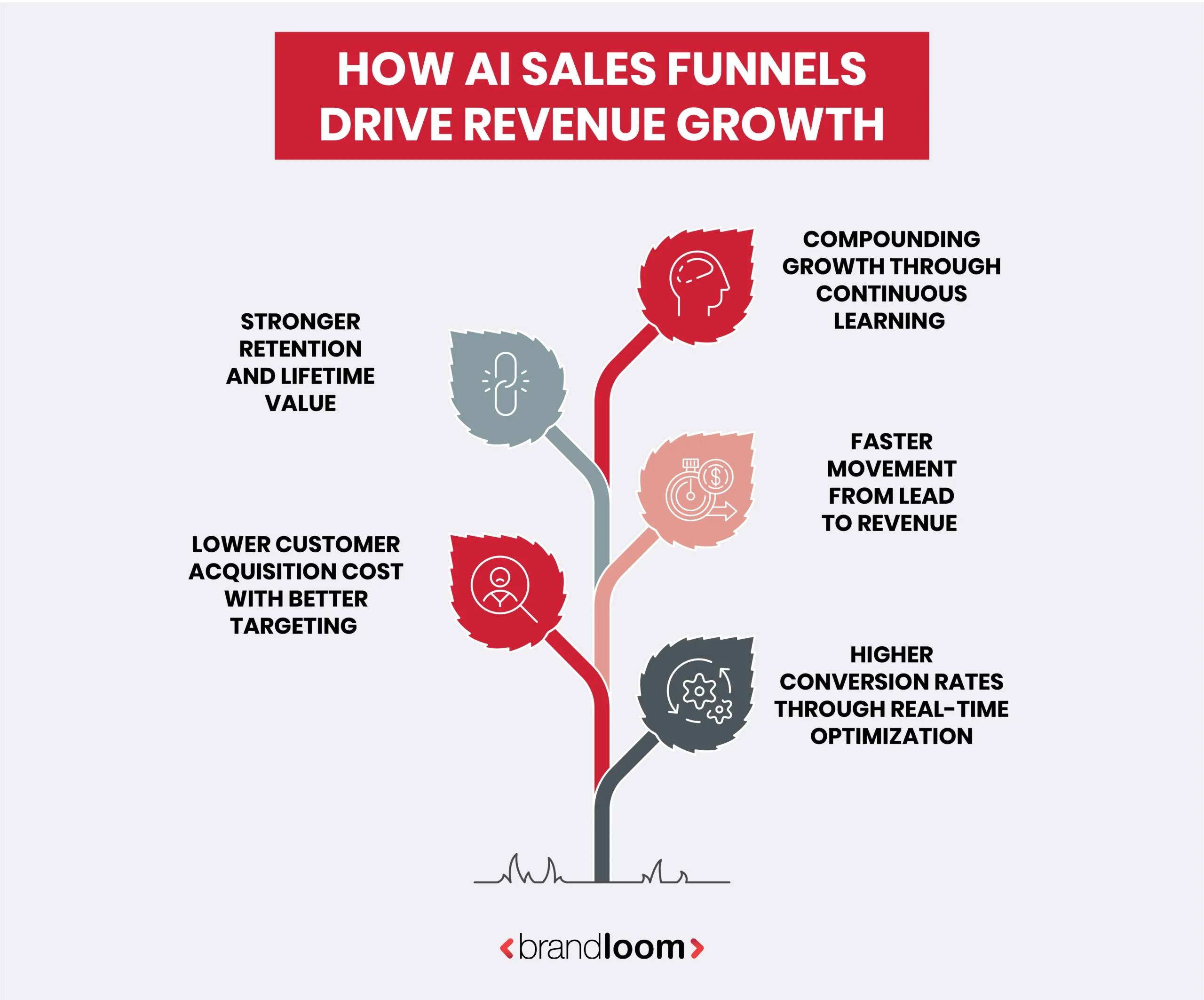
1. Higher Conversion Rates Through Real-Time Optimization
One of the biggest advantages of AI-powered funnels is their ability to adapt instantly. Messaging, timing, and targeting adjust based on live customer behavior. Instead of static campaigns, the funnel responds when intent is highest. This directly improves conversion rates because prospects receive the right push at the right moment.
2. Lower Customer Acquisition Cost with Better Targeting
Traditional funnels often spend heavily to generate volume, but not all leads convert. AI reduces this inefficiency. With smarter targeting and advanced lead scoring, the system focuses on qualified leads who are more likely to move forward. This improves efficiency and lowers customer acquisition costs over time.
3. Faster Movement from Lead to Revenue
Speed plays a critical role in conversions. Delays in follow-ups or engagement often lead to drop-offs. AI sales funnels eliminate this gap by automating responses, triggering actions instantly, and maintaining momentum. This accelerates the journey from lead generation to closing deals, improving overall pipeline velocity.
4. Stronger Retention and Lifetime Value
Revenue growth does not stop at conversion. By continuously tracking customer behavior, AI identifies opportunities for upselling, cross-selling, and re-engagement. This strengthens the customer relationship and increases lifetime value, making each acquisition more valuable over time.
5. Compounding Growth Through Continuous Learning
The most important advantage is long-term improvement. Every interaction feeds data back into the system. Over time, AI-powered funnels become more accurate in predicting outcomes and optimizing performance.
What stands out in practice is how quickly these gains start to stack. Small improvements in targeting, timing, and personalization compound across the funnel, turning incremental wins into meaningful revenue impact.
Who Should Use AI Sales Funnels?
The strength of AI sales funnels becomes clearer when you see how they perform across different business models. While the core system remains the same, the application changes based on how each industry approaches growth.
1. D2C: Personalization That Drives Conversions
For D2C brands, scale often comes with a personalization challenge. AI-powered sales funnels solve this by tailoring product recommendations, offers, and messaging based on customer behavior. From dynamic landing pages to personalized follow-ups, every interaction becomes more relevant. This directly improves conversion rates and reduces drop-offs.
2. SaaS: Turning Trials into Paying Customers
In SaaS, the gap between sign-up and activation is critical. AI marketing automation helps track user activity within the product and triggers contextual nudges. Whether it is onboarding emails, feature recommendations, or upgrade prompts, AI lead nurturing ensures that users move forward based on their usage patterns rather than generic timelines.
3. B2B Services: Smarter Lead Qualification and Sales Alignment
For B2B companies, not every lead is worth pursuing. With advanced lead scoring and behavioral analysis, AI sales funnels help identify high-intent prospects early. This allows sales teams to focus on qualified leads, improving efficiency, and increasing the chances of closing deals.
4. eCommerce: Recovering Revenue and Increasing Basket Value
In eCommerce, lost opportunities often come from abandoned carts or missed upsells. AI tracks these signals in real time and triggers re-engagement campaigns. From cart-recovery emails to cross-sell recommendations, automated marketing funnel systems ensure potential revenue does not slip away.
Across these industries, one pattern remains consistent. When funnels become adaptive instead of static, they align more closely with how buyers actually make decisions. That alignment is what ultimately drives better results.
Why AI Sales Funnels Are a Competitive Advantage in 2026
The competitive landscape has shifted. Most brands today have access to the same tools, platforms, and channels. What separates high-growth companies from the rest is not execution, but how intelligently they operate.
This is where AI sales funnels create a clear advantage. They move beyond static processes and bring continuous optimization to decision-making across the funnel.
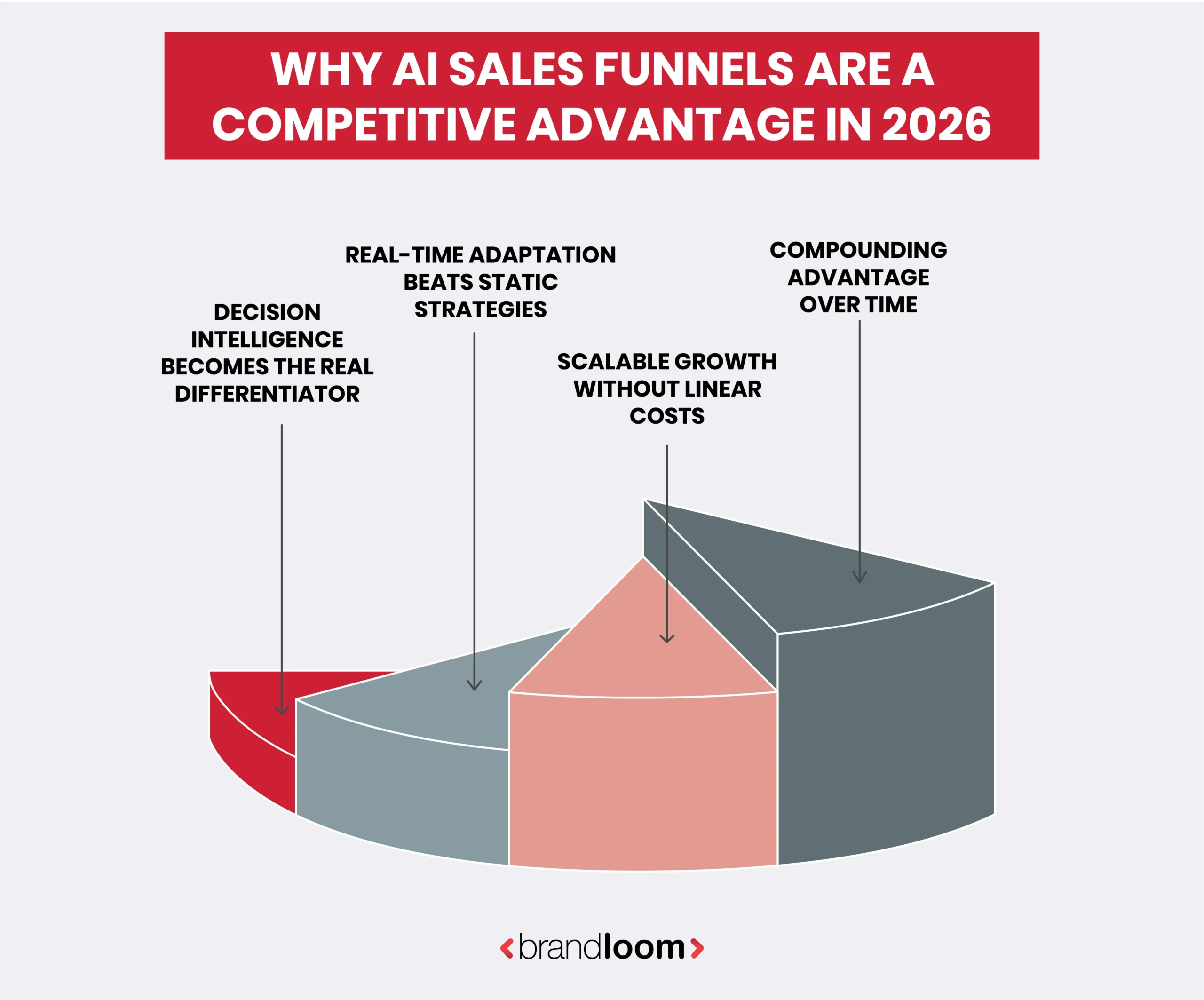
1. Decision Intelligence Becomes the Real Differentiator
In 2026, execution is no longer a competitive edge. Most brands have access to the same tools and channels. What sets them apart is how well they make decisions. AI sales funnels enable faster, data-backed decisions across the funnel, improving outcomes without increasing effort.
2. Real-Time Adaptation Beats Static Strategies
Traditional funnels rely on predefined rules and delayed optimization. AI-powered sales funnels adapt in real time by reading customer behavior and adjusting instantly. This allows brands to stay aligned with user intent instead of reacting after opportunities are lost.
3. Scalable Growth Without Linear Costs
Growth used to mean higher spend or larger teams. With automated sales funnels, scalability comes from efficiency. AI continuously optimizes performance, allowing brands to grow without proportionally increasing resources.
4. Compounding Advantage Over Time
The biggest advantage is not immediate; it builds over time. As AI sales funnels learn from every interaction, they become more accurate and effective. This creates a system where performance improves consistently, giving early adopters a strong and lasting edge.
Common AI Sales Funnel Mistakes to Avoid
AI sales funnels can improve targeting, personalization, and conversions, but implementation matters. Many businesses adopt AI tools expecting immediate results, only to see inconsistent outcomes because the underlying strategy is weak. Here are some of the most common mistakes brands make and how to avoid them.
1. Over-Relying on Tools Without Strategy
AI can automate decisions, but it cannot replace business strategy.
One of the biggest mistakes brands make is assuming that simply adopting AI tools will automatically improve performance. In reality, AI is only as effective as the goals, inputs, and systems behind it. Without a clear funnel strategy, audience understanding, messaging framework, and conversion path, automation often amplifies inefficiencies rather than solving them.
The focus should be on building a structured system first and then using AI to optimize it.
2. Poor Data Quality
AI performs only as well as the data it receives.
Incomplete customer information, duplicate records, outdated contact details, and inaccurate attribution can significantly weaken performance. Poor-quality data leads to weak targeting, inaccurate lead scoring, irrelevant personalization, and wasted ad spend.
Brands need clean, organized, and consistently updated customer data to make AI-driven sales funnels effective. Regular audits, proper tagging, and reliable tracking systems are essential.
3. No CRM Integration
Disconnected systems create disconnected customer experiences.
Many brands invest in AI-powered marketing tools but fail to connect them with their CRM. When sales, marketing, and customer data remain fragmented, teams lose visibility into customer journeys, buying intent, and conversion opportunities.
Integrating AI sales funnels with CRM systems helps centralize data, automate lead nurturing, personalize communication, and improve decision-making across the funnel.
4. Ignoring the Human Touch
Automation should support relationships not replace them.
While AI can personalize communication and automate responses, customers still value human interaction, especially during complex decisions or high-value purchases. Over-automation can make experiences feel impersonal and transactional.
The most effective AI sales funnels combine automation with human intervention at the right moments whether through personalized consultations, support, or sales conversations. AI works best when it enhances human judgment, not when it replaces it entirely.
Conclusion
The idea of a sales funnel has evolved. What once worked as a structured, step-by-step process is now being replaced by systems that think, adapt, and optimize continuously.
AI sales funnels bring intelligence into every stage, from lead generation to closing deals. Instead of managing disconnected activities, businesses can now build unified systems that respond to customer behavior in real time. This shift is not just about efficiency. It is about building a predictable and scalable revenue engine.
From our perspective at BrandLoom, the biggest mistake brands make is treating AI as a tool instead of a system. Tools can improve parts of the funnel. Systems transform how the entire funnel performs.
The focus going forward should not be on adding more campaigns or channels. It should be about building a connected, intelligent framework powered by AI marketing automation that continuously improves decision-making.
Brands that get this right will not just see incremental gains. They will build a structural advantage in how they acquire, convert, and retain customers.
Frequently Asked Questions
An AI sales funnel uses AI marketing automation to manage the entire customer journey, from lead generation to conversion. It analyzes customer behavior, qualifies leads, and optimizes engagement in real time. At BrandLoom, we build AI sales funnels that continuously learn and improve, helping businesses move from manual execution to intelligent, data-driven growth.
AI improves conversion rates by analyzing user intent and optimizing messaging, timing, and channels. It uses lead scoring and behavioral data to engage potential customers at the right moment. BrandLoom leverages AI-powered sales funnels to reduce drop-offs and ensure that every interaction aligns with real-time customer intent.
A strong AI sales funnel requires CRM automation, chatbot marketing, predictive analytics, and automated sales funnel software. These tools work together to manage data, automate engagement, and optimize decisions. At BrandLoom, we integrate the right tools into a unified system that drives consistent lead-to-revenue automation outcomes.
Yes, AI marketing automation helps small businesses compete by improving efficiency and reducing manual effort. It automates lead nurturing, improves lead generation, and enhances targeting. BrandLoom helps small businesses implement automated sales funnels that scale without requiring large teams or high budgets.
Lead scoring with AI analyzes customer behavior, engagement patterns, and intent signals to rank prospects based on conversion potential. It continuously updates scores as new data comes in. BrandLoom uses AI-driven lead scoring within AI sales funnels to help sales teams focus on high-value opportunities.
Yes, AI sales funnels reduce acquisition costs by targeting high-intent users and filtering out low-quality leads. With better lead scoring and optimized campaigns, brands spend less on ineffective channels. BrandLoom builds AI-powered funnels that improve efficiency and deliver stronger ROI from marketing investments.
Building an automated sales funnel typically takes a few weeks, depending on complexity and data readiness. Setting up AI marketing automation, integrations, and workflows requires planning and testing. At BrandLoom, we focus on building scalable AI sales funnels that start delivering insights and performance improvements early.
Industries like D2C, SaaS, B2B services, and eCommerce benefit the most from AI sales funnels. These models rely heavily on lead generation, personalization, and conversion optimization. BrandLoom helps businesses across these sectors implement AI-powered sales funnels that align with their unique customer journeys.
While not mandatory, chatbot marketing significantly improves lead generation by enabling real-time interaction. AI chatbots qualify visitors, answer queries, and guide users through the funnel. BrandLoom integrates chatbots into AI sales funnels to capture and engage potential customers more effectively.
You measure ROI by tracking conversion rates, customer acquisition cost, and lifetime value. AI sales funnels provide detailed insights into every stage of the journey, making performance easier to evaluate. BrandLoom uses data from AI marketing automation systems to connect funnel performance directly to revenue outcomes.