
The rules of brand building are changing fast. In the AI era, businesses no longer compete only for search rankings, ad impressions, or website traffic. Today, they compete for something more valuable: selection, citations, and recall. This shift is redefining how brands approach positioning in marketing and why a strong brand positioning strategy demands a completely different mindset in 2026 and beyond.
Traditional search relied heavily on keywords and rankings. Now, AI-powered platforms and every major AI system increasingly shape discovery. Whether customers use ChatGPT, Google AI Overviews, or voice assistants, AI generates summaries, recommendations, and brand comparisons in real time. Instead of showing ten blue links, AI often delivers one synthesized answer. That means brands must earn trust before customers even visit a website.
Brands with stronger messaging, clearer differentiation, and higher brand authority stand a better chance of being surfaced and remembered. Businesses must also build deeper customer trust, because AI-driven experiences increasingly prioritize credibility and consistency.
At BrandLoom, we believe the smartest brand strategy for the digital age is no longer about being seen everywhere it is about being remembered for something meaningful.
What Is Brand Positioning? Understanding Its Role in Modern Marketing
To understand modern marketing, businesses must first understand brand positioning. Simply put, brand positioning definition refers to the unique space a brand occupies in the minds of customers compared to competitors. If you want to define brand positioning, think of it as the perception customers develop about what makes a brand different, relevant, and worth choosing.
The brand positioning meaning goes beyond products or pricing. It shapes how customers perceive a company’s expertise, value, and promise. Strong positioning influences brand perception because it helps customers quickly associate a business with specific strengths, solutions, or values. For example, some brands stand for affordability, while others become known for innovation, trust, or premium quality.
In simple terms, effective brand positioning in marketing answers one important question: Why should customers remember and choose your brand over others?
Why Brand Positioning Matters More Than Branding Alone
Many businesses confuse branding with positioning, but they serve different purposes. Branding focuses on visual elements such as logos, tone, and brand identity, while positioning defines what a brand stands for in the market.
A strong positioning strategy marketing approach shapes a company’s market position by clarifying its value and reinforcing consistent brand messaging. Without positioning, branding can look attractive but fail to create meaning.
Customers remember brands that stand for something specific. Clear positioning builds familiarity, improves customer trust, and strengthens long-term brand equity. In crowded markets, memorable brands rarely win by chance; they win by being distinct.
How AI Is Changing Brand Discovery and Recall
Search behavior has changed dramatically over the last few years. Traditional SEO once focused on ranking websites through keywords, backlinks, and technical optimization. Users searched on Google, scanned multiple results, and visited websites before making decisions. Today, discovery works differently.
Modern consumers increasingly rely on AI-powered experiences that deliver direct answers instead of endless links. Google’s AI Overviews, ChatGPT recommendations, voice assistants, and other AI tools now summarize information, compare options, and suggest brands instantly. In many cases, AI generates responses that reduce the need to click through several websites.
This shift has introduced a new form of discovery powered by AI models and LLM-driven recommendations. Instead of asking, “Which website ranks first?” marketers must now ask, “Which brand will AI mention first?” This change makes brand positioning in the AI era far more important than ever.
AI systems also prioritize trusted sources. Brands with strong authority signals, consistent messaging, customer proof, and mentions in credible industry publications are more likely to appear in recommendations.
Why Brand Recall Is Becoming Harder
At the same time, brand recall is becoming more difficult. Consumers face constant information overload, endless content, and thousands of competing messages every day. AI-generated summaries compress choices into short answers, which reduces opportunities for brands to stand out visually or emotionally.
As a result, many businesses begin to look interchangeable. Similar messaging, similar offers, and similar claims create commoditization, making differentiation harder. Without a clear market positioning strategy, brands risk becoming forgettable.
The New Battle: Being Selected by AI
Today, brands compete in a new environment where visibility alone does not guarantee success. Businesses must position themselves to be cited, trusted, and recommended by AI systems in real time.
A strong brand strategy for the digital age now requires brands to build authority, consistency, and clarity across every channel. Winning brands will not simply appear online—they will earn selection. In brand positioning in the AI era, memorability increasingly determines discoverability.
Why Being Memorable Is the New Competitive Advantage
In crowded markets, visibility alone no longer guarantees growth. Many brands generate impressions, clicks, and reach but still struggle to grow profitably. Why? Because people rarely remember brands they cannot clearly differentiate.
In today’s noisy digital environment, memorability has become a stronger advantage than temporary visibility. A strong brand differentiation strategy helps businesses stand apart, stay relevant, and remain top-of-mind when customers are ready to act. Simply appearing in front of audiences is not enough anymore; brands must leave a lasting impression.
Visibility Without Recall No Longer Wins
For years, marketers focused heavily on impressions, reach, and traffic. But impressions do not automatically create memory. Customers see thousands of ads, posts, and recommendations every day, yet only a few brands stay memorable.
This reality exposes the limitations of performance marketing. Paid campaigns can generate short-term clicks, but weak positioning often leads to rising acquisition costs. When brands fail to establish a clear identity or solve meaningful pain points, customers compare them mainly on price.
As competition increases, weak positioning contributes to higher CAC because customers struggle to distinguish one brand from another. Without strong market positioning, visibility quickly loses value.
Strong Positioning Builds Trust and Preference
One of the biggest benefits of brand positioning strategy is stronger memorability. Brands that clearly communicate what they stand for become easier to trust and easier to choose.
Memorable brands improve brand recall, create stronger customer trust, and act as a clear key differentiator in crowded markets. As a result, they often experience better conversion rates, faster decision-making, and higher customer loyalty over time.
The 5-Part Brand Positioning Framework for the AI Era
Building a memorable brand in an AI-first environment requires more than creative messaging or short-term campaigns. Brands must position themselves in ways that both people and AI systems can understand, trust, and recommend. The following framework helps businesses strengthen differentiation, improve recall, and increase visibility in AI-driven discovery environments.
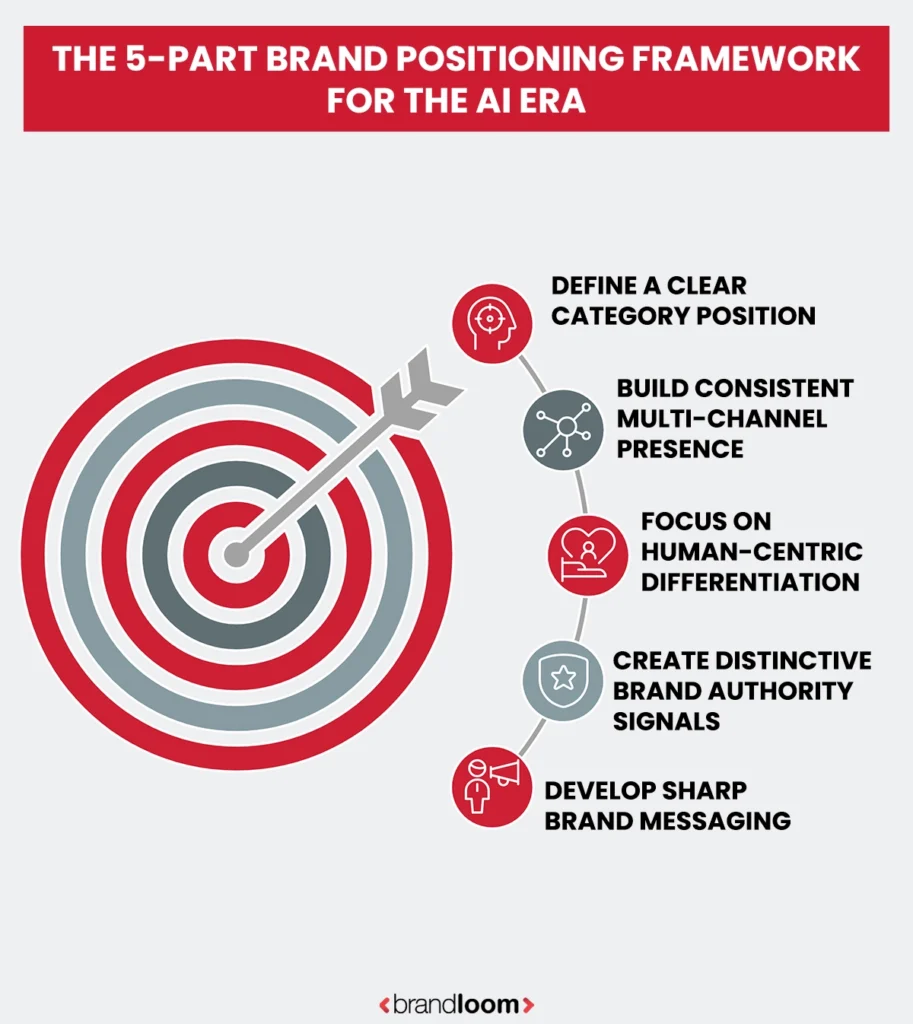
1. Define a Clear Category Position
Generic brands often disappear in AI search because they fail to communicate a clear identity. If every business sounds the same, AI systems struggle to identify what makes one brand more relevant than another. Customers face the same problem.
Strong brands own a category or define a niche clearly. Instead of competing broadly, they establish a recognizable market position that makes selection easier. A focused market positioning strategy helps brands create stronger recall and better differentiation.
For example, calling your company a “digital agency” says very little. Thousands of competitors use the same label. However, positioning yourself as a “Strategic Growth Partner” immediately communicates expertise, outcomes, and specialization. This approach strengthens both brand strategy and positioning.
The clearer your category position, the easier it becomes for customers—and AI—to understand where your brand fits.
2. Develop Sharp Brand Messaging
Strong positioning fails when messaging becomes inconsistent. Brands must communicate the same value proposition across every customer touchpoint, including websites, social media, public relations, blogs, email campaigns, and sales conversations.
AI increasingly learns from repeated messaging signals. When a brand consistently communicates similar themes, benefits, and positioning across channels, AI systems become more confident in understanding and recommending that business.
A strong positioning strategy requires businesses to simplify and sharpen communication. Customers should quickly understand what your brand does, who it serves, and why it matters.
For example, if your website emphasizes affordability while your PR positions you as premium, customers receive mixed signals. AI systems notice those inconsistencies too.
A successful brand positioning strategy depends on repetition, consistency, and clarity. Strong brand messaging improves recognition and increases the chances of recall when customers need solutions.
3. Create Distinctive Brand Authority Signals
In the AI era, credibility influences discoverability. AI systems prefer authoritative and trustworthy sources when generating recommendations or comparisons. Brands that demonstrate expertise often gain stronger visibility.
Businesses can strengthen authority through thought leadership, mentions in trusted industry publications, case studies, customer reviews, expert interviews, podcasts, and original research. These signals help AI systems identify which businesses deserve trust.
For example, if a founder regularly contributes expert insights, publishes research, or appears in respected media outlets, AI systems are more likely to associate the brand with authority.
Strong brand strategy brand positioning depends not only on messaging but also on proof. Businesses must show expertise instead of simply claiming it.
Effective brand positioning and differentiation strategies combine credibility with consistency. Over time, these efforts strengthen brand authority, improve visibility, and influence customer confidence.
4. Focus on Human-Centric Differentiation
AI has made generic messaging easier to create, which also makes generic positioning more dangerous. Many brands now publish similar-sounding content, making differentiation increasingly difficult.
To stand out, businesses must embrace a human centric approach. Instead of repeating broad claims like “best quality” or “trusted service,” brands should position themselves around values, experience, expertise, and real customer outcomes.
Customers remember brands that solve meaningful pain points. They trust businesses that communicate empathy, specialized knowledge, and relevance to their needs.
A strong brand differentiation strategy focuses on what competitors cannot easily copy. This may include founder expertise, a unique process, exceptional service, or a specific audience focus.
The most effective strategies of brand positioning create emotional relevance, not just visibility. Memorable brands connect with people in ways generic messaging never can.
5. Build Consistent Multi-Channel Presence
Strong positioning breaks down when messaging changes across channels. Fragmented communication confuses customers and weakens recall. If your website says one thing, LinkedIn says another, and PR communicates something different, trust declines.
Consistency matters across search, content marketing, LinkedIn, PR, reviews, podcasts, videos, and customer conversations. Repeated messaging strengthens recognition and improves memorability.
Modern discovery is increasingly AI driven, meaning customers may encounter an AI brand recommendation before visiting a website. That makes consistency even more important.
Many successful brand positioning strategy examples show the same pattern: clear positioning reinforced repeatedly across every touchpoint. A strong positioning strategy example always combines repetition with clarity.
The brands that stay memorable rarely communicate randomly they communicate consistently.
Brand Positioning Examples in the AI Era
Understanding positioning becomes easier when businesses see it in action. Strong positioning does not rely on broad claims or generic labels. Instead, it creates clarity around who the brand serves, what makes it different, and why customers should remember it. The best brand positioning examples show how small shifts in messaging can dramatically improve visibility, trust, and memorability.
B2C Example: Premium Skincare Brand
Many skincare brands position themselves broadly as “natural skincare” brands. The problem? The category feels overcrowded and difficult to differentiate. When dozens of brands use the same language, customers struggle to remember any one of them.
A stronger positioning strategy example would focus on specificity and customer needs. Instead of saying “natural skincare,” a brand could position itself as:
“Dermatologist-backed clean skincare for sensitive skin.”
This positioning immediately creates sharper brand perception. It tells customers who the product serves, why it is credible, and what makes it different. Sensitivity-focused skincare also becomes a stronger key differentiator in AI-driven recommendations.
B2B Example: Agency Positioning
Many agencies still describe themselves as “full-service marketing agencies,” but that phrase no longer communicates meaningful value.
A stronger B2B brand positioning strategy focuses on outcomes and expertise. For example:
Instead of: “Full-Service Marketing Agency”
Position as: “Strategic Growth and Intelligence Partner”
This positioning signals business impact, specialization, and strategic thinking rather than execution alone.
AI-Native Brand Example
Modern AI brands increasingly position around outcomes instead of product features. Rather than promoting technical capabilities, they focus on transformation.
For example, an AI automation platform may avoid saying “workflow automation software” and instead position itself as:
“The fastest way to eliminate repetitive work and improve productivity.”
In the AI era, customers remember benefits more than features.
Common Brand Positioning Mistakes in the AI Era
Even strong products struggle when positioning lacks clarity. In the AI era, weak positioning not only affects customer decisions but also reduces discoverability. AI systems increasingly evaluate consistency, authority, and relevance before surfacing brands in recommendations. Avoiding common positioning mistakes can significantly strengthen long-term visibility and recall.
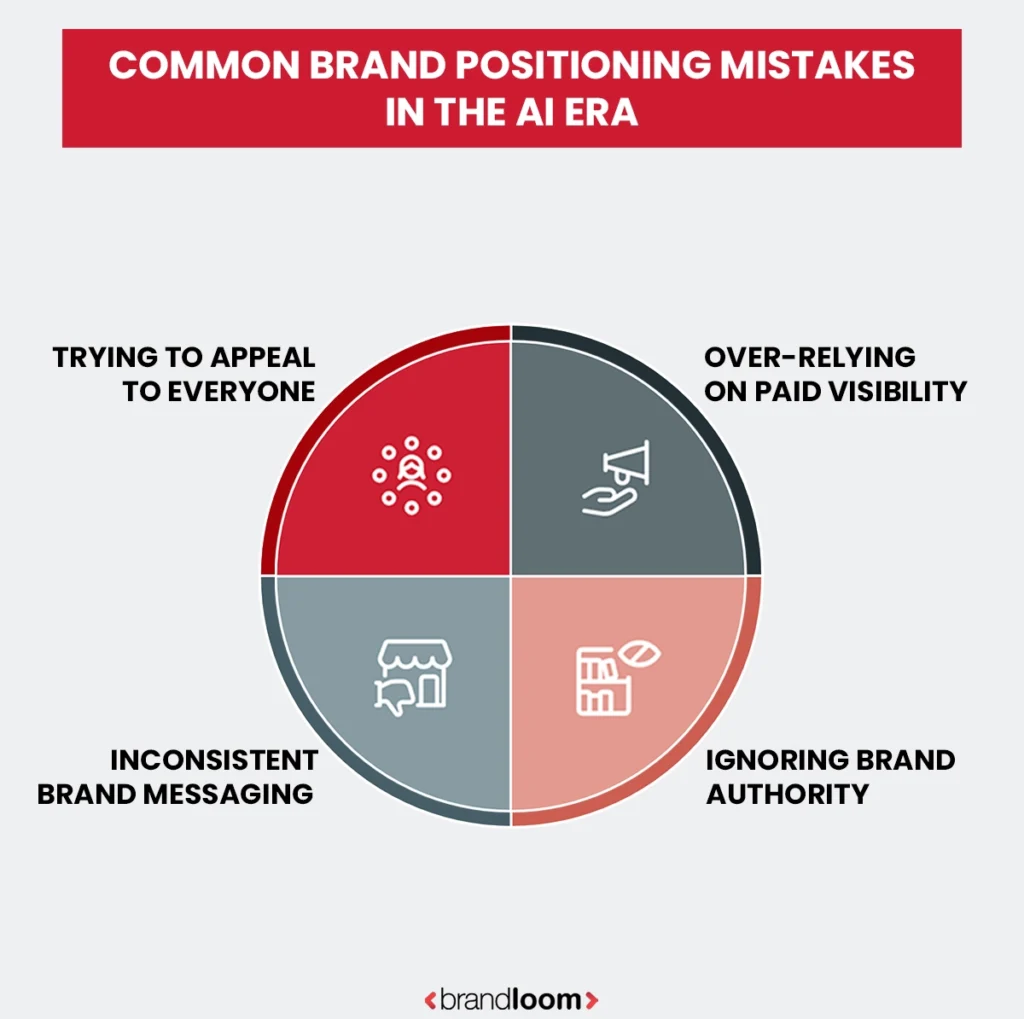
Trying to Appeal to Everyone
One of the biggest positioning mistakes is trying to serve everyone. Generic messaging often sounds safe, but it weakens memorability. When brands use vague claims such as “high quality,” “customer-focused,” or “best solutions,” customers struggle to remember what makes them different.
The best brand position strategy focuses on clarity, specialization, and relevance. Brands build stronger recall when they speak directly to a specific audience and solve clear problems.
Over-Relying on Paid Visibility
Many businesses invest heavily in ads while neglecting positioning. Paid campaigns can drive temporary traffic, but ads alone rarely create long-term preference.
Without a clear market position, customers compare brands mainly on price, convenience, or promotions. Strong positioning gives people a reason to choose and remember a brand after the ad disappears.
Inconsistent Brand Messaging
Mixed messaging weakens trust. If a website communicates premium expertise while social media sounds casual or disconnected, customers receive conflicting signals.
More importantly, every AI system learns from repeated patterns. Inconsistency confuses AI-driven discovery and reduces confidence in recommending a brand. A strong brand positioning strategy definition depends on clarity and consistency across channels.
Ignoring Brand Authority
Brands that fail to build credibility often struggle with discoverability. Reviews, expert content, media mentions, and thought leadership strengthen trust signals and improve brand equity. Without authority, even great positioning may fail to gain traction.
How to Create a Brand Positioning Strategy in 2026
Building strong positioning requires more than creative ideas or catchy taglines. In an increasingly AI powered world, brands must communicate clear value, consistency, and differentiation across every touchpoint. If you are wondering how to create a brand positioning strategy, the process starts with understanding customers and ends with consistent execution.
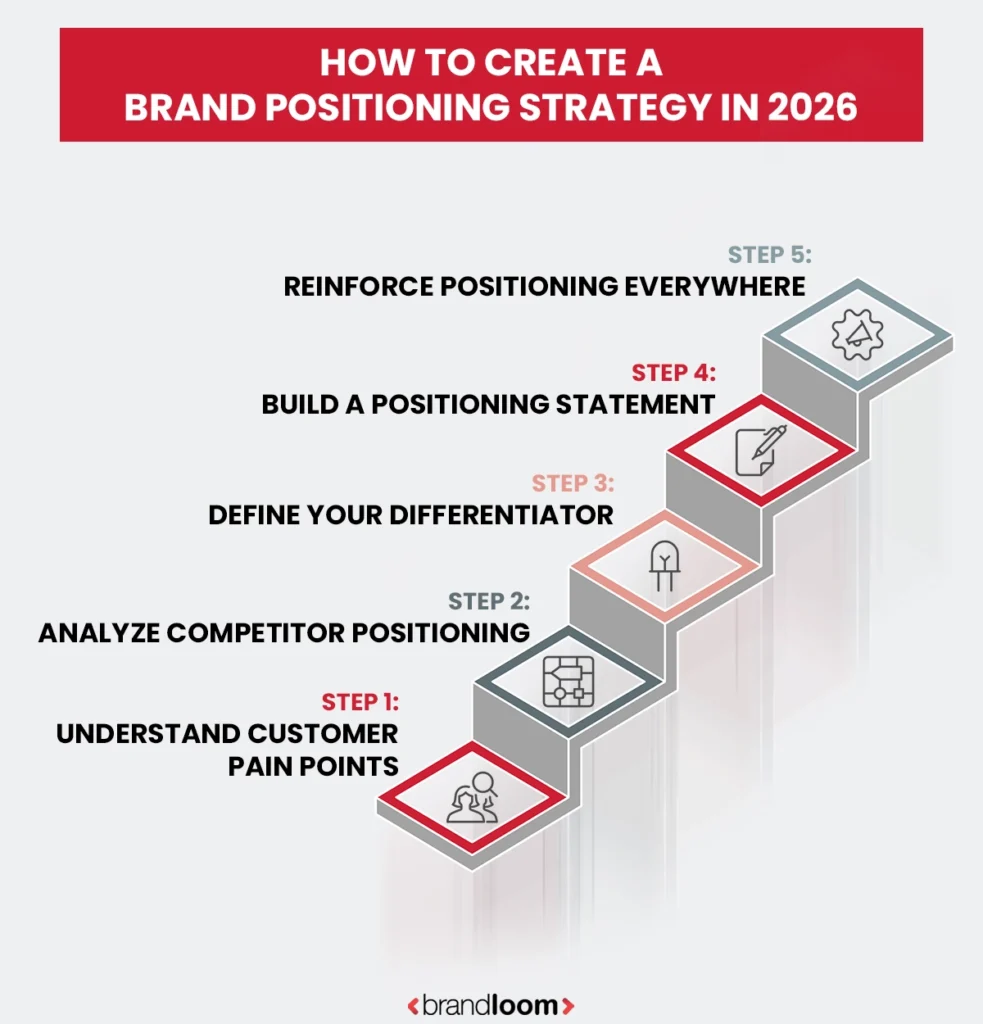
Step 1: Understand Customer Pain Points
Every successful positioning strategy begins with audience research. Before deciding what your brand stands for, understand what your customers struggle with.
Identify their goals, frustrations, buying triggers, and unmet needs. Review customer feedback, surveys, reviews, search behavior, and sales conversations. Strong positioning solves real problems instead of relying on assumptions.
Step 2: Analyze Competitor Positioning
Study how competitors describe themselves. Look at their websites, messaging, value propositions, and social presence.
The goal is not to copy competitors but to identify gaps. Ask yourself: What are they all saying? Where do they sound identical? What opportunities remain underserved? Clear positioning often emerges where competitors lack specificity.
Step 3: Define Your Differentiator
Once you understand the market, identify what makes your brand memorable. Your differentiator could be expertise, service quality, founder experience, process, audience specialization, or unique outcomes.
Strong brand messaging should clearly communicate this advantage. Customers remember brands that stand for something specific.
Step 4: Build a Positioning Statement
If you are asking what is a brand positioning strategy, this step turns strategy into clarity. Use a simple brand positioning strategy template:
For [audience], [brand] is the [category] that [differentiator].
For example: For scaling D2C brands, BrandLoom is the strategic growth and intelligence partner that combines branding, digital marketing, and AI-led insights.
Step 5: Reinforce Positioning Everywhere
Positioning only works when repeated consistently. Align your website, content, PR, reviews, and thought leadership to strengthen brand authority and recall.
Conclusion
The future of branding is no longer about chasing visibility alone. As AI reshapes how people discover businesses, brands must adapt to a new reality. Search is becoming recommendation-driven, summaries are replacing clicks, and AI increasingly decides which businesses deserve attention. That makes brand positioning in the AI era more important than ever.
In this new landscape, memorability becomes the real competitive moat. Strong positioning does more than improve visibility it strengthens trust, increases conversions, improves recall, and builds lasting preference. Brands with clear messaging and stronger brand authority are more likely to earn both customer confidence and AI recommendations.
The most successful brand positioning strategy 2026 will focus on clarity, differentiation, and consistency. The brands people remember are often the same brands that stand for something meaningful and communicate it repeatedly.
At BrandLoom, we believe the winners of the AI era will not simply be the loudest brands, they will be the clearest, most trusted, and most memorable. Because in a world shaped by AI, being remembered matters more than being seen.
Frequently Asked Questions
Brand positioning in marketing refers to how a business creates a distinct place in customers’ minds compared to competitors. It communicates what makes a brand different, valuable, and memorable. BrandLoom often emphasizes that strong brand positioning helps businesses improve trust, relevance, and long-term customer preference.
Brand positioning in the AI era is evolving from simply gaining visibility to becoming memorable and trusted. AI increasingly recommends brands through summaries and comparisons instead of traditional search results. We focus on building consistent messaging and authority so AI systems recognize and recommend brands more effectively.
A strong brand positioning strategy helps businesses differentiate themselves in crowded markets. It shapes customer perception, improves recall, and builds preference over time. BrandLoom frequently highlights that brands with clear positioning often achieve better conversions, stronger loyalty, and more sustainable business growth.
Brands stay memorable when they communicate a clear value proposition and consistently solve customer problems. We recommend using a strong brand differentiation strategy, maintaining messaging consistency, and building emotional relevance. Clear communication across platforms strengthens recognition and improves long-term recall.
A successful brand positioning strategy includes audience research, differentiation, credibility, consistent messaging, and clarity. BrandLoom often advises businesses to align positioning with customer pain points and trust signals to improve memorability, visibility, and stronger customer relationships.
AI changes brand discovery by prioritizing trusted recommendations instead of traditional rankings. AI-powered search experiences summarize information and compare brands quickly. We believe businesses with stronger positioning, authority, and consistency have a better chance of gaining visibility in AI-driven search environments.
Brand awareness measures recognition, while brand positioning shapes perception. People may know a brand but still not understand why it matters. BrandLoom frequently explains that positioning gives meaning to awareness by helping customers associate brands with specific strengths or benefits.
Creating a brand positioning statement starts with identifying your target audience, category, and differentiator. A useful framework is: For [audience], [brand] is the [category] that [differentiator]. We recommend keeping the statement simple, relevant, and caustomer-focused.
Common brand positioning mistakes include vague messaging, inconsistent communication, weak differentiation, and depending too much on paid ads. BrandLoom regularly observes that brands struggle when they fail to define a clear market position or try appealing to everyone.
Businesses improve brand recall through repetition, consistency, and clear messaging. We recommend reinforcing positioning through content, reviews, PR, and storytelling. Customers remember brands more easily when businesses consistently communicate what makes them different and valuable.