Most brands think they are ready for the next wave of e-commerce. They have optimized their listings, run their ads, and built a decent website. But AI shopping does not care about any of that.
When a customer asks an AI assistant to find the best moisturizer for dry skin under ₹800, it does not browse your website. It pulls structured data, trusted reviews, and verified product attributes. If your brand is not sending the right signals, you do not exist in that result.
The brands that win the next five years are not the ones with the biggest budgets. They are the ones who prepared first. At BrandLoom, we have helped dozens of brands make that shift — and this guide shows you exactly how.
What Is AI Shopping, and Why Should You Care?
Shoppers no longer type keywords and scroll through pages. They ask an AI assistant for exactly what they want, like a gift for a mom who loves gardening and lives in a small apartment, and get a direct recommendation.
Amazon has Rufus. Google has AI-powered Shopping search. Meta is testing AI shopping across Instagram and Facebook. This shift is already here.
If your product data isn’t optimized for AI, you become invisible. The assistant skips you, the customer never sees you, and competitors win the sale.
We help brands prepare early. Explore how to ready your brand for AI shopping before it becomes essential.
How AI Shopping Works: Understanding the Technology Behind the Revolution
Before we discuss how to get your brand ready for AI shopping, you’ll first need a clear understanding of the science behind this technology. The mechanics matter because they are at least partly what determines whether your products are recommended or ignored.
Now, let me explain the underlying difference between traditional search and AI-powered shopping.
Conventional Search: Old School Looking for Products
Traditional search engines work on a simple idea: keyword matching. You type “red running shoes,” and the engine finds pages containing those exact words. It ranks them by relevance and links. Straightforward, but limited.
The problem is that the engine does not know what you actually want. Search “shoes for marathons” and a page describing “running footwear for long-distance races” may never appear, even though it is exactly what you need. The words do not match, so the connection is never made.
Traditional search also overwhelms. Type “laptop”, and you get thousands of results. The work of filtering, comparing, and deciding falls entirely on you. That is what creates decision fatigue and abandoned carts.
AI-Powered Search: The Revolutionary Difference
AI-based search happens in a whole new realm. It’s not simply matching keywords; it understands meaning, intent, context, and relationships between concepts.
The AI immediately learns that this person desires the following:
- Footwear designed for comfort over extended periods
- Suitable for urban environments like sidewalks and pavement
- Good for walking several miles at a time
- Probably cushioned soles for shock absorption
- Likely breathable materials for all-day wear
- Probably casual or semi-casual style that works in city settings
- Perhaps lightweight construction to reduce foot fatigue
- Possibly slip-resistant for varied urban surfaces.
It is interesting to see how much the AI can gather from a simple, casual request. It does not just take the words literally. It understands the need behind them and translates that into specific product requirements.
How AI Analyzes and Recommends Products
After the AI understands the shopper’s desires, it sets off a series of lightning-fast analytical steps:
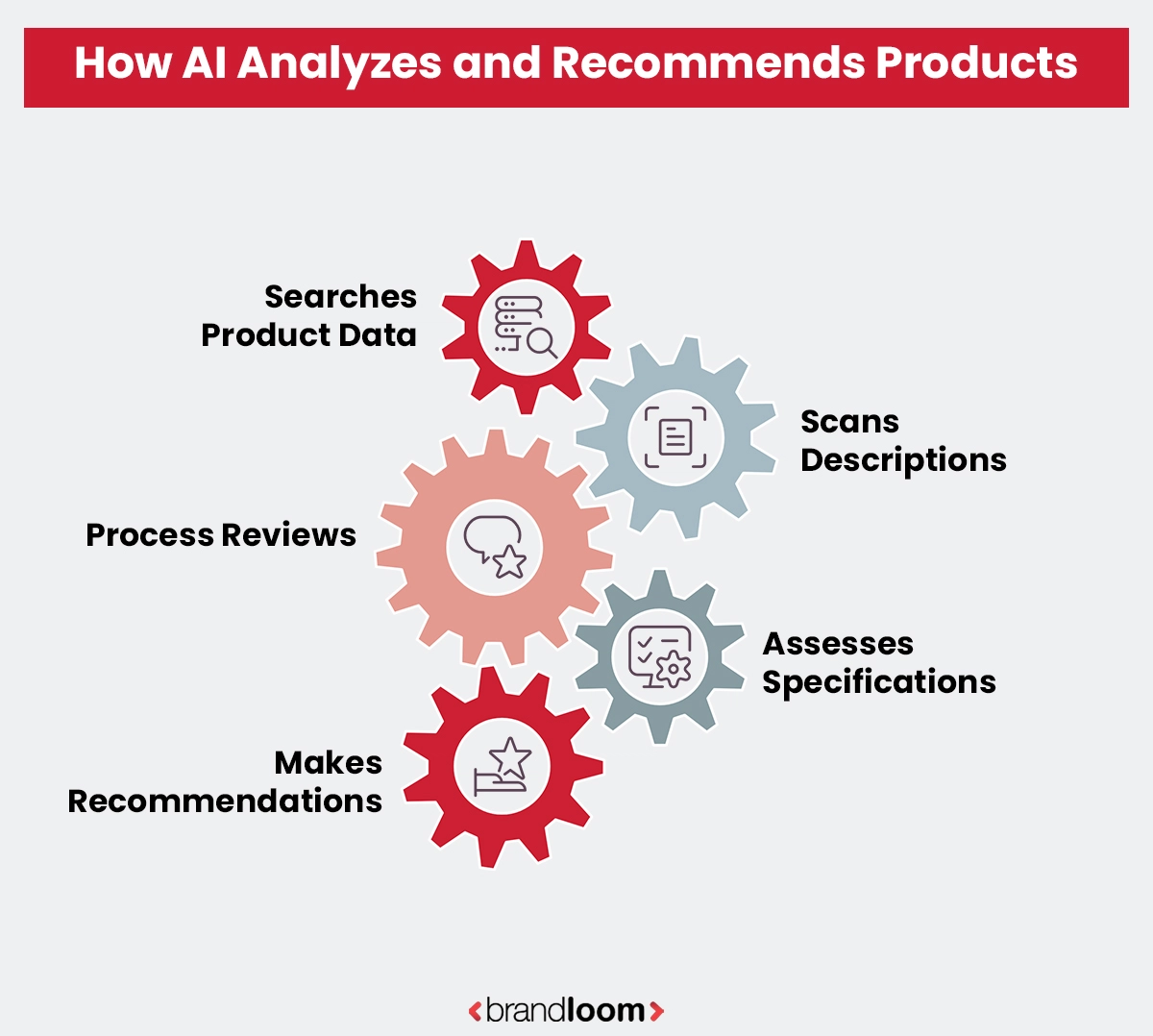
- Searches product data: The AI quickly searches massive volumes of product information to find products that actually address the shopper’s predicament, rather than just keyword matches.
- Scans descriptions: It scours through your lengthy product descriptions to pick up on actual features, materials, and benefits. When your description reads “ergonomic cushioning for all-day urban walking,” the AI will suss out what makes that appealing to shoppers in terms of comfort.
- Process reviews: The A.I. goes through hundreds of customer reviews to substantiate claims and identify patterns. When several customers say, “I walked 10 miles without pain,” the AI knows your product works fine.
- Assesses specifications: It verifies technical aspects, such as cushioning thickness, weight, and breathability, to ensure they meet the shopper’s requirements.
- Makes recommendations: Finally, the AI presents 3-5 carefully matched products instead of overwhelming shoppers with 500 options. These are data-driven recommendations, not random selections.
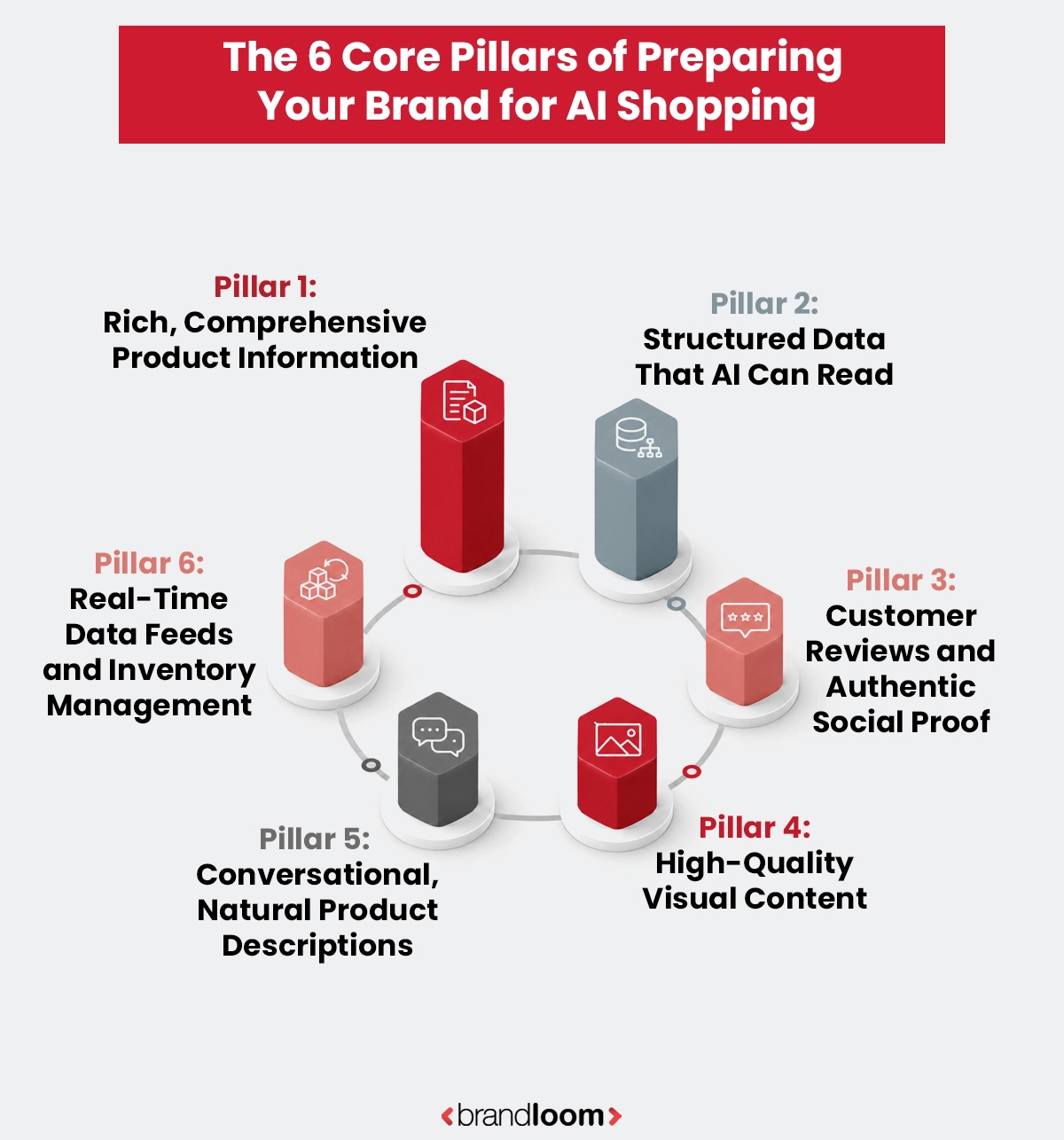
The 6 Core Pillars of Preparing Your Brand for AI Shopping
Preparing your brand for AI shopping comes down to six pillars. Let’s have a look at those pillars-
Pillar 1: Rich, Comprehensive Product Information
AI shopping assistants need detail to make smart matches. Go beyond basic specs and build data that AI can act on:
- It must include exact measurements, materials, certifications, as well as care instructions
- Benefit-focused copy that explains what a spec means in real use
- Clear use cases showing who the product suits and why
- Another must have is consistent categorization and tags
- Full sizing information for wearable items
Strong product data forms the foundation everything else builds on. Brands that audit and enrich their catalogs first give AI the clarity it needs to recommend them over competitors with thinner data.
Pillar 2: Structured Data That AI Can Read
Structured data will help with AI understanding your catalog instantly instead of guessing. Four schema types matter most:
- Product schema for names, descriptions, prices, and availability
- Organization schema to signal brand authority and location
- FAQ schema linking customer questions directly to your answers
- Offer schema to keep pricing and promotions current in real time
Without this layer, even excellent product content stays invisible to AI systems scanning for reliable, machine-readable answers.
Pillar 3: Customer Reviews and Authentic Social Proof
AI weighs real buyer feedback more heavily than brand messaging. A few things make reviews work in your favor:
- Natural language that helps AI match listings to conversational searches
- High review volume, which signals trust
- Recent reviews, which signal an active, selling product
- Fast responses to reviews, including critical ones
- Photo and video reviews for added credibility
Build a system that requests reviews after delivery and makes rating quick. BrandLoom, India’s leading reputation and reviews management agency, can help you build a review pipeline that keeps AI systems recommending you consistently.
Pillar 4: High-Quality Visual Content
AI now reads images and video, not just text. Strong visual content includes:
- Multiple high-quality, multi-angle product photos
- Lifestyle shots showing real-world use
- Short product videos demonstrating key features
- Consistent visual style and quality across listings
- Descriptive alt text on every image
- 360-degree views where possible
Many brands overlook this pillar entirely, assuming AI only reads text, and lose recommendations they could easily have earned.
Pillar 5: Conversational, Natural Product Descriptions
AI shopping assistants function like a conversation with your customer, so your descriptions should read that way too:
- Answer real questions directly, like compatibility, battery life, or ease of cleaning
- Drop jargon and keyword-stuffed phrasing built for search engines
- Focus on outcomes rather than raw specs
- Add comparison context so AI understands where your product sits against alternatives
Descriptions written for humans, not crawlers, perform far better inside AI-driven shopping experiences.
Pillar 6: Real-Time Data Feeds and Inventory Management
Traditional search engines crawl your site periodically, but AI shopping assistants pull data live. Real-time feeds give you an edge through:
- Accurate stock levels, so AI skips out-of-stock items
- Instant pricing and promotion updates
- Fresh reviews and sales velocity signaling current popularity
- Automatic seasonal stock adjustments
Brands running live, connected data feeds consistently outrank those relying on static catalogs, since AI simply trusts current information more than yesterday’s.
These foundations closely align with modern E-commerce SEO Services. Here brands optimize product pages, technical structures, content quality. They also use user experience to improve visibility across both traditional search engines and AI-powered shopping platforms.
Top AI Shopping Platforms Shaping E-Commerce
AI shopping is no longer a single platform or feature. It is a growing ecosystem of tools that are actively changing how customers discover, evaluate, and buy products.
Google Shopping AI, Amazon‘s recommendation engine, Meta’s AI-powered discovery ads, and conversational assistants like ChatGPT and Perplexity are all making purchasing decisions on behalf of users. Performance Marketing strategies also need to evolve alongside AI shopping. As paid campaigns, product feeds, audience targeting, and conversion data increasingly influence how brands reach high-intent customers across digital platforms.
Understanding where your customers are shopping with AI is the first step to showing up there. Missing even one platform means handing that customer to a competitor who prepared better.
GEO and AEO: the two new disciplines your brand needs in 2026
Optimizing for AI search is not one practice — it is two distinct disciplines that work together. Understanding the difference helps you allocate effort correctly and avoid the mistake of doing one while ignoring the other.
Generative Engine Optimization (GEO)
GEO is the practice of structuring your content so that AI models. For example- ChatGPT, Google’s AI Overviews, Perplexity, Gemini etc. generate responses that feature, cite, or recommend your brand. Unlike traditional SEO, which targets a ranked list of links, GEO targets the synthesized answer itself. If a shopper asks “what’s the best moisturizer for dry skin under ₹800?” and your product appears in the AI’s generated response, that is GEO working. The signals that drive GEO include authoritative product copy, structured data, high review volume, factual and citable descriptions, and strong brand entity recognition across the web. Generative AI SEO Services help brands adapt their content strategy for this new search environment.
Answer Engine Optimization (AEO)
AEO is the practice of making your content the direct answer to a shopper’s question. Where GEO is about being cited in a generated response, AEO is about being the source that gets surfaced when someone asks a specific question — “Is this product vegan?” “Does it work with Android?” “What size should I order?” The primary tools for AEO are FAQ schema, Q&A-structured product descriptions, and review content that mirrors real shopper language. If your FAQ schema answers a question better and more directly than any competitor’s page, answer engines will surface your brand first. Pillars 2, 3, and 5 are your AEO levers. The FAQ section at the bottom of this page is already doing AEO work — it just needs to be kept current, expanded, and properly marked up with schema.
How GEO and AEO work together
GEO gets you into the generated answer. AEO gets you into the direct answer. A brand that does both shows up whether a shopper is asking a broad discovery question (“what moisturizer should I buy?”) or a specific intent question (“is X moisturizer safe for rosacea?”). Together, they cover the full arc of AI-assisted shopping — from discovery to decision. The six pillars in this guide are your foundation for both. GEO and AEO are not separate strategies bolted on top; they are the lens through which every pillar should be executed.
AI Shopping vs Traditional E-commerce
| Traditional Shopping | AI Shopping |
| Keyword search | Conversational search |
| Hundreds of products | Curated recommendations |
| User compares products | AI compares products |
| SEO-focused | Entity-focused |
AI Shopping Readiness Checklist
Before AI can recommend your products, it needs to read, understand, and trust your data. Use this checklist to identify where your brand stands and what needs fixing before competitors get there first.
While AI shopping introduces new optimization requirements, strong SEO services remain essential. The reason behind this is search visibility, technical health, content quality, and authority signals continue to influence how customers discover brands online.
Schema Implemented
Schema markup tells AI systems exactly what your product is, what it costs, and who it is for. Without it, AI has to guess, and it usually recommends someone else instead. If your product pages lack structured data, you are invisible to the fastest-growing discovery channel in e-commerce.
Product Reviews Enabled
AI shopping assistants weight review data heavily when making recommendations. A product with no reviews or too few is treated as unverified and skipped. Enabling reviews and building a system to collect them consistently is one of the highest-impact steps you can take right now.
Product Feeds Updated
Outdated product feeds send wrong information to AI platforms, leading to incorrect recommendations, failed transactions, and lost trust. Your feeds need to reflect accurate pricing, availability, and attributes at all times. Stale data is one of the most common and most avoidable reasons brands get deprioritised by AI systems.
Mobile Optimised
AI shopping recommendations almost always lead to a mobile experience. If your product pages load slowly, display poorly, or create friction on a phone, the recommendation is wasted. Mobile optimisation is no longer about reach, it is about not losing customers that AI already sent you.
Rich Descriptions
AI does not just read your descriptions, it interprets them. Thin, generic copy gives it nothing to work with. Rich descriptions that explain benefits, use cases, materials, and context help AI match your product to the right customer query with confidence.
Inventory Sync
Recommending an out-of-stock product is one of the fastest ways to lose AI platform trust. Real-time inventory sync ensures AI systems only surface products that are actually available, protecting your visibility and your customer experience simultaneously.
The Problem AI Shopping Solves
Picture a parent buying a laptop for their teenager. They search online. Five hundred options appear. They do not understand processor specs, RAM differences, or storage types. Three hours, 15 open tabs, and a comparison spreadsheet later, they still feel uncertain. This is decision fatigue.
AI shopping eliminates it entirely. Instead of 500 results, an AI assistant asks three questions, processes thousands of products, and recommends the three best matches. The parent decides in minutes.
Understanding Product Discovery in the AI Era
AI shopping has completely revolutionized the way product discovery is done. Acknowledging this change is very important to preparing your brand for successful AI shopping.
Traditional product discovery followed a predictable path:
- The customer looks for a category
- The customer is offered hundreds or thousands of results
- The customer filters the selection down
- The customer browses the pages of different products
- Customer does a product comparison
- Customer reads reviews along with specifications
- Customer arrives at a decision
The process involved time, effort, and patience. The majority of customers gave up this tiring process due to decision fatigue before reaching the checkout counter.
On the other hand, AI shopping dramatically cuts down the time spent in the whole process:
- Customer tells AI shopping assistant what they want
- AI may ask questions for further clarification
- AI checks and sorts through thousands of products in no time at all
- AI presents 3-5 products that are perfect matches
- Customer picks one and completes their purchase.
This compression is both an opportunity and a threat. The advantage is that when your product is recommended by AI, the sale is practically done because the customer relies on the AI’s reasoning. The disadvantage of an AI non-recommendation is that you will be completely out of the picture, as the customer will not even consider you. Thus, it is very important and urgent to make your brand ready for AI shopping.
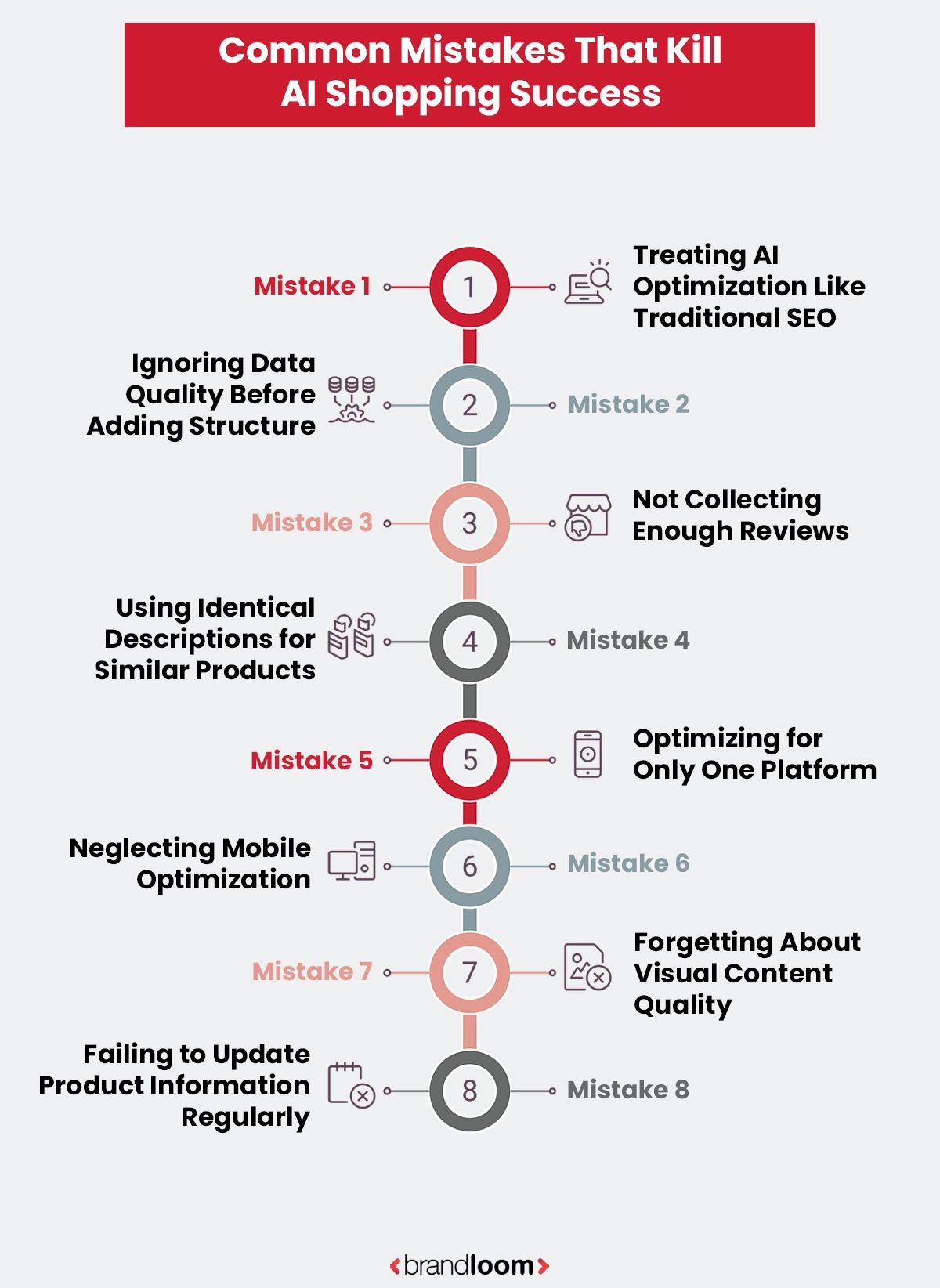
Common Mistakes That Kill AI Shopping Success
Here, we have been working with hundreds of brands to get their brands ready for AI shopping. We’ve watched the same mistakes made again and again. Below are some mistakes brands should never make.
Mistake 1: Treating AI Optimization Like Traditional SEO
AI is not like search engines. Keyword stuffing helps nothing. Density calculations are irrelevant.
What to do instead: Pay attention to detailed information written in standard language. Make it clear why your company was created and give context. AI can understand the substantialism of who you are, what the product does, and for whom.
Many brands rush to implement schema markup without first improving their actual product information. Structured garbage data is still garbage.
Mistake 2: Ignoring Data Quality Before Adding Structure
What to do instead: Fix your content, then add your structure. Enrich descriptions, complete specifications, and add quality images before implementing structured data markup.
Mistake 3: Not Collecting Enough Reviews
10 reviews of a product don’t cut it. AI requires scale to trust patterns and make confident recommendations.
What to do instead: Aim for hundreds of reviews per product. Construct systems for systematic review collections that continually generate new feedback.
Mistake 4: Using Identical Descriptions for Similar Products
Copy-pasted descriptions, even with minor changes, confuse AI and reduce recommendations for all similar products.
What to do instead: Create distinct descriptions for every product. Point out the uniqueness of each variation so the AI can properly match the product to the right customer.
Mistake 5: Optimizing for Only One Platform
The AI shopping tools from Amazon, Google Shopping, and Meta all function differently. Focusing on only one platform for optimization will hamper overall growth.
What to do instead: A detailed strategy should be developed to prepare your brand for AI shopping, applicable across all major platforms.
Mistake 6: Neglecting Mobile Optimization
Mobile devices are the primary means of shopping with AI. Poor mobile experiences lead to lost sales, even if AI has recommended your product.
What to do instead: The entire product page must be perfectly optimized for mobile, with fast loading times, legible text, and a smooth checkout flow.
Mistake 7: Forgetting About Visual Content Quality
Images are heavily analyzed by the AI. The AI will not be able to ‘see’ your product from the descriptions if the images are low-quality, inconsistent, or missing.
What to do instead: Get high-quality product photos taken from multiple angles and pay the photographers. Also, use lifestyle shots and maintain consistent quality throughout your catalog.
Mistake 8: Failing to Update Product Information Regularly
AI supports only fresh, current data. Bit by bit, products with old information get less and less visibility in AI engines’ recommendations.
What to do instead: Regular updates of product information. Always refreshing descriptions, constantly collecting new reviews, and keeping up with the current availability and pricing.
How to Measure AI Shopping Success
Optimising for AI shopping without measuring results is guesswork. These five metrics tell you whether your efforts are working.
- AI Referral Traffic: Track traffic arriving from AI-powered platforms like Google Shopping, Perplexity, and ChatGPT. Growing AI referral traffic means your structured data is being picked up and trusted.
- AI Citations: Monitor how often your brand appears in AI-generated responses. Frequent citations indicate strong product data, review volume, and content authority.
- Product Recommendation Frequency: Measure how often your products appear in AI recommendation results. Low frequency despite good traffic usually points to gaps in schema, descriptions, or review count.
- Conversion Rate: AI-referred visitors arrive with higher purchase intent. If conversion rates from AI traffic are low, the problem is on the product page, not the recommendation engine.
- Assisted Revenue: Not every AI interaction leads to an immediate purchase. Assisted revenue tracks sales where AI played a role earlier in the journey, giving you the full picture of what it is actually driving.
Conclusion
Customers no longer search for products; AI finds products for them. Brands that aren’t optimized for AI will simply disappear from results, losing visibility and sales to competitors who are ready.
The good news? The path forward is clear. Six pillars- rich product data, structured information, customer reviews, quality visuals, conversational descriptions, and live data feeds are all you need to dominate AI-powered recommendations.
The only question is, will you act now or wait until it’s too late?
Our team has built its reputation on delivering real, measurable results for businesses across India. We don’t just advise; we execute. Schedule your free website audit with BrandLoom today and make your brand unstoppable in the age of AI shopping.
Frequently Asked Questions
AI shopping replaces traditional keyword searches with smart conversations; customers simply describe what they need, and AI finds the perfect product instantly. This cuts shopping time from hours to minutes and delivers a truly personal experience. BrandLoom helps brands get ready for this shift so they stay visible and competitive in 2026 and beyond.
42% of CRM buyers used AI search during their evaluation, and those buyers were 36% more likely to purchase than those who did not use AI search. And that number grows every day. Brands without optimized product data get skipped entirely: no visibility, no sales. BrandLoom steps in to close that gap, making sure AI platforms fully understand and actively recommend your products.
AI ranks products based on complete information, review volume, and data quality, not just keywords. Products with rich, well-organized data get recommended far more often. BrandLoom ensures your listings meet every signal AI platforms look for.
AI needs detailed specifications, strong descriptions, quality images, structured data markup, and genuine customer reviews. The more complete your data, the more confidently AI recommends you. BrandLoom audits and enhances all these data points for your brand.
Brands need rich descriptions, structured schema markup, strong reviews, quality images, and real-time inventory data. Together, these signals help AI understand and recommend your products. Our team implements all six pillars systematically to maximize your AI visibility.
Schema markup serves as a translation system that provides complete product information to AI systems for immediate, precise understanding. Without it, AI struggles to process your information and often omits your products from recommendations altogether. BrandLoom’s technical team implements complete schema markup across your entire catalog, giving AI every reason to recommend your brand.
7. How does AI personalize product recommendations for online shoppers?
AI reads natural conversation to understand what a shopper truly needs, then instantly matches them with the most relevant products. Brands with detailed, varied product data get matched to more customer segments. We structure your product data to maximize these personalized matches.
AI rewards brands that provide complete information, earn strong reviews, use proper structured markup, and maintain accurate real-time data. Every gap in your product data is an opportunity for a competitor to take your place. BrandLoom builds a bulletproof AI presence for your brand, covering every factor that drives recommendations and sales growth.
Start with a full audit of your product data, then systematically enrich descriptions, implement schema markup, build review collection systems, upgrade visuals, and ensure seamless mobile optimization. Each step compounds your visibility across every major AI shopping platform. BrandLoom handles this entire process end-to-end, transforming your store into an AI-ready powerhouse built for exponential growth.