Digital marketing strategy in 2026 is not simply an upgrade of today’s marketing practices. It signals a significant shift in how brands attract customers, build trust, and drive growth. The pace of change is increasing, and marketers who rely on traditional approaches risk falling behind as consumer behavior becomes more complex and data-driven.
Modern customers move through digital environments with remarkable speed. They rely on AI assistants, explore hyper-personalised experiences, and make decisions long before they land on a website. Real-time data, automation, and generative AI are reshaping how marketers plan, execute, and measure success. These changes are not early signals. They are becoming the foundation of effective marketing.
This is the reality shaping future digital trends in 2026.
AI now creates content at scale. Predictive analytics in 2026 identifies opportunities before they appear in dashboards. Customer experience has become a core performance indicator, supported by AI-driven customer experience tools across the entire funnel. Marketers today are responsible for orchestrating integrated systems that guide awareness, conversion, and loyalty.
The brands that succeed will combine smarter tools, stronger insights, and aligned teams. As a top digital marketing agency in India, we at BrandLoom see this shift as an opportunity to build modern, efficient strategies fueled by data-driven decision-making and measurable outcomes.
2026 is approaching quickly. The time to prepare is now.
The 2026 Marketing Landscape: Trends Shaping the Next Digital Era
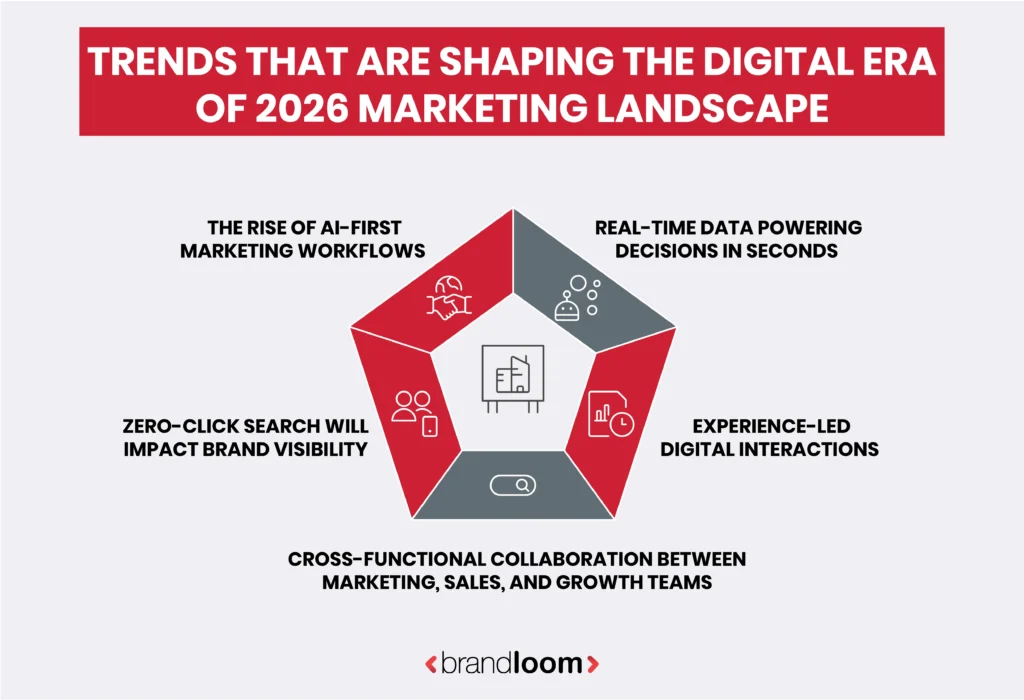
The marketing environment is evolving rapidly, and by 2026, brands will operate in a world defined by intelligence, speed, and customer-centric experiences.
The most significant shifts will come from how marketers respond to future digital trends 2026 and apply emerging digital technologies in 2026 in practical, outcome-driven ways.
Instead of focusing on deep technical infrastructure, the true advantage will lie in how teams use more intelligent workflows and create personalised interactions that feel natural to the customer.
This era will reward brands that operate with agility and clarity, and those that understand how data, AI, and experience design work together to influence growth.
1. The Rise of AI-First Marketing Workflows
By 2026, marketing teams will function with AI-first workflows where automation handles the heavy lifting and humans focus on strategy and creativity. For example, campaign planning tools will automatically generate audience segments based on behavioural patterns.
Content engines will recommend what topics to create based on predicted search intent. AI models will identify underperforming ads and instantly suggest new variations.
These capabilities will deliver a more personalised AI-driven customer experience because decisions will be based on accurate predictions rather than guesswork. Brands that adopt these workflows early will produce higher-impact marketing with fewer resources.
2. Real-Time Data Powering Decisions in Seconds
Marketers are moving into a world where live information, rather than historical reports, guides decisions. Real-time data ecosystems will highlight which campaigns need attention, which customer journeys show friction, and which product pages are losing conversions.
For example, a retail brand will be able to detect a sudden spike in demand for a trending product and immediately increase ad budgets to capture more sales. A fintech app will see user drop-offs in a specific onboarding step and fix it within minutes.
This level of instant insight will turn agility into a measurable competitive advantage in 2026.
3. Zero-Click Search Will Impact Brand Visibility
Zero-click search is becoming a major force in shaping digital visibility. Users often receive answers directly on the search page through AI summaries, SERP modules, and enhanced snippets. For example, when someone searches for a skincare routine, they may see a complete AI-powered answer that summarises expert guidance.
The challenge for brands is to remain visible even when the user never visits the website. Structured data, entity optimisation, and trust signals will help brands appear within these high-value SERP features. In 2026, visibility will rely on how clearly a brand’s information is understood by search systems rather than how many links it earns.
4. Experience-Led Digital Interactions (CX as a Growth Channel)
Customer experience will be a core growth driver rather than a support function. Customers expect frictionless, personalised, and intuitive interactions at every stage. For example, an ecommerce brand may use data to tailor homepages based on each visitor’s browsing history.
A travel platform may use predictive modelling to offer personalised itineraries in one click. These experience-led moments build loyalty and influence purchase decisions.
In 2026, brands that invest in experience design will outperform competitors because customer experience becomes a measurable revenue channel.
5. Cross-Functional Collaboration Between Marketing, Sales, and Growth Teams
Silos slow down decision-making, and by 2026, successful brands will operate with cross-functional collaboration as a standard. Marketing, sales, analytics, and growth teams will share a unified view of customer journeys and performance metrics. For example, marketing teams will share campaign intent data with sales teams so follow-up calls feel more relevant.
Sales teams will report customer objections that help marketing refine messaging. Growth teams will work with product and content teams to optimise onboarding. This alignment will create a unified revenue engine that improves efficiency, enhances customer satisfaction, and shortens the path to conversion.
Generative AI in 2026: The New Engine of Modern Marketing
Generative AI will redefine the way marketers think, plan, and execute campaigns in 2026. What was once considered advanced will soon become standard practice across content creation, personalization, customer journeys, and optimization. The biggest impact will not come from isolated tools but from how teams use generative AI together with machine learning marketing tools, automation, and predictive insights to create faster, smarter, and more relevant experiences.
The shift toward AI-driven marketing will allow brands to reach higher levels of operational efficiency, reduce manual work, deliver better customer service, and achieve more measurable outcomes with every campaign. This is the moment where AI becomes the true engine behind modern marketing.
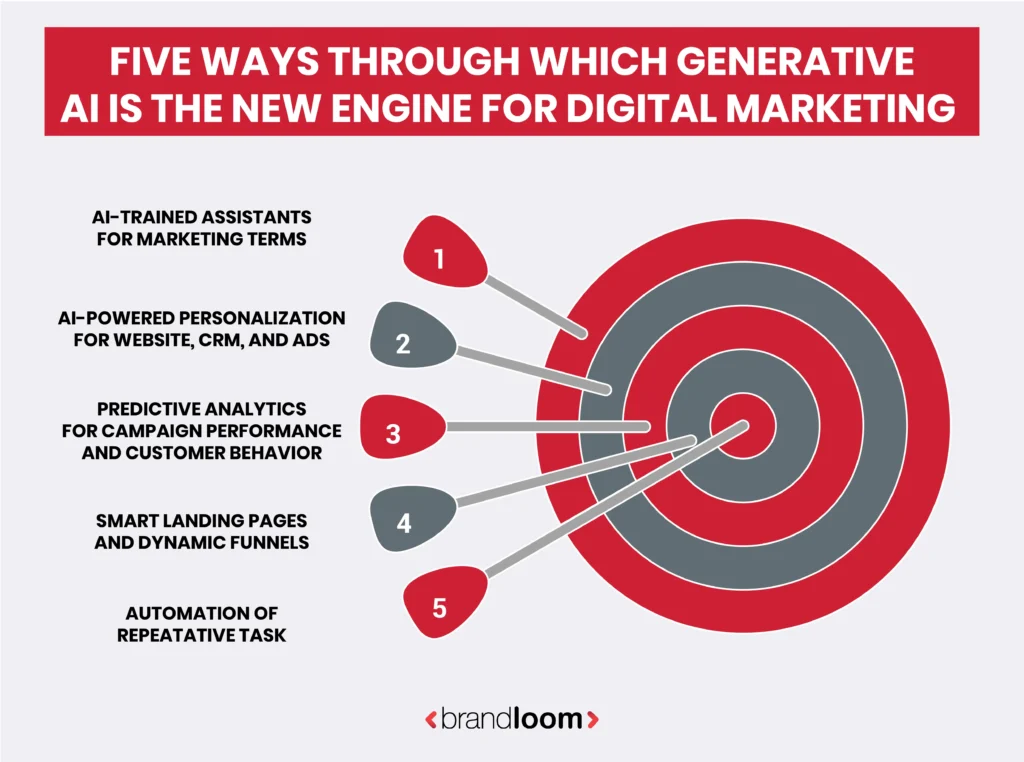
1. AI-Trained Assistants for Marketing Teams
By 2026, every marketing team will work with AI-trained assistants that support copywriting, targeting, segmentation, and performance analysis. These assistants will understand brand tone, audience behaviour, and channel nuances.
For example, marketers will be able to generate long-form content, ad variations, SEO outlines, social captions, and email sequences instantly with improved AI content optimization.
Targeting and segmentation will become more accurate because AI will recognise patterns in customer behaviour that humans overlook. An AI assistant will be able to analyse a campaign’s performance across multiple channels and recommend which audience groups should be removed, expanded, or retargeted. This level of intelligence will enable marketers to spend more time crafting a strategy instead of managing tasks.
2. AI-Powered Personalization for Website, CRM, and Ads
Personalization will move far beyond simple dynamic text or product recommendations. With generative AI, brands will deliver experiences that adapt in real time based on intent, browsing behaviour, and historical actions. A website can show different layouts, banners, and CTAs depending on whether the visitor is a returning customer, a new lead, or someone comparing prices.
In CRM systems, AI will score leads more accurately and generate personalised email flows based on what the customer is likely to do next. Ads will adjust messaging depending on viewer profiles. For example, a travel brand’s AI engine may automatically generate three ad versions for adventure seekers, discount hunters, and luxury travellers without requiring human intervention.
This level of real-time personalization will create stronger engagement and push conversion rates higher across every step of the buyer journey.
3. Predictive Analytics for Campaign Performance and Customer Behavior
Predictive analytics 2026 will allow marketers to look beyond what happened and anticipate what is likely to happen next. Instead of relying only on dashboards and past performance metrics, teams will use AI to forecast campaign results, customer drop-offs, purchase intent, and content performance.
For example, predictive models will identify which blog topics will drive the most traffic next month or which product categories will see a surge in demand based on seasonal patterns. Similarly, retention teams will get alerts when customers show early signs of churn so they can intervene immediately.
These insights will empower marketers to plan smarter, spend more efficiently, and allocate budgets based on data-backed projections instead of assumptions.
4. AI-Led CRO: Smarter Landing Pages and Dynamic Funnels
Conversion Rate Optimization will shift towards an AI-first approach. Landing pages will evolve in real time, adapting headlines, images, and CTAs based on visitor behaviour. A customer who hesitates may see a trust badge or testimonial. A high-intent visitor may see a limited-time offer.
Dynamic funnels will personalise the entire journey. For example, if a user abandons a pricing page, AI will identify whether they need a better value explanation, a personalised discount, or a case study for reassurance. This kind of AI-led CRO will significantly improve conversions and shorten purchase cycles.
5. Automation of Repetitive Tasks: Creative and Strategic Time Unlocked
In 2026, process automation RPA combined with generative AI will eliminate repetitive tasks across reporting, audience building, scheduling, and campaign monitoring. Teams will no longer spend hours compiling weekly dashboards or manually adjusting bids.
For example:
- Reports will be generated instantly with insights already summarised.
- Audiences will update automatically based on real-time behaviour.
- Machine learning rules will handle daily campaign checks.
This level of automation will give marketers valuable time to focus on ideas, storytelling, brand building, and long-term strategy. It ensures teams operate with healthier workloads while maintaining high-quality output.
Why Marketers in 2026 Can’t Wait for Monthly Reports
Marketing in 2026 will be defined by speed. The brands that win will not rely on month-end PDFs or static presentations but on instant insights that drive action.
With customer expectations shifting faster than ever, marketers must move from reactive planning to data-driven decision making powered by real-time data, predictive models, and connected systems.
Quarterly trends and historic charts will remain valuable, but the real competitive advantage will come from how quickly teams can turn live signals into measurable outcomes.
1. The Shift From Historical Reporting to Real-Time Optimization
Traditional reporting depends on what has already happened. Real-time intelligence focuses on what is happening right now. Marketers in 2026 will optimize campaigns as soon as engagement patterns shift, creative fatigue emerges, or new segments begin to convert.
For example, if a paid campaign experiences rising cost-per-click within an hour, AI-assisted systems can automatically adjust bids, creative variations, or targeting to preserve performance. If website behaviour shows a sudden spike in interest for a product category, a brand can launch time-sensitive offers instantly.
Real-time optimization allows teams to fix problems before they impact revenue and scale opportunities at the moment they appear.
2. Real-Time Dashboards for CMOs and CROs
CMOs and CROs need visibility into performance, revenue, and customer behaviour at all times. This is why real-time dashboards will become standard across growth-focused organizations. These dashboards consolidate marketing, sales, and product data into a single view that leaders can act on.
For example, a CMO can track ROAS across channels, see which campaigns are losing momentum, and allocate budget instantly. A CRO can monitor pipeline health, lead velocity, conversion rates, and churn signals without waiting for weekly updates.
This level of transparency helps leadership teams align technology, insights, and decisions across the entire funnel.
3. Leveraging CDPs to Unify Marketing and Sales Data
As customer journeys become more complex, customer data platforms will act as the central brain of modern marketing. CDPs unify first-party data from websites, CRMs, apps, email systems, and offline interactions. This gives marketers a single customer profile that updates in real time.
For example, when a user clicks an ad, downloads a guide, or speaks with a sales rep, the CDP immediately updates their profile and triggers the next action. This can involve personalised email content, retargeting sequences, or relevant product recommendations.
By connecting marketing and sales data, brands create seamless journeys and deliver highly relevant experiences using real-time personalization tools.
4. How Real-Time Data Increases ROAS, CPA Efficiency, and LTV
Real-time data improves performance across every financial metric:
- Higher ROAS: Budget shifts toward top-performing segments faster.
- Lower CPA: Underperforming ads are paused automatically before they drain spend.
- Higher LTV: Personalization becomes more accurate, improving retention and repeat purchases.
For example, if a subscription brand sees downgrades rising among a specific customer cohort, real-time systems can trigger retention campaigns instantly. If a product suddenly trends on social media, bids can increase to capture demand at its peak.
The brands that master real-time intelligence in 2026 will operate with sharper precision, more agile decision-making, and stronger long-term growth.
Digital Transformation for Marketers: What Actually Matters in 2026
Digital transformation in 2026 is no longer about migrating legacy systems or upgrading IT infrastructure.
For marketers, it is about improving speed, precision, and revenue impact.
The brands that lead the next era will treat transformation as a marketing function, not a technology project. The goal is sharper execution, better decision-making, and higher-performing customer journeys.
True successful digital transformation happens when people, processes, and platforms work together to unlock smarter growth.
The focus is clear: transform how marketing teams operate, collaborate, and measure outcomes.
1. Transformation Is Not IT. It Is About Marketing Effectiveness
Marketing transformation means redesigning how teams perform and deliver value. In 2026, digital transformation strategies shift toward real-time content delivery, faster experimentation, AI-supported campaign execution, and seamless customer experiences.
For example, instead of waiting weeks for IT to build dashboards, marketers use AI-ready tools to generate insights instantly. Instead of inefficient request queues, marketing teams automate workflows that accelerate creative approvals, email sequences, and audience targeting.
Transformation becomes about enabling better marketing, not upgrading hardware.
2. Eliminating Outdated Marketing Processes
Many marketing teams still rely on outdated practices that slow down performance. Manual reporting, disconnected channels, and siloed teams create delays, inaccuracies, and missed opportunities.
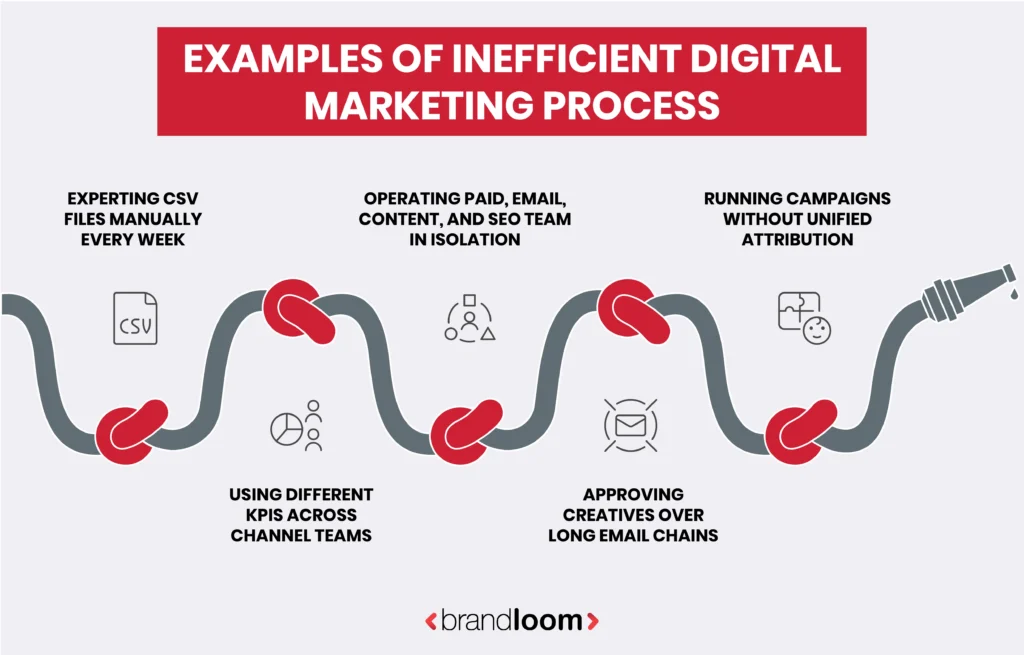
Examples of inefficient, outdated processes include:
- Exporting CSV files manually every week
- Using different KPIs across channel teams
- Operating paid, email, content, and SEO teams in isolation
- Approving creatives over long email chains
- Running campaigns without unified attribution
In 2026, digital transformation initiatives will prioritise removing these bottlenecks to unlock operational efficiency. Automated dashboards replace spreadsheets. Centralised systems replace channel silos. Collaboration tools replace long approval loops.
When these outdated processes disappear, marketers gain more time to focus on strategy, creative, and scaling winning initiatives.
3. Why Marketers Need Automation-First Workflows
Automation is not a nice-to-have in 2026 — it is a requirement for staying competitive.
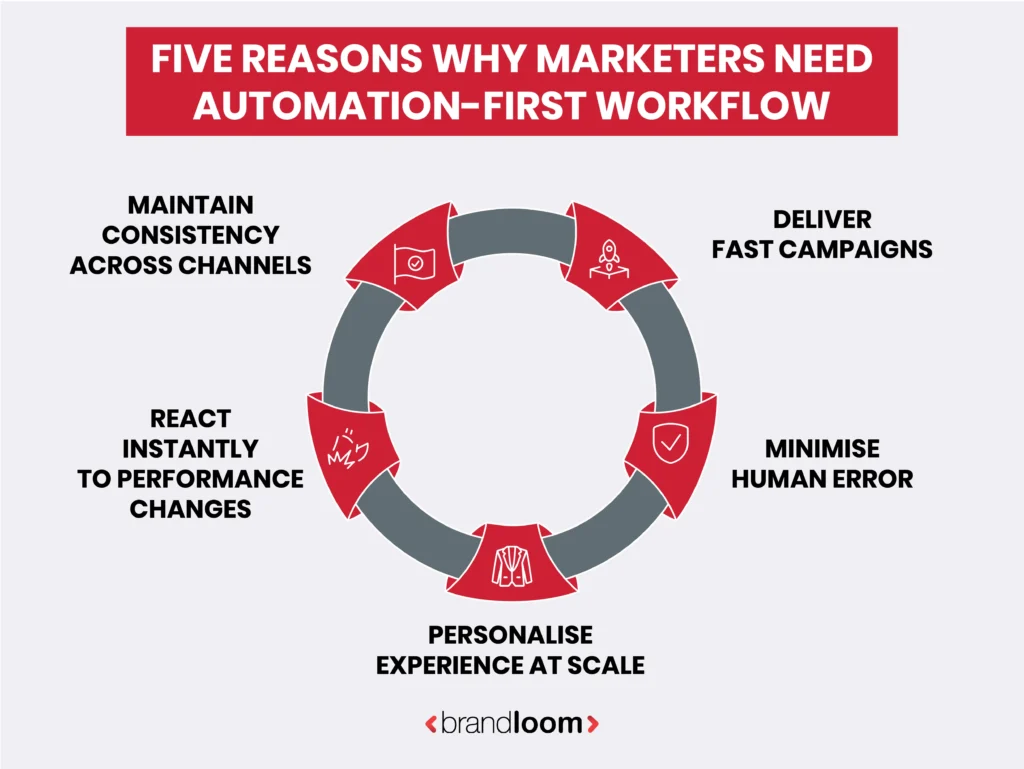
Automation-first workflows help marketers:
- Deliver faster campaigns
- Minimise human error
- Personalize experiences at scale
- React instantly to performance changes
- Maintain consistency across channels
For example, automated email journeys adapt to user behaviour without manual intervention. Paid campaigns adjust budgets and bids based on real-time performance. Content workflows route tasks automatically from brief to approval to publishing.
This shift frees marketers from repetitive work and allows them to focus on creativity, insights, and innovation. Automation becomes a foundation for modern, effective marketing organisations.
4. Cross-Functional Alignment Between Marketing, Sales, CX, and Product
A transformed marketing organisation does not operate alone. Growth in 2026 depends on how well teams collaborate. Marketing, sales, CX, and product must work as one cross-functional unit with shared goals, shared systems, and shared insights.
Examples of strong cross-functional alignment include:
- Unified KPIs for acquisition, retention, and lifetime value
- Shared dashboards are visible to all revenue teams
- Joint planning for launches, campaigns, and customer journeys
- Combined customer feedback loops used by product and CX teams
When teams align, customer experience becomes consistent, and decision-making becomes faster. This unified approach accelerates business growth far more than isolated team efforts ever could.
5. Moving From Campaign Thinking to Growth System Thinking
Traditional campaign thinking is linear and often disconnected. Brands plan, launch, measure, and repeat. In 2026, marketers must shift to growth system thinking — an always-on, data-powered approach where every touchpoint feeds into a continuous cycle of learning and improvement.
Growth systems include:
- Always-on experimentation
- Real-time audience insights
- Automated lifecycle marketing
- Predictive triggers and behaviour-based journeys
- Continuous learning loops supported by AI
This mindset turns marketing into an evolving system where improvements never stop. Teams move faster, learn faster, and scale faster.
Brands that embrace this approach will dominate in 2026 with smarter decisions, stronger customer experiences, and more resilient growth engines.
The Transformation of Search: Preparing for AI, Zero-Click, and No-SERP Results
Search is changing faster than any other marketing channel, and 2026 will mark its biggest shift yet. Traditional rankings and blue links are giving way to AI-generated answers, conversational search, multi-step reasoning, and predictive responses.
This new environment demands an AI-ready content strategy that prioritizes clarity, depth, structure, and entity-based relevance rather than outdated keyword-heavy practices. With more searches ending without a website visit, marketers must rethink how visibility, attribution, and engagement work in a world shaped by generative AI and dynamic search experiences.
1. The End of Classic SERPs as We Know Them
Static SERPs with ten blue links are becoming rare. Instead, users see AI summaries, knowledge panels, instant answers, video snippets, and visual overviews. In some cases, search engines may bypass SERPs entirely and deliver results inside chat interfaces or voice-driven assistants. This makes zero-click search optimization essential for marketers who want their brand to remain visible even when users never click through.
An example is when a customer searches “best skincare routine,” and the AI assistant provides a full routine without linking out. Brands must ensure their information is recognized, trusted, and surfaced in these answers.
2. How AI Assistants Will Dominate Brand Discovery
AI assistants will become the primary gateway for discovery. Instead of browsing multiple websites, users will rely on AI tools to compare products, summarize reviews, shortlist solutions, and recommend next steps. For marketers, this means your brand must be discoverable through these systems, not just organic search.
If a user asks an AI agent, “What is the best CRM for small businesses?” the assistant will respond with options rooted in structured data, verified sources, and sentiment analysis. Marketers must optimize their content for these decision-making flows or risk becoming invisible.
3. New SEO: Entities, Semantic Content, Structured Data
The new world of SEO revolves around meaning, not keywords. Search engines rely on entities, metadata, and contextual understanding to decide what information is reliable. This is why search experience optimization 2026 requires:
- Clear entity definitions around products, brands, and concepts
- Schema markup for articles, FAQs, products, and reviews
- Semantic content that explains relationships, not just topics
- Consistent brand data across all channels
For example, a hotel chain using structured data for amenities, pricing, reviews, and locations will be surfaced more often in generative answers compared to a competitor with unstructured, inconsistent content.
4. Content Built for Machines and Humans
Content must now satisfy two audiences at once. Humans want clarity, authority, and strong storytelling. Machines need structure, factual precision, and defined entities. A successful strategy blends both. That means:
- Writing with topic depth and expert perspectives
- Using headings and clean markup for machine parsing
- Crafting helpful answers to common questions
- Ensuring accuracy so that AI systems can confidently reuse
This approach supports both the customer experience and the algorithms that shape visibility.
5. How Marketers Can Future-Proof Visibility
Marketers can stay ahead by adopting strategies designed for zero-click and AI-driven discovery:
- Use structured data to improve machine understanding
- Build authority signals through expert content and citations
- Optimize for conversational and multi-step search queries
- Strengthen E-E-A-T with credible sources and real insights
- Ensure brand information is consistent across the web
The brands that thrive in 2026 will treat search as an ecosystem, not a ranking battle. By preparing for AI-first discovery and search experiences that bypass traditional SERPs entirely, marketers can safeguard and expand visibility in a rapidly evolving digital landscape.
Building a 2026-Ready Digital Marketing Strategy
A winning digital marketing strategy for 2026 is not built on tools alone. It requires a mature, scalable, and insight-driven foundation that connects marketing, sales, customer success, and product. CMOs and CROs need a framework that blends technology with execution, creativity with data, and planning with adaptability.
As AI reshapes channels, content, and customer behaviour, leaders must focus on developing a digital marketing strategy that is resilient, revenue-aligned, and intentionally built for business growth.
A modern roadmap goes beyond campaigns and channels. It demands systems that align technology with strategy, encourage experimentation, and turn insights into action through continuous learning. The following steps create the foundation for a 2026-ready marketing engine.
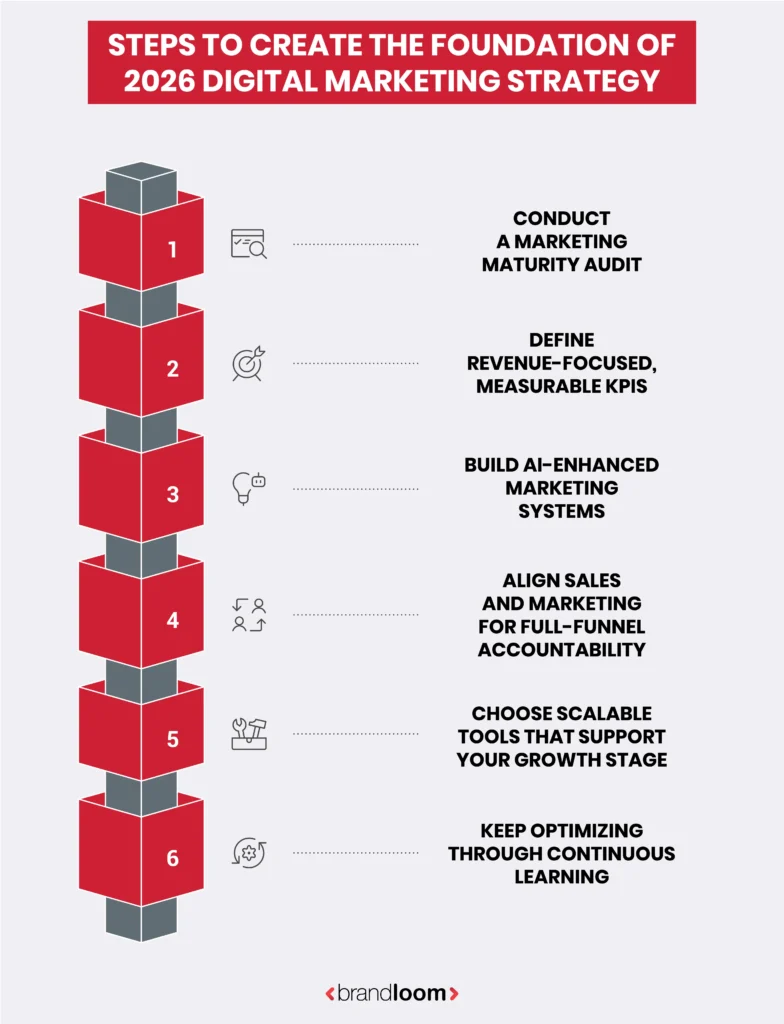
Step 1: Conduct a Marketing Maturity Audit
Before selecting tools or launching initiatives, CMOs and CROs must understand their organisation’s current capabilities. A marketing maturity audit examines data readiness, channel performance, attribution clarity, team skill sets, content strength, and workflow bottlenecks.
For example, if a brand still relies on isolated analytics tools or inconsistent reporting, it signals an early maturity stage. If cross-channel campaigns lack unified tracking or customer insights, it indicates missing structural foundations. The audit helps leaders prioritise investments, eliminate guesswork, and build a roadmap grounded in reality.
Step 2: Define Revenue-Focused, Measurable KPIs
A 2026-ready strategy requires KPIs linked directly to revenue, not vanity metrics. CMOs and CROs must set measurable goals across the full funnel, including:
- Pipeline created
- ROAS and blended CAC
- Lead-to-opportunity conversion
- Retention and expansion revenue
- LTV growth
These KPIs ensure alignment between marketing and revenue teams. They also push leaders to track outcomes instead of activity, helping both functions stay focused on business impact.
Step 3: Build AI-Enhanced Marketing Systems
To operationalise a modern strategy, teams must integrate AI into content, targeting, customer journeys, and reporting. This is where digital marketing planning and strategy evolves into intelligent automation.
Examples include:
- AI engines recommending content based on behaviour
- Predictive scoring for leads and accounts
- Automated testing frameworks for landing page CRO
- Conversational AI improving customer engagement
Rather than adding tools for the sake of innovation, CMOs should build systems that support clear workflows, eliminate manual effort, and enhance decision-making.
Step 4: Align Sales and Marketing for Full-Funnel Accountability
A true digital transformation roadmap 2026 requires eliminating departmental silos. Marketing and sales must combine insights, attribution data, and messaging to create an integrated funnel.
For example, shared dashboards allow sales teams to see real-time campaign performance, while marketing teams receive immediate feedback on objections and conversion blockers. Cross-functional rituals such as weekly pipeline syncs, shared revenue goals, and unified measurement frameworks ensure both teams stay aligned on outcomes instead of operating separately.
Step 5: Choose Scalable Tools That Support Your Growth Stage
Tech stacks often fail because they are chosen for trends rather than fit. CMOs should select tools based on three criteria:
- Can the tool scale with the brand’s growth?
- Does it support integration across sales, marketing, and CX?
- Does it align with the organisation’s maturity level?
Early-stage companies may need lightweight all-in-one platforms, while mid-market brands benefit from modular tools. Enterprise teams may require advanced AI, CDP systems, and deeper automation layers. The right stack becomes a multiplier rather than a cost centre.
Step 6: Keep Optimizing Through Continuous Learning
In 2026, the strongest teams will treat strategy as a living system. CMOs and CROs must build a culture of experimentation and continuous learning.
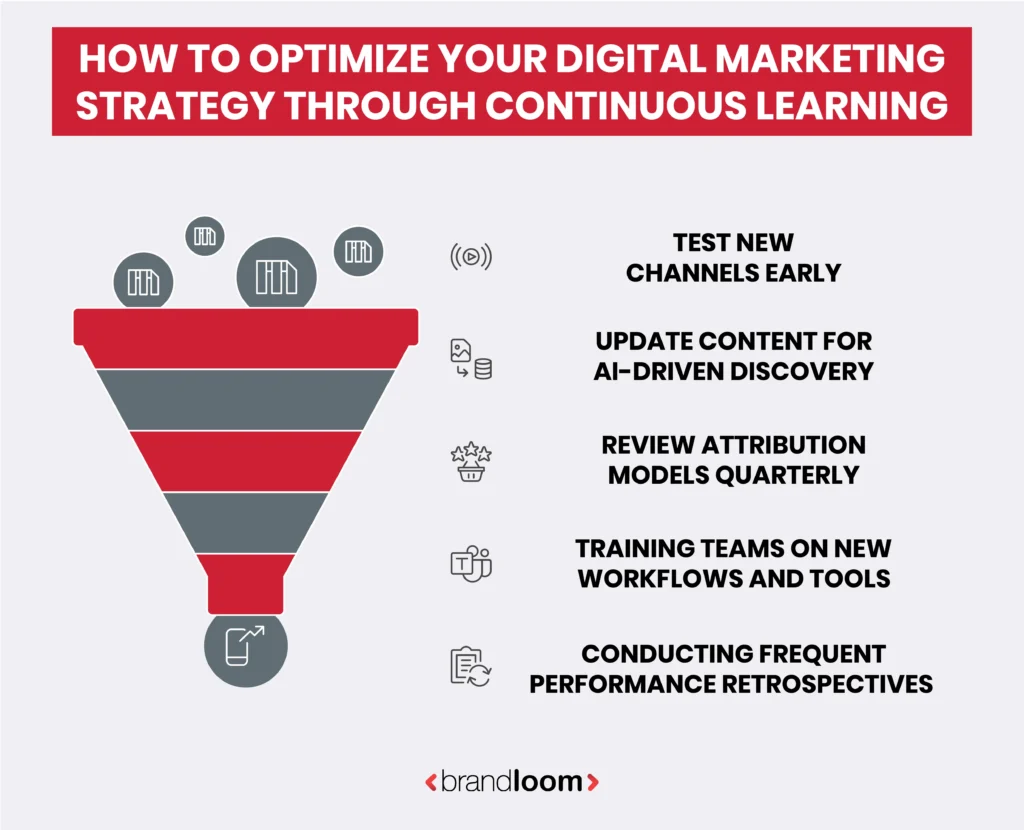
This means:
- Testing new channels early
- Updating content for AI-driven discovery
- Reviewing attribution models quarterly
- Training teams on new workflows and tools
- Conducting frequent performance retrospectives
A strategy that evolves consistently will outperform one written and forgotten. The goal is agility, adaptability, and long-term business growth supported by smart systems and aligned teams.
Industry Playbooks 2026: Digital Marketing Strategy Examples from Leading Brands
As markets evolve and customer expectations rise, every industry needs a different approach to transformation. There is no universal digital business strategy. The most effective brands customise their marketing systems based on behaviour patterns, buying cycles, and revenue models. Below are industry-specific digital marketing strategy examples showing how leaders are preparing for 2026 using AI, automation, and predictive insights.
1. Retail and eCommerce: AI-Led Product Discovery and Real-Time Offers
In retail and eCommerce, the winners will be brands that personalise every step of the buyer journey. AI engines will power product discovery by analysing browsing behaviour, search patterns, and intent signals.
Shoppers will see dynamic pricing, real-time bundle recommendations, and instant offers triggered by micro-behaviours. Retailers already using AI-driven merchandising are seeing stronger conversions and higher repeat purchases, making this a critical playbook for 2026.
2. SaaS: AI Onboarding, Churn Prediction, and Expansion Revenue
For SaaS companies, 2026 will be the year of predictive growth. AI-led onboarding flows will guide users through personalised activation paths, reducing time-to-value. Churn prediction models will instantly flag at-risk accounts, while automated expansion workflows will surface upsell opportunities based on usage data. SaaS leaders who adopt these systems early will build more stable, predictable revenue engines.
3. D2C: Personalization Engines and Automated Lifecycle Marketing
D2C brands will rely heavily on automated lifecycle journeys. AI models will tailor product recommendations, email sequences, and retention incentives at the individual level.
Personalization engines will also shape website experiences in real time, improving average order value and customer lifetime value. Brands that embrace automation will scale faster while keeping operational costs lean.
4. B2B: Account-Based Marketing Enhanced by Predictive Analytics
B2B marketers will shift from broad lead generation to precise account targeting. Predictive analytics will score accounts based on intent, engagement, and readiness, helping teams prioritise revenue-heavy opportunities.
Automated ABM sequences, intent-driven content, and real-time sales intelligence will create a coordinated, high-performing growth system. This playbook will be one of the most powerful for B2B teams entering 2026.
Small Business & Startup Strategy: Growing Efficiently in 2026
For small businesses and startups, competing with established brands has always been a challenge. In 2026, digital marketing strategies for small businesses and digital marketing strategies for startups will rely less on big budgets and more on smart systems, AI-driven workflows, and efficient processes. The goal is to generate measurable growth while keeping operations lean and scalable.
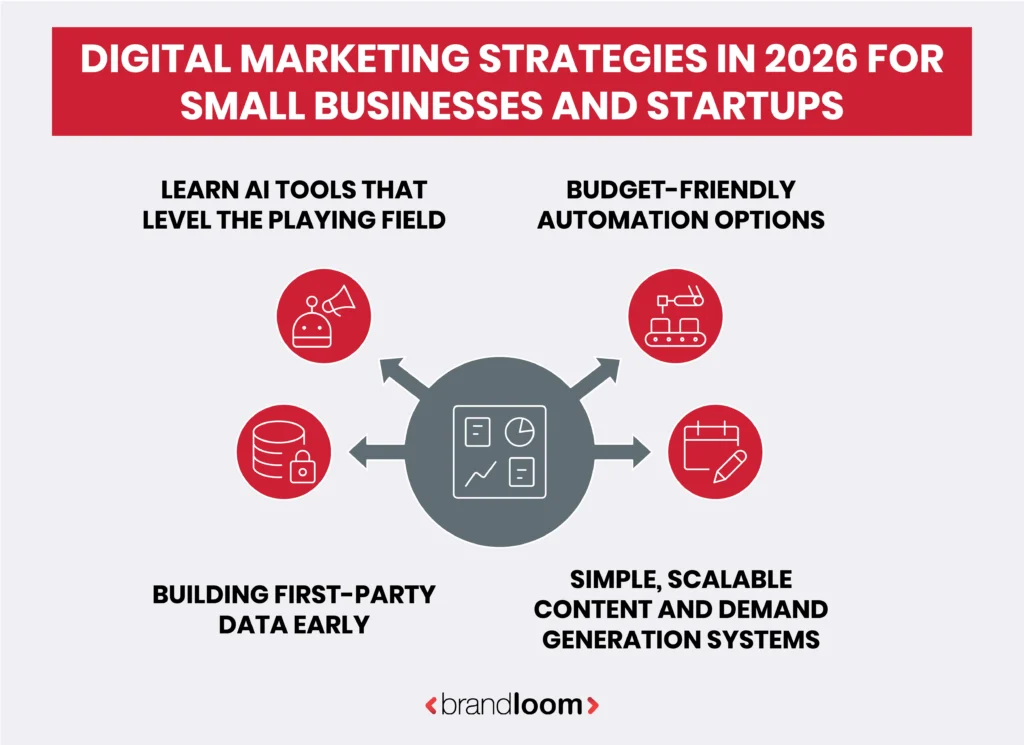
1. Learn AI Tools That Level the Playing Field
Small teams can now leverage AI tools to handle content creation, audience segmentation, predictive targeting, and even ad optimization. For example, an AI-powered copywriting assistant can generate blog posts, social media content, and email sequences, allowing a two-person marketing team to perform at the level of a larger organization.
2. Budget-Friendly Automation Options
Automation tools that were once reserved for enterprise brands are now accessible to startups. From scheduling campaigns and sending personalized emails to automating social media posting, these solutions reduce repetitive work and free marketers to focus on strategy and creativity.
3. Building First-Party Data Early
Collecting first-party data from day one is critical. Startups can use website sign-ups, app interactions, and email engagement to create robust customer profiles. This data forms the backbone of personalized campaigns, ensuring that every touchpoint drives value.
4. Simple, Scalable Content and Demand Generation Systems
Small businesses can implement content and demand generation strategies that grow with the company. Modular campaigns, repurposed content, and automated nurture flows allow startups to maintain consistency, drive leads, and increase retention without overextending resources.
By combining AI, automation, and smart data practices, small businesses and startups can compete effectively, optimize spend, and scale quickly in 2026, turning limited resources into measurable business growth.
Conclusion
Marketing success in 2026 will belong to brands that embrace change proactively. A forward-looking digital marketing strategy in 2026 is no longer optional it is the foundation for sustainable business growth. Brands that integrate AI, real-time data, hyper-personalized customer experiences, and automation into their workflows will not only keep pace with evolving consumer expectations but also outpace competitors.
Reactive approaches, relying on outdated reports or manual processes, will leave marketers struggling to capture opportunities as they emerge. Leaders who prioritize digital transformation initiatives, align teams across marketing, sales, and CX, and leverage tools that deliver measurable outcomes will build systems that scale efficiently and consistently.
As a leading digital marketing company in India, we at BrandLoom help businesses transform these insights into actionable strategies, enabling teams to make smarter decisions, optimize campaigns in real time, and create experiences that drive lasting growth. The brands that adapt first will define the market and own 2026.
Frequently Asked Questions
A digital marketing strategy in 2026 is a comprehensive plan that guides how businesses leverage digital channels, technologies, and data to drive measurable growth. Unlike traditional approaches, it integrates AI, real-time analytics, automation, and hyper-personalized customer experiences into every stage of the marketing and sales funnel. This strategy focuses on actionable insights from real-time data, predictive analytics, and cross-functional collaboration rather than legacy reporting.
In 2026, successful digital marketing strategies emphasize aligning marketing, sales, CX, and product teams to optimize operational efficiency and deliver consistent, measurable outcomes. For marketers, this includes AI-driven content, predictive personalization, and digital transformation initiatives that improve engagement and conversions.
At BrandLoom, we help businesses develop a digital marketing strategy in 2026 by combining advanced analytics, AI tools, and automation with a growth-focused roadmap. This ensures marketing campaigns are not only data-driven but also agile enough to adapt to emerging future digital trends 2026, giving brands a competitive edge in an increasingly fast-moving digital landscape.
Updating your digital strategy for 2026 is crucial because consumer behavior, technology, and market dynamics are evolving faster than ever. A static or outdated approach can result in missed opportunities, poor engagement, and declining ROI. Emerging technologies like generative AI, predictive analytics, and real-time personalization tools are redefining how customers interact with brands.
Modern marketers must adopt digital transformation strategies that integrate AI-driven workflows, automation, and cross-functional collaboration to remain competitive. Updating your strategy ensures campaigns are aligned with measurable business outcomes and optimized for continuous improvement.
BrandLoom works with businesses to revise and future-proof their digital strategies, helping them harness real-time data and AI to deliver personalized experiences that drive engagement, retention, and revenue. By continuously updating your digital strategy, you can anticipate market shifts, respond faster to emerging future digital trends 2026, and position your brand for sustainable business growth in 2026 and beyond.
In 2026, several digital trends will significantly impact business growth and marketing effectiveness. Generative AI will transform content creation, ads, and personalization, while real-time data will enable marketers to optimize campaigns instantly. Zero-click searches, AI assistants, and search experience optimization 2026 will change how users discover brands online.
Customer experience will dominate decision-making, requiring brands to implement hyper-personalization, seamless multichannel journeys, and data-driven interactions. Predictive analytics will help anticipate customer behavior, improve retention, and optimize marketing spend. Digital transformation initiatives and AI-powered automation will drive operational efficiency and measurable outcomes.
BrandLoom helps businesses harness these trends by developing AI-ready, data-driven strategies that combine machine learning marketing tools, real-time personalization tools, and cross-functional processes. By staying ahead of these trends, brands can scale effectively, maximize ROI, and ensure their marketing is agile enough to adapt to emerging technologies and changing customer expectations in 2026.
AI search will redefine digital marketing in 2026 by reducing reliance on traditional SEO tactics and prioritizing AI-ready content strategy. Users increasingly receive answers directly from AI assistants and search engines, creating a surge in zero-click searches. This means brands must optimize content not only for clicks but for visibility in AI-generated summaries, structured data results, and semantic search results.
Marketers will need to focus on search experience optimization 2026, ensuring content is accurate, structured, and conversational enough for AI comprehension while remaining valuable for humans. Personalized search experiences and predictive insights will allow brands to target audiences with precise, relevant messaging.
BrandLoom works with companies to build AI-optimized strategies that integrate digital transformation initiatives, predictive analytics, and machine learning marketing tools. By adapting content for AI search, brands can maintain visibility, drive engagement, and achieve business growth, even when users bypass traditional search clicks.
A 2026-ready digital strategy requires tools that integrate AI, automation, analytics, and personalization. Core solutions include customer data platforms to unify first-party data, real-time personalization tools to deliver tailored experiences, predictive analytics 2026 to forecast customer behavior, and machine learning marketing tools for optimization across campaigns. Automation platforms for email, ad bidding, and reporting are essential to improve operational efficiency and free teams for strategic work.
Businesses also need analytics dashboards that provide instant visibility into performance metrics and measurable outcomes. Collaboration platforms help align marketing, sales, CX, and product teams to execute digital transformation strategies efficiently.
BrandLoom helps organizations select and implement the right stack, integrating AI and automation into a cohesive digital marketing strategy. These tools enable marketers to make data-driven decisions, optimize campaigns in real time, and position their business for scalable business growth in 2026.
Zero-click and AI-generated search results are becoming the norm, making traditional SEO insufficient for 2026. Brands must adopt , using structured data, semantic content, and knowledge-based approaches to appear in AI assistants and search summaries. Optimizing for search experience optimization 2026 ensures content is discoverable even without clicks, maintaining visibility and authority.
Personalization is key. Using real-time personalization tools and customer data platforms, marketers can tailor experiences to search intent and behavioral patterns. Monitoring AI-driven SERPs allows continuous optimization of content relevance, formats, and metadata.
BrandLoom works with brands to develop digital transformation initiatives that integrate AI, content, and data-driven approaches, ensuring visibility in zero-click environments. By proactively preparing, marketers can leverage AI search to drive engagement, build credibility, and achieve measurable business growth even when users do not visit their website directly.
First-party data is central to a successful digital strategy in 2026. With rising privacy regulations and declining third-party cookies, brands must rely on their own customer insights to deliver personalized experiences, optimize campaigns, and measure outcomes. First-party data enables marketers to segment audiences accurately, predict behavior, and deliver tailored messaging across channels.
Integrating this data with customer data platforms and real-time personalization tools ensures consistency and relevance across touchpoints. Predictive analytics then turns first-party data into actionable insights that improve engagement, retention, and conversions.
BrandLoom helps businesses build robust first-party data frameworks as part of digital transformation strategies, enabling AI-driven personalization and machine learning marketing tools to perform effectively. Brands that prioritize first-party data gain a competitive advantage, create deeper customer relationships, and unlock sustainable business growth in 2026.
Automation in 2026 will transform marketing efficiency and effectiveness. By combining process automation RPA, AI-driven content creation, and real-time personalization tools, marketers can eliminate repetitive tasks like reporting, campaign setup, ad testing, and segmentation. This frees teams to focus on strategy, creative work, and optimizing customer experiences.
Automation also improves performance outcomes. For example, AI can adjust ad bids dynamically, trigger personalized emails based on behavior, and schedule social posts optimized for engagement. Predictive analytics ensures these automated actions align with measurable KPIs like ROAS, LTV, and conversion rates.
BrandLoom works with businesses to implement digital transformation initiatives that integrate automation with machine learning marketing tools and digital strategy in 2026, helping brands achieve operational efficiency and consistent business growth.
In 2026, marketers need KPIs that reflect real-time performance, customer engagement, and revenue impact. Core metrics include ROAS, customer lifetime value (LTV), conversion rate, churn rate, engagement metrics, and predictive behavior insights. Real-time dashboards powered by customer data platforms allow monitoring and optimization continuously rather than waiting for monthly reports.
KPIs should also track personalization effectiveness, AI-driven content performance, and process efficiency to measure the impact of digital transformation strategies. This ensures that every marketing initiative is tied to measurable outcomes.
BrandLoom helps organizations define and track KPIs within a digital strategy in 2026, aligning marketing, sales, and CX teams to optimize campaigns for maximum business growth and operational efficiency.
Small businesses can build an effective digital marketing strategy for startups and digital marketing strategies for small business by focusing on lean, AI-driven, and scalable systems. Prioritizing first-party data, automation, and real-time insights allows limited teams to compete with larger brands. Predictive analytics 2026 and machine learning marketing tools help target high-value segments and optimize campaigns for measurable outcomes.
Budget-friendly AI tools, CRM platforms, and real-time personalization tools can handle content, lead nurturing, and campaign monitoring without requiring large teams. Continuous learning and optimization ensure campaigns remain relevant as trends evolve.
BrandLoom supports small businesses in developing a digital strategy in 2026, combining AI, data-driven decision-making, and digital transformation initiatives to drive efficient growth and long-term business growth, even with constrained resources.