So, you think most of your customers are using regular online search to find your services and products? Online search itself is changing like never before, and most e-commerce brands are yet to take notice. Now, Google and ChatGPT are deciding what shoppers see before they even visit a website.
Your potential customer types a query, and now they get a quick AI-generated product shortlist. No more scrolling through 10 blue links, but an AI Overviews box that answers everything upfront.
The shift has quietly rewritten the ways people search for services and products online. The traditional buyer journey of keyword → search results → product page has transformed into an AI-driven search journey.
AI tools like ChatGPT now create product recommendations in real time using data analytics, predictive insights, marketplace listings, and brand credibility signals. It’s time your e-commerce brand wakes up to the impact of AI on paid search advertising.
You can’t overlook the importance of AI ecommerce discovery. If AI tools skip your products, the customer may never see your brand. Even paid ads are losing ground. Google’s AI Overviews now dominate both organic search results and paid search ad placements. Meanwhile, ChatGPT Search is becoming the default search engine for millions of users seeking no-scrolling, instant, and correct answers.
The era of AI-led eCommerce discovery is on, and now AI tools, not just marketers, affect buying intent. To sync with the change, your e-commerce brand needs more than SEO or ads. It needs a solid strategy for AI search for ecommerce.
That’s exactly where BrandLoom comes in. We assist eCommerce businesses to stay visible, relevant, and stable in an era where emerging AI agents decide search results.
The AI Search Revolution: What Just Got Changed?
Over the last year, an online search shift has taken place. It is not just about an algorithm update. How the information is delivered to users has changed drastically. Earlier search engines used to function on a simple methodology:
Type a keyword → get a list of links → click to explore. But that has changed, and now you have ChatGPT product discovery.
ChatGPT has introduced a conversational search mode. This, along with Google AI Overviews ecommerce, has replaced search results with search answers. Your target buyers no longer look through pages. They get instant summaries, product suggestions, comparisons, and recommendations. All these are the results of AI search optimization for brands.
You have to understand the fact that AI agents behave very differently from traditional search engines. Here’s how:
- They don’t just display information — they interpret it based on context, patterns, sentiment, authority, and user behavior.
- They quicken the online buying process with a shorter funnel.
- AI models analyze structured data, consistent product attributes, reviews, ratings, and brand credibility.
- They give more importance to brands with clean data, strong authority, or product signals.
Remember, zero-click ecommerce discovery is more than a search update, it’s a revolution- and your brand must adapt to it.
How Google AI Overviews Affect E-Commerce Visibility
Have you witnessed a slump in your e-commerce site traffic of late? Or, do you feel your paid ads aren’t driving as many clicks? The answer is Google’s AI Overviews. It has a direct effect on online search results, changing how users find services and products and interact with ads.
- You will find Google’s AI Overviews at the top of the search page, atop paid ads and organic search results. Your target buyers do not see a list of clickable links or sponsored products. Instead, they get an AI-generated summary of the most relevant answers. For your eCommerce brand, AI search for ecommerce is crucial. If your products do not show up in the AI summary, they may not reach enough viewers.
- Earlier, paid search ads and organic listings competed for the same traffic. Both have been overshadowed by AI overviews. AI-generated summaries offer users everything they need—product recommendations, comparisons, pricing, and reviews —instantly. So, organic and paid ads are now getting reduced CTR.
- Google’s AI doesn’t just summarize content; it also picks the apt products for users. These AI-generated buying guides use trust signals like brand authority, product availability, price consistency, and review scores. Your buyers no longer need to browse through dozens of search results or pages. They get AI-driven product recommendations in a jiffy.
- This shift has literally changed the rules of SEO and paid search. You can no longer rely only on keyword optimization and ad bidding. It’s time to focus on your brand’s AI signals. To be chosen by Google’s AI, it needs consistent data points, Structured, detailed product information, High-quality reviews and ratings, and an authoritative brand presence.
Ultimately, it is not about ranking for keywords anymore. Your ecommerce brand has to be relevant for AI ecommerce discovery.
The Impact of AI on Paid Search Advertising
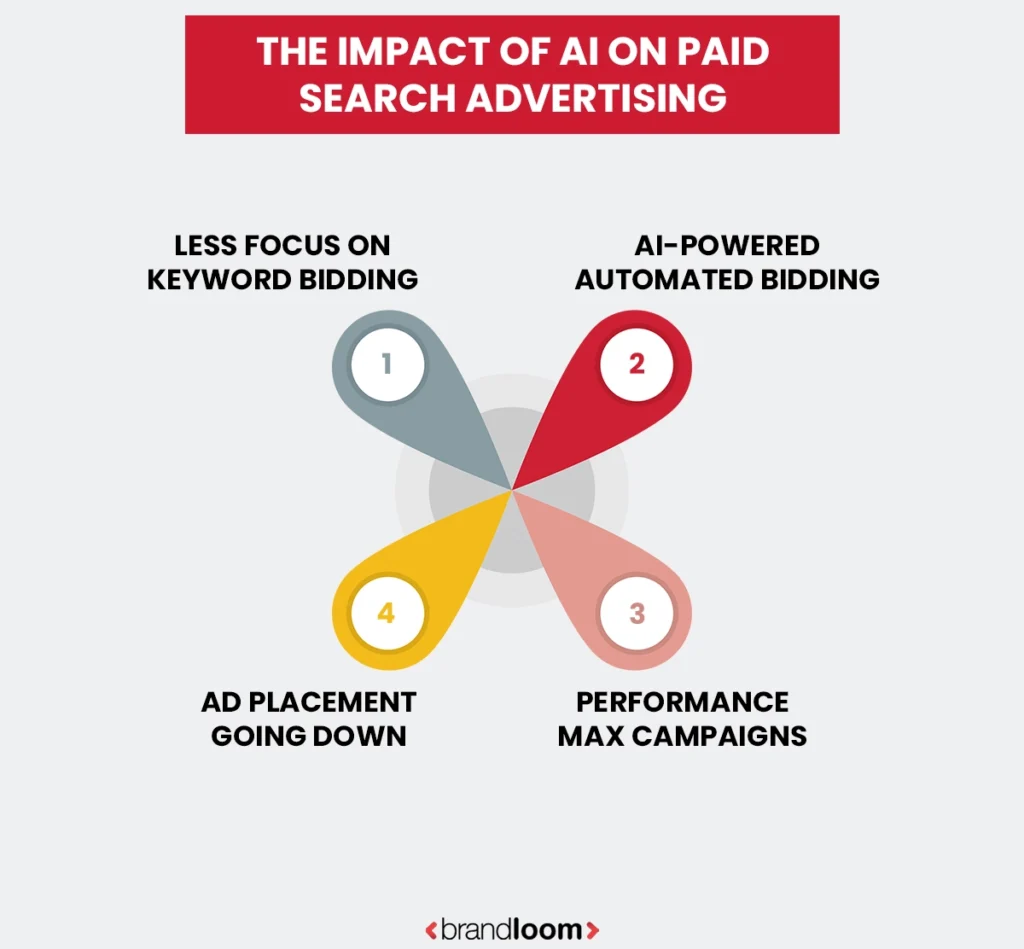
The world of paid search advertising is changing in a big way, thanks to the AI-driven search models. Tools like ChatGPT and Google’s AI Overviews are changing the buyer experience. They are also transforming how digital marketers structure and plan campaigns.
- Less focus on keyword bidding – Earlier, paid search was mostly about keyword bidding. Now, AI has taken over the decision-making process. AI shopping assistants do not focus solely on keywords; they analyze user intent, behavioral patterns, and other contextual signals to offer the most relevant results.
- AI-Powered Automated Bidding – Google Ads has already rolled out automated bidding options. Now, self learning AI tools are refining these. AI can now adjust bids based on User behavior, Ad relevance, and Product signals. It is time for digital marketers to adapt to automated, AI-powered systems. For paid search advertising, the bidding strategy change calls for a shift in campaign optimizations. It’s about understanding user intent signals to drive the best ROI.
- Ad Placement weakening – One clear effect of AI search for ecommerce is the reduced visibility of paid ads. AI Overviews now occupy search results. Leaving little space for organic listings and paid ads. This affects both click-through rates and ad performance. You may find your brand ads are getting pushed further down the page.
- Performance Max Campaigns – Brands are witnessing more AI-driven advertising. AI-powered search will tweak everything from creative assets to audience targeting in real-time. The focus is on maximum conversion.
- Paid search advertisers must adopt an AI mode so that campaigns automatically adapt based on the best-performing signals. Your brand will need dynamic, AI-friendly ads matching the intent of evolving search queries.
ChatGPT Search + AI Assistants –Welcome to New Online Shopping Means
As AI technologies keep evolving, ChatGPT and other AI assistants are not only enhancing search results. They are gradually replacing your regular search engines for zero-click ecommerce discovery. A multi-step online shopping journey is now a seamless, faster experience powered by AI shopping assistants.
ChatGPT Search for Product Discovery
Your customers no longer manually browse through search results, clicking on different links to find what they need. They prefer using AI search tools that offer relevant, instant solutions. When a user types “ Best Powerbank under INR 1000”, ChatGPT or Google’s AI Overviews will offer an instant shortlist, saving them time and effort. This is how most products are discovered and sold online.
AI-Generated Product Comparisons Replacing the Funnel
The AI comparison is taking over the traditional online shopping funnel. Your customers do not move from search to comparison to selection; they get side-by-side product comparison and AI-generated buying guides. AI assistants use reviews, ratings, and prices to come up with product recommendations.
For eCommerce brands, this can be a game-changer. The customer need not explore numerous search results to reach your website. They quickly and directly find the product from an AI-generated summary.
Need for Concern for Brands without a Plan
Brands without e-commerce content optimization will see their sales figures and visitors go down. If your brand does not appear in such AI-generated product comparisons, it will remain invisible to the majority of buyers. Shoppers are increasingly opting for AI summaries over ads, so products not listed will struggle to exist for them.
What Brands Must Do to be AI Discoverable
With AI ecommerce discovery replacing regular search methods, eCommerce brands must refine their digital marketing strategies. Showing up on Google SERPs or relying on paid search ads will not be enough for visibility. The game has changed, and AI-driven search is at the center stage.
To stay visible and discoverable in this new shopping realm, your brand must focus on AI intent — not just keywords.
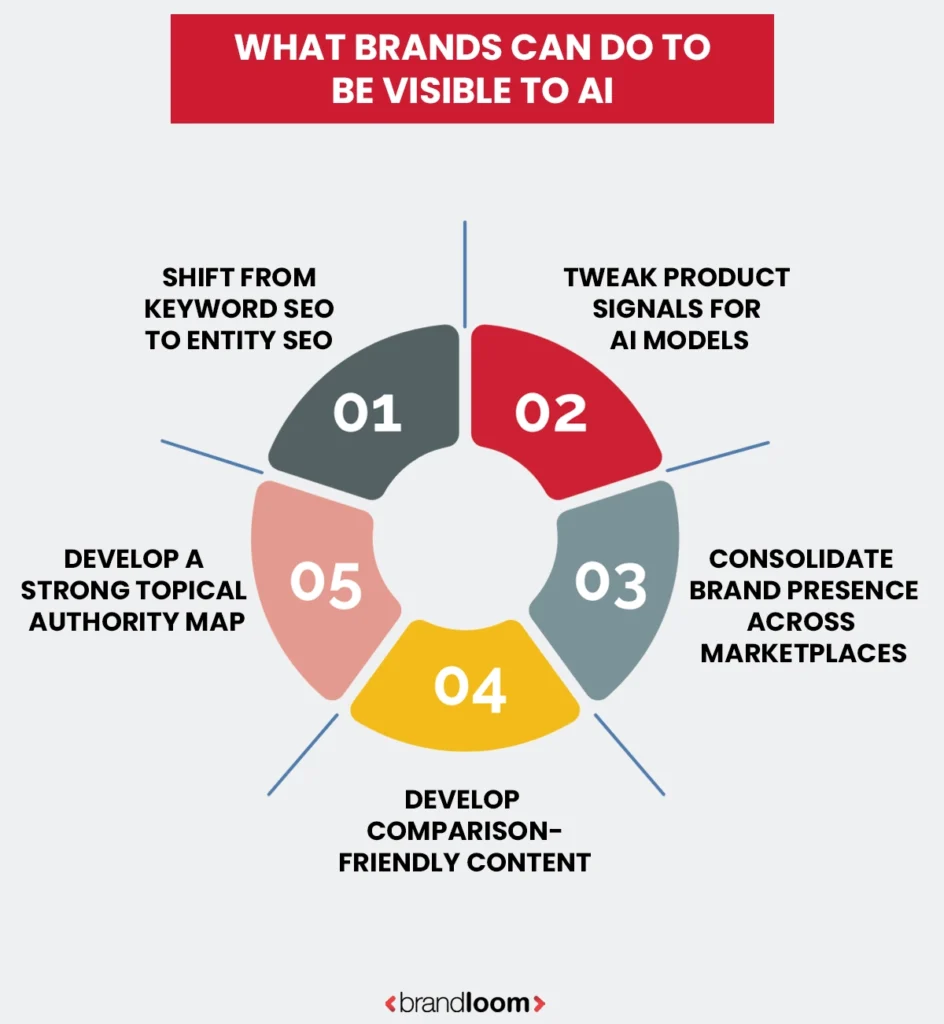
Move from Keyword SEO to Entity SEO
Traditional SEO is keyword-focused, where Brands target specific phrases to rank for those terms. AI tools interpret search queries based on user intent. So your e-commerce SEO 2026 policy must be focused on entity SEO, optimizing for the brand and product as entities, not just specific keywords.
So, what does Entity SEO involve?
- Building a strong brand presence across different platforms
- Creating structured data and using schema markup to signal the most relevant products to AI tools.
- Ensuring your content answers specific user questions
Refine Product Signals for AI Models
AI tools rely largely on product signals like reviews, ratings, and detailed product descriptions to make recommendations. So, your brand product pages must contain the rich data that AI tools look for. These include:
- Structured data to describe product features and benefits clearly
- Optimization for high-quality reviews and ratings
- Consistency in price and product availability across all listings
Strengthen Brand Presence Across Marketplaces
AI search is now extending beyond Google to popular marketplaces like Amazon and eBay. So, your brand must optimize its listings on these platforms, too. Many AI-based search engines fetch product information from such marketplaces. So, optimize listings across these platforms to make sure your products show up in AI-driven product recommendations everywhere.
Your listings on these platforms must be in sync with brand voice and contain accurate, detailed product data. The information on availability and pricing must be consistent.
Create Comparison-Friendly Content
AI-powered tools like Google’s AI Overviews love product comparisons. AI models compare products on factors like price, reviews, and features. They present these comparisons directly in the search results.
How to ensure your products feature in these AI product comparisons? Use the following types of content:
- Buying guides for different product categories
- “A vs. B” comparison guides
- Feature breakdowns and use case scenarios
Develop a Strong Topical Authority Map
Google’s AI models favor brands with an authoritative presence in their domains. So, you should develop a topical authority map to get included in AI Overviews. It means you have to focus on creating high-quality, evergreen content that reflects authority in your sector.
Using AI-based SEO principles in your content strategy is your key to success. AI analyses brands on their content authority, and so a solid strategy for consistent, authentic content will help you stay ahead. That is where BrandLoom’s expertise comes in handy.
Preparing for AI-Generated Product Recommendations
AI isn’t just summarizing the web anymore — it’s curating product recommendations. Options are aplenty- from Google’s AI Overviews, ChatGPT product discovery, or Gemini’s commerce-focused results. AI is now generating product lists for users who never scroll past the first page. For e-commerce brands, the question is clear: Are you AI-recommendation ready?
AI-Literate Product Data
AI models don’t browse your website like human viewers. They will look for structured signals like:
- Image quality and alt-text
- Schema markup
- Product title clarity and Specification accuracy
- Availability + pricing consistency
- Review volume and sentiment
Incomplete, inconsistent, or thin product data will make AI tools skip your brand. This is where many brands struggle; they optimize for human readers and not AI-driven shopping trends.
Strengthen Brand Trust Signals
AI prefers brands that appear consistent, credible, and verified across the open web. They look for trust signals like:
- Strong review sentiment
- Detailed FAQs
- High-quality backlinks
- Consistent NAP
- Third-party brand mentions
- Marketplace authority
If AI agents cannot independently verify your brand’s authority, they won’t show products in AI-generated shortlists.
Optimize for AI Summaries
AI answers need clear, factual, unambiguous content. So, your site content must include:
- Comparison-ready content
- Bullet-pointed features
- Tight, data-backed descriptions
- Conversational tone
Product visibility in AI results is not about keyword ranking. Data clarity and consistency are important here. This is where the impact of AI on paid search advertising crosses paths with SEO. Even your brand ads won’t perform well if the AI behind Google Ads cannot understand your product easily.
How AI Is Rewriting the E-Commerce Marketing Rules
Artificial intelligence has become a core part of e-commerce operations. It is redefining the nuances of e-commerce marketing. It is transforming how eCommerce brands engage with customers, drive sales, and lead the race.
AI-Powered SEO: From Keywords to Intent
With AI, ranking for keywords is getting replaced by ranking for user intent. Modern AI tools can understand context, search patterns, and behavioral signals. So, your brand needs AI-based SEO for better visibility. AI models increasingly decide what content shoppers get to see online. In this AI-first landscape, it needs entity-based optimization, NLP, and semantic search to stay competitive.
AI-Driven Paid Advertising- Smart and Real-Time
Paid search advertising is also getting the AI makeover. Google’s Performance Max campaigns and AI-powered bidding systems are overpowering traditional keyword-based bidding. AI tools optimize campaigns based on real-time signals like user behavior, search patterns, and demographics.
Your brand must tweak its paid search strategies to focus on ad relevance, automated bidding, and dynamic creative generation. The AI tools analyze ad relevance for the user’s intent to display the most personalized ads.
Conversion Rate Optimization- Based on AI
AI doesn’t just help brands drive traffic — it helps turn that traffic into customers. AI-powered CRO tools analyze user behavior and offer brands insights on user journey optimization. You can use AI-driven chatbots and personalized product recommendations to improve customer experience and conversion rates.
With AI handling the data analysis, brands can quickly find out underperforming sections of their websites and take suitable steps.
The Role of AI in UX Personalization
AI is fundamentally changing UX by offering personalized shopping experiences. With AI-powered personalization, brands can refine product suggestions, marketing messages, and even pricing strategies. These are based on the user’s search history, previous interactions, preferences, etc.
As shoppers seek more personalized experiences, AI empowers your brand to exceed customer expectations. Choose from means like custom offers, personalized emails, or dynamic content for better customer engagement.
A Look into an AI-Ready E-Commerce Strategy
AI-driven discovery has shaken up the e-commerce arena, and you can’t rely on outdated strategies or traditional search methods. Your e-commerce brand needs a solid AI-ready strategy that adapts to these changes.
AI-Powered SEO: Shifting to Entity Optimization
E-commerce brands need to focus on implementing AI-powered SEO in their websites. This means developing a clear, structured, data-based identity for both the brand and its products. AI models look for authoritative names and categories over regular keywords. Your brand needs to:
- Use contextually relevant content to match user intent.
- Use schema markup for product details.
- Update content regularly to match AI’s evolving algorithms.
Smart Paid Advertising
AI-powered advertising demands that brands optimize their ads for relevance. They must focus on real-time, context-based signals over just keywords. Automated bidding and Performance Max campaigns are tools that empower brands to meet the changing needs.
Your brand must focus on making dynamic, context-based ads. It is also necessary to monitor ad performance and tweak campaigns based on AI feedback.
Enhanced CRO with AI
Your brand needs conversion rate optimization with full AI integration. AI helps you identify high-performing customer journeys. You can then optimize conversion paths in real-time. When you use AI tools to test, analyze, and implement changes on an e-commerce website, it helps improve conversion rates.
To stay competitive, you can:
- Offer AI-powered personalization like dynamic pricing and custom product recommendations.
- Use ML models to test A/B variations in real-time.
- Use predictive analytics to foresee customer behavior and modify strategies.
AI-Driven UX for Better Shopping Journeys
A successful e-commerce strategy includes personalization. AI tools analyze huge amounts of data and offer customization suggestions. Brands must try to use AI for personalization at every customer touchpoint.
These include:
- Use advanced AI algorithms for better product recommendations.
- Personalize website experience based on user data.
- Use AI-powered chatbots for a better shopping journey.
Continuous Monitoring and Refinement
The AI landscape is constantly changing. Your brand must observe and adapt accordingly. So you need to watch customer behavior, ad performance, and AI-based insights. This makes it easier to refine your AI-ready e-commerce strategy.
Conclusion
The rise of AI search for ecommerce and AI-generated recommendations is changing the online shopping scene. Now, AI agents decide what consumers see. Your content gets through when it is the most relevant, data-rich, and user-intent-driven.
To stay competitive in this new environment, e-commerce brands must evolve. You need powerful and flexible AI-ready strategies that involve structured data, real-time customer behavior, and AI intent analysis. Certainly, you need a partner to help you design and implement a custom and effective e-commerce SEO strategy for 2026.
At BrandLoom, we understand this shift and help e-commerce brands adapt to the AI-driven future. We guide brands to stay visible, relevant, and prepared for the next wave of AI ecommerce discovery. This ensures AI agents proactively recommend and choose your products, enhancing visibility noticeably.
FAQs
Google AI Overviews place AI-generated summaries right at the top of search results. These summaries override both organic listings and paid ads. This helps e-commerce brands to become visible to target buyers faster and easier. When buyers get a product shortlist, they will not look through multiple page links in regular web search results. Your brand must get strong and relevant product data, review signals, and structured content for better AI ecommerce discovery.
Over time, the number of users using AI tools like ChatGPT is increasing. ChatGPT is now turning into a viable shopping platform that offers curated product suggestions directly in conversational search. It makes use of structured merchant feeds and user behavior and data.
So, your users may skip regular online searches to find your products. AI search for ecommerce is set to gain further momentum. So, you must optimize site content for conversational queries, structured feeds, and data consistency. This will help improve your brand visibility in AI search.
Online shoppers are becoming more aware and demanding over time. They expect faster answers to their product queries over browsing through multiple pages and categories. AI tools like ChatGPT interpret large amounts of data and produce curated product suggestions rather than standard search results.
This makes things easier for buyers and helps them save time, too. The AI-driven shopping trends have overtaken the regular online buying journey. AI-driven search shrinks the funnel and improves conversion rates.
Brands must focus on using structured data, showing content authority, and off-site presence. Then they will get easily featured in ChatGPT product discovery. When your site content has structured data, product comparisons, and consistent information, it is more likely to get better brand visibility in AI search.
You will also gain by using high-quality schema markup, consistent reviews, and availability signals. These elements attract AI shopping assistants to brands selling services or products online.
To succeed in the era of AI ecommerce discovery, brands should focus on making their product pages accessible and attractive to the AI tools. That means using structured data, offering consistent availability and pricing, clear descriptive text, and rich reviews on your website.
As AI-powered agents decide what to show to users, product pages must go beyond keywords. These pages would instead focus on user intent, context, and completeness. This also affects the impact of AI on paid search advertising. Brands visible to AI tools experience better performance across organic and paid channels.
AI recommendation engines check several data streams for product offerings and recommendations online. They look into product attributes, user behavior, review ratings, brand credibility, and structured feeds.
Modern AI tools also use hybrid models, collaborative filtering, and content-based filtering to find out user needs. They analyze individual user needs and offer suitable recommendations in overviews. So, AI-based models rely on this comprehensive content set, making product data and customer interaction optimization a must for brands.
To show up in ChatGPT Search results, brands must optimize content for intent-based queries, structured data, and conversational style. Focusing only on keywords will not help much. You can use FAQ-style or comparison-list content on your brand website to attract AI search agents more easily.
Your product feed must be AI-friendly, with strong ratings and reviews, consistent metadata, and high-quality images. ChatGPT product discovery is driven by product trust signals and data completeness.
Structured data is a prerequisite for zero-click ecommerce discovery. It offers AI tools with clear, trusted signals about your product’s name, brand, price, availability, reviews, and category. This makes it easier for AI agents to understand your offerings.
They can then include it in AI-generated product shortlists or summaries. If your site lacks structured data, your product may not be picked by AI models — regardless of its quality. This will hurt both organic performance and paid search results.
AI engines pay importance to signals showing credibility, consistency, and authenticity. For trust building, brands should use high-quality backlinks, maintain consistent NAP, and brand metadata. They also need positive user reviews and ratings, and maintain uniform product availability/pricing across online platforms. AI shopping assistants also prefer a strong presence on major marketplaces. Brands overlooking these factors risk losing out on AI search for ecommerce.
Businesses must act fast to adapt to the impact of AI on paid search advertising and AI ecommerce discovery. They should focus on restructuring product data for AI readability and using schema markup on their sites. Besides, they need to make comparison-friendly content, adapt to the new shopping funnel, and revamp paid search campaigns. A content and data strategy for AI search optimization will make your brand visible, competitive, and chosen.