
Voice search is rapidly transforming how people search the web for information.
As more people use smartphones, smart speakers, and digital assistants than ever before, they are conversing with their gadgets and expecting prompt and accurate answers.
More than 71% of people prefer voice questions over typing because they are faster and easier to use.
It makes optimizing content for voice search critical for businesses. Voice search optimisation enhances the visibility of your content or website in search results during voice searches.
“Hey Siri, how do I improve my website’s SEO?”
“OK Google, show me the best vegan restaurants nearby.”
These represent a preview of the search’s future and are no longer only voice commands.
But here’s the catch: most websites aren’t optimizing content for voice search yet.
You get the advantage there.
You’re losing out on an increasing amount of organic traffic if you’re still relying solely on conventional SEO strategies.
Not only is it a wise move, but in today’s voice-first digital environment, optimizing content for voice search is essential.
In this blog, we’ll break down:
- What voice search is,
- Why it’s reshaping the SEO landscape,
- And how you can start making your content better for voice search to make your site rank higher, connect better, and be ready for the future.
Ready to be heard in the voice-first era? Get in touch with India’s award-winning Professional SEO agency, BrandLoom. We can help you optimize your website content for voice search.
What is voice search, and Why It’s changing SEO?
Anyone may now browse the web without entering keywords into a search box thanks to voice search technology.
Natural language processing (NLP), speech recognition, and artificial intelligence (AI) enable voice search to comprehend spoken queries and provide relevant results, sometimes instantly.
Say “Alexa,” “Hey Google,” or “Siri” to get the weather, play your favorite music, or find a restaurant nearby. Like “What’s the best way to lose weight naturally?” Voice inquiries are whole sentences or inquiries. Normal outcomes, which might produce words that are short or broken apart, are not the same as this.
- “How can I make my content more voice search-friendly?”
- “When is the closest pharmacy closing?”
Because these voiced inquiries mirror everyday language, voice search is becoming increasingly popular among users who are always on the move. It is also quicker and more intuitive.
Manufacturers are now adding voice-enabled systems to cars, smart speakers, computers, and home electronics. They continue to create more devices that people can use without touching.
Businesses must reconsider how they arrange, store, and utilize their data if they want to remain ahead of the competition.
SEO is also evolving with the growing trend of voice search, as the way people search for products online is shifting.
Rather than a keyword-based typed search, people now ask more conversational and complete questions.
Location-based voice searches are increasing the importance of local SEO practices.
The use of AI by search engines has heightened to understand conversational context and the meaning of questions. Therefore, SEO is becoming more natural and user-oriented rather than solely keyword stuffing.
Why Optimizing Content for Voice Search Is No Longer Optional?
The way people look is changing very quickly. Voice search has gone from being a fun hobby to something people do every day. More than 4.2 billion intelligent voice assistants are in use worldwide. Users now converse with their gadgets rather than only typing questions.
What makes optimizing content for voice search so important, then?
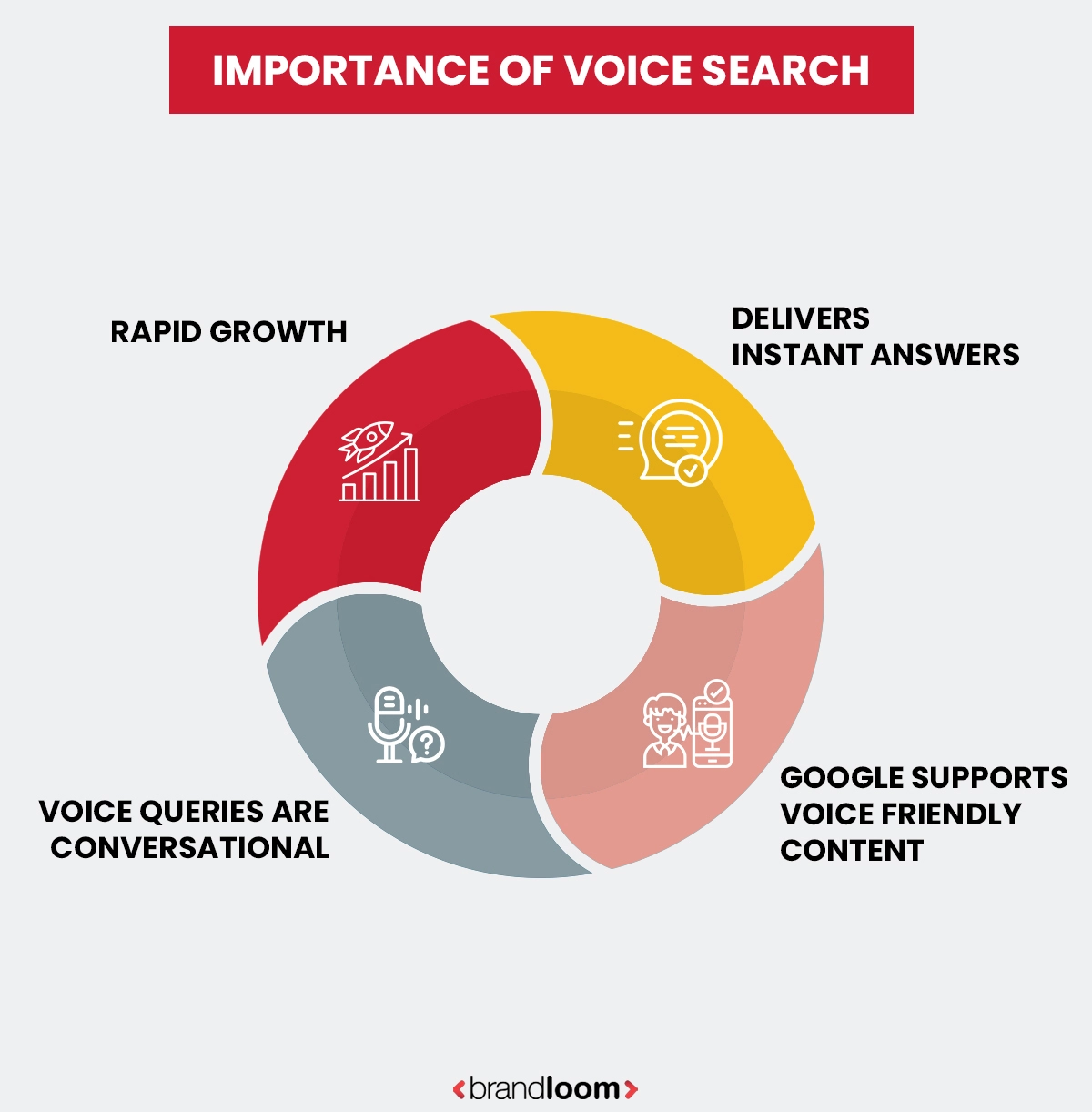
1. Voice Search is Growing, Rapidly
According to Google, 27% of the world’s internet users use voice search on mobile devices. As smart gadgets become more integrated into homes, cars, and businesses, people will interact with them even more frequently. Ignoring voice search means losing access to a constantly growing audience.
2. Voice Search Delivers Instant Answers
Unlike conventional search, which often requires users to sift through multiple results, voice assistants aim to deliver the best response instantly. If you ignore optimizing content for voice search, you won’t just fall behind; you’ll become invisible.
3. Voice Queries Are More Conversational
People speak differently from the way they type. Voice search is more natural and question-driven:
- Typed: “voice search SEO tips”
- Spoken: “How do I optimize my content for voice search?”
To rank, your content needs to match that tone, format, and intent.
4. Mobile and Local SEO Go Hand in Hand with Voice
Mobile and local intent are closely related to voice search. Queries like “pharmacy open now” and “coffee shops near me” dominate voice traffic. If your company relies on local SEO, you must focus on optimizing content for voice search.
5. Google Rewards Voice-Friendly Content
When people ask Google questions over the phone, the system delivers the quickest and most relevant answers. Google is more likely to feature well-organized content that immediately answers user questions as a highlighted snippet or spoken result through Google Assistant.
In this age of ease and short attention spans, voice search gives you results right away that are specific to you. Your content may draw greater attention, purchases, and traffic if your rivals have previously voice-optimized it.
Voice vs. Text Search: What’s the Difference?
Effective content optimization requires an understanding of the ways voice search varies from conventional text-based search. The form, tone, and context of the questions differ greatly, despite the fact that both seek to satisfy user intent.
1. Tone and Structure
Naturally, voice search inquiries are more conversational. Users often utilize short words like “best DSLR camera 2025” while typing. These lack the natural flow of speech and are rife with keywords.
Conversely, voice searches imitate our speaking patterns. A customer might ask, “What is the best DSLR camera to buy in 2025?” To reflect how people actually communicate, you need to create your content in a more conversational, Q&A format.
2. Search Intent
A voice search often has a more straightforward and focused goal. An example of a spoken command might be, “What’s the fastest way to get to the airport?” when they need to know something quickly or have a lot of things to accomplish at once. Such as “How late is Starbucks open tonight?”
However, text searches are often more thorough or inquisitive. For instance, a user may type “airport directions” or “Starbucks hours” and prepare to browse through the listed results. Optimizing content for voice search means anticipating these intent-rich questions and responding with clear, concise answers.
3. Device Usage and Context
Desktops and computers are where most text searches happen because users have the time and space to look through many results. People use voice search – mainly on phones, smart speakers, and car systems – without needing their hands. Therefore, on a mobile device, usability, speed, and responsiveness are crucial. Voice-first consumers will not use your website if it is not mobile-friendly.
4. Search Results Display
Users may choose what they want to click on from a variety of information, including lists of links, rich snippets, picture packs, and more, shown in text-based search results. You can’t have that luxury with voice search.
The assistant usually just gives one spoken response, the best, most relevant response determined by the algorithm, especially on smart speakers. Your material has to be really clear, organized, and optimized for response boxes or featured snippets in order to rank at the top.
We’ll then go over the precise tactics you can use for optimizing content for voice search so you can rank in this new search age.
Core Strategies for Optimizing Content for Voice Search
Voice search is changing how people use search engines, so SEO needs to be rethought by companies and people who write content. Keyword strategies that used to work no longer work by themselves.
Pay attention to how people talk, what they want, and how fast you can answer them clearly. To start optimizing content for voice search, here are some important things you can do.
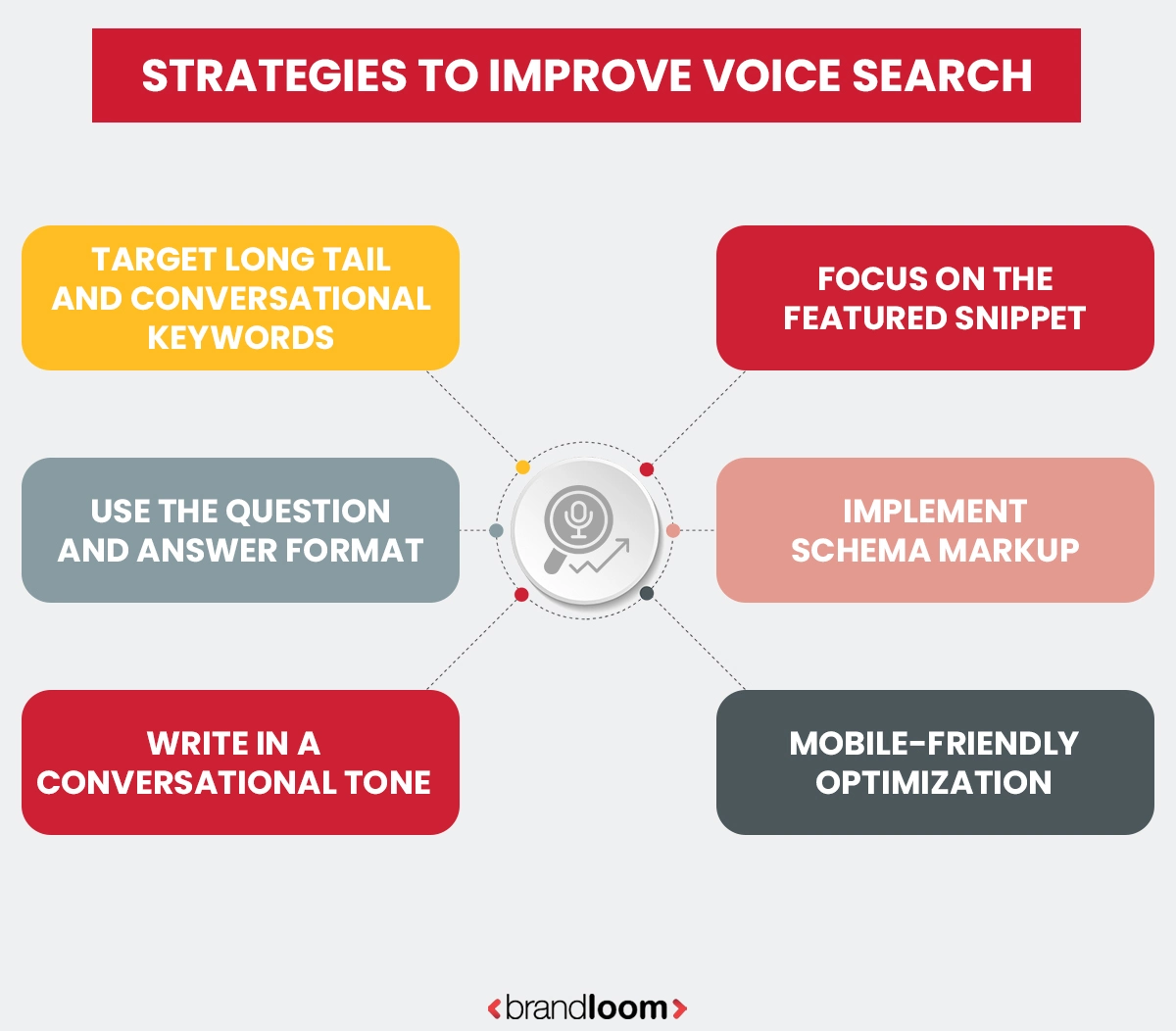
1. Target Long-Tail and Conversational Keywords
Questions asked by mouth are often longer than those written down, and they often include whole lines or queries. A person who speaks could ask, “What’s the weather like in Delhi tomorrow?” Type “weather Delhi.”
This can show up in the way you look by using long-tail lines that sound normal and question-based terms that sound like people talking. You may locate helpful voice-friendly search options with the use of tools such as Google’s “People Also Ask” area, SEMrush, and AnswerThePublic.
2. Structure Your Content Around Questions and Direct Answers
Voice search users often want an answer that is clear and easy to understand. Voice helpers are more likely to pick up your content when you organize it to answer frequently asked questions, especially in the form of a FAQ list.
Ask ChatGPT For radio readouts or marked parts, each response should be succinct and direct, with no more than 40–50 words if at all feasible. Your work should be based on the queries you believe the individuals you want to reach may have.
3. Write in a Conversational, Natural Tone
Make your content sound casual and personable, just like voice inquiries. Avoid using overly scientific terms or robotic language. Write as if you’re speaking directly to someone. This approach helps search engines recognize the relevance of your information and increases the chances they will select your response for voice results.
4. Focus on Featured Snippets (Position Zero)
Google often retrieves voice search results from content at “position zero,” also referred to as “featured snippets.” You increase your chances of getting highlighted when you pose a question in your headline and follow it with a clear, concise answer. For search engines to comprehend and rank your content, you should also give your sections, tables, and lists obvious names.
5. Implement Schema Markup and Structured Data
Structured data is what search engines mostly use to rank and analyze voice search results. Some types of schema code, like FAQPage, HowTo, or LocalBusiness schema, may help search engines understand what your website is about better. You need to tweak your technology if you want your content to stand out and be answerable by voice.
6. Optimize for Mobile Experience
Your website needs to be adaptable because most voice searches are done on phones. To do this, your site needs to be mobile, have clean style, be easy to navigate, and load quickly. Google’s voice algorithm will quickly find and punish a website that loads slowly or doesn’t look good on mobile devices.
7. Don’t Overlook Local SEO
Questions specific to the area, such as “Where’s the nearest bakery?” a substantial percentage of voice queries, such as “Is there a 24-hour pharmacy near me?”
To draw in this traffic, make sure your Google company Profile is current with the correct address, phone number, and company hours.
Use local keywords as well as information that answers often requested local inquiries about your sector or region.
By using these techniques, you’re not only improving your website’s search engine optimization but also making it quicker, easier, and more user-friendly for actual users. And it is precisely what search engines reward in the era of voice-first engagements.
Make Your Website Voice-Ready: Technical SEO Essentials
Making material that is voice-friendly is only one aspect of the problem. Voice search can find and get to your content, but your website needs to meet certain technology requirements so that data can be sent quickly and correctly.
Pay attention to page speed first. Both Google and voice search users usually anticipate immediate responses.
People won’t use your website for voice searches if it loads slowly.
Use tools like Google PageSpeed Insights or GTmetrix to find out why your website is taking so slow to load. Reduce the size of pictures, enable browser storage, and use less JavaScript to speed up page loading, especially on mobile devices.
Next, see whether your website is responsive. Since most voice searches happen on smartphones, you must design your website to adapt and deliver a smooth user experience on smaller screens.
Site security is another important consideration. When searching for a specific location or critical piece of information, Google prefers secure websites. For SEO and user confidence, make sure your website is using HTTPS and has a valid SSL certificate.
Putting structured data into practice is equally important. When you annotate product listings, company hours, recipes, or FAQs, you increase the chances of search engines using your content for rich snippets or spoken voice responses by adding structured data. Start by following the instructions on Schema.org or Google’s Structured Data Markup Helper.
A well-structured sitemap, suitable internal linking, and a logical and understandable URL structure are also essential. They not only make it simpler for Google to crawl and index your website, but they also compete for voice search attention and increase your website’s total search visibility.
Don’t Forget Local SEO: Voice Search and ‘Near Me’ Queries
Voice search isn’t just changing how people search, it’s also changing where and why they search. One of the biggest growth areas in voice queries is local intent. People often use voice assistants while they’re out and about to ask questions like:
- “Where’s the nearest coffee shop?”
- “Is there a petrol pump open near me?”
- “Best pizza delivery near me right now.”
These are referred to as “near me” questions, and they offer local companies enormous potential.
Your Google Business Profile has to be completely optimized in order to get this traffic. Verify that the name, address, phone number, website URL, business hours, and categories of your organization are accurate and consistent across all platforms.
Next, integrate location-based keywords throughout your website content. For example, instead of just “custom jewelry design,” try “custom jewelry design in South Delhi” or “handmade gold rings near Connaught Place.” Use natural phrasing and city or neighborhood-specific terms that match how locals actually speak.
Don’t forget the role of online reviews and ratings. Voice assistants often use reviews to determine which businesses to recommend. Encourage happy customers to leave positive reviews on Google and relevant directories. A high star rating can influence both visibility and click-through rates.
Finally, ensure your website includes NAP (Name, Address, Phone Number) details in text format (not just in images) on your homepage and contact page. And if you serve multiple locations, create dedicated landing pages for each to help your site appear in geo-specific searches.
Content Formats That Work Best for Voice Search
Optimizing content for voice search goes beyond keywords; format plays a major role too. Voice assistants prioritize content that is well-structured, easy to interpret, and directly aligned with natural spoken queries. The following formats consistently perform best when it comes to voice-first content.
1 FAQ Sections: Match Real-Life Questions
Frequently Asked Questions (FAQs) are one of the most powerful formats for voice search. Since many voice queries begin with “what,” “how,” or “can I,” organizing your content into direct Q&A style helps Google easily match queries to your responses. Try including conversational questions that your audience might actually ask aloud, for example:
- “How long does shipping take?”
- “What are the benefits of voice search optimization?”
2 How-To Guides: Perfect for Step-by-Step Queries
Users often turn to voice assistants for real-time help with everyday tasks. That’s why how-to guides work so well, especially when structured clearly. Break down the process into numbered steps, and keep instructions concise. A voice assistant is more likely to pick content that answers:
- “How do I reset my router?”
- “How to make cold brew coffee at home?”
3 Listicles: Easy to Scan, Easy to Speak
List-based articles, like “Top 5,” “Best 10,” or “7 Ways”, offer digestible chunks of information that voice assistants can quickly summarize. These formats also lend themselves well to featured snippets, especially if you include a short intro followed by clean, bullet-pointed or numbered lists.
4 Definition-Style Answers: Start With Clarity
For informational queries like “What is voice search optimization?” it’s best to include a clear, 1–2 sentence definition at the top of your content. Google and other voice platforms often pull directly from this kind of summary when choosing a voice result.
5 Local Landing Pages: Hyper-Relevant for ‘Near Me’ Queries
If your business serves multiple regions or neighborhoods, creating dedicated location-based landing pages is a must. These pages should answer common local questions, include phrases like “near me,” and provide accurate contact info, hours, and directions. This is vital for ranking in voice searches like:
- “Best hair salon near me open now”
- “Where can I get dosa in Whitefield?”
6 Short, Snappy Answers: Get to the Point
While your overall content can be long-form and comprehensive, each section should offer bite-sized answers (ideally 30–50 words) that could stand alone if read aloud. Voice assistants often extract these summaries as spoken responses, so make them count.
Using these content formats and structuring them with intent, can significantly improve your visibility in voice search results. It’s not just about being found anymore; it’s about being the answer users hear.
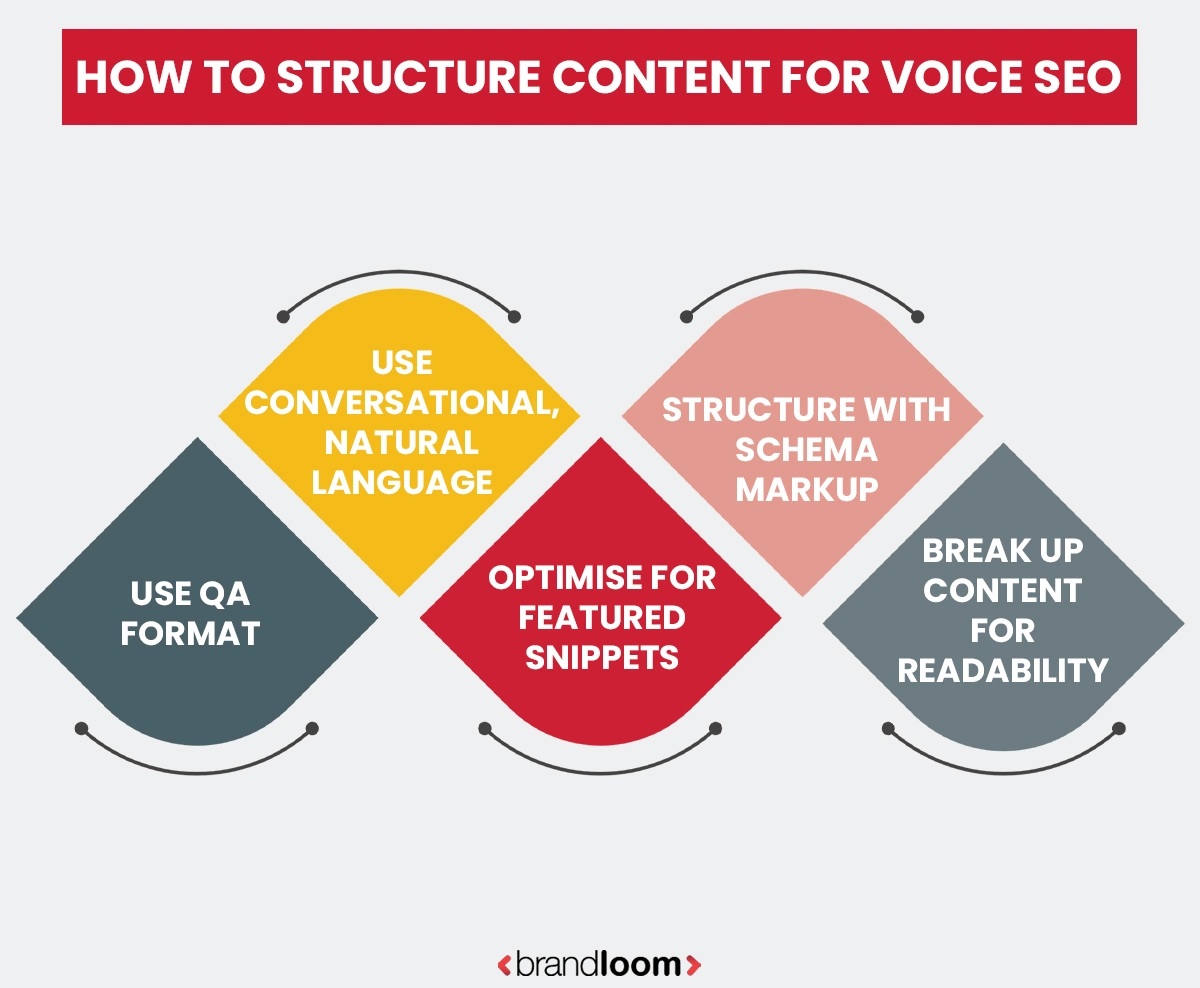
How to Structure Content for Voice SEO
To format your content and make it voice SEO-friendly, think about answering the questions in conversational language. Voice assistants retrieve answers that can be easily read and answer the user’s question directly.
Here is the way to structure your content:
1. Use QA format
Make the content sound like people talk.
- Tie in headers like “What is…”, ”How do I…”, etc.
- For each header, answer in a brief sentence or two, and expand further as needed.
2. Optimise for Featured Snippets
The voice assistants tend to draw upon the feature snippet:
- Key questions should be formatted using <h2> or <h3> headings.
- Where possible, give bullet-pointed answers.
- Make answers precise, factual, and to the point.
3. Use Conversational, Natural Language
You want to avoid robotic keyword stuffing. Instead:
- Write in the way in which a person would speak.
- Use complete sentences and phrases, such as” the best way to”…, “how to” …, “near me”, etc.
4. Structure with Schema Markup
Detailed information (schema.org): Add it to pages
- FAQ schema
- How-To schema
- LocalBusiness schema
This will assist Google in knowing which areas contain direct answers to some basic questions.
5. Break Up Content for Readability
- Short paragraphs (2–3 lines).
- Clear subheadings.
- Bullet points, numbered lists.
- Glossaries/definitions as applicable.
Tip: Imagine that your page is a discussion.
Put the question that your audience would ask, then answer clearly and naturally.
Common Pitfalls to Avoid in Voice Search Optimization
While voice search offers new opportunities for visibility, many websites miss the mark due to a few avoidable mistakes. If you’re serious about optimizing content for voice search, steering clear of these pitfalls is just as important as following best practices.
Writing for Bots, Not Humans
One of the biggest mistakes is creating content that’s overly keyword-stuffed or robotic in tone. Voice queries are human and conversational; your content should be too. If your answers sound unnatural when spoken aloud, they won’t perform well in voice search. Always read your content out loud during editing to ensure it flows naturally.
Ignoring User Intent
Not all queries are created equal. Some are informational, others are navigational or transactional. Failing to match your content to the user’s intent can result in low engagement and poor voice search performance. For example, someone asking, “How do I apply for a PAN card?” wants a step-by-step answer, not a general overview or sales pitch.
Overlooking Local Optimization
A huge percentage of voice searches are local, yet many businesses forget to optimize for location-based queries. If your Google Business Profile is incomplete, outdated, or inconsistent with your website, you risk missing out on “near me” traffic. Not optimizing for local SEO also reduces your chances of being included in voice results from smart assistants.
Neglecting Mobile Experience
Since most voice searches happen on smartphones, a poor mobile experience can severely hurt your rankings. Slow load times, difficult navigation, or non-responsive design make it harder for search engines to recommend your site, especially for voice. If your site isn’t mobile-friendly, voice optimization efforts may fall flat.
No Structured Data Implementation
Many businesses overlook schema markup because it’s technical, but skipping it can limit your visibility. Structured data helps search engines understand your content contextually, making it more likely to be pulled into featured snippets or voice answers. Without it, your site may be passed over for more clearly marked competitors.
Burying the Answer
Another common pitfall is hiding the actual answer deep within the content. Voice assistants prefer concise, direct responses, ideally within the first few sentences. If users (and search engines) have to dig for information, it reduces the chance of your content being selected for voice results. Always lead with the answer, then explain further if needed.
Avoiding these missteps can help your voice search strategy deliver better results, more traffic, and a stronger connection with your audience.
Monitoring voice search visibility driven by AI
Because AI platforms are changing how people access information, brands cannot just monitor traditional rankings; they must also monitor how AI engines read, quote, or disregard their content.
This is especially crucial in cases where the user poses natural-language or voice-based queries for content optimization in voice search or voice search SEO. It is essential to monitor AI visibility to ensure your brand is present in the conversational results that shape contemporary search behaviour.
Why Monitoring AI Visibility Matters
Now, AI-powered services such as Google’s AI Overviews, ChatGPT, Perplexity, and Gemini provide direct answers by drawing on various sources. Unless your brand is listed in these summaries, there is no guarantee that users will ever visit your site, even though you may have a high ranking in the search engine results pages.
What Brands Should Track Every Month
- Monitor the frequency of your content’s appearance in AI Overviews. This incorporates informational voice queries on mobile devices and voice assistants.
- Summaries of Audit ChatGPT, Perplexity, and Gemini. These sites tend to influence users’ choices without displaying complete result pages.
- Keep a track of rival references. If your competitors are more frequently seen, then your optimization scheme or your systematic data needs improvement.
- Detect missing schema, snippet holes, or poor topical authority. Such concerns can ensure that AI engines do not choose your content as an answer.
- Assess the question based on clarity keywords. These involve long-tail keywords and conversational search terms used by voice search users.
By regularly reviewing these aspects, interested parties can maintain a high profile in AI-enhanced search experiences and compete effectively in a fast-paced digital environment.
Final Thoughts: Is Your Site Ready for Voice SEO?
Voice search isn’t just a trend; it’s a transformation. As more users turn to digital assistants for instant, spoken answers, the rules of SEO are evolving. Success in this new landscape isn’t about ranking for keywords alone; it’s about anticipating questions, offering clear and conversational answers, and delivering them quickly and seamlessly across devices.
By optimizing content for voice search through structured formats, mobile-friendly design, local relevance, and natural language, you’re not just improving your visibility. You’re positioning your brand to become the answer users hear first.
To summarise,voice search SEO is not a separate strategy, but rather it is the organic development of good SEO practice. When your content is written in a language that the user can understand and provides concise, clear answers, you are on your way there.
- Target natural, question-based keywords (how, what, where, why).
- Consider search engine optimisation to have featured snippets because voice assistants tend to display answers in snippets.
- Make sure that your content is easy to understand, to the point, and well-organized so that algorithms can read it.
- Accelerating page speed and mobile UX is a crucial voice search ranking factor.
- Adopt structured data to make sense of your content to search engines.
In a world where people are talking more than typing, it’s time your content spoke their language.
Start today, because if your content isn’t voice-ready, it’s already falling behind. Get in touch with the best digital marketing agency in India for optimizing content for voice search.
Need help making your content voice-ready? Partner with BrandLoom, the Best Indian SEO Marketing Agency, and allow your brand to be the voice users hear.
FAQs
Voice search optimization is the process of enhancing your website’s technology, design, and content to ensure optimal performance when users do spoken searches on voice-enabled devices. This entails modifying for AI-powered assistants like Alexa, Siri, Google Assistant, and others.
Unlike traditional SEO, which often focuses on short, written keywords, voice search optimization prioritizes natural language processing (NLP), long-tail conversational phrases, and directly answering queries. Information must be arranged to conform to human speech patterns, often using whole sentences or questions like “What is the best skincare routine for oily skin?”
The ultimate goal of voice search optimization is to make sure your content is the answer consumers hear when they ask their devices for help while driving, cooking, or multitasking. For more information on voice optimization, get in touch with marketing agencies such as BrandLoom for optimizing content for voice search to get better results.
VSO stands for Vpice Search Optimization. By speaking rather than typing, this innovative SEO method adapts your content to the way visitors search by talking. Digital marketers must include VSO strategies into their broader SEO initiatives as voice assistants and smart devices become more common.
In digital marketing, VSO focuses on several key areas:
– Recognizing the purpose of voice questions
– Making content that is voice-friendly using question-based keywords
– Using schema markup, or structured data, can aid search engines in comprehending context
– Making sure local SEO is ready and mobile performance is quick
For marketers, VSO is more than just a trend; it’s an essential tool for reaching constantly moving customers, obtaining position-zero placements, and improving customer engagement via simplicity and speed.
In digital marketing, the phrase Voice Search Optimization, or VSO, is utilized. By speaking rather than
In both form and function, voice search differs significantly from standard text search.
Short, keyword-rich phrases like “best DSLR 2025” or “cheap hotels Paris” are often entered by users during standard searches. These inquiries are fragmented and often lack whole phrases or appropriate wording. The searcher expects to have to go through several links to get the answer.
On the other hand, voice search simulates genuine spoken language. Comprehensive questions like “Which DSLR camera is best for travel photography in 2025?” are asked by users. as well “What are the best budget hotels in Paris?” These are more in-depth, conversational, and often very specific inquiries. Users expect quick, simple answers since voice search is frequently used in real-time situations, as while walking, driving, or multitasking.
Thus, voice search is more intent-driven, context-sensitive, and answer-focused than it is concerned with browsing options. To determine what is sent back to the user, it also heavily relies on highlighted excerpts and structured data.
By focusing on spoken language patterns rather than static keywords, voice search is changing SEO. The conventional SEO approach has to change as more people communicate with search engines via voice commands.
Here are some reasons voice search is essential for SEO:
Increasing Adoption Voice search is increasingly becoming the main way that people get information due to the proliferation of smart speakers, voice assistants, and mobile devices. You will lose out on a significant portion of organic traffic if you ignore it.
Featured Snippets Predominate: To extract replies, voice assistants often use featured snippets (position zero). If your content is voice-optimized, you have a better chance of winning.
Benefits of Local SEO: Voice searches often include local intent (e.g., “pharmacy near me”); hence, it is essential that actual locations appear in these queries.
Faster User Journeys: Voice search is helpful for users who want prompt, precise answers. Utilizing SEO strategies that encourage this behavior can enhance engagement, reduce bounce rates, and increase conversions.
In short, voice search is transforming the way people interact with information, and SEO must adapt to remain competitive and relevant.
Optimizing your website for voice search requires a deep understanding of user behavior, technical SEO, and content strategy. This is a thorough explanation of how the best marketing companies can help optimize:
Make use of long-tail and conversational keywords.
Use terms that ask questions, such as “how to,” “what is,” and “best way to.” Popular voice questions may be found with the use of resources like Google’s “People Also Ask” feature or AnswerThePublic.
Make Organized Q&A Content
Make sure your material is formatted to directly address user inquiries. Voice assistants may benefit from concise summaries, how-to manuals, and FAQ sections.
Aim for Position Zero, or Featured Snippets.
Use H2 or H3 headers to organize your information, then provide succinct, educational responses. Featured snippet exposure is increased with the use of lists, tables, and detailed instructions.
Make sure it loads quickly and is mobile-friendly.
Since most voice searches happen on mobile devices, your website needs to load quickly and be easy to use on small displays.
Make use of Schema Markup
To help search engines understand the context of your content, use structured data. Use relevant schema types like FAQPage, Article, HowTo, and LocalBusiness.
Make Your Website Local Search Friendly
Keep your Google Business Profile up to date with your address, phone number, and working hours. Add city-specific or region-specific keywords to relevant sites.
By aligning your website’s structure and content with how people search and speak in real-world contexts, you may significantly improve the chances that your website will be selected as the spoken answer in a voice query.
The organization and structure of your material are crucial for exposure, as voice assistants are designed to provide a single, definitive response, often taken from highlighted snippets.
The content categories that work well for voice search are as follows:
1. Frequently Asked Questions, or FAQs
FAQs instantly address consumer questions in a simple question-and-answer format. Voice search is a natural way to ask questions. Each FAQ might be a voice search result if it is structured correctly.
2. Tutorials and How-To Guides
It is simpler for Google to extract helpful information to react aloud from detailed how-to text that is divided into logical phases, numbered lists, or brief paragraphs.
3. Listicles
Voice assistants may give brief, easily assimilated insights by selecting one or two topics from a list.
4. Introductions in the Definition Style
Voice questions often start with “What is…” or “Define…” Search engines like material that provides a concise, understandable description at the start of the page for these kinds of inquiries.
5. Local Landing Pages
Location-specific information works exceptionally well for companies in voice search, especially for “near me” inquiries. Pages with contact details, maps, business hours, and local keywords like “best café in Bandra” improve your chances of appearing as the suggested local result.
6. Content That Is Snippet-Optimized
Voice assistants are more likely to read aloud material that is optimized for position zero, such as headers, straight replies, bullet points, or schema markup. For optimal results, keep important responses to 50 words or less.
Google uses natural language processing (NLP), contextual clues, and artificial intelligence (AI) to offer the most accurate and relevant answer to a voice query. With a focus on purpose, clarity, and speed, it highlights material that is conversational, direct, and easy to read aloud.
Sites perform better when they use concise replies, question-based headers, and a suitable layout (such as bullet points and short paragraphs) because voice assistants often pull responses from featured snippets (position zero).
Google also considers mobile optimization, page speed, and structured data (e.g., FAQ and HowTo schema) to ensure voice-friendly, fast delivery. The businesses that appear in local searches depend on several factors, including location, the accuracy of their Google Business Profile, and the presence of positive reviews.
Simply put, Google favors content that is well-structured, voice-ready, and provides dependable, timely answers to queries. It is always recommended to take help of digital marketing experts to grow your business online.
As the most popular source of responses that voice assistants read aloud, featured snippets are essential to voice SEO. Google often selects the answer to a voice search inquiry from the information that appears in position zero, the highlighted snippet that appears above all other search results.
To improve your chances of getting featured, create content that does the following:
Provide clear, succinct answers to particular queries in 40–50 words.
Make use of titles such as “What is…” or “How to…”
Add tables, lists, or other structured forms.
Include schema markup such as HowTo or FAQPage.
Being in the highlighted snippet offers a substantial SEO advantage since it is the only answer the customer hears during voice search.
Voice search optimization may significantly increase foot traffic and exposure for local businesses. A lot of voice inquiries are location-based, such “pharmacy open now” or “coffee shop near me.” Businesses may show up in these highly targeted, mobile searches by optimizing for voice, particularly via local SEO.
To gain, nearby companies need to:
Make sure their Google Business Profile is current and full.
Add voice-friendly material, such as FAQs and directions, to their website and use location-specific keywords.
Promote favorable client testimonials
Voice search increases calls, visits, and conversions by enabling local companies to appear when consumers are ready to take action. It is best to rely on digital marketing agencies such as BrandLoom, which can cater to all the needs to help grow your business.
Conversational keywords play a crucial role in voice search optimization. Users often speak full, natural-sounding questions, such as “How do I apply for a passport?” instead of typing shortened phrases like “passport application process.”
Using conversational, question-based, and long-tail phrases may align your content with real-world speech patterns. Virtual assistants like Google Assistant, Siri, or Alexa are more likely to surface your content in voice search results when you optimize for their query style. To put it simply, writing in a way that reflects how people speak makes your information more accessible and readable.
As longer, more specific phrases that closely mimic natural speech patterns, long-tail keywords are ideal for voice search optimization. An example of a long-tail keyword might be “what are the best running shoes for flat feet?” as opposed to general terms like “running shoes.”
Voice SEO benefits from these keywords in a number of ways:
They are better at capturing conversational questions.
Voice SEO increase relevancy by reflecting user intent.
They increase the likelihood that highlighted snippets will rank.
When contrasted to short keywords, they lessen competition.
Long-tail keywords help Google choose your page as the spoken response by aligning your content more closely with genuine voice requests.
Yes, schema markup is essential for voice search optimization. Schema markup, also known as structured data, is the code you add to your website to help search engines better understand your content. It greatly improves the way your content is interpreted and displayed, especially in voice and highlighted snippet results, even though it has no direct impact on rankings.
For voice search, schema markup gives Google more details about your content, such as whether it is a product listing, a how-to guide, a local business page, or a frequently asked topic. Search engines may choose and provide your material as a voice response with confidence thanks to this context.
For instance, Google uses the FAQPage template to extract clean question-answer pairs for voice assistants.
Voice-friendly step-by-step material is made possible via the HowTo schema.
Local Business schema enhances visibility for location-based or “near me” inquiries.
Voice search is all about giving Google the ability to fetch the appropriate response at the right moment, and schema markup helps with that.
Mobile optimization is essential for voice search results since most voice searches are performed on smartphones and other mobile devices. If your website is not mobile-friendly, it is unlikely to show up in voice search results, even if it has great content.
In both voice and conventional search, Google gives preference to websites that are quick, responsive, and easy to use. A website designed for mobile devices guarantees:
Pages should load in less than three seconds.
Without zooming, the text is simple to read.
Menus and buttons are touch-friendly.
Content looks well on all screen sizes.
Usability and quickness are crucial in voice search. In order to provide customers with the spoken, instantaneous replies they anticipate, Google prefers websites that provide a smooth mobile experience. If your website is slow, congested, or hard to use on a phone, it’s unlikely to make the cut.
To put it simply, mobile optimization is a voice SEO need that goes beyond simple user experience.
Even while most analytics systems don’t always clearly distinguish voice search data from conventional SEO, there are still a number of tools that may assist you in monitoring, evaluating, and refining your voice search optimization efforts.
1. Search Console by Google
You may determine which inquiries are driving traffic, particularly long-tail and question-based questions, by using the keyword-level analytics that Google Search Console offers. Although “voice searches” are not labeled, voice use is often indicated by inquiries like “how,” “what,” “best way to,” and “near me.”
2. Analytics via Google
Utilize Google Analytics to monitor mobile user activity and voice-search-friendly webpages. To assess the effectiveness of voice-optimized websites, track data such as bounce rate, average session time, and traffic from mobile devices.
3. RespondToThePublic
This tool helps you find long-tail keywords that mimic normal speech and voice search-friendly content possibilities by displaying actual queries people are asking about your keywords.
4. Ubersuggest, Ahrefs, and SEMrush
You can monitor keyword rankings, find voice-style inquiries, and examine rival material that could be showing up in featured snippets—the most popular source of voice responses, with these SEO solutions.
5. “People Also Ask” (PAA) boxes
Although it’s not a tool in and of itself, keeping an eye on the PAA boxes in SERPs gives you insight into how Google groups similar voice searches and responses. For a better understanding, these clusters are visualized using tools such as AlsoAsked.com.