Search has evolved from keywords to conversations – and only AI-ready brands will stay visible.
LLMO shows you how to dominate AI Overviews, ChatGPT, Gemini, Perplexity, and every LLM that matters.
With AI-based engines such as ChatGPT, Gemini, and Perplexity transforming the customer experience of finding brands, conventional SEO is no longer sufficient.
LLM Optimisation (LLMO) is more than just keywords; it is about gaining trust as an AI system that mentions, refers to, and remembers relevant information in AI-based responses.
You are not seeking rankings; you are gaining power in discussions. This streamlines, standardizes, and verifies your data, making it more prominent in AI-generated search engines, where it matters most.
Digital visibility does not measure in clicks, but rather in citations. To remain visible and authoritative in the era of generative AI, your brand will need a reevaluation of its approach.
Partner with BrandLoom, the best LLMO agency in India And discover your brand performance on ChatGPT, Gemini, and other AI search engines.
What Is LLM Optimisation (LLMO)?
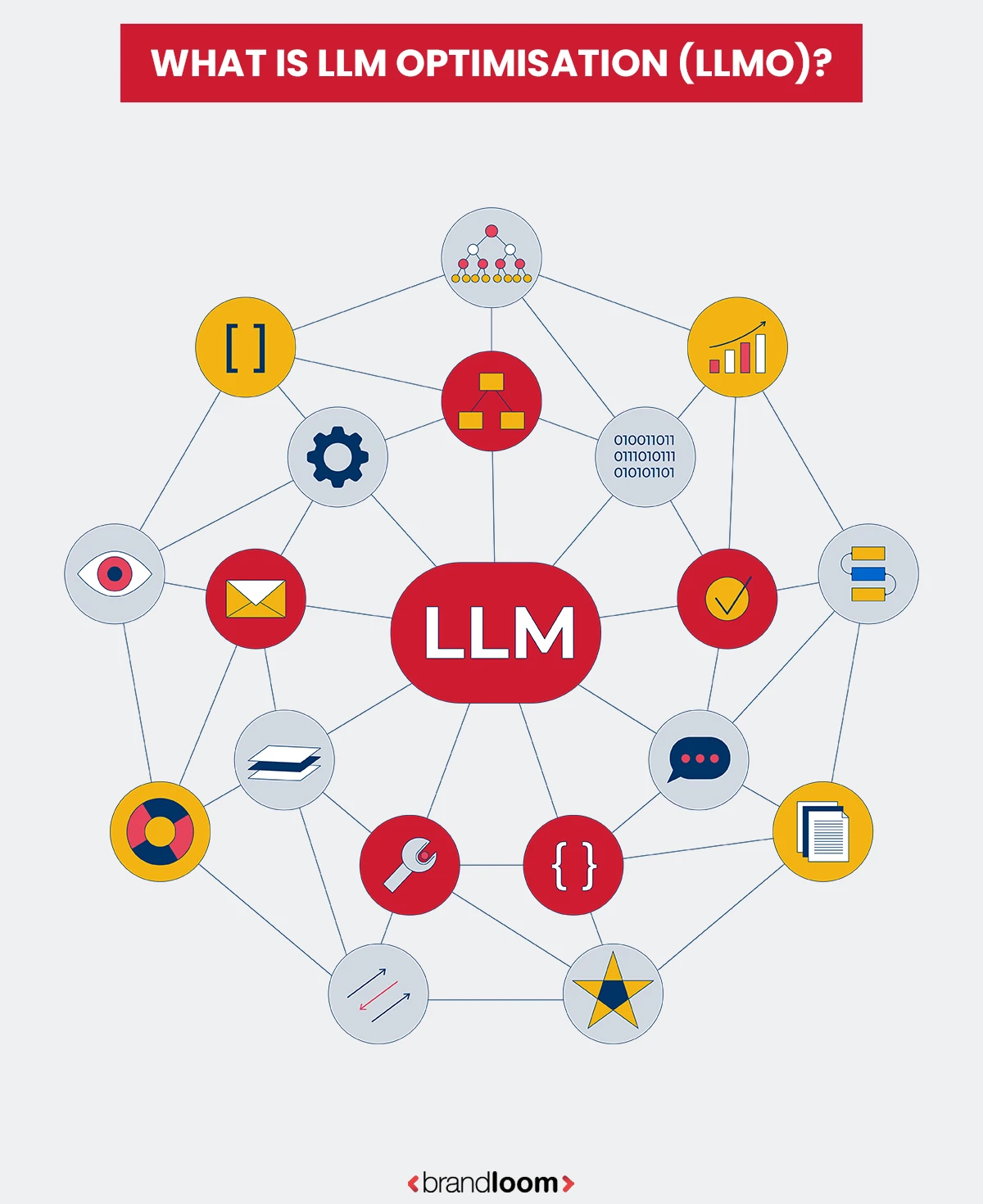
The future of SEO is LLM Optimisation (LLMO), which optimizes for ChatGPT, Gemini, Perplexity, and other large language models.
Rather than optimizing for clicks and rankings, LLMO aims to help your brand get mentions, quotes, and recommendations by AI systems.
Whereas SEO focuses on keywords and backlinks, LLMO builds entity-level authority and structured credibility, enabling AI engines to recognize and trust your content.
It is a simple goal: to be among the answers provided by AI, not just the blue links of Google.
From Search to Suggestions: How LLMs Are Changing Discovery
Artificial intelligence-based platforms are changing the way people search.
Conventional search relies on the ranking of the signals, such as backlinks and domain authority. Conversely, AI engines build a preference for credibility, factual knowledge, and systematic information to produce answers.
Key shifts include:
- Backlinks to trustworthiness: Context, authority, and citation are now more important than volume. AI engines now look for mentions within meaningful contexts, expert references, and consistent brand authority signals across the web. This means trustworthiness – not volume – is what determines visibility inside AI-generated answers.
- Keywords to Entities: AI models no longer depend on matching keywords. Instead, they understand entities. AI models bring together concepts, brands, and people with verified information. This shift makes semantic clarity, structured data, and consistent brand identity far more important than traditional keyword stuffing.
- Ranking to Recommendations: In AI-driven search, users don’t receive a list of 10 blue links – they receive direct recommendations from LLMs. These assistants choose a few trustworthy brands to mention, often just two or three. If your brand is optimized for LLMO, you become part of these AI-curated suggestions.
According to a 2025 study, currently, AI assistants fulfill almost 12% of all online queries – and the percentage is rising each month.
SEO vs LLMO: What’s the Difference?
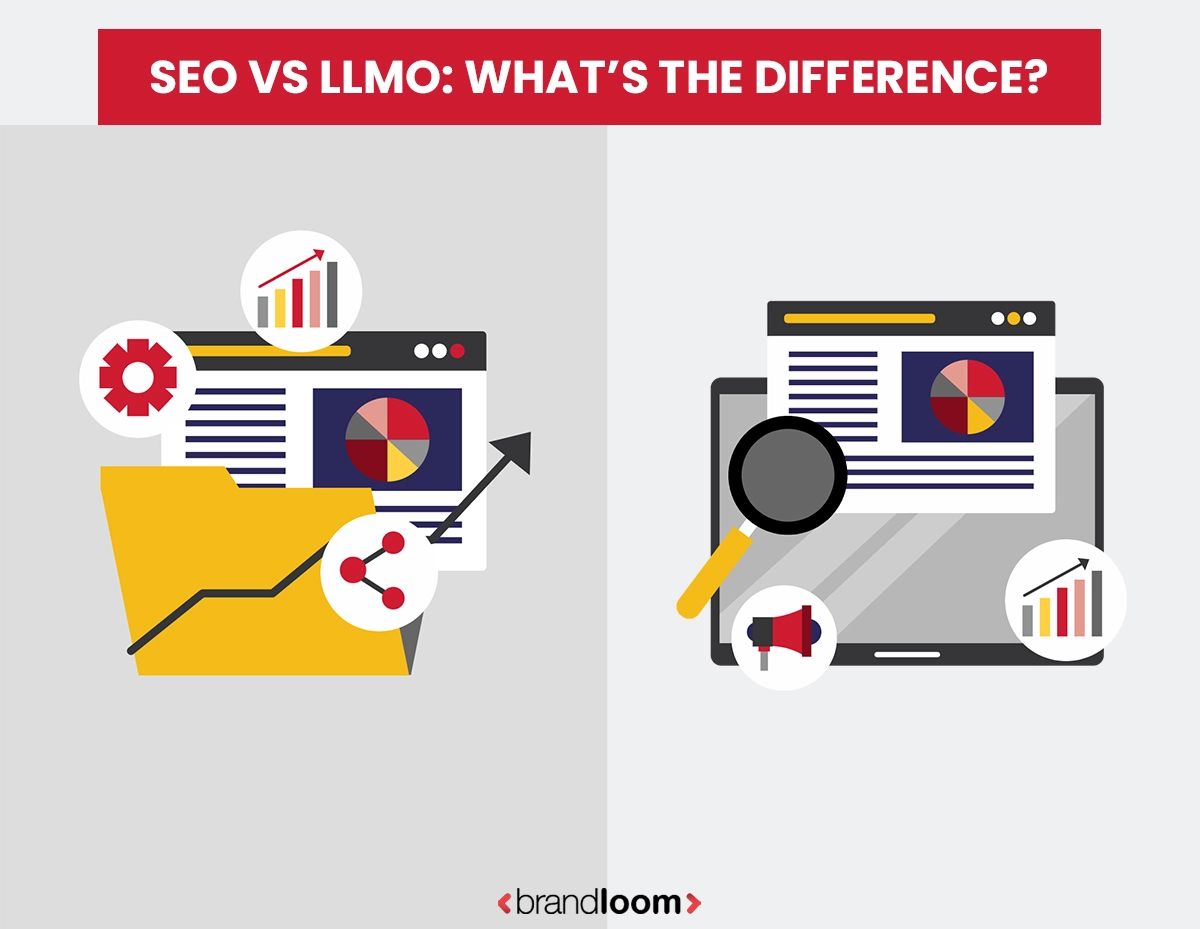
SEO gets you clicks. LLMO earns you credibility.
Where SEO (Search Engine Optimization) aims to rank higher in Google through keyword use, backlinks, and ranking signals, LLMOptimization (LLMO) aims to be visible in AI-based search engines, such as ChatGPT, Gemini, and Perplexity.
Traditional SEO services can get your work visibility through search results, but LLMO can provide you with comprehension, references, and suggestions from AI engines as answers in conversations.
Success in LLMO is more dependent on entity consistency, structured data, and factual correctness, rather than keyword density. It is not a competition of clicks, but rather an authority, credibility, and trust-building exercise for AI-generated content.
With the new era of AI search optimization, it is up to the brand to transform beyond the usual SEO into AI-ready content strategies that enable it to feature in AI responses, as opposed to search results.
Concisely, SEO attracts traffic, and LLMO attracts credibility. The two are indispensable, yet the secret to success in AI-driven search results is LLM Optimization.
Let’s summarise the differences.
| Factor | SEO | LLMO |
| Goal | Rank higher on Google | Be cited in AI-generated answers |
| Focus | Keywords, backlinks, ranking signals | Entities, structure, authority |
| Platform | Search engines (Google, Bing) | AI engines (ChatGPT, Gemini, Perplexity) |
| Output | Blue links in SERPs | Mentions or citations in AI responses |
| User Interaction | Clicks and visits | Conversations and recommendations |
How Does LLM Optimisation Work?
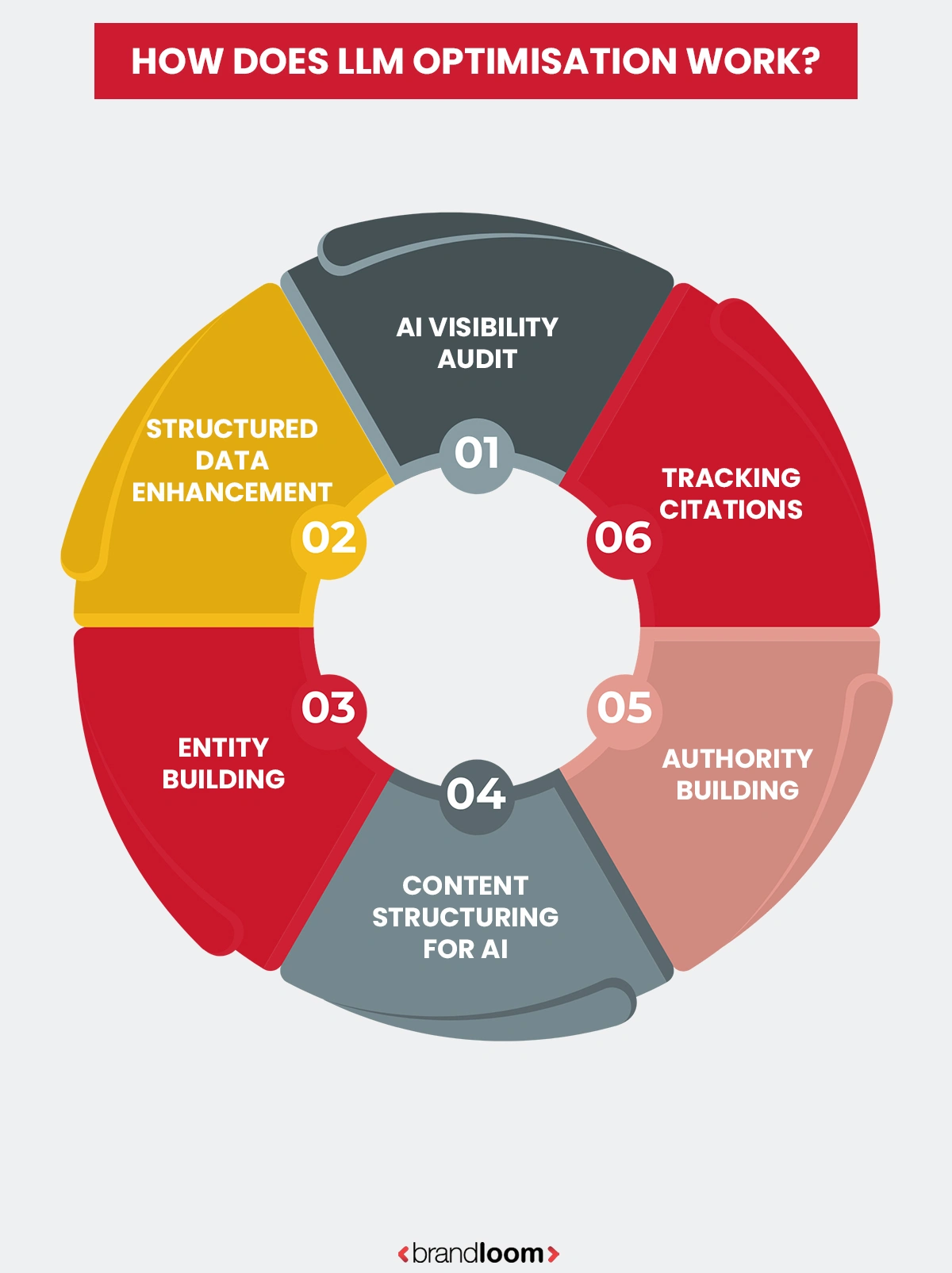
The strategic process of making your brand explainable, likable, and referable to AI-driven search engines like ChatGPT, Gemini, and Perplexity is LLM Optimisation (LLMO).
Rather than optimizing based on keyword rankings, LLMO aims to enhance your presence in AI-generated responses through structured data, reliable content, and entity authority.
AI Visibility Audit
Begin with an AI visibility audit to assess the frequency of your brand’s reference or recognition by AI engines.
At BrandLoom, the Best LLM Optimisation Agency in India, visibility audits identify gaps in entity recognition across ChatGPT, Gemini, and Perplexity. This helps you estimate your baseline AI search optimization and identify content gaps.
Structured Data Enhancement
Add schema markup (FAQ, HowTo, Organization, Product, and Review) and rich metadata to your website. Formatted content enables AI technology to categorize your content effectively, thereby enhancing brand visibility and trust in AI-driven search results.
As an AI SEO Agency in India, our team at BrandLoom ensures that AI engines accurately classify your content, thereby improving your chances of getting citations in AI-generated responses.
Entity Building
Consistency generates recognition. Be consistent in the name of your brand, services, location, and contact information across all directories, websites, and social media sites.
It enhances the authority of entities, allowing AI-generated images and Google’s Knowledge Graph to recognize your brand as a reliable source.
Content Structuring for AI
Win online credibility with PR functionality, partner relationships, and quality backlinks.
These are external indicators that inform AI engines that your brand is authoritative and trusted in its field, which is a significant success in AI-assisted search optimization.
Authority Building
Win online credibility with PR functionality, partner relationships, and quality backlinks.
These are external indicators that inform AI engines that your brand is authoritative and trusted in its field, which is a significant success in AI-assisted search optimization.
Tracking Citations
Lastly, keep track of the usage and mention of your brand by AI models. To determine your visibility, you can query AI engines manually or use specialized tools to monitor it.
Frequent monitoring will help keep your LLMO strategy up-to-date, as AI systems do.
Taken together, these measures transform your brand into a name you can trust, a brand that is consistent and verifiable – the three successes of the AI-driven generation of visibility.
Why LLMO Matters in 2026 & Beyond
With AI-powered search dominating digital discovery, conventional SEO is no longer sufficient.
Nowadays, AI platforms do not simply present informational content based solely on keyword relevance, but also on trust, structure, and authority.
When search evolves beyond keywords, BrandLoom’s LLM Optimisation Services ensure your brand becomes part of AI-generated answers, not just traditional search results.
Evolving Search Landscape
- AI is replacing the rankings with recommendations – users would prefer to query ChatGPT or Gemini instead of searching manually.
- Structured content and entity optimization for AI search are now the drivers of the brands.
- Power and trustworthiness are more relevant than the number of backlinks in determining AI mentions.
Mini-case example:
One of the tech SaaS brands optimized its FAQs and data to be visible on ChatGPT. It was in more than 200 AIs generated answers in 60 days – increasing referral traffic by 35 percent without appearing higher in Google.
In short, AI has become the discovery layer, not only a search interface. LLMO is the way to make sure your brand is included in the conversation. With credibility and facts, your business gains access to the discussion – and to the future of search.
How to Optimize for LLMs and AI Engines
To optimize Large Language Models (LLMs) such as ChatGPT, Gemini, and Perplexity, it is necessary to adopt strategies that prioritize understanding, trust, and authority over the heavy use of keywords in SEO.
LLM Optimisation (LLMO) is about ensuring your brand is visible in AI-generated responses where discovery has become conversational rather than search-based.
Structured schema markup
To start with, there is a need to introduce structured schema markup (FAQ, HowTo, and Organization). These assist AI engines in comprehending the interconnection between your content, brand, and services.
Then, establish and support an llms.txt file for AI visibility. This is a new best practice that informs AI crawlers on how to interpret and access your site’s data.
Conversational and answer-based writing
Create content that reflects the way users pose queries, and avoid keyword stuffing. Instead, focus on conversational writing with answers. Include facts, figures, and authoritative references to create credibility.
High-quality, long-form content with in-depth explanations, thoroughly and transparently presented, has a higher quote probability from AI engines compared to repetitive content posts.
Authority Building
Another foundation of AI-based search optimization is authority. Get placements in reputable publications, digital PR placements, and links on reliable websites. These are all indicators that your brand is a specialist in the field, as AI models recognize it.
Entity audit
Finally, conduct an entity audit using search engines, such as Google Knowledge Graph. Verify the consistency of brand information, including name, address, services, and tone, across the internet. These measures strengthen your reputation throughout AI engines.
The practices can make AI models perceive your brand as trustworthy, stable, and testable, which are the three pillars of AI visibility.
Why You Should Not Ignore LLMO in 2026
As AI engines rapidly replace traditional Google SERPs, brands that fail to optimize for LLMs risk being pushed out of the online discovery funnel. Search behavior is shifting fast.
By 2026, most user queries are expected to be AI-driven, meaning users will rely on AI Overviews, chat-based search, and multimodal assistants instead of clicking blue links. If your brand is not visible in these AI-generated answers, you do not exist where your customers are searching.
Lost AI visibility = lost customers.
When LLMs summarize results, they only mention a handful of brands. If your competitors invest in LLMO before you, their names will consistently appear in AI responses – and users will choose them first, simply because they see them first.
This is not just an AI trend. It is a business threat.
Ignoring LLMO means:
- Your competitors get recommended before you in AI answers
- Your organic traffic declines even if your SEO is strong
- Your brand authority weakens as AI assistants stop referencing you
- Your customer acquisition costs rise because paid ads must fill the gap
However, investing in LLMO now has a double benefit:
It boosts AI visibility AND indirectly strengthens your SEO rankings, because AI-ready content aligns perfectly with E-E-A-T, semantic relevance, and structured clarity – all core ranking signals for Google.
2026 will reward the brands that move early.
If you want to retain visibility, protect your market share, and future-proof your digital strategy, LLMO can no longer be optional -it is now urgent.
Common Mistakes That Limit Your AI Visibility
Despite employing the correct strategy, numerous brands commit serious LLMO errors, resulting in lost visibility in AI-driven search results.
Relying solely on traditional keyword SEO
One of the most significant pitfalls to mention is the need to use traditional keyword SEO rather than entity SEO. The AI engines prioritize context, factual accuracy, and authority over simple keyword matches.
Missing structured data
Absent or incomplete structured information also restricts AI interpretation of your content. Your site is difficult for LLMs to understand without schema markup.
Lack of credible external references or PR mentions
The other significant mistake is the absence of credible external sources or PR mentions. AI models also rely on official sources. When there is no mention of the brand elsewhere, it does not get suggestions.
Clickbait titles
Likewise, AI algorithms can be confused by clickbait headlines, which makes your content less authoritative.
Neglecting updates
Another way brands damage their AI visibility is by failing to update outdated or unverifiable claims. On the other hand, AIs are biased towards accuracy and will not include content with dubious facts.
Skipping llms.txt
Finally, if you do not consider the llms.txt file or use incorrect formatting, the metadata will cause the AI crawlers to crawl your site incorrectly.
In the age of AI-driven discovery, LLM Optimisation for businesses is a continuous process, rather than a one-time event.
Pay attention to verified, organized, and authoritative information, and avoid taking shortcuts that compromise accuracy. Creating AI-ready content today will keep your brand visible, referenced, and reputable tomorrow.
The Future of LLM Optimisation and AI Search
“Tomorrow’s brands won’t compete for clicks — they’ll compete for citations.” – Avinash Chandra, Founder & CEO, BrandLoom.
AI Engines Will Redefine Discovery
Rather than a list of search results, users will get direct answers as suggested by AI models. To remain visible, brands must enhance their authority over their entities, ensure factual consistency, and utilize structured data signals to feature in AI-generated results.
Integration of AEO and LLMO
The boundary between Answer Engine Optimization (AEO) and LLMO will blur. The two strategies aim to transform content into AI-readable, context-driven, and credible content. Companies that are AI-prepared in their content strategies will take the lead in visibility across both conversational and voice-based mediums.
Rise of llms.txt and Knowledge Graphs
The future optimization of AI searches will depend on the development of novel protocols. They are llms.txt, or the instructions that AI crawlers should follow to understand the content of websites. Combined with tools such as Google’s Knowledge Graph, brands can enhance the recognition of entities and ensure peace and harmony on the web.
Hence, discovery is shifting to generative AI, and LLMO is emerging as the pillar of digital visibility.
The future will not be about search results, but rather about AI-driven conversations that build user trust and brand perception, leveraging structured data, entity optimization, and authority-building.
Conclusion
The future of AI-powered search is LLM Optimisation (LLMO), which will transform how brands are seen and recognised online.
Conventional SEO methods focus on ranking based on algorithms, whereas LLMO aims to build trust in AI technologies that power tools such as ChatGPT, Gemini, and Perplexity.
It implies that brands must produce authentic, contextually rich, and verifiable content that aligns with user intent and real-world knowledge.
By leveraging content credibility, structured data, and semantic depth, businesses can strengthen their presence in AI-powered search results. The future lies in the brands that grasp the meaning of SEO and LLMO, balancing car accuracy and conversational intelligence.
It is time to make your digital strategy future-proof and stay ahead of the development of AI-driven searches with BrandLoom’s top LLMO services.
Start optimizing for AI-driven search today – transform your visibility with LLMO!
Prepare Your Brand for AI-Driven Search
Ready to make your brand visible in AI responses?
Begin with a free AI Visibility Auditand see where ChatGPT and other AI engines already recognize your brand.
FAQs
LLMO is an optimization of your brand in AI-generated responses of ChatGPT, Gemini, and Perplexity.
It operates by streamlining your content, organizing information, entities, and authority to allow AI engines to comprehend, have confidence, and reference your site.
Some of the strategies LLMO uses to make your brand appear reliable to AI models include schema markup, LLMS.txt files, fact-based writing, and credibility signals.
In place of ranking in SERPs, LLMO aims to obtain citations and recommendations in conversational AI responses, making your business more discoverable in AI-based search.
As a leading AI optimization agency in India, we at BrandLoom Consulting focus on contextual linking, verified data, and clear formatting – enabling AI engines to trust your brand and accurately reference it.
In traditional SEO, priority is given to ranking the webpages in Google through the use of keywords, backlinks, and on-page optimization. However, LLMO strives to ensure that your content is comprehensible and credible to artificial intelligence tools such as ChatGPT and Gemini.
Rather than fighting to be on that blue link, brands are competing to be cited and mentioned in AI-generated answers. LLMO places more emphasis on entity optimization for AI search, structured data, factual accuracy, and credibility signals. Whereas SEO is based on an algorithmic ranking, LLMO is based on AI understanding and semantic context.
They are both important, though LLMO is critical to visibility in AI-enabled search, as it enables users to provide answers without links. Leading firms like BrandLoom, known as the Best LLM Optimisation Agency in India, optimise your entity data, schema markup, and conversational relevance to help AI engines trust your content.
LLM Optimization is essential, as people increasingly use ChatGPT, Gemini, and other AI assistants to find answers rather than relying on search engine results. AI-based search prioritizes reliable, structured, and verifiable information, ensuring that only authoritative brands are referenced.
In the absence of LLMO, companies will lose visibility in AI suggestions. LLMO assists AI models in learning about your brand, categorizing your information, and citing you with confidence.
With the growth of generative AI search, you and your expertise can be presented in conversational responses, build user trust, and attract high-quality intent traffic without relying solely on Google rankings.
Partnering with an AI SEO Agency in India, such asBrandLoom Consulting, helps improve AI visibility by enhancing structured data, credibility signals, and entity consistency.
To ensure your site appears in ChatGPT or Gemini output, optimize it for entity clarity, structured data, and credibility. Add schema markup (FAQ, How-To, Product), create an llms.txt file, maintain brand consistency, and publish well-cited, fact-based content.
BrandLoom’s SEO experts build authority through PR mentions, expert quotes, and trusted backlinking. AI engines focus on brands that have trustworthy, transparent, and testable material.
Ask ChatGPT or Gemini to check your prompts regularly to ensure consistent brand mentions.
LLMO makes the AI models knowledgeable of your site and confident to include it in an answer.
The best content for LLMO is long-form, structured, factual, and contextual articles. AI engines like content that includes headings, bullet points, verified information, citations, frequently asked questions, and explanations in a conversational style.
Instead of stuffing your pages with keywords, ensure that you clearly and thoroughly address the user’s intent. AI models are more likely to refer to guides, tutorials, frequently asked questions, scholarly knowledge, and official descriptions. Uses manual tests and visibility tools to measure how effectively AI engines are using your content.
The application of schema markup and regular entities makes your content interpretable. As the Best Digital Marketing Agency in India, BrandLoom’s LLM Optimization Services prioritizes accuracy, transparency, and semantic completeness. These are the primary aspects of high-quality LLM-optimized content that are valued by AI search.
Structured data can assist LLMO by helping AI engines become more familiar with the content, relationships, and context of your website.
The schema markup, such as FAQ, HowTo, Organization, Product, and Article, generates machine-readable cues that enhance AI understanding in these areas.
This organized layer enables LLMs to verify facts, categorize content, and identify entities. The more your brand is featured as part of an AI-powered search result, the more likely it is.
Rich metadata also enriches knowledge graph recognition. In a nutshell, formatted data turns your site into an easily accessible and reliable source of information that the AI model trusts.
The llms.txt file serves as a roadmap for AI crawlers, similar to robots.txt, but is explicitly designed for LLMs.
It instructs AI engines on how to locate, process, and use the content on your site. llms.txt lets you set your preferred URLs, content types, licensing, and usage preferences, making your content more visible in search engines with AI and ensuring it is appropriately indexed.
By including this file, LLM understanding can be enhanced, facilitating the use of data in a safer and more structured manner. The larger the AI model is based on standardized signals, the more critical the llms.txt file is for modern LLM optimization.
AI visibility can be measured in businesses by conducting manual tests with ChatGPT, Gemini, and Perplexity. When you ask questions about your niche, you can trace the references, mentions, and recommendations of your brand by the AI.
Artificial intelligence citation auditors are being developed, yet manual auditing remains useful. Additional signs are growth in referral traffic on AI-based sites, branded search lift, and Knowledge Graph.
According to professionals at BrandLoom Consulting, the most important aspect of AI citation frequency is based on the LLMO principle: visibility is not based on clicks, but rather on how frequently AI models rely on and mention your content.
Yes, small firms can gain a lot through LLMO. The use of AI-driven search optimization equalizes the playing field by prioritizing relevance, accuracy, and trust over the quantity of backlinks or domain authority.
Small brands can be included alongside larger brands in AI-generated answers, using structured data, consistency, and factual information. Small businesses establish authority through PR mentions, high-quality content, and semantic consistency, which LLMO promotes.
Because AI assistants currently address a significant portion of localized queries, optimizing LLMs will enable small businesses to increase their visibility in the discussions where customers search.
BrandLoom builds credibility through PR, high-authority backlinks, and digital presence expansion, a hallmark of the Best AEO Agency in India.
To rank better in AI-based search, it is essential to be an entity that is consistent, structured, and authoritative. Write conversational, answer-oriented information buttressed by proven facts using schema markup, put it in an llms.txt file, and write it.
Ensure the brand information is consistent across all web platforms, update it regularly, and receive high-quality backlinks or PR mentions. Avoid using keywords and old-fashioned assertions, as AI engines penalize insecure sources.
Test AI regularly to monitor visibility. Experts at BrandLoom Consulting use best practices of LLMO through clarity, accuracy, trust, and structure, which are crucial elements AI engines follow in the generation of answers.