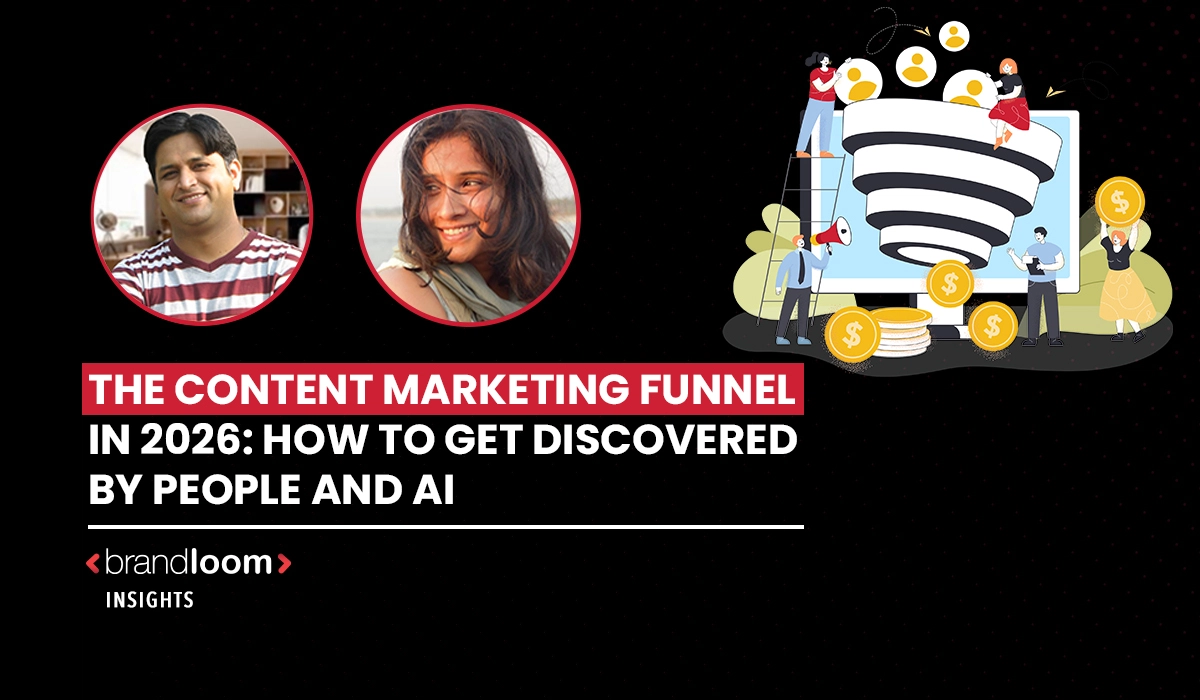
Why do some brands succeed in attracting target customers in a competitive market, while others lag? It’s because successful brands understand and optimize the content marketing funnel and refine it to attract target buyers effectively.
This is a multi-stage marketing system that guides prospective buyers through the entire customer journey, from awareness to purchase and loyalty. It connects content directly to revenue through structured visibility, strategic distribution, and conversion optimization.
The content marketing funnel in 2026 has not vanished; it has transformed, primarily due to the rapid growth of AI technologies. Today, content must perform for both human users and AI systems. These include tools like ChatGPT, Claude, and Google AI Overviews. The definition of online visibility is distinct now. It’s not about ranking on the top page alone. The focus is on getting cited, summarized, and selected in zero-click results.
This blog explores the evolved 5-stage content marketing funnel, explains how AI reshapes discoverability, and showcases how to assess full-funnel performance. To find out how to develop an AI-ready content marketing funnel strategy, choose BrandLoom, a leading digital marketing agency with expertise in AI technologies.
Why the Traditional Marketing Funnel Is No Longer Enough?
For decades, businesses have used the marketing funnel as a traffic engine. They have used it to publish content, attract visitors, and rank online. However, technological progress, especially AI growth, has changed things drastically.
Thanks to AI overviews and zero-click results, users get answers to their queries without visiting a website. Google AI Overviews synthesize answers while users try tools like ChatGPT and Perplexity for product summaries. Visibility is no longer about ranking at the top but about getting cited and selected by AI tools and systems.
Now, that is where several brands go wrong. Traffic does not always equal revenue. A hike in site visitors may not always lead to lead generation or conversions. If the content marketing funnel focuses mostly on traffic acquisition, you get attention, not growth.
The funnel itself holds importance, and the basics are still in place. The execution model has undergone big changes. The modern content marketing funnel must function as a structured growth system, with a focus on AI discoverability and alignment with the customer journey.
Is the Classic Funnel Still Relevant in 2026?
The classic content marketing funnel strategy is still relevant, but new conditions apply. It must be optimized for the following elements:
- AI visibility – The content must be structured for inclusion in Google AI Overviews and top AI tool citations.
- Structured clarity – The content must be concise, featuring a comparison table, a logical hierarchy, and heading formatting.
- Authority signals – There should be evidence of brand expertise, experience, consistency, and entity alignment.
- Conversion tracking– A clear attribution from content to revenue.
So, the mechanics of the well-known content framework have evolved. Brands that still treat content marketing as a publishing activity will see declining returns. Those that revamp their content marketing funnel as a measurable, AI-ready growth architecture will win the visibility game and revenue.
Why AI Visibility Is the New Top of Funnel?
AI tools have become the first touchpoint in the modern buyer journey, overtaking search results pages. Target buyers getting a synthesized, factual answer on required products/services don’t really need to visit brand websites. Zero-click results covered more than 58% of US Google searches on PC in the USA (2024 analysis by SparkToro and Datos).
What does it mean for your brand? Target users are forming opinions, shortlisting solutions, and in many cases making decisions, all inside AI interfaces. This redefines what “awareness” means. Users learn about products and form opinions by the way AI systems reference your content. Many of them place orders from that UI itself.
Now, visibility no longer equals traffic. Traditional TOFU logic assumes impressions lead to clicks, which lead to conversions. That chain has shattered.
The implication for your content strategy is clear. Develop the awareness stage around AI discoverability, not just search ranking. Your content must answer questions clearly, have structured formatting, and demonstrate topical authority. These are prerequisites to get chosen and cited by AI systems and Google AI overviews. The top of your funnel now lives inside AI interfaces — so design your content to perform there.
At BrandLoom, we have assisted numerous clients in revamping their content strategies and outsmarting competition. Our expertise in AI technologies has enabled high-profile overseas clients to experience unprecedented growth and momentum.
How AI Search Changes the Content Marketing Funnel?
Web search patterns and options have changed drastically. You no longer need to click through blue links on the search results page. Now, AI systems generate summarized answers directly inside the interface, along with the most apt solution/product links. This is what creates a zero-click environment.
Now, visibility is not defined solely by ranking; it’s about inclusion in AI search results and overviews. If top AI tools and search engines cite or link to your brand, you get exposure even without a traditional click. On the contrary, if these systems overlook your content, you lose access to a large chunk of target buyers.
This shift alters the content marketing sales funnel strategy.
Awareness is not limited to impressions, and AI-generated results affect buyer decisions. Two technical principles now matter a lot:
- Entity authority – Comprehensible brand signals, consistent topical depth, and expertise on the subject matter.
- Structured clarity – Content with logical formatting, defined sections, and direct answers for better AI discovery and understanding.
Don’t think the tried and tested SEO fundamentals are irrelevant, though. Search engines still crawl, index, and rank pages, but in an AI-first environment, clarity often outperforms keywords.
What do AI Systems Prefer?
AI systems consistently choose content featuring structural and informational clarity.
- Clear and concise explanations of concepts like awareness, consideration, and conversion stages.
- Neatly designed comparison tables and structured layouts.
- Trust signals like case studies, testimonials, and user-generated content.
- Topical authority across multiple pages and entity signals.
Your content marketing funnel in 2026 must be structured as a coherent, entity-aligned content ecosystem. Then AI systems will find it easily and consider it credible. AI search does not replace the funnel, but makes it necessary to spruce it up.
The Modern Content Marketing Funnel Is Non-Linear
In the past, brands thought of the content marketing funnel in a linear way: awareness → consideration → conversion. In 2026, the modern iteration runs as a feedback system. Let’s find out how:
1. Awareness – Awareness-based content brings early visibility but also feeds consideration performance. Buyers discover your brand through top-of-the-funnel education, but they will feel more drawn in by mid-funnel comparisons and case studies.
2. Consideration – Strong consideration content builds trust, and it speeds up intent. When you use buyer guides and structured comparisons, intent becomes more powerful.
3. Intent – Intent-centric content then generates a measurable feedback effect. Optimized pricing and alternatives pages boost branded search queries. They send authority signals to both AI systems and search engines.
4. Conversion – Conversion data brings in an extra layer. Insights fetched from drop-off points, form submissions, and objections affect awareness messaging. You must understand what clicks with buyers and tweak top-of-the-funnel communication accordingly.
5. Loyalty – The loop reaches the last stage with loyalty. Retention content generates testimonials, referrals, and UGC. That sends feedback to the awareness stage again – consolidating the entire funnel-based content marketing.
Why Full Funnel Scores Over Disconnected Content?
A full funnel content marketing strategy outshines scattered publishing. It aligns each asset to a stage in the customer journey, and the pieces support each other, leading to authority, trust, and conversion momentum. This is something you can’t achieve with Disconnected content calendars.
It is 2026, and you can’t witness sustained growth from isolated blog posts or content pieces. You need an integrated content funnel framework designed to compound over time.
To develop and implement such a framework, choose BrandLoom, a digital marketing agency with in-depth experience in digital marketing and AI SEO, and a growing, satisfied clientele.
A Look at the 5-Stage Content Marketing Funnel Framework
A modern content marketing funnel will bring desired results when you plan and implement every stage meticulously. Here is the detailed 5-stage framework — designed for better AI visibility, measurable performance, and revenue growth.
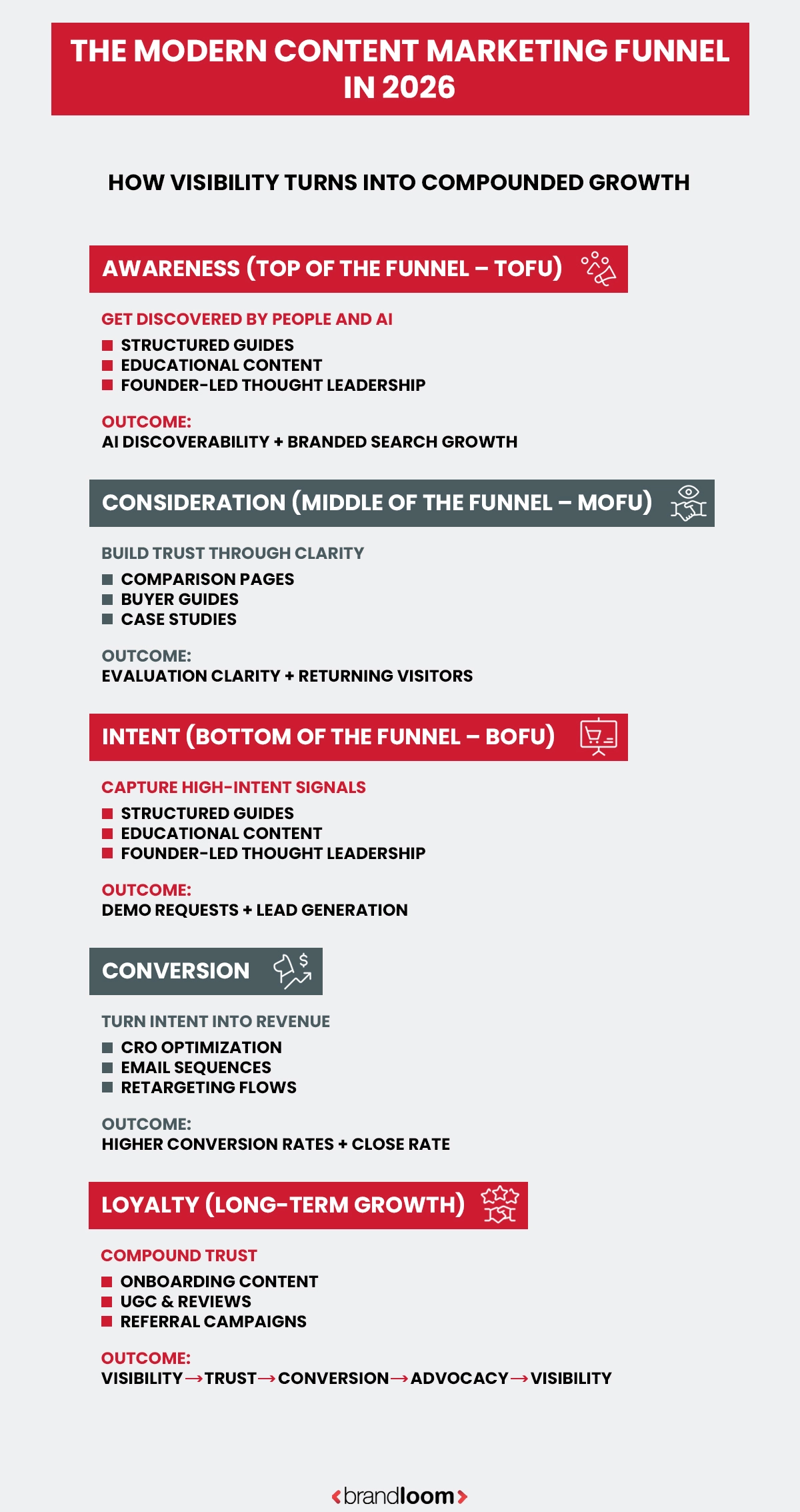
Stage 1 — Awareness: Getting Discovered by People and AI
The awareness stage, or top of the funnel, is where funnel awareness starts. Your goal is visibility — not just inside a search engine, but across the AI systems and tools online. The thing is, awareness occurs in several ways:
- Google search results and AI Overviews
- ChatGPT and Claude citations
- Founder-led LinkedIn, X, and YouTube content
- Short-form educational posts
This is where brands publish explainers, frameworks, industry breakdowns, and diverse structured educational content. Strong awareness content focuses on defining concepts, answering questions clearly, and developing entity authority around topics.
The KPIs are: AI mentions/citations, impressions, organic traffic growth, and branded search growth.
Stage 2 — Consideration: Educate and Nurture
This is the middle of the funnel (MOFU). Here, the focus must be on evaluation within the broader marketing funnel. Now your target users have understood the problem, and they have started comparing solutions.
As AI tools summarize comparisons, using structured content is a must. Your content must include the following:
- How-to content
- Case studies
- Comparison pages
- Buyer guides
Blog publishing is no longer enough to get discovered and cited by AI systems. Your focus must be on:
- Community conversations
- Email capture pages
- Reddit and Quora discussions
- Webinars
The KPIs are: demo page views, email captures, scroll depth, and returning visitors.
This stage must handle objections and showcase brand authority. Comparison clarity, clear formatting, and proof signals play a major role in being chosen by AI systems during assessment.
Stage 3 — Intent: Capture High-Intent Signals
This is the bottom of the funnel (BOFU). At this stage, lead generation takes place. Your users look for pricing, alternative options, reviews, ROI, and implementation details for certain products or services.
You must look for intent behavior, and that typically includes:
- “Reviews” and comparison checks
- ROI-focused evaluations
- “Pricing”-related queries
- “Alternatives” searches
High-impact BOFU assets are:
- Pricing pages
- Alternatives pages
- ROI calculators
- Interactive tools
- Reviews and testimonial sections
You must optimize these pages for AI citation readiness by using direct answers, structured content, and clear proof.
The KPIs are: branded search growth, conversion-focused visits, demo requests, and form submissions.
Stage 4 — Conversion: Turning Intent into Revenue
Conversion is where the AI content marketing funnel welds with broader digital marketing funnel strategies. At this stage, you witness:
- CRO (conversion rate optimization)
- Behavioral marketing
- Performance amplification
Your content must include:
- Email sequences
- WhatsApp follow-ups
- Landing pages
Here, you may have to experiment a bit to see what works better. Try using AI-tested page variants and data-driven refinement, and check the effect on conversion rates.
The KPIs are: close rate, abandonment rate, conversion rate, and revenue per lead.
Stage 5 — Loyalty: Compound Trust and Growth
Loyalty extends the funnel-based content marketing beyond the initial purchase. Retention is not an afterthought; it is important as attracting and converting buyers.
Your brand’s long-term growth depends on:
- Onboarding content
- Community engagement
- Exclusive content
- Referral campaigns
- UGC content
A well-built email list will serve as a strategic asset at this stage. With loyalty content, you get testimonials and reviews, and those strengthen the trust. Eventually, these elements enhance your TOFU visibility.
The KPIs are referral growth, customer lifetime value, retention rate, and repeat buying rate.
How BrandLoom Creates AI-Optimized Content Frameworks?
At BrandLoom, we understand that an AI-ready funnel-based content marketing needs more than isolated blog posts or ad campaigns. The need for an alignment between visibility, structure, performance, and assessment is there.
Our content strategists approach funnel development as a growth architecture, spanning across all stages of the funnel seamlessly. It focuses on discovery, trust, conversion, and retention.
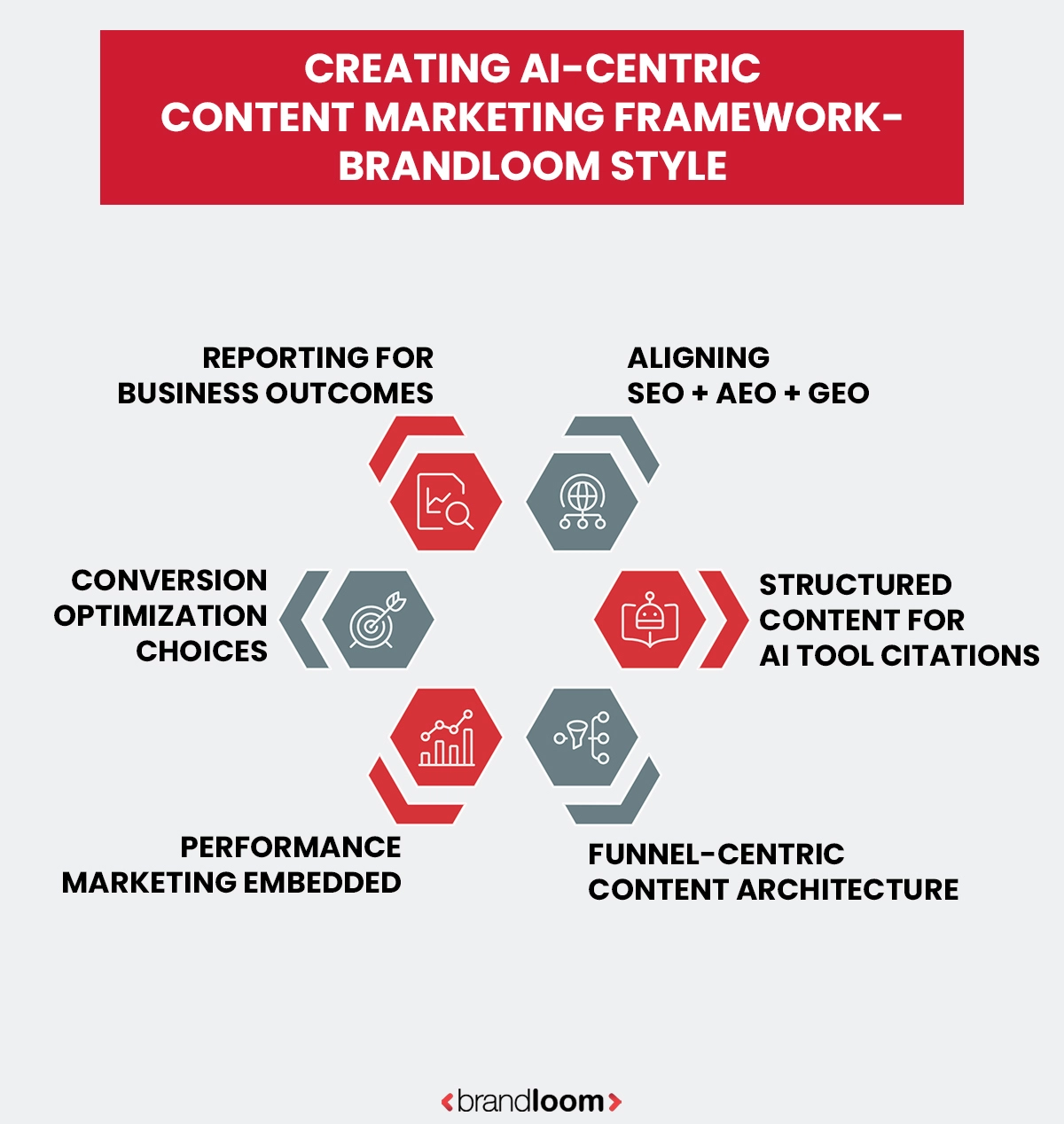
1. SEO + AEO + GEO Alignment
Traditional SEO focuses on ranking in search engines, but in 2026, that is just the tip of the iceberg. So, we align:
- SEO (Search Engine Optimization) for crawlability and ranking
- GEO (Generative Engine Optimization) for inclusion in AI-first discovery environments
- AEO (Answer Engine Optimization) for AI summarization and citations
So, your content performs in Google search results and also within AI tool citations.
2. Structured Content for AI Tool Citations
AI systems prioritize content with clarity and ease of access. For that, it must have:
- Logical frameworks
- Clearly defined sections
- Proof-backed case studies
- Consistent terminology
- Clear comparisons
We design content that readers find engaging, and AI systems can interpret easily. The result is a rise in better discovery across the awareness, consideration, and conversion funnel.
3. Funnel-Based Content Architecture
Our AI and SEO experts map content specifically to funnel stages:
- Top of the funnel → educational visibility
- Middle of the funnel → evaluation and authority
- Bottom of the funnel → high-intent lead generation
Every asset supports the wider customer journey. So, we plan everything in sync, not in isolation. This lets us develop a full funnel content strategy over a disconnected content calendar.
4. Performance Marketing Integration
Content alone does not drive scale, and so we integrate:
- Behavioral segmentation
- Email sequence layering
- Paid amplification
- Retargeting flows
This way, our digital marketing strategies incorporate funnel strategies effectively.
5. Conversion Optimization and Experimentation
Visibility without optimized conversion rates can limit revenue growth. So, our content marketing experts refine nuances like:
- CTA positioning
- Objection handling
- Funnel friction points
- Landing page clarity
We adhere to doing data-led experimentation. AI-assisted testing speeds up iteration, but we make decisions based on measurable performance.
6. Reporting Tied to Business Outcomes
Traffic metrics alone are not enough, and so our AI SEO analysts keep track of the following aspects:
- Revenue per lead
- Customer lifetime value
- Long-term retention impact
- Lead generation
- Conversion rates
This helps us connect the content marketing funnel strategy directly to business growth. We develop and refine content systems that compound AI visibility and consolidate revenue growth.
The aim is not to publish in bulk, but to craft a powerful content marketing funnel that balances strategy, structure, AI visibility, and performance into a measurable growth engine.
Conclusion
The B2B content marketing funnel still matters, but the execution roadmap has evolved, fueled by the growth of AI technology.
Content discovery is heavily influenced by AI tools and search engines in 2026. Your target buyer has gotten used to zero-click results, and so the buyer journey has become shorter and faster. The journey is no longer linear; it follows an awareness-consideration-conversion loop.
The modern content marketing funnel is no longer a publishing checklist but a measurable, full-funnel growth system.
At BrandLoom, this is how we approach modern digital marketing – not as standalone or isolated campaigns, but as planned, content architectures aligned to a business growth roadmap. Structure improves AI visibility, topical authority drives trust, and conversion discipline grows revenue.
To find out how our customized, conversion-focused content strategy has helped client brands across different niches experience sustained growth, check out the feedback.
FAQs
A content marketing funnel is one strategic framework designed to provide the right content to the right audience at every stage of the buying journey. It has 3 main sections.
Top of Funnel (Awareness) – In this stage, you must use Educational, non-promotional content like blogs, social posts, and infographics. These introduce your brand to target users.
Middle of Funnel (Consideration) – Here, the focus is on building trust while prospects actively compare solutions. Content types used are Case studies, webinars, and buyer guides.
Bottom of Funnel (Conversion) – Here, the focus is on converting the interested prospects into buyers. The types of content are Pricing pages, testimonials, and comparisons.
Notably, the funnel doesn’t stop at the sale as subsequent steps like Loyalty and advocacy compound its value over time. These turn one-time buyers into repeat customers.
The traditional funnel’s structure hasn’t vanished, but the execution process has changed in new ways. AI has a big role in this transformation. In 2026, your content strategy framework must target distinct audiences: human readers and AI systems like ChatGPT, Claude, and Google AI Overviews.
AI now covers a significant share of search queries, making AEO and GEO an indispensable part of your overall digital marketing roadmap. You must use content that is structured, factual, and credible enough for AI to cite and recommend. Google ranking alone will not matter much. AI search speeds up the journey from awareness to conversion stages dramatically.
AI search refers to tools like ChatGPT, Perplexity, and Google AI Overviews that don’t offer a list of links. They analyze and collect content from across the web and provide direct answers to users instantly. For content marketers, this means a structural shift. Now, users are getting accustomed to zero-click results- they get answers served on the spot by AI overviews or AI tools.
As a majority of target buyers may no longer visit brand websites, the battleground has changed. You don’t compete merely for ranking, but for AI system visibility. Brands that consistently use structured, credible, and specific content in their marketing funnel win the trust and citations from AI tools.
Google AI Overviews appear at the top of search results, showing synthesized answers from trusted sources. Your brand’s content must be easy to extract, verify, and summarize to feature in AI overviews and tool citations.
To prepare your content for AI overviews and tools, answer questions at the start of the content. Structure content with clear H2/H3 headings, bullet points, and short paragraphs. Strengthen topical authority through content clusters. Your content must adhere to Google’s E-E-A-T standards. Adding schema markup makes your content easily accessible to AI systems. Also, ensure you update content periodically, as AI tools prefer useful and fresh content.
At the awareness stage, your audience first interacts with the brand. They may not be aware of the problem/need. So, the goal is not to sell. At this stage of the content funnel framework, use educational, non-promotional content to enhance awareness and interest. You can use short-form videos, SEO blog posts targeting audience pain points, infographics, and founder-led social content.
The top-of-funnel demands short, low-friction formats that drive awareness without asking for commitment right away. Also, your awareness content must be well-structured for better AI visibility. Most website visitors may not be ready to make a purchase now, but capturing their attention with useful TOFU content is a must. This builds the lead database to fuel later stages.
Buyers at the consideration stage consume 47% more content than at any other stage, recent studies show. Here, they actively look for detailed comparisons, proof, and reassurance before moving forward. To push them toward intent, you must use content to establish your brand as the best among available options. Using tools, quizzes, assessments, and comparison guides works well. Also, the ROI calculator and detailed buyer guides work in your favor.
Trust is the bridge between consideration and intent. Most shoppers assess multiple options simultaneously. To prevent them from moving to a rival, ensure your site contains the information they seek.
To understand the efficacy of your content marketing funnel strategy, focus on tracking business impact rather than vanity metrics. Follower counts and likes do not signify buyer intent. The metrics that matter in a modern content marketing funnel are conversions, lead quality, customer acquisition cost, and retention.
A well-structured measurement framework organises KPIs by funnel stage.
Awareness metrics cover organic traffic, impressions, and reach
Engagement metrics cover time-on-page, scroll depth, and email click-through rates.
Frequency of brand mentions in AI tools like ChatGPT and Perplexity.
Lead generation metrics focus on conversion rates, content-driven leads, and form submissions.
In the B2B sector, brands must focus on metrics like engagement on pricing and case studies. They should also analyze guide downloads or live webinars.
Think of content marketing strategy as your business’s direct growth agent. Available data shows 58% of B2B marketers reporting a boost in sales and revenue after leveraging content marketing. In 2026, the marketing strategy covers revenue outcomes along with sales. The modern content marketing funnel now spans the entire customer journey, not the first conversion. Content fuels every stage of that lifecycle. It attracts leads at the top, nurtures them in the middle, and converts them at the end. Post-buying loyalty content is used to retain them and re-fuel the awareness stage.
Most marketing budgets still chase new customers, but in reality, getting a new customer costs much more than retaining an existing one. A growth in customer retention rates by only 5% can grow the profits by approx 25% to 95%, according to Harvard Business Review and Bain & Company research.
Content plays a strong role in building this loyalty. A majority of buyers rely on post-purchase content, like reviews, usage tips, and product videos, to make up their mind. These types of content make them feel more confident about their purchase. Brands using such content strategically get more returning customers.
Don’t think of a performance-driven content funnel as a content calendar. It’s an integrated system where every piece of content has a specific role in moving prospects closer to conversion or retention. Adopting a full-funnel strategy can improve overall marketing ROI. Your TOFU content must answer broad questions authoritatively. The MOFU content should feature structured comparisons and ROI frameworks. These can draw leads closer to a purchase decision. Using AI effectively in sales funnel management will help your brand get a higher ROI. The expertise and assistance of a veteran digital marketing agency like BrandLoom will help your company excel in performance content marketing.