Imagine a situation where a potential high-intent customer searching for products/services offered by your brand fails to locate it. What happens next?. Instead of your brand, they find your competitors with sharp, location-specific ads, clear directions, and a compelling CTA. They woo the customer hands down. That’s the power of hyper-targeted local PPC strategies.
Several local businesses lose revenue, not because of poor offerings, but because their local PPC Ad strategy doesn’t align with the way local search works. Local discovery has changed drastically.
Online searches like “near me,” “open now,” or “best in [region]” are not just queries. They serve as immediate purchase intent to AI-powered search engines. Platforms like Google Ads choose businesses that merge relevant keywords, location targeting, and optimized ad experiences.
Generic campaigns and broad targeting will not yield results. It’s time for hyperlocal marketing campaigns. Businesses using hyper-targeted local PPC ads and aligning geographic areas, user intent, and real-time behavior can capture high-value local audiences at the right time.
In this blog, we’ll analyze what hyperlocal advertising is and how to build local PPC strategies that not only drive clicks but also attract high-value customers.
To plan and implement such hyperlocal PPC campaigns, you need an experienced digital marketing and SEO agency with extensive expertise. BrandLoom, with the track record of assisting growing and D2C brands multiply their traffic and conversions, fits in well.
What is a Hyperlocal PPC Campaign and How is It Different?
Most businesses run local PPC ads, but only a few can handle them with precision. That accuracy and streamlined planning define a hyperlocal PPC campaign.
A hyperlocal PPC campaign targets users within tightly defined geographic areas. These may include specific ZIP codes, neighborhoods, or a small radius (1–3 km) around your business. Instead of targeting buyers in an entire city, you focus on:
- High-conversion micro-locations
- Areas closest to your store
- Zones with strong purchase signals
So, your ad spend is directed toward local audiences with high buying intent.
Why Hyperlocal Targeting Works?
Local online searches are driven mostly by immediacy and proximity. The latest data shows:
- Search interest in “near me” queries has grown 34x over the last 2 years.
- Searches like “open now near me” have increased by over 400% year over year.
- 76% of customers using mobile phones to conduct a local search are likely to visit a nearby business within 24 hours.
What do all these statistics point to? Your target users searching locally are not browsing casually. A majority of them have high buying intent.
How Does It Differ from Traditional PPC?
Traditional PPC focuses on reach, whereas location-based ad targeting focuses on intent, proximity, and action. Here’s what you need to do for success in local PPC advertising:
- Rather than broad targeting, focus on specific geographic areas.
- Use location-specific ad copy, local offers, and proximity-based CTAs.
- Optimize ads for calls, store visits, and real-world actions, not just traffic growth.
Why Does This Affect Conversion Rates?
If the ads align with user intent, relevant keywords, and location-specific landing pages, you get a hike in conversion rates. Hyper-targeted local PPC strategies don’t just improve online search visibility. They make your business appear exactly when a nearby buyer searches for products or services.
What are the Key Components of Successful Local PPC Campaigns?
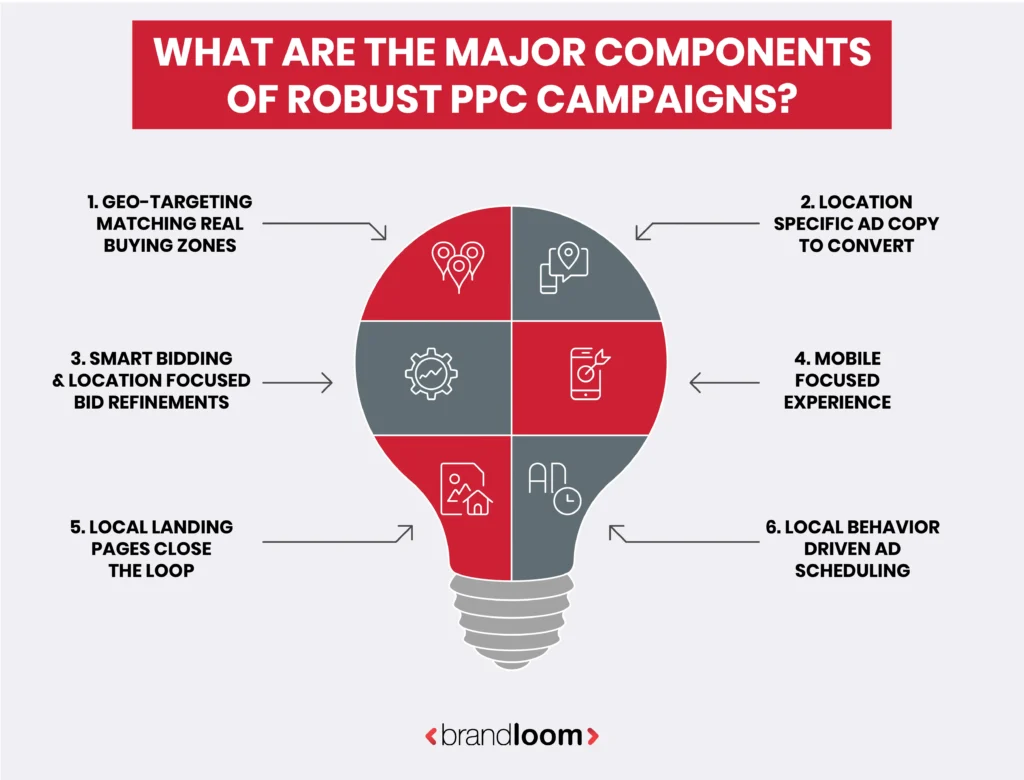
You may not face difficulties in running local PPC ads. However, managing campaigns that consistently drive foot traffic and conversions is a different ball game. It requires precision and expertise across multiple levers.
Listed below are the major components of hyper-targeted local PPC strategies:
Geo-Targeting That Matches Real Buying Zones
Think of this as the foundation of your brand’s local PPC advertising campaign. Rather than targeting entire cities, high-performing campaigns focus on:
- Neighborhood clusters
- Radius targeting (1–5 km around store locations)
- Specific ZIP codes or PIN codes
Google Ads lets advertisers target users based on physical location or location intent. This ensures your ads show only to local customers who are actually nearby. This helps improve ad spend efficiency.
Location-Specific Ad Copy That Converts
Generic ads don’t work in local search. So, your ad copy should reflect factors like:
- Immediate value (e.g., “Walk In Today”)
- The location (e.g., “Best Salon in Kurla”)
- Clear action (e.g., “5 mins away”)
Adding such location extensions helps improve credibility by showing your brand outlet address, distance from the buyer, and map directions. These help reduce friction and improve conversion rates, especially for mobile users.
Smart Bidding & Location-Based Bid Adjustments
When trying hyperlocal advertising, you will realize that not all areas perform equally. High-performing campaigns focus on:
- Reducing bids in low-performing zones
- Increasing bids in high-conversion locations
- Allocating budget based on real performance data
Google Ads supports bid adjustments by location, and so you can scale visibility where it matters the most.
Mobile-First Experience
Most of your target buyers use mobile devices, and so optimize your hyperlocal PPC campaigns for mobile devices. It should include:
- Simple navigation and directions
- Fast-loading landing pages
- Embedded click-to-call functionality
The latest data highlights that mobile users often take immediate actions like visiting or contacting businesses after doing an online search. A sluggish or broken experience will make them choose another option.
Local Landing Pages to Close the Loop
Only clicks do not assure conversion; the user experience has a role to play in that. Your landing pages should contain:
- location-specific information
- local keywords and references
- updated maps, directions, and contact info
- local offers or proof like reviews
The alignment between the ad, landing page, and location leads to the desired conversion rate.
Local Behavior-Based Ad Scheduling
Timing is important in local PPC strategies. So you must schedule ads based on local user behavior. You should:
- Show ads during peak store hours
- Avoid spending during low-conversion periods
- Increase bids during high-demand time slots
These ensure your local PPC advertising is visible when customers are most likely to interact with it.
What are the Top Platforms for Hyper-Targeted Local PPC?
Choose the right platform to ensure your local PPC ads consistently reach high-intent local audiences. Not every platform fares the same on location targeting precision or offers the same conversion potential.
Let’s have a detailed look at where hyper-targeted campaigns perform best:
Google Ads: The Core of Local PPC
If your aim is to capture active local search intent, Google Ads is a must. With it, you can:
- Show ads directly in local search results (including Maps)
- Target users based on specific geographic regions, radius, or pin codes
- Use location extensions to display address, distance, and directions
Google also enables store visit tracking. This helps businesses measure how ads translate into real-world foot traffic. For high-intent queries like “near me” or “open now,”, Google is your preferred platform for conversions.
Facebook & Instagram Ads: Local Demand Generation
Unlike Google, Meta platforms capture passive intent and convert it into demand. On platforms like Facebook and Instagram, you can:
- Run localized creatives meant for specific zones
- Cover users by metrics like location, interests, and behaviors
- Create custom audiences as per past engagement patterns
This goes well with Eateries, retail outlets, salons, and Fitness centers etc. These places are ideal for awareness and retargeting.
Microsoft Ads (Bing): Underrated but Useful
Microsoft Ads offers:
- Solid performance for older or desktop-heavy audiences
- Cost-effective clicks in certain geographic regions
- Lower competition compared to Google
For some sectors, this can lower overall ad spend without reducing visibility in local search.
Platform Strategy That Works
High-performing brands don’t use just one platform to increase foot traffic with PPC. They merge:
- Microsoft Ads to optimize cost efficiency
- Meta Ads to create and retarget local audiences
- Google Ads to capture demand (high-intent local search)
Such a multi-platform approach will help improve your brand’s conversion rates and reach.
To develop platform specific hyperlocal PPC ad campaigns, choose BrandLoom, an agency that has successfully assisted high-profile clients reach their growth targets, over the years.
Local Search Trends to Watch
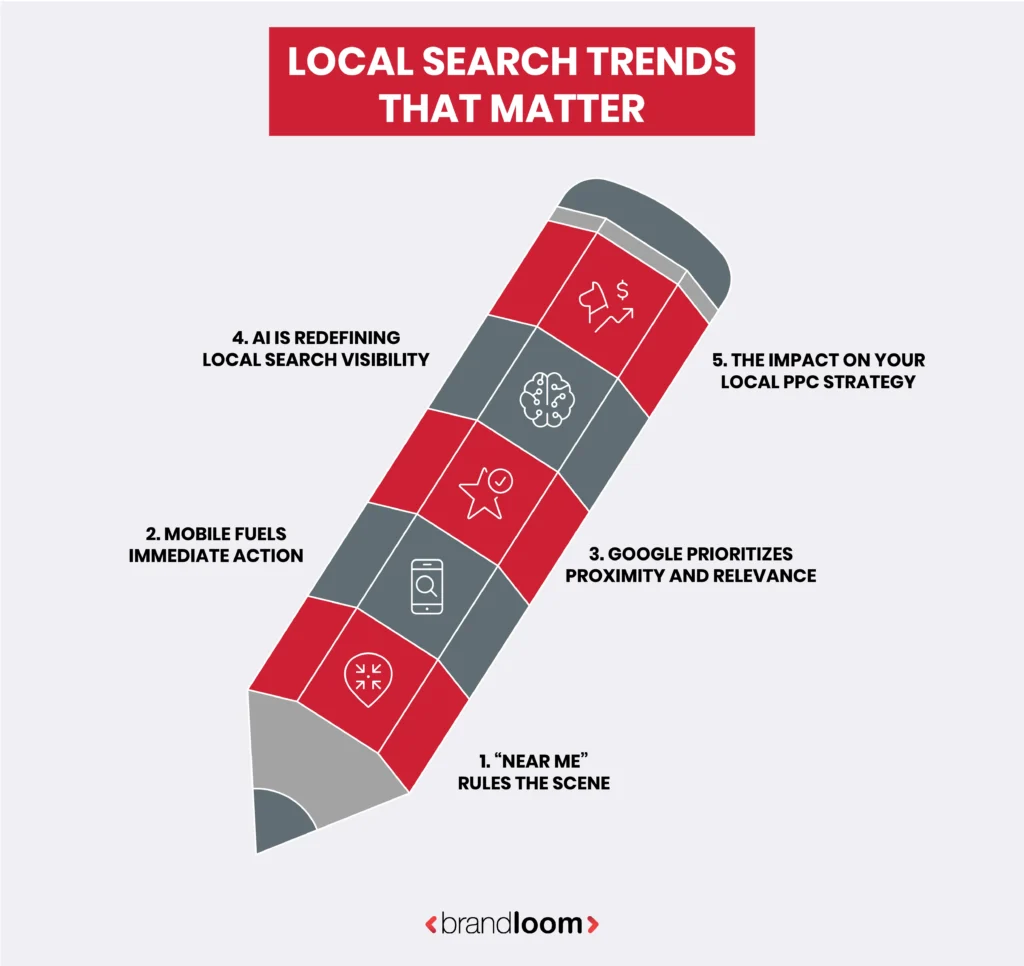
Local PPC performance is not only about setup but it is affected deeply by the evolution of local search behavior. If your hyperlocal PPC campaigns don’t align with these shifts, your ad spend will increase and conversion rates will nosedive.
“Near Me” Is Now Default
Your target users won’t type full queries like “best unisex salon in Kolkata.” Instead, they will search for “salon near me,” “best café nearby,” etc. This shift means Google prioritizes proximity, relevance, and user intent in search results.
Advertisers must focus on nuances such as local keywords, location targeting, and accurate business information.
Mobile Drives Immediate Action
A large part of your target users now uses mobile devices. Approx 76% of users doing local search on their mobiles visit a business within 24 hours, according to available data. They can either visit or call the service provider.
This means your local PPC ads must load quickly, match real-time user intent and direct to instant actions.
Google Is Prioritizing Proximity and Relevance
Google’s local algorithm increasingly prefers:
- High-quality engagement and reviews
- Listings with strong relevance signals
- Businesses near the searcher
This has a direct effect on the performance of your local PPC strategies.
AI Is Reshaping Local Search Visibility
AI-based features like automated recommendations, local packs, and smart bidding are transforming the way users locate local businesses. Google Ads now uses machine learning to:
- Predict conversion scope
- Optimize bids in real time
- Improve targeting across geographic areas
So, your hyperlocal PPC campaigns should be data-backed, structured for automation, and continuously optimized.
The Effect on Your Local PPC Strategy
To stay competitive, your local PPC campaigns must be:
- Optimized for mobile users
- Focused on high-intent micro-locations
- Aligned with real-time local intent
Local search is not only about visibility any longer. It’s about immediacy.
Not sure how to choose the right local advertising strategy? Learn how Local Service Ads and Google Ads differ and which works best for your business with expert insights from BrandLoom.
Setting Up Hyper-Targeted Local PPC Campaigns- Step-by-Step
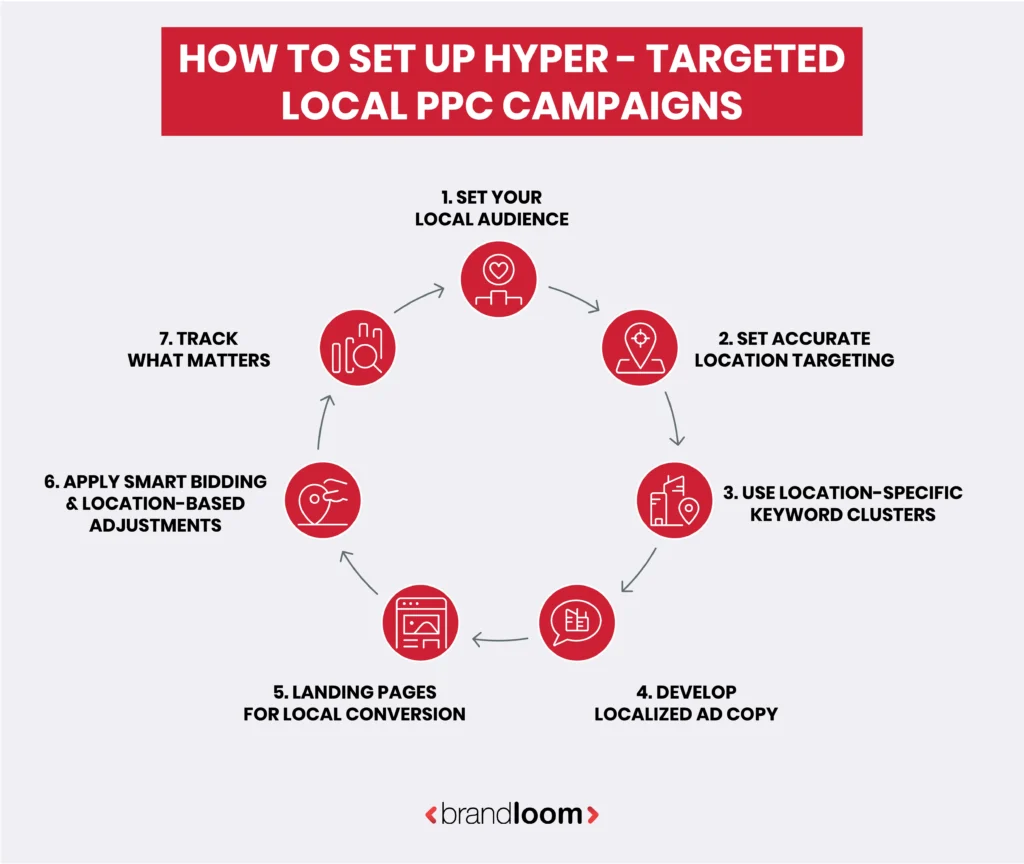
Where do you think several local PPC strategies fail? It is in the execution phase. The reason is not using complex toolsets. The root cause is campaigns that do not align with local intent, geographic precision, and conversion flow.
We’ll look at a step-by-step process of planning and implementing hyper-targeted local PPC campaigns:
Define Your Local Audience
First, know your local audience. You must have clarity on the following:
- Geographic areas (city → neighborhood → micro-location)
- Search intent (urgent vs research-driven)
- Customer behavior (working professionals, students, retired lot)
The key is to avoid broad targeting and choosing local audiences who are within reach of your business.
Set Precise Location Targeting
Use Google Ads to:
- Apply radius targeting (1–5 km around store/outlet)
- Target specific pin codes or ZIP codes
- Exclude irrelevant or low-performing areas
Make sure you target people physically in your area and avoid “interest-based” targeting unless it is necessary. Then your local PPC ads reach users who are more likely to convert.
Develop Location-Based Keyword Clusters
Your keyword strategy should have a blend of:
- High-intent terms (e.g., “open now,” “book today”)
- Core service keywords (e.g., “dentist,” “gym”)
- Location modifiers (e.g., “near me,” “in Navi Mumbai”)
This helps improve search relevance and reduce wasted clicks.
Create Localized Ad Copy
Your ads should:
- Include strong CTAs (“Visit Today,” “Call Now”)
- Mention location-specific cues
- Mention the proximity (“2 mins away”)
Use location and call extensions to improve visibility and conversion rates directly from search results.
Optimize Landing Pages for Local Conversion
Optimize your landing pages for local conversion. They should:
- Render fast on mobile devices
- Match the location + keyword intent
- Include accurate maps, directions, and contact info
- Clearly show the product or service
Consistency across ads, landing pages, and locations is a must.
Apply Smart Bidding & Location-Based Adjustments
Begin with Maximize Conversions or Target CPA. Then refine bidding by:
- Lowering spend in low-conversion areas
- Increasing bids in high-performing geographic areas
This helps reduce ad spend while improving efficiency.
Track What Actually Matters
To track things that matter, you should set up:
- Store visit conversions (if applicable)
- Call tracking
- Direction clicks
Without tracking, you won’t be able to optimize local PPC campaigns effectively.
How to Measure and Optimize Local PPC Campaigns?
Running local PPC advertising campaigns is important, but it is equally important to analyze, interpret, and optimize the campaigns. That is what brings real success.
Track the Right Conversion Actions
In local PPC, success is not limited to clicks. The focus must be on real-world actions. So, track the following:
- Direction clicks (map interactions)
- Store visits (if eligible in Google Ads)
- Phone calls (click-to-call)
- Form submissions or bookings
These signals directly reflect local buyer intent and foot traffic.
Use Data to Refine Location Targeting
Not all geographic areas perform equally well. You can analyze performance by using:
- Location (pin code / radius zones)
- Device (mobile vs desktop)
- Time of the day
Based on the analysis, increase bids in high-performing zones and reduce spend in low-performing areas.
Optimize Keywords and Search Terms
Review your search terms report regularly.
- Identify new high-intent local keywords
- Add negative keywords to filter irrelevant traffic
- Refine targeting according to actual user queries
This way, your ads remain aligned with relevant keywords and local intent.
Continuously Improve Ad Copy and Landing Pages
Use A/B testing to optimize:
- Location-specific messaging
- Headlines and CTAs
- Offers and urgency triggers
You can also try variations of your landing pages, mobile usability etc. Small changes can make a visible difference in conversion rates.
Use Analytics and Local Insights
You have to use:
- Google Analytics to analyze user behavior
- Google Business Profile insights for local engagement
- Google Ads reports to understand campaign performance
These specialized tools help you understand the efficacy of your hyper local advertising campaigns. You can also figure out what drives actual conversions and where drop-offs happen.
Remember that local PPC strategies are not static. To get the desired outcome, you must continuously analyze the data, make necessary tweaks, and align the campaign with evolving local search behavior.
Let BrandLoom’s digital marketing experts and SEO analysts support you in crafting and implementing a suitable hyperlocal PPC ad strategy for your brand.
Hyperlocal PPC works even better when paired with strong local SEO. Check out this comprehensive local SEO audit checklist by BrandLoom to ensure your business is fully optimized for local discovery.
Utilizing Competitor Insights for Local PPC Success
The reality is, in local PPC, you’re not competing globally. You are locking horns with a handful of local businesses targeting the same geographic areas and local buyers. That makes competitor insight very useful.
Here’s how you can leverage competitor analysis and taste success in local digital advertising:
Identify Entities Leading Local Search
Search your core keywords + location and observe brands appearing in paid search results consistently. Check their ad messaging and offers, and usage of location extensions and CTAs. This offers you actionable insights of local competition.
Analyze Their Strategy Deeply
Use tools like SEMrush and Spyfu to understand estimated ad spend, competitor keywords, and Ad copy variations. Then you can refine your:
- Relevant keywords
- Ad copy positioning
- Bidding strategy
Win on Relevance, Not Budget
Remember that you can’t win based on higher bids alone. To outshine local competitors, you need:
- Better-aligned landing pages
- More precise location targeting
- Stronger location-specific messaging
In local PPC, the brand spending more does not get the edge over the one matching user intent better.
Curious how to plan and execute competitor analysis for success in hyper local advertising? Let BrandLoom’s SEO experts and strategists assist you.
Conclusion
Local PPC is no longer about visibility, it is more about precision, intent, and timing. Consumers looking online for a product or service in their area are not browsing casually. They have buying intent. To woo those customers, your local PPC ads must align well with:
- Relevant keywords
- Location targeting
- Seamless landing page experience
Hyper-targeted campaigns let you focus your ad spend on high-intent local audiences. This, in turn, helps improve conversion rates, and lead digital interactions into real store visits. With local search evolving with AI and mobile-centric browsing, businesses relying on generic campaigns will lag behind.
So, you must build location-specific, intent-driven local PPC strategies, continuously optimize, and position your brand correctly. That’s how hyperlocal PPC campaigns drive real growth.
For planning and executing effective hyperlocal PPC strategies choose BrandLoom, an agency with proven expertise in digital marketing realms. Let our marketing experts and SEO analysts assist in your brand growth.
See how hyperlocal strategies drive measurable growth. Read how a US fashion retailer boosted visibility and traffic using targeted local SEO and digital strategies with BrandLoom.
FAQs
Local PPC (Pay-Per-Click) is a digital advertising strategy in which businesses run ads targeting users in specific geographic areas. The aim is to attract local customers and convert them. In it, brands bid on relevant keywords in platforms like Google Ads. So, they appear on search results when people seek a nearby product or service. Local PPC ads use location targeting, location extensions, and call buttons. These lead to immediate actions like calls, direction requests, or store visits. The target is to tweak ad spend on high-intent users, improve conversion rates, and generate actual foot traffic.
Hyperlocal PPC advertising is a specific type of local PPC strategy that targets users within precise, location-specific areas, like neighborhoods, streets, or small-radius areas. There is no broad city-based targeting. It focuses on micro-locations with higher conversion scope. Brands use location targeting, specific ZIP codes, and bid refinements to reach and attract nearby buyers actively searching. With refined ad copy and location-based landing pages, hyper-localization helps you improve conversion rates and lower ad spend. It reaches physically close users who are ready to act.
Hyperlocal targeting differs from regular PPC campaigns since it focuses on precision over reach. In regular PPC campaigns, the focus is mostly on cities or states. In local PPC advertising, specific geographic areas like neighborhoods, pin codes, or a small radius around a business are in focus. This lets advertisers align ads with real-time local buyer intent. Hyperlocal campaigns use location-based ad copy, precise location targeting, and refined bid adjustments. The conversion rates rise, ad spend waste goes down, and search result relevance improves.
Hyperlocal PPC campaigns work well when geographical closeness strongly affects buying decisions. Examples include: real estate, restaurants, salons, clinics, gyms, retail stores, etc. These businesses rely mostly on local customers searching for nearby options. Hyper-targeted campaigns help them appear in the right search results. They use location-specific keywords and precise ad targeting to improve calls, visits, and bookings. Even service-based businesses like plumbers or electricians gain by using targeting specific ZIP codes and high-demand regions. Proximity helps hyperlocal PPC strategies work well, driving revenues.
Radius targeting in Google Ads lets you to use local PPC ads within a defined distance from your business location. You can find it from campaign settings → locations → advanced search in the application. Then you have to enter the address and select a distance. You can also specify exclusions to avoid low-performing geographic areas. Use radius targeting with location-specific keywords, ad copy, andbid adjustments for better efficiency. This way, your ad spend covers nearby users, increasing local search relevance and conversion rates.
You should use a mix of platform-native and third-party tools to manage hyperlocal PPC campaigns. Use Google Ads for location targeting, bid adjustments, and performance tracking. Then use it with Google Business Profile insights and Google Analytics to assess user behavior and local engagement. Also, choose tools like SEMrush and SpyFu to better analyze competitors keywords and regional search results. Platforms like Optmyzr or WordStream help you manage ad spend, automate tasks, and improve conversion rates. Together, these tools help you take data-driven decisions for effectivelocal PPC management.
Yes, hyperlocal PPC can visibly improve in-store visits. It targets high-intent users within close geographic areas actively searching for a product or service. When you use location targeting, “near me” keywords, and location extensions, the ads appear right when target users are ready to act. Features like click-to-call and directions helps lower friction. It makes things easy for local buyers. As campaigns target high-intent audiences, they improve conversion rates ad ensure your ad spend is directed toward potential users.
To track conversions from hyperlocal ads you should focus on both online and offline actions. Google Ads lets you track calls, form submissions, and direction clicks directly from your ads and landing pages. For physical visits, enable store visit conversions. Using Google Analytics helps you analyze user behavior post-click. Google Business Profile insights reveal user interactions like calls and navigation requests. Together, these metrics help see how the local PPC strategies are affecting conversion rates and store visits.
Mobile optimization is vital in hyperlocal PPC as most local search occur on smartphones. These users often take immediate actions. When users search for a nearby product or service, they expect easy directions, fast-loading landing pages, and click-to-call options. If their experience is slow or not mobile-friendly, brands lose high-intent local customers. Optimized mobile experience enhance conversion rates, reduce bounce rates. It makes your local PPC ads more effective.
You must review and adjust Hyperlocal targeting regularly. The frequency will depend on performance data. Analyze your campaigns weekly to understand trends across geographic areas, search results, and conversion rates. Increase bids in high-performing locations and reduce or exclude low-conversion zones for ad spend optimization. Seasonal demand, local events, and competitor activity also affects campaign performance. Keep on refining location targeting, keywords, and ad copy to align your local PPC strategy with real-time user behavior and get desired results consistently.