Picture this: your business runs a well-funded paid campaign, traffic flows to your website, and visitors leave within seconds. No inquiries. No conversions. No follow-up. The campaign performed. The website did not. This scenario is the same across thousands of businesses every month, and the root cause is almost always the same: poor web design.
Your website works around the clock – unlike any ad or social post. Every visitor forms an opinion about your brand the moment they land, shaped almost entirely by design. Slow load times, outdated visuals, or hard-to-find information lose credibility before a word is read.
At BrandLoom, we’ve seen what gets web design right – and this guide distills exactly that.
What Is Web Designing in 2026?
A decade ago, web design meant colors, images, and static pages. In 2026, it means architecting a digital experience that performs on every device, ranks in AI-powered search, and converts visitors into customers.
Web design is no longer a one-time project. It is a living discipline that integrates UX, mobile-first layouts, SEO, and conversion psychology into a single growth system.
It is also inseparable from marketing. A well-designed website amplifies every channel – organic, paid, social, and email. A poorly designed one undermines all of them.
Types of Web Designing
Every business website has a different job to do – and the design approach should match that job precisely. Here are the core types of web design your brand should know:
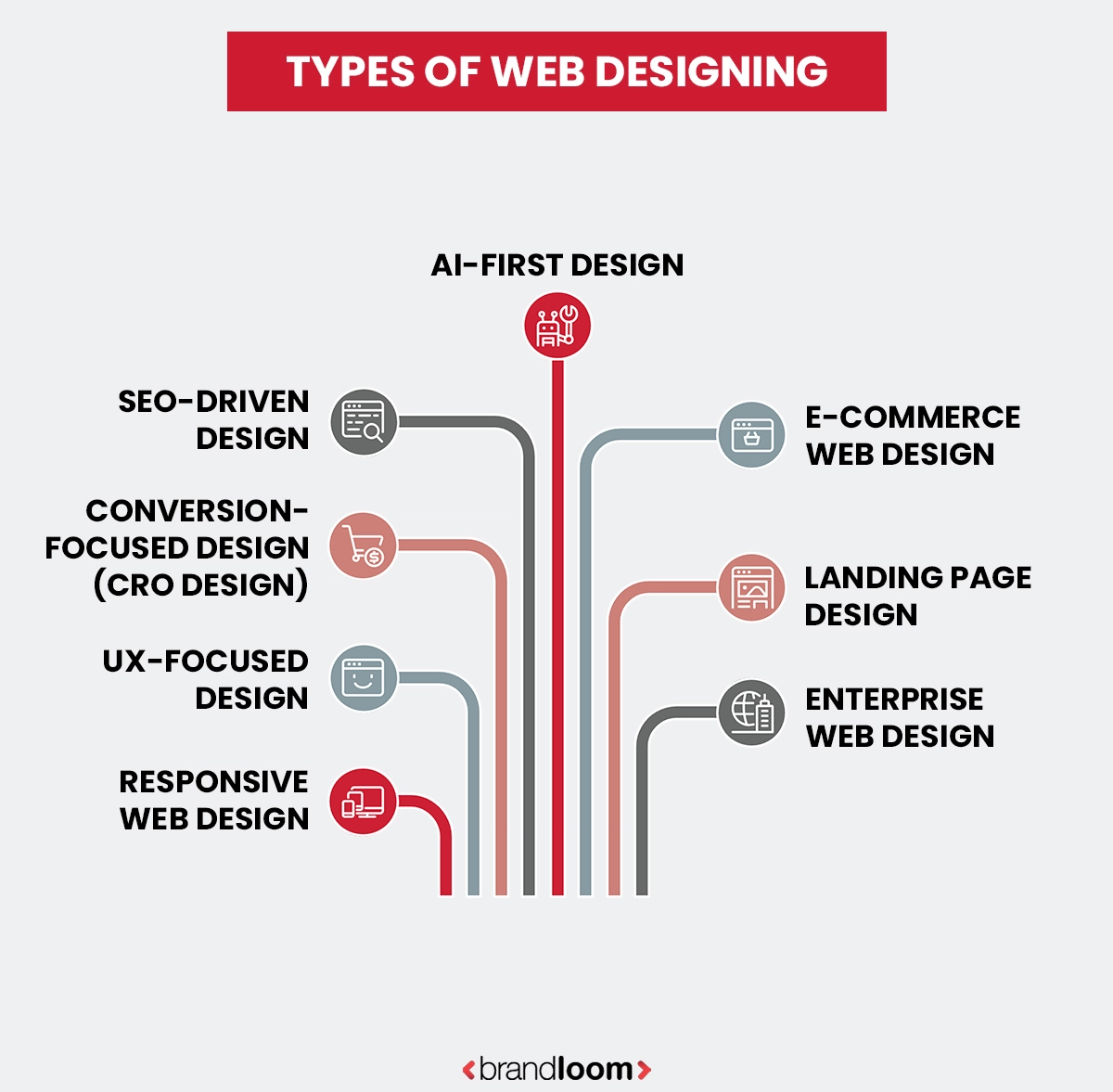
Responsive Web Design:
Layouts that automatically adapt to any screen size – desktop, tablet, or mobile – ensuring a consistent user experience across devices.
UX-Focused Design:
A design approach centered on the user journey, making navigation intuitive, reducing friction, and guiding visitors toward desired actions.
Conversion-Focused Design (CRO Design):
Builds pages specifically to drive actions – purchases, inquiries, sign-ups – using psychological triggers, clear calls to action (CTAs), and strategic layout.
SEO-Driven Design:
Integrates technical and structural design choices – clean code, semantic markup, fast loading times, and crawlable architecture – to maximize organic search visibility.
AI-First Design:
Structures content semantically so that AI-powered search engines and AI overview systems can interpret, index, and surface your content accurately.
E-Commerce Web Design:
E-commerce is all about specializing in design for product listing pages, checkout flows, and shopping experiences that reduce drop-off and increase purchase completion.
Landing Page Design:
High-intent, single-purpose pages built for specific campaigns, with minimal distractions and maximum conversion focus.
Enterprise Web Design:
Scalable, modular design systems built for large organizations managing multiple products, regions, or audiences from a single platform.
Top Web Design Trends in 2026
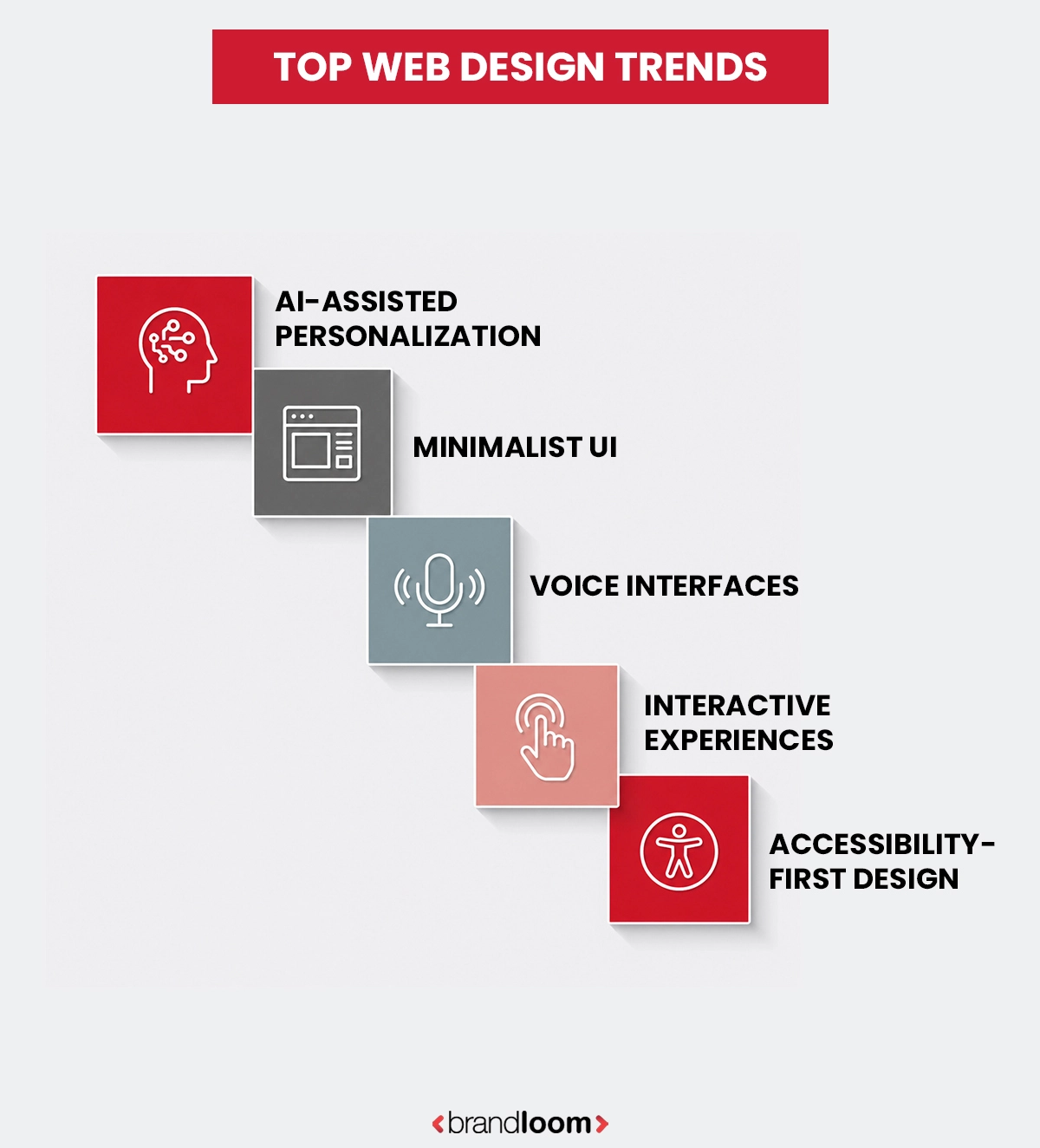
The best websites in 2026 are not just visually impressive. They are intelligent, inclusive, and built around how people actually browse today.
1. Adopt a Mobile-First Design Approach
Websites now adapt in real time to individual user behavior, showing different content and layouts based on who is visiting. Brands using AI personalization report higher engagement and better conversion rates.
2. Minimalist UI
Clean layouts, generous white space, and focused navigation consistently outperform cluttered designs. Minimalism in 2026 is as much a performance decision as it is an aesthetic one.
3. Voice Interfaces
As voice search becomes embedded in daily browsing, websites need to accommodate voice-based navigation and content discovery. This means structuring content conversationally and ensuring pages answer questions directly.
4. Interactive Experiences
Scroll-triggered animations and micro-interactions keep users engaged longer and make complex information easier to absorb. When used with restraint, interactivity makes a browsing experience genuinely memorable.
5. Accessibility-First Design
Designing for accessibility from the start produces better experiences for every user, not just those with impairments. In 2026, it is also increasingly a legal and SEO requirement across major markets.
How Web Design Shapes Every Dimension of Your Brand’s Online Growth
Your website is your highest-stakes marketing asset. Every campaign, every rupee of ad spend, and every piece of content eventually leads back to it, making design a financial decision, not a creative one.
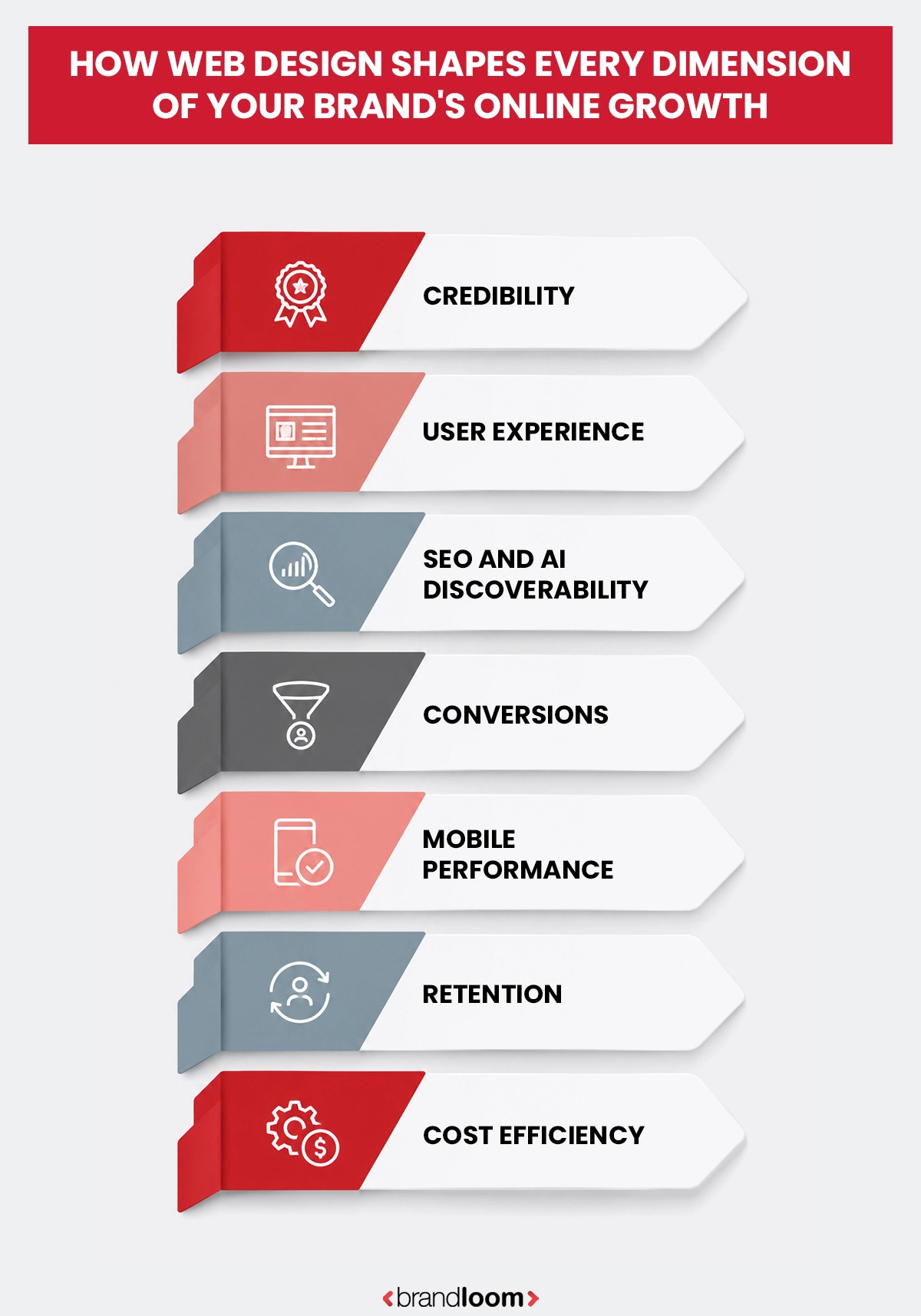
- Credibility: Visitors judge professionalism before reading a word. Clean, consistent design builds instant trust.
- User experience: Effortless navigation keeps visitors engaged longer and signals quality to search algorithms.
- SEO and AI discoverability: Core Web Vitals are a design report card. Search engines now use AI to evaluate structure and experience, so weak design costs both rankings and visibility in AI-powered, zero-click search results.
- Conversions: A site converting at 3% instead of 1% triples revenue from the same traffic.
- Mobile performance: Most visitors arrive on phones. A frustrating mobile experience loses audience and rankings alike.
- Retention: Speed and familiarity build quiet trust, bringing customers back.
- Cost efficiency: Every channel funnels traffic to your website. Better design lowers acquisition costs across the board.
7 Proven Web Design Strategies That Turn Your Website Into a Revenue Engine
Great web design does not announce itself – it simply works. Every click that flows naturally, every page that loads instantly, and every visitor who converts is a result of deliberate design decisions made long before they arrived. These eight strategies ensure those decisions are the right ones.
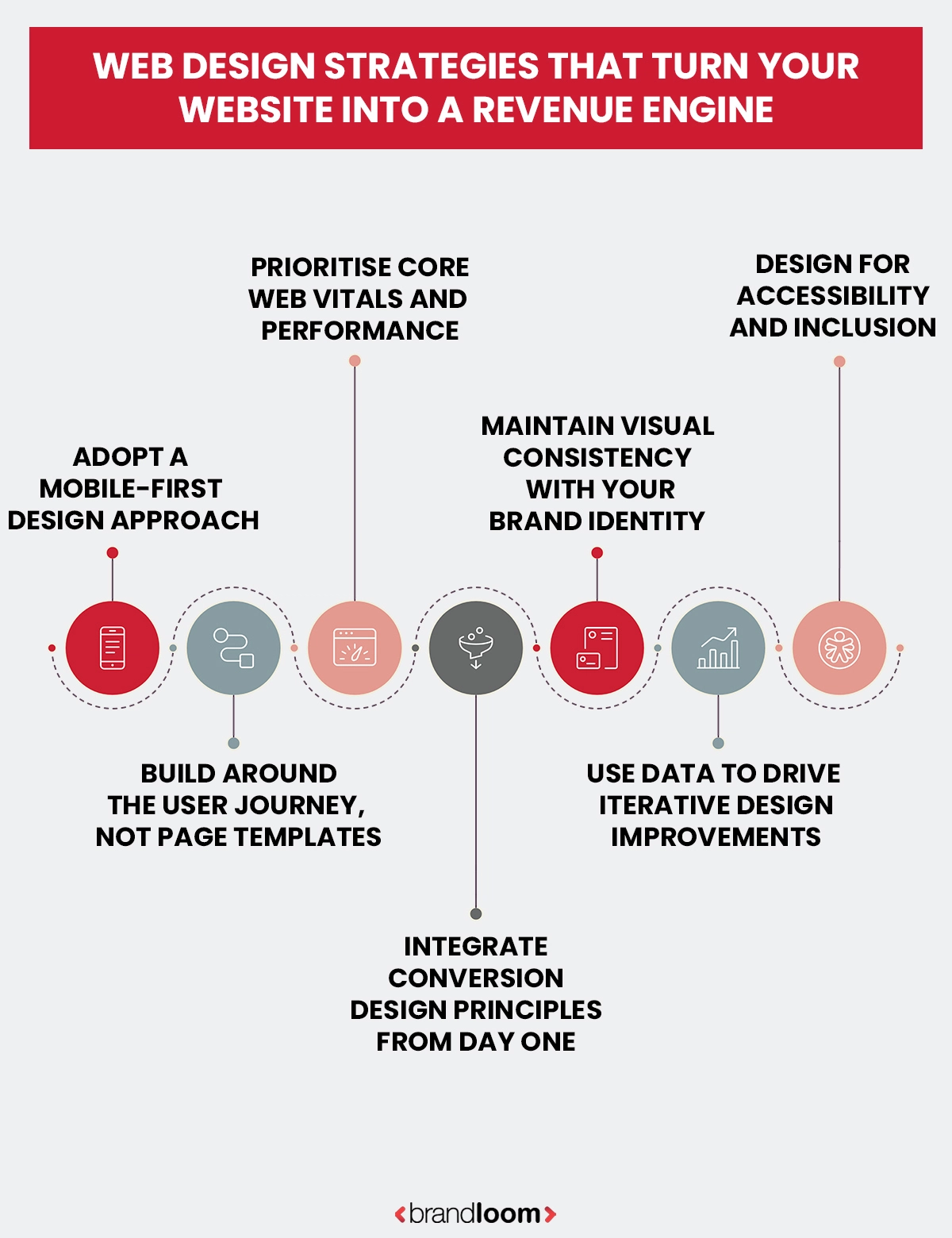
1. Adopt a Mobile-First Design Approach
Start every design decision at the smallest screen, then scale up. Prioritize thumb-friendly navigation, readable typography, and fast load times. If it works on mobile, it works everywhere.
2. Build Around the User Journey, Not Page Templates
Map your audience’s path from discovery to decision before designing a single page. What questions do they have at each stage? What friction stops them from acting? Every page should answer those questions – not just look good.
3. Prioritize Core Web Vitals and Performance
Google’s Core Web Vitals – LCP, CLS, and INP – measure real user experience and directly influence search rankings. Optimize image sizes, reduce server response times, and eliminate render-blocking scripts. Performance is a design discipline, not just a development one.
4. Integrate Conversion Design from Day One
Start with one question: what do you want visitors to do on this page? Every decision – where the eye goes, how long the form is, what the button says – should point toward that action. Keep forms short, place testimonials near decision points, and test regularly.
BrandLoom, India’s leading web design and digital strategy agency, can audit your current website and rebuild your conversion architecture to improve inquiry and lead generation rates.
5. Maintain Visual Consistency with Your Brand Identity
Typography, color, iconography, and spacing should all align with your broader brand identity. Inconsistency erodes trust. Build a design system and keep it updated.
6. Use Data to Drive Iterative Improvements
Web design is not a one-time event. Use heatmaps, session recordings, and A/B testing to understand how visitors actually behave. Identify high-exit pages and conversion bottlenecks. Improve continuously.
7. Design for Accessibility and Inclusion
Descriptive alt text, sufficient color contrast, and clean markup help every user – including those with visual or motor impairments. Accessible design also strengthens search rankings. It is the right thing to do, and it makes strong business sense.
Designing for AI Search & Zero-Click Discovery
AI-powered search now answers questions directly, often without a single click to your website. Winning that visibility starts with AI-first design: clear headings, concise definitions, and content structured for machines to parse, not just humans to read.
Semantic HTML gives search engines and AI crawlers a reliable map of your content hierarchy. Schema markup adds explicit context, telling AI systems exactly what your page offers, from products to FAQs to reviews.
Together, these elements determine whether your brand appears in AI Overviews. BrandLoom, India’s leading web design agency, can structure your site to earn this visibility.
Why Website Security Is Part of Modern Web Design
Security is no longer a backend concern. In 2026, it is a visible, front-facing design decision that directly affects how users perceive and interact with your website.
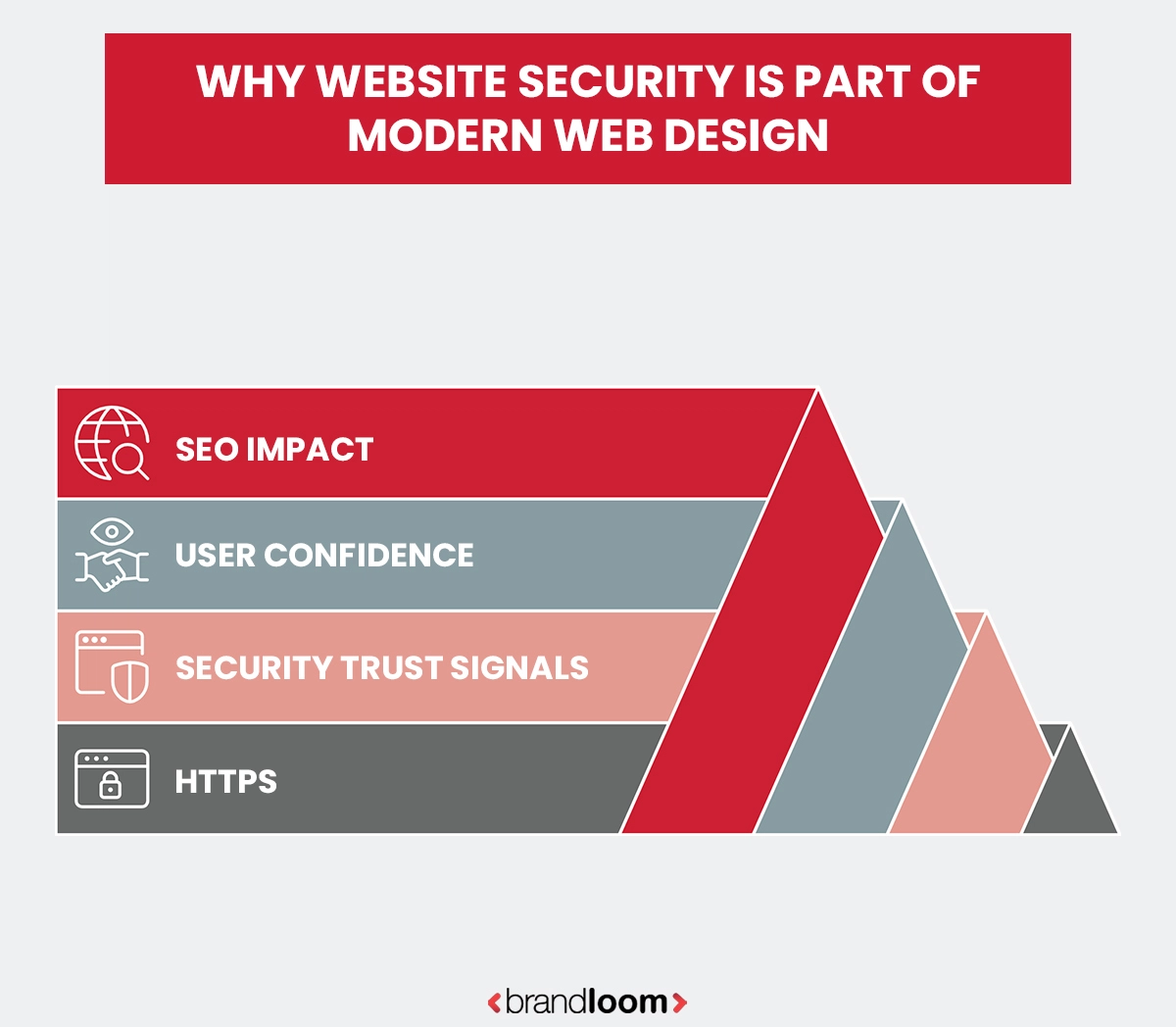
1. HTTPS
HTTPS encrypts data exchanged between your site and its visitors, protecting sensitive information like passwords and payment details. Any site still running on HTTP is flagged as “Not Secure” by modern browsers, which is often enough to make a visitor leave immediately.
2. Security Trust Signals
SSL certificates, secure payment badges, and verified review widgets are visual cues that tell visitors your site is safe. Placing these signals near high-stakes actions like checkout buttons or contact forms directly reduces hesitation and abandonment.
3. User Confidence
Visitors make trust decisions in seconds. A site that looks secure, loads over HTTPS, and displays recognizable trust badges creates the psychological safety users need to share their details or complete a purchase.
4. SEO Impact
Google has used HTTPS as a ranking signal since 2014 and continues to reward secure sites in search results. Beyond rankings, a secure site reduces bounce rates driven by browser security warnings, which further strengthens your overall search performance.
Web Designing vs Web Development
Understanding the differences and comparisons between web design and web development helps you ask better questions, brief agencies more effectively, and allocate budget appropriately.
| Dimension | Web Designing | Web Development |
| Primary Focus | Visual layout, UX flow, brand identity, information architecture | Functionality, database integration, backend systems, security |
| Key Outputs | Wireframes, prototypes, design systems, responsive layouts | Working code, APIs, CMS integrations, performance infrastructure |
| Tools Used | Figma, Adobe XD, Sketch, prototyping tools | HTML, CSS, JavaScript, PHP, Python, React, Next.js |
| Success Metric | User engagement, conversion rate, brand consistency | Uptime, load speed, security, technical performance |
| User Impact | Determines how users perceive and interact with the site | Determines whether the site functions as intended |
| Overlap Area | Front-end design decisions affect development complexity | Development constraints shape design possibilities |
Challenges in Web Designing in 2026 and How to Navigate Them
Every web design project runs into obstacles that can delay timelines or dilute quality. Knowing them early helps you solve them before they get costly.
- Challenge 1: Balancing visual quality with load speed.
Solution: Use modern image formats, load heavy content only on scroll, and check page weight before launch. - Challenge 2: Designing for multiple devices and screen sizes.
Solution: Design for the smallest screen first, then scale up. Test on real devices, not just browser previews. - Challenge 3: Building for flexibility and future updates.
Solution: Build modular pages and sections, so updates do not force a full redesign. - Challenge 4: Managing timelines and stakeholder expectations.
Solution: Break the project into clear phases and share progress at each stage.
How Do You Know If Your Web Design Is Actually Working? Track These KPIs
Measuring web design impact requires tracking metrics across five categories. Each one tells a different part of the story, and together they show how your website is really performing for your business.
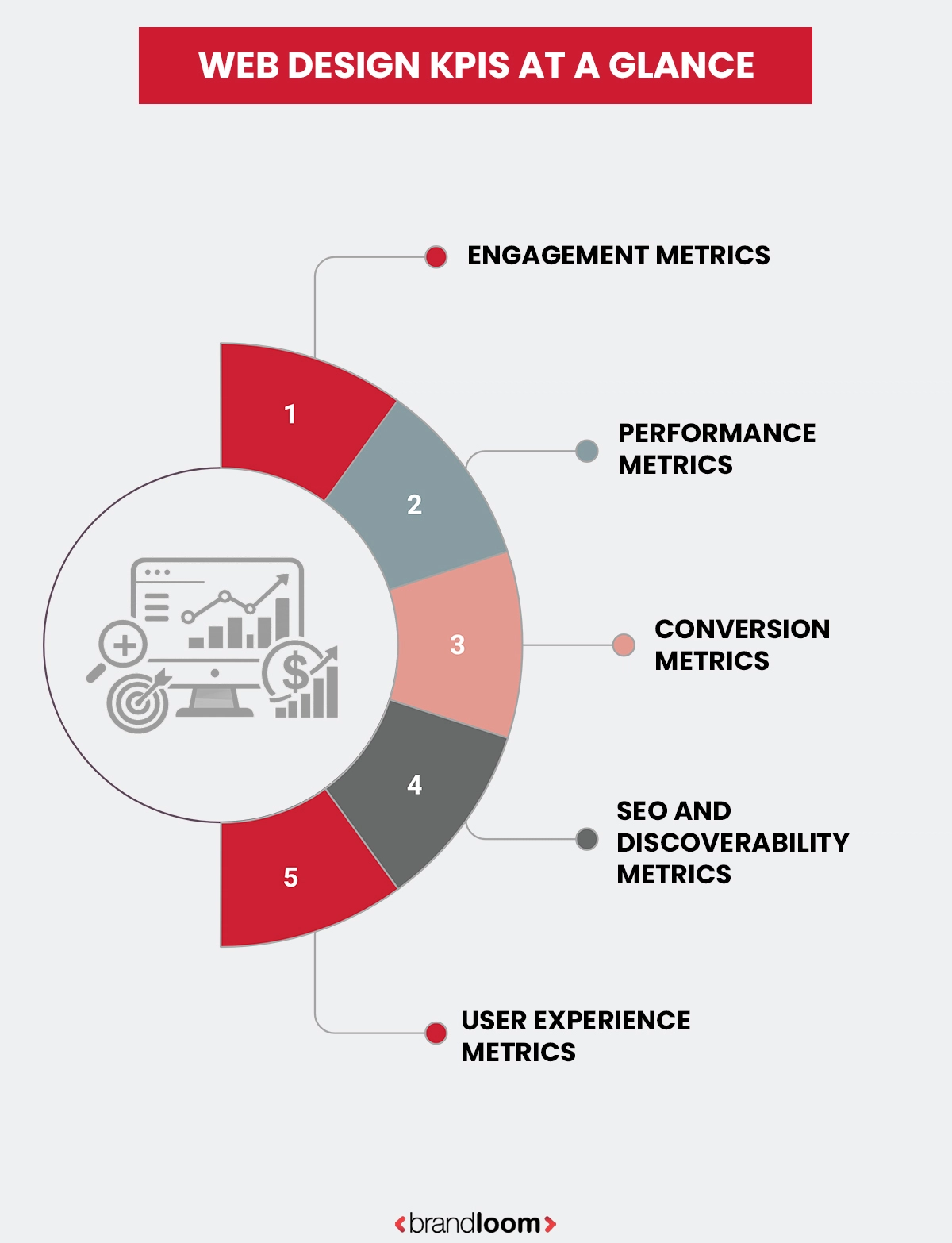
Engagement Metrics
Engagement reveals how visitors respond the moment they arrive, and whether your design holds attention through the journey.
- Average session duration
- Pages per session
- Scroll depth on key pages
- Return visitor rate
Performance Metrics
A slow or unstable site undermines engagement, conversions, and rankings all at once.
- Page load time (target: under 2.5 seconds for LCP — largest contentful paint)
- Core Web Vitals scores (LCP, CLS, INP)
- Mobile vs desktop experience parity
- Time to first byte (TTFB)
Conversion Metrics
These connect your design investment directly to commercial outcomes.
- Overall website conversion rate
- Landing page conversion rate
- Form completion rate
- CTA click-through rate (CTR)
- Cost per lead from organic traffic
SEO and Discoverability Metrics
Your design shapes how search engines crawl, interpret, and rank your content.
- Organic search traffic volume
- Keyword ranking positions
- Featured snippet and AI overview appearances
- Crawl error rate and index coverage
User Experience Metrics
Numbers show what is happening. UX metrics show why, pointing to where visitors lose interest or leave.
- Bounce rate by page
- Heatmap click and scroll patterns
- Session recording drop-off points
- Accessibility audit score (WCAG compliance level)
Web Designing in 2026 at a Glance
| Factor | Importance |
| Mobile First | Very High |
| Core Web Vitals | Very High |
| UX Design | Very High |
| SEO Structure | Very High |
| AI Discoverability | High |
| Accessibility | High |
10 Signs Your Website Needs a Redesign
If any of these sound familiar, your website may be costing you more than you realize.
- High bounce rate: Visitors leave almost immediately, signaling that your page fails to meet their expectations or load fast enough.
- Poor mobile experience: layouts break, text is too small, and buttons are hard to tap on a phone.
- Slow load speed: Pages take more than three seconds to load, costing you both visitors and search rankings.
- Low conversions: Traffic arrives but does not convert, pointing to friction in your design, copy, or user journey.
- Outdated design: Your site looks like it was built five years ago, which quietly erodes trust before a word is read.
- Hard to navigate: Visitors cannot find what they need quickly, leading to frustration and early exits.
- Poor search rankings: Your site is buried in search results because it lacks SEO-friendly structure, speed, or mobile optimization.
- No clear calls to action: Visitors do not know what to do next because your pages lack direction or visible next steps.
- Brand inconsistency: Your website no longer reflects your current brand identity, messaging, or visual standards.
- Difficult to update: Your team avoids making changes because the backend is rigid, outdated, or requires developer support for every edit.
The BrandLoom Framework for Web Designing
BrandLoom follows a structured, five-stage framework that makes your website visually strong, commercially sound, and technically solid from day one.
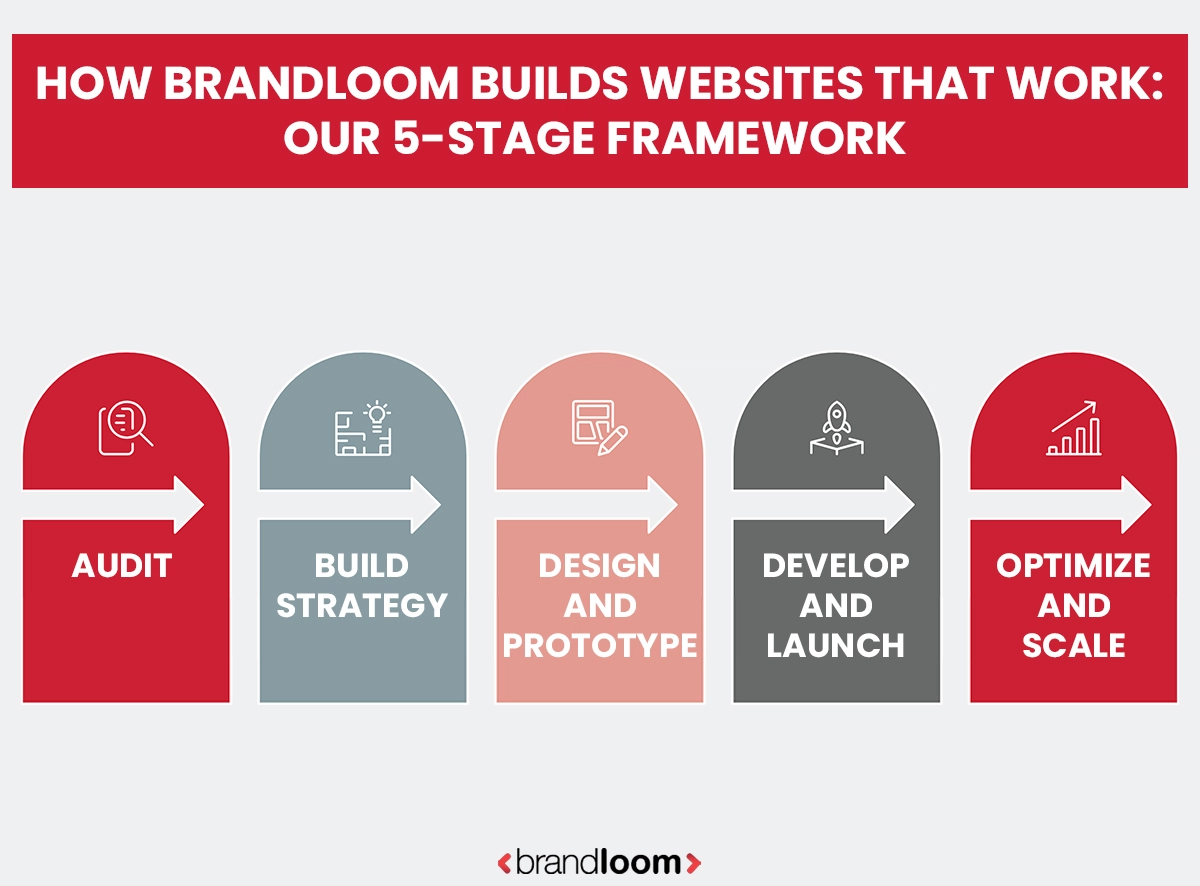
Stage 1: Audit
We start with a full audit of your existing site (or competitor sites, if you are starting fresh), covering technical performance, UX flow, conversion architecture, SEO health, mobile experience, and brand consistency. This produces a prioritized list of issues and opportunities.
Stage 2: Build Strategy
We define your audience, primary conversion goals, journey-stage content needs, and target keywords. This strategy document briefs every design and development decision that follows.
Stage 3: Design and Prototype
Our designers create responsive, mobile-first layouts that translate your brand identity into a digital experience. We build interactive prototypes so you can refine UX before development begins.
Stage 4: Develop and Launch
Our developers build to spec, prioritizing Core Web Vitals, semantic HTML, schema markup, and security. We test across devices, browsers, and accessibility standards before launch.
Stage 5: Optimize and Scale
We track performance through analytics and heatmaps, run A/B tests, and scale your architecture as your business grows.
BrandLoom in Action: A3 Logics
A3 Logics came to BrandLoom with two decades of IT experience and a strong vision – but a website that told neither story. Their digital presence did not reflect who they were or where they were headed.
We started by identifying their brand archetype: the Hero. From there, everything followed – a color palette with purpose, a visual style that balanced technology with a human touch, and copy that finally gave their work the clarity it deserved. The result was a website that positioned A3 Logics as a distinct, people-first IT company with an identity strong enough to anchor all future communication.
Conclusion
Your website is often the clearest signal of where your business stands. If traffic is coming in but conversions are weak, or your site feels dated, or you are simply not showing up in search anymore, the design is usually where the problem begins.
Web design in 2026 touches everything: how fast your pages load, how your content is organized, and how it feels on a phone. None of it is a one-time fix. The brands that keep investing in their websites – even in small, steady ways – are the ones that pull ahead over time.
Your website is not a cost. It is something that compounds. Every improvement you make today pays back for months ahead.
If your website is not working the way your business deserves, BrandLoom can help you find out why and fix it. Start with an audit.
Frequently Asked Questions
Web designing in 2026 means building websites that work for both people and AI-powered search systems. Experience signals, content clarity, and page structure all influence how your site ranks and converts. BrandLoom builds AI-ready websites that earn visibility and turn traffic into results.
Traditional web design was about how pages looked on a desktop. Modern web designing covers every device, every user journey, and every search format. The shift is simple: from making websites attractive to making them work. Design is now a continuous process, not a one-time project.
Every marketing channel you run sends traffic to your website. If that site does not engage visitors or guide them toward action, your entire marketing spend underperforms. Strong web design builds credibility, improves search rankings, and drives leads and conversions directly.
A high-performing website is fast, works on every device, easy to navigate, and consistent with your brand. Each element supports the others. Weaken one, and the whole experience suffers. BrandLoom builds websites where every piece works together as one connected system, not a checklist.
Page speed, mobile usability, site structure, and content organization all feed directly into search rankings. These are design decisions, not development afterthoughts. BrandLoom designs with both people and search systems in mind, so your website earns visibility across every format search takes today.
Web design shapes how your site looks. UX design ensures visitors find what they need without frustration. Web development brings both to life in code. When all three work well together, visitors barely notice any of it. They simply find what they came for and act.
Most of your visitors are on their phones. A site that works poorly on mobile loses both audience and search rankings. Mobile-first web design ensures your site loads fast, navigates easily, and displays cleanly on any screen. In 2026, this is the minimum standard, not a bonus.
Visitors react to how your site looks before they read a single word. Clean layouts, consistent branding, and fast load times quietly signal that your business is credible. BrandLoom’s web design approach works on both sides: earning trust and making it easy for visitors to take the next step.
If your bounce rates are high, conversions are weak, your site looks dated, or you are not showing up in search, it is time. A good website redesign starts with a clear strategy, not just a new look. Design built around goals consistently delivers stronger results.
Look for an agency that thinks strategically before it designs. They should audit before they propose, understand SEO and AI search, and offer ongoing support after launch. BrandLoom offers end-to-end web design engagements combining strategy, UX, visual design, development, and post-launch optimization – not just a one-time build.