As marketing budget planning for FY2-27-28 has staretd, this is the right time to step back and create a marketing budget allocation strategy that helps you grow your business, reach new audiences, and drive stronger revenue. But growth today is not just about spending more. It is about making smarter decisions with your marketing budget so every investment moves you closer to better ROI.
The challenge is not whether you should invest in marketing. It is where you should invest, how much you should allocate, and which channels will actually contribute to business growth. From paid media and organic visibility to creator partnerships and emerging AI-led discovery, the choices are growing.
At BrandLoom, we have been closely observing how marketing trends are evolving and what separates businesses that scale from those that struggle with inconsistent growth. Based on what we are seeing, here is how businesses should think about marketing budget allocation in 2027 to maximize returns and build sustainable growth.
At the same time, artificial intelligence is transforming overall marketing operations. AI tools now help marketers analyze performance data, predict campaign outcomes, and optimize budgets across channels in real time. This shift is forcing businesses to rethink traditional budgeting methods. Companies now need more dynamic marketing spend allocation models.
As a leading digital marketing agency, we understand how challenging it can be to allocate funds effectively across diverse marketing activities. Strategic budgeting today requires balancing acquisition, brand building, retention, and technology investments to drive sustainable, full-funnel growth.
What Is Good Marketing Budget Allocation?
Marketing budget allocation is not just about deciding how much you spend on marketing. It is about creating a structured marketing budget plan that helps you invest in the right channels, campaigns, and initiatives to achieve measurable business growth. A good marketing budget allocation strategy ensures that your marketing investment supports both short-term performance and long-term brand growth.
In practical terms, this means identifying strategic areas of investment across channels such as paid search, social media advertising, content marketing, SEO, email marketing, and brand campaigns. But instead of spreading budgets randomly, effective marketing budget planning focuses on where you can generate the best ROI, build stronger brand visibility, drive higher conversion rates, and achieve sustainable customer growth.
A strong marketing budget should support the entire customer journey—from awareness and consideration to conversion and retention. Without a structured approach to advertising budget allocation, businesses often overspend on short-term campaigns while underinvesting in long-term growth drivers like organic visibility and customer retention.
From BrandLoom’s experience working with startups, D2C brands, and enterprise businesses, the most effective marketing budget allocation plans balance immediate business outcomes with sustainable growth, ensuring every marketing expense contributes to broader business goals.
Why AI Visibility Is Becoming Part of Marketing Budget Allocation
Marketing is entering a new phase of discovery. For years, brands focused heavily on search rankings, paid media, and social reach to drive visibility. But as AI-powered platforms increasingly shape how consumers discover products, services, and information, marketers are beginning to rethink where visibility happens. From AI-generated answers to conversational discovery, businesses are recognizing that being visible inside AI ecosystems may soon become as important as ranking on search engines.
1. The Shift in Consumer Discovery Behavior
Consumer discovery behavior is evolving rapidly. Instead of relying solely on traditional search engines, users increasingly seek answers through AI search engines, AI Overviews, and conversational platforms like ChatGPT. Rather than browsing multiple links, consumers expect direct recommendations, summaries, and comparisons, fundamentally changing how brands are discovered online.
2. From SEO to GEO: The Rise of Generative Engine Optimization
This shift has accelerated the rise of Generative Engine Optimization (GEO). While traditional SEO focuses on rankings and keywords, GEO emphasizes improving visibility inside AI-generated responses. Brands are increasingly optimizing content to improve citation likelihood, contextual relevance, semantic authority, and discoverability across AI-powered interfaces.
3. Why LLM Visibility Is Becoming a Competitive Advantage
Large language model (LLM) visibility is becoming an important competitive differentiator. If a brand consistently appears in AI-generated recommendations or informational summaries, it can influence customer consideration much earlier in the buying journey. Businesses that fail to establish visibility risk becoming invisible in emerging discovery ecosystems.
4. Building AI Content Infrastructure for Discovery
To strengthen AI discoverability, organizations are investing in AI content infrastructure. This includes creating authoritative content ecosystems designed for machine readability, semantic clarity, and contextual depth. AI-powered optimization tools are now widely used by enterprise marketing teams to improve personalization, predictive insights, and content performance.
5. Structured Data and Knowledge Graph Optimization Matter More Than Ever
Structured data and knowledge graph optimization are becoming increasingly important for AI visibility. Schema markup, entity-based content organization, and knowledge graph signals help AI systems better understand a brand’s products, expertise, and credibility, increasing the likelihood of inclusion in AI-generated responses.
6. Why Marketing Budgets Are Expanding Toward AI Visibility
As digital ad costs continue rising across major platforms, marketers are seeking more sustainable visibility channels. Retention marketing often costs substantially less than acquiring new customers, making long-term discoverability, trust, and AI visibility an increasingly strategic area of marketing budget allocation.
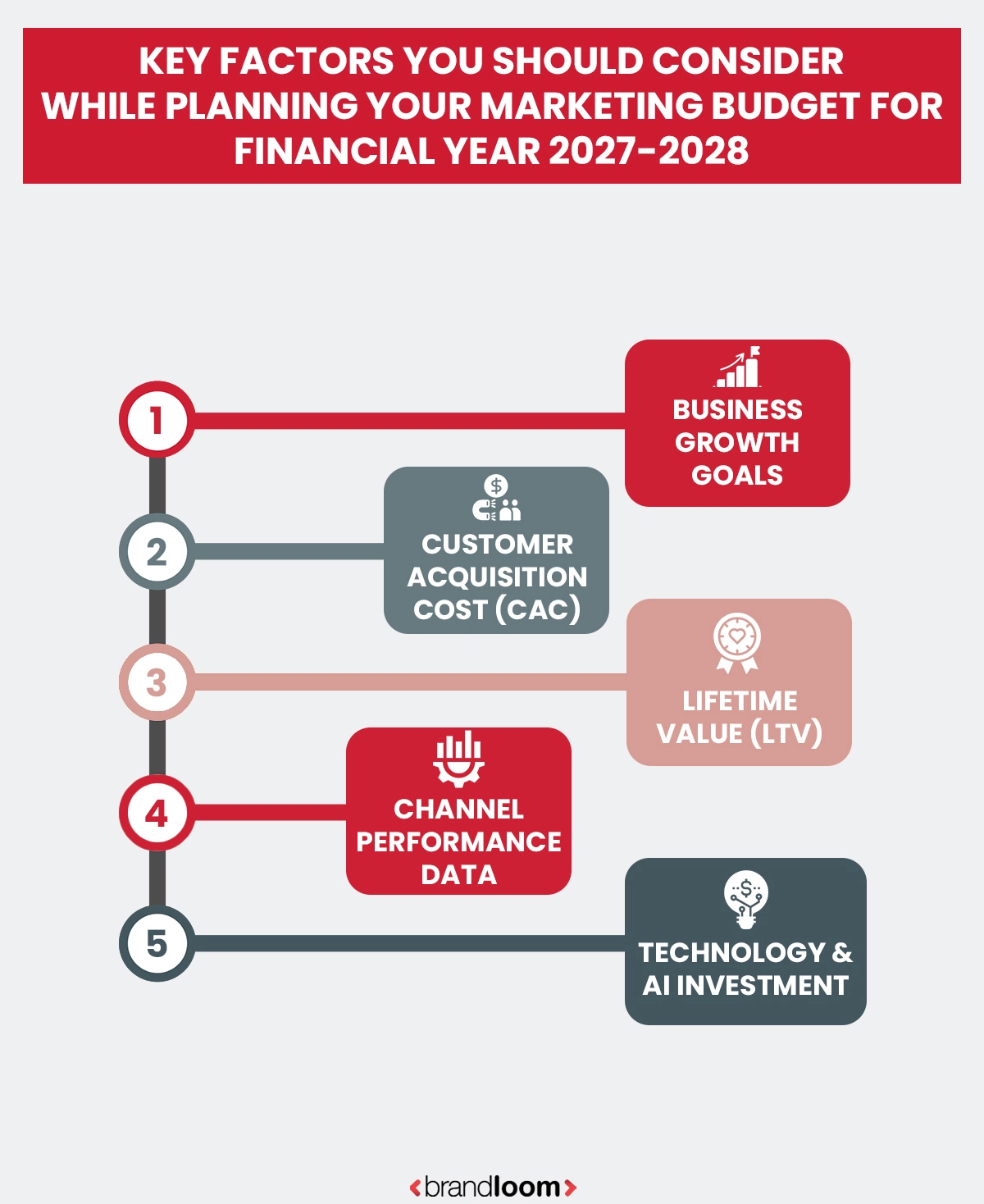
Key Factors You Should Consider While Planning Your Marketing Budget For Financial Year 2027-28
Creating an effective marketing budget allocation strategy requires more than estimating how much to spend on advertising. In financial year 2027-28, companies must consider several strategic factors that determine how budgets should be distributed across channels, campaigns, and long-term growth initiatives.
1. Business Growth Goals
Every marketing budget planning process should begin with clear business goals. A startup aiming for rapid market entry may allocate more funds toward customer acquisition, while an established brand may prioritize retention, brand building, and market expansion. Budget decisions must directly support the company’s broader growth objectives.
2. Customer Acquisition Cost (CAC)
Rising customer acquisition cost (CAC) is one of the biggest challenges facing marketers today. As competition increases across digital platforms, businesses must carefully evaluate how much they spend to acquire each customer. Monitoring CAC helps teams adjust marketing spend allocation toward channels that deliver the best efficiency and sustainable growth.
3. Lifetime Value (LTV)
Alongside CAC, lifetime value (LTV) helps businesses understand the long-term revenue potential of each customer. When companies compare CAC with LTV, they gain clearer insights into which marketing channels deserve a larger share of the budget. This balance ensures marketing investments generate strong return on investment (ROI) over time.
4. Channel Performance Data
Data-driven decisions are critical for modern marketing performance. By analyzing performance data such as traffic, engagement, and conversion rates, businesses can identify their most effective campaigns and allocate budgets toward the highest-performing channels.
5. Technology and AI Investment
Finally, companies must allocate budgets toward technology and automation. AI-driven tools are helping marketing teams gain real-time visibility into campaign performance, enabling smarter and faster strategic budget allocation.
From BrandLoom’s perspective, businesses that invest in analytics and AI platforms often gain a significant advantage in optimizing their overall marketing strategy.
Traditional vs Modern Marketing Budget Allocation
Marketing budget allocation has evolved significantly over the past decade. Traditional budgeting methods often focused heavily on distributing the advertising budget across a limited set of channels, such as television, print, or basic digital ads. These decisions were frequently based on past spending patterns rather than detailed marketing performance insights. As a result, many companies struggled to connect their marketing efforts with measurable business outcomes.
In contrast, modern digital marketing budget allocation is far more dynamic and data-driven. Businesses now operate across multiple marketing channels, including search, social media, content platforms, and emerging AI-driven discovery environments. This diversity requires marketers to continuously evaluate campaigns and channels using real-time data.
A key difference between traditional and modern budgeting approaches can be seen in how decisions are made and optimized:
| Traditional Marketing Budget Allocation | Modern Marketing Budget Allocation (Financial Year 2027-28) |
| Budget based on historical spending | Budget based on performance data and analytics |
| Focus on a few major channels | Investment across multiple marketing channels |
| Limited measurement and delayed reporting | Real-time visibility into marketing performance |
| Static yearly budgets | Flexible budgets are adjusted continuously |
| Heavy emphasis on ad spending | Balanced investment across performance, content, and brand |
We believe that businesses that adopt flexible, data-driven allocation strategies tend to achieve higher conversion rates and more sustainable growth. A modern marketing budget allocation strategy prioritizes continuous optimization and smarter allocation of marketing spend across high-performing channels.
Recommended Marketing Budget Breakdown for Financial Year 2027-28
A well-structured marketing budget breakdown helps businesses distribute resources across channels that support both short-term performance and long-term brand growth. In Financial Year 2027-28, companies can no longer rely solely on paid advertising. Instead, an effective digital marketing budget allocation should balance acquisition, brand building, retention, and technology investments.
A practical framework many businesses follow looks like this:
| Marketing Category | Suggested Allocation |
| Performance marketing (paid ads, PPC, paid social) | 35–40% |
| Content marketing & SEO | 20–25% |
| Brand marketing | 15–20% |
| Retention marketing (email, CRM, loyalty programs) | 10–15% |
| AI & analytics tools | 5–10% |
Performance marketing typically receives the largest share because it directly drives traffic, leads, and revenue. However, relying entirely on paid campaigns can increase customer acquisition cost (CAC) over time. This is why companies must also invest in content marketing, SEO, and brand-building initiatives that improve organic visibility and strengthen brand awareness.
Retention marketing is another critical component of modern marketing budget allocation. Acquiring new customers is often more expensive than retaining existing ones, so allocating funds toward customer engagement, email marketing, and loyalty programs can significantly improve long-term profitability.
As a leading digital marketing agency, we at BrandLoom believe that the most successful companies treat their marketing channels as part of a connected ecosystem rather than isolated campaigns. A balanced marketing budget allocation strategy ensures that marketing efforts across acquisition, brand, and retention work together to drive sustainable growth and stronger overall marketing performance.
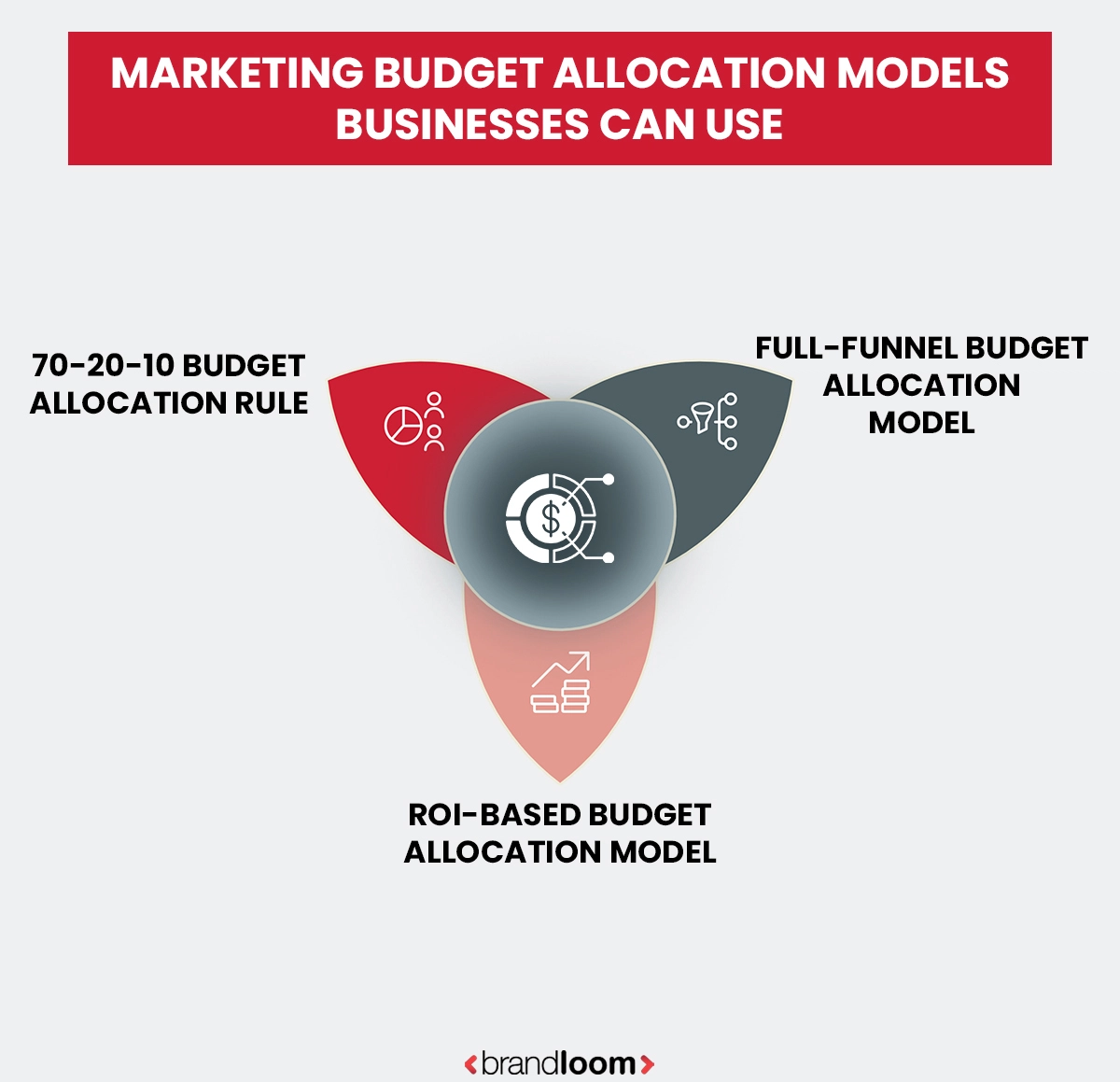
Marketing Budget Allocation Models Businesses Can Use
Businesses often struggle with deciding exactly how to distribute their marketing spend allocation across channels. This is why many organizations rely on structured marketing budget allocation models to guide their decision-making. These frameworks help marketing teams allocate resources efficiently while maintaining flexibility for testing new opportunities.
1. The 70-20-10 Budget Allocation Rule
One of the most widely used approaches is the 70-20-10 rule. In this model, 70% of the marketing budget allocation goes toward proven performing channels that consistently deliver results. Around 20% is allocated to emerging campaigns and channels that show growth potential, while the remaining 10% is reserved for experimentation. This structure allows businesses to maintain stability while encouraging innovation.
2. Full-Funnel Budget Allocation Model
Another effective approach focuses on allocating budgets across the entire customer journey. In this model, businesses invest in awareness campaigns, consideration-stage content, conversion-focused performance marketing, and retention initiatives. This type of marketing budget optimization ensures that marketing investments support every stage of the buying process rather than concentrating only on acquisition.
3. ROI-Based Budget Allocation Model
Some companies allocate budgets primarily based on marketing performance metrics. By analyzing ROI tracking, conversion rates, and channel performance data, businesses can shift spending toward campaigns and channels that generate the highest return.
We have observed that the most effective marketing budget allocation strategy often combines elements from multiple models. Companies that continuously analyze performance data and adjust budgets accordingly tend to achieve stronger and more sustainable growth.
Types Of Marketing Budget Allocation
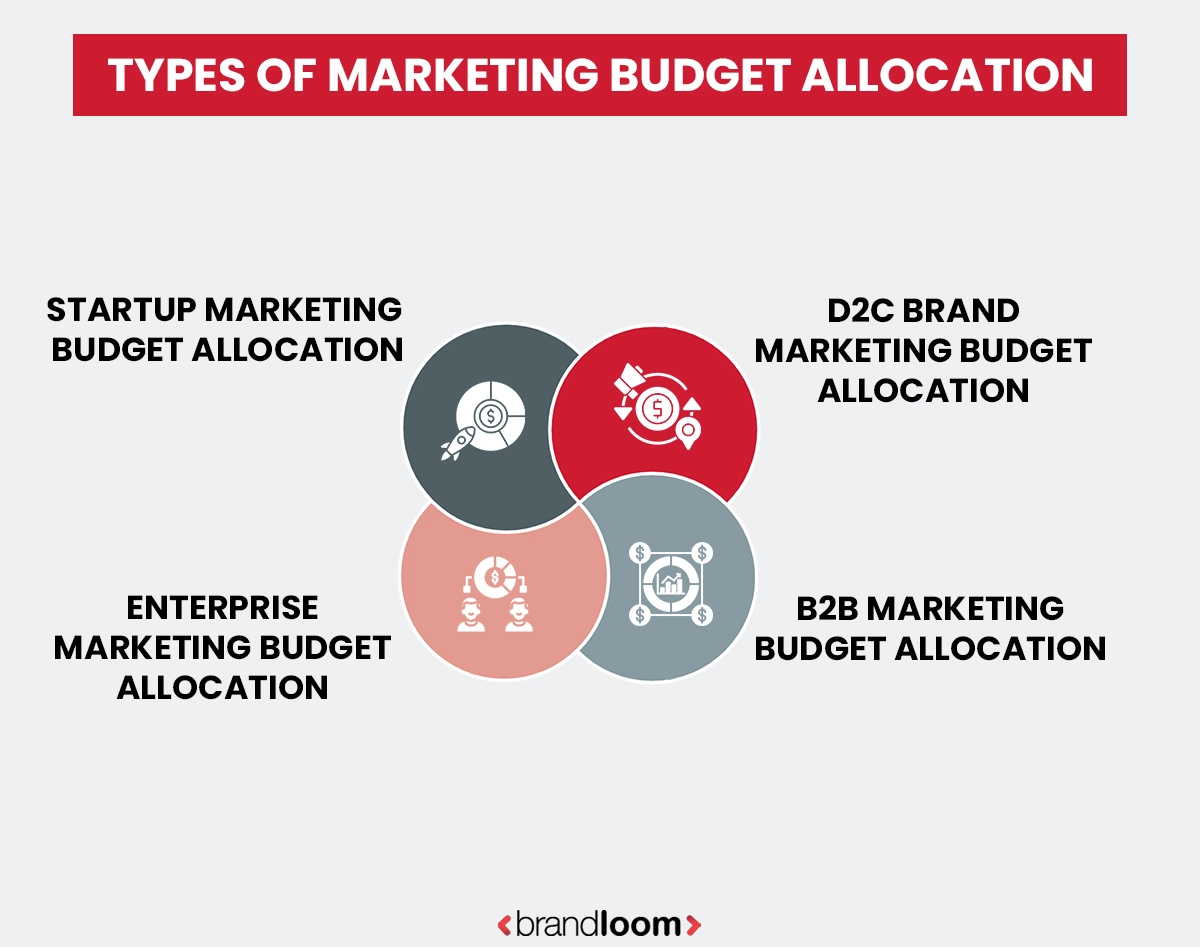
Different businesses require different approaches to marketing budget allocation. Factors such as industry, growth stage, and customer acquisition strategy influence how companies distribute their marketing investments. Below are practical examples of how various businesses structure their marketing budget planning.
1. Startup Marketing Budget Allocation
Startups typically focus on rapid customer acquisition and validating their product-market fit. A large portion of their advertising budget often goes toward paid search, social media ads, and performance campaigns that generate immediate traffic. However, startups should also allocate a portion of their marketing costs toward SEO and content marketing to build sustainable visibility over time.
2. D2C Brand Marketing Budget Allocation
Direct-to-consumer brands usually allocate a significant share of their digital marketing costs toward paid social advertising, influencer collaborations, and performance campaigns. These channels help D2C brands scale customer acquisition quickly. At the same time, many brands invest in retention initiatives such as email marketing, loyalty programs, and customer engagement strategies to improve lifetime value.
3. B2B Marketing Budget Allocation
For B2B companies, the B2B marketing budget often prioritizes long-term relationship building and lead generation. A large share of the marketing plan and budget is typically allocated to content marketing, LinkedIn advertising, webinars, and thought leadership initiatives. These strategies help attract qualified leads and nurture them through longer buying cycles.
4. Enterprise Marketing Budget Allocation
Large enterprises usually adopt a more diversified media budget allocation across multiple marketing channels. Their marketing spend allocation may include brand campaigns, omnichannel advertising, advanced analytics platforms, and large-scale content initiatives. Enterprises also invest heavily in data infrastructure and marketing technology to maintain real-time visibility into campaign performance.
The most effective marketing budget allocation strategy is always tailored to the business model. While startups may prioritize acquisition and rapid growth, mature companies often focus on balancing performance marketing with brand investment and customer retention to drive sustainable overall marketing success.
Common Marketing Budget Allocation Mistakes You Should Avoid
Even with a defined marketing budget allocation strategy, many businesses struggle to distribute their budgets effectively. Certain mistakes can significantly reduce marketing performance and lead to inefficient marketing expenses. Recognizing these issues helps companies improve their marketing budget planning and achieve better returns.
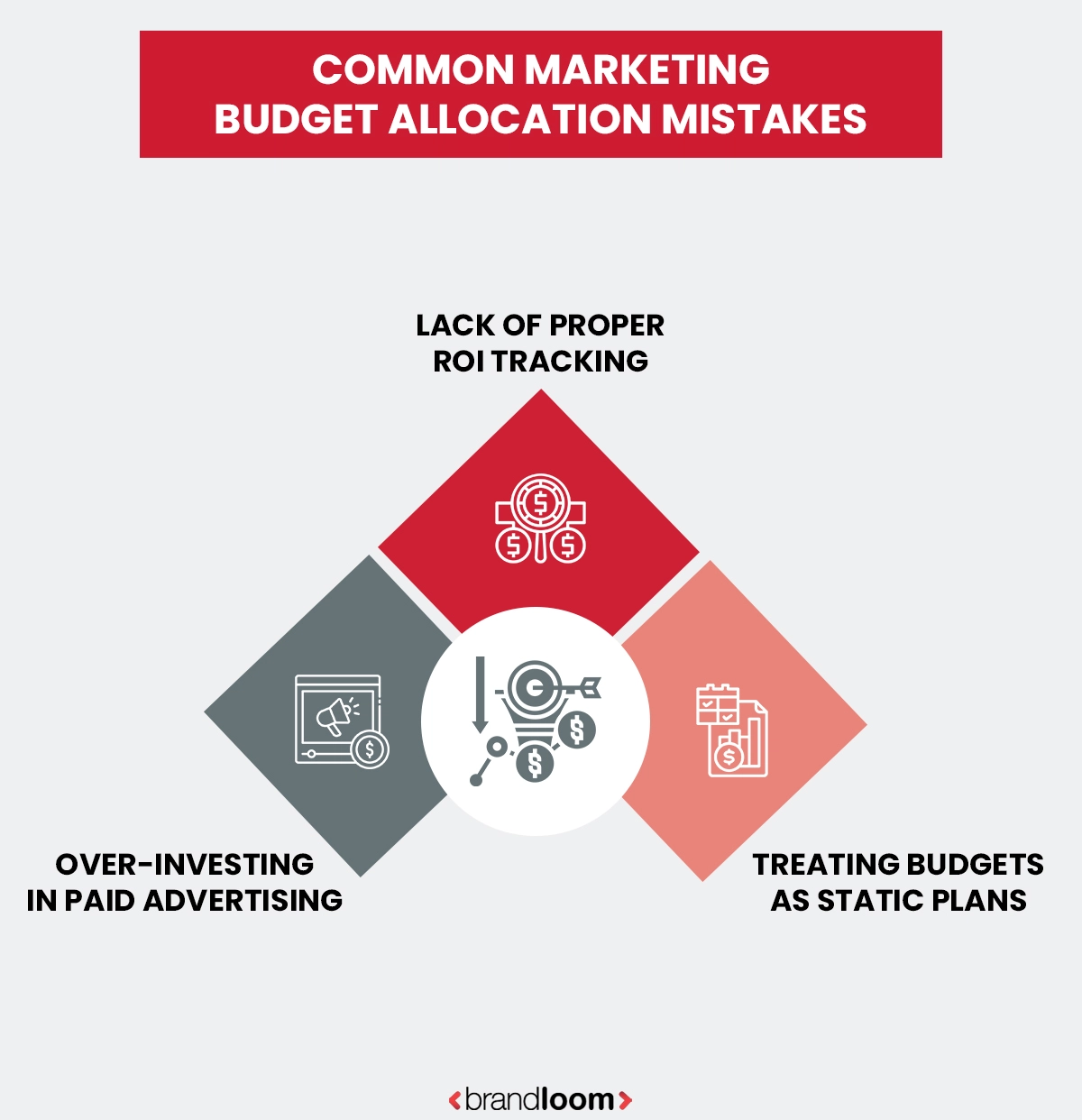
1. Over-Investing in Paid Advertising
Many companies allocate a large portion of their advertising budget to paid campaigns while ignoring long-term growth channels. Although paid ads deliver quick traffic, relying entirely on them often increases customer acquisition cost (CAC). Businesses should balance paid advertising with content marketing, SEO, and brand-building initiatives.
2. Lack of Proper ROI Tracking
Another common issue is failing to track campaign performance effectively. Without accurate ROI tracking and detailed performance data, marketing teams cannot identify which campaigns and channels deliver the best results. This leads to wasted marketing spend and weak marketing budget optimization.
3. Treating Budgets as Static Plans
Many organizations create annual budgets but rarely revisit them. However, market conditions, platform algorithms, and consumer behavior change frequently. Regular reviews and flexible marketing spend allocation help businesses adapt quickly and improve their overall marketing performance.
Businesses that continuously analyze performance data and adjust budgets accordingly achieve stronger and more sustainable marketing results.
How Often Should Businesses Reallocate Marketing Budgets?
Marketing budgets should not be treated as fixed annual plans. Consumer behavior, channel performance, competition, and market conditions can shift quickly, making regular budget reassessment essential for maintaining efficiency and growth. The most effective businesses approach budget allocation as an ongoing optimization process rather than a once-a-year decision.
1. Monthly Reviews for Performance Monitoring
Businesses should conduct monthly marketing budget reviews to monitor performance trends and identify early signals of inefficiency. These reviews do not always require major spending changes, but they help teams assess metrics such as customer acquisition cost (CAC), return on ad spend (ROAS), lead quality, conversion rates, and retention performance. Monthly reviews also allow marketers to identify underperforming channels before inefficiencies become expensive.
2. Quarterly Reallocation for Strategic Optimization
While monthly reviews focus on monitoring, quarterly budget reallocation allows businesses to make more meaningful strategic adjustments. Every quarter, companies should evaluate which channels are generating sustainable returns and which no longer justify investment. For example, if organic search, retention campaigns, or referral channels begin outperforming paid acquisition, budgets may need to shift accordingly. Quarterly reassessment helps businesses remain aligned with changing customer journeys and business priorities.
3. Seasonal Adjustments Based on Market Demand
Seasonality plays a major role in marketing effectiveness. Businesses often experience fluctuations in consumer demand based on holidays, festivals, weather patterns, industry cycles, or shopping behavior. Seasonal adjustments help marketers increase investment during high-conversion periods while optimizing spending during slower months. Retail, travel, healthcare, education, and B2B sectors often benefit significantly from flexible seasonal budget planning.
4. AI-Assisted Optimization for Smarter Decisions
AI-assisted optimization is increasingly helping businesses make faster, data-informed allocation decisions. AI-powered tools can analyze campaign performance, predict trends, identify audience shifts, and recommend budget adjustments in near real time. Rather than relying solely on historical reporting, marketers can use predictive insights to allocate budgets more efficiently, reduce waste, and respond quickly to changing market conditions.
The most successful businesses combine monthly monitoring, quarterly reallocation, seasonal flexibility, and AI-assisted optimization to create a more agile and performance-driven marketing budget strategy.
BrandLoom’s Market Budget Framework For Financial Year 2027-28
Planning your marketing budget for FY 2027–28 is not just about deciding how much to spend. It is about building a structured approach that helps you invest in the right areas, prioritize growth opportunities, and generate measurable returns.
At BrandLoom, we believe your marketing budget should support both immediate business goals and long-term brand growth. That is why we follow a clear framework that helps businesses allocate budgets strategically, reduce wasted spend, and ensure every marketing investment contributes to stronger business outcomes.
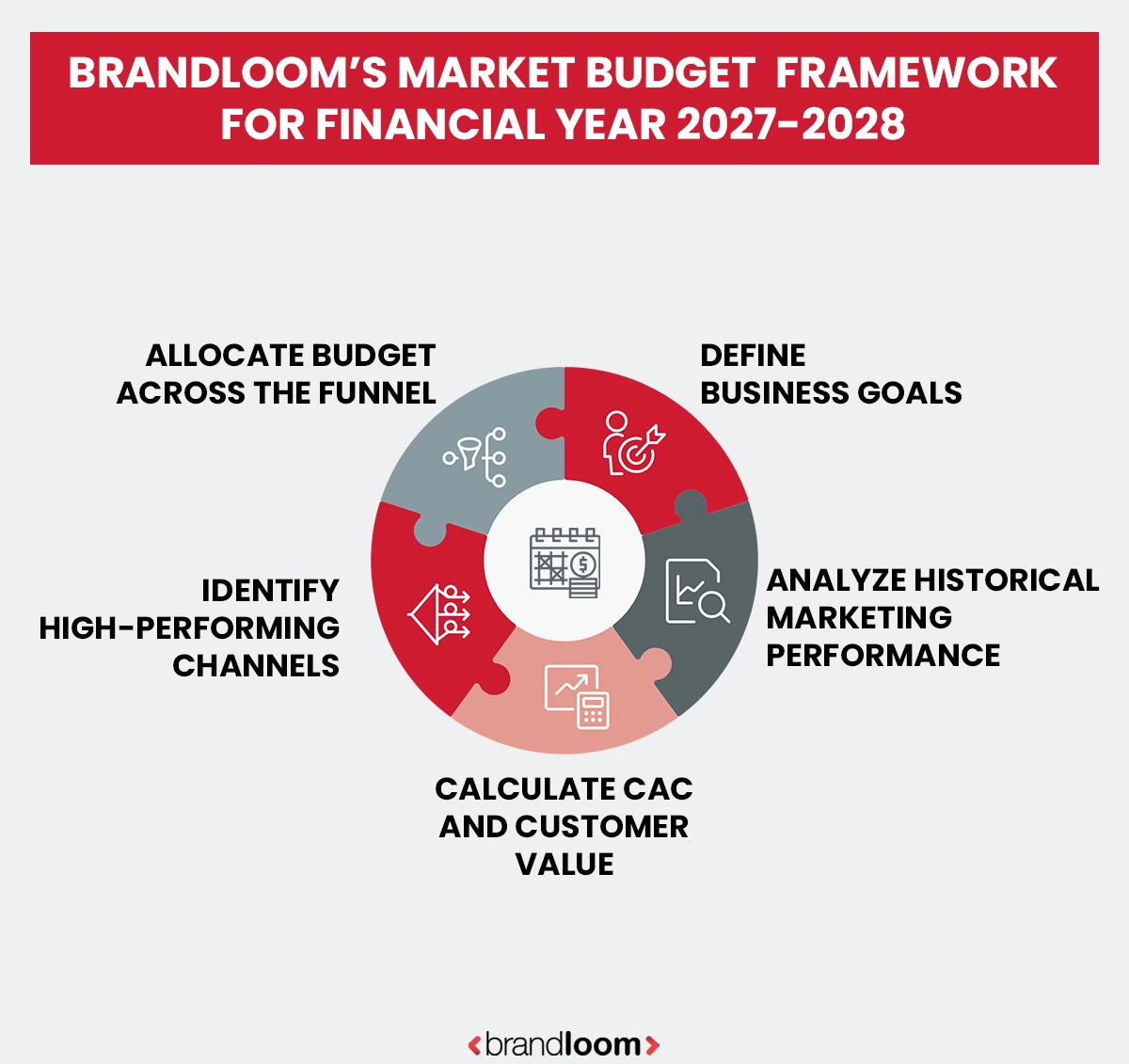
1. Define Business Goals
Start by identifying the primary objectives of your marketing efforts. Whether the goal is lead generation, revenue growth, market expansion, or brand awareness, these priorities will shape your marketing budget planning decisions.
2. Analyze Historical Marketing Performance
Review past campaigns to understand which marketing channels generated the best results. Evaluating metrics such as traffic, engagement, and conversion rates helps identify the most effective channels for allocating future marketing spend.
3. Calculate CAC and Customer Value
Understanding customer acquisition cost (CAC) and lifetime value allows businesses to determine how much they can realistically invest to acquire each customer while maintaining profitability.
4. Identify High-Performing Channels
Use performance data to determine which campaigns and channels drive the strongest results. This ensures that your marketing budget allocation prioritizes proven opportunities.
5. Allocate Budget Across the Funnel
Distribute budgets across awareness, consideration, conversion, and retention initiatives to create a balanced growth strategy.
Companies that continuously monitor performance and refine their marketing budget strategy are far more likely to achieve sustainable growth and stronger return on investment (ROI).
Conclusion
Marketing in Financial Year 2027-28 requires you to take a more thoughtful and data-driven approach to your marketing budget allocation. Rising customer acquisition costs, evolving consumer behavior, expanding marketing channels, and the growing role of AI tools mean you can no longer rely on fixed or outdated budgeting methods. Instead, you need a flexible marketing budget allocation strategy that balances customer acquisition, brand building, retention, and technology investments.
A well-structured approach to marketing budget planning helps you allocate resources across high-performing channels while continuing to invest in long-term growth drivers such as content marketing, SEO, and brand development. When you combine performance data, ROI tracking, and strategic experimentation, you gain better clarity on where your marketing investments are creating the strongest business impact and delivering measurable returns.
As one of India’s leading digital marketing agencies, we at BrandLoom have observed that the most successful organizations treat budgeting as an ongoing optimization process rather than a one-time annual exercise. By continuously refining marketing spend allocation and aligning it with evolving business goals, companies can build stronger marketing systems that drive sustainable overall marketing performance and measurable growth.
Frequently Asked Questions
At BrandLoom, we recommend a marketing budget allocation strategy that balances acquisition, retention, brand building, and AI visibility instead of focusing only on paid ads. Businesses should invest in performing channels, strengthen content marketing, and use performance data to guide marketing spend allocation that supports both short-term results and long-term return on investment (ROI).
From our perspective, most businesses should allocate 7–12% of revenue to their marketing budget. High-growth startups may invest 15–20% to accelerate acquisition, while established companies typically maintain 6–10% for sustainable growth, stronger brand awareness, improved conversion rates, and consistent overall marketing performance.
BrandLoom typically recommends allocating 60–75% of the marketing budget to digital marketing budget allocation across channels such as SEO, paid search, content marketing, and social media. Digital channels provide real-time visibility, measurable marketing performance, and stronger ROI tracking, making them central to modern marketing budget planning.
BrandLoom recommends a balanced marketing budget breakdown where performance marketing budget drives immediate conversions while brand marketing investment builds long-term demand. A practical structure allocates about 60% to performance campaigns and 40% to brand-building activities, ensuring sustainable marketing efforts and consistent business growth.
The 70-20-10 marketing budget allocation model divides spend into 70% for proven performing channels, 20% for emerging campaigns and channels, and 10% for experimentation. BrandLoom uses this framework to maintain stable marketing performance while testing innovative strategies that may improve future digital marketing budget allocation.
At BrandLoom, we see AI transforming marketing budget allocation by enabling predictive analytics, smarter targeting, and automated campaign optimization. Companies increasingly allocate budgets to AI marketing tools, analytics platforms, and automation systems that improve performance data analysis, reduce ad spending waste, and strengthen strategic budget allocation.
BrandLoom recommends a hybrid marketing budget strategy for startups. Paid ads help drive immediate traffic and validate product-market fit, while SEO and content marketing build long-term visibility and lower customer acquisition cost (CAC). Startups should gradually shift budgets toward organic channels as marketing performance stabilizes.
BrandLoom advises reviewing the marketing budget allocation strategy quarterly while monitoring marketing performance monthly. Frequent reviews allow teams to adjust planned budgets, shift spending toward performing channels, and optimize campaigns and channels based on evolving performance data and ROI insights.
At BrandLoom, we base marketing budget planning on key metrics such as customer acquisition cost (CAC), lifetime value (LTV), conversion rates, channel ROI, and overall marketing performance. These metrics help businesses identify high-performing marketing channels and ensure marketing spend allocation aligns with core business goals.
BrandLoom recommends data-driven marketing budget optimization to reduce waste. Companies should track ROI across campaigns and channels, pause underperforming ad spending, and reinvest in high-performing marketing channels. Using analytics tools and real-time visibility helps marketing teams continuously refine their marketing budget allocation strategy.