Many D2C business owners aren’t confused about performance marketing vs growth marketing. They’re stuck on a more critical decision: where should the budget actually go?
In today’s market, attention is fragmented, and ad platforms are getting more expensive. So the default move is obvious: put more money into paid ads to drive faster results. And it works for a while.
But over time, something starts to shift. Customer acquisition costs rise. Returns begin to plateau. You keep increasing spending, launching more campaigns, pushing harder for conversions, yet real, sustainable growth doesn’t follow.
That’s where the problem lies. Most brands don’t have a spending problem. They have an allocation problem.
Too much budget goes into short-term performance. Too little goes into building systems that reduce dependency on ads over time. As a result, growth becomes expensive, inconsistent, and difficult to scale.
At BrandLoom, we see this pattern play out repeatedly with D2C founders. The common mistake is treating growth as a campaign rather than a system. This is where the confusion between growth marketing and performance marketing begins.
One promises immediate results, while the other focuses on building systems that last. Choosing the wrong approach or relying on just one can slow down your brand’s growth.
The reality is simple. Performance marketing vs growth marketing is not about picking a winner. It is about understanding how each approach fits into your growth journey and how combining both can unlock predictable, scalable success.
As a leading digital marketing agency in India, we at BrandLoom help D2C brands solve this by aligning budget allocation with growth stages so performance drives immediate results while growth systems build long-term scale.
Because the brands that grow consistently aren’t choosing one over the other, they’re investing in both with the right balance.
What is Performance Marketing?
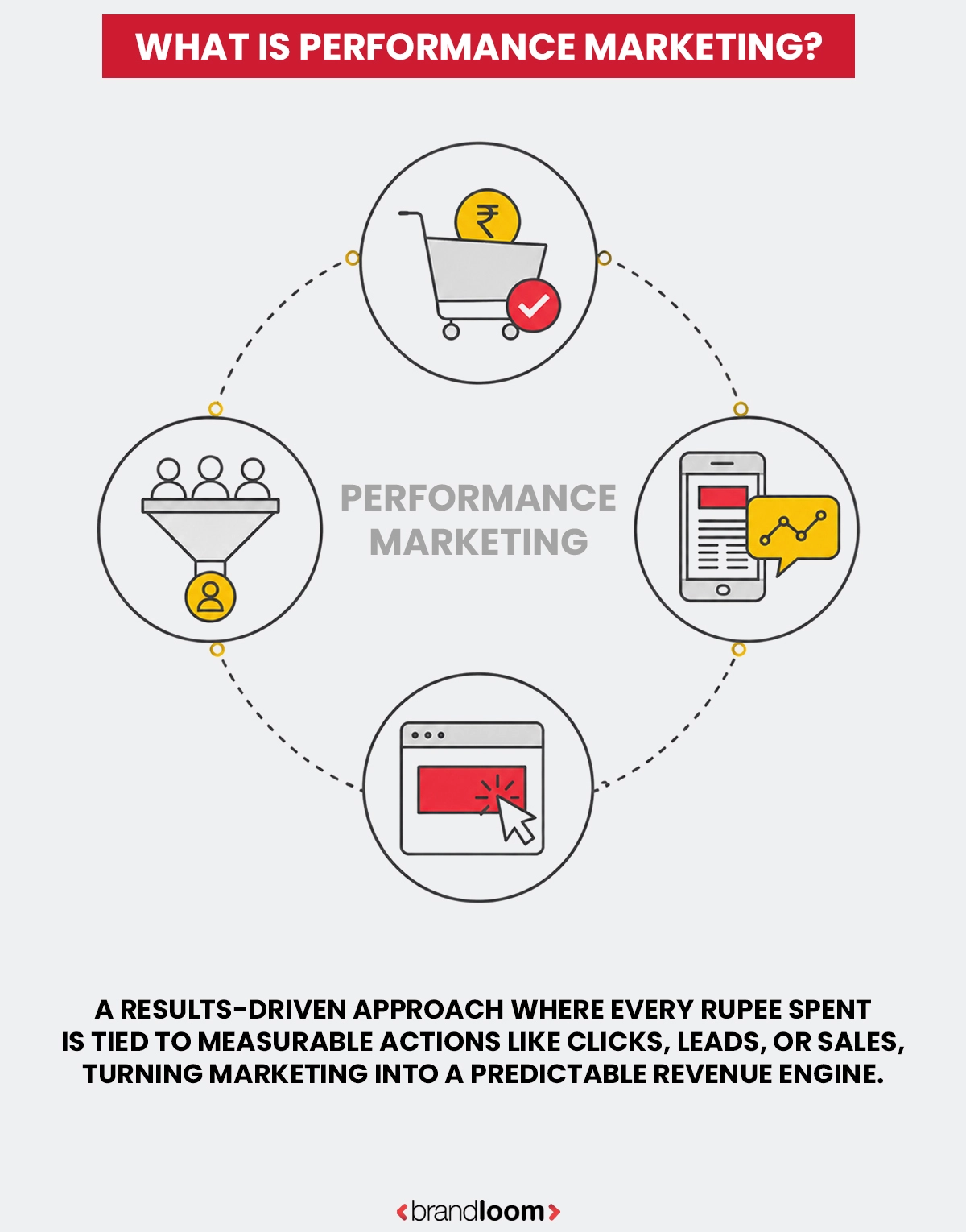
Performance marketing is a results-driven approach where brands pay only when a specific action occurs. This action can be a click, a lead, or a sale. It is marketing that focuses on measurable outcomes and direct returns.
Unlike traditional advertising, this model ties every rupee of ad spend to performance. That is exactly why many D2C founders lean into it early. At BrandLoom, we often tell clients that a performance marketing strategy is not just about running ads. It is about building a predictable revenue engine backed by data.
Key Channels in Performance Marketing
The most common channels used in performance marketing for e-commerce include:
- Paid ads on platforms like Google and Meta
- Affiliate and influencer partnerships
- Search-driven campaigns, often linked with performance marketing SEO
These channels are designed to capture demand and convert users who are already in the buying phase of the customer journey. From our experience at BrandLoom, brands that align their messaging with user intent at this stage see the strongest results.
Core Metrics That Define Performance Marketing
Success in performance marketing depends on a few critical metrics:
- Customer acquisition cost (CAC) measures how much you spend to acquire one customer
- Return on ad spend (ROAS) shows revenue generated from campaigns
- Conversion rate tracks how many users take the desired action
These metrics allow brands to make fast decisions and refine their paid ads strategy in real time. At BrandLoom, we focus heavily on optimizing these numbers because even small improvements can significantly impact profitability.
Pros and Limitations
Pros:
- Delivers immediate traffic and revenue, ideal for short-term growth
- Highly measurable and data-driven
- Easy to scale with increased ad spend
- Enables quick testing and optimization of campaigns
Limitations:
- Increasing customer acquisition cost over time
- Heavy dependence on continuous ad spend
- Limited focus on customer retention and long-term value
- Can become inefficient without a broader marketing strategy
The key insight we share at BrandLoom is simple. Performance marketing can accelerate growth, but it cannot sustain it on its own.
What is Growth Marketing?
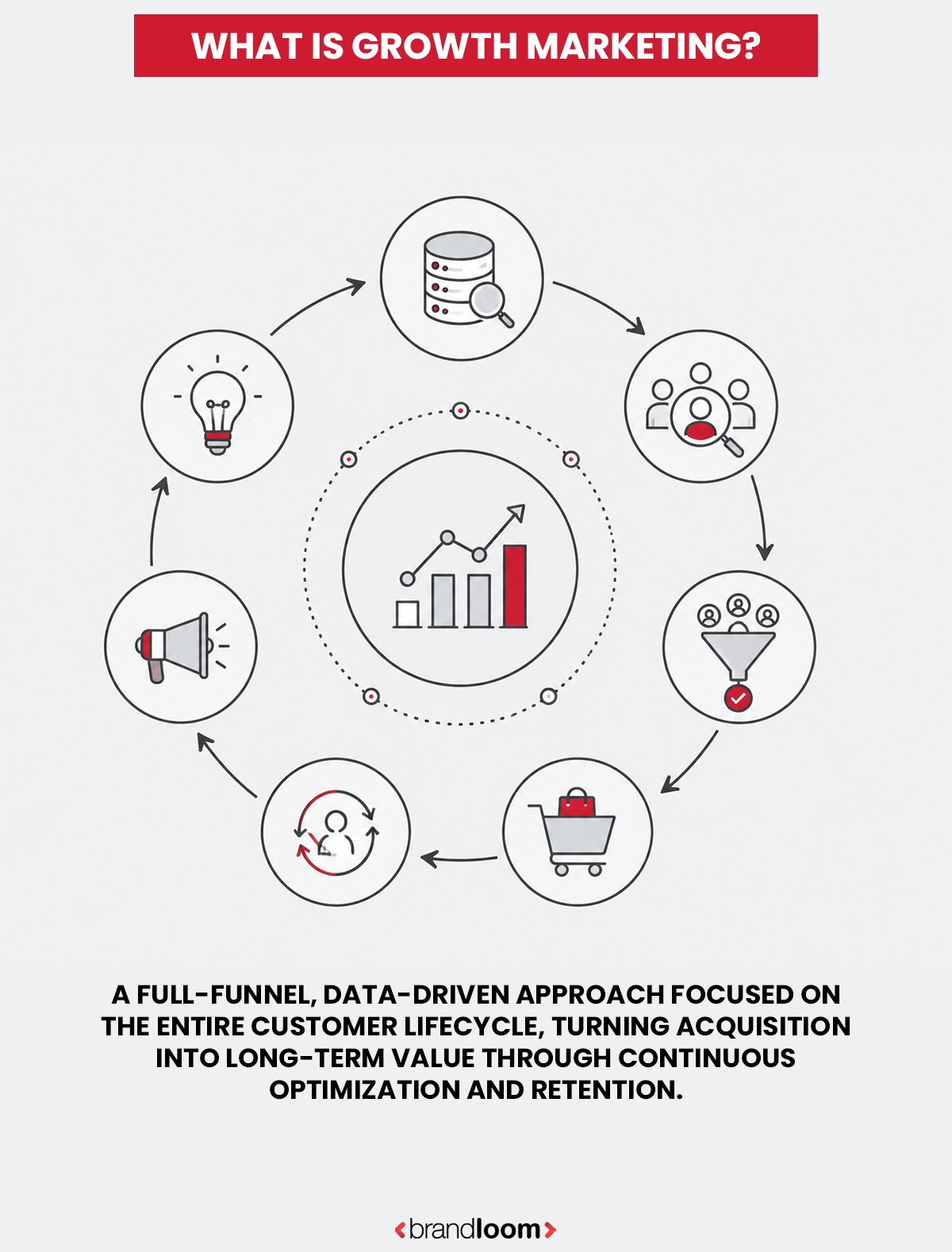
Growth marketing goes beyond acquisition. It focuses on the entire customer lifecycle, from the first interaction to repeat purchases and referrals. It is a data-driven approach designed to drive sustainable, long-term business growth.
Unlike traditional marketing or even pure performance marketing, growth marketing does not stop at conversions. It examines how users behave after becoming customers and how to maximize their value over time. At BrandLoom, we often describe a strong growth marketing strategy as a system. Not a campaign, but a continuous loop of learning, optimizing, and scaling.
What Does Growth Marketing Entail in Terms of Deliverables?
Growth marketing is often misunderstood as simply “running campaigns to drive growth.” In reality, it is a structured, full-funnel approach designed to improve acquisition, conversion, retention, and customer lifetime value. Unlike traditional marketing, growth marketing focuses on continuous experimentation, optimization, and measurable business outcomes.
For D2C and eCommerce brands, growth marketing deliverables go beyond paid ads and include systems that create sustainable, scalable growth.
1. Customer Acquisition Strategy
Growth marketing begins with building a predictable customer acquisition engine. This includes audience research, channel strategy, paid media planning, SEO, content marketing, and performance campaigns across platforms such as Google, Meta, marketplaces, and influencer partnerships.
Deliverables include:
- Paid ad strategy and campaign setup
- Audience segmentation and targeting
- Landing page optimization
- Organic traffic strategy
- Performance tracking frameworks
2. Conversion Rate Optimization (CRO)
Traffic means little if visitors do not convert. Growth marketers continuously optimize the buying journey to improve conversions and reduce drop-offs.
Deliverables include:
- Website and landing page audits
- A/B testing for creatives, CTAs, and checkout flows
- Heatmap and user behavior analysis
- Checkout optimization
- Funnel performance reporting
3. Retention & Lifecycle Marketing
Acquiring customers is expensive. Growth marketing focuses heavily on retaining them and increasing repeat purchases.
Deliverables include:
- Email and WhatsApp automation workflows
- Cart abandonment recovery campaigns
- Customer reactivation strategies
- Loyalty and referral programs
- Personalized customer journeys
4. Analytics & Growth Experimentation
Growth marketing is deeply data-driven. Every strategy is measured, tested, and refined to improve ROI.
Deliverables include:
- KPI dashboards and reporting
- Cohort and customer behavior analysis
- CAC, LTV, and retention tracking
- Experimentation roadmaps
- Continuous growth testing
At BrandLoom, growth marketing is treated as a long-term business system rather than a short-term tactic—helping brands build profitable customer relationships, improve retention, and scale sustainably.
Full-Funnel Approach Explained
A core strength of growth marketing for D2C is its full-funnel focus. Instead of targeting just acquisition, it optimizes every stage of the customer journey:
- Acquisition: Bringing in new users through multiple channels
- Activation: Ensuring users take meaningful first actions
- Retention: Encouraging repeat engagement and purchases
- Referral: Turning customers into advocates
This full-funnel marketing approach ensures that brands are not just acquiring customers but also keeping them engaged.
Channels Used in Growth Marketing
Growth marketing uses a mix of channels that support both acquisition and retention:
- Content marketing to educate and build trust
- Email and SMS campaigns for lifecycle engagement
- Conversion rate optimization to improve user experience and increase conversions
At BrandLoom, we emphasize combining these channels to create a seamless experience across touchpoints.
Key Metrics That Matter in Growth Marketing
Growth marketing is not measured by vanity metrics alone. While impressions, clicks, and traffic matter, the real focus is on sustainable business growth, profitability, and customer value over time. The right metrics help brands understand whether they are attracting quality customers, retaining them effectively, and maximizing long-term revenue.
Customer Acquisition Cost (CAC)
CAC measures how much it costs to acquire a new customer through marketing and advertising efforts. A lower CAC with strong conversion rates indicates efficient growth.
Customer Lifetime Value (LTV)
LTV tracks the total revenue a customer generates throughout their relationship with a brand. Growth marketing aims to increase LTV through retention, upselling, and repeat purchases.
Conversion Rate
This measures the percentage of users who complete a desired action, such as making a purchase, signing up, or booking a demo. Higher conversion rates signal better funnel efficiency.
Retention Rate & Churn Rate
Retention rate shows how many customers continue buying from your brand, while churn rate measures customer drop-offs. Strong retention is a hallmark of effective growth marketing.
Return on Ad Spend (ROAS) & Revenue Growth
ROAS measures advertising efficiency, while revenue growth indicates whether marketing efforts are contributing to scalable business expansion.
Why Growth Marketing Focuses on Retention
The real power of growth marketing lies in retention. Acquiring customers is expensive, but retaining them increases lifetime value and improves profitability. A strong retention strategy helps build customer loyalty, turning one-time buyers into repeat customers.
Pros and Limitations
Pros:
- Drives sustainable and scalable growth
- Reduces dependency on paid acquisition
- Improves customer retention and lifetime value
- Builds strong brand relationships
Limitations:
- Takes longer to show results compared to short-term campaigns
- Requires consistent experimentation and resources
- Harder to measure in the early stages
At BrandLoom, one belief guides every growth marketing strategy we build. Real growth does not come from more traffic alone. It comes from maximizing the value of every customer you already have.
Key Differences Between Performance and Growth Marketing
When comparing performance marketing vs growth marketing, most D2C founders assume they serve the same purpose. They do not. While both contribute to business growth, they solve very different problems.
Performance marketing is built for speed. It helps you acquire customers quickly through paid ads and measurable campaigns. Growth marketing, in contrast, is built for sustainability. It focuses on the entire customer journey, ensuring customers stay, return, and generate more value over time.
At BrandLoom, we often simplify this for founders. Performance marketing drives transactions. Growth marketing builds systems. The easiest way to understand growth marketing vs performance marketing is through a side-by-side comparison.
Performance Marketing vs Growth Marketing: Side-by-Side Comparison
| Aspect | Performance Marketing | Growth Marketing |
| Primary Goal | Immediate revenue and conversions | Long-term business growth and scalability |
| Time Horizon | Short-term results | Sustained growth over time |
| Funnel Focus | Acquisition and conversion-focused | Full-funnel marketing approach |
| Key Channels | Paid ads, affiliates, search | Content marketing, email, SMS, CRO |
| Core Metrics | Customer acquisition cost (CAC), ROAS, conversion rate | Lifetime value (LTV), retention rate, engagement and CAC: LTV ratio |
| Customer Focus | New customer acquisition | Retention and customer loyalty |
| Strategy Type | Campaign-driven | System-driven |
| Scalability | Depends on ad spend | Builds compounding growth |
| Risk Factor | Rising customer acquisition cost | Slower initial results |
| Outcome | Quick wins | Sustainable, predictable growth |
What This Means for D2C Brands
For D2C founders, this comparison highlights a critical insight. Relying solely on performance marketing can drive rapid revenue growth, but it often leads to rising ad spend and shrinking margins. On the other hand, focusing only on growth marketing strategy without acquisition can slow down momentum.
We consistently see that brands struggle when they treat these approaches as interchangeable. They are not. Each plays a distinct role in your D2C marketing strategy.
The real advantage comes from understanding when to use each. Performance marketing vs growth marketing is not a competition. It is a balance between speed and sustainability.
And that balance is what separates brands that grow temporarily from those that scale consistently.
How Each Impacts D2C Brands
For D2C brands, the choice between performance marketing vs growth marketing directly impacts profitability, scalability, and survival. Most brands do not fail because of poor products. They fail because their marketing strategy cannot sustain growth.
At BrandLoom, we consistently see one pattern. Brands that rely only on acquisition struggle. Brands that invest in retention scale.
Performance Marketing Impact on D2C
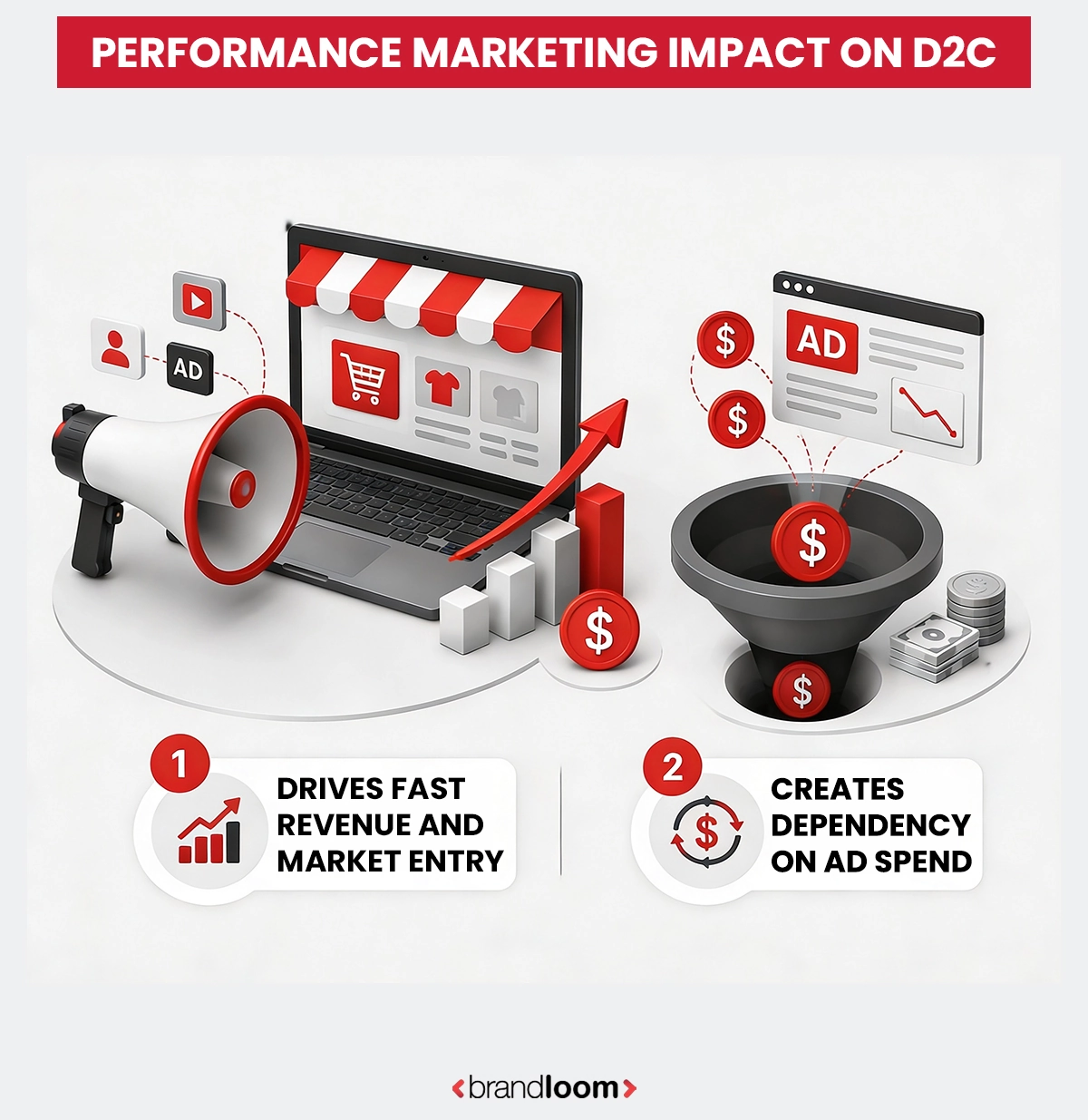
1. Drives Fast Revenue and Market Entry
Performance marketing for e-commerce gives D2C brands speed. With a strong paid ads strategy, you can:
- Launch products quickly
- Validate demand in real time
- Scale revenue within weeks
This makes performance marketing essential in the early stages. It helps brands gain visibility and generate immediate cash flow.
We often use performance campaigns as a testing engine. It tells you what works before you scale further.
2. Creates Dependency on Ad Spend
The challenge begins when brands rely only on this model.
- Increasing ad spend reduces margins
- Rising customer acquisition cost makes scaling harder
- Growth becomes tied to platform algorithms
Over time, many D2C brands hit a ceiling. Revenue grows, but profits shrink. This is where performance marketing alone starts to break.
Growth Marketing Impact on D2C
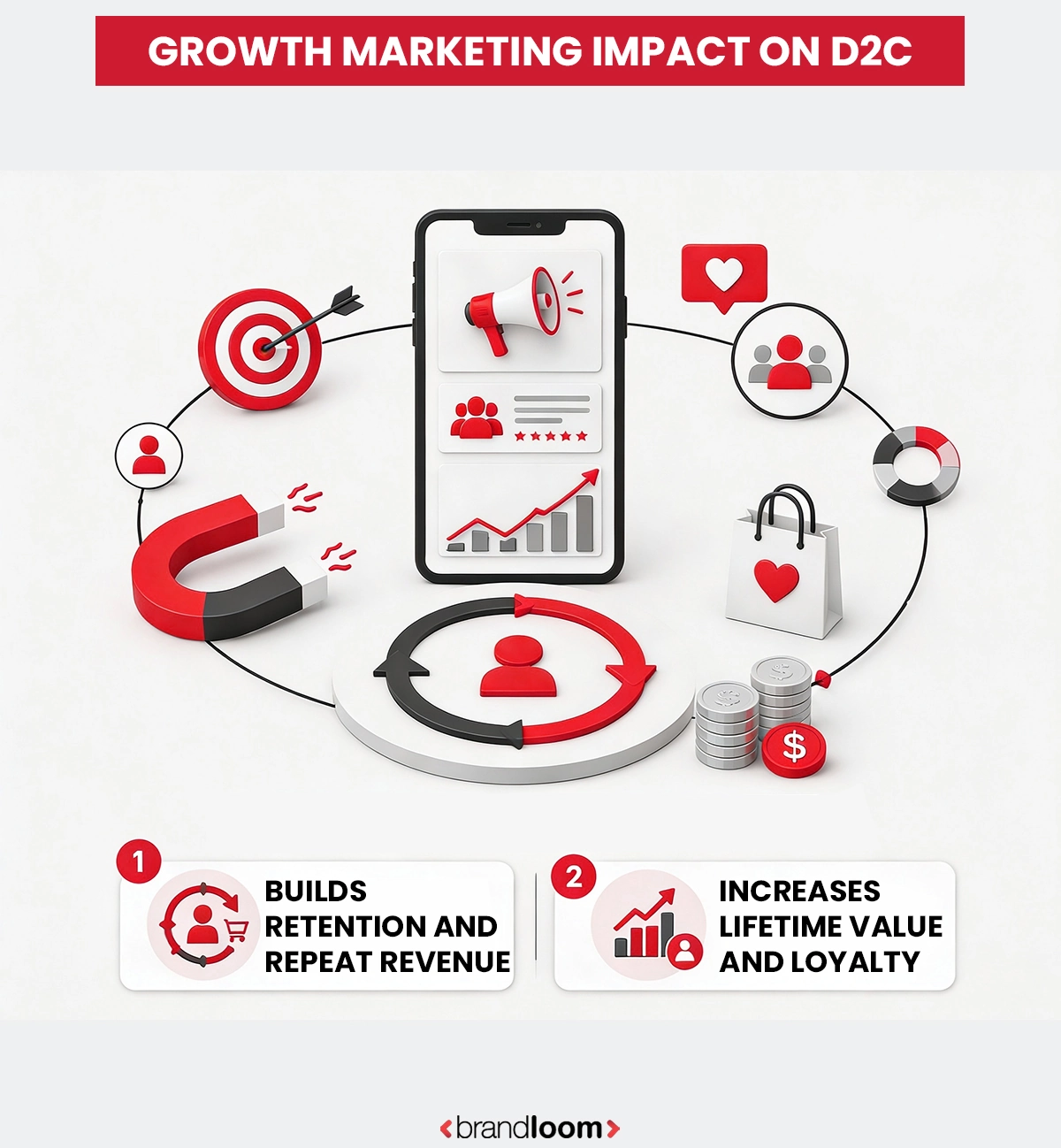
1. Builds Retention and Repeat Revenue
Growth marketing for D2C shifts the focus from transactions to relationships. Instead of chasing new users, it maximizes the value of existing ones.
A strong retention strategy helps brands:
- Increase repeat purchases
- Improve customer retention
- Build predictable revenue streams
We treat retention as the foundation of scalable growth, not an afterthought.
2. Increases Lifetime Value and Loyalty
The biggest advantage of a growth marketing strategy is higher lifetime value.
- Customers buy more than once
- Engagement improves across the customer journey
- Brands build strong customer loyalty
A loyal customer not only purchases again but also refers others, reducing overall acquisition costs.
The Core D2C Challenge
Most D2C brands today struggle with the same issues:
- High customer acquisition cost
- Low retention rates
- Overdependence on paid channels
This is why the debate around performance marketing vs growth marketing matters.
At BrandLoom, the conclusion is clear: Performance marketing drives initial growth. Growth marketing sustains it. The brands that win are not choosing between the two. They are learning how to balance both to create consistent, scalable business growth.
When Should You Use Performance Marketing?
Not every stage of your business requires the same approach. Knowing when to prioritize performance marketing can help you move faster and avoid wasted marketing efforts.
We typically recommend using a strong performance marketing strategy when speed and immediate results matter most.
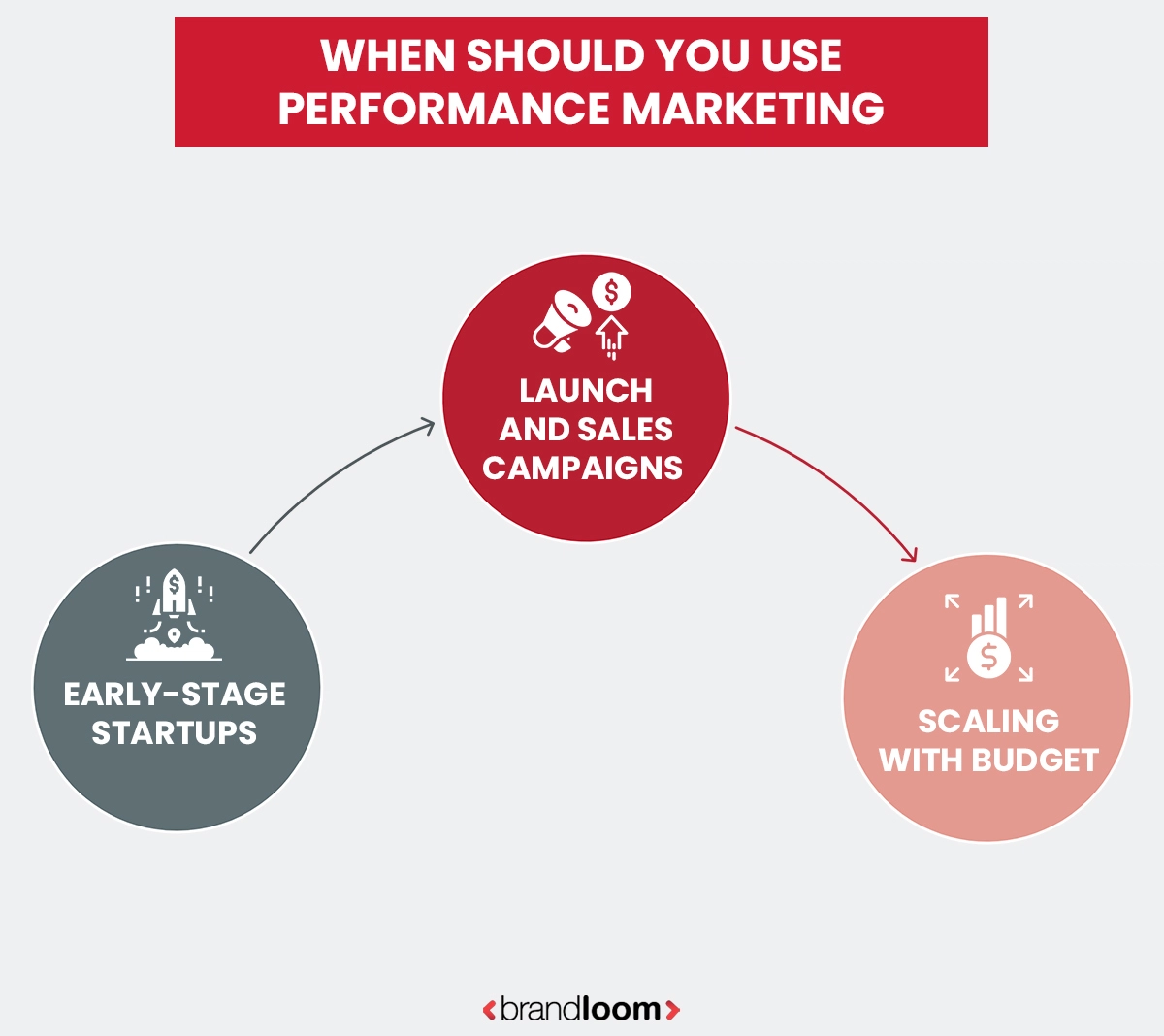
1. Early-Stage Startups
If you are just starting out, performance marketing is one of the fastest ways to validate your product.
- Test demand quickly
- Identify your target audience
- Understand what messaging converts
A focused paid ads approach allows you to gather real data instead of relying on assumptions. This is critical for building a strong foundation.
2. Launch and Sales Campaigns
Launching a new product or running a seasonal sale requires momentum. This is where performance marketing excels.
- Drive immediate traffic
- Generate quick conversions
- Maximize visibility during peak periods
At BrandLoom, we often use high-intent campaigns during launches to capture demand at the right moment.
3. Scaling with Budget
When you have capital to invest, performance marketing becomes a powerful scaling tool.
- Increase reach through a paid ads strategy
- Double down on high-performing campaigns
- Accelerate short-term growth
However, this works only when your unit economics are strong. If your customer acquisition cost is too high, scaling can quickly become unsustainable.
The Key Takeaway
Performance marketing works best when your goal is speed. It helps you acquire customers, validate ideas, and generate revenue in the short term.
Our experts always emphasize one thing. Use a performance marketing strategy to kickstart growth, but do not rely on it alone if you want long-term business growth.
When Should You Focus on Growth Marketing?
Most D2C brands do not realize when to shift from acquisition to retention. They keep increasing ad spend, expecting better results. But growth does not come from more traffic alone.
This is exactly where a strong growth marketing strategy becomes critical for long-term business growth. A common perspective shared by our experts at BrandLoom is that scaling is not just about acquiring more users. It is about extracting more value from every customer you already have.
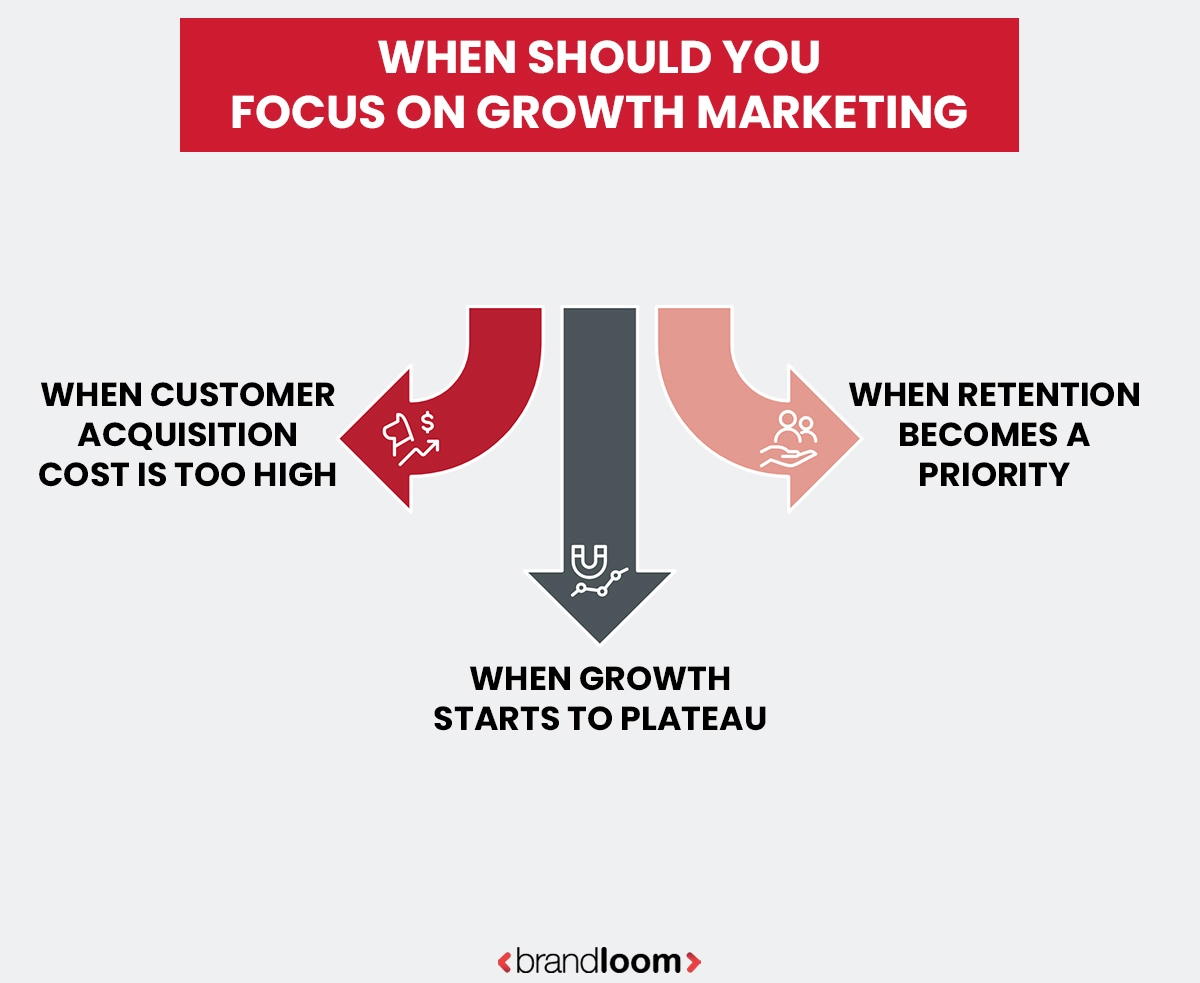
1. When Customer Acquisition Cost Is Too High
A rising customer acquisition cost is the first warning sign. If you are paying more for each customer but not increasing revenue per user, your margins shrink.
The smarter move is not always to further optimize ads. It is to improve what happens after the first purchase. A focused retention strategy helps you generate more revenue from the same customers, reducing pressure on acquisition.
2. When Growth Starts to Plateau
Many D2C brands hit a plateau even after increasing paid ads. Traffic grows, but revenue does not scale at the same pace.
This happens because acquisition alone cannot drive sustained results. Growth marketing for D2C solves this by improving every stage of the customer journey, from onboarding to repeat purchases.
The real leverage comes from small improvements across the funnel, not just bigger budgets.
3. When Retention Becomes a Priority
If your customers are not coming back, your growth model is broken. Constant acquisition is expensive and difficult to sustain.
A strong growth marketing strategy focuses on:
- Improving customer retention
- Increasing lifetime value
- Building long-term customer loyalty
The Key Takeaway
The core idea is simple. Acquisition gets you customers. Retention makes them valuable. Growth marketing becomes essential when you want predictable, scalable outcomes.
As we emphasize, investing in full-funnel marketing helps brands move from chasing short-term wins to building systems that drive sustained growth.
Key Metrics That Matter for D2C Growth
Tracking the right metrics is what separates random growth from predictable scaling. Many D2C brands focus only on top-line revenue, but that rarely tells the full story. To build a strong D2C marketing strategy, you need to measure both acquisition and retention.
A commonly emphasized approach by BrandLoom is to balance short-term performance with long-term value. These are the metrics that truly matter.
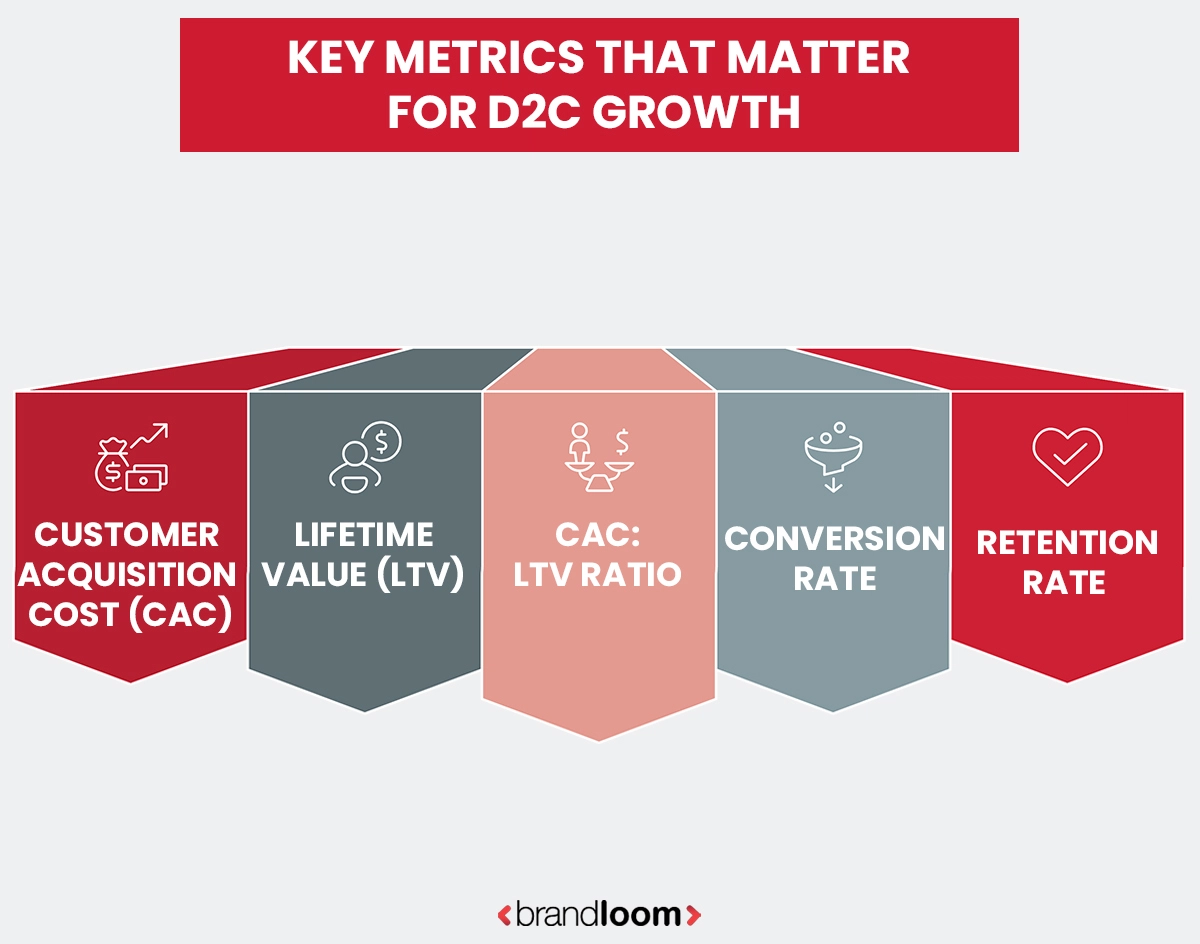
1. Customer Acquisition Cost (CAC)
Customer acquisition cost tells you how much you spend to acquire one customer. If your CAC keeps rising, your growth becomes expensive and difficult to sustain.
2. Lifetime Value (LTV)
Lifetime value measures how much revenue a customer generates over time. Increasing LTV is key to improving profitability and scaling efficiently.
3. CAC: LTV Ratio
This ratio shows whether your business model is sustainable. A healthy balance between customer acquisition cost and lifetime value ensures long-term business growth.
4. Conversion Rate
Your conversion rate indicates how effectively your website or landing pages turn visitors into customers. Even small improvements can significantly impact revenue.
5. Retention Rate
Customer retention measures how many customers come back to buy again. Strong retention reduces dependency on paid acquisition and supports full-funnel marketing success.
Focusing on these metrics helps you make smarter decisions. Instead of chasing vanity numbers, you build a system that supports consistent and scalable growth.
Conclusion
The question is not simply performance marketing vs growth marketing. The real question is what your business needs at its current stage and how you plan to scale.
Performance marketing gives you speed. It helps you acquire customers, validate demand, and generate immediate revenue through a focused paid ads strategy. This makes it essential in the early and growth stages when traction matters most.
However, speed alone does not build a durable business. Without retention, rising customer acquisition costs will continue to erode your margins. This is where a strong growth marketing strategy becomes critical.
By improving customer retention, increasing lifetime value, and optimizing the full customer journey, you create a system that supports sustained growth.
At BrandLoom, the focus is on helping brands combine the strengths of both approaches. Through performance marketing, businesses drive acquisition and immediate results, while growth marketing strategies strengthen retention, customer experience, and long-term profitability.
The brands that win are those that balance short-term performance with long-term thinking. When executed together, performance marketing and growth marketing become less a comparison and more a powerful, unified strategy for scalable business growth.
Frequently Asked Questions
The key difference between performance marketing and growth marketing lies in their focus. Performance marketing drives immediate results through a paid ads strategy and conversions, while growth marketing focuses on long-term business growth through retention and full-funnel marketing. As highlighted by BrandLoom, one drives acquisition, the other builds sustainable systems that maximize customer value.
No, performance marketing alone is not enough for D2C brands. While it helps acquire customers quickly, rising customer acquisition costs can limit profitability. Without a strong growth marketing strategy, retention and lifetime value remain low. BrandLoom emphasizes combining both approaches to achieve scalable and sustainable business growth.
Growth marketing in eCommerce is a full-funnel strategy that focuses on acquiring, converting, retaining, and re-engaging customers to drive sustainable growth. It comprises customer acquisition, conversion rate optimization, retention marketing, A/B testing, personalization, analytics, and loyalty-building. According to BrandLoom, growth marketing helps eCommerce brands improve customer lifetime value and profitability.
For startups, performance marketing is useful early on to validate demand and generate quick traction. However, relying only on it can increase customer acquisition cost over time. A balanced growth marketing strategy ensures retention and scalability. BrandLoom recommends starting with performance and gradually integrating growth marketing for sustained business growth.
Growth marketing reduces customer acquisition cost by increasing customer retention and lifetime value. When customers return and refer others, brands spend less on acquiring new users. Through full-funnel marketing and retention strategies, businesses improve efficiency. BrandLoom highlights that maximizing existing customers is the most cost-effective growth lever.
Performance marketing primarily focuses on acquisition and conversions, not long-term customer loyalty. While it can bring in new users, it does not directly build relationships. To improve loyalty, brands need a growth marketing strategy that includes retention and engagement. BrandLoom stresses combining both approaches for stronger brand connections.
D2C brands balance paid ads strategy with retention by combining performance marketing and growth marketing. Paid ads drive traffic, while retention systems increase lifetime value and repeat purchases. This creates a full-funnel marketing approach. BrandLoom recommends aligning acquisition with retention for efficient business growth.
The most important metrics include customer acquisition cost, lifetime value, conversion rate, and customer retention. These metrics define both short-term performance and long-term growth. A strong growth marketing strategy focuses on balancing these numbers. BrandLoom emphasizes tracking the CAC to LTV ratio for sustainable scaling.
Growth marketing may seem expensive initially because it requires investment in systems and retention strategies. However, it reduces long-term costs by improving lifetime value and lowering customer acquisition costs. Performance marketing can become costly over time as ad spend rises. BrandLoom views growth marketing as a long-term investment.
Yes, combining performance marketing vs growth marketing is the most effective approach. Performance marketing drives acquisition, while growth marketing improves retention and customer loyalty. Together, they create a scalable D2C marketing strategy. BrandLoom consistently recommends this hybrid model for sustainable business growth.