AI isn’t a “future trend” anymore- it’s everywhere, in your website, emails, social posts, and ads, etc. Almost 90% of marketers include AI in their work, while teams using AI report 44% higher productivity, according to available data. Brands are past the stage of testing AI; they are actively reallocating their marketing budgets for it.
The returns are out there, with McKinsey reports showing brands investing in AI in marketing and sales have witnessed revenue growth of 3% to 15%. It has turned into a powerful and versatile engine for growth and substance in any sector. Your brand, too, needs a well-designed AI marketing strategy to stay ahead.
Business leaders must understand that AI usage is not limited to trying new tools. AI has become a core part of marketing and business operations faster than most people thought. If your brand can’t utilize AI-powered marketing properly, it will certainly fall behind rivals who have embraced it successfully.
This blog is aimed at founders, CMOs, D2C brands, SaaS leaders, and ecommerce owners who want to master personalized marketing with AI. We’ll look into the core of AI marketing, changes expected in 2026, and ways to develop a killer AI-based digital marketing strategy.
You do not need to be an AI expert to use the technology for your marketing and business growth. You will need the apt strategy and an expert ally like BrandLoom to plan and implement it. Our digital marketing experts and AI strategists can streamline the process, enabling your brand to get the most out of AI marketing.
Why 2026 Can Be the Most Disruptive Year in Marketing History
Like some brand owners, you may feel the last few years whizzed past in terms of technology adoption. In 2026, things can get even faster, and personalized marketing with AI will take center stage. Here’s why:
- AI in digital marketing is no longer experimental. Businesses of different types are using generative AI like never before, and some have claimed tangible ROI benefits. What does it mean for business owners like you? Your rivals are already using AI-led growth strategies.
- At the same time, Global ad revenue is growing big time. It is set to cross $1.25 trillion by the end of 2025. Estimates show digital marketing covers a large chunk of it, and this trend will grow further in 2026. Brands are using smart AI tools to spend on specific platforms for maximum ROI.
- Meanwhile, AI search optimization is changing how people find information about products/services, and how they buy or book them online. Google’s AI Overviews are rolling out to web users worldwide, changing the online browsing and buying experience for billions of people. Your target customers are getting smarter, and they have more choices to pick from.
2026 is the year when changing customer expectations collide with AI marketing automation and ad spend head-on. Without a well-designed AI marketing strategy 2026, your brand willstruggle to stay visible and lose out on target buyers.
Choose the AI and SEO analysts at BrandLoom to offer you in-depth consultation and develop a custom AI-driven SEO strategy that hits the bull’s eye.
What AI Marketing Really Means in 2026?
Before you get into the nuances of an AI digital marketing strategy, learn what it really means. It is no longer just about a few flashy tools – chatbots or automated processes running in the background. By 2026, the use of AI in marketing will not become much wider. It will become a powerful ecosystem and redefine how brands create content, understand customer journeys, and offer personalized shopping experiences.
Let us have a look at it:
- AI marketing involves AI-based data analysis, automation, content creation, and forecasting in each step of the marketing funnel.
- In each stage, brands are using Generative AI for quick content production.
- For better customer journey mapping, brands are using AI technology to the hilt. They are relying a lot on emerging AI technologies, like predictive analytics and intelligent automation.
So, AI marketing in 2026 is a unified marketing ecosystem where AI is the key to the roadmap. However, your brand will still need a hybrid AI marketing strategy to succeed. AI still cannot handle the complexities of cultural context and strategy creation like expert human professionals.
The 2026 AI Marketing Framework- Core Pillars
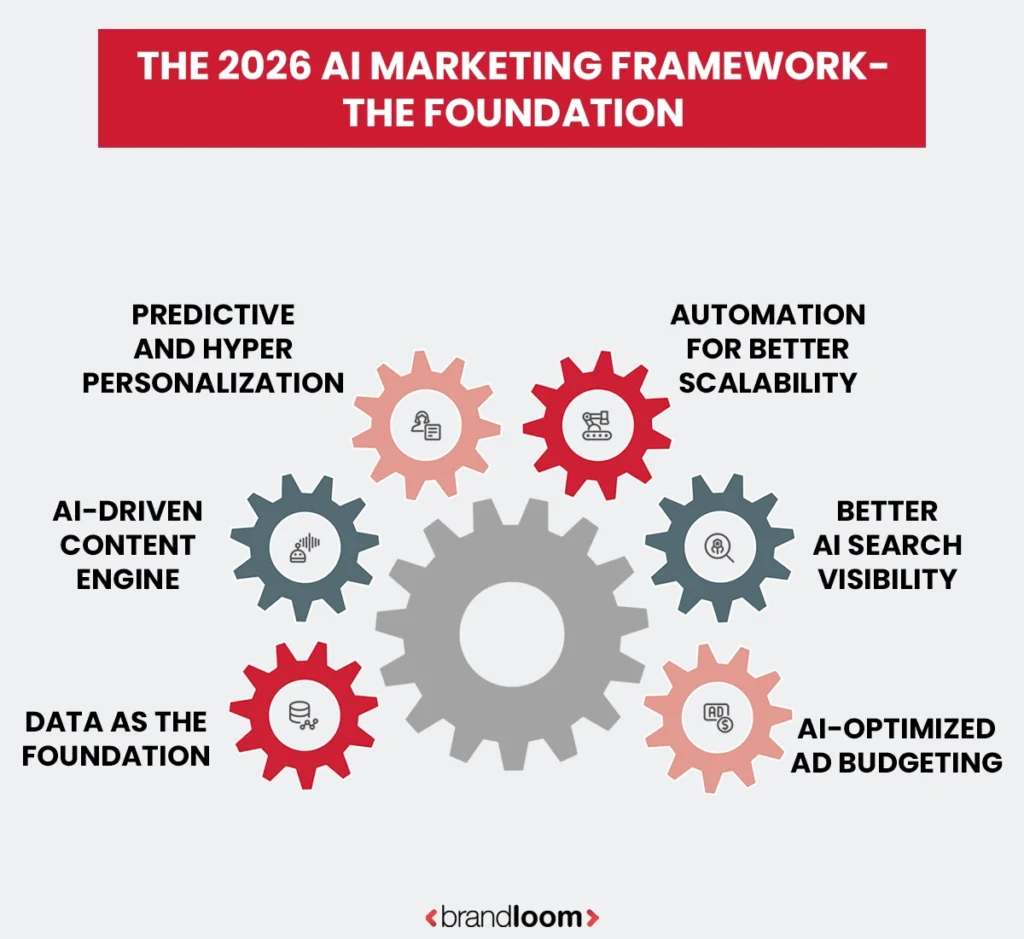
To develop a winning AI marketing strategy 2026 for your brand, stop thinking of any specific AI tool. It’s time you focus on creating an AI-based ecosystem. This automated system will gather and analyze datasets, create content, and gain insight from customer journeys. But you need an Expert AI marketing Agency like BrandLoom to navigate this transition.
There are some major pillars on which your AI Marketing Framework will stand and thrive:
1. Data Foundations
AI is only as good as the data you offer it. If your data is messy, the AI tool will not be able to process it well. So, focus on how you gather, store, and organize data. So, you will need:
- A clean, updated CRM without duplicate or junk records.
- Capturing first-party data from emails, phone numbers, purchase history, etc.
- Proper analytics setup
- Clear view of the customer journey
2. AI-Powered Content Engine
Your brand must use AI content optimization tactics. However, you must focus on AI to speed up content layout and planning, but use human expertise for strategy and voice.
Use Generative AI tools for emails, ad copy, social posts, and blog drafts. Also, use AI tools to repurpose existing content quickly. Ace content creators use their skills and expertise to ensure tone and positioning are consistent.
3. Predictive & Hyper Personalization
Your target users do not want generic messages anymore. So, use AI to customize the user experience. The predictive capabilities of these tools will be useful here.
Your AI-based hyper-personalized campaigns will focus on user segmentation by behaviors, not just demographics. These advanced tools also offer Product/content recommendations based on past user actions. Your users get very personalized emails, offers, and website experiences.
4. Automation for Scale
Your AI CRM strategy should involve automation of repetitive tasks so that your team can pay attention to important and complex topics. So, what can you automate?
- Lead scoring
- Welcome and follow-up emails
- Reporting dashboards and weekly performance summaries
- Simple chatbot support
- Retargeting audiences
5. AI Search Visibility (SEO → GEO → AEO → GAISEO)
The way your customers search for products or services is changing. They don’t look at the top 5 search results on a page anymore. Now, they get AI overviews, neatly presented in a box. Your brand must appear within these AI overviews for better user visibility.
How do you ensure that? We suggest you focus on:
- Schema/structured data for easy AI tool readability
- Covering customer questions in depth, showing authority
- Clear, structured content with FAQs, how-to steps, etc.
- Relevant, contextual content.
6. AI-Optimized Ad Spend
Your AI digital marketing strategy should focus on spending smarter and in the right areas, not just on the amount. Use AI analytics to find winning audiences faster. You can gain by using performance data to automatically move the budget to what works. There is no alternative to continuous testing with images, hooks, offers, landing pages, etc.
Feeling unsure about finding the right partner to develop your AI marketing framework? Give our AI strategists at BrandLoom a call.
Understanding what the New-Era Buyers Want
The buying habits of your consumers have changed much more in the last couple of years than in the last decade. In 2026, this trend will pick up pace further. They do not need convenience alone, but also look for relevant information, personalized experiences, and instant clarity on products and services.
Remember, these are not assumptions, but data-backed insights.
1. Need for Hyper Personalization
A McKinsey study shows 71% of consumers expect personalized experiences, and even a larger proportion are unhappy when there is a lack of it. So, generic messaging will lower conversions in 2026. Personalized product suggestions and custom emails work well. This applies to all types of brands, including D2C, SaaS, eco, and e-commerce.
2. Faster Answers to queries
Google’s focus on AI Overviews clearly hints at the users’ liking for quick answers to queries online. AI-generated result formats can lower response to regular and organic links. Your audience won’t like to browse search results- so your brand must appear in the AI overview box.
3. Seamless, connected journeys
With digital ad spending budget going up fast, customers have endless alternatives, and competition is intense. Your target buyers navigate so many modes- social media circles, website, email, etc. How do you offer them a consistent and relatable experience throughout? AI customer journey mapping is the way to go.
The 2026 buyer wants deeper personalization, better speed, and a consistent shopping journey. To meet these expectations, you need an AI marketing strategy 2026 crafted by experts in digital marketing and AI. That is where BrandLoom steps in. Our AI expert and SEO analysts create custom AI marketing strategies after extensive analysis.
How AI Will Change Content Creation Forever
Content is the first place where brands feel the reach and impact of AI. In 2026, this impact will be more powerful.
You can already use Generative AI to write drafts, create images, summarize research, and repurpose content. It will become much more functional and autonomous over time. Digital marketers already report using AI most heavily for content creation, editing, and analysis.
Here’s what most brands miss: the core aspect- AI speeds up content production and adds to volume. How do you make your content stand out? You have to think smart and focus on users’ needs.
In 2026, brands with the following strategies will win the content game:
- Content refined by humans for storytelling and emotional depth
- Content supported by first-party data insights
- AI search and tool-optimized content
- Content built around real customer intent
Remember, while AI is great at making drafts, variations, hooks, and summaries, it can’t replace expert human insight, brand voice, cultural understanding, etc. So, you can use AI to speed up production, not replace critical thinking.
The 90-Day AI Marketing Roadmap for Business Owners
Why do you think many businesses fail at AI? It is not because the tools are hard. They simply lack a strategic AI roadmap and fail to utilize the tools in the right ways.
Here is a 90-day AI digital marketing roadmap for your brand:
Stage 1 – Fixing the Foundation
First, you must gain clarity and find out why and where things are going wrong. Where are customers dropping off, and what is working on the website? After detailed analysis, focus on fixing your basics like analytics, CRM data, and tracking. Without clean and organized data, you will not get much benefit from AI.
Next, map your customer journey from discovery to buying. Pick the areas where using AI can help you speed up things and improve conversions. You may choose domains like content creation and email follow-ups. This is where our AI Readiness Audit services come in handy.
Stage 2 – Develop your AI Game
We recommend using AI in your marketing process in a structured way.
- Start with content creation and use generative AI to create drafts for blogs, posts, emails, and ads. Of course, use your skilled writers to refine those contents. This will help speed up production while maintaining quality.
- Follow it up with AI marketing automation strategies. These could include an abandoned-cart follow-up or a welcome sequence. These automated processes will run in the background and help improve conversions.
- Finally, use AI to assist your team with performance marketing. It can be used for testing creatives, refining audiences, and cutting down on wasted ad spend.
At the end of it, you will observe your marketing journey has become lighter, faster, and more consistent.
Stage 3 – Add Intelligence
This is where you stop just using AI tools. It is time to start thinking intelligently and get the most out of these tools.
Start segmenting customers by their behavior, then offer them contextually relevant content. Refine the website and email journeys so customers feel understood. AI tools offer dashboards and metrics to let users understand the progress over time. Keep what works and get rid of what does not, and learn from the journey.
A Case in Example- AI-Led Performance Turnaround for Ashley Stewart
Let us take a close look at a case study showing how AI marketing can be utilized for unprecedented revenue and conversion growth.
Ashley Stewart is a leading US-based fashion brand focusing on clothing and lifestyle products for plus-sized women. Their product range is strong, and demand is good, but the paid campaigns were not very effective. The ROAS was inconsistent, and the cost per conversion was rising. With the target users becoming fragmented, they found it tough to maintain a sustained performance.
They approached our AI marketing experts and SEO analysts at BrandLoom for a solution. We designed and implemented an AI-driven performance marketing campaign to improve conversion efficiency and revenue.
Strategy highlights:
- We improved campaign signals and structure for better AI learning and optimization.
- Our team expanded high-intent reach using broad match + automated bidding.
- We developed a creative system with consistent updates, reduced fatigue, and full compliance.
The Results:
The result of our AI-assisted performance marketing campaign was quick and tangible. With BrandLoom’s assistance, Ashley Stewart achieved a staggering 400% increase in ROAS. The cost per conversion was lowered by $2.94, leading to 13,800+ additional purchase events. Total purchase value growth was $1.16M. This proves how AI brings great business results when you use clean inputs, strong creativity, and proper optimization.
Mistakes to Avoid in AI Marketing Strategy 2026
Every business wants to use AI, but only a few manage to use it in the right way. In 2026, making the same AI marketing mistakes will slow you down and hurt your brand growth.
Here we have listed the common AI-powered marketing mistakes to avoid:
- You may have seen brands trying one AI tool after another for the best results. Without a planned business AI marketing guide, changing to a new tool won’t help much.
- AI generates content quickly, but it lags behind humans in emotional depth and cultural context. Overusing AI for Branding makes you sound robotic, repetitive, or generic.
- AI is powerful, but only when you feed it with proper data. When your CRM is messed up or tracking lacks depth, AI will falter with predictions.
- Overusing AI in customer interactions can backfire. Excessive automated emails will irritate your customers, for example. Personalization that lacks depth cuts no ice.
- Are you not ready for AI-assisted search? It can hurt your brand’s visibility and growth. Optimizing only for traditional SEO will have limited results on visibility and conversion. Google’s AI Overviews continue to reduce clicks to organic results.
- Stop blindly copying what your rivals are doing for AI search optimization. A customized, well-planned AI marketing strategy will suit your brand the best.
At BrandLoom, we help your brand overcome these problems by acting as your AI execution partner, not a regular consultant. Our AI and SEO experts carry out an AI Readiness Audit and, based on the analysis, come up with a strategy for personalized marketing with AI. You get a complete, effective AI marketing strategy that brings you steady, consistent growth.
Conclusion
2026 isn’t just another year of digital marketing; it will change the perception of AI-powered business growth. Brands that adapt to AI marketing automation strategies and personalize at scale will sustain. Those still relying on guesswork and outdated marketing methods will fade away faster than expected.
Your customers have already embraced AI, and AI search is here to stay. Even the online platforms you use for marketing – like Google, Meta, etc, have jumped on the AI bandwagon, too. The important question is when your brand is going to develop and use an apt AI marketing strategy 2026?
Will it lead the charge or respond when it’s too late?
Contact our digital marketing and AI SEO experts at BrandLoom when you want a clear, well-planned, and research-backed AI digital marketing strategy.
Remember, the smartest brands of 2026 won’t just use AI; they will use it with clear intention, strategy, and expertise.
Let’s get on the road to the future of marketing 2026, together.
FAQs
You can think of an AI marketing strategy in 2026 as a complete marketing plan with AI integrated in every aspect. It is much more than using a new or several AI tools. Such a strategy uses advanced AI tools to analyze customer data and predict behavior. It can also create and optimize content.
It also helps brands personalize buyer journeys and improve digital ad spend efficiency across channels. When you have an AI-powered marketing strategy, you get more real-time insights. You need not rely on guesswork. The goal is simple: use AI to make your digital marketing smarter, faster, and more effective. Contact BrandLoom’s AI marketing analysts for the most effective strategy.
Business owners cannot keep AI out of their 2026 marketing strategy. Online platforms and customer behaviors are now AI-based. Your target buyers expect a very personalized shopping experience. And that is where AI tools do their magic. Search and ads are increasingly being driven by AI.
Brands with clean data and structured content get chosen by AI agents consistently. Without AI, businesses find it tough to stay relevant and reach target customers easily. With personalized marketing with AI, you can stay visible, reach buyers quickly, and get an edge.
AI is transforming digital marketing in 2026 in many ways, faster than most can imagine. AI-powered marketing makes your campaigns quicker, more predictive, and very personalized. Platforms like Google and Meta now use AI tech to decide what type of content, ads, or recommendations their users can see.
What does it mean? Brands must feed cleaner data and smarter content into these systems to get the maximum output. Using AI helps your company speed up content creation, AD ROI analysis, and map the customer journey well. Overall, AI is set to make digital marketing faster, customized, and more predictable. To get clarity and an AI-ready marketing strategy for sustained growth, contact us at BrandLoom.
An AI-powered marketing strategy includes elements like automated workflows, predictive analytics, an AI-assisted content engine, and clean first-party data. It also covers personalized customer journeys and AI-optimized ad performance. Your brand will need strong GEO/AEO practices to stay visible in AI overviews.
An AI digital marketing strategy relies on real-time insights and continuous optimization. Ultimately, you will have to find a balance between AI efficiency and human creativity to get the best results.
In 2026, AI improves customer targeting and personalization in different ways. AI tools can analyze real-time behavior, preferences, past purchases, and intent signals deeply. They can find out whatevery customer is likely to do next. These AI tools offer personalized content, including predictive suggestions and ads for repeat buyers.
This leads to higher customer engagement and reduced shopping cart abandonment. With predictive analytics, brands can better customize journeys across email, ads, and websites. Customer personalization becomes automatic, scalable, and quite accurate.
There are plenty of tools businesses can use for AI-led growth strategies:
A content AI tool for drafting and repurposing content
A CRM to store clean first-party data
AI-powered ad platforms (Google, Meta) for optimization
AI email automation tools
AI-based predictive marketing tools
SEO/GEO/AEO tools to stay visible in AI search
Remember that your goal is not to use many AI tools. You have to pick the best ones for your brand’s needs and use them well. Our AI SEO experts at BrandLoom will guide you here.
AI tools help visibly improve SEO and content marketing. With these tools, you can create structured, intent-driven content quickly and easily. Such content can help your company perform well in AI-powered search results like Google’s AI Overviews.
Besides, with such AI tools, you can analyze user questions, competitor gaps, and semantic patterns better. With the right AI tools and strategies, you can optimize content better. Then, it appears directly in AI summaries, answer boxes, and conversational search results.
AI can fully automate many repetitive marketing tasks in 2026. These include creating and managing marketing emails, lead scoring, content repurposing, ad testing, etc.It can also help you refine and automate campaign optimization.
This involves changing budgets, audiences, and creatives in real time. For content creation, you can use AI tools to draft first versions, create variations, and reformat posts for specific online platforms. These automations free digital marketers from manual tasks. They can focus on strategy, creativity, and customer relationship improvements.
Small businesses can adopt AI marketing affordably, but they need the right AI-driven SEO strategy. They can embrace low-cost or free AI tools that automate high-impact tasks. With these tools, they can automate repetitive tasks like content drafting, social media scheduling, basic email flows, and more.
They can also embed such AI tools into their existing CRM, website, and marketing stack. It is better that you begin with one or two use cases, like faster content creation. With clean data and a clear strategy, even small AI inclusions bring you major marketing gains. At BrandLoom, we have guided several growing brands to adopt AI for long-term growth and profitability.
To assess ROI in 2026, you must track how AI improves efficiency, revenue, and cost savings.
Brand owners must observe the following aspects:
– Improved email or funnel conversion rates
– Faster content creation
– Lower cost per lead
– Higher repeat purchases
– Lower manual workload
– Better customer segmentation
AI’s ROI isn’t measured just in revenue boost. You also have to look at gains like making smarter decisions and time-saving. With the right AI marketing strategy 2026, you can experience improved campaign performance, better buyer retention, and enhanced visibility.