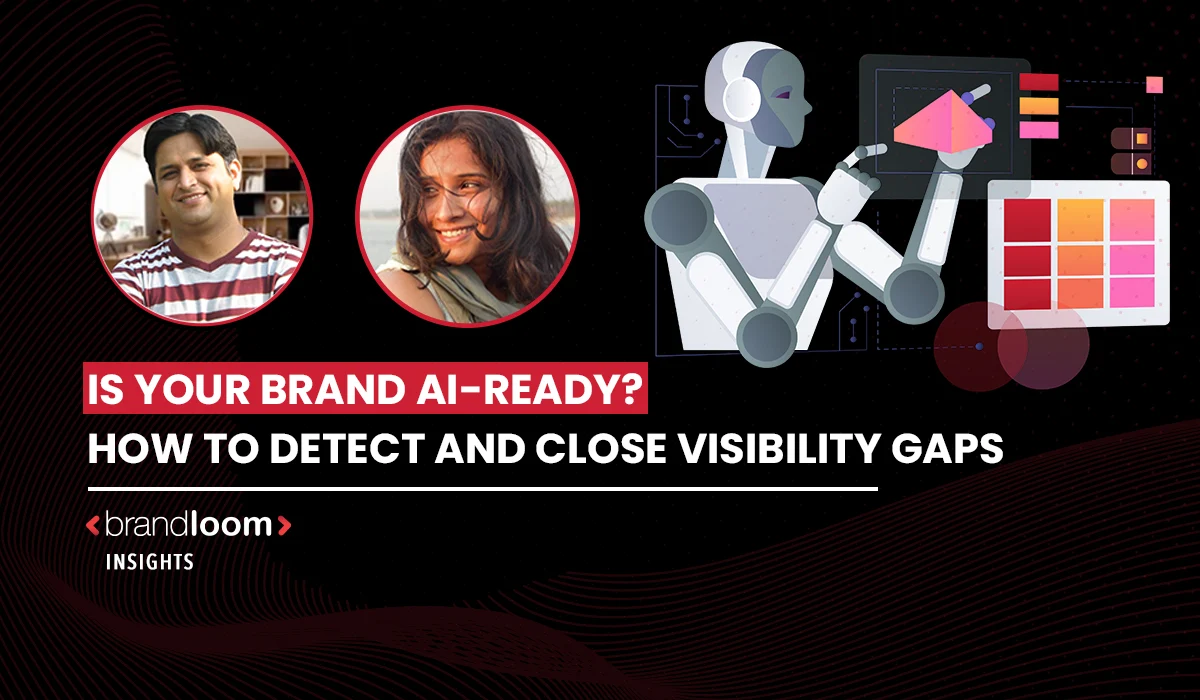
Did you know your brand’s visibility is quietly moving from Google search results to AI-generated answers?
AI-driven search is now deciding which brands get seen – and which ones disappear.
If your brand isn’t prepared, you risk disappearing from the digital landscape faster than you think.
AI has transformed the way customers research, compare, and communicate with brands. The conventional SEO method is no longer sufficient, as AI engines determine whether a business will be featured in answers, summaries, and recommendations.
Consequently, any company will have to pose a big question: Is your brand AI-ready in this new era of AI discovery?
Visibility is now characterised by AI readiness.
Poorly structured data, an unclean AI tech stack, or an undefined AI adoption strategy mean your brand will not show up in AI search.
This impacts your AI-driven decision-making and erodes your AI-based competitive advantage. Worse still, you might miss essential opportunities in AI-enabled business development because none of the content aligns with AI expectations.
Nonetheless, BrandLoom, the best AEO agency in India, helps brands bridge this gap through proper AI readiness assessment, enhancing data preparedness for AI, and developing a dedicated strategy to integrate AI. You can prepare to transform your business through AI and expand your visibility across all touchpoints.
Why AI-Readiness Now Defines Brand Visibility
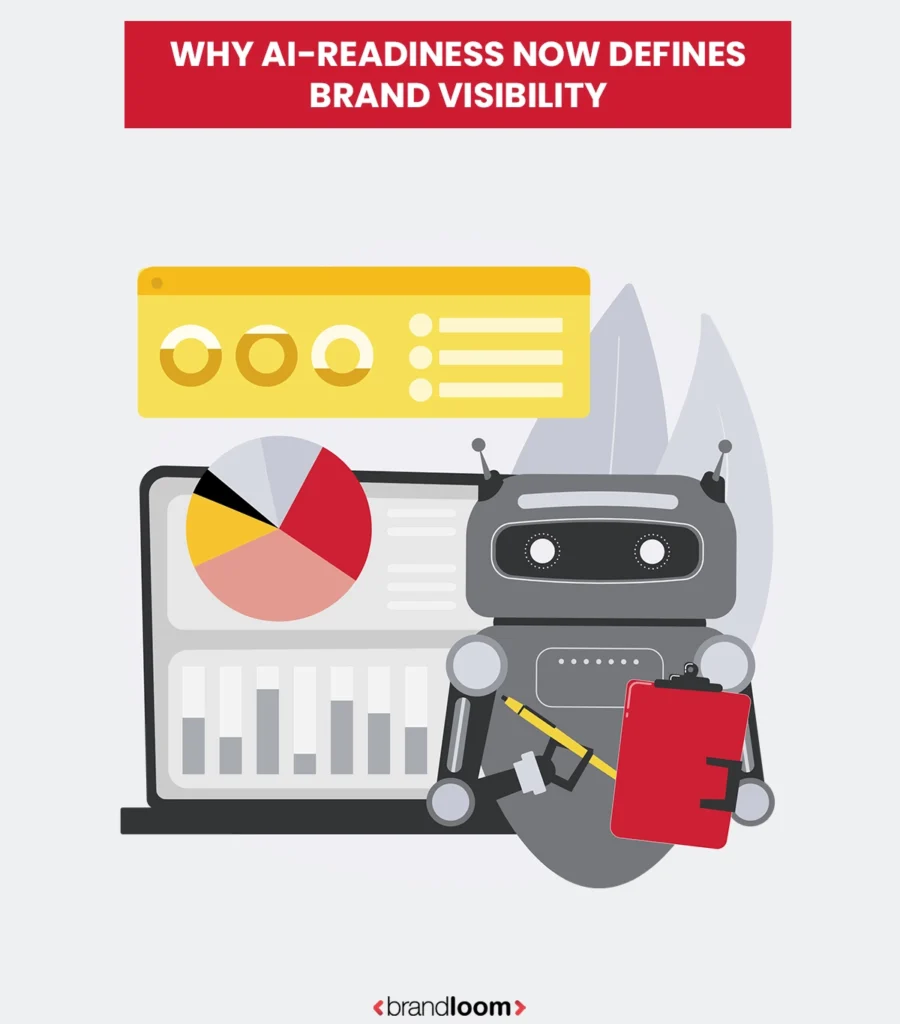
AI has become the gateway to online discovery. Google, Bing, Meta, Amazon, and even small search tools all use AI to decide what content to show. As a result, brands that do not prepare themselves to discover with AI are quickly forgotten. Worse still, they might not be aware of what they are missing.
Thus, you need to know what business AI readiness, AI readiness assessment, and AI capability evaluation actually mean nowadays, or you need an expert AI Marketing Agency like BrandLoom to handhold you.
Keywords are not the only element that AI analyzes. It also analyzes meaning, structure, authority, freshness, and user intent. In case you lack these signals, your brand will lose visibility in AI-generated responses.
And, if you were wondering, is your brand AI-ready? If so, then you are ahead of competitors who are not yet ready to assess their content, data, and AI approach.
This article deconstructs all that you need to know:
- How AI evaluates brands.
- The metrics to assess AI tools in businesses.
- The cues AI makes to prioritise or suggest brands.
- Visibility gaps, which most brands ignore.
- How to prepare to be found by an AI search.
- AI readiness assessment workflows and tools.
- A plan to future-proof your brand.
Let’s begin with the fundamentals.
What AI-Readiness Means for Modern Brands
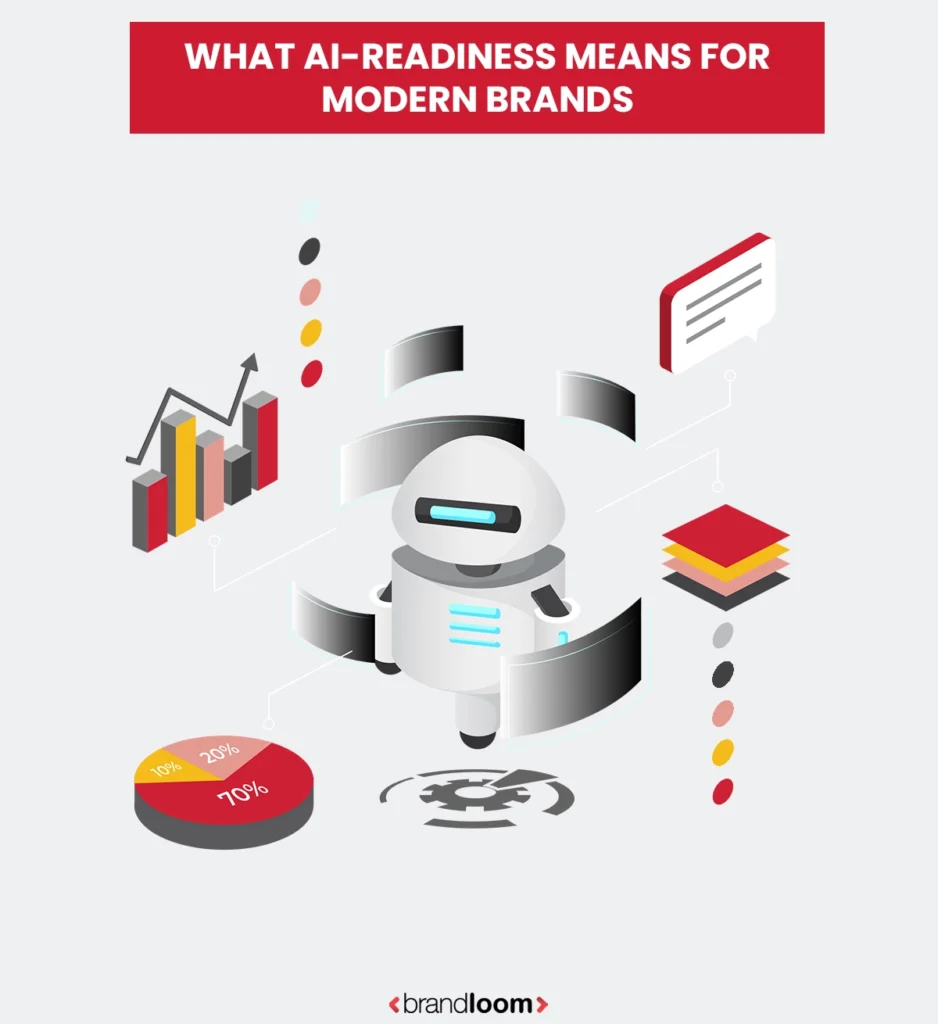
The AI-readiness of your brand is your ability to understand AI, embrace it, and leverage it across marketing, operations, visibility, and customer experience. Although it might sound technical, the main point is that AI requires quality indicators on your brand to interpret, trust, and refer to you.
This is what AI-readiness entails:
1. AI for business means getting to know how AI supports your goals.
Brands should understand where AI can add value. For example, AI could be used to automate content processes, identify audience intentions, or predict purchasing patterns. By understanding the role of AI, brands not only save time by saving energy but also develop a robust AI adoption plan.
2. AI for brands means the innovative application of AI tools
Most brands experiment with random AI without considering whether it is appropriate for their workflow.
The correct tools should be used in content audits, SEO optimization, structured data, competitor tracking, and customer journey analysis.
That is why knowing the proper criteria for evaluating AI tools in enterprises is essential. The appropriate tools help you scale. The bad ones cost both time and money.
3. AI infrastructure readiness
AI-based discovery engines analyze data in real time. Therefore, brands must have clean, accessible data, structured content, strong schema, and a user-friendly website. AI may struggle to interpret your brand fully without these technical foundations.
4. Workforce readiness for AI
AI enhances productivity, yet your staff needs to know how to use it. You scale without friction when you train people on prompts, workflows, and responsible AI practices.
5. AI governance framework
Brands require guidelines on how to use AI safely and ethically. This eliminates risks and aligns with responsible AI.
The combination of these factors defines your AI maturity model score. They also affect your ranking within AI-based search applications.
How to Check If Your Brand Is Missing AI Visibility Opportunities
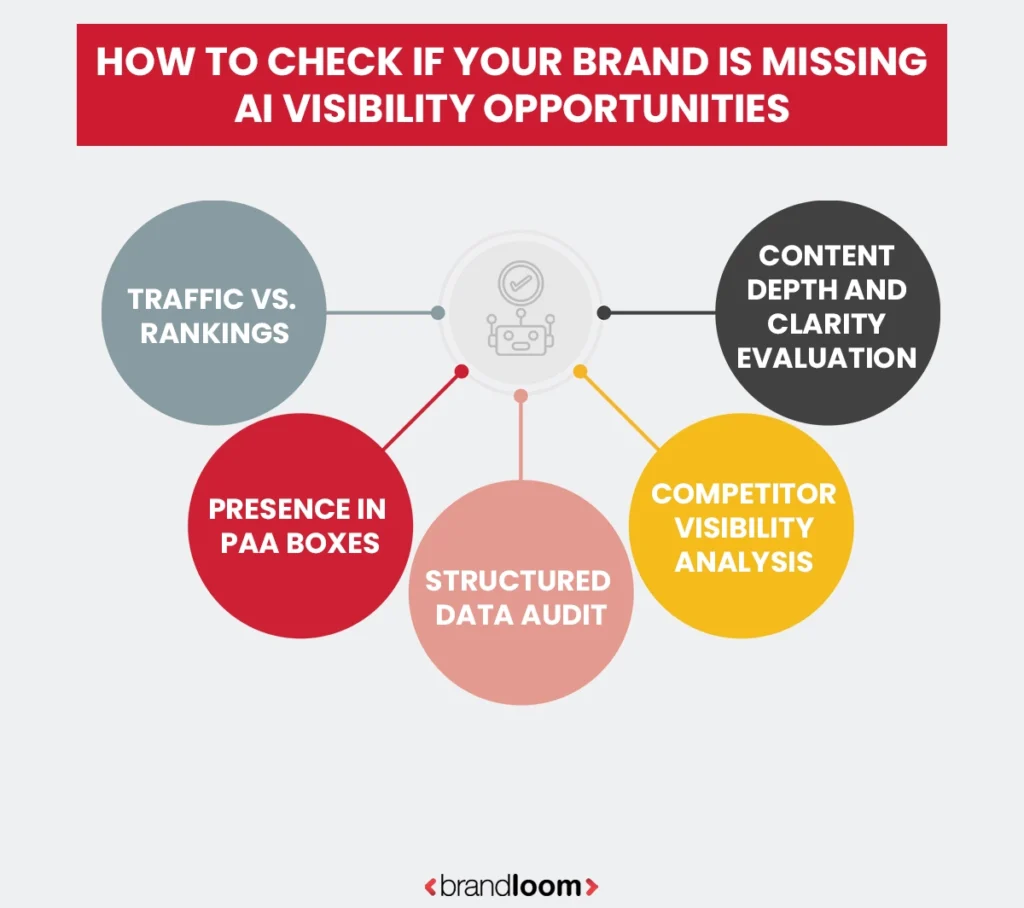
The search is transformed by AI, and the way customers find brands is changing. Thus, you should also consider whether your business is becoming less visible due to weak signals or a lack of AI-readiness. This is how you can analyse your current state and identify your first alert indicators using clear, data-driven metrics.
1. Monitor Traffic vs. Rankings
Begin by comparing the organic traffic and keyword rankings.
When rankings appear steady but traffic drops, AI Overviews might be stealing clicks. This means that your AI readiness, business AI readiness, or AI transformation readiness requires more work.
2. Check Your Presence in PAA Boxes
Now look at your visibility in People Also Ask (PAA) sections.
These boxes are used to train AI models’ responses. The absence of PAA implies a lack of topical authority, AI capability assessment, and AI-based decision-making support.
3. Audit Your Structured Data
Next, validate your schema.
The absence of structured data is a bad omen that your AI infrastructure is not ready and that you are unable to receive AI summaries.
Look for gaps in the article, FAQ, product, and How-to schemas.
4. Analyse Competitor Visibility
Next, determine whether competitors are more frequent in AI responses.
When they appear, and you do not, then your AI adoption strategy and AI-based business transformation need to be addressed.
5. Evaluate Content Depth and Clarity
Lastly, revise your content structure. Websites with small or unstructured information pose a threat to organisations’ AI-readiness, as AI values clarity, concise sentences, lists, and direct answers.
Monitoring these signals enables you to detect visibility gaps early and develop a robust AI integration strategy that enhances discoverability in the AI-driven search space.
The Most Common AI Visibility Gaps Brands Overlook
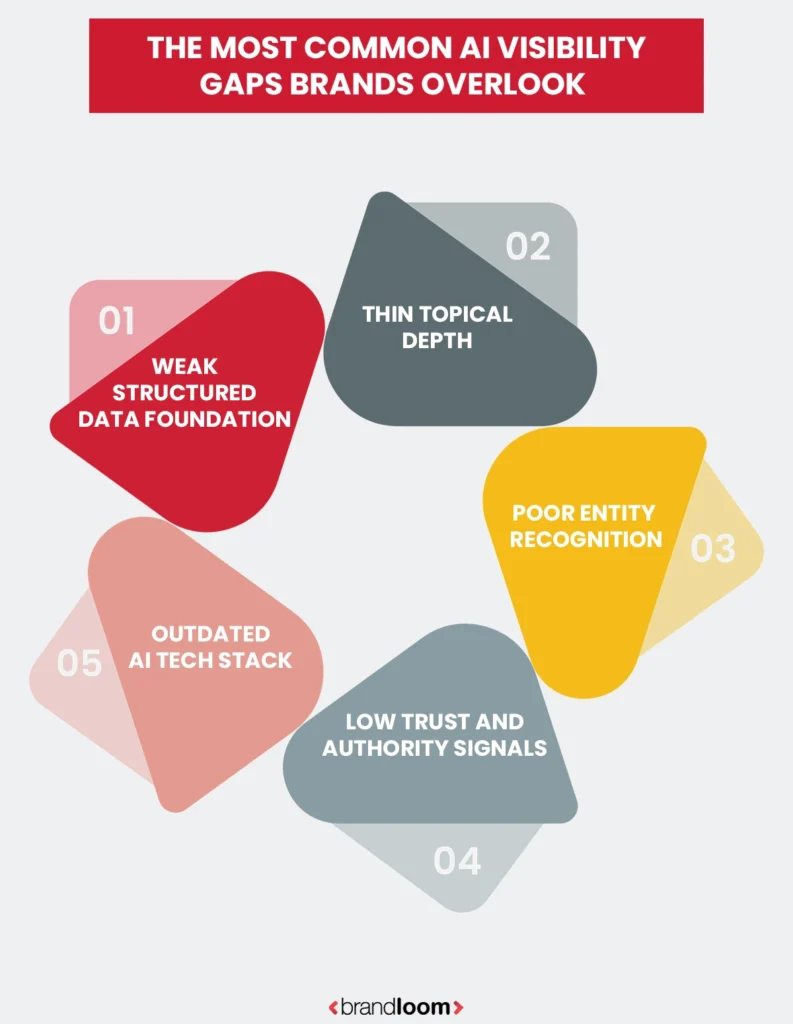
A lot of brands are spending on digital marketing, yet they become invisible in AI-based search. This is because they ignore essential gaps that influence AI preparedness, AI maturity, and long-term discoverability. These are the most frequent problems that are worth keeping an eye on.
1. Weak Structured Data Foundation
Many sites lack a clean, complete schema. Artificial intelligence engines are based on structured information to comprehend context.
Lack of schema diminishes the data preparedness for AI and undermines AI-based decision-making indicators. Common issues include no FAQ or How-To schema, incorrect product markup, and outdated article schema.
2. Thin Topical Depth
Brands tend to post superficial material. Nonetheless, deep, clear, and purposeful models are more acceptable to AI models.
This disconnect lowers AI capability assessment scores and affects business development with AI in place.
3. Poor Entity Recognition
AI search engines prefer brands with well-defined entities.
The absence of author bios, vague brand descriptions, and inconsistent naming undermines business AI preparation and AI transformation preparation.
4. Low Trust and Authority Signals
AI tools uses credibility signals. Poor E-E-A-T decreases your possibility of appearing in AI Overviews. This has a direct effect on your AI integration strategy and general visibility.
5. Outdated AI Tech Stack
Many brands operate on outdated systems. This slows data processing and affects the readiness of the AI infrastructure. Consequently, artificial intelligence cannot assess your work well.
By sealing such gaps, the brands improve AI preparedness within their organizations and remain competitive in AI-based discovery.
How AI Search Engines and AI Overviews Work
The use of AI search engines performs content analysis differently from traditional search. They are meaning-oriented, contextual, and interrelated. Consequently, your AI preparedness and AI adoption plan directly influence how your brand is reflected in AI-generated summaries and answers.
1. How AI Search Engines Understand Content
AI models do not read keywords only. They consider intent, profundity, form, and power. They gauge data readiness for AI, entity readiness, and overall AI power.
AI search engines prioritise clear answers, strong schema, verified entities, and high authority content. This step aids AI-powered decision-making and enhances accuracy.
2. How Google’s AI Overviews Select Information
AI Overviews provide brief reports on the best ideas of act-now answers. To achieve this, Google measures the indicators of organisational AI readiness, AI tech stack evaluation, and structured data quality.
Failing to achieve these standards renders your brand invisible. AI Overviews consider schema accuracy, page structure, topical depth, source authority, and user intent match.
3. Why This Matters for Brands
AI engines promote content that is well-equipped in AI infrastructure and has stable entity profiles. They, however, punish ambiguous material, poor markup, or old systems.
As such, enhancing these cues will increase your visibility in AI responses, PAA boxes, and AI summaries (Long form). Knowing how AI search engines operate will position your brand to be transformed by AI and seen long-term.
Signals Google’s AI Overview Considers
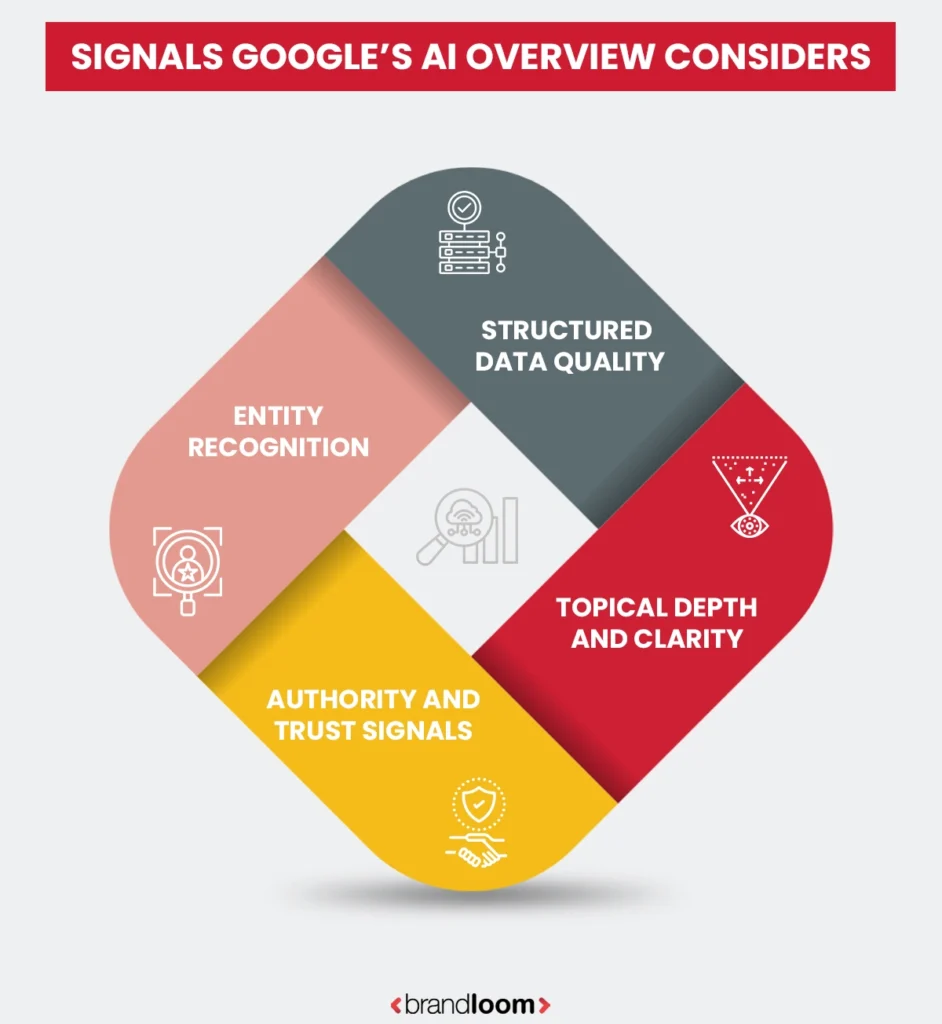
1. Structured Data Quality
Google tests your schema to ensure it is clean, complete, and up to date. AI models are trained on structured data to derive context.
Poor markup reduces your AI capability evaluation and visibility. Key elements include FAQ schema, How-to schema, Product markup, Author and entity schema.
2. Topical Depth and Clarity
Google is more attracted to the content that directly answers questions. Short sentences, bullet points, and a good fit of intent augment your opportunities. This aids the AI-based decision-making process in search models.
3. Authority and Trust Signals
AI Overviews determine your E-E-A-T strength. Clear author bios, professional commentary, and citations enhance AI readiness within an organisation.
4. Entity Recognition
Google rewards those brands that are consistent in their entity profile. Good entity clarity can make your content an opportunity for AI-powered business growth.
Optimising these signals enables you to enhance your AI integration strategy and become more visible in AI-driven search.
How to Optimise Content for AI Answers and PAA Boxes
At BrandLoom, we firmly believe that AI-driven discovery requires brands to maximise content optimisation as AI engines are now focused on clarity, structure, and authority.
By adopting the correct method, our AI experts will help you enhance AI preparedness, improve business AI preparedness, and create more opportunities to feature in AI solutions and PAA boxes.
1. Begin With Direct, Clear Answers.
AI models like content that is direct and to the point. Write short sentences. Respond to the overall question in the first two lines. This enhances AI capability evaluation and helps to make AI-backed decisions.
2. Use Bullet Points and Subheadings
Semantic structure helps AI models scan more quickly. Summarise steps, benefits or features with bullets. Precise subheadings improve the organization’s AI preparedness and visibility.
3. Strengthen Topical Depth
AI engines reward depth. Include supportive descriptions, examples, and other concepts. This aligns with AI-enabled business expansion, as it establishes greater authority.
4. Improve Schema and Structured Data
Added FAQ, How-To, and Article schema. Make sure the markup is complete and error-free. Clean schema eases the preparation of the AI infrastructure and increases the qualification for PAA boxes.
5. Enhance Entity Clarity
Specify your brand, authors, and services. Include bios, company descriptions, and uniform naming. This entails better indicators for the AI integration strategy and enhances trust.
These types of optimisation ensure your brand appears in AI responses more often, and in the long run, your brand will be visible in the AI-based search space.
Tools to Audit Your Brand’s AI Readiness and Content Gaps
Why You Need AI Readiness Tools
Brands are not always able to understand how AI search engines perceive their content. The right tools enable you to detect optimisation gaps quickly. Thus, it is more convenient to evaluate AI visibility through organised analysis. Countless enterprises have begun trusting BrandLoom as the Best LLM Optimisation Agency in India.
Essential Tools to Use
Audit your brand AI optimisation and find areas of weakness with these tools:
- Surfer SEO & Clearscope – Analyze topical richness and semantic coverage.
- Also Asked & Answer: Find opportunities and question clusters for PAA.
- NeuronWriter -Enhance coverage and intent alignment.
- Schema Markup Validator -Check structured data problems.
- ChatGPT vs. Gemini – An AI test of visibility and answerability.
BrandLoom AI Readiness Audit Tool (suggested by the AI optimisation company India) – Assess the optimisation gap in LLM.
How These Tools Help
The tools provide explicit insights into content quality. They point out missing keywords, poo444fr entities, and structural problems. In addition, they demonstrate the appearance of your website in AI-generated summaries. Companies collaborating with BrandLoom, the Best AEO Agency in India, can achieve faster improvements. As a result, brands can address AI visibility gaps and reinforce their presence in search.
How to Fix Low Visibility Caused by Weak Data or Schema
With a weak schema, AI systems cannot fully comprehend your content, reducing your visibility on AI search engines and AI Overviews. To correct this, you need to strengthen your technical foundation and improve the presentation of your brand information.
You are supposed to run structured data tests to identify errors, missing fields, and invalid markup that can confuse search engines. Second, enrich the schema with FAQs, How-To, Product, or Review schema to provide AI with more context. You need to ensure that your entities are clear too by ensuring that pages have similar names, categories, and attributes.
Also, canonical tags can be used to avoid duplicate content issues and allow AI to choose the correct version. You need to work on the URL structure to make navigation cleaner and more understandable. Also, optimize the size of big pages to improve the speed, which is a relevant signal to AI. Lastly, use the breadcrumb schema to enhance clarity in hierarchy.
As soon as AI recognizes your structure, you become more visible.
What Type of Content Performs Best in AI-Driven Search
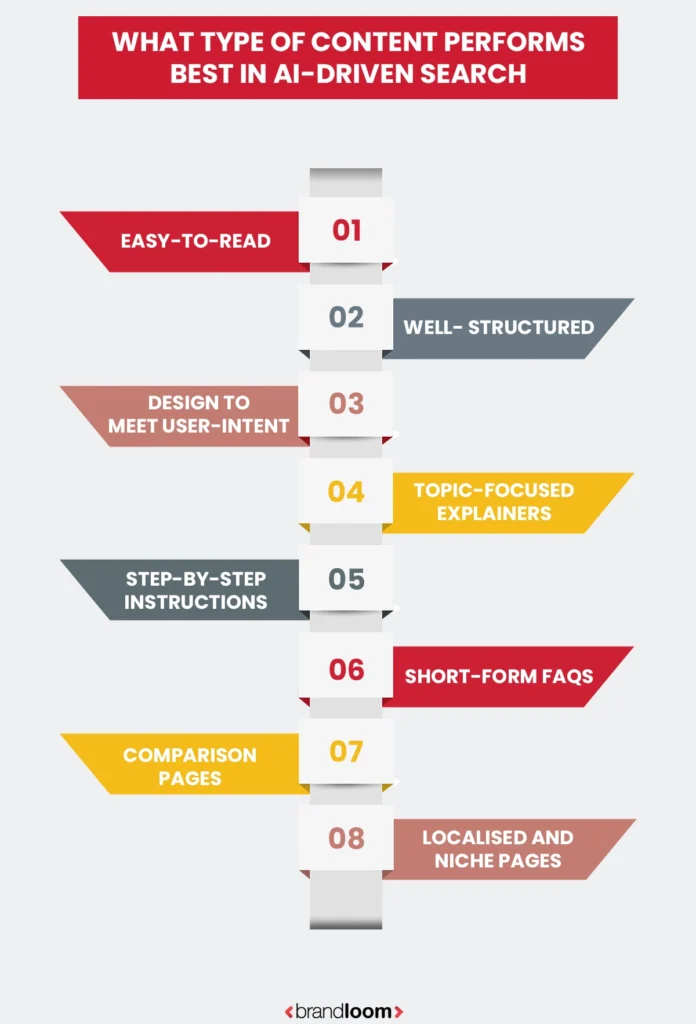
The AI-based search favors content that is easy to read, well-structured, and designed to meet the intent. Thus, brands should maximize AI-ready formats, AI-ready data, and high entity clarity.
The reason why such topic-focused explainers work is that they directly respond to user intent and assist AI models in extracting clean signals. Step-by-step instructions are highly rated for their ability to align with AI-based decision-making and make complex operations easier.
Short-form FAQs are effective because they are comparable to AI Overviews, which summarise information in brief, actionable answers. Entity-rich content is better, as it helps secure your organization’s AI readiness and enhances search engine recognition.
Comparison pages are effective since they are structured and present contrasted insights that AI systems can easily process. Localised and niche pages are effective because they are focused on specific intents, which AI systems are more concerned with to be accurate.
With structured, purposeful content you produce, your brand can be seen more prominently in AI search results.
Building Long-Term AI Visibility and Staying Competitive
The strategic blend of content quality, data preparedness, and continuous optimisation is the key to long-term AI visibility. Early investments ensure that brands adopt AI more quickly, enhance their AI preparedness, and stay ahead of competitors.
Build a Strong AI-First Content System
AI search engines favor information that is preliminarily structured, explicit, and purposeful. Thus, it is necessary to consider the content as an asset, which should be developed not as a single operation.
Key steps include:
- Post information that responds to queries and assists in making decisions based on AI.
- Ensure entity consistency across pages to enhance organizational readiness for AI.
- Feed the models with new data regularly to ensure they read new, reliable information continuously.
Strengthen Your Technical and Data Foundation
Your technical well-being determines how AI systems perceive your brand. Even minor problems will prevent visibility. Focus on:
- Enhancing the schema to accommodate data preparedness for AI.
- Eliminating mistakes in your sitemap, URL structure, and canonical tags.
- Turning structured information into meaningful connections between your brand, products, and topics.
Leverage AI Optimization Tools and Insights
AI-driven search continues to evolve every week. Therefore, you have to employ tools that monitor gaps, track entity performance, and analyze competitors. You should:
- Track PAA boxes, AI Overviews, and conversational queries.
- Follow what content succeeds with the help of such tools as Surfer, Semrush, and personal AI auditors.
- Examine keywords that elicit AI search results.
Stay Consistent and Future-Focused
Long-term visibility requires discipline. Those brands that revise their content every month remain competitive and relevant to AI search. Through persistent upgrades and robust technical governance, you build resilience, power, and long-term AI-driven business growth.
Conclusion
AI-driven search is reshaping how brands gain visibility. You must strengthen your AI readiness, improve your data readiness for AI, and build content that supports AI-powered decision-making.
When your schema, entities, and technical signals stay consistent, your brand becomes easier for AI systems to understand.
Additionally, the leading Indian AEO agency, BrandLoom, offers structured content and continuous optimisation to help you remain competitive in an evolving landscape.
Now is the time to upgrade your strategy and invest in long-term AI-enabled business growth.
FAQs
A brand is AI-ready when its content, data, and digital assets are structured in a way AI systems can understand. This includes strong data readiness for AI, clean schema, clear entities, and consistent brand signals. AI readiness also means using an AI adoption strategy, training teams, and evaluating your AI capabilities.
When AI tools can interpret your content easily, your visibility increases across AI-driven search results. Leading agencies like BrandLoom help businesses map these requirements and align their digital strategy with AI-powered search changes.
A brand becomes fully AI-ready when it builds systems that support continuous optimisation,responsible AI practices, and scalable automation. In short, AI readiness means your brand is future-proof and discoverable.
You can check your AI visibility by analysing your structured data, schema quality, and content clarity. Start by reviewing whether your pages address user intent and align with People Also Ask patterns. Then assess your data readiness for AI and ensure your brand entities appear consistently across platforms.
Use AI readiness assessment tools to detect gaps in content depth, topical authority, and structured formatting. Agencies such as BrandLoom conduct detailed audits to identify issues in AI-powered decision-making areas, PAA formats, and AI Overview triggers.
Look for missing schema types, unclear metadata, and weak internal linking. When you fix these issues, you strengthen your AI integration strategy. Brands that audit regularly avoid losing visibility in AI Overviews.
Many brands overlook weakly structured data and inconsistent schema. Others miss missing or unclear entities, which prevent AI systems from understanding brand identity. Businesses often ignore thin content that fails to match AI-powered decision-making signals.
Some skip technical optimisation, such as slow pages, broken links, or poor UX. Our experts at BrandLoom often find that businesses ignore content formats preferred by AI-driven search systems.
Another common gap noted by BrandLoom’s SEO professionals is the absence of an AI governance framework or responsible AI practices. When brands fail to update content for AI search engines, they lose rankings, visibility, and competitive advantage.
AI search engines analyse meaning, intent, and accuracy instead of relying solely on keywords. Google’s AI Overview uses machine learning to detect authority, clarity, and trust signals. This impacts visibility because AI focuses on semantic relevance, structured data, and brand consistency.
If your brand lacks AI readiness, it may not appear in AI-generated summaries or answers. AI Overviews compress information, so only the strongest sources appear.
Brands with updated schema, rich entities, and high-quality content win visibility. As a result, businesses must optimise for AI-driven search experiences to stay discoverable in competitive markets.
Google’s AI Overview considers entity clarity, authoritative content, and strong structured data. It evaluates your schema, internal linking, and content quality. It also checks whether your pages deliver accurate, up-to-date answers.
Google analyzes your domain expertise, data readiness for AI, and how well your content matches user intent. The system prefers pages that include step-by-step guidance, FAQs, and trustworthy insights.
Additionally, Google reviews behaviour signals such as engagement and click patterns. As experts at BrandLoom advise, when your content aligns with its AI integration strategy, your brand appears more frequently in AI-generated results.
Brands must write clear, structured content that answers intent in the first paragraph. They should add FAQs, bulleted lists, and concise summaries. They must use schema markup because AI systems rely on this data.
Next, they should enhance entity clarity by consistently naming people, places, and products. Brands must use short sentences to match AI-powered decision-making formats.
Moreover, they must ensure pages load quickly and avoid clutter. It also helps to review AI-driven search results and mirror the formats ranking there. When these strategies combine, brands increase their chances of appearing in AI answers and PAA results.
You can use AI readiness assessment tools, structured data validators, and entity analysis platforms. Tools like Google Search Console and schema testing tools reveal technical issues.
AI-powered platforms help you measure your AI capability assessment, content depth, and entity visibility. You can also use NLP-based tools to evaluate semantic gaps and keyword coverage. Furthermore, competitors’ AI-driven rankings provide insights into your weaknesses.
For broader analysis, you can use AI maturity model frameworks to check organizational AI readiness. When you use these tools regularly, you maintain a strong AI adoption strategy and close visibility gaps early.
You should start by adding the correct schema types to your pages and testing them in structured data tools. You must clarify your brand entities and ensure they stay consistent across your site.
Next, improve your internal linking so AI systems can map relationships. Update your metadata and ensure your URLs follow a clean structure. Also, compress images and improve page speed. Add breadcrumb schema to assist navigation.
When you improve data readiness for AI, your visibility increases. A strong AI integration strategy ensures AI systems correctly interpret your content and rank it higher.
AI-driven search prefers structured, intent-based content. Step-by-step guides, clarity-focused explainers, and data-backed insights perform strongly. FAQs rank well because they match conversational and question-based search patterns.
Comparison content works because AI can map structured differences easily. Entity-rich articles strengthen your brand identity in AI systems. Localised pages perform well due to precise intent. AI tools also prefer content with schema, short sentences, and easy formatting.
When your content shows AI readiness and supports AI-powered decision-making, it ranks better in AI-generated answers. Brands that write for clarity dominate AI-driven visibility.
A brand must update its AI readiness strategy regularly. It should create content that adapts to new AI search behaviours. It should also upgrade its schema, enhance entity clarity, and maintain strong technical SEO.
Using an AI capability assessment helps identify weak areas. Brands must train teams in AI skills and build a culture of continuous optimisation. They must also follow responsible AI practices and monitor signals that AI systems prioritise. Additionally, they must invest in structured, evergreen content.
When brands follow a long-term AI adoption strategy, they stay competitive and future-proof their visibility. Many brands collaborate with us at BrandLoom, the best SEO agency in India to adapt to constant algorithm updates and AI-driven search changes.