In 2026, millennials and Gen Z will cover approximately 32% of global consumer spending. So, if you want them as customers, you must understand how to tailor your marketing strategies to appeal to them. Crafted marketing strategies for Millennials vs. Gen Z will be critical to your survival.
These two generations have overlapping as well as unique priorities and mindsets, directly affecting their buying behavior. With shopping dynamics and trends changing fast, the way they shop, engage, and form brand loyalties has changed. If your brand still uses outdated marketing strategies, it won’t be long before it gets overcrowded by others.
Using a common strategy for these different generations will not work. You will need a deep understanding of millennials vs. Gen Z differences to develop a generation-specific marketing strategy for each category.
You will need the expert guidance and insight of leading digital marketers to develop an apt brand strategy for Gen Z and millennials. BrandLoom, with an extensive background in branding and digital marketing, is your perfect ally on this journey.
In this blog, we will learn the major differences between Gen Z and millennials for shopping needs and choices, ways to develop apt generational marketing strategies, and pitfalls to avoid.
Millennials vs Gen Z: Key Marketing Differences in 2026
Before developing apt marketing strategies for these two generations, you must understand who Gen Z is and what a millennial is, clearly.
Millennials denote a generation born between 1981 and 1996 – often called the first digital generation. They witnessed the launch of the internet, social media, andsmartphones. However, the Great Recession of 2008 deeply affected their financial habits and shopping priorities. Many of them dealt with the menaces of student debt and unemployment.
Gen Z, born between 1997 and 2012, grew up with smartphones, the internet, and social media. Their shopping decisions are largely influenced by digital tools and specific social networking platforms. The COVID-19 pandemic made them financially aware. However, they get attracted to brands with social and environmental commitments.
Despite some common shopping patterns, the overall purchasing behaviors, expectations, and values differ greatly. Gen Z shoppers are digital-first and seek social relevance, environmental footprint, and authenticity, while Millennials prefer brand loyalty and long-term value. You will see both types of shoppers relying heavily on social media recommendations for shopping.
Such major differences show up clearly in their shopping behavior:
- Millennials prefer doing deep research, comparison, and choosing brands that they feel are trustworthy.
- Gen Z explores through social media feeds, acts on impulse, but detaches fast when something does not feel authentic.
Understanding this distinction is vital for brands targeting these buyer types —because ignoring it will make marketing strategies ineffective.
Here’s a more detailed look at the buying patterns and preferences of millennials and Gen Z:
| Parameter | Millennials (Born 1981-1996) | Gen Z (Born 1997-2012) |
|---|---|---|
| Spending Power | $4 trillion by 2030 | $12 trillion in the U.S. by 2030 |
| Approx. Social Media Usage | 3.2 hours/day on platforms like Facebook, Instagram, Twitter | 5.1 hours/day on platforms like TikTok, Instagram, Snapchat |
| Brand Loyalty | Mostly remain brand loyal if they trust a brand | Not very brand loyal, prefer novelty |
| Purchase Decision Drivers | Influenced largely by online reviews and influencers | Driven deeply by social media recommendations (77%) |
| Price Sensitivity | Seeking value for money, willing to pay more for quality | Highly price-conscious, prefer affordable options, deal seekers |
| Financial Behavior | Higher debt from student loans, mortgages | Frugal and focused on financial independence |
| Tech Integration | Adapted to the digital age, prefer PC and mobile apps | Digital natives prefer mobile-first and AR experiences |
| Cause Engagement | Support sustainability and diversity, less vocal | Deeply engaged in social causes, gender equality, climate change, etc. |
To analyze the shopping preferences of these two generations and develop effective marketing strategies, you should use AI-driven personalization. Choose a branding and digital marketing agency with proven expertise in emerging AI technologies in marketing– BrandLoom, the winner of the 2025 Martech AI awards.
Why Traditional Marketing Fails with Millennials and Gen Z?
Why do you think old-school marketing approaches do not work with Millennials and Gen Z? They have very specific buying preferences and financial mindsets, sometimes overlapping and contrasting.
Traditional marketing strategies with longer attention spans, linear funnels, and repetition-based loyalty fail to shine in a changing marketing scene. Such dated roadmaps fail with Gen Z in particular, as they need speed, relevance, and participation. Similarly, millennials lose interest in brands leaning heavily on trends, as they prefer depth, credibility, and consistency. Without customized, generational marketing strategies, brands fail to engage and convert them into customers.
What is the result?
- Gen Z buyers don’t convert because they find the experience slow or boring
- Millennials disengage because brand messaging feels shallow or inconsistent
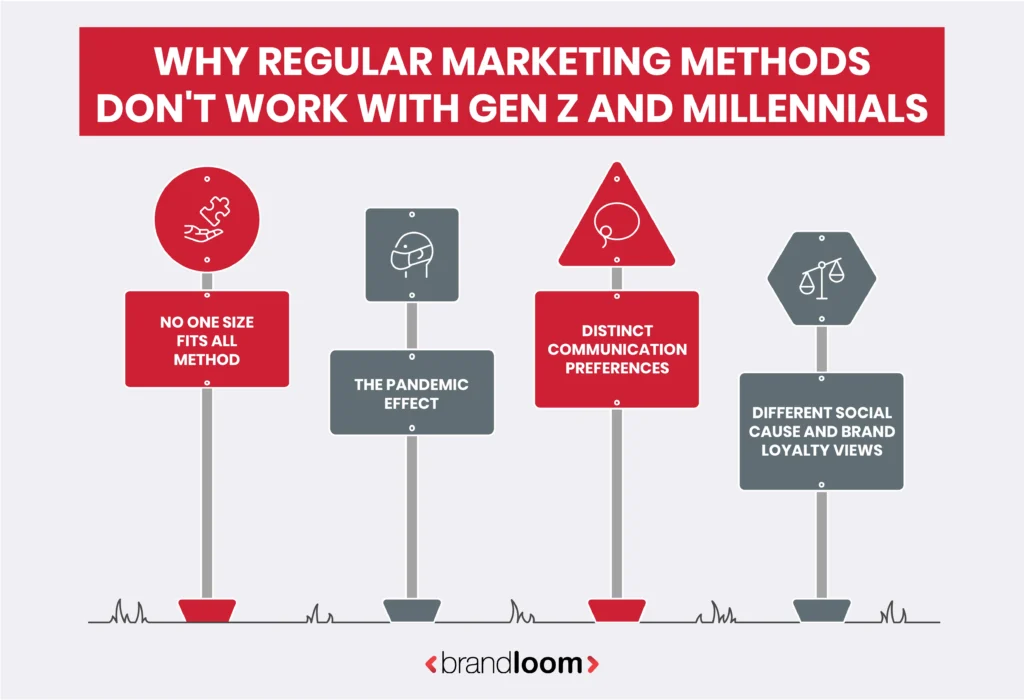
1. “One Size Fits All” Strategy Falls Flat: Millennials vs. Gen Z
A big reason why many brands fail to attract millennials and Gen Z is that they stick to age-old marketing strategies. They fail to understand the differences between these two generations, their mindsets, and their shopping and financial priorities. So, a strategy that suits millennials well may not appeal to Gen Z shoppers.
2. The Effect of the Pandemic: Millennials vs. Gen Z
The COVID-19 pandemic affected both millennials and Gen Z populations, but not in the same ways. It shaped their purchasing behaviors and expectations differently. Here’s how:
Several Millennials, already reeling from the after effects of student loan debt and the 2008 recession, also experienced steep workplace struggles, including job loss. It made them more careful about spending than in the past.
Unlike Millennials, Gen Z experienced the pandemic at the beginning of their career. Job uncertainty led them to adopt a pragmatic approach to their usual carefree, impulsive spending. They quickly shifted to making affordable, deal-centric purchases.
Brands failing to grasp these Millennials vs Gen Z marketing differences falter with their strategies, too.
3. Different Communication Choices: Millennials vs. Gen Z
Millennials and Gen Z have different preferences for marketing channels to engage with brands. Typically, over 60 percent of millennials prefer communication through email and long-form content, even though they have embraced social media over the years. They love email marketing, including exclusive discounts andloyalty rewards. You can use brand storytelling content to attract and engage them.
Gen Z loves instant communication using different social media channels. You will see them spending hours on interactive digital platforms like TikTok, Instagram, and Snapchat, messaging, and product search. They are not so fond of using emails for brand communication and other needs.
4. Different Views on Brand Loyalty and Social Causes
Brand loyalty remains a major factor for Millennial marketing trends in 2026. However, they expect the entities to align with their core values. Gen Z buyers care deeply about brands with social and environmental footprints, according to the 2024 Nielsen Consumer Trends Report. You will see them increasingly prefer companies using greener manufacturing methods. They actively avoid brands with unethical practices.
So, you can see why using a generic marketing strategy fails to gain traction with these generational buyers. To analyze and understand millennials vs Gen Z differences and develop apt marketing strategies, you need a veteran branding and digital marketing agency. At BrandLoom, our marketing analysts and branding experts can show you the right way.
The Risks of Not Adapting to Gen Z and Millennial Marketing Trends 2026
Don’t make the mistake of using a unified brand strategy for Gen Z and millennials in 2026. That will make your brand lose efficiency, reliability, and visibility. Remember that both millennials and Gen Z, despite their unique traits, respond to different triggers across message, channel, and shopping experience.
If your brand does not adapt to the Gen Z and Millennial marketing trends in 2026, the risks are too big:
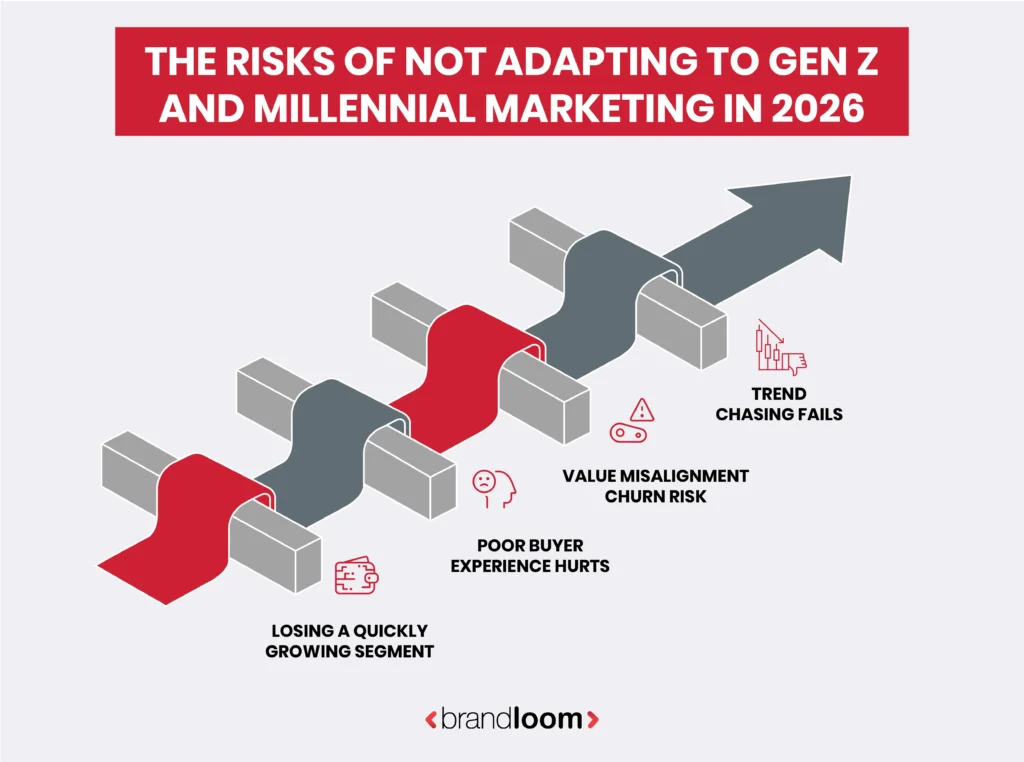
1. Losing a Fast-growing Segment: Millennials vs. Gen Z
Despite their young age, Gen Z’s spending power is on the rise. NielsenIQ projects it to touch $12 trillion by 2030. If you lack a Gen Z- centric marketing strategy, you risk losing this group to competitors already deploying apt generational marketing strategies.
2. The Risk of Value-Misalignment Churn
Gen Z’s relationship with brands is quite conditional. If they find your brand’s purpose and behavior don’t match, they won’t take long to switch to another. A Thomson Reuters study found that 81% of Gen Z buyers change buying decisions according to brand action and reputation. Even the millennial generation expects brands to resonate with their core values.
3. Poor Customer Experience is a Deal Breaker
Poor customer experience can be a sure-fire way of repelling both millennials and Gen Z buyers. Both of them will leave a brand after one or a few negative interactions. In this area, the millennial generation tends to be more sensitive than Gen Z. So, strategic loopholes like slow response times or poor self-service options will drive both types of buyers away from your brand.
4. Trend Chasing Can Backfire: Millennials vs. Gen Z
The lack of proper knowledge on Millennial buying behavior will cost your brand dearly. Millennials, after undergoing major events like the recession and the pandemic, seek value in brands. They have no time for inauthentic brand positioning. If you get too much into chasing trends, you will lose a large section of millennial buyers.
So, how do you identify the risks and loopholes in your omnichannel brand strategy? Seek the expertise of the agency that has set new standards in branding and digital marketing over the decades. Count on BrandLoom’s impeccable track record and experience in developing niche-specific branding solutions.
How Brands Should Adapt Generational Marketing Strategies in 2026?
It is 2026, and you cannot rely on age-old marketing systems anymore, as they can be downright risky. Millennials and Gen Z now command a major chunk of market share in any sector. However, you must understand the millennials vs Gen Z differences before developing niche-specific strategies. They engage, evaluate, and convert in different ways, but also share some commonalities.
We will look into some useful ways to adapt your brand positioning for both Gen Z and millennials:
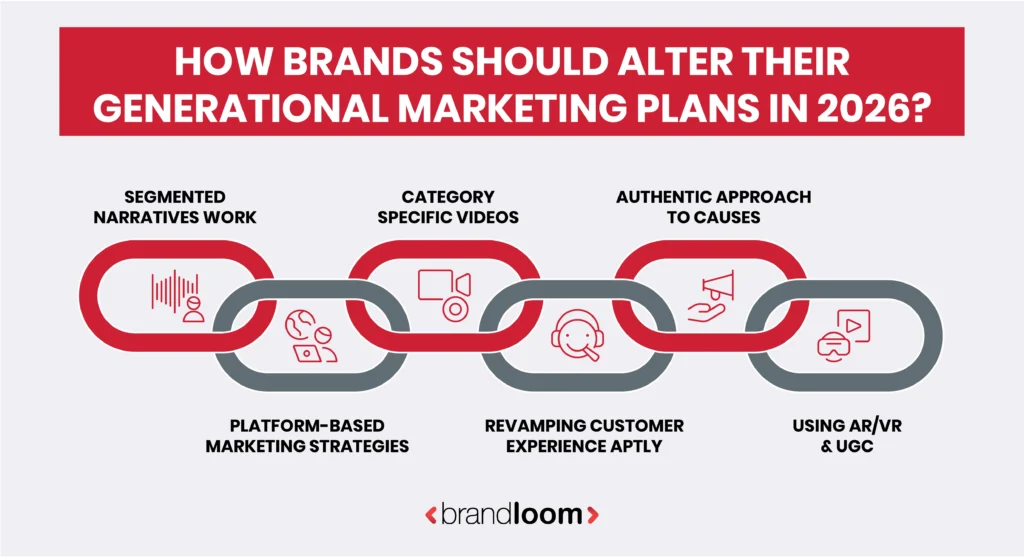
1. Using Segmented Narratives: Millennials vs. Gen Z
Use generation-focused narratives to create your brand’s marketing strategy. Millennials respond well to genuine storytelling, value-led positioning, and context matching with their needs and situations. They love brands scoring well on consistency and credibility. Gen Z buyers look for speed, clarity, and value alignment in brands.
So, your brand needs unique messaging systems- with narrative depth to engage millennials and purpose-driven immediacy for Gen Z.
2. Developing Platform-centric Marketing Strategies
One vital aspect of developing a Millennials vs Gen Z marketing strategy is to understand how they consume social media. While Millennials use social media a lot, Gen Z spends more time on those portals. Most Millennials prefer platforms like Instagram, Facebook, and YouTube for educational, testimonial, and story-based content. You will see Gen Z thriving on TikTok, Instagram Reels, and Snapchat for short-form, trend-led, and interactive content.
Your brand will need Platform-specific formats with content that matches the preferences of these different generations.
3. Using Videos Judiciously: Millennials vs. Gen Z
It’s a no-brainer that video and interactive content win your audience better than static ones. But generational differences apply to video consumption, too.
Gen Z uses video to consume short, authentic, creator-driven content. They are more into mobile-first, raw engagement. However, you will find the Millennials watching longer, polished, educational videos and DIY guides on YouTube and Facebook. While Gen Z prefers mobile devices, Millennials use a mix of mobile, desktop, and even streaming devices.
Clearly, your brand needs to use videos in its marketing blueprint to appeal to those distinctive generations.
4. Redesigning Customer Experience – But in Different Ways
To appeal to millennials and Gen Z buyers, redesign your brand’s customer experience. They both detest brands offering a poor shopping experience, but in different ways.
Millennials go for loyalty programs, personalization, and continuity, while Gen Z prefers instant brand responses, mobile-optimized UX, and seamless social commerce.
Your brand must revamp its marketing strategy well to improve customer experience for these distinct demographics.
5. Being Authentic about Causes: Millennials vs. Gen Z
Both millennials and Gen Z buyers prefer brands that have social, environmental, and humanitarian causes. However, your brand positioning for Gen Z will work if it’s authentic about supporting such issues.
Performative activism is what they dislike and won’t take long to reject such brands. Gen Z expects brands to take a strong stance on social and environmental issues, while the millennial generation is more pragmatic.
So, next time you champion an earth-friendly initiative, ensure it is well planned and executed, not just for show.
6. Leverage AR/VR Tech and UGC
Gen Z buyers, who grew up in the digital era, show more inclination for emerging technologies, including augmented reality and virtual reality. They also embrace user-generated content over brand ads. Unlike Millennials, they look for interactive and immersive experiences- even in marketing and brand communications.
So, you should consider using such futuristic technologies to engage and retain Gen Z buyers. You can, for example, include things like virtual try-ons, 3D product demos, or interactive brand activations. Similarly, UGC helps build trust with this generation as they prefer authenticity. So, you can use product reviews or BTS content in marketing strategies to keep it realistic.
Still unsure about picking the right partner for revamping your brand strategy for Gen Z? At BrandLoom, we have the in-depth expertise and skilled marketing analysts to do the needful. Check out our outstanding success in designing a killer SM campaign for Jungle Crow for a better idea.
Self-Service and Chatbots: Meeting the Needs of Millennials and Gen Z
In 2026, both Millennials and Gen Z will embrace self-service in customer support over regular human support. Gen Z, in particular, is more comfortable using self-service options like knowledge bases, automated troubleshooting, and AI chatbots. Research shows that over 60% of Gen Z buyers choose self-service for simple inquiries, valuing speed, convenience, and control.
Millennials aren’t far behind here; over 50% of them are showing preferences for using chatbots. However, they prefer the AI-powered chat agents for simple tasks like order tracking or answering FAQs. Gen Z buyers are naturally inclined to use such chatbots. Overall, both generations appreciate fast, frictionless customer service that the AI-enabled chatbots and self-service portals offer.
It is time for your brand to start integrating self-service and chatbot solutions into its app and website. It is no longer a nice-to-have add-on, but self-support options are a must to attract these tech-savvy buyers. Brands that prioritize these tools will succeed in keeping pace with the evolving service preferences of Millennials and Gen Z. Once again, you can gain by seeking the expertise of BrandLoom in the AI chatbot development niche.
Conclusion: Millennials vs. Gen Z
Without effective and customized generational marketing strategies for Gen Z and millennials, your brand risks losing out on a large chunk of both groups.
Your brand will need tailored marketing strategies to appeal to the millennial generation, witnesses of career volatility, digital transitions, and Gen Z, digital natives who thrive on social media. They view brands through lenses that both overlap and move apart.
Several brands fail to grasp the subtle nuances of digital marketing trends in 2026 and consumer behavior changes. They wonder why the conversion rate and customer loyalty have gone down.
To develop generation-specific branding strategies that win both millennial and Gen Z buyers, your brand needs unique strategies. Focus on creating segmented messaging systems, improving customer journeys seamlessly, and developing social content resonating with different generations.
To develop marketing strategies that are designed on the understanding of generational differences, you need deep insights and expertise in marketing and branding. Rely on BrandLoom, the preferred marketing and branding ally for several youth-focused brands, with an unmatched track record of campaigns making brands successful, in India and abroad.
FAQs
1. What is the difference between Millennials and Gen Z consumers in 2026?
In 2026, the difference between Millennials and Gen Z consumers is not only about age, but also about how they think of brands. Millennials experienced the Great Recession, which made them value-driven buyers focused on trust, consistency, and long-term benefits. They research and compare a lot, but once they trust a brand, they stick to it.
Gen Z consumers are true digital natives who experienced the pandemic in their adolescence. They grew up with smartphones and social media as their companions. The latter is what they use the most to find and evaluate brands and make purchases. They are drawn towards supporting social and environmental issues.
Brands often struggle to develop a fitting brand positioning for Gen Z. This is mainly because this generation of buyers has developed unique buying habits, and their priorities differ from those of others. They use social media for pretty much everything in life, including shopping and assessing brands. Social content plays a key role in Gen Z purchase decisions.
So, brands relying more on traditional endorsements and ad spend will not appeal to them. They embrace interactive, user-generated content and influencer marketing over regular campaigns. Also, Gen Z prefers newer platforms like Snapchat and TikTok over others. They are quick to dismiss brands whose values and actions are misaligned.
Millennial buying behavior has changed over the years, slowly but steadily. The recession of 2008 has played a major role in redefining Millennial buying behavior. Earlier, they focused on brand identity and lifestyle alignment, but later chose utility, reliability, and ROI. You will find them doing deep research, comparing choices, and checking out reviews and recommendations before purchase.
Brand loyalty matters, but they focus more on consistency. Sustainability and ethics appeal to them, but they are more realistic on those grounds than Gen Z buyers. To understand their buying preferences and design effective marketing strategies, count on BrandLoom for its expertise in developing tailored marketing roadmaps for several domestic and offshore brands.
To understand the marketing strategy for Gen Z, you need clarity on Gen Z consumer behavior in 2026. Called digital natives, Gen Z buyers discover brands primarily through platforms like TikTok and Instagram. They check out short-form video, peer content, and reels. Polished traditional brand ads do not affect them much, but influencers do.
Social media is integral to their buying decisions. To appeal to Gen Z buyers, you must focus on creating several touchpoints across the journey. Such buyers may discover your brand on TikTok, research on YouTube, evaluate you through Reddit, and purchase via Instagram. On each channel, the brand must feel consistent. Also, if your brand is consistently active in social and environmental activities, it is more likely to attract Gen Z.
To balance marketing forGen Z and millennials,your brand should avoid the older unified marketing strategy. It will gain from a segmented marketing roadmap and clarity on generational differences in buying and brand assessment. Millennials, affected by economic instability and long-term responsibilities, prefer consistent brand experiences, trust-driven messaging, and detailed information.
Gen Z expects speed, relevance, and authenticity in branding, offered through social media platforms. Your core brand values, product quality, and positioning should remain consistent. However, try to make messaging, platforms, and content formats varied to appeal to both generations of buyers. At the same time, long-form storytelling and email click with Millennials, Gen Z like short-form video and creator-led content.
Traditional digital marketing fails to find traction with younger audiences as it was designed for predictable journeys, brand-controlled messaging, and linear attention spans. These do not align with the consumer behavior changes. Gen Z and Millennials rely on different social media platforms and digital channels to find and learn about products.
Younger audiences also trust peers more than brands, so older celeb-endorsed ads may not work with them. They also have no appetite for delayed responses, irrelevant messaging, and slow websites. Digital marketing trends in 2026 point to relevance, speed, and participation. To develop Gen Z -centric marketing campaigns, choose a trusted digital marketing service provider like BrandLoom.
Artificial Intelligence is integral to modern generational marketing strategies. AI tools help you analyze the nuances of Millennials vs Gen Z marketing easily. You can design hyper-personalized, data-driven marketing campaigns for these two buyer groups. AI enables marketers to analyze vast datasets in real time, identifying behavioral, contextual, and psychographic traits unique to millennials and Gen Z.
In 2026, AI helps design and refine your generational marketing strategies. With AI-driven personalization, you can make your marketing campaigns more effective and better equipped to cover specific buyer personas. AI-powered tools and chatbots analyze user interactions to refine website experiences.
Gen Z is hooked on social media for pretty much everything, so that is what brands should leverage to gain their trust. They look for visible action and sustained behavior, not just claims. Your brand must focus on building and sharing credible social proof to get their attention. To keep them interested in your services/products, you should offer quick support and be transparent about pricing and policies.
Customer experience matters a lot to them. They also love brands that are serious and consistent about social and environmental causes. To gain more insight into how to win over Gen Z buyers for your brand, choose the leader in digital marketing and branding: BrandLoom.
While both Gen Z and Millennials use digital channels, they differ in how they use them. Millennials prefer a mix of traditional digital, social, and long-form content. But you will see Gen Z relying mostly on short-form, interactive, visual, and community-driven platforms. They love using platforms like TikTok, Instagram, and Snapchat for both brand discovery and making buying decisions. For Millennials, an omnichannel brand positioningworks better, as they use Facebook, Instagram, and LinkedIn, along with older mediums like email, for brand communication.
Brands must understand the different aspects of Gen Z and Millennial buying behavior to make their strategies future-ready. The brand foundation must be strong, and values, product quality, and positioning should be consistent across platforms. However, you need to know the millennials vs Gen Z differences in using digital platforms, types of content, assessment methods, etc.
It’s time you discard transactional advertising and focus on making authentic, value-driven, and interactive communities. You will gain by using authentic user-generated content, BTS content, and by focusing on sustainability and social justice. Using AI to enhance your generational marketing strategies will help. In this context, you can choose partners like BrandLoom with proven expertise in AI-assisted marketing.