AI Chatbots are transforming how modern businesses communicate, convert, and scale. They respond instantly, reduce workload, and guide customers at every step.
Today, customers expect speed. They expect clarity. And they expect brands to be available 24/7.
AI chatbots help companies meet these expectations with consistent, personalised conversations. They also improve lead generation and streamline support across all digital touchpoints.
As markets grow more competitive, businesses must adopt intelligent automation to stay ahead. Companies that use AI-driven chat systems gain efficiency, accuracy, and stronger customer satisfaction.
This is why many brands choose the best AI marketing agency in India, BrandLoom, to implement powerful AI chatbot solutions.
What is an AI Chatbot?
An AI chatbot is a software that uses artificial intelligence (AI) and natural language processing (NLP) to generate human-like responses on the basis of user input.
But what is an AI chatbot, really?
Compared with rule-based chatbots, AI-powered chatbots can understand context, learn from dialogues, and engage in real-time conversations.
Companies typically employ such bots in their customer services, messaging, and websites to increase customer interactions and automate standard tasks. AI chatbots can provide smarter, more intuitive customer experiences by taking the functionality and experience of the past and making it smarter, dependent upon a knowledge base and pre-trained models.
Conversational AI revolves around them, as conversations with customers across platforms can be attended to by the business at a reduced cost and prompt rate. The AI chatbots are revolutionising online communication. The best online marketing agency, BrandLoom, delivers digital marketing through AI chatbots, enabling superior performance in online customer interactions and increasing customer engagement across online channels.
Understanding AI Chatbots
AI chatbots are dynamic technologies that allow conducting intelligent dialogues with the help of conversational AI, natural language processing (NLP), and machine learning. They tend to be trained in advance on large knowledge bases and can consume the input from a user and produce human-like responses in real time, unlike the more rules-based systems.
Such chatbots assisted by AI can be embedded into messaging platforms, websites, and virtual assistants to be deployed in repetitive tasks, as well as for customer engagement. They learn through interaction and thereby keep getting better, and give more customised experiences to customers.
Consequently, AI chatbots are transforming business operations in terms of customer service with scalable and customer-intelligent bots throughout the interaction.
A Brief History of AI Chatbots
The history of AI chatbots began with a rules-based model in the 1960s called ELIZA, which mimicked a psychotherapist through a set of scripted responses. ALICE and subsequent bots later enhanced this by recognizing patterns.
The emergence of virtual assistants like Siri and Alexa introduced the trend of AI-based chatbots that employ a natural language processing (NLP) strategy. The latest and greatest chatbots are based on generative AI and extensive data backgrounds that also manage to sound nearly human and become the secret sauce of customer service and customer experience in a variety of businesses.
How Do AI Chatbots Work?
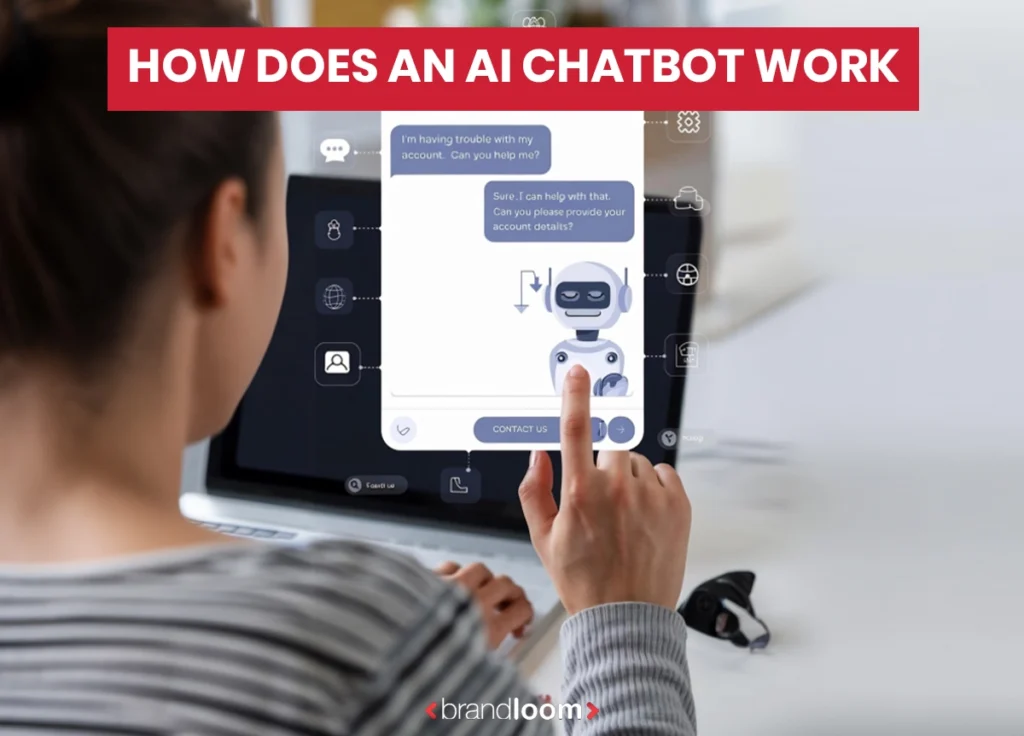
AI chatbots apply artificial intelligence (AI) and natural language processing (NLP) to interpret the user input. These bots use text to determine purpose and context. Such bots generate a human-like response, with pre-trained models and knowledge bases.
AI Chatbots do not require the elimination of the rule-based bots; unlike rule-based bots, they learn the history of interactions. They can become better with time with the help of machine learning. They work on the platforms, websites, and messaging apps. The generative AI allows free and non-emotional reactions.
They automate the redundant procedures in customer service. Chatbots support customers in real-time and enhance customer experiences and customer engagements with their intelligent automation. As BrandLoom mentioned, digital engagements can be more than a #1 rank in Google nowadays; smart AI talks are going to help in this.
Key Features of AI Chatbots
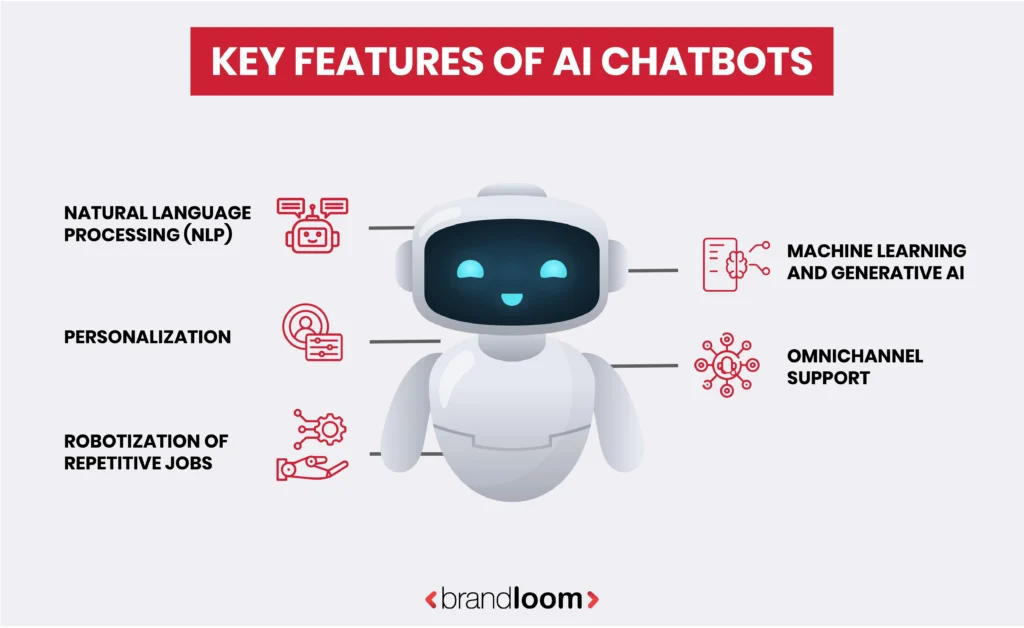
The development of AI chatbots incorporates functionality that makes them very effective business and customer tools. Artificial intelligence-based chatbots can respond to user input in real time as compared to rules-based chatbots that operate using fixed scripts. They rely on natural language processing (NLP) to understand questions, identify intent, and generate human-sounding conversational responses.
Natural Language Processing (NLP)
NLP helps chatbots to deduce human language and, therefore, helps them communicate better.
This ability allows chatbots to understand user intent, tone, and context with high accuracy. They can interpret slang, variations in phrasing, and even complex queries.
NLP also enables smooth, human-like responses that keep conversations natural. As a result, businesses can provide faster and more meaningful interactions.
NLP-driven chatbots reduce confusion, handle multilingual queries, and enhance user satisfaction.
Machine Learning and Generative AI
Chatbots can continuously improve their interactions with customers by learning and improving themselves through experience.
With every conversation, they adapt to new patterns and behaviours. They analyse past data to refine accuracy and predict user needs.
Generative AI also helps create richer, more context-aware responses that feel personalised. This continuous learning makes chatbots smarter over time.
It allows businesses to scale customer service without sacrificing quality. ML-powered chatbots become more efficient, proactive, and reliable with use.
Personalization
They store the history of transactions and give recommendations to the same customer.
This makes every interaction more relevant and tailored. Chatbots remember customer preferences, past issues, and browsing patterns. As a result, they can offer timely suggestions and personalised offers.
This level of familiarity builds a deeper connection with customers. It also speeds up problem resolution and boosts customer loyalty.
Personalised chatbots help brands deliver an experience that feels human and attentive.
Omnichannel Support
AI chatbots could be easily incorporated with messaging applications, websites, and social media.
This ensures customers enjoy a seamless experience across all digital touchpoints. Chatbots maintain the same information, tone, and quality on every platform. They let users switch channels without losing context.
This improves customer accessibility and convenience. Omnichannel support also reduces communication fragmentation. Businesses can engage audiences consistently, no matter where they interact.
Robotization of Repetitive Jobs
It overwhelms human agents, as they deal with frequently asked questions, booking, and customer service-related queries effectively.
By automating repetitive tasks, chatbots minimise human fatigue and errors. They handle high-volume queries with speed and precision. This frees human teams to focus on complex and strategic tasks.
Automation ensures faster resolutions and shorter wait times. It also enhances workflow efficiency across departments. With reduced manual workload, businesses can scale support operations easily and cost-effectively.
The AI chatbots are also paired with knowledge bases and pre-written workflows to provide the proper real-time support. This makes them credible for customer interactions and internal business procedures.
Use Cases: Where AI Chatbots Excel
Our experts at BrandLoom emphasise the usefulness of chatbots in making consumer interactions more efficient. AI chatbots are very useful in the following areas:
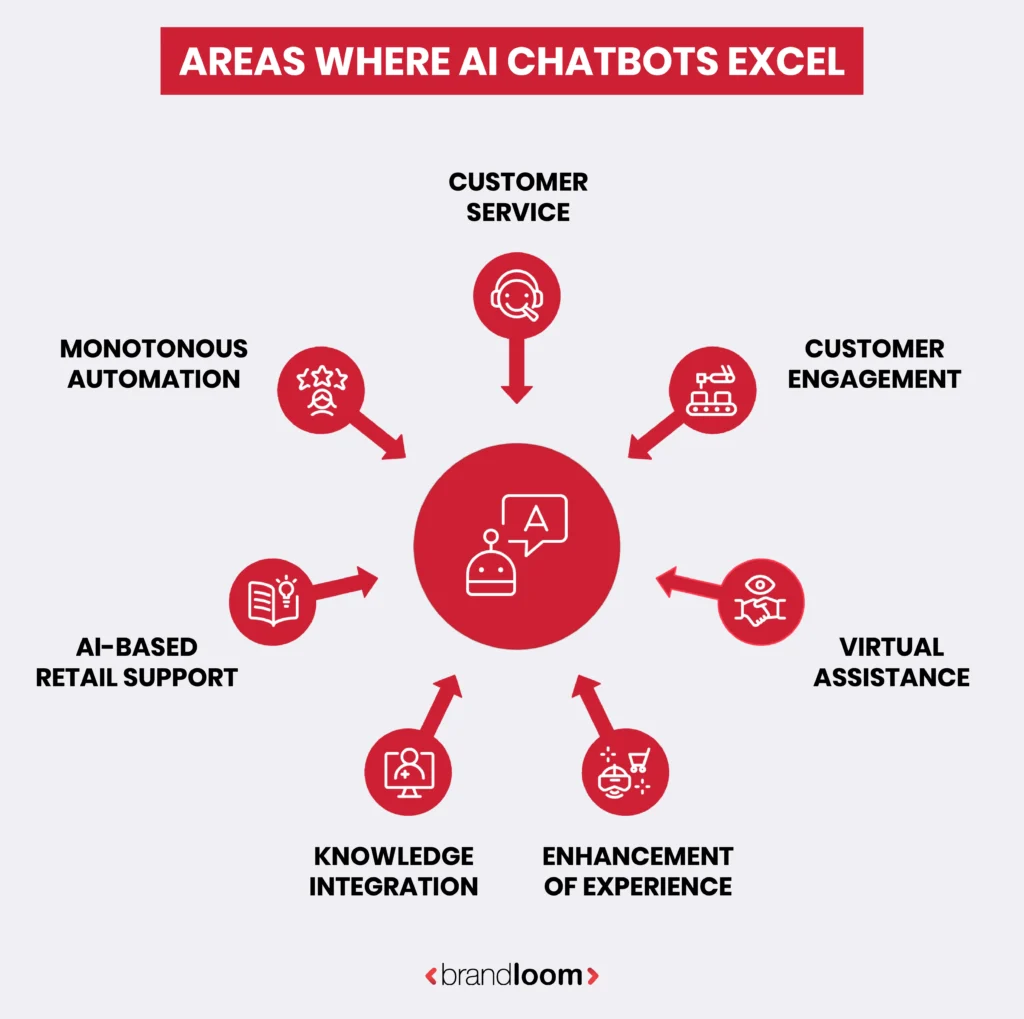
Customer Service
AI chatbots are fast to respond to customer service requests, which helps save wait times and process repetitive queries. This leads to quick answers and the development of trust.
AI bots handle large volumes of queries with ease. They reduce pressure on support teams. They maintain accuracy even during peak hours.
These bots also provide multilingual support. This creates a smooth and reliable service flow. Companies can scale customer support without increasing staff.
Monotonous Automation:
They can robotically perform routine operations, such as order tracking, reservation confirmations, and frequently asked questions, while leaving human operators to respond to more challenging questions.
This saves significant time for teams. It reduces errors in repetitive tasks. These bots ensure fast and consistent responses. It also improves workflow efficiency.
Businesses can manage high workloads with fewer resources. Automation allows staff to focus on critical and human-driven tasks.
Customer Engagement
With chatbots, customers can stay engaged at all times, receiving updates, recommendations, and personalized conversations via messaging apps and websites.
They initiate proactive interactions. The chatbots boost user retention through timely prompts. They share relevant offers based on behaviour.
These bots help customers navigate products easily. This keeps audiences involved throughout their journey. It improves brand awareness and loyalty over time.
AI-Based Retail Support
AI bots drive retail assistance in online shopping through online suggestions and simplify the purchasing processes.
They guide shoppers step by step. These bots reduce friction in decision-making. They recommend complementary products.
They help customers compare options quickly. This boosts cart size and purchase confidence. Retailers can increase conversions with minimal effort.
Virtual Assistance:
Chatbots are virtual assistants that manage scheduling, reminders, and onboarding services, and increase productivity.
They streamline daily tasks with precision. Chatbots reduce the risk of missed deadlines. They support new employees during onboarding.
The chatbots personalise reminders and notifications. This helps users stay organised. Virtual assistants make business operations smoother and smarter.
Knowledge Integration
When they have access to prepared knowledge bases, they give correct answers to different domains, and this will make the process of decision-making error-free and improved.
These bots retrieve information instantly. They ensure accuracy with verified data. They reduce dependency on human support teams.
AI-powered chatbots keep knowledge updated and accessible. This helps users find answers quickly. It also strengthens internal operations within companies.
Enhancement of Experience:
AI chatbots enhance the overall customer experience by providing consistent, contextual, and anytime responses.
Chatbots eliminate communication gaps. They ensure smooth interactions across platforms. They adapt to customer preferences.
These bots make support predictable and satisfying. This builds long-term customer loyalty. Businesses deliver exceptional experiences with minimal effort.
At BrandLoom, we believe that AI-powered chatbots are no longer optional – they are central to creating more thoughtful and connected digital journeys
AI Chatbots vs. Traditional Chatbots
Chatbots powered by AI are very different from rules-based chatbots. Whereas simple bots use a programmed script and decision trees, AI chatbots are based on natural language processing (NLP), machine learning, and generative AI to respond humanely in real-time. They learn enormous amounts of information and can adjust to inputs a user feeds them, individualize interactions, and become better with repeated input.
On the contrary, conventional bots are unable to learn through conversations and incapable of performing compound tasks. Consequently, AI chatbots will result in customer engagement and customer experiences.
The major merits of AI chatbots include –
- real meanings behind phrases and ideas, not keywords
- Grow to be better after each communication
- Provide more intelligent customer services on a platform-inclusive basis
| Features | AI Chatbots | Rule-based Chatbots |
| Technology Base | Built on NLP, machine learning, and generative AI. | Rely on pre-programmed scripts and decision trees. |
| Learning Ability | Continuously learn from user input and improve over time. | Cannot learn or adapt; responses stay fixed. |
| Response Quality | Deliver human-like responses and adapt to context. | Provide rigid, predefined answers to specific queries. |
| Customer Engagement | Enable richer customer engagement and enhance customer experiences. | Limited interaction often frustrates users. |
| Complex Queries | Handle multi-turn conversations and complex tasks. | Struggle with compound or ambiguous queries. |
| Personalization | Individualize responses using pre-trained knowledge and data insights. | No personalization; every user gets the same scripted reply. |
| Scalability | Effective across multiple messaging apps, websites, and platforms. | Limited scalability; often restricted to one channel. |
| Improvement Over Time | Grow better with each conversation through machine learning. | Static performance; no evolution or adaptation. |
The Technology Stack Behind AI Chatbots
Chatbots based on artificial intelligence are supported through a very complex technology stack, which enables the generation of human-like responses in real-time. The core of it is the feature of artificial intelligence (AI), which is enabled by natural language processing (NLP) and machine learning.
These elements allow bots to interpret what the user says, retrieve information from knowledge bases, and produce precise responses based on generative AI.
The use of integration layers between the chatbots, databases, CRMs, and messaging apps would allow them to further improve the interaction with customers and automate monotonous processes. Analytical tools assist in monitoring performance and the improvement of interaction.
The most critical ones are:
NLP engines to understand language
These engines decode user intent and context. They interpret grammar, tone, and patterns. They make chatbot responses sound natural and human-like. NLP engines also handle multiple languages and variations in phrasing. This ensures accurate, meaningful conversations.
Continuous improvement in machine learning
Machine learning helps chatbots learn from every interaction. They analyse behaviour, trends, and feedback. They refine their accuracy over time. This makes conversations smarter and more relevant. The system becomes better with more data.
Dynamic customer service application programming interfaces (API)
These APIs connect chatbots with databases, CRMs, and business tools. They enable real-time access to customer information. They allow seamless task automation. APIs ensure smooth workflows between systems. This improves both response quality and operational efficiency.
What are the Benefits of Using AI Chatbots
AI-powered chatbots are tremendously helpful in business as they can automate routine work and provide real-time and human-like contexts. They enhance customer experience and automate the process of customer service through websites and messaging apps.
Using natural language processing (NLP) and the most comprehensive knowledge bases, such bots make it efficient to improve customer experiences. At BrandLoom, our specialists suggest employing AI chatbots to maximize companies’ digital connection and curtail operational expenses.
The advantages of it are:
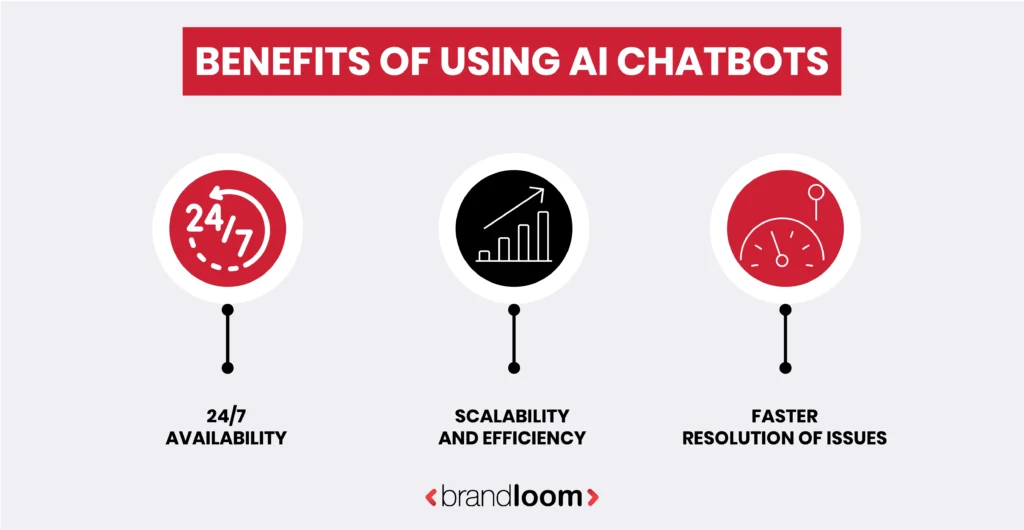
24/7 Availability
Chatbots do not sleep when human agents do. The customers can get support when they need it, during peak time or late at night; hence, increased customer satisfaction and global coverage. An online shop can be used as an illustration of an instance study that can answer questions, even when the business is closed, and make it more dependable and trustworthy.
Scalability and Efficiency
Chatbots can interact with thousands of users at once. This ensures that the business can grow its activities at a very rapid rate without always needing to employ and train additional staff. As such, they are economical without necessarily having to cut corners.
Faster Resolution of Issues
Chatbots can automatically resolve frequent technical issues, such as tracking orders, resetting passwords, or making reservations, eliminating the need for pre-programmed responses and relying on AI-based learning. This shortens customer waiting time, allowing human agents to focus on more complex cases.
Challenges of Using AI Chatbots
Notwithstanding the numerous advantages of AI-driven chatbots, there are some barriers. The setup is quite complex, and there is also a problem with data privacy and user input misunderstanding. At BrandLoom, meticulous control of chatbot strategies is in place to prevent such drawbacks.
The major ones are:
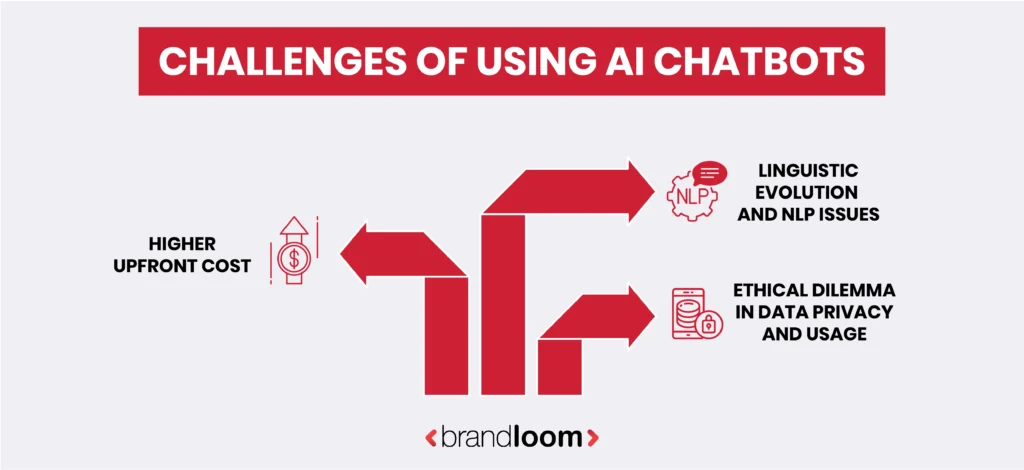
High Initial Costs of Development and Training:
The costs of development and training are high at the outset. Being expensive makes it a barrier to small and medium-sized businesses, and a significant risk when the chatbot is poorly implemented and does not fulfill the needs of the user, resulting in losing ROI.
Understanding Slang, Sarcasm, and Nuance
Language evolves rapidly. Chatbots trained on formal data will not learn regional slang or abbreviations, nor will they acquire new words. This immediately ages the bot and annoys people.
Ethical data use
The currency of the digital age is trust. Even a breach of data ethics can destroy user trust immediately and result in substantial financial penalties and reputational damage. Ethical AI is not a feature that can be applied; it must be one of the core principles embedded in the design process from the outset.
How Does ChatGPT Compare To Other AI Chatbots
ChatGPT uses generative AI to have context-aware conversations, which makes it different than other AI-powered chatbots. It can provide precise, realistic answers based on a large pre-trained knowledge base.
In contrast to the majority of the bots, it is more sensitive to the input of the user and keeps the conversation more natural. BrandLoom experiments with ChatGPT to provide more content and to engage with customers on platforms.
The key feature of ChatGPT:
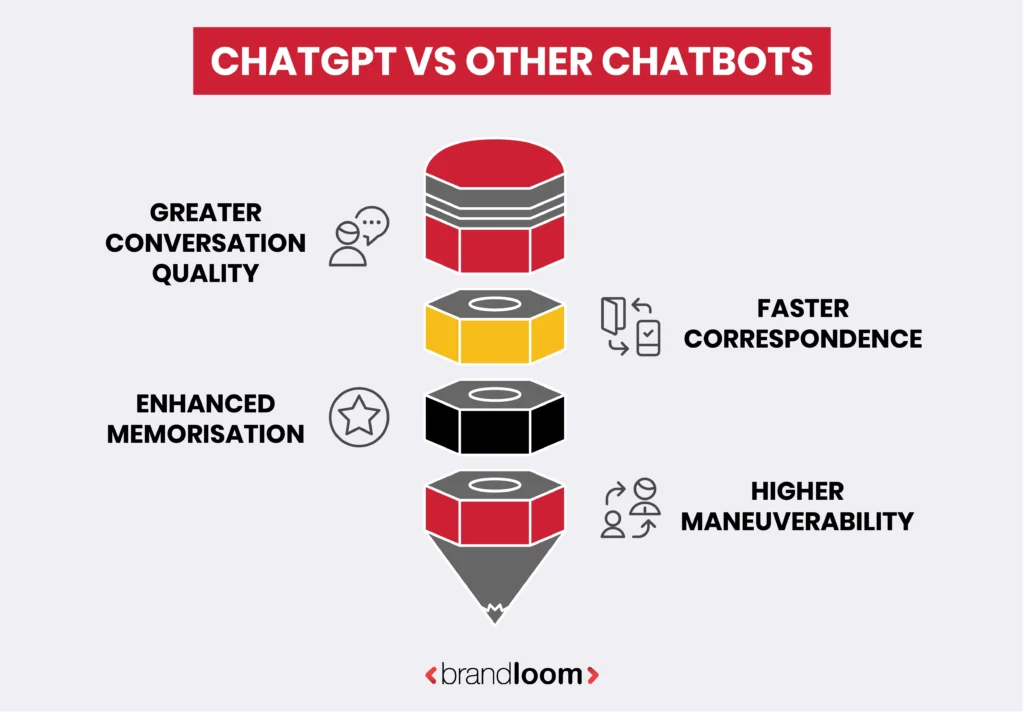
Better quality of the conversation and corresponding tone
ChatGPT will automatically adjust its formality and style to match the user’s prompt. Moreover, it creates more human responses that are creative rather than slick-cut scripts that are predetermined.
It recognises emotional cues and adapts accordingly. It keeps conversations natural, smooth, and engaging. This makes interactions feel personalised and intuitive for users.
Improved context memorisation of long messages
That enables it to sustain the coherence of longer exchanges. Consequently, the user can refer to previous sections of the conversation without having to repeat the information.
It recalls details from earlier prompts and responds with continuity. This improves efficiency and reduces misunderstandings. Users experience a more connected and meaningful flow of dialogue.
Heightened maneuverability in the sense of industries and activities
Its extensive training data gives it extensive information on an infinite number of niches. As a result, it can quickly learn to converse about specialized issues, whether it be legal advice or fiction writing.
It adapts to different domains with accuracy. It understands technical language and unique industry requirements. This makes it a versatile assistant for both professional and creative tasks.
How to Integrate AI Chatbots in an Online Store
Incorporating AI chatbots in online stores will improve the customer experience and increase sales. Such bots are used to work with routine tasks, product finding, and customer care in real time.
BrandLoom’s skilled digital marketing experts advise on customising e-commerce through AI in business settings. Find out about AI-driven eCommerce personalisation.
The steps involved in having AI chatbots:
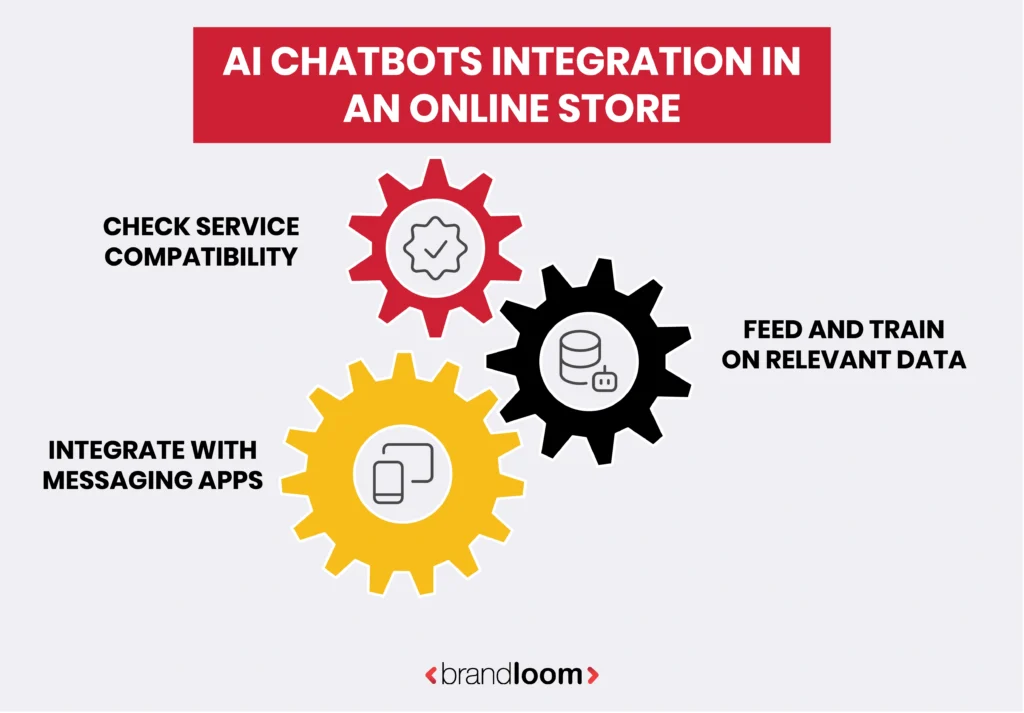
First, select a chatbot platform that is compatible with your e-commerce service
Look for platforms that will be natively integrated with your store, such as Shopify or WooCommerce. You should also ensure that the platform can support your business’s future growth and traffic.
Then, train the bot based on relevant knowledge bases
Enter your product catalogs, FAQs, and transcripts of previous customer services. Constant refreshment of its knowledge base with new products, promotions, and general seasonal questions to keep it up-to-date.
Finally, integrate it with messaging apps to reach out to more customers
Integrate the chatbot into such common channels as WhatsApp, Facebook Messenger, and Instagram. This multi-channel strategy delivers to customers the platform they prefer most, opening your digital storefront to a broader range of customers
What is the Best AI Chatbot
There is no single best AI-enabled chatbot, as each is differentiated and has its own unique capabilities. However, BrandLoom considers the best AI Chatbots to be –
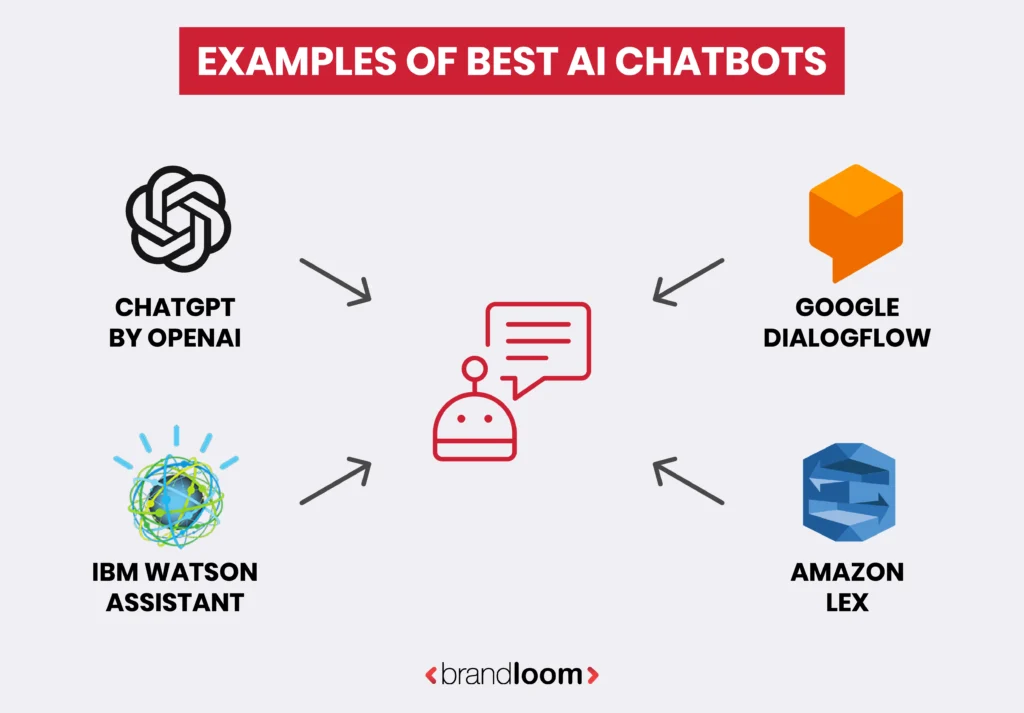
ChatGPT by OpenAI
It is very good at creating contextually rich content. In addition, it uses a sophisticated language model that makes the conversations extremely natural and involving.
It adapts quickly to the user’s tone and intent. ChatGPT handles complex questions with clarity. It also delivers creative, accurate responses across many domains.
Google Dialogflow
The platform works well with the Google Cloud ecosystem and other services. Additionally, it offers robust conversational development and voice application development.
Google Dialogflow integrates smoothly with existing business tools. It supports multilingual interactions. It also enables fast deployment for chat and voice solutions.
IBM Watson Assistant
Watson is an expert in interpreting sophisticated customer intents within the enterprise environment. As a result, it provides exact responses based on its robust deep learning and logic functions.
It delivers high accuracy for industry-specific use cases. This IBM Watson Assistant reliably handles large enterprise workloads. It also improves decision-making with its strong analytical capabilities.
Amazon Lex.
It offers the tested technology that drives Amazon Alexa. This bot also provides scalable integration with AWS services at an affordable price, enabling the creation of powerful voice and text applications.
Amazon Lex. supports advanced speech recognition. It helps businesses quickly build interactive chat experiences. It also ensures high performance even at large volumes.
They are a combination of natural language processing (NLP) techniques and generative AI to offer human-like responses, computerize customer support operations, and enhance customer engagement with websites, apps, messaging apps, and other tools.
Final Thoughts: The Future of AI Chatbots
The generative AI, natural language processing (NLP), and contextual learning are some of the evolutions that the future of AI-powered chatbots is currently experiencing. These bots will be less robotic and hyper-personalize the customer experience on any platform.
As virtual assistants are being made smarter, they will be used to deal with complicated requests, sentiments, and multilingual assistants in real time. As a leading Indian AI marketing agency, BrandLoom, we have already harnessed the power of innovations in order to increase customer interaction and support.
Hence, the AI chatbots in the upcoming years will not only be present to conjure up a robot to take over routine tasks but will also guide development, taking the form of the digital embodiments of the brand on the ever-changing web.
FAQs
ChatGPT uses generative AI to have context-aware conversations, which makes it different than other
Businesses that would prefer to take care of their frequently asked questions, complete orders, coordinate visits, and converse with clients through messengers, websites, and social media use AI chatbots. They rely on natural language processing (NLP) and machine learning so that they recognize what the user has entered and react in a human-like way.
Another possible use of chatbots is utilization in the sphere of healthcare, education, and retail to personalise the experience of life, reduce the costs of support, and maximise efficiency. At BrandLoom, AI chatbots are utilised to give brands a smooth digital experience, enabling them to increase customer satisfaction.
A good example of a chatbot AI is ChatGPT by OpenAI. ChatGPT is a generative AI and highly developed natural language processing (NLP) software that provides intelligent conversational answers. It is able to respond to questions, aid writing, describe difficult concepts, and even pass off as a chatty fellow human being.
Other AI-powered chatbots are Google Dialogflow, IBM Watson Assistant, and Amazon Lex. With such bots, customers commonly use them in customer service, e-commerce, and enterprise systems.
BrandLoom usually analyses tools such as ChatGPT to foster deeper interactions with customers, automate content offerings, and assist companies in the development of smarter online platforms.
Alexa is an example of artificial intelligence (AI) and natural language processing (NLP) virtual assistant created by Amazon that, however, cannot be classified as an AI chatbot. Although capable of voice-based conversations and the ability to do things such as –
play music,
set reminders, and
Control smart appliances.
Alexa is not a general-purpose conversation tool.
In contrast to chatbots that use AI, such as ChatGPT, Alexa has a set pattern and can easily be integrated with the Amazon environment. Nevertheless, it has some common technologies and helps to improve the customer experience.
In BrandLoom, voice-based customer interaction is studied through Alexa-like tools to be used as a means of communication.
chatbots, such as the talk-through voice and natural language processing (NLP), but it is not a classic chatbot.
One of the things that Siri is programmed to do includes –
Sending out a message,
Having a reminder, or
Verbal giving of an instruction.
Siri is more of an iOS-based technology than a chatbot, which is commonly routed through messaging apps and websites.
The fact that Siri responds to human commands by using artificial intelligence (AI) and machine learning, however, makes it a very conversational AI, similar to chatbots in functionality.
Siri is an AI-based virtual assistant developed by Apple. It shares a few things in common with AI
An AI chatbot is a computer program that uses artificial intelligence (AI) and natural language processing (NLP) to engage in a conversation with people, as if it were a real person. It interprets user-entered information, determines its meaning, and processes it using a pre-trained knowledge base or generative AI.
Unlike the conventional rules-based bots, AI-powered chatbots learn and evolve through interactions by using machine learning. They provide immediate feedback, automate routine tasks, and cater to customers. When integrated into a website, app, or messaging system, an AI chatbot optimises customer service and provides a more personalised experience. The efficiency of such a tool delivers similar customer interactions on a different scale.
An AI chatbot is not like a regular (rules-based) chatbot because it is more flexible and intelligent, and creates a better experience. Regular scripted chatbots only respond to certain keywords or commands, resulting in limited interaction.
They are preset and are not able to learn anything based on new interactions. In comparison, the AI-powered chatbots utilise natural language processing (NLP) and machine learning models to comprehend the user input, depending on the situation, and give human-like responses.
The improvement of AI chatbots occurs through learning from prior discussions. They are more natural, dynamic, and personalised than others. They are also more efficient in solving complex requests and engaging customers on different platforms.
AI chatbots have multiple high-tech technologies behind them, which allow them to comprehend and intelligently respond to users. The principal elements are the following:
Artificial Intelligence (AI): Equips bots with the capability of making decisions in a manner that is akin to human beings.
Natural Language Processing (NLP): Facilitates the perception of anything spoken or written by the user.
Machine Learning: The bots train to learn and be better as they communicate.
Generative AI: creates similar reactions in human beings in real time.
Knowledge Bases: They store information to give the correct answers.
Integrations and APIs: Connect CRM, databases, and messengers with bots.
These interconnected tools collaborate to give advanced, scalable, and intelligent customer service and support systems.
Chatbots are one of the ways that the business world has implemented to support its customer care units, carry out tedious tasks, and streamline operations. They can give FAQs, take bookings, generate leads, and support websites and messaging around the clock.
When it comes to e-commerce, AI chatbots help recommend products and also recover carts. In HR, chatbots facilitate onboarding and answering questions for employees. To market, they involve users in personalised messages and the collection of feedback.
AI chatbots lower the operational costs, make human agents available to handle more complicated work. As per BrandLoom’s AI marketing experts, these bots provide quicker and more consistent service, thus staying useful in all sales, support, and internal communication processes.
Chatbots replicate a conversational experience using natural language processing (NLP) and machine learning. Indeed, advanced chatbots will never be able to recreate human emotion or even deep reasoning. However, they can understand context, interpret intent, and offer coherent and relevant responses.
They can handle multi-turn dynamic conversations and improve over time through learning. With the help of tools such as GPT-based models, AI chatbots can produce made-up replies that are very close to human conversational language.
They have not yet, however, developed genuine consciousness or empathy, so the interaction may seem natural. However, it is still pre-programmed, which in turn is based on training and data patterns.
The application of AI chatbots involves the predominant use of ML, which makes these tools intelligent and adaptive. ML allows chatbots to make use of the previous interaction experience of the company to identify the trends and enhance their responses over time.
In comparison to rule-based bots with strict instructions, the ML-based chatbots require huge amounts of data to analyse to learn about user behaviour, tastes, and intentions. This allows them to have deeper personal chats, anticipate the user’s needs, and provide more complex requests. ML also assists in fine-tuning natural language understanding (NLU) and the capability of a chatbot to deal with the contextual nature of a conversation. Essentially, machine learning will give bots a brain and make them evolve.
In most cases, AI chatbots outperform rule-based chatbots because of their ability to deal with complex, dynamic, or unpredictable conversations. As rule-based bots work on a rigid program, they are only capable of carrying out simple tasks such as providing yes/no answers.
In contrast, AI chatbots based on natural language processing and machine learning can understand context, adjust to different inputs, and respond to them in a human-like and individualistic manner.
They can handle multi-turn conversations, adapt to previous interactions, and be cross-channel.
Rule-based bots are simpler to design and even manage, but AI chatbots are much more pliable, clever, and effective in engaging with customers. We at BrandLoom believe that the AI-driven bots are more adaptable and efficient than the traditional models in terms of engagement.
AI chatbots can be used in businesses with high-volume customer engagement. E-commerce has the advantage of –
24-hour customer care,
product recommendations, and
order tracking.
On the other hand, In the banking and finance industry, chatbots deal with balance queries, loan questions, and fraud identification. In healthcare, they are used for appointment booking, symptom checks, and reminders to patients. Chatbots are utilised in travel and hospitality to facilitate –
reservations, cancellations, and changes to itineraries.
Automation of inquiries and selecting the best lead is also helpful in education, telecommunications, and real estate. The advantages to these sectors include efficiency, cost reduction, as well as user experience in terms of real-time intelligent interactions. The top AI marketing agency, BrandLoom emphasises the power of chatbots in the digital interaction of various industries with an AI touch.
Chatbots with AI offer 24/7 customer service opportunities and improve them significantly by reaching customers and providing instant support in many channels. They can address the most common requests, like the frequently asked questions (FAQs), order tracking, and account data, so that their human counterparts can solve the more complicated matters.
Chatbots, with natural language processing (NLP), will be able to interpret the intent and make relevant responses to the users in real-time. They minimize wait times, raise the level of responsiveness and consistency, and tailor communications to the user’s history. Moreover, the chatbots also gather valuable feedback and information to improve continuously.
Overall, they improve customer satisfaction, reduce operational expenses, and provide a more fluid and reactive experience of service delivery. As experts at BrandLoom state, chatbots are the solution to providing reliable and individual experiences to customers.
Despite their achievements, AI chatbots have certain limitations. They can struggle to solve complex, ambiguous, or emotionally charged questions and provide wrong answers. Chatbots are frequently not very empathetic or able to act based on human instinct and have a sense of sarcasm and subtle language.
These chatbots heavily rely on the quality of training data and can provide wrong or biased responses in case of poor quality of data. There is also an option where users like to talk to a human being, particularly when they have to discuss sensitive issues.
Furthermore, It may also be challenging to integrate it with legacy systems and make it privacy-compliant. Such constraints point to the necessity of human control and continuous enhancement.