
In today’s changing world of digital marketing, businesses are on a never-ending quest to break new ground and improve their online presence and gain traffic that converts. While most marketers focus heavily on content creation, paid advertising, and traditional link-building techniques, there exists a powerful yet significantly underutilized SEO strategy that is blog commenting, and it can transform your digital presence.
This guide shall unleash the hidden powers of blog commenting as an SEO weapon, providing you with actionable insights, proven strategies, and expert techniques to build authority, drive traffic, and build meaningful relationships in your industry.
What Is Strategic Blog Commenting?
Blog commenting is more than just leaving a casual comment on a blog post. It’s an advanced digital marketing tactic that centers around being a part of contextually relevant conversations (like those happening in your niche) by making thoughtful, value-added comments that accomplish multiple business goals at once.
When executed professionally, blog commenting can be part of a solid foundation for getting links, owning some thought leadership, sending traffic to your site, and starting relationships with other bloggers and industry influentials.
The main difference between casual commenting and strategic blog commenting lies in the intentionality behind each interaction. Strategic commenters approach each opportunity with specific goals in mind, whether that’s demonstrating expertise, adding unique value to discussions, or positioning themselves as authorities within their niche.
The Evolution of Blog Commenting
Blog commenting has developed over time with huge shifts. Initially, in the early days, comment boxes would have been filled with spammy comments with generic observations, all attempts to manipulate, somehow, in the name of search engine optimization.
But as search engines developed and bloggers got serious about moderating comments, stricter moderation policies were put in place by blog proprietors, and the landscape shifted dramatically.
Apparently, successful blog commenting today involves a more subtle approach that values genuine value creation over short-term success. Today, search engines can quickly identify and devalue spammy links and generic comments, making authentic engagement not just preferable but essential for success.
Key Components of Effective Blog Commenting
Blog commenting is more than writing a few words here and there to represent your existence; it’s a subtle yet powerful way to build relationships, boost visibility, and establish authority within your niche. For your blog comments to truly work, they need to consist of all three of the following elements, like good content and relevancy, professional appearance, and strategic timing and consistency.
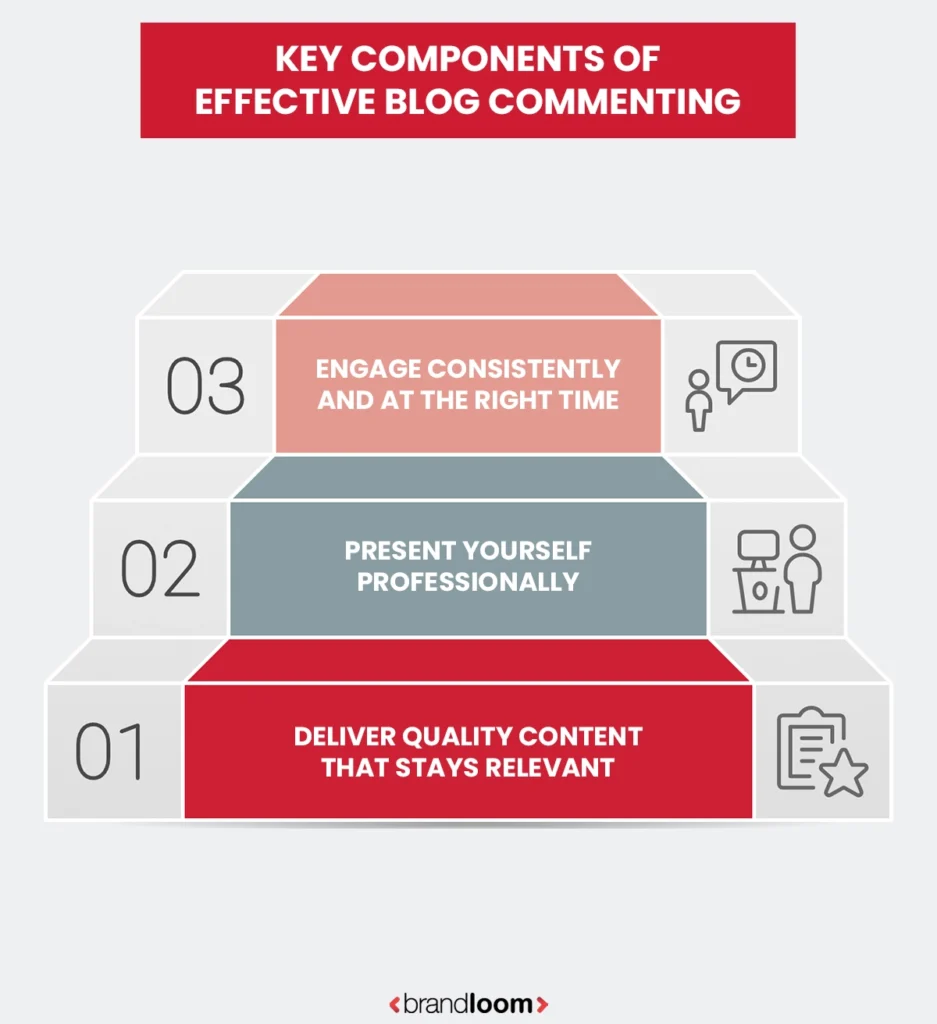
1. Deliver Quality Content That Stays Relevant
Begin by carefully reading through the entire blog post. Comprehend the main message, arguments, and the audience for which the author writes. This lets you make a thoughtful reply instead of just parroting the same few points or asking questions that were already addressed by a post.
When you comment, add real value to the discussion. Don’t just say “Great post!”—instead, you can:
- Share a personal insight or relevant experience.
- Ask a question that encourages thoughtful discussion.
- Develop a point made by the author, providing new insight.
- Drop a relevant resource or link, but only when it adds to the conversation.
By offering useful insights, you show that you’re engaged and that your input matters. In both cases, both the blog writer and readers will be more likely to remember you and possibly visit your site.
2. Present Yourself Professionally
Your comment reflects your personal or business brand. So when you leave a comment, make sure it looks polished and professional.
Use a proper grammar format and punctuation, and spell things out clearly. Begin with a short greeting or an acknowledgment of the topic of the post, and then go on to present your ideas in a coherent and easy-to-read manner.
Differentiate your comment by:
- Split your comments into smaller, readable parts.
- Use italics or highlights to emphasize ideas.
- End with your real name, position, or brand name, not a spammy title.
People take well-written and well-structured comments seriously. When you pay attention to detail, they will place greater trust in your opinion and will go check out your content.
3. Engage Consistently and at the Right Time
If you really intend to grow through the commenting business, then you have to turn up regularly. Don’t comment once and disappear. Instead, make it a habit to comment weekly or a few times per month at least on those blogs that interest you.
Consistent engagement builds relationships. Blog authors and regular readers will start recognizing your name, and they’ll value your thoughts more over time.
To stay consistent:
- Pick 5 to 10 blogs in your niche.
- Subscribe to them or set reminders.
- Check in regularly and leave thoughtful comments.
This steady presence helps you build influence and earn trust within your online community.
The Strategic Benefits of Professional Blog Commenting
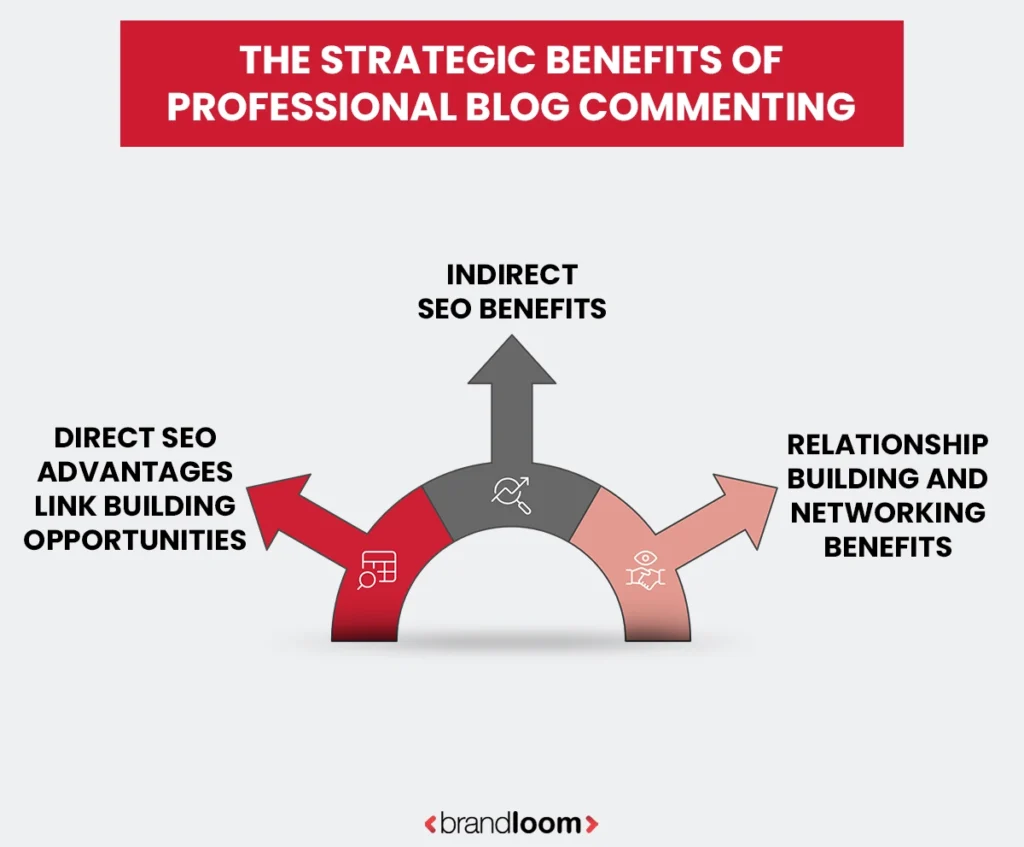
1. Direct SEO Advantages: Link Building Opportunities
You can gain exposure when blog commenting is done in the right way. Although most blog sites use nofollow tags, those links still have a role to play in your SEO strategies. Search engines treat them as trust signals to judge the relevance, authority, and diversity of links to your site.
Well-placed SEO blog comments with other SEO techniques can drive high-quality referral traffic to your site, strengthen your link profile, and feed into external content development efforts.
Benefits of meaningful comments on blog posts:
Link Profile Diversification
By commenting on blogs for free, you add variety to your backlink profile. Nofollow links from relevant and high-quality blogs create a natural link pattern. This will help secure your blog from penalties arising out of unnatural link spikes or over-optimization.
Contextual Relevance Signals
A blog comment on an industry-related post gives search engines great contextual signals. Over time, Google starts associating your domain with certain topics and keywords, boosting your authority within that niche.
Quality Referral Traffic
This type of traffic is quality referral traffic wherein users who appreciate some insightful comment would click on the link to find out more. They come with genuine interest; unlike the one that would be attracted by a broad ad campaign, you are sending very clear engagement signals to the search engines, showing that users find value in your content.
Natural Link Velocity
In the comment section, linking grows slowly. This slow pace is called natural link velocity, and it appears organic to search engines. By doing this, you avoid the algorithm noticing big spikes in your backlinks, thus letting your SEO strategy stay under the radar and work.
Co-citation and Co-occurrence Benefits
Even if you do not link directly, your website or brand acquires authority when it is mentioned alongside other well-trusted sources being advertised in the comment discussions. Such indirect association effects, referred to as co-citation and co-occurrence, might raise your expertise perception in the eyes of search engines.
2. Improved Online Visibility: Expand Your Digital Footprint
Strategic blog comments can exponentially increase the brand’s reach beyond its website. Each comment left on a blog post becomes another avenue of touch for the brand. Whether sharing an expert opinion or posing meaningful questions, you place your name before an audience who might otherwise not find you.
Here is how frequent blog commenting increases the visibility of your brand:
Multi-Platform Brand Presence
Nice comments left on blogs across different sites land you on new platforms where your potential clients crowd. Each comment adds a new layer to building brand exposure and getting people to associate your name with noteworthy insight.
SERP Expansion
In some instances, your remarks on blogs enter search results. Users searching for particular topics might stumble upon your comment even before hitting upon your actual site. This kind of visibility helps you rank on long-tail queries related to topics you might not have targeted basically in your content.
Social Proof & Industry Credibility
Your active participation in well-known industry blogs strengthens your credibility in the eyes of prospective clients and partners. Readers tend to put trust in those who consistently engage in meaningful conversations, especially when this takes place on a platform with a reputation.
Audience Reach Multiplication
Every blog opens interaction with a unique audience. Those who commonly follow a certain writer or publication might never search for you directly, but a good blog comment can get you noticed. This exposure is precious, especially for niche markets.
Brand Recall and Recognition
Readers who repeatedly see your name or brand in the best blog comments start to recognize you. Over time, this builds familiarity. When they need help, products, or services in your field, your name comes to mind first.
Competitive Advantage
While most businesses will concentrate on social media or advertisements, blog commenting for SEO gives you ground in less crowded but highly active spaces. You will maintain exclusivity by providing something worthwhile where nobody else is looking.
3. Enhanced Local and Niche Authority
By commenting on blog posts in a particular region or industry, you narrow down on your niche authority and enhance local SEO.
Topical Authority Development
Regularly commenting on blogs that discuss your niche lays down proof for the search engines, indicating that that website is part of that topic ecosystem. Over time, Google boosts your content for related keywords because it sees your ongoing participation in those conversations.
Expert Entity Recognition
The constant supply of thoughtful insight into several blogs associates your name or brand with an expert. Google starts recognizing you as an authority and thereafter begins showing your content in knowledge panels or featured snippets.
Local SEO Enhancement
Commenting on blogs of your locality, news sites, or community forums sends strong geographical signals. This helps the search engines understand your location and area of service, thereby improving your ranking in local search results.
Long-Tail Keyword Opportunities
Blog comment sections often include natural, conversational phrases. These phrases can inspire content ideas that target long-tail keywords. You improve your chances of ranking for specific, high-intent searches by mirroring how real people talk about your topic.
Semantic SEO Benefits
Every blog comment you write in natural language adds to the semantic web. You help search engines understand not just your keywords but also the deeper context and meaning behind them.
4. Indirect SEO Benefits
Content Inspiration and Market Research
Active participation in blog commenting affords you insights on current industry trends, the common challenges your target audience faces, and potential content opportunities. These insights allow you to efficiently frame your content strategy and produce blog content that is relevant and timely.
Competitive Intelligence
Watching comment sections on industry blogs gives clues as to what your competitors are doing and how they position themselves, besides identifying potential gaps in the market. This way, you can realign your own strategy and fill the gaps with content or services on demand.
Brand Reputation Management
Being actively engaged in deliberations on industry blogs represents your brand positively, while flawless professionalism adds immensely. These constructive comments to blogs lift your online presence and feed into the public’s view of your expertise and professionalism. Over time, this strategy builds up the reputation as well as a proactive brand management mechanism.
5. Relationship Building and Networking Benefits
Direct Access to Industry Influencers
By leaving thoughtful and relevant comments on a blog, you open the door to direct engagement with thought leaders of your industry, other well-known bloggers, or even co-workers. The interactions take place in a natural, content-driven environment, giving your outreach the air of authenticity as opposed to forced networking. Eventually guest posting opportunities, joint venture arrangements, mentorships, or even long-term business partnerships could arise from these real connections.
Peer-to-Peer Networking
A blog comment section draws in all sorts of professionals from within the industry. By engaging actively, you speak not only to the blog author but also start building rapport with other readers going through similar scenarios and challenges.
Converting these peer group discussions into fruitful ideas can lead to content collaboration, referrals for services, or formal partnerships. A number of fruitful business relationships and joint initiatives began with a lone, insightful comment that was simply above the rest.
Community Building
As you actively contribute to certain blog communities, you start to establish your credibility as a trusted source. Eventually, other readers, including the author of the blog, start to take note of and appreciate your input.
This steady exposure can help you get invitations to participate in expert roundups, sit on industry panels, or participate in joint projects. You aren’t just consuming content; you are woven into the community’s narrative. That presence creates loyalty, establishes trust, and makes you a go-to resource within your niche.
How to Find High-Quality Blog Commenting Opportunities
A. Identifying Authority Blogs in Your Industry
1. Domain Authority Assessment
Start with targeting high-profile bloggers with good domain authority and great credibility in your niche, as backlinks through such sites hold the highest value and reach eager audiences. You should, therefore, try to gauge the level of authority blogs hold before investing your time, using Moz’s Domain Authority Checker, Ahrefs, or SEMrush.
Doing good blog commenting on such platforms, even with nofollow links, pops up your visibility, supports your expertise, and may, in due course, boost the rankings of websites through commenting.
2. Engagement Level Assessment
Do not just look at the conventional domain metrics; instead, go for real human engagement. Give priority to websites with active comment sections that depict importance and thoughtfulness. If insights are regularly shared or questions are being asked throughout the weeks, a comment made by you here will not go unnoticed. The presence of an active comment section is indicative of a healthy blog community that would most probably value your input.
3. Content Quality and Relevance
Ensure the blog consistently publishes high-quality, industry-relevant content. The closer the blog’s content aligns with your niche or audience, the more natural and impactful your blog post comment will feel. Commenting on unrelated content dilutes your efforts and can come off as spammy, even if your tone is professional.
When your blog comments contribute meaningfully to content that matches your brand’s expertise, readers and search engines start viewing you as a relevant voice in the space.
B. Research Tools and Techniques
1. Google Search Strategies
Use Google to flank and identify relevant free blog commenting sites with advanced techniques from your own domain. Search strings to try:
“your industry” + blog
“your niche” + comment policy
“your keyword” + leave a comment
“your topic” + what do you think
These searches drive you to blogs that welcome interaction and perhaps some nice blog comments from others in your industry. So they help you find blog commenting sites that offer active moderation and useful content.
2. Social Media Discovery
Social media sites like Twitter and LinkedIn, most especially, act like real-time portals for new blog offerings. Follow industry influencers to watch what they share from blogs. Fresh posts are always prime for greater attention and blog comments, therefore, affording a timely chance for your commentary to be noticed.
This strategy will assist you in dropping a comment on the blog while the post is fresh in the minds of both readers and the author.
3. Competitor Analysis
Take a look at where your rivals are commenting. You can track their engagement trends by using tools such as BuzzSumo or Ahrefs or doing it manually. By analyzing what your competitors are doing, you find out which blog commenting sites are working for other sites in your niche, and you can develop some ideas about what to write in blog comments that get results.
Observe how they engage and what sort of tone they set, and which topics prompt conversation. Once there, you can start to copy their successes or identify the gaps they’re not seeing.
C. Evaluating Comment Section Quality
1. Moderation Standards
High-quality blogs usually have clear commenting policies and actively moderate entries. Look for sites that exclude spam, allow only worthwhile contributions, and are conducive to respectful discussions. These sites would allow your blog comment to sit alongside other valuable insights instead of next to low-effort or irrelevant comments.
The blog that manages comment sections ensures a better environment for efficient blog commenting SEO and building more credible backlink opportunities.
2. Comment Depth and Quality
Before posting, read some of the blog post comments. Are readers putting forward genuine opinions, expert knowledge, or thoughtful questions, or are most of the blog comments just a set of generic one-liners?
Try to keep posting on those blogs where most blog comments have deep content, clarity, and relevancy. Such discussions would let you shine with well-thought-out responses and help build a smarter and more engaged community.
3. Author Engagement
Pay attention to whether the blog author answers comments left on his blog frequently. Active participation on the part of the blogger is a sign of a dynamic and interactive blog. And it increases the likelihood that your comment will directly lead to a response, discussion, or even a collaboration down the line.
If the blog’s creators appreciate the comment section, they’ll form relationships with the most frequent commenters, which can lead to greater visibility and even invitations to guest post.
Comment Structure and Content Strategy
Opening with Value
Begin your comment with a powerful, thoughtful opening that demonstrates that you have not simply skimmed through the post. Similarly, mention a discussion point from the piece itself or one that makes a point. This approach establishes your credibility from the first sentence and signals that your input adds value to the discussion.
Personal Experience Integration
Back up your remark with your own experiences, professional opinions, or real-life examples. When you express interesting viewpoints that add to the article’s core concepts, you’re providing your readers with original discussion that isn’t already baked into the post itself. This very approach makes you sound like someone who knows something, instead of someone who merely wants to know.
Question Generation
Propose meaningful questions that would indicate a deeper understanding of that topic. A well-worded question can encourage more discussion as well as claim the attention of others, including the blogger. The more conversation you generate, the more overall people will interact with the post and will create new networking opportunities.
Common Pitfalls in Blog Commenting and How to Avoid Them
While blog commenting can boost SEO, build authority, and drive traffic, it’s easy to fall into traps that reduce its effectiveness or, worse, damage your reputation. To get the full benefits of this strategy, you must recognize and avoid common mistakes that dilute the power of your blog comment.
1. The Spam Trap: Avoid Generic and Low-Value Comments
Recognizing Generic Blog Comments
If you’re the kind of person who frequently writes phrases like “Great post!” or “Thanks for sharing!”, you’re not alone, but you are squandering a chance. These kinds of generic blog comments aren’t valuable at all and just make your comments look spammy to moderators writing them and to search engines. They make clear that you didn’t really read or grapple with the blog post.
So stand out and always share specifics from the content and your viewpoint. That’s what makes a great blog comment worth reading.
Don’t Copy-Paste Your Comments
It might save time to reuse the same blog post comment structure on different blogs, but the effect is lost on the readers you are trying to communicate with. People likely won’t respond to comments that appear to be formulaic, and because they show no real interest, you risk getting your comments ignored or deleted.
Write each blog comment as if it is its own, with regard to the blog theme, readership, and subject. Personalized comments demonstrate real engagement and foster better relationships.
2. Over-Promotion and Link Manipulation
Avoid Hard-Selling in Blog Comments
Pushing your product or service in every comment may seem like a quick way to generate leads, but it usually backfires. Effective blog commenting for SEO focuses on value first. Share helpful insights, and let your link serve as a natural next step, not the core of your message.
Don’t Manipulate Anchor Text or Drop Spammy Links
Resist the temptation to fill your blog with your keyword-laden links or with the same content as your lead site or useless promotion links. By the way, most reputable sites do nofollow, so the SEO value is hardly there in the first place. But more importantly, these methods act as a red flag to moderators and search engines.
Instead, you should only link when the link contributes value or context to the conversation. This approach helps improve website rankings with comments naturally over time.
3. Missed Opportunities for Engagement and Relationship Building
Don’t Just Drop a Comment and Leave
Many people make the wrong mistake of “hit-and-run” commenting. If the blog author or other readers reply to your blog comment, get back to them and continue the conversation. This may ultimately result in important connections, backlinks, or maybe even partnerships.
Engage Respectfully on Sensitive Topics
If a post touches on controversial subjects, keep your comments respectful. Avoid making inflammatory comments. Staying professional, even while disagreeing, can protect your brand and build trust in the industry community.
Watch Timing of Comments
While it is fine to engage with the older posts, ensure that your input is timely and relevant. Do not repeat something that is outdated, but rather give some new angle or relate it to current trends. This helps in making your position as an active and informed professional.
Advanced Strategies for Maximum Impact in Blog Commenting
Once you are aware of all the fundamentals in blog commenting, it’s time to take it to the next level. Building website authority through comments, bringing in targeted traffic, and boosting your reputation, you need more than just occasional, one-off interactions. These advanced techniques will keep on rewarding recognition and results through your blog commenting.
1. Create a Systematic Blog Commenting Schedule
To get maximum benefit for SEO from blog commenting, consistency is a must. Do not comment randomly or when you happen to stumble upon a post. Always work on a well-structured schedule.
- Identify high-authority blogs in your niche that publish quality content on a regular basis.
- Create a commenting calendar; decide on the number of comments for blog posts you will be putting down every week.
- Give time for reading posts with care before responding.
By commenting with consistency and adding value, you become a familiar name in that space. Gradually, both readers and blog owners come to link your presence with quality, reliability, and insight—a key part of what makes blog commenting effective for SEO.
2. Time Your Comments Strategically for Visibility
The timing of a comment on a blog may significantly influence its visibility and its effect.
- Comment after the content is first posted. Early comments tend to sit high in the thread, gaining some appreciation from following readers and the blog author.
- Set Google Alerts or follow RSS feeds to stay notified when your target blogs publish new content.
That said, just don’t rush to put a comment. An ill-considered comment is of no weight in a blog even if it appears first. A comment of excellent quality with thorough and relevant analysis later may require more votes than a hastily prepared response.
3. Showcase a Variety of Skills Across Blog Comments
Use blog commenting as a personal branding tool. While it’s essential to stay on topic, every blog post comment presents an opportunity to highlight different strengths.
For example:
- On a marketing blog, share data-backed insights from your own campaigns.
- On a tech blog, discuss practical implementation challenges you’ve overcome.
- On a leadership blog, contribute lessons learned from managing teams.
By diversifying your input, readers who see your blog comments across multiple platforms get a broader understanding of your expertise. This strategy not only boosts your reputation but also builds trust with potential clients or collaborators.
4. Track and Optimize Comment Performance
In order to make blog commenting for SEO go beyond a strategy that may or may not work, it is essential to monitor what is working.
- Track referral traffic using Google Analytics to check which blog comments are driving visitors to your website.
- Track engagement volumes: Do people reply more to some comment types than others?
- Track which blogs attract your target audience depending on who interacts with your comments.
Such a data-driven strategy will help you to focus your style and focus on blog commenting sites where your viewpoints resonate most. With time, you will start observing trends about certain tones, topics, or formats that work better. Use that insight to propagate the results.
The Future of Blog Commenting in SEO
As search engines evolve, prioritizing user experience, blog commenting will remain important. Not for the direct link-building potential, but for creating genuine human connections. While the SEO weight of comment links may be limited, the indirect benefits of blog commenting, such as brand awareness, community interaction, or relationship cultivation, may even weigh more than ever before.
From here, the winning formula of blog commenting for SEO rests on precisely how well you provide real value. Rather than attempting to trick search engine algorithms, concentrate on thoughtful, insightful, and original comments to actualize meaningful conversations.
With ever-increasing strength, artificial intelligence and machine learning will continue to separate genuine engagement from spam or automation, rewarding search engines for authentic ones. In other words, the more people-oriented and relevant your comment seems in front of bloggers, the more priceless or rewarding it becomes for the readers as well as for your longer-term SEO journey.
In the future, the winners in blog commenting will be the individuals and brands who prioritize meaningful contribution over manipulation. Build trust, offer insights, and stay consistent. If you continue showing up with integrity, your blog comments will help strengthen your digital presence and support lasting SEO success.
Conclusion
Blog commenting is still one of the most underused and powerful techniques in the SEO world. But, when you think of it strategically, with the goal of actually providing value, you open up opportunities to generate traffic, build authority, and develop those lasting relationships that can help grow your business for years to come.
Blog commenting success isn’t just about dropping a comment on every blog you encounter. It is the result of being present as a thoughtful, engaged member of your industry’s online communities. It’s all about building that trust and being seen regularly by sharing insights, asking great questions, and being a respectful participant.
Remember, effective blog commenting is a long-term strategy. It’s not about immediate payoff but about building a platform for influence and connection. With time, the reputation you gain through authentic engagement compounds, resulting in stronger backlinks, improved brand recognition, and increased collaboration opportunities.
We, at BrandLoom, guide businesses to transcend the fundamentals of SEO. Our team knows how tactics such as blog commenting can raise your digital presence. If you are willing to take high-impact methods into your SEO strategy, then we are here to help you put in place a personalized, performance-driven plan of action.
Begin investing in blog commenting today, with patience, quality, and consistency, and watch it evolve into one of the smartest moves in your content and SEO strategy.
Frequently Asked Questions
Blog commenting in SEO involves leaving valuable, thoughtful remarks on blog posts to engage in conversations, establish expertise, and subtly promote brand visibility. Unlike spammy comments or keyword stuffing, this technique focuses on earning ratings by adding meaningful insights. Unlike spammy comments or keyword stuffing, this strategy focuses on building credibility by contributing relevant insights.
While most blog comment links are nofollow, the indirect SEO benefits, such as boosting domain relevance, increasing user engagement, and fostering relationships with bloggers, are incredibly valuable. At BrandLoom, we encourage businesses to consider blog commenting as a part of an overall content strategy that values acceptance over engagement. By interacting meaningfully with targeted blog audiences, you not only build trust but also drive referral traffic that can positively impact your search engine performance.
Yes, blog comments can support your website’s SEO, though not always in the direct, link-building sense. Most blog links are nofollow, which means they don’t pass direct link juice. However, effective blog commenting still improves search engine optimization by driving qualified traffic, increasing brand exposure, and positioning your site as an authority in your niche.
When you regularly leave relevant comments on high-authority blogs, search engines recognize your ongoing engagement within a specific topic cluster. At BrandLoom, we’ve helped clients use blog commenting to build online visibility and connect with both readers and influencers.
To compose good comments on a blog, you must read the blog post carefully and respond intelligently and contextually. Avoid spammy comments that say “Nice article!” or “Great post!” because they have no value and oftentimes are ignored. Instead, comment on something specific in the article, ask a thoughtful question, or describe how you personally experienced something related.
Use your real email address and never spam promotional or unrelated links. At BrandLoom, we teach our clients to develop relationships rather than backlinks. Insightful and well-written comments on blogs help earn trust from both the blog owner and their audience, leading to long-term engagement and even opportunities for collaboration.
Absolutely. Blog commenting, when done right, can drive highly targeted traffic to your website. By engaging on blogs that your audience already reads, you attract interested users who are more likely to click through to learn more about your brand. Rather than just promoting your site, offer genuine insight that encourages others to explore your content naturally.
At BrandLoom, we’ve used blog commenting to increase organic visibility and bring in warm leads. The key lies in consistency and relevance, commenting on the right blogs within your industry, and offering thoughts that reflect your expertise. That way, each comment becomes a subtle but powerful marketing tool.
Free blog commenting sites can act as preliminary tools; nevertheless, investing quality time in the high-authority blogs incites better outputs. These platforms have an actively engaged audience, high domain authority, and active moderation, thereby lending a better crowd and appreciation for your original blog comment.
Here, at BrandLoom, we encourage clients to employ a balanced approach: begin with more readily available sites in attempting to identify relevant comments, then slowly move to heavy-hitter industry blogs for the real impact. Apart from visibility, these high-quality domain sites help you bond with the major influencers and help you earn their trust toward becoming an authority in the long run within your industry.
Several blog commenting mistakes can damage your brand’s credibility and undermine your SEO efforts. Common errors include posting spammy comments, using keyword-stuffed anchor text, ignoring the blog’s comment policy, or failing to engage with replies. Another mistake is leaving generic comments that don’t add value.
Always tailor your blog post comment to the topic and audience. At BrandLoom, we help clients develop comment strategies that prioritize thought leadership and relevance. We recommend avoiding automated commenting tools, as they often result in poor-quality, irrelevant posts. Focus on building relationships and offering genuine insight; this approach is far more effective and respected.
It is always more important to focus on consistency rather than on volume when practicing blog commenting for SEO. Ideally, commenting on a few relevant posts each week would give much-needed exposure to a higher authority site within your industry. Frequent, valuable engagement shows both readers and search engines that your brand actively participates in industry conversations.
At BrandLoom, we suggest integrating blog commenting into your broader content and link-building calendar. Use it alongside social media outreach, guest posting, and on-site content development to maximize visibility. Well-maintained and well-executed blog commenting accrues meaningful engagement and also assists in the ranking of websites through comments that come from genuine, sincere assistance.
Every blog has its own set of commenting rules, but some best practices apply universally. First, always read the blog post before commenting so your response stays relevant. Avoid spammy links, offensive language, or overly self-promotional content. Use your real email address, maintain a respectful tone, and follow the blog’s comment policy, often found below the post. Add value, share insights, ask thoughtful questions, or bring in related experiences.
At BrandLoom, we advise our clients to treat blog comments as professional micro-engagements. You’re not just leaving a message; you’re building credibility, forming relationships, and contributing meaningfully to the community. Done right, your comment becomes a gateway to trust and visibility.
Yes, blog comments can support your SEO strategy, especially when used thoughtfully. While most comment links are “nofollow” and may not directly impact your rankings, they can still drive qualified traffic, strengthen topic relevance, and improve user signals that search engines notice.
Blog commenting allows you to participate in niche communities, build your brand, and establish trust with your target audience. At BrandLoom, we use effective blog commenting for SEO to help clients grow authority and create natural backlink diversity. The key is adding real value through relevant insights. When done consistently, this indirect engagement builds a foundation that supports long-term SEO growth.
Blog comment backlinks are links placed within a comment section on a blog post, typically pointing to your website. Most of these links are “nofollow,” which means they don’t pass direct link equity, but that doesn’t make them useless. They can still drive traffic, enhance link profile diversity, and support search engine optimization through contextual relevance.
The trick is to leave comments that add value, not spam. At BrandLoom, we train clients to focus on building relationships through thoughtful commenting rather than link dropping. A genuine, well-written comment with a link to a helpful resource can generate trust and even referral traffic.
You can search on Google with the following specific queries:
“Your niche” + “leave a comment”
“Your industry” + “blog” + “comments”
“Your keyword” + “What do you think?”
Such searches will help you in locating blogs that genuinely accept and encourage discussion. Also, social media can be a tool itself. Consider these platforms, especially LinkedIn or Twitter, to monitor the engagements of your competitors. At BrandLoom, we advise the use of tools such as Ahrefs, Moz, or SEMrush to discover high-authority blogs in your niche. Don’t just aim for volume; choose blogs where your blog comment will be seen by the right audience, ensuring your effort translates into visibility and connection.