The digital marketing landscape is constantly evolving, and one of the most significant areas of change is social media. As we move into 2026, social media strategy in 2026 is going to look drastically different from what we’ve seen in previous years. For business owners, staying ahead of these changes is crucial to maintaining relevance and driving results.
At BrandLoom, we pride ourselves on being an ROI-driven and accountable digital marketing company in India. Our goal is to help businesses 10X their web traffic and sales in record time. Over the years, we’ve seen the incredible potential of social media in driving growth and generating leads. And as we look ahead to 2026, we’re already preparing for the changes that will impact how brands market themselves online.
In this blog, we will guide you through the main trends that are going to define social media strategy in 2026. Whether you’re a startup owner or have an established business, understanding these trends will help you build a solid foundation for your social media marketing efforts in the future. So let’s dive in!
The Future of Social Media in 2026: What You Need to Know
As we approach 2026, social media is undergoing a huge transformation. Business interaction with audiences, content production, and sales will be entirely different. Even if these transformations are partially completed, understanding them is a must in order to be in competition. To succeed in social media strategy in 2026, business owners must embrace emerging trends and leverage the evolving tools that will shape the digital landscape.
Below, there is a breakdown of the key factors driving the future of social media and how one can harness them to accelerate business growth.
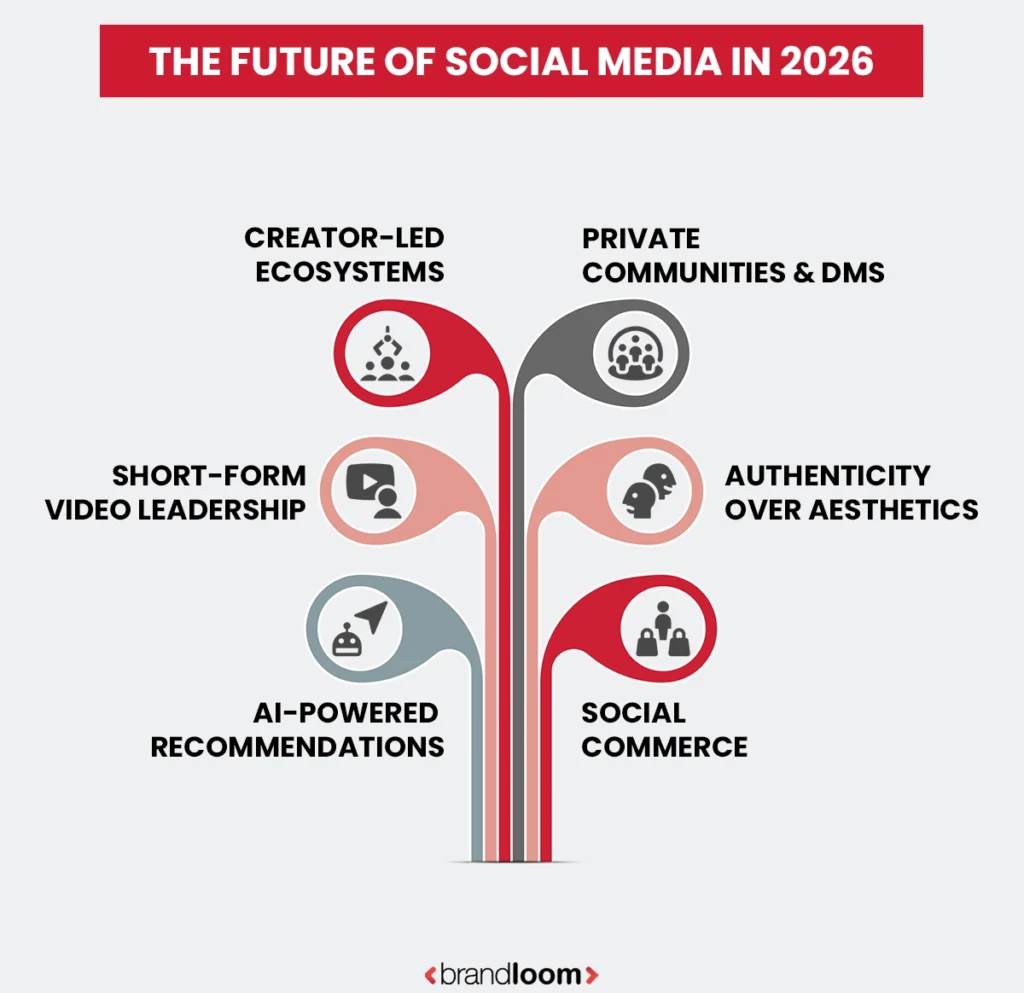
1. AI-Powered Recommendations: The Backbone of Social Media Strategy in 2026
One of the most exciting developments in social media strategy in 2026 is the increased role of artificial intelligence (AI). Social media platforms such as Instagram, Facebook, and YouTube are already leveraging AI to provide personalized content to each user. However, in 2026, we will be able to check even more powerful algorithms that will use AI to make recommendations based on user behavior, preferences, and interactions in real time.
If you are a business owner, consider this scenario as a challenge to generate content that will be in line with the audience preferences. AI will dictate the content that gets seen, and data-driven insights will be crucial for crafting your content strategy. Emphasizing on the three parameters such as what algorithm prioritizes, engagement, relevance, and watch time increase your chances of being visible to potential clients.
2. Short-Form Video Leadership: Dominating Social Media in 2026
The short-form video is dominating the visual content market, with platforms like TikTok, Instagram Reels, and YouTube Shorts. But in 2026, it will be the primary type of content consumption. The users nowadays love the short content because it is fast-paced, effortless to consume, and extremely engaging. Thus, as the attention spans keep getting shorter, the short-form video will still be the top social media strategy in 2026.
For business owners, this means you’ll need to master the art of creating engaging, bite-sized content that tells a story, entertains, or educates in under 60 seconds. But there’s more to it than just posting random videos. Your social media content strategy needs to align with your brand voice, values, and messaging.
The success of the short-form video depends on the creation of the content that speaks to the audience’s likes. The short video can be used to either promote the product, give a sneak peek, or add value via tutorials, and still, it will be able to attract the audience and have the widest reach. By leveraging tools like Instagram’s Explore tab, you can increase your brand visibility and drive more traffic to your website.
3. Creator-Led Ecosystems: The Rise of Influencer Collaborations
In 2026, the creator economy will continue to thrive. However, the definition of an “influencer” will evolve. Instead of relying solely on celebrity endorsements, businesses will focus on building partnerships with real people and creators who genuinely resonate with their target audience.
For the companies, this will open up new avenues for them to get their products and services through creator collaborations. The partnership with micro-influencers or content creators who share your brand’s vision could aid you in producing more genuine and relatable content. By entering the creator-led ecosystem, you will not only gain the trust of the audience but also have good grounds for your business.
When planning your social media strategy for 2026, consider how you could work with creators to produce content, promote your products, or have a contest. Trust-based content marketing will bring about real-time engagement as well as lead to long-term relationships with your audience.
4. Private Communities & DMs: The Shift Toward Personalized Engagement
Although public social platforms such as Facebook and Instagram will still have their significance, private communities and direct messaging (DMs) will be the primary means in 2026. Consumers are craving more intimate, personalized interactions with brands. Private groups and DMs offer the perfect space for this.
To optimize your social media marketing strategy, think about making a community-led marketing approach, that is, creating private Facebook or Telegram groups where your followers can interact with your brand in a significant way. Use DMs for one-on-one communication, providing personalized recommendations or answering customer queries in real-time.
The shift to private communication also creates an opening for new opportunities in conversational commerce, the ability to sell products through messages and conversations. By 2026, DMs will be one of the most used sales channels for businesses, giving customers the possibility to ask questions and buy products in an easy and interactive manner.
5. Authenticity Over Aesthetics: Trust Takes the Lead
The year 2026 is going to be the year of authenticity. Customers are fed up with content that is too perfect and not real. Brands that are genuine and approachable will be the ones to connect with the customers. Aesthetics will still matter, but authenticity will be the differentiator.
One of the main aspects of your social media strategy should be to promote the more humane aspect of your company. It can be done by publishing customer-generated images and stories, showing the behind-the-scenes of your operation, and presenting your staff and clients in pleasant and human ways. The more genuine your content feels, the more it will resonate with your audience.
The trust that is built with your audience based on authenticity is one of the main factors that should be considered in forming long-term relationships. People want to be associated with brands that they trust, and authenticity will drive better results than any amount of glossy visuals.
6. Social Commerce: Turning Conversations into Sales
By 2026, social commerce will play a significant role in social media strategies, as companies will continue to migrate their sales to platforms like Instagram, Facebook, and YouTube. Consumers are increasingly shopping directly from social media, and businesses that integrate social commerce will see higher conversions from engagement.
In order to gain the maximum benefit from this trend, the following approaches can be adopted by businesses:
- Make Use of Shoppable Posts: Tag the products in your posts, and stories so that the users are able to purchase them without leaving the platform.
- Conduct Live Shopping Events: The audience is to be engaged in real-time through live shopping events on platforms such as Instagram Live and Facebook, where customers can purchase instantly.
- Use Real-Time Product Recommendations: AI will drive personalized product suggestions, boosting sales by showing relevant items at the right moment.
Building a social media funnel that guides users from awareness to purchase through shoppable posts and live events is crucial for success. By aligning your content with platform-specific strategies and real-time engagement, you can seamlessly turn interactions into sales, driving both ROI and customer satisfaction.
Building a Social Media Funnel for Success in 2026
At BrandLoom, we recognize that a successful social media strategy for 2026 entails not merely uploading content and waiting for the best outcome but in-depth planning and execution. Therefore, with the right social media strategy, businesses won’t only be able to attract customers but will also have a chance to build engagement through every stage up to conversion. No matter if you are an experienced businessperson or just starting out, this strategy will help you maximize your social media efforts and convert engagement into measurable results.
Stages of the Social Media Funnel: Nurturing Your Audience at Every Step
To build an effective social media funnel, it’s essential to understand the key stages your audience goes through before they make a purchase. Here’s how we, at BrandLoom, break down the journey:
Awareness
The funnel’s first phase is to make your brand known to the target market. In 2026, short-form video will be the most effective tool for attracting and keeping people’s attention. As the content consumers exponentially get more attracted to the platforms like Facebook, Instagram Reels, and YouTube Shorts, the short, punchy, and engaging videos will help you stand out in a crowded marketplace.
However, connecting to your target audience is not just about making excellent content; it’s also about making sure that it gets to the right people. Here is where the AI-powered recommendations become a solution. Social media platforms are more and more based on AI-driven algorithms to provide personalized content delivery by taking audience preferences and habits into account.
What You Should Do: Focus on creating short-form videos that provide value and encourage sharing. Leverage AI tools to optimize content for each platform’s algorithm, ensuring maximum reach.
Consideration: Build Trust with Authentic Content, Testimonials, and Reviews
Once you’ve captured attention, the next step is to move your audience to the consideration stage. Here, the building of trust is the key to winning over customers. The modern consumers are not satisfied with just having the best item; they want to be a part of the brand they trust.
At BrandLoom, we recommend focusing on authentic content that humanizes your brand. Share raw footage, tell the customer stories, and give the audience the real-life testimonials. Try to use the user-generated content to prove to your audience that there are real people who highly appreciate your products.
What You Should Do: Share testimonials and reviews from real customers who have had positive experiences with your brand. Produce content that is easy to relate to and that illustrates the values and principles of your brand. Engage in conversations through comments, DMs, and live events.
Conversion: Drive Sales with Seamless Shopping Experiences Through Social Commerce
The last step of the funnel is where the conversion takes place. It is predicted that in 2026, social commerce will be the most effective means of turning engaged followers into loyal customers. Instagram, Facebook, and TikTok are among the platforms that have already incorporated shopping functionalities that enable customers to buy goods straight from their newsfeed without exiting the application.
At BrandLoom, we believe in creating seamless shopping experiences that make it easy for users to buy from you at the moment of interest. Whether it’s through shoppable posts, live shopping events, or real-time product recommendations, you need to eliminate any friction in the buying process.
What You Should Do: Use shoppable posts and direct messaging (DM) automation to lead users through the buying journey. Leverage AI-empowered personalized product recommendations to deliver tailored buying options.
AI Social Media Tools Every Business Owner Needs In 2026
The implementation of AI has become a must rather than a choice. AI is not a trick or a gimmick, but you need to have it at the heart of your social media marketing strategy in 2026 if you are thinking of serious gains, consistency, and results.
AI is not a shortcut. Not a substitute for creative thinking. But it works as a system that lets you speed up, be in the picture, and make better, faster decisions every day. Social media moves in real time. Algorithms change quickly. Audience behavior shifts even faster. AI helps you keep up without guessing or burning out.
How AI Can Be Effectively Integrated Into Social Media Strategies
AI works best when you use it across planning, creation, and optimization, not just for writing captions. Think of it as a system that supports smarter thinking, not shortcuts.
Here’s how to integrate it properly.
1. Generate Smarter Content Ideas Based on Audience Preferences
The majority of firms create and share content that is based on their own perception of what will attract the audience. In 2026, that method is no longer viable in social media. The platforms of social media give preference to what is relevant, and relevance is derived from behaviors, not from assumptions.
With the help of AI, you can distinguish between the things your audience always reacts to, and you can then allow that knowledge to steer your content strategy.
The following are ways to use AI:
- Detect common customer inquiries and concerns through the analysis of comments, DMs, reviews, and search behavior
- Come up with topic ideas that are in line with the audience’s preferences rather than with internal opinions or non-converting trends
- Establish distinct content pillars so that your posts will be perceived as interconnected, deliberate, and recognizable over time
- Content mapping to funnel stages: awareness content to attract, trust content to educate and conversion content to provoke action
- Create a sustainable social media content strategy rather than posting at random or making quick last-minute reactions.
2. Write High-Impact Hooks That Increase Watch Time
In social media strategy in 2026, the first line decides everything. If your opening doesn’t capture attention immediately, the platform moves on and so does your audience.
Even the best video content fails if the hook doesn’t land. People scroll fast. Algorithms measure how quickly viewers drop off. That’s why hooks now play a direct role in watch time, reach, and overall visibility.
AI helps you approach hooks strategically instead of relying on guesswork.
Use AI to:
- Generate countless hook variations for a single concept, so that you can discover the one which really gets the audience’s attention
- Try the different styles of hooks, like leading with curiosity, problem-based, and authority, to find out the one that resonates with your audience the most
- Rephrase the hooks for each social media platform, since the approach that works for Instagram may not be successful on LinkedIn or Shorts
- Keep the brand voice consistent, while trying out different hook formats
- Increase the watch time and early retention, which the platforms regard as strong quality signals
When hooks are good, the audience stays longer. When the audience stays longer, algorithms favor your content and push it even more. Heavy hooks give rise to that momentum. They send out early positive signals, improve distribution, and lead to better performance across your social media channels.
3. Repurpose Long-Form Video Into Scalable Short-Form Content
Creating new content every day drains time, energy, and focus. In the upcoming social media strategy in 2026, efficiency matters as much as creativity. Repurposing isn’t a shortcut; it’s a smart way to scale without burning out.
Long-form video already contains your best ideas. AI helps you unlock that value and distribute it across platforms in formats audiences actually consume.
AI allows you to:
- Break one long video into several clips, each suitable for Reels, Shorts, and other short film formats.
- Extract key talking points from podcasts, webinars, interviews, or founder talks
- Rewrite video insights into captions, carousel posts, and text-led content without repeating the same message.
- Turn one recording into weeks of short-form content, maintaining momentum and consistency.
- Preserve message clarity and brand voice, even while publishing across multiple formats.
Such a method endorses long-term visibility while satisfying the need for frequent posting. It supports businesses in being consistent, boosting watch time, and accelerating the implementation of social media growth strategies without draining their workforce.
4. Optimize Posting Time With Real-Time Learning
There was a time when the concept of a fixed “best time to post” was applicable, but not anymore. Social media strategy in 2026 is characterized by changing audience behaviors at all times and the response of the platforms to real-time signals instead of static schedules.
AI helps you adapt instead of guessing. When you combine AI with analytics, you stop relying on generic advice and start making decisions based on actual performance.
With AI and analytics, you can:
- Test posting times based on the types of content, as the performances of videos, carousels, and text posts are different
- Compare reach, engagement, and conversions to understand what timing truly delivers results
- Adjust schedules using real-time performance data, not outdated benchmarks
- Make the brand always visible without audience fatigue by improving consistency without overposting
- Have the tools necessary to support continuous social media optimization strategies that keep up with the platform behavior
By adopting this method, you will be able to keep your social media strategy in 2026 in sync with the current workings of the platforms and not with how they worked last year. When timing adapts to data, content performs better, engagement stays steady, and growth becomes more predictable.
Platform-Specific Content Strategy in 2026
According to the new social media strategy in 2026, each platform behaves differently, rewards different signals, and serves content to audiences in unique ways. Treating every platform the same weakens performance. Strong results come from designing a platform-specific content strategy that matches how people consume content and how algorithms rank it.
Below is how content strategy needs to shift by platform.
Instagram Social Media Marketing Strategy
Instagram has established its identity around short-form video, speed, and interaction.
The platform prioritizes content that captures attention instantly and keeps people engaged.
To perform well on Instagram:
- Lead with short-form video first, especially Reels, as they drive discovery and reach
- Hook viewers within the first 3 seconds, or the content loses momentum
- Focus on community replies, because comments, replies, and DMs signal relevance
- Optimize for saves over likes, as saves indicate long-term value and boost distribution
- Create content people return to, not just scroll past
Instagram rewards content that feels personal, useful, and interactive. A strong Instagram social media marketing strategy focuses on watch time, saves, and conversations, not vanity metrics.
LinkedIn Content Strategy
LinkedIn is not a visual entertainment platform. It is a platform for thinking. People come to LinkedIn to learn, reflect, and evaluate credibility. The algorithm rewards content that demonstrates clarity of thought, depth of experience, and real-world understanding. When you approach LinkedIn like Instagram or chase short-term engagement, content falls flat. When you approach it with intention, it compounds.
If you want to gain visibility and credibility on LinkedIn, then put your emphasis on quality and not on quantity, on insight and not on good looks.
How to Make Yourself Seen on LinkedIn
- To perform consistently on LinkedIn, structure your content around expertise and perspective.
- Prioritize thought leadership that reflects lived experience, strong opinions, and practical insights. Content performs best when it teaches something only experience can explain.
- Present long-form posts that inform, provoke new thoughts, or sort out tricky strategies into understandable thinking. The depth of the text keeps the readers attached, and at the same time, it indicates the authority of the writer.
- Use founder-led and leadership content to humanize the brand. When leaders share decisions, reflections, and lessons, trust builds naturally.
- Tell B2B stories around growth journeys, strategic decisions, failures, and course corrections. Real stories resonate more than polished claims.
- Encourage discussion intentionally, because meaningful comments extend reach and deepen visibility. Ask thoughtful questions that invite perspective, not validation.
LinkedIn posts are at their best when they educate before they sell. An efficient LinkedIn tactic is based on trustworthiness, regularity, and openness of communication. This method will gain trust, bolster the situation, and eventually, help the brand become authoritative in the B2B social media marketing industry for a long time.
YouTube Content Strategy
YouTube remains the strongest platform for long-term authority in social media in 2026. Unlike short-form platforms, YouTube rewards depth, consistency, and retention.
To grow on YouTube:
- Create long-form educational content that solves real problems
- Focus on high watch time, as retention directly impacts visibility
- Build content around deep education, not surface-level tips
- Optimize videos for search, as YouTube acts like a long-term discovery engine
- Think in series, not one-off uploads
YouTube content compounds over time. A strong YouTube strategy supports SEO, builds credibility, and continues driving traffic long after publishing.
Why Platform-Specific Strategy Matters
It is important to understand that each social media platform has its own way of operating. They each offer incentives for certain actions, observe different types of user interactions, and present the content to users in their unique styles. When you treat every platform the same, performance suffers.
To get consistent results, you must design content around how each platform measures success.
- Instagram prioritizes saves, replies, and retention. Content needs to deliver immediate value and encourage people to come back to it.
- LinkedIn is all about the depth of content, its relevance, and the conversations it triggers. This means that the content that supports and reflects the real-life experience will be accompanied by educating people, providing professional discussions, and so on.
- YouTube values watch time, consistency, and search behavior. Long-form, educational content that holds attention continues to grow over time.
Since the signals are different, there should be a separate social media optimization strategy for each platform. When the content complies with the platform’s behavior, the distribution is improved naturally, and the engagement turns out to be more meaningful.
In social media strategy for 2026, the main source of growth will be alignment, not duplication. Brands that produce content based on how each platform operates will be able to turn their effort into measurable results and gain authority by attracting attention.
Social Media Growth Strategies That Work in 2026
Forget hacks. They don’t build momentum. They create spikes that disappear.
The only thing that can guarantee growth is to do the basics but to a higher level and to do them for a long time until the algorithm and the audience trust you. Week one will not show you any explosive results. It will seem to you that nothing is going on. Then the compounding kicks in. Growth is at first very slow, then it suddenly becomes exponential.
Here are the social media growth strategies that actually work:
- Show up consistently. Post on a predictable rhythm so the platform can learn what you do and who should see it. Consistency trains distribution and builds familiarity with your audience.
- Take a clear position. Quit trying to please everybody. Clearly state your beliefs, the people you help, and the areas of your expertise. Good positioning makes your content easily identifiable.
- Create audience-first content. Speak to what people care about, struggle with, and search for. Address real questions. Solve real problems. When your content serves the audience, engagement follows naturally.
- Collaborate with creators strategically. Partner with creators who already speak to your target audience. Co-create content, share perspectives, and tap into existing trust. Creator collaborations can accelerate reach without feeling like ads.
If you adhere to these strategies, you will build something that lasts. You will not chase attention; you will earn it. And when the compounding begins, your social presence will no longer feel like a strain; it will start to work as an asset.
Why Most Businesses Fail at Social Media in 2026
The primary cause of failure for most businesses on social media is not a lack of effort but
rather a lack of a system. They post when they remember, chase whatever looks popular, and then wonder why reach drops or leads don’t come in.
Social media in 2026 has evolved significantly. Platforms now actively reward brands and creators who show up consistently, hold audience attention, share genuinely relevant content, and foster real interaction. When these fundamentals are in place, even simple posts can gain meaningful visibility. Mastering consistency, retention, relevance, and engagement ensures that good content does not just exist but actually reaches the people it is meant for.
Here are the most common reasons businesses lose momentum:
- They post without a strategy. They publish random updates without clear goals, pillars, or a funnel. When you don’t plan your content around awareness, trust, and conversion, you attract the wrong audience or no audience at all.
- They do not use video. Videos are prioritized by social platforms because they attract users and increase the time they spend watching. Limiting yourself to only static posts leads to a smaller audience and slower growth. Video is compulsory now; it is your way of capturing the audience’s attention.
- They don’t build a brand voice. Many brands sound generic because they copy what others say. A weak or inconsistent brand voice makes your content forgettable. When you communicate clearly and consistently, people recognize you faster and trust you sooner.
- They do not create a DM system. Only engagement does not bring in revenue. The easiest conversion channel of having direct conversations is often overlooked by businesses. Whenever you do not prompt, reply, or follow up for interested people to come into DMs, you let go of warm intent.
- They blindly chase trends. Trends can sometimes result in more visibility, but at the same time can also cause one’s positioning to be less clear. When a brand is following every trend that is not even connected to its message, it confuses the audience and attracts low-intent followers who never convert.
If you avoid these mistakes, you put yourself ahead of most businesses immediately. You stop posting for noise and start building a channel that creates visibility, trust, and sales over time.
Conclusion
Social media in 2026 is no longer about posting often or chasing surface-level engagement. It is about building systems that create visibility, earn trust, and drive measurable business results. Platforms have evolved, audiences are more selective, and algorithms now reward relevance, retention, and genuine interaction.
At BrandLoom, we believe social media should work as a growth engine, not a guessing game. Businesses that succeed are the ones that rely on data, embrace video, design platform-specific strategies, and build real relationships through content, community, and conversation.
The shift is clear:
- From hacks to consistency
- From aesthetics to authenticity
- From random posting to structured funnels
- From reach-chasing to trust-building
Growth may feel slow in the beginning, but when strategy, content, timing, and engagement align, momentum compounds. What starts quietly turns into authority, visibility, and predictable outcomes.
This is exactly how we approach social media at BrandLoom. We help businesses move beyond noise and build social media strategies that deliver long-term value, strong positioning, engaged audiences, and real conversions.
Social media rewards those who play the long game. With the right strategy and the right execution, brands don’t just keep up with change; they lead it.
Frequently Asked Questions
Social media strategy is a mechanism that leverages attention to gain trust and trust to generate revenue, and all this is done with the help of data, platform behavior, and constant execution.
A solid social media strategy establishes your target audience, your offers, your content pillars, your posting frequency, and your DM-to-sale process.
It also integrates with your overall social media brand strategy so that every post communicates your brand personality rather than sounding like generic marketing.
At BrandLoom, our social media experts kick off by crafting a social media strategy around quantifiable targets: leads, booked calls, and sales rather than just likes. We also build platform rules into your plan, so you publish content that earns reach through retention, saves, and conversations. This approach improves the impact of social media on marketing strategy across your entire business.
Business owners should give priority to three things: consistency, clarity, and conversion. Build a repeatable social media content strategy instead of posting when you remember. Start with 3–5 content pillars, create proof content (results, reviews, behind-the-scenes), and publish short-form video weekly. Then apply social media growth strategies like creator partnerships, comment replies, and DM prompts.
At BrandLoom, we help clients with creating a social media strategy that runs like a system: we plan content, script hooks, design funnels, and track what drives leads. We also teach you to take a clear position, so people instantly understand who you help and why you’re different. When you follow best social media strategies, you stop chasing trends and start compounding attention into trust.
By 2026, platforms will reward watch time, saves, and real conversations more than polished aesthetics. Your social media marketing strategy must match this shift, because algorithms now push content that holds attention and creates interaction.
Businesses will also rely more on DMs and private communities, so your social media strategy must include DM flows, reply scripts, and trust-building content. At BrandLoom, we run weekly performance reviews and apply social media optimization strategies fast, so you don’t rely on outdated “best time to post” advice.
We build a living social media optimization strategy that adapts to real data: retention, saves, click-throughs, and lead quality. This is how brands keep performance stable even when al
Top trends include AI-led discovery, short-form video dominance, creator-led ecosystems, private communities, and social commerce. Brands will win by building a social media strategy that fits each platform instead of copying the same post everywhere.
For example, an Instagram social media marketing strategy should prioritize Reels retention, saves, and DM replies. A B2B social media marketing strategy on LinkedIn should focus on founder-led insights, strong opinions, and comment-driven conversations.
At BrandLoom, we help you choose the right trends for your business, then turn them into a practical execution plan content pillars, creator outreach, and conversion CTAs. We also ensure your social media marketing strategy stays ROI-driven, so trends support sales, not noise.
AI affects reach, speed, and decision-making. Platforms use AI to recommend content, so your social media strategy must optimize for retention, relevance, and engagement signals like saves and replies. AI also helps you execute faster.
Many owners ask, how can ChatGPT be effectively integrated into social media strategies? Use it to generate content ideas, write hooks, draft captions, repurpose long videos into short clips, and create DM scripts, then refine everything with your brand voice.
At BrandLoom, our GEO and social media experts use AI as a support system, not a replacement. We combine AI speed with human strategy, so your social media marketing strategy stays consistent, your content stays authentic, and your results stay measurable.
Content works best when it feels real, teaches quickly, and drives action. Short-form video leads because it boosts discovery, but proof content builds trust: testimonials, case studies, customer stories, and behind-the-scenes.
Build your social media content strategy around saves, shares, and conversations, not just views. A practical social media strategy example is posting 4 Reels a week, 2 value carousels, and daily stories that invite replies and DMs.
At BrandLoom, we show businesses how to build a successful social media strategy by scripting strong hooks, simplifying the message, and aligning every post with a funnel stage. We also keep your tone consistent with your brand, so content feels recognizable across platforms. This is how the best social media strategies create authority and sales.
Small businesses grow by staying focused and running a simple system. Start with a social media strategy template: define your niche, audience pain points, offers, content pillars, and weekly posting rhythm.
Then follow how to create a social media strategy that fits your schedule, batch content, repurpose one long recording into multiple shorts, and engage daily in comments and DMs.
At BrandLoom, we guide founders through developing a social media strategy that drives leads even with limited time. We also show you how to create an effective social media strategy by tracking retention, saves, and inbound messages every week. Use consistent proof (reviews, before/after, behind-the-scenes), and you will earn trust faster. These social media growth strategies compound results without burning you out.
To convert engagement to sales, create a funnel and eliminate friction. To begin, know what a social media marketing strategy is: it is a plan that leads consumers from knowing about a product to buying it through the use of content, offers, and clear next steps.
The users of your social media strategy should be directed to DM with “keyword,” click on a product tag, join a group, or book a call. When applicable, incorporate shoppable posts and live sessions, and do not delay in DMs.
At BrandLoom, our approach is to create a social media optimization strategy that is conversion-first: we associate the content with the three stages of the funnel, design the CTAs, and create DM scripts that feel human. Additionally, we do not only consider the number of leads but also the quality; thus, the revenue generated through your social media presence will be substantial.
You need tools that support planning, publishing, engagement, and measurement. Start with a content calendar, brand templates, and a clear social media strategy presentation so your team executes the same priorities.
Use AI tools for scripts, hook variations, repurposing, and caption drafts, then edit for brand voice. Use scheduling tools to stay consistent, and use a DM inbox tool or CRM to track leads and follow-ups. At BrandLoom, we set up a simple tool stack and teach teams to use it weekly.
We also apply social media optimization strategies through analytics dashboards, so you improve faster with real data. Tools don’t replace strategy, but they reduce friction and help your social media marketing strategy stay consistent.
Brands should measure what drives business outcomes, not vanity metrics alone. Track reach, but prioritize retention, saves, shares, and meaningful comments because they signal real value and algorithm strength.
Track DMs, link clicks, booked calls, lead forms, and purchases to judge your social media strategy and ROI. Use platform analytics plus your CRM to connect posts to revenue, then refine your social media optimization strategy weekly.
At BrandLoom, we set clear KPIs by funnel stage and review performance every week, so you know what content creates visibility, trust, and sales. This measurement style strengthens the impact of social media on marketing strategy because you prove what works. When you track the right signals, you repeat the best social media strategies and scale predictably.