Google’s evolving AI-driven algorithms have significantly changed how content is evaluated and ranked. Many businesses relying on outdated SEO methods are experiencing declining visibility.
By 2026, semantic SEO and predictive SEO will no longer remain optional. They are going to dominate search results. Outdated keyword-only methods are losing effectiveness, while semantic and predictive SEO provide a sustainable competitive advantage.
Semantic SEO enables search engines to determine the actual meaning of content by analyzing its main subjects and involved entities, and user search objectives, without depending on repeated keywords. Predictive SEO identifies audience search patterns before trends reach their peak, while it enables early ranking acquisition during periods of minimal competition.
Transform your online presence with India’s best SEO company. Experience unparalleled expertise, innovative strategies, and dynamic results.
Organizations must implement AI tools together with structured data, trend forecasting, and comprehensive topic clusters, which demonstrate their expertise. The process involves enhancing user experience for both human users and AI systems, which includes Google’s AI Overviews.
The future of SEO has arrived. Google’s 2026 algorithms prioritize contextual understanding and AI-driven search over traditional tactics. Brands relying on basic SEO are losing ground daily.
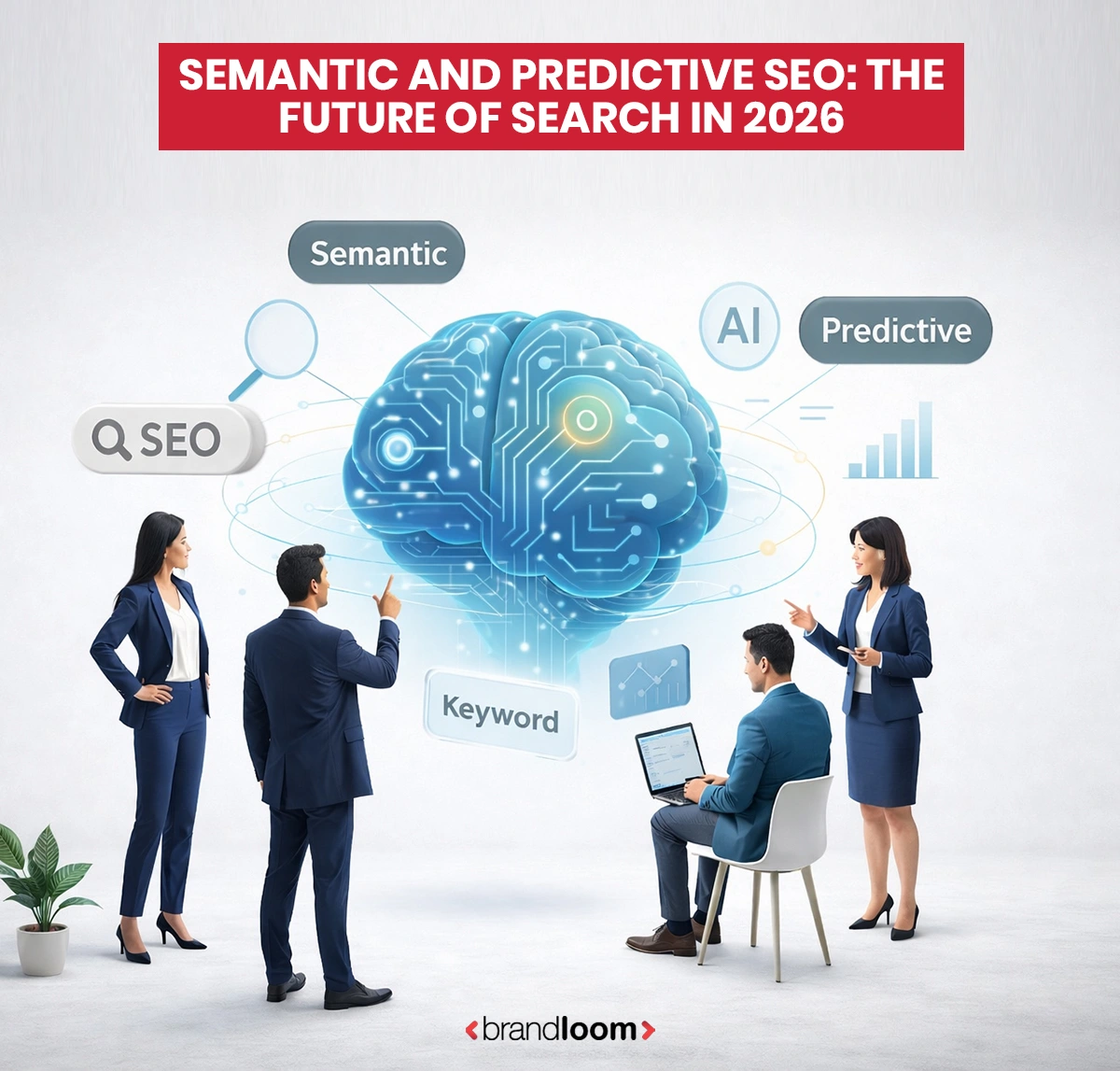
BrandLoom is among India’s leading digital marketing agencies specializing in AI-driven SEO and measurable ROI strategies, implementing advanced SEO methods that use AI technology to create optimal content release schedules.
This blog will provide readers with practical methods to establish topic authority and demonstrate through actual case studies how both semantic SEO and predictive SEO lead to substantial business growth. The search landscape has transformed, and businesses need strategies that match where visibility actually happens now.
Maximize your online visibility with Delhi NCR’s leading SEO company. Expert tactics, customized solutions, and proven success to grow your business.
Why Traditional SEO Is No Longer Enough
Businesses experienced success with traditional SEO methods, which lasted for almost twenty years. The formula required businesses to select high-traffic keywords, which they needed to distribute throughout their content while they created backlinks to achieve higher search rankings.
But that era is ending.
Modern search engines utilize advanced artificial intelligence systems, which include Google BERT, MUM, and AI Overviews, to analyze content using human language comprehension methods. The system can detect synonyms and determine contextual meanings while it comprehends how different entities connect and anticipates the most relevant details that users will request.
The old approach of repeating “best digital marketing agency India” fifteen times on a page doesn’t just fail; it actively hurts rankings. Search engines flag it as over-optimization and poor user experience. More importantly, it completely misses how people actually search in 2026.
The following changes demonstrate actual developments:
- People use voice search to create lengthier conversational queries, which include this request: “What is the most effective method for enhancing brand visibility of a startup company that is about to launch in Bangalore?”
- AI Overviews synthesize information from multiple sources, rewarding depth over keyword matching.
- Zero-click results present answers directly on search results pages, which need structured data and clear content.
- Conversational search requires users to speak in natural language to state their intent instead of using keyword-based search terms.
Boost your digital footprint with Mumbai’s top SEO company. Innovative strategies, personalized service, and measurable results for your business.
What Is Semantic SEO? Understanding Meaning Over Keywords
Semantic SEO meaning centers on a fundamental but powerful shift: focusing on topics, intent, and relationships instead of individual keywords. This method is shifting the way companies generate material for search engines and users.
Semantic SEO meaning: It is about building content to help search engines understand the meaning, context, and intent of searches by focusing on entities, relationships between them, and full topic coverage. Semantic SEO focuses on topics rather than individual keyword phrases and is used to develop more comprehensive content ecosystems.
Rather than the question of “which keyword should I target?” A semantic SEO strategy presents a deeper level of inquiry:
- What is the user ultimately trying to achieve with this search?
- What other concepts must be addressed to cover this topic in its entirety?
- What are the various entities connected to this subject?
- What framing is useful for the search engines to understand the purpose this content serves?
- Which supporting topics strengthen the main content’s authority?
This is an indication of the way in which contemporary search engines have developed. Their function is no longer (just) to return matching keywords for user queries; they infer meaning, relate entities, and anticipate user action using complex AI models.
Elevate your online presence with Gurgaon’s premier SEO company. Tailored strategies, expert analysis, and impactful results to drive your success.
Semantic SEO vs Predictive SEO: Quick Comparison
| Feature | Semantic SEO | Predictive SEO |
|---|---|---|
| Focus | Meaning and intent | Future search trends |
| Goal | Build topical authority | Rank before competitors |
| Method | Entities, structured data, clusters | Trend analysis, forecasting |
| Impact | Improves AI understanding | Captures early search demands |
| Best For | Long-term authority | Early ranking advantage |
How Semantic Search Changed SEO
The semantic search revolutionized how search engines look at queries. When a person executes a search for “apple,” semantic search seeks to discern whether the person is referring to the fruit, the technology company, Apple Music, or something entirely different by considering various signals:
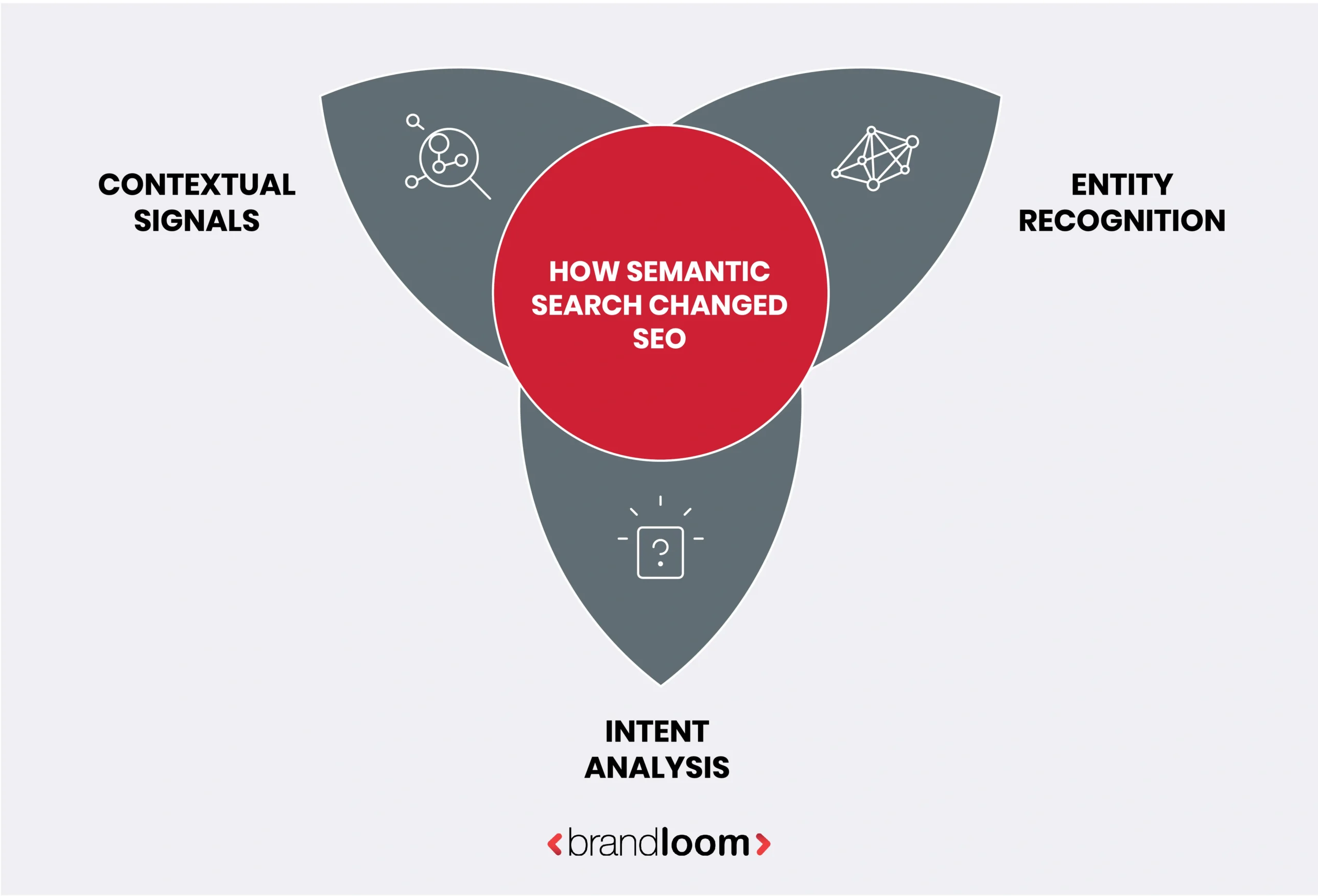
Contextual Signals
- Pre-existing search history and habits
- Location and device signals
- Time of day and seasonal context
- Words surrounding “apple” in the query
Entity Recognition
- Structured forms of relationships in the Google Knowledge Graph
- Links between brands, individuals, locations, and ideas
- Historical associations with similar queries
Intent Analysis
- Whether the user is interested in learning, buying, navigating, or comparing
- Commercial vs. informational intent signals
- Stage in the customer journey
This is semantic analysis in SEO: the ability to understand meaning beyond literal word matching. It’s why two people searching the same term can see completely different search results based on context and intent.
Unlock your website’s potential with Pune’s leading SEO company. Expert strategies, personalized service, and proven results to elevate your brand.
Semantic SEO Strategy: The Core Principles
For a semantic SEO strategy to drive success, it requires shifting from keyword-focused thinking to topic-driven authority:
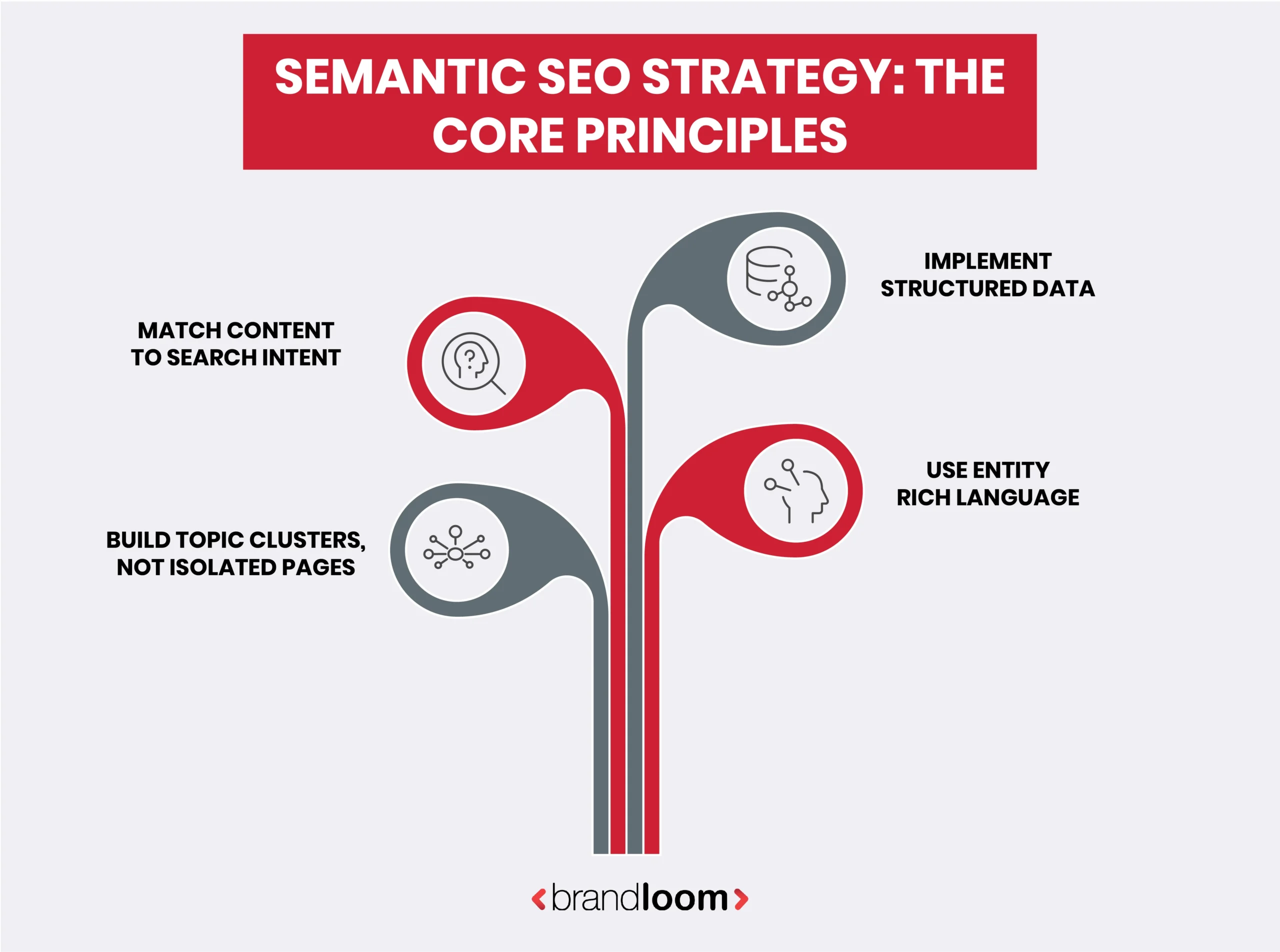
1. Build Topic Clusters, Not Isolated Pages
Produce pillar content that explains a basic core topic supported by cluster content exploring specific subtopics. Internal linking between these pieces strengthens topical authority.
For instance, a pillar page about “Brand Positioning Strategy” can link to cluster content around competitive analysis, messaging frameworks, audience research, and the visual identity: all related ideas that search engines identify with the broader topic ecosystem.
2. Use Entity-Rich Language
Entities are discrete individuals, brands, locations, concepts, or objects that search engines recognize and monitor. Semantic keywords are not mere synonyms of target words; they are related entities and concepts that also contribute context.
3. Match Content to Search Intent
Every query carries intent: informational (learning), navigational (finding), commercial (researching), and transactional (buying). Semantic SEO enables content creation that matches user requirements according to their current needs during every section of their journey.
4. Implement Structured Data
Schema markup serves as the communication method that website owners use to show search engines their content’s precise meaning. The process transforms undefined content into measurable, complete entities that demonstrate their relationships with one another.
The SEO specialists at BrandLoom use schema implementation for their content, which includes articles, FAQs, how-to guides, organizational information, and personal data to create a precise understanding of each content item and its relationship to other subjects.
Looking for top SEO results in Bangalore? BrandLoom offers unmatched expertise, cutting-edge strategies, and customized solutions for your success.
How to Do Semantic SEO: Practical Implementation
The process of understanding semantic SEO requires different skills than its actual implementation. The good news? The process of implementing semantic SEO does not need total content reconstruction. The process requires the use of a strategic framework, which changes the methods used to develop and connect content.
The following five-step framework provides a clear, actionable path for implementing a semantic SEO strategy that helps search engines understand what a brand represents and how its content connects to user needs.
Step 1: Identify Core Entities
The brand presents its main products, services, people, concepts, and topics. These elements establish the base for the semantic SEO framework.
Step 2: Map Topic Clusters
Group related content around pillar pages. Each cluster should comprehensively cover a subject from multiple angles, creating depth rather than breadth.
Step 3: Apply Structured Data
Use schema markup to explicitly define what content means. The implementation process becomes easy through tools like Google’s Structured Data Markup Helper.
Step 4: Optimize for User Experience
User experience and semantic SEO functions work together as one system. The content that benefits humans also benefits artificial intelligence systems. The writer should create content through natural expression, complete question responses, and structured information presentation.
Step 5: Build Entity Relationships
Link to authoritative sources, reference specific people and brands, connect to relevant concepts, and demonstrate expertise through comprehensive coverage.
What Is Predictive SEO? Anticipating Tomorrow’s Searches Today
Semantic SEO helps search engines understand content, and predictive SEO positions businesses ahead of demand curves by creating content before topics become competitive.
What is predictive SEO? It’s the practice of identifying and publishing content for emerging search trends before they peak, using data analysis, pattern recognition, and AI-powered forecasting to anticipate what users will search for next.
The standard SEO process creates content after search volume information becomes available. Predictive SEO operates through proactive publishing, which occurs before other companies identify potential advantages.
How Predictive SEO Works
Predictive SEO is essentially a fusion of several data-driven methods:
Trend analysis: Platforms such as Google Trends show what ideas are on the rise. Brands are able to build authority early on, before the competition gets too heavy, by publishing sooner.
Seasonal Behavior Recognition: A lot of searches are seasonal. Those brands that supply this content months ahead of the seasonal peaks will establish early rankings and build trust with search engines over time.
Emerging Query Discovery: As industries change, technologies advance, and consumer trends evolve, new search queries emerge. Identifying such queries at an early stage is bound to have a competitive advantage.
Intent Forecasting: Users exhibit consistent behavior patterns in pre-purchase research, seasonality of interest, and response to industry moves. Predictive SEO sees these patterns and writes content based on what will be needed next.
The Technology Behind Predictive SEO
Artificial intelligence and machine learning investigate extensive datasets to discover patterns that humans cannot perceive:
- Search volume trajectories across time periods
- Social media conversation trends and sentiment
- Industry publication patterns and topic emergence
- Seasonal behavior, repetition, and anomaly detection
- Cross-platform user behavior signals
The AI-based insights provide BrandLoom’s strategy teams with precise content opportunity forecasting, which enables clients to stay ahead of market demand while achieving the agency’s established record of rapid traffic growth.
How Semantic and Predictive SEO Work Together
The combination of semantic depth and predictive timing creates the most powerful results. Semantic SEO builds comprehensive topical authority through thorough coverage. The Predictive SEO system enables authority development to occur before the saturation of topics. Their combined efforts produce an SEO strategy that remains effective in the future because it uses AI-based search technology.
The combination establishes a compounding advantage, which continues to enhance its power throughout time.
The practical applications of semantic and predictive methods demonstrate their interactive capabilities across multiple situations. For example, the jewelry e-commerce brand used both methodologies to develop their strategic plan, which included two different approaches:
- Semantic Implementation: Built comprehensive topic clusters covering jewelry care, cleaning methods for different materials, storage solutions, and seasonal guidance. Implemented structured data and created entity-rich content connecting jewelry types with care products and contexts.
- Predictive Implementation: Analyzed seasonal patterns and published monsoon jewelry care content three months early (March), capturing rankings before competition intensified. Identified emerging trends and created content months before demand peaked.
Results: When the monsoon season arrived, the brand owned page one rankings across dozens of queries. AI Overviews featured their content prominently. Organic traffic grew 300%+, eliminating most paid search spending.
The AI Connection: How Artificial Intelligence Powers Modern SEO
The future of SEO in 2026 requires an understanding of current artificial intelligence applications in search technology.
AI-Driven Search Engines
The search engines Google and Bing, together with new AI search platforms, employ machine learning models that:
- Understand context and nuance in queries
- Generate synthesized answers from multiple sources
- Personalize results based on user behavior and preferences
- Continuously learn and adapt to language evolution
AI-Powered SEO Tools
SEO professionals now use artificial intelligence to conduct their work, which includes
Semantic keyword research and topic clustering
Content optimization based on top-performing semantic patterns
Automated schema markup generation
Predictive analytics for search trends
Content gap analysis across semantic spaces
Creating Content in the AI Era:
AI-generated content is becoming more common, but search engines now enhance their ability to recognize authentic expertise and valuable content, which fulfills Google E-E-A-T principles (Experience, Expertise, Authoritativeness, Trustworthiness).
The most effective strategy combines human expertise with AI tools instead of competing between AI systems and human intelligence. Our BrandLoom SEO experts combine AI research tools with their analysis and optimization knowledge while using their strategic thinking, their brand expertise, and their editorial judgment, which requires human input.
Zero-Click Results and AI Overviews: The New Ranking Reality
The most important transformation in search optimization occurs through zero-click results, which enable users to obtain answers directly from search results without visiting any websites.
Types of Zero-Click Results
Featured snippets, Knowledge panels, People Also Ask boxes, AI Overviews (AI-generated summaries), Local pack,s and calculator conversion tools.
The SEO Paradox
Zero-click results are a paradox: They decrease clicks to your site, but actually being in them drastically increases your brand visibility and authority.
The answer is not to steer away from zero-click optimization; it’s to strategically pursue it while simultaneously creating content compelling enough to generate clicks for deeper engagement.
Optimizing for AI Overviews
AI Overviews pull information from multiple authoritative sources to generate comprehensive answers. To be included:
- Build strong topical authority through comprehensive content coverage.
- Use clear, structured content that AI can easily parse and cite
- Implement structured data to help AI understand your content context.
- Create definitive, well-researched content that AI systems can trust.t
- Establish brand credibility through a consistent, authoritative presence.
BrandLoom helps brands position themselves not just for traditional rankings but for visibility within AI-generated responses that increasingly dominate search results.
The Future of SEO: What 2026 and Beyond Hold
What does the future of SEO look like as we move deeper into 2026 and beyond?
1. Multimodal Search
Search will increasingly blend text, image, video, and voice. Users will snap photos to ask questions and search multiple formats at the same time. Content optimization for multimodal discovery purposes has become essential.
2. Hyper-Personalization
Search results will become increasingly personalized based on user history, context, location, preferences, and real-time signals. Generic optimization gives way to adaptable content that serves different user segments.
3. Search Everywhere
Search functionality is embedding itself across every digital surface: social platforms, messaging apps, e-commerce sites, and productivity tools. Your content needs to be discoverable wherever your audience searches, not just on Google.
4. Intent Prediction as Standard
Search engines will get better at predicting user needs before they articulate their requirements. Proactive content recommendations, anticipatory answers, and predictive results will become the norm.
5. Authority and Trust as Differentiators
As AI makes content creation easier, the differentiator won’t be volume; it’s authority, trustworthiness, and genuine expertise. Building and demonstrating E-E-A-T becomes even more critical.
SEO’s future scope has expanded beyond its current focus to include brand positioning, content authority, and trust-building activities throughout the digital ecosystem, which continues to grow more complex.
Conclusion
Searching in 2026 is not about gaming algorithms or keyword stuffing. You’re not matching a query; you’re matching the most relevant, authoritative, helpful resource for your audience and what they are asking now, but also next.
Semantic SEO allows the search engines to recognize the real value of your content. Predictive SEO allows you to be in the right position to take advantage of an opportunity before it’s apparent. Combined, they are developing a long-term competitive moat in an AI-powered search landscape.
The brands that succeed won’t be the ones with the most content or the largest budget; they’ll be those with the greatest insights into who they are talking to, the clearest understanding of their topical authority, and a strategic vision for anticipating what’s next.
BrandLoom is built for this future. We partner with forward-thinking brands to build search strategies that don’t just chase algorithms; they build lasting authority, trust, and growth.
The future of search is here. The question is, are you ready?
Frequently Asked Questions
Semantic SEO creates content that search engines can truly understand by focusing on meaning, context, and relationships between concepts. It builds topical authority instead of targeting isolated keywords. This helps search engines grasp user intent and full information needs. BrandLoom develops semantic SEO strategies that build expertise and long-term authority.
Traditional SEO focuses on keywords and technical factors, while semantic SEO focuses on meaning and user intent. It builds topic clusters and entity relationships instead of optimizing single pages. Semantic SEO strengthens overall authority. BrandLoom combines traditional SEO fundamentals with advanced semantic strategies.
Predictive SEO anticipates future search trends and creates content before demand peaks. The system uses data patterns together with AI insights to forecast user behavior and market opportunities. The method establishes initial authority through its forward-looking strategy. BrandLoom helps brands capture opportunities ahead of competitors.
Predictive SEO aligns with AI-powered search by using data and behavioral insights to forecast upcoming queries. It creates content for future intent, not just current demand. This matches how AI understands trends and patterns. BrandLoom uses AI-driven insights and expert strategy to stay ahead of search shifts.
AI overviews pull information from authoritative, well-structured content. Semantic SEO builds depth, entity clarity, and structured data that AI systems trust. Content that contains only keywords does not provide the necessary contextual information. BrandLoom optimizes brands for visibility within AI-generated search responses.
Search engines analyze context, natural language, location, and behavior signals to understand intent. They identify whether users want to learn, buy, compare, or act. AI systems recognize layered meaning in conversational queries. BrandLoom creates content aligned with different intent types for better relevance.
Entities are the foundation of how modern search engines understand content. An entity is any distinct person, place, organization, product, or concept that search engines can identify and catalog in their knowledge graphs. Instead of viewing content as keyword strings, search engines map relationships between entities. Your brand becomes an entity with attributes, connections, and context.
Yes, predictive SEO helps brands rank earlier by targeting trends before competition grows. It builds proactive content clusters and early authority. This creates long-term visibility advantages. BrandLoom uses forecasting and AI insights to help brands capture demand early.
Brands should build their authority through topical expertise instead of focusing solely on specific keywords. The company needs to implement three specific components, which include structured data, content clusters, and conversational optimization. Long-term success requires organizations to use predictive planning methods. BrandLoom helps brands implement future-ready SEO strategies.
Yes, but keywords alone are not enough. They must be integrated into semantically rich, authoritative content. The focus is now on topic coverage and intent alignment. BrandLoom combines keyword research with semantic SEO for sustainable growth.