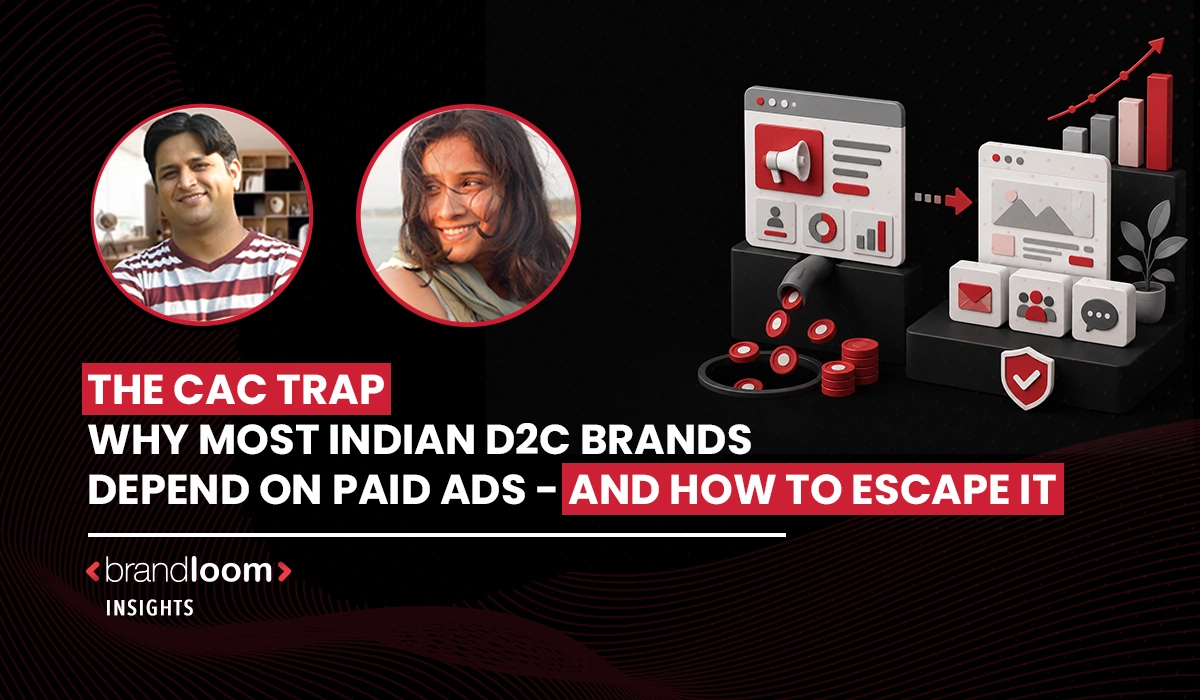
Imagine this: your D2C brand does ₹50 lakhs a month. The numbers look great until you check the P&L and see ₹40 lakhs went straight to Meta and Google ads. Pause ads for a week, and orders drop 45% overnight. Those “loyal customers” were just people who saw your ad at the right moment.
This isn’t growth. It’s ad arbitrage, and it’s far more common than Indian D2C founders admit. The average D2C brand here spends 50–70% of revenue on paid acquisition. For every ₹100 earned, ₹50–70 flows back to the same platforms that brought those customers. You’re not building equity. You’re renting attention.
The longer this continues, the deeper the dependency. Rising CPMs and tighter attribution make it costlier every year. Brands that escape this trap do not do it by spending smarter on ads. They do it by building something ads cannot buy.
What Is the CAC Trap?
The CAC trap is a state of paid dependency where a D2C brand generates most of its revenue from paid advertising channels like Meta and Google. The moment ad spend is reduced, revenue collapses because no organic, referral, or repeat-purchase infrastructure exists to sustain it.
Brands in this trap are not building a customer base. They are renting one. Every new customer costs more than the last as platform CPMs rise, and margins shrink with every campaign. The uncomfortable truth: if turning off your ads tomorrow would kill your business, you do not have a brand. You have an arbitrage operation.
Why Most D2C Brands Fail to Reduce CAC?
Most brands treat CAC as an advertising problem. So they optimize ads — better creatives, tighter audiences, smarter bidding. CAC dips briefly, then climbs again. The cycle repeats.
The real problem is structural. These brands have built their entire revenue engine on paid acquisition and have no alternative infrastructure to fall back on. No owned channels. No organic traffic. No referral loop. No retention system.
Cutting paid spend without those alternatives in place doesn’t reduce CAC. It reduces revenue. Until the underlying structure changes, CAC will keep rising regardless of how well the ads perform.
What Is D2C Customer Acquisition Cost (CAC)?
The full form of CAC is Customer Acquisition Cost — what your brand spends to win one paying customer.
The CAC formula: Total Acquisition Spend ÷ New Customers Acquired.
Simple enough, but most brands undercount it. A fully loaded CAC includes ad spend, agency fees, creative production, influencer costs, tool subscriptions, salaries, and the margin lost on first-purchase discounts. All of it counts.
Average CAC for Indian D2C brands has risen sharply over the last four years, and order values have not kept pace. Most brands now lose money on the first purchase and need multiple repeat buys just to break even.
CAC alone means nothing. It only matters against LTV — the total net revenue a customer generates over time. A healthy D2C business runs at a strong LTV to CAC ratio. If you spend significantly more acquiring a customer than that customer ever spends with you, you are not building a brand. You are funding a slow burn.
Types of Customer Acquisition Channels in D2C
Understanding D2C customer acquisition cost means understanding where those costs originate. Not all channels carry the same price tag or deliver the same long-term value.
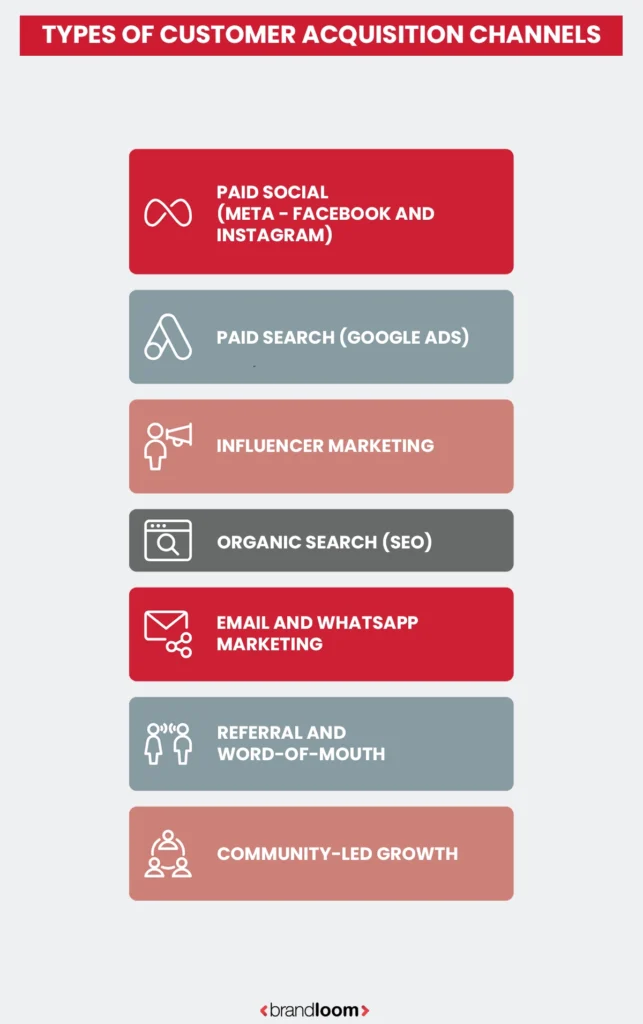
- Paid social (Meta – Facebook and Instagram): The most common channel for Indian D2C brands is social media. High reach, precise targeting, but rising CPMs and post-iOS 14.5 attribution gaps make this increasingly expensive and harder to measure.
- Paid search (Google Ads): High purchase intent, useful for branded and category keywords. Works well for higher-AOV products but faces stiff price competition – and heavy reliance on it deepens paid ads dependency in D2C.
- Influencer marketing: Can drive strong first-purchase volumes. CAC varies widely by influencer tier, category, and brief quality.
- Organic search (SEO): Near-zero incremental CAC per visitor once content ranks. Takes 12–18 months to compound but delivers the highest-quality, lowest-cost traffic long term.
- Email and WhatsApp marketing: Owned channels with negligible cost per send. The most powerful tools for driving repeat purchases and improving LTV.
- Referral and word-of-mouth: Referral-acquired customers carry 70–80% lower CAC than paid channels and tend to retain better.
- Community-led growth: The slowest to build but the most defensible. Genuine communities turn customers into advocates – at zero incremental acquisition cost.
Why Brand Building Matters More Than Lowering CAC
CAC is not just a financial metric. It is a strategic one. How dependent you are on paid acquisition determines how defensible your business actually is.
The paid dependency problem
- Any competitor can outbid you for the same audience
- Ad costs keep rising, ROAS keeps falling
- Brands without organic channels get squeezed from both sides
- And most are doing all of this while losing money on every sale
What the market is telling you
Investors have already read this signal. The question is no longer how fast you are growing. It is when you will be profitable.
The shift that changes everything
Brands with strong organic presence and genuine loyalty do not just spend less to acquire customers. They attract customers that paid-only brands cannot reach at any price. Reducing CAC is not a cost-cutting exercise. It is a brand-building exercise.
CAC Benchmarks for Indian D2C Brands
Not all CAC figures mean the same thing across categories. A ₹900 CAC that looks expensive in one vertical may be perfectly healthy in another. Use these benchmarks to assess where your brand stands.
| Category | Healthy CAC Range | Warning Zone |
| Beauty and Skincare | ₹300 – ₹600 | Above ₹800 |
| Fashion and Apparel | ₹500 – ₹900 | Above ₹1,200 |
| Wellness and Supplements | ₹600 – ₹1,000 | Above ₹1,400 |
| FMCG and Food | ₹200 – ₹500 | Above ₹700 |
| Home and Lifestyle | ₹400 – ₹800 | Above ₹1,100 |
| Footwear | ₹500 – ₹950 | Above ₹1,300 |
The Impact of D2C Customer Acquisition Cost on Brand Growth
High D2C customer acquisition cost in India doesn’t just hurt margins – it shapes every decision a brand can and cannot make. From how you fund growth to how loyal your customers become, the cost of acquisition sits at the center of it all.
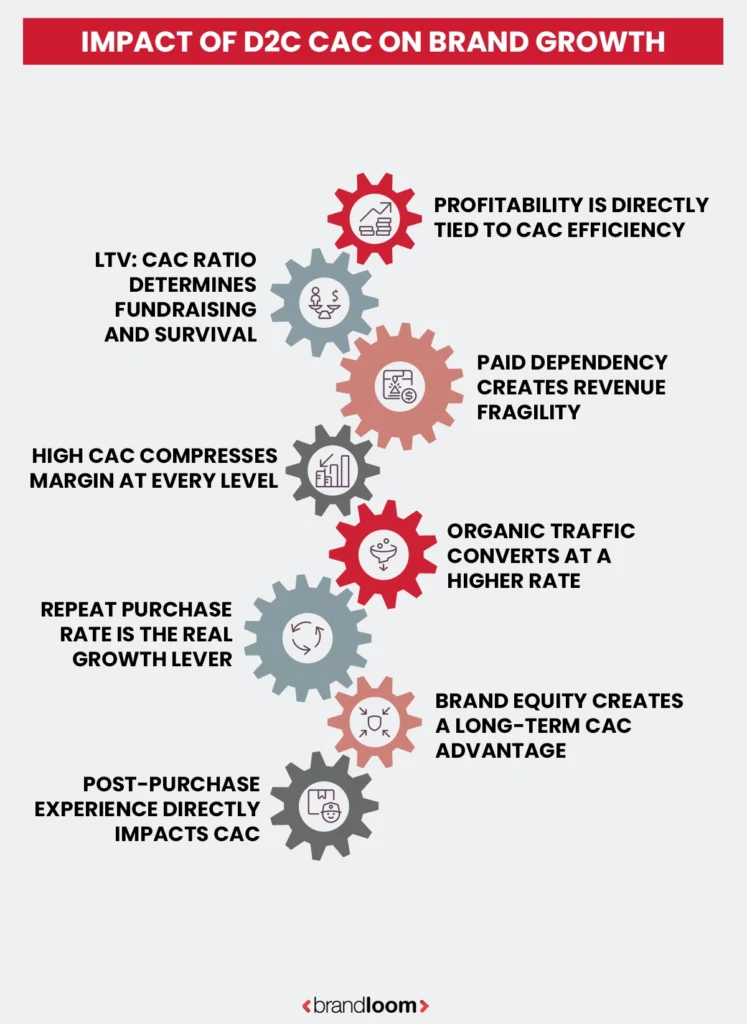
1. Profitability Is Directly Tied to CAC Efficiency
When acquisition cost consistently outpaces gross margin on the first order, every new customer your brand wins is a loss. Breakeven only arrives after multiple repeat purchases — but most Indian D2C brands never get there because repeat rates are too low to carry the math.
Paid-only growth is not a strategy in this environment. It is a slow bleed. Scaling ad spend when the unit economics are broken does not fix the problem. It accelerates the burn.
2. LTV: CAC Ratio Determines Fundraising and Survival
Before any investor looks at your revenue, they look at this number. Below 1:1, you’re spending more to acquire customers than they ever return. The benchmark for a healthy, scalable D2C business is 3:1. Brands above it attract better funding and invest in brand building. Brands stuck below 2:1 are permanently dependent on external capital just to fund the next new customer acquisition cycle.
3. Paid Dependency Creates Revenue Fragility
E-commerce dependent on paid ads feels like growth until the moment it doesn’t. When 80%+ of revenue runs through paid channels, your business isn’t a brand – it’s a media buying operation. Cutting spending and ecommerce revenue drop after reducing ads can hit 40–50% within weeks. No buffer against algorithm changes, iOS updates, or CPM spikes during Diwali. Revenue becomes a function of ad spend, not brand strength.
4. High CAC Compresses Margin at Every Level
The high CAC ecommerce problem is self-reinforcing. When D2C paid acquisition cost eats 30–50% of revenue, nothing remains for product quality, packaging, or customer experience – the exact things that would lower CAC over time. High CAC leaves no budget to escape high CAC. Pricing flexibility disappears. No room to compete on quality.
5. Organic Traffic Converts at a Higher Rate
Organic traffic for D2C brands converts better because intent is self-generated, not ad-triggered. Brands shifting 20–30% of traffic to organic report conversion rates 1.5x to 2x higher than paid. Lower CAC, better customers, higher AOV, stronger retention. Paid acquisition resets every month. Organic builds.
6. Repeat Purchase Rate Is the Real Growth Lever
Increasing the repeat purchase rate is one of the fastest ways to improve CAC efficiency in D2C businesses. A brand at 25% repeat loses money. A brand at 55% – same 100 customers – is profitable by Year 3. Every percentage point improvement means more revenue extracted from customers you already paid to acquire.
7. Brand Equity Creates a Long-Term CAC Advantage
Brands investing in positioning, community, content marketing for ecommerce brands, and customer experience build a compounding CAC advantage. Brand search grows, direct traffic increases, referral rates climb, blended CAC falls. This is the difference between a D2C brand- building strategy and an ad arbitrage business model in commerce. Arbitrage breaks when economics fail. A brand keeps attracting customers even when the ads are off.
8. Post-Purchase Experience Directly Impacts CAC
Every rupee invested in post-purchase experience, e-commerce – delivery communication, packaging, onboarding, and follow-up reduces effective CAC for the next cohort. A customer who has a remarkable first experience tells people. Word-of-mouth is the lowest-CAC acquisition channel available, generated entirely by what happens after the purchase.
Strategies to Leverage Brand Equity to Reduce D2C Customer Acquisition Cost
Cutting CAC isn’t about spending less on ads. It’s about building assets that bring customers in without paying for every single one.
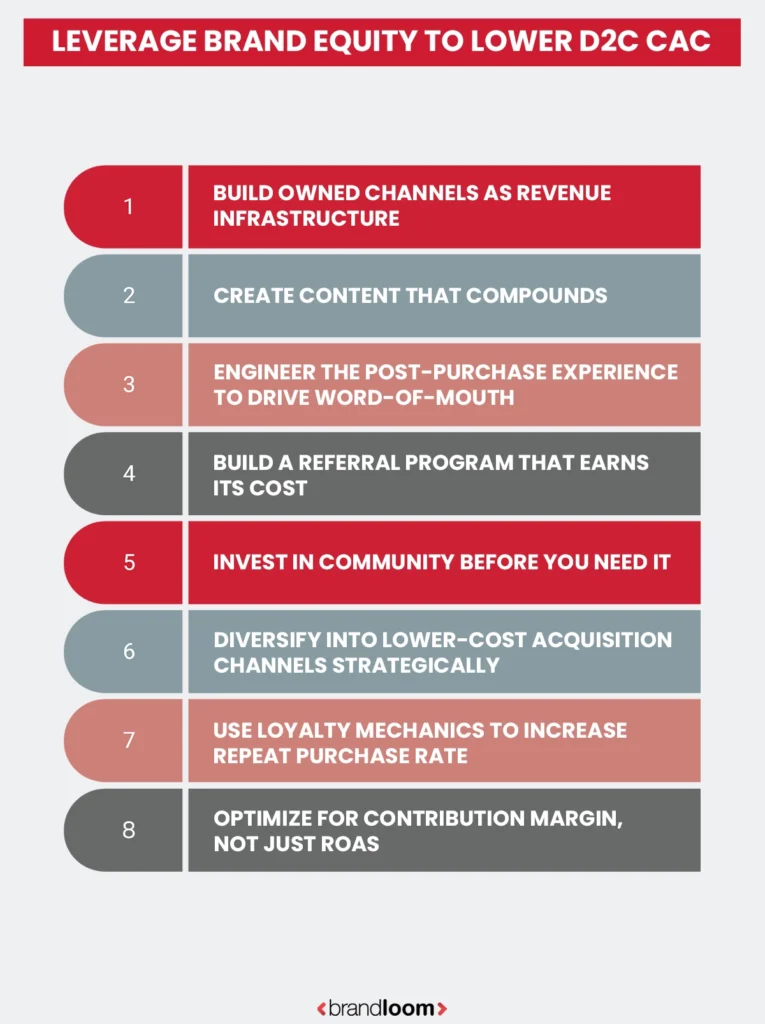
1. Build Owned Channels as Revenue Infrastructure
Email and WhatsApp aren’t support tools. They’re revenue channels. Build flows for new, lapsed, and high-LTV customers at near-zero cost.
2. Create Content That Compounds
Ads stop the moment you stop paying. SEO content keeps working for years. Guides and comparisons build authority and traffic together.
3. Engineer the Post-Purchase Experience to Drive Word-of-Mouth
Most brands go silent after shipping. A simple sequence — delivery confirmation, usage tips, check-in, replenishment reminder — lifts repeat purchases. Make unboxing shareable.
4. Build a Referral Program That Earns Its Cost
Referral customers arrive pre-qualified with higher LTV. Skip generic discount schemes. Reward customers who genuinely love the product.
5. Invest in Community Before You Need It
Community is D2C’s strongest moat. No ad budget can replicate it. BrandLoom helps D2C brands build community-led growth that cuts paid dependence and compounds equity.
6. Diversify Into Lower-Cost Acquisition Channels Strategically
Don’t abandon paid. Reduce reliance on it. Blend paid, SEO, referrals, and community. Track blended CAC across all channels, not just individual ROAS.
7. Use Loyalty Mechanics to Increase Repeat Purchase Rate
Loyalty programs drive repeat purchases and generate first-party data that sharpens paid targeting. They turn existing customers into a reliable revenue base.
8. Optimise for Contribution Margin, Not Just ROAS
ROAS ignores COGS, logistics, and returns. A strong ROAS with high return rates can still lose money. Track contribution margin per customer to find what actually works.
Performance Marketing vs. Brand Building: Key Differences
| Dimension | Performance Marketing | Brand Building |
| Time horizon | Short-term (campaign by campaign) | Long-term (12–36 months to compound) |
| Cost structure | Variable – scales with spend | Fixed investment with compounding returns |
| Revenue dependency | Revenue stops when spending stops | Revenue continues and grows independently |
| Customer quality | Ad-triggered, lower intent | Self-selected, higher intent, and LTV |
| Competitive moat | None – any brand can outbid you | Strong – community, content, and brand affinity are hard to replicate |
| CAC trajectory | Rises over time as CPMs increase | Falls over time as organic channels compound |
Challenges in Reducing D2C Customer Acquisition Cost
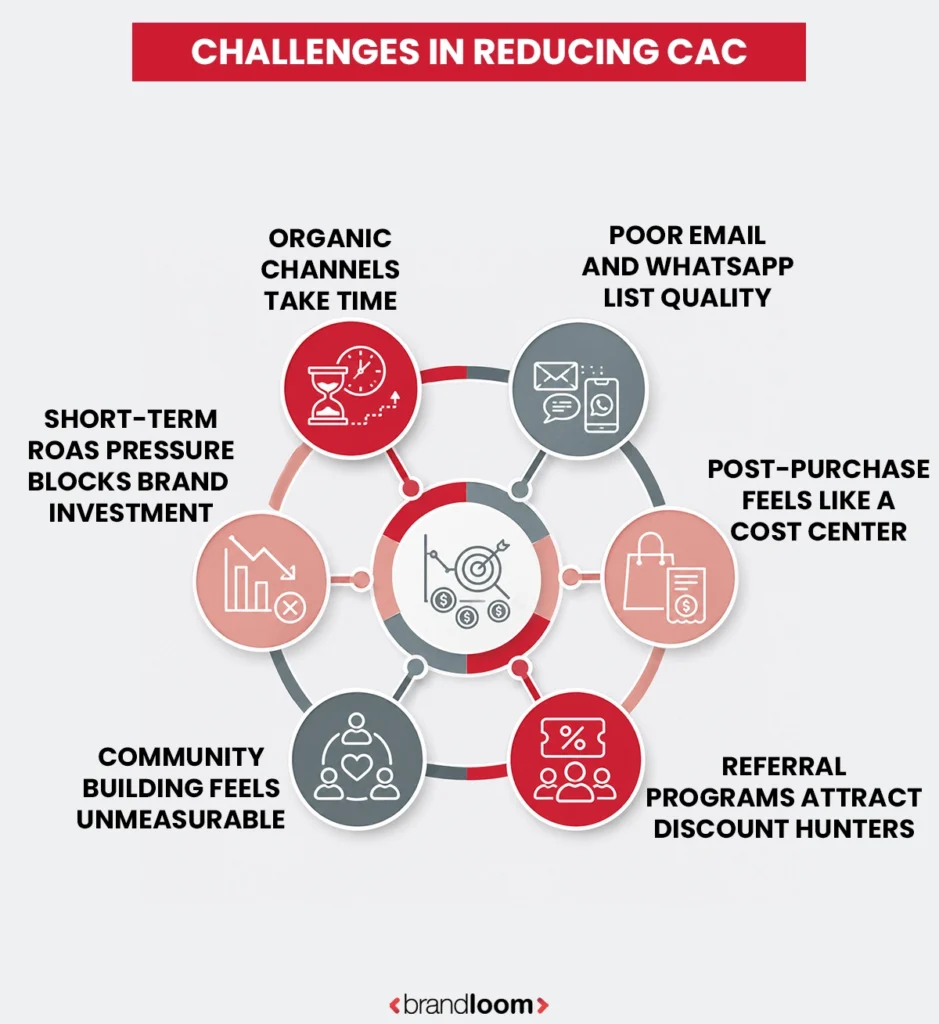
Challenge 1: Organic channels take time to show results.
Solution: Start SEO and content investment 12–18 months before you need it to perform. Treat organic as infrastructure, not a campaign. Delay is the most expensive mistake you can make.
Challenge 2: The email and WhatsApp list quality is poor.
Solution: Focus on list hygiene before list size. Segment by purchase behavior, not demographics. A list of 20,000 engaged subscribers outperforms 200,000 cold contacts on every metric.
Challenge 3: Post-purchase investment feels like a cost center.
Solution: Reframe it as a CAC reduction tool. Every repeat purchase generated by a post-purchase flow lowers the effective CAC for that cohort. Build a 30/60/90-day post-purchase sequence and measure its impact on second-purchase rate.
Challenge 4: Referral programs attract discount hunters, not genuine customers.
Solution: Tie referral rewards to the referred customer’s second purchase, not the first. This filters out one-time seekers and rewards referrers whose recommendations lead to real relationships.
Challenge 5: Community building feels vague and unmeasurable.
Solution: Define success with hard metrics – member-generated content rate, referral rate from community members, repeat purchase rate versus non-community customers. These make community investment defensible in any budget conversation.
Challenge 6: Short-term ROAS pressure makes brand investment difficult.
Solution: Build a separate measurement framework for brand-building that tracks blended CAC reduction, organic traffic growth, and direct traffic trends over 6–12 months. Present both performance and brand metrics together in leadership reporting.
KPIs to Measure D2C Customer Acquisition Cost Success
As we know, CAC’s full form in digital marketing is Customer Acquisition Cost; tracking it in isolation tells you what you spent. These metrics tell you whether it was worth it, and where the business is actually headed.
Tracking CAC in isolation tells you what you spent. These metrics tell you whether it was worth it – and where the business is actually headed.
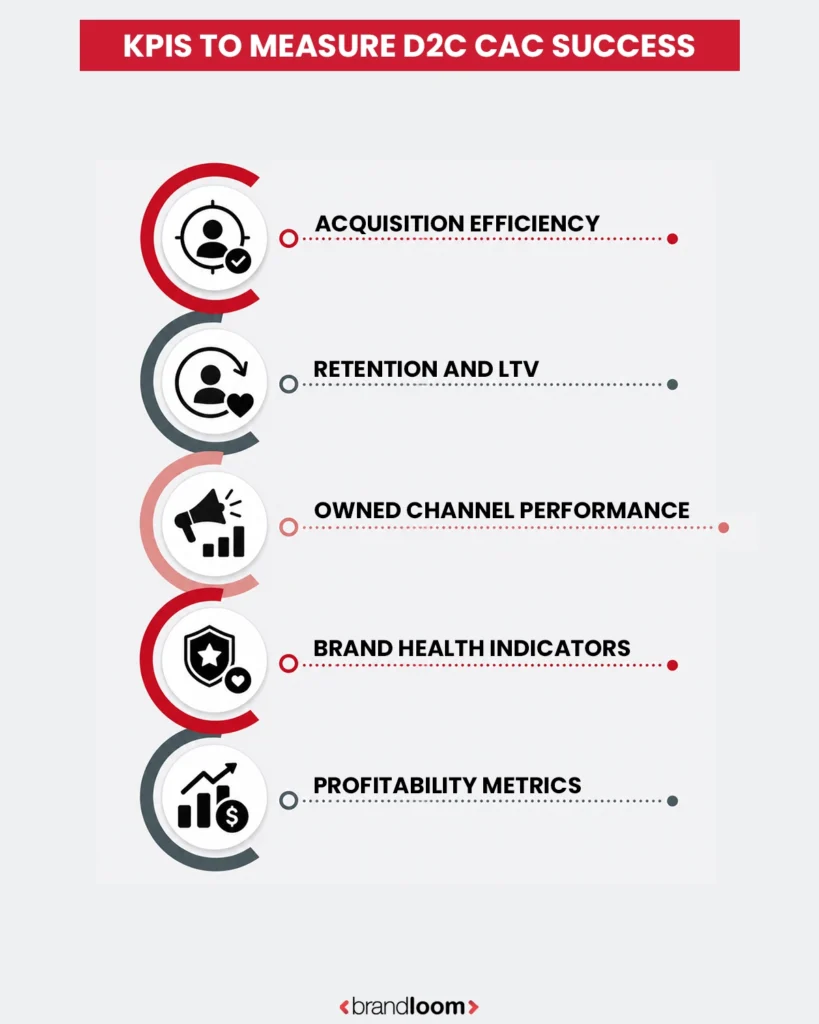
Acquisition Efficiency
- Blended CAC across all channels combined
- Paid CAC vs. organic CAC
- CAC payback period in months
- New customer acquisition rate by channel
Retention and LTV
- Increase repeat purchase rate D2C across 30-day, 90-day, and 12-month cohorts
- LTV: CAC ratio by acquisition channel
- Average order frequency per acquiring customer
- Customer lifetime value D2C by channel
Owned Channel Performance
- Email marketing revenue, e-commerce as a percentage of total revenue
- WhatsApp marketing revenue, ecommerce conversion rate
- Subscriber growth rate and list engagement
- Post-purchase experience, e-commerce second-purchase conversion rate
Brand Health Indicators
- Organic traffic for D2C brands as a percentage of total traffic
- Direct traffic growth month-on-month
- Branded search volume trend
- NPS and referral rate
Profitability Metrics
- Contribution margin per acquiring customer
- Blended gross margin after returns and logistics
- Revenue from repeat customers as a percentage of total revenue
- Month-on-month LTV: CAC ratio improvement
The BrandLoom Framework for Reducing D2C Customer Acquisition Cost
Most brands try to fix CAC by optimizing ads. The real fix is structural. This five-step framework moves a brand from paid dependency to compounding, owned growth.
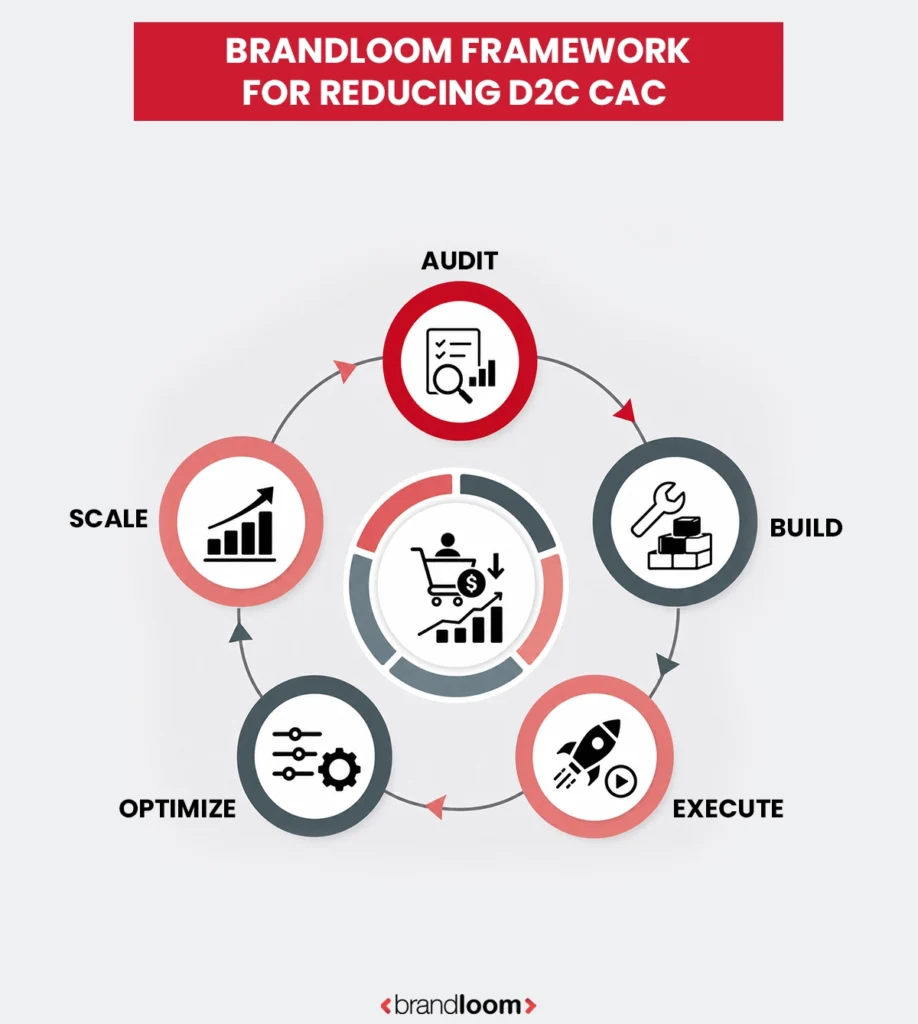
Step 1: Audit — Know Your True Numbers
Most brands undercount real CAC by tracking ad spend alone. A full audit includes creative costs, agency fees, tool subscriptions, and first-purchase discount margins. Run it alongside a revenue mix audit: paid, organic, repeat, referral. If paid dominates, you are in the trap.
Step 2: Build — Develop Your Owned Channel Infrastructure
Build email and WhatsApp as revenue infrastructure. Set up segmented lists, post-purchase automation flows, and a content calendar that serves both SEO and owned channel needs.
Step 3: Execute — Launch Retention and Content Systems
Deploy your post-purchase journey, publish SEO-optimised content, activate your referral program, and begin community building in parallel. Establish systems first. Revenue signals follow.
Step 4: Optimize — Improve Based on Data
Run cohort analysis to find your highest-LTV acquisition channels. Double down on those. Cut spend on high-CAC, low-LTV channels. Refine flows based on open rates, CTR, and second-purchase conversion.
Step 5: Scale — Reduce Paid Dependency Progressively
With owned channels generating meaningful revenue and organic traffic compounding, begin reducing paid dependency. Reinvest savings into brand-building content and community. Track blended CAC monthly against your LTV: CAC target.
Conclusion
You started with a brand doing ₹50 lakhs a month. You end with a question: how much of that Revenue is actually yours? If turning off your ads tomorrow would collapse your business, you do not have a brand – you have an ad arbitrage operation with a shelf life determined by Meta’s next CPM hike.
The CAC trap is not an acquisition problem. It is a brand problem. Brands that break free invest in experiences worth talking about, content worth finding, communities worth belonging to, and owned channels worth opening. The path from paid dependency to brand equity is a 12–18 month commitment, not a 90-day sprint.
BrandLoom, India’s leading D2C brand and growth strategy consultancy, can guide you through every step – from a full CAC audit to a complete owned-channel and brand-building architecture that drives sustainable, profitable growth.
Frequently Asked Questions
CAC (customer acquisition cost) is the total spend to acquire one new paying customer – ad spend, agency fees, creative costs, and tool subscriptions included. In India, the average D2C customer acquisition cost has risen hugely. Most brands are still undercounting it, whereas with ours, CAC audits routinely, you will find the real number is higher.
The CAC formula is: CAC = Total Acquisition Spend ÷ New Customers Acquired. For a fully loaded CAC calculation, include ad spend, agency retainers, creative costs, influencer fees, and tool subscriptions. Research into multi-channel CAC calculation shows that brands relying on ad-platform dashboards alone can underestimate their true cost of acquisition by 40–45%, a gap that grows as team sizes, agency relationships, and martech stacks expand.
A 3:1 LTV (Customer Lifetime Value) to CAC ratio is the benchmark for a sustainable D2C business. Below 1:1 means you lose money on every acquisition; above 3:1 signals a healthy, scalable model. We can help you model and improve your LTV: CAC ratio through retention strategy and owned channel development.
The CAC trap describes a D2C brand whose revenue relies overwhelmingly on paid acquisition, making continuous ad spend essential for survival. As platform costs increase, margins shrink, leaving nothing for brand-building. If pausing ads would collapse revenue, the brand is caught in this trap.
Revenue falls because paid-dependent brands lack organic, repeat, and referral channels capable of sustaining sales independently. Once ads stop, the sole source of new customers vanishes. Brands with strong owned channels, SEO, and high repeat rates maintain steady Revenue even when paid spend decreases.
Indian D2C brands can lower CAC by building owned channels like email and WhatsApp, generating 25–35% of Revenue at near-zero cost; investing in SEO for compounding organic traffic; creating post-purchase experiences that spark word-of-mouth; and gradually shifting budget from paid ads toward retention and community.
A healthy D2C brand should generate 30–40% of revenue from repeat customers, while top performers reach a lot more than that, lowering blended CAC and boosting profitability. If repeat revenue falls below 20%, retention and lifecycle marketing systems urgently need investment – and that’s exactly where BrandLoom starts.
No. Performance marketing scales a proven product but cannot build brand equity alone, leaving brands with no moat – any competitor can outbid you for the same audience. Sustainable D2C brands treat performance marketing as one element within a broader mix, including organic, owned, community, and referral channels.
Warning signs include Revenue dropping 40%+ when ad spend decreases, repeat customers contributing under 20% of Revenue, organic traffic below 15% of total, negligible email and WhatsApp engagement, and flat or declining branded search. If customers can’t recall your brand unprompted, you’re ad-dependent, not a brand.
Community-led growth begins before it’s needed – identify your most engaged customers and create a dedicated space, like a WhatsApp group, Discord, or forum, where they connect. Community members show higher LTV, referral rates, and retention. BrandLoom helps D2C brands design community programs that drive acquisition and retention.