Instagram has evolved from the fancy image and video sharing persona into a powerful revenue engine for brands across all sectors. In 2026, this trend is only set to grow. As per the latest data, 82% of consumers buy products/services through social content several times a year.
The link between social engagement and buying decisions is very clear. That explains why your brand needs a solid Instagram strategy in 2026.
But why focus on Instagram among the social media channels? About 62% of marketers say that Instagram consistently offers a positive return on investment.
It is a powerful digital platform that you can use to obtain tangible business outcomes. However, for the maximum and sustained benefits, you need an expert-crafted Instagram ROI strategy.
The reality is that, despite its clear potential, many marketers struggle to measure Instagram ROI. Only 30% marketers feel sure about tying engagement metrics to real-life conversions.
How do you close the gap between awareness and revenue? Shift from tracking the vanity metrics and develop a strategic, full-funnel approach for ROI.
Instagram’s ad revenue is expected to touch $67 billion by 2025, and that should make its role in driving business growth clear to you. You need customized, data-driven strategies developed by social media marketing and branding veterans.
At BrandLoom, we have the expertise to utilize Instagram’s evolving algorithms and newer features to bring lasting results. Contact us when you need a solid, custom Instagram branding strategy, and our SMM experts will design the roadmap.
Read our blog to find the ways to design a reel-focused Instagram strategy for 2026 that increases your brand visibility, conversions, and grows a loyal online community.
Defining Your Ideal Brand & Audience on Instagram
Instagram reels strategy is not a one-size-fits-all solution. Billions of users view dynamic content on this platform every day. However, it is important to understand your brand’s goals and define your target audience first. Without that, you will struggle to develop a killer Instagram strategy in 2026.
For e-commerce brands, Instagram is a dynamic platform to showcase products, grow traffic, and turn followers into paying customers. These brands can directly link to product pages, and then their customers can place orders easily.
Service-based businesses can use Instagram to build long-term relationships with potential clients by positioning themselves as a thought leader. They can use behind-the-scenes content, customer testimonials, and brand USPs in reels for Instagram lead generation.
B2B brand owners who think Instagram isn’t their cup of tea must do a reality check. It is a very useful platform to showcase expertise, build brand authority, and engage target customers fast. They can use Instagram to share industry insights, case studies, and client success stories. These help strengthen their reputation and connect with the right partners.
Ultimately, regardless of your business type and segment, Instagram is a suitable platform to engage with your target audience. To hit the sweet spot, you need a customized reel-focused Instagram engagement strategy. Instagram has the tools to read the audience’s pulse and develop a thriving community.
You need the right partner with resources and expertise to guide you on the way, and that’s where BrandLoom steps in.
The Evolution of Instagram and the Effect on ROI
Instagram is no longer a digital platform where people share touched-up images. It has become a powerful content-to-conversion system that brings real business results. As we step into 2026, Instagram’s algorithm and content landscape have shifted. That is why your brand must understand the changes and refine its Instagram funnels 2026 accordingly.
Instagram’s Algorithm Shift
You cannot rely only on a high follower count or a viral post for better visibility on Instagram. Now, Meta chooses profiles based on engagement and relevance. Meta looks for content that connects with the users naturally. You will see content with more shares, and that gets saved by followers, has a higher organic reach.
The content triggering engagement and connections through comments, direct messages, orsaves matters more. Businesses can use this algorithm shift for Instagram lead generation and reaching more customers.
How do Reels impact discoverability and conversions?
Video content, particularly Instagram Reels, is very important for brands trying to succeed on the platform. Reels now work as a discovery engine, and you can reach more target customers using reels quickly.
As Instagram focuses on reels, your brand must develop a suitable strategy for it. A reel-focused Instagram social media marketing strategy can help it get more traffic, generate leads, and increase conversions.
Sprout Social’s guide on Instagram ROI indicates that brands developing strategies for higher engagement, increased website traffic, and improved conversion rates will succeed in 2026. They must focus on measurable results rather than superficial metrics.
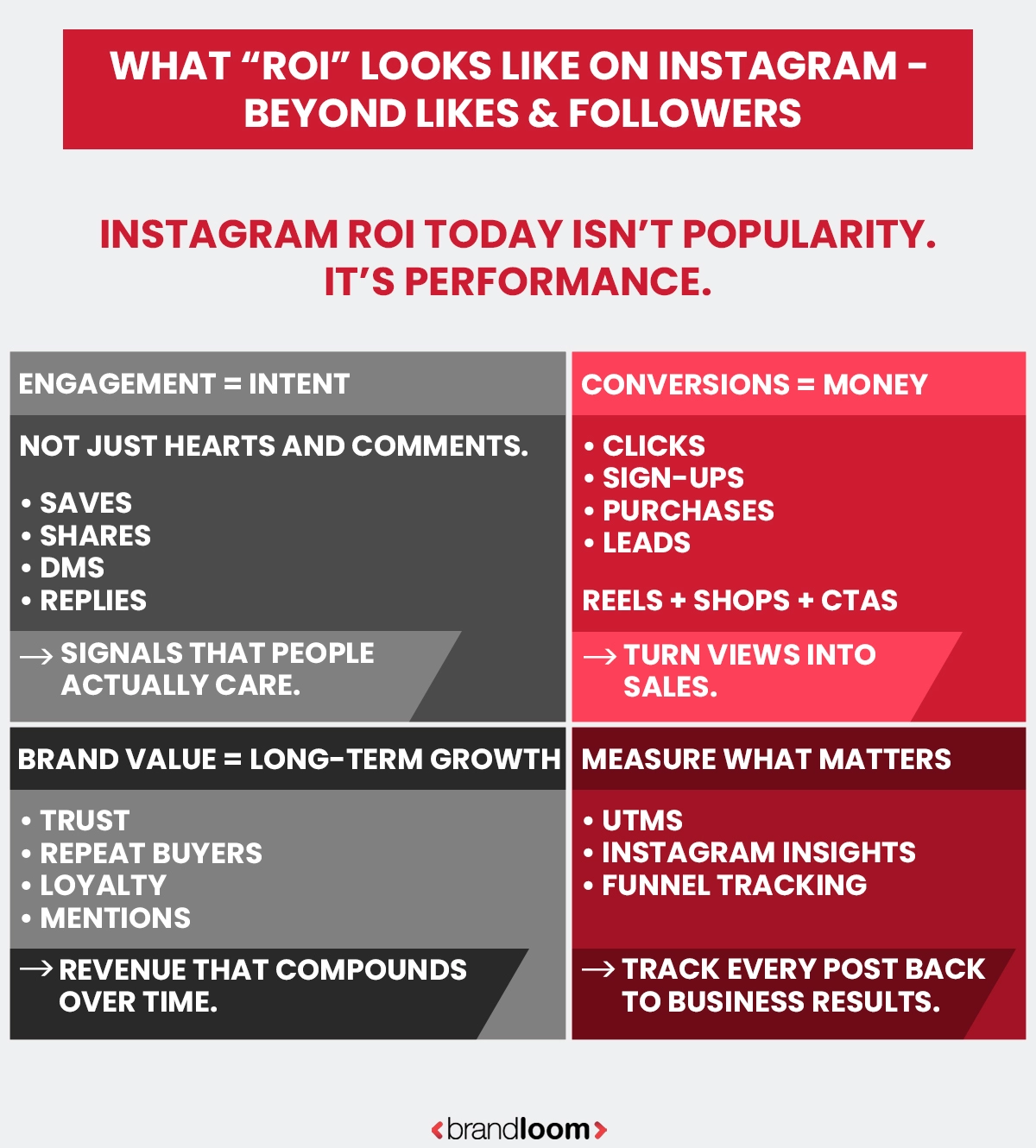
What “ROI” Looks Like on Instagram – Beyond Likes & Followers
In 2026, the definition of Instagram ROI has extended way beyond simple likes, comments, or follower count. Your brand needs engaging content that leads to conversions and revenue.
1. Engagement as a Key Metric
Your Instagram engagement strategy must be effective. The new Meta algorithm prefers content that gets enough user engagement. So, brands must use and create Instagram content that triggers these interactions, leading to deeper relationships with their audience. Businesses that measure engagement rates can find out how their content is working.
2. Conversions & Sales
Your Instagram ROI strategy cannot be complete without conversion tracking. This covers actions like clicks to a landing page, sign-ups, or purchases through Instagram Shopping. Instagram lets users engage in direct sales — especially through Reels and shoppable posts.
This is why it is beneficial for e-commerce businesses. Use tools like UTMs and Instagram Analytics to learn how your Instagram activity is turning into revenue.
3. Brand Awareness & Long-Term Value
Brand awareness is a must for ROI, online or offline. It is not just about reach or impressions. Now, brands must focus on things like customer sentiment, repeat interactions, and loyalty over the number of post viewers.
4. ROI Tools and Best Practices
Your business will need the right tools to analyze these metrics. To track ROI, observe real-time performance, and refine content, you can use tools like Instagram Insights and Sprout Social.
However, using tools will not be enough to develop a powerful Instagram social media marketing strategy. Our social media marketing experts at BrandLoom can create the right Instagram strategy for your brand and implement it well.
Why Instagram ROI is so Hard to Measure?
You may find it tough to measure your brand’s Instagram ROI. There are several factors that complicate direct attribution and result tracking. You can’t escape the multi-faceted nature of Instagram campaigns.
Instagram isn’t just about sales; it is also about making your brand visible, relatable, and reliable. These intangible benefits are tough to quantify in direct monetary terms.
You may also find it tough to tackle the attribution gap. Your consumers engage with Instagram content in different stages of their journeys. They can, for example, watch a story, a reel, a static post, or interact with comment threads. This fragmented journey makes it hard to find the moment of conversion.
Another thing you have to deal with is privacy norm changes. Apple’s App Tracking Transparency has limited how you can track user actions across different platforms.
You may face problems in analyzing the efficacy of strategies for Instagram growth. This is more applicable to paid campaigns.
Have you observed how Instagram has made a big leap to visual storytelling and influencer collaborations? This effectively blurs the line between organic reach and paid campaigns. To measure your campaign success, you must get data from multiple sources.
This makes ROI calculation tougher. You can try analytics tools, but traditional ROI models may not fully capture the true value of Instagram marketing.
Which Instagram Metrics Prove ROI?
To prove Instagram ROI, you must track metrics linked directly to your business objectives. Remember that likes and comments don’t necessarily equate to business growth on this platform.
Here’s a look at the major Instagram metrics that help prove ROI:
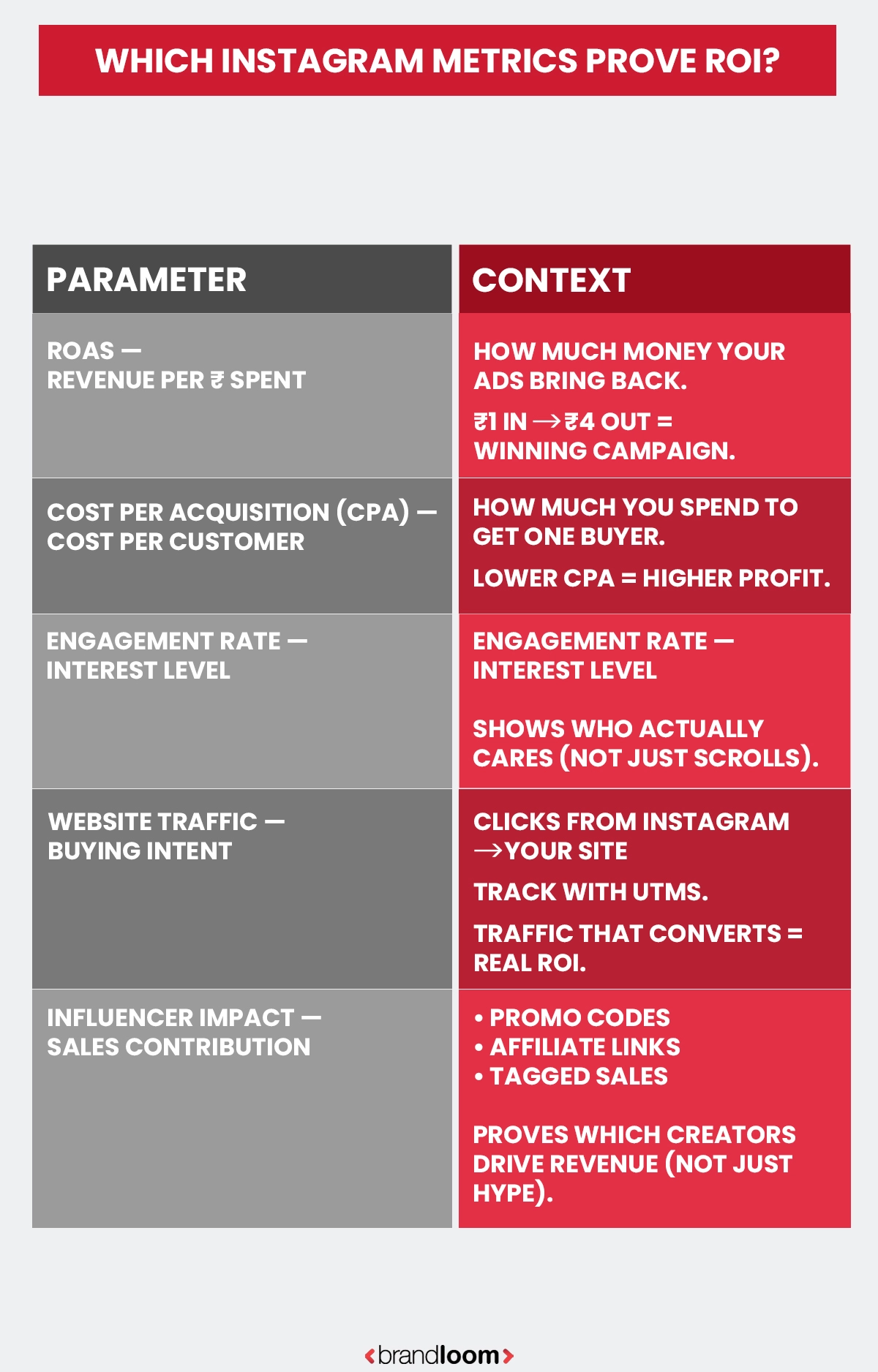
1. Return on Ad Spend – ROAS is the gold standard for measuring ROI, especially for paid campaigns. ROAS calculates how much revenue you earn for each dollar spent on ads. High ROAS means your Instagram ads are bringing sales.
2. Cost Per Acquisition – This metric helps find out the cost of acquiring a customer through Instagram. Divide the total campaign costs by the number of conversions, and you will see the amount spent in acquiring paying customers.
3. Engagement Rate – High engagement may not always indicate high revenue, but it shows strong brand affinity and interest. Engagement rate—calculated as the total engagement divided by the total reach shows you how well your content works on the target users.
4. Website Traffic – To see how many visitors are directed to your website through Instagram links, track traffic from Instagram using UTM parameters. If these visitors convert, the ROI calculation becomes easier.
5. Influencer Marketing Metrics – For influencer collaborations, you have to track promo codes, affiliate links, and traffic. These metrics help you find out how influencers contribute to both direct sales and long-term brand growth.
These metrics give you a complete picture of Instagram’s effect on brand growth, beyond just likes and shares.
How to Measure Instagram Marketing ROI?
To measure Instagram marketing ROI, you need to look beyond just tracking likes and comments. You must focus on tangible business outcomes to know how your efforts are working.
The ROI formula (Value − Investment ÷ Investment × 100) shows the return on each dollar spent.
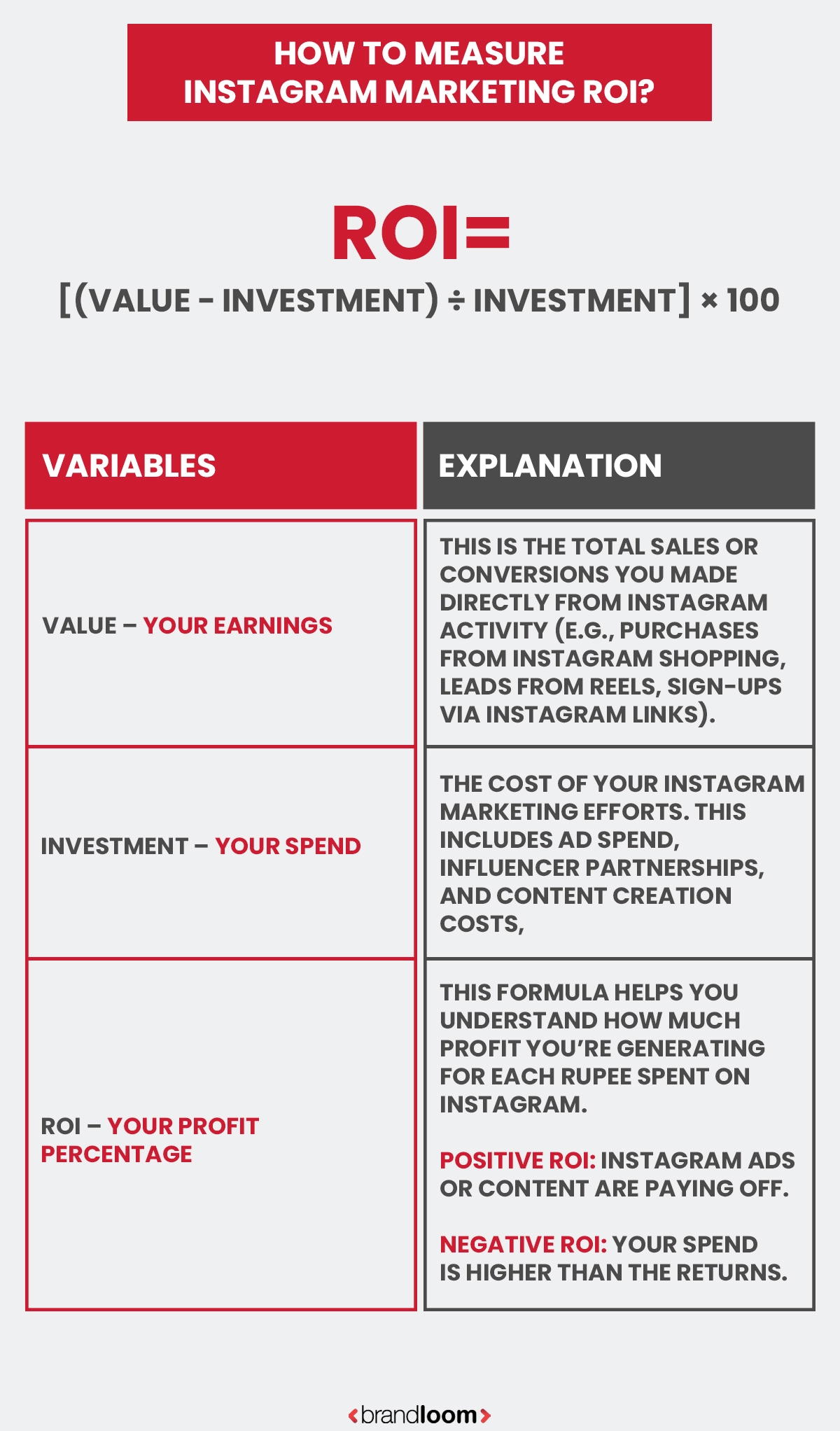
You should begin by setting clear objectives for your Instagram ROI strategy. It can be for generating sales, increasing brand awareness, driving traffic, etc. For paid campaigns, focus on metrics like Cost Per Acquisition, Cost Per Click, and Return on Ad Spend. They directly connect your investment to conversions.
For organic strategies, pay attention to engagement metrics, reach, and audience growth. You can track website traffic from Instagram and watch the percentage of traffic turning into sales. That is how you get solid insights into ROI.
Influencer marketing campaigns should track parameters like promo redemption rates or affiliate revenue. This links the effect of social proof to real revenue. When you analyze these metrics regularly, you figure out where to optimize and grow sales.
This data-driven approach, as mentioned by Sprout Social, ensures you generate measurable results from Instagram marketing efforts.
Content Strategy & Format Mix- A Look at Instagram Funnel
There’s no one-size-fits-all model for effective Instagram marketing. To maximize ROI, your brand must refine its content strategy for each stage of the marketing funnel.
The nice thing is that Instagram offers many content formats. So you can use them for needs like conversions, leads, and creating brand awareness.
1. Top of Funnel – Awareness & Discovery
At the awareness stage, you should aim to reach the maximum target buyers and introduce your brand to them. This is where Instagram Reels come into the picture. Reels help grab users’ attention quickly with short, engaging videos.
Use reels to tell your brand story, introduce your products, or offer value-based content. Instagram’s algorithm favors reels, and so they reach new audiences fast. Use hashtags and location tags strategically to improve brand visibility. Using reels with user-generated content helps improve reach.
2. Middle of Funnel – Consideration & Engagement
When the audience knows your brand, try making them interested in your products or services. To grow these leads, you can use Instagram Stories. These Stories are useful for sharing product demos, behind-the-scenes content, customer testimonials, and more.
The idea is to make them interested in your brand and its offerings. Engage with your audience by using online polls, questions, and interactive features like quizzes and stickers. This encourages followers to spend more time with your content, and the bond gets deeper. Besides, use carousel posts to showcase different product features or benefits.
3. Bottom of the Funnel – Conversion & Action
After getting customer attention and developing a strong bond, try to turn followers into customers. With Instagram Shopping and shoppable posts, you can directly link products to your Instagram feed, Reels, or Stories. Besides, you should use attractive CTAs in captions or within Reels.
These will inspire the followers to make the purchase without delay. This is good for booking a consultation or signing up for the brand newsletter.
4. Retention & Advocacy
Your Instagram branding strategy is not only for making followers into buyers. Once a customer buys a product or service, you can use Instagram to retain them. Then you can resort to indirect advertising.
How do you keep existing customers engaged and encourage them to share experiences with others? Use Instagram Live sessions, exclusive promotions, or loyalty programs.
Ask returning buyers for reviews, since UGC is very effective. This is how you turn customers into brand ambassadors.
By using these content formats at the right time, you can improve your Instagram marketing efforts. The results include better conversion rates, higher engagement, and long-term customer relationships.
Creating an Instagram-First Funnel – Step–by–Step
To build an effective Instagram funnel, you must guide users from awareness to conversion. Later, put the focus on making them brand advocates. Here’s how you should proceed:
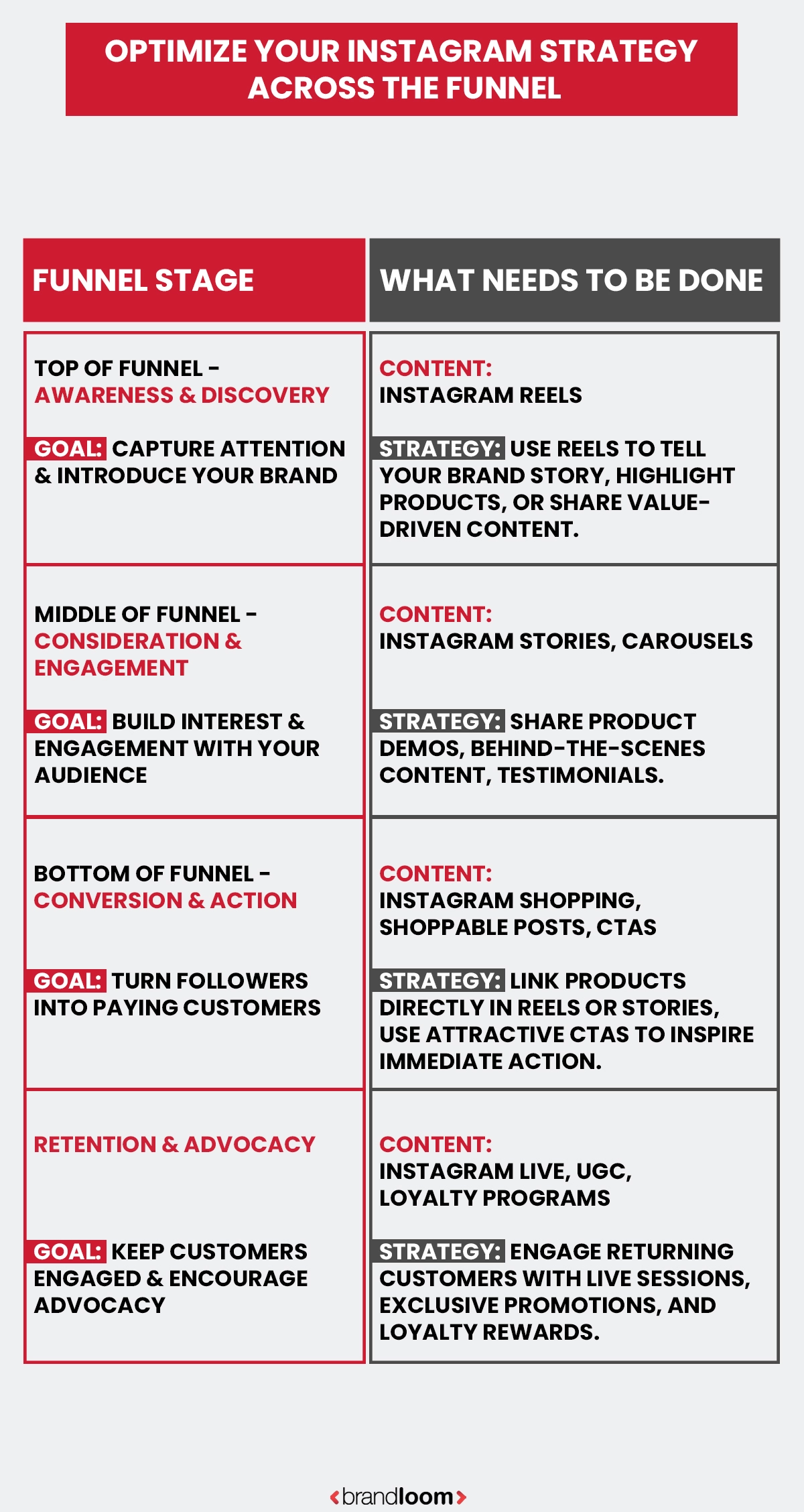
1. Awareness — Capture Attention
At the Top of the Funnel, use Instagram Reels to capture audience attention easily. Their short, engaging format helps you reach new audiences. Make your reels more effective by using the right hashtags and video elements. The content must clearly reflect your brand values.
2. Engagement — Build Relationships
In the Middle of the Funnel, focus on engaging users. At this stage, use Instagram Stories to share behind-the-scenes content, promotions, or product demos. Showcase products or services with Carousels and use polls or questions to encourage participation. The agenda is keeping followers interested in the brand.
3. Conversion – Drive Action
At the Bottom of the Funnel, use Instagram Shopping or Shoppable Posts to improve conversions. You can tag a product directly in your content for easy purchase access. Also, use clear CTAs that encourage followers to take action.
4. Retention — Nurture Loyalty
After followers turn into buyers, keep them engaged with Instagram Live sessions, product updates, or custom offers. At this stage, user-generated content proves to be very helpful. Interact with DMs to show those customers that your brand cares for them.
5. Advocacy — Turn Customers Into Ambassadors
At the last stage, you should focus on making happy customers into brand ambassadors. Encourage those customers to share their experiences and tag your brand. Try offering referral incentives or discounts to make it work.
For more in-depth guidance on ways to turn Reels into revenue and get a killer Instagram strategy, reach out to us at BrandLoom.
Community & Engagement- Growth Boosters
Your brand’s Instagram marketing strategy 2026 should not be focused only on content creation. It is also about creating an engaged community that advocates for your brand. To make the most use of Instagram, focus on user engagement. When your followers are engaged, your brand content will appear in their feed or Explore tab.
How do you nourish this engagement? The best way is to use polls or Q&A sessions, direct messaging, and replying to comments. Instagram Stories are good for engaging in real-time and keeping your followers connected.
To improve engagement, encourage your brand followers and customers to share their experiences through content. UGC builds trust and creates social proof.
This is logical as potential customers are more likely to trust content created by existing customers. Ask your followers to tag the brand in their posts or share their experiences.
Focus on the Right metrics and Tools for Instagram conversions
To utilize Instagram’s potential as a digital marketing platform, you must focus on the right metrics. Besides, use performance data to continuously optimize your brand strategy. Here are the major metrics to track:
- Engagement Rate – Track likes, comments, shares, and saves to understand how well your content is working on the target audience.
- Conversion Rate – Measure how many users take action after engaging with your content, for buying or signing up for a newsletter, etc.
- CTR – If you’re running Instagram Ads or directing traffic to a landing page, the CTR lets you check the efficacy of the CTAs.
- ROI – This is your ultimate goal. Analyze the revenue or leads generated in comparison to your advertising budget, content creation costs, and tools.
Tools and Strategies to Quicken Your Growth
For Instagram lead generation and conversion, you can choose Instagram Insights and tools like Sprout Social. They help you track these metrics in real time.
Through these online platforms, you get in-depth data on reach, engagement, and audience demographics. These are important to develop and refine your content strategy.
For better results, you should monitor performance and conduct A/B testing on different content elements like images, captions, CTAs, and posting times. Testing lets you find out what works best for your audience, and then you can refine accordingly.
4 Ways to Increase Instagram ROI in 2026
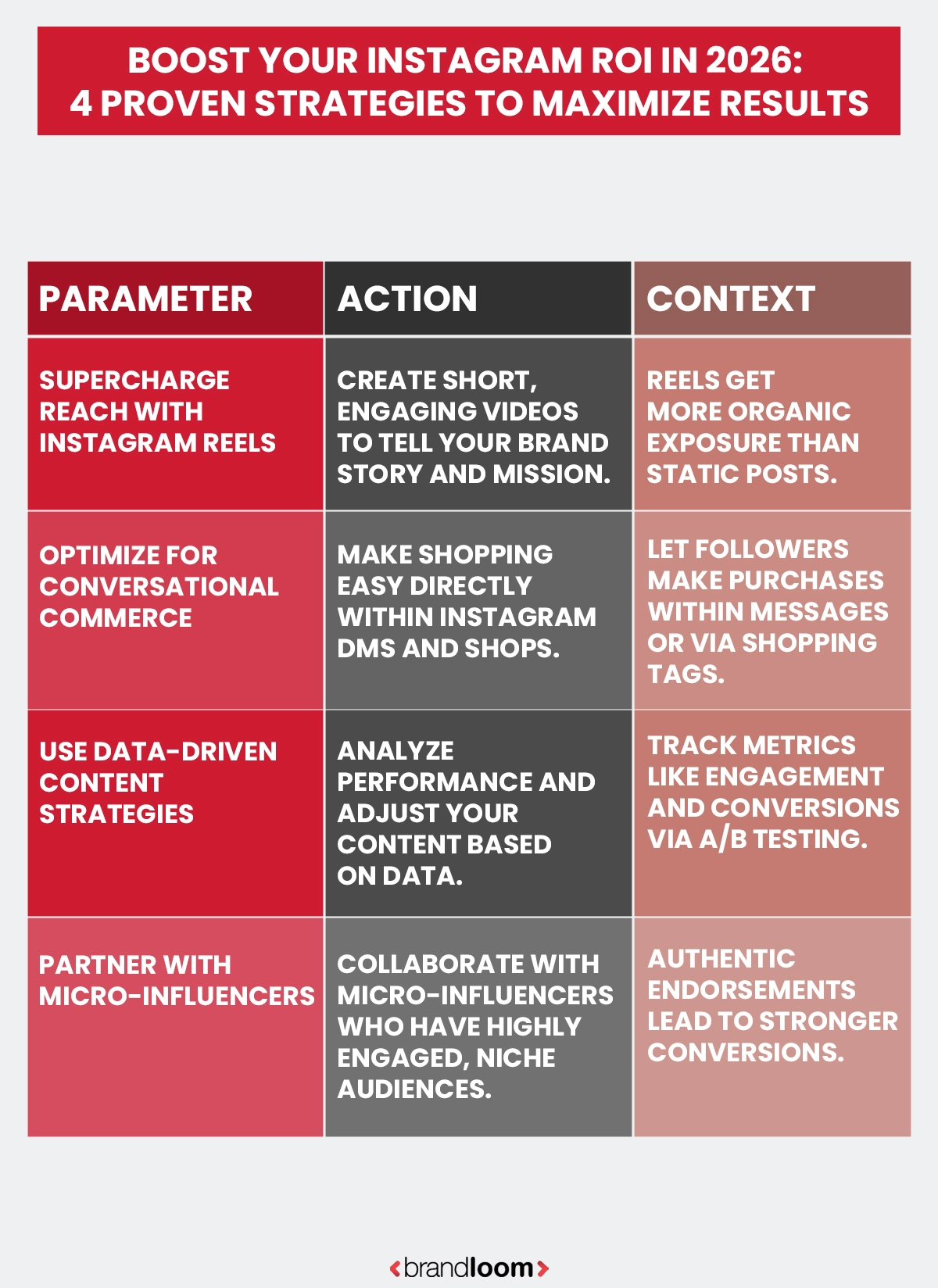
Try these expert-recommended measures to boost your Instagram ROI in 2026:
1. Leverage Instagram Reels for Increased Reach
Instagram Reels have become powerful discovery tools that can help your brand go viral. Reels have higher organic reach compared to static posts or Stories. To maximize ROI in 2026, create engaging, short-form videos showing your brand story and mission.
These will help resonate with your target audience. Also, use trending audio, creative visuals, and strong CTAs for better conversions.
2. Optimize for Conversational Commerce
In 2026, conversational commerce will grow, but why? Just look at the growth of Instagram Shops and DM-based transactions. These help you use seamless purchasing options directly within Instagram. Your followers can buy directly within the messages and shopping tags. This gives a boost to conversion rate and ROI.
3. Incorporate Data-Driven Content Strategies
Without a data-driven approach, your Instagram promotion strategy will remain incomplete in 2026. Use Instagram Insights, A/B testing, and performance analytics to make your content strategy polished.
Try different types of content like carousel posts, Stories, or Reels, and see which ones give the highest engagement and conversions. Then align your content strategy with key metrics like conversion rate and CTR for improving post efficacy.
4. Tie up with Micro-Influencers
Influencer marketing continues to thrive. However, in 2026, you can gain better ROI by teaming up with micro-influencers. They have more niche, highly engaged audiences that are more likely to convert. They offer authentic endorsements, and those help generate trust, leading to higher conversion rates.
If you find traditional celebrity endorsements costly, tweak the Instagram influencer marketing strategy. Choose influencers whose followers closely align with your target audience to get better engagement and more direct sales.
How To Build A Conversion System Beyond Vanity Metrics
For your Instagram branding strategy to succeed, do not focus only on vanity metrics like likes, comments, and follower counts. These may not reflect business growth. Focus on effective metrics leading to customer acquisition, engagement, and long-term loyalty.
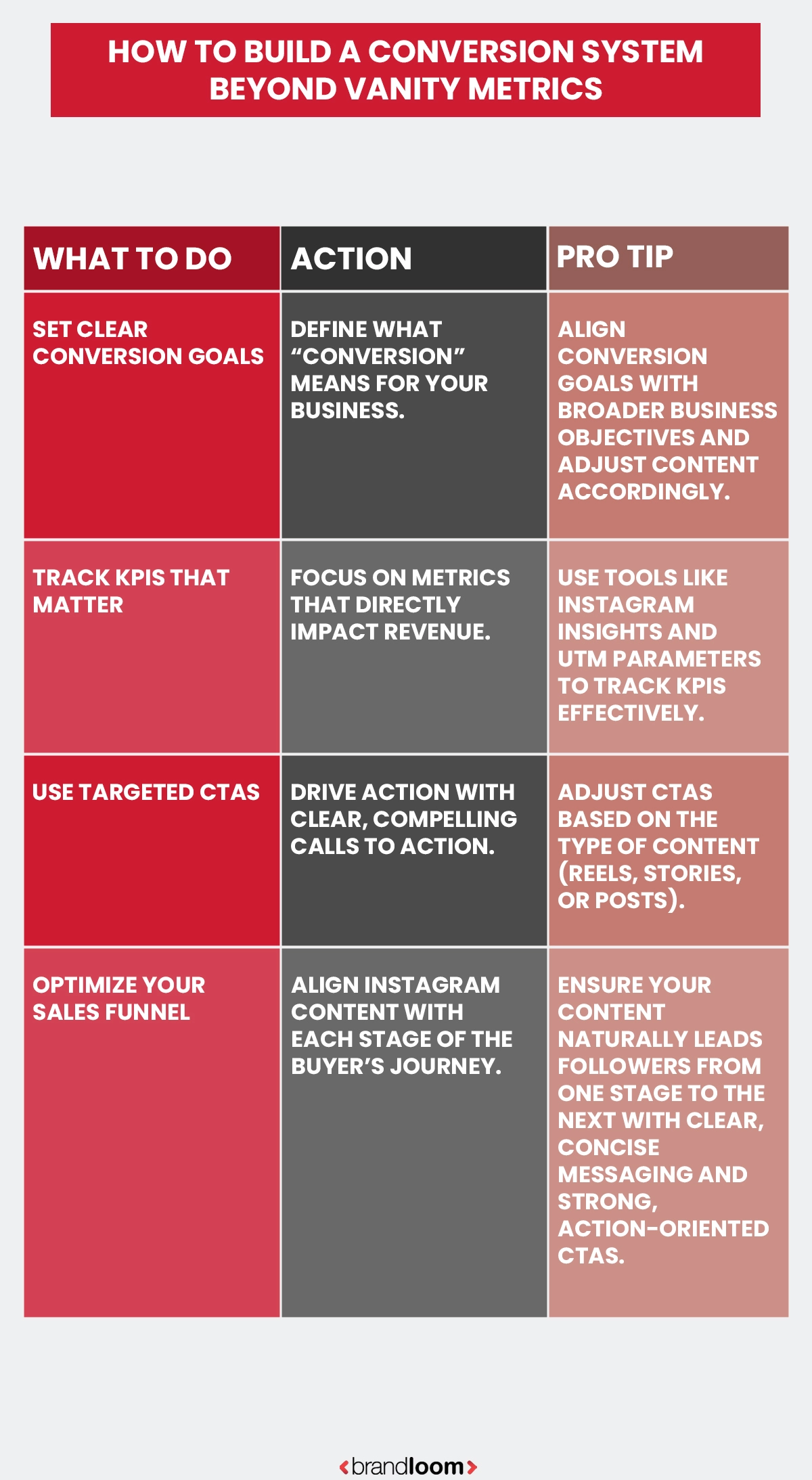
1. Set Clear Conversion Goals
Begin by defining what a “conversion” means for your business. Is it a newsletter sign-up, or a completed purchase? Match these conversion goals with your broader business objectives. Then you can develop effective Instagram posts, stories, or reels to move followers along the sales funnel.
2. Track Key Performance Indicators
Engagement matters, but you must track KPIs that directly affect the bottom line. These include metrics like Cost per Acquisition, Return on Ad Spend, click-through rate, and conversion rate.
They show clearly how your Instagram efforts are leading to measurable business results. There are tools like Instagram Insights, Google Analytics, and UTM parameters for KPI tracking.
3. Use Targeted Calls to Action
Encourage your followers to take action with strong, clear CTAs. You can then offer certain products right away or offer a limited-period promotion. Tweak based on the type of content you’re posting.
4. Optimize the Sales Funnel
A seamless, optimized sales funnel converts your followers into customers. So, your Instagram content must align with every stage of the buyer’s journey—awareness, consideration, and decision.
You can use educational content for the awareness stage, while testimonials and product demos fit the consideration stage. For the decision stage, use direct purchase links. When the content syncs with the buyer’s intent, your audience converts easily.
Align your content with clear conversion goals and focus on real, measurable actions to get an Instagram digital marketing strategy forlong-term ROI.
The Need for Expert Supervision
Instagram offers great potential for your brand to grow, both in terms of user base and revenue. However, you may face problems in developing the right strategy for Instagram conversions, given the changing algorithms and user needs, etc. Partnering with a professional digital marketing agency like BrandLoom can make a big difference.
We understand the evolving algorithm of Meta and can create customized strategies to improve engagement and conversions. Our SEO and digital marketing experts use advanced tools to analyze real-time performance, optimize your content, and track ROI.
We handle the strategy, execution, and optimization for Instagram SEO so that you can focus onbusiness activities.
Choose the ally with the experience of developing and refining an Instagram growth strategy for several high-profile clients,and experiencesteady business growth.
Conclusion
Instagram is more than just a social media platform – it is a versatile and powerful tool for business growth in 2026.
You can use a well-structured strategy to utilize its new features and turn Reels into revenue. It also helps you easily connect with the target audience and strengthen your relationship with them.
However, developing the right Instagram marketing strategy may not be simple. You may find it tough to analyze and understand the changing Meta algorithms. You may be unsure about ways to utilize new and upcoming features in the platform. That is where BrandLoom fits into the scene.
We have the branding and social media expertise to develop a strong, custom Instagram ROI strategy. Reach out to our team for an in-depth consultation and rejuvenate your Instagram growth.
FAQs
1. What is an Instagram ROI strategy in 2026?
An Instagram ROI strategy in 2026 should focus on analyzing and maximizing returns from Instagram efforts. The focus is no longer on superficial metrics like likes or followers. In 2026, Instagram’s algorithm is focused on user engagement, relevance, and conversions.
So, a strong Instagram marketing strategy 2026 win will cover creating content to get real business outcomes, including sales, lead generation, or brand awareness. Brands should use tools like Instagram Insights and Sprout Social to analyze performance, optimize content, and calculate ROI. It is about building an effective strategy to utilize Instagram for business growth.
Reels are very useful to create revenue on Instagram. Instagram reels attract more users and lead to high engagement in a short time span. Businesses can use short, engaging videos in reels to capture the target audience’s attention and engage them.
Also, using these reels, you can easily introduce products or services to a broader audience. Many brands are making use of Instagram Shopping features to let users shop directly from their profiles. Besides, well-made reels drive traffic to landing pages, adding to conversion. Use powerful call-to-actions to turn Reels into revenue.
In 2026, the most effective Instagram content for conversions must be engaging, authentic, and aligned with audience choices. Reels continue to attract a large number of people globally to the platform.
Your Reels engagement strategy must include content like product demos, tutorials, behind-the-scenes content, or customer success stories. Another good idea is using User-generated content. It helps develop trust and social proof.
For variety, you can use Instagram Stories with interactive features like polls, quizzes, and swipe-up links. These have very high engagement and conversions.Carousel posts showcasing several products or services can also directly drive sales.
Instagram funnels 2026 help target customers through the buyer journey from discovery to conversion. For this, your brand must use strategic content and targeting. The journey is:
Top of the Funnel – Grabbing attention with Reels and organic content.
Middle of the Funnel – Engaging followers with Stories, Carousels, and interactive features.
Bottom of the Funnel –Driving conversions with shoppable posts, clear calls to action (CTAs), and retargeted ads.
Your brand must design suitable content for each stage for the desired Instagram conversions.
To turn Instagram views into sales, businesses need a powerful Instagram engagement strategy. You can begin by creating engaging content that grabs attention, like Reels, product demos, or tutorials. Use clear CTAs in your posts to trigger direct buying actions. Use Instagram Shopping to tag products in your posts and Reels.
Additionally, you can engage with regular buyers and interact with them to get reviews and shares that eventually lead to more orders. Of course, your landing pages must be well optimized for a smooth buying experience from Instagram to checkout.
To measure Instagram ROI, your brand must focus on key metrics beyond just likes and followers. The major metrics are engagement rate, including comments, shares, and saves,as they show how well your posts are connecting with target buyers.
Conversion rate is important to track how many users take action, like placing orders. With click-through rate, you analyze the usefulness of links or CTAs in posts and Stories. Customer acquisition cost shows the amount you incur to convert a follower into a customer.
Yes, Reels are highly effective for Instagram lead generation in 2026. These short, engaging format posts grab viewers’ attention quickly.
So, businesses are using reels to market and endorse their services and product range. Reels allow your brand to showcase products/services, share tutorials, BTS scenes, or tell stories in a creative way.
These can improve brand awareness. Using a strong CTA in these reels can help improve sales. Overall, Reels are a powerful tool to generate viewer interest and turn views into leads.
Direct Messages are a personal and effective way for brands to engage with target customers and improve conversions. They can use DMs to respond quickly to customer queries, offer personalized suggestions, or exclusive discounts.
They let you engage in conversations with new users, too. You can build trust and address customer issues immediately through DMs. This can be useful to win new customers. Overall, DMs serve as a nice add-on with other means to boost Instagram conversions.
Businesses make some common errors, and those can reduce Instagram ROI. Over-relying on surface-level metrics like likes and follower count is one example. Inconsistent branding across posts, Stories, and Reels will make your target users puzzled, and they may flock to other brands.
It is also important to understand nuances like the timing or engagement tactics for this platform. In any case, you should not create or post content without developing a solid Instagram marketing strategy 2026. Lastly, not analyzing content performance on Instagram and the ROI will be a big mistake.
Small businesses can build an effective Instagram funnel by using Instagram’s free features and organic reach. They should start with Reels and hashtags to grow awareness and reach new audiences, at the top of the funnel. Then, at the Middle of the Funnel, they build relationships using Instagram Stories and interactive polls.
Such content encourages followers to engage with it. Using Carousels to showcase the products or share valuable tips can work here, too. For the Bottom of the Funnel, they should use shoppable posts and clear CTAs to improve conversions. Even using DMs to offer personalized responses can lead to purchases. Overall, they should monitor performance metrics to optimize the content and Instagram engagement strategy.