Have you observed a major shift in the online browsing experience recently? Try searching with phrases like “best dermatologist for sunburn in Kurla” or “top free cloud Accounting software”. You will see AI-overviews showing the required information in a neatly organized box. That is what using an AI-first content strategy brings – better online visibility.
AI is rewriting the online search experience, and people are embracing AI tools for information, comparing services, and even buying products and services. McKinsey & Company data shows that approximately 50% of consumers are using AI-based search tools to make buying decisions.
Such AI search tools show user-focused, updated content with markers like trust, context, and authority. An AI-optimized content strategy helps your brand get cited by these engines and stay competitive. If your content fails to meet Google’s EEAT parameters, it won’t appear in the AI overviews and search results. The results? Reduced access to target customers and loss of revenue. To adapt to the evolving scenario, it needs a suitable AI-ready content framework.
This is why you need the guidance and service of a professional digital marketing agency with expertise in AI-SEO optimization. At BrandLoom, we offer all the necessary insight, and our AI SEO analysts can craft the right strategy for your brand.
In this blog, we will explain the importance of developing an AI-first content strategy, discuss the ways to develop it, common mistakes to avoid, and more.
What an AI-ready Content Strategy Looks Like in 2026?
AI tools are becoming so powerful that they can summarize information on any topic, in real time, with accuracy going up with time. So, your brand must focus on becoming an authority or credible entity in its sector, rather than just publishing more content.
Decoding an AI-first Content Strategy
An AI-focused content strategy is a content strategy designed to fulfil the needs of AI models and technologies. This lets these generative systems understand, verify, and cite your pages – while fulfilling user needs and improving conversions. Such a content strategy focuses on clarity, proof, and content structure. It ensures your brand content shows up easily in regular search engine queries and AI-generated overviews.
Remember, the goal is not to generate bulk content quickly with generative systems. You have to focus on specific, evidence-led content that offers value to the target users. The usual technical SEO guidelines are still relevant.
SEO vs GEO: How Generative Engine Optimization Works
With SEO, your website gets a high rank, but that is not enough for better visibility in a competitive scene. GEO, or generative engine optimization, helps your brand appear in the AI overviews. It appears more frequently in answers generated by AI systems like ChatGPT, Perplexity, and Anthropic.
It is time the marketing teams stop treating blog posts as output. They should focus on creating a content ecosystem with structure, internal linking, and citations from credible sources. The next step is checking how often your content is cited within top AI system answers.
AI-Generated Content Vs AI-Trusted Content
We all have seen how easy it is to create content with generative engines. Even a teenager can create a blog or piece of content with a professional flair within seconds, with the right prompts. However, this is what brands still get wrong- the focus must be on content trusted by AI.
Anyone can use generative systems to create content, but using bulk AI-generated content will not help your brand. You must understand that AI search engines don’t automatically trust content; they must verify it. Your brand needs AI-trusted content to become accessible to target users consistently.
The Major Difference between AI-Generated and AI-Trusted Content
AI-generated content refers to content created by AI tools (like ChatGPT, Claude, Gemini, or Perplexity) as per prompts used by humans. The common trait of such content is a similar pattern and repetition, along with occasional factual errors. Anyone with basic knowledge of the generative systems can create such content within a few seconds.
AI-optimized content contains some basic traits, like:
- Answer-first content writing + clear user intent matching.
- EEAT content strategy.
- References, mentions in trusted sources online (verified sources).
Here is a small checklist to follow to develop AI-trusted content for your brand:
- Definitions and examples of topics covered.
- Real-world examples like user reviews and case studies.
- Evidence with cited source.
- Structured data for content. (for better AI tool access and indexing)
How AI Search Engines Choose What to Cite
The AI systems you see all use certain mechanisms to choose online sources to cite and to prepare answers to user queries. But what are the deciding factors? Let’s have a look.
Google AI Features: Fundamentals Still Affect Inclusion
What Your Users See?
Generative engines offer compact overviews or summaries in response to user queries at the top of search results. They also quote links for users to study the sources.
What Site Owners Must Understand?
Google’s site-owner guidance focuses on issues that were relevant even before the arrival of AI technology. For effective AI SEO optimization, your content will need strong core SEO, evidence-based writing, topical authority,and AI-tool-friendly formatting.
The bottom line is that if generative systems cannot find and analyze your site content, they won’t feature it in Google overviews and snippets.
Why “Query fan-out” Matters?
You will see that Google is using a method called query fan-out to resolve user queries. It basically breaks user queries into subtopics and runs multiple searches at once, looking into different sources. The aim is to address the user intent better.
For example, a query like the “best CRM for Retail brands” will fetch users’ sub-queries like pricing, integrations, setup time, pros/cons, etc. For AI Overviews content optimization, cover sub-questions related to the topic, add comparisons, and support claims with evidence.
How AI Search Tools Like ChatGPT and Perplexity Choose Sources?
Your target users are using plenty of AI tools, but a majority rely on options like ChatGPT and Perplexity.
- ChatGPT includes inline citations and a Sources view in its results. So, it will pick pages that are specific and verifiable and feature structured data for the content.
- Perplexity says its AI tool searches the internet in real time and summarizes information from sources, so users get direct citations.
So, your site must have an AI-readable content structure. Make sure the content includes enough real-world case studies, definitions, examples, comparisons, etc.
The AI Trust Stack — Creating Cite-worthy Content in 2026
AI search engines pull answers to user queries from sources and websites they find trustworthy and relevant. So, your brand content must be useful, reliable, and feature schema markup for content. Google’s own guidance points to using people-first content and using E-E-A-T as a major metric.
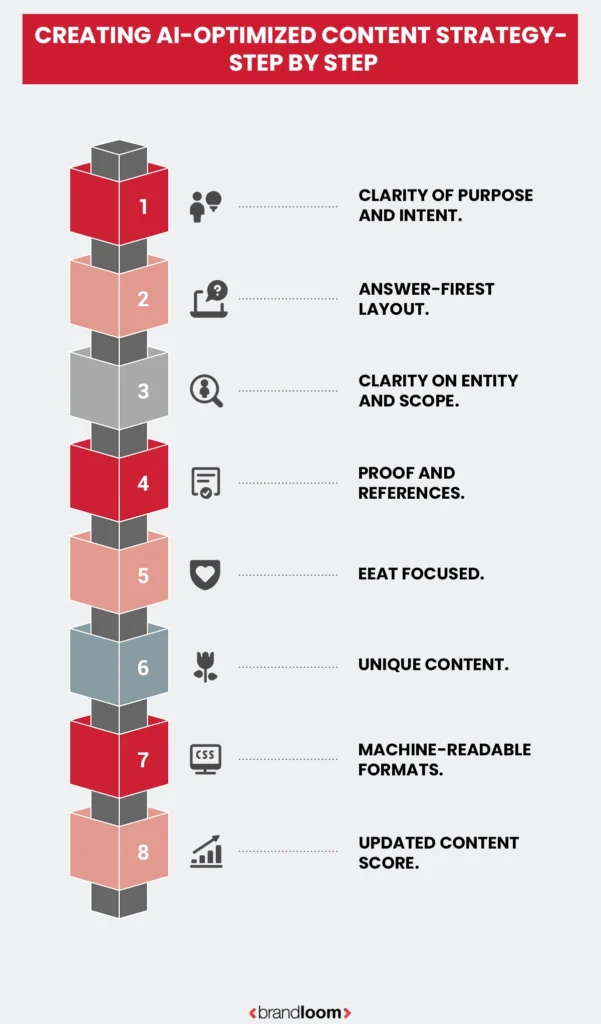
How to Create an AI-Optimized Content Strategy- A Step-by-Step Approach
1. Purpose and Intent Clarity
On each page, make it clear to the target audience what they will get from it. That holds true for every content you use on the website as well. It can be a blog or a landing page, for example.
2. Answer-first Layout
AI tools and your users need the right answers to their queries. So, you should be using answer-first content writing on your site. For a topic, begin with a small but direct answer that AI can easily find and analyze. Later, you can expand on it. This is especially ideal for long-form AI-optimized content.
3. Entity and Scope Precision
There should be no ambiguity in your brand content, as it makes things difficult for AI systems. For AI-readable content structure, you must clearly define key terms, the audience, and the geography/industry. For example, if a blog is meant for B2B SaaS and D2C brands, mention it explicitly.
4. Scope for Verification – Proof and References
AI search engines will trust your content when they can easily verify it. So, use different types of proofs that help create trust signals for AI engines. So, for any claim, use a data point, screenshot, policy reference, or documented evidence as applicable.
5. Focus on EEAT
Both generative systems and human readers prefer content with relatable experience and accountability. For the EEAT content strategy, you can add author context, practical experience cues (for products and services), and update content.
6. Uniqueness of Content
What makes AI-generated content identifiable is the sameness. Millions are using the same AI tools to generate content on the same topics quickly, so the tone and style make it easy to spot. Try to include content credibility signals likefirst-party learnings, teardown examples, case snippets, etc. For example, you can use a quality checklist used before shipping your products to outlets.
7. Machine-readable Formatting
For better visibility in AI answers, focus on AI search visibility optimization. Your site content should have a well-defined structure, with H2/H3 hierarchy, bullets, definitions, and short paragraphs. Do not use large text chunks.
8. Updated Content Scores
Do not become complacent after publishing content, even when you maintain all metrics for the AI-ready content framework. Update your content periodically, both for webpage and blog topics. You should also update the statistics and references used.
Developing an effective strategy to develop AI-trusted content is not a simple task. You will need the expertise and guidance of veteran digital marketers and AI SEO analysts.
Rely on BrandLoom to develop an expert-backed content strategy that gives your brand a solid edge. Want to learn more about an AI-optimized content creation strategy? Contact our AI experts and SEO strategists to carry out an in-depth AI Visibility Audit.
An In-Depth Look at AI-Citable Web Content
Here we take a closer look at what AI-trusted content looks like and how to create it:
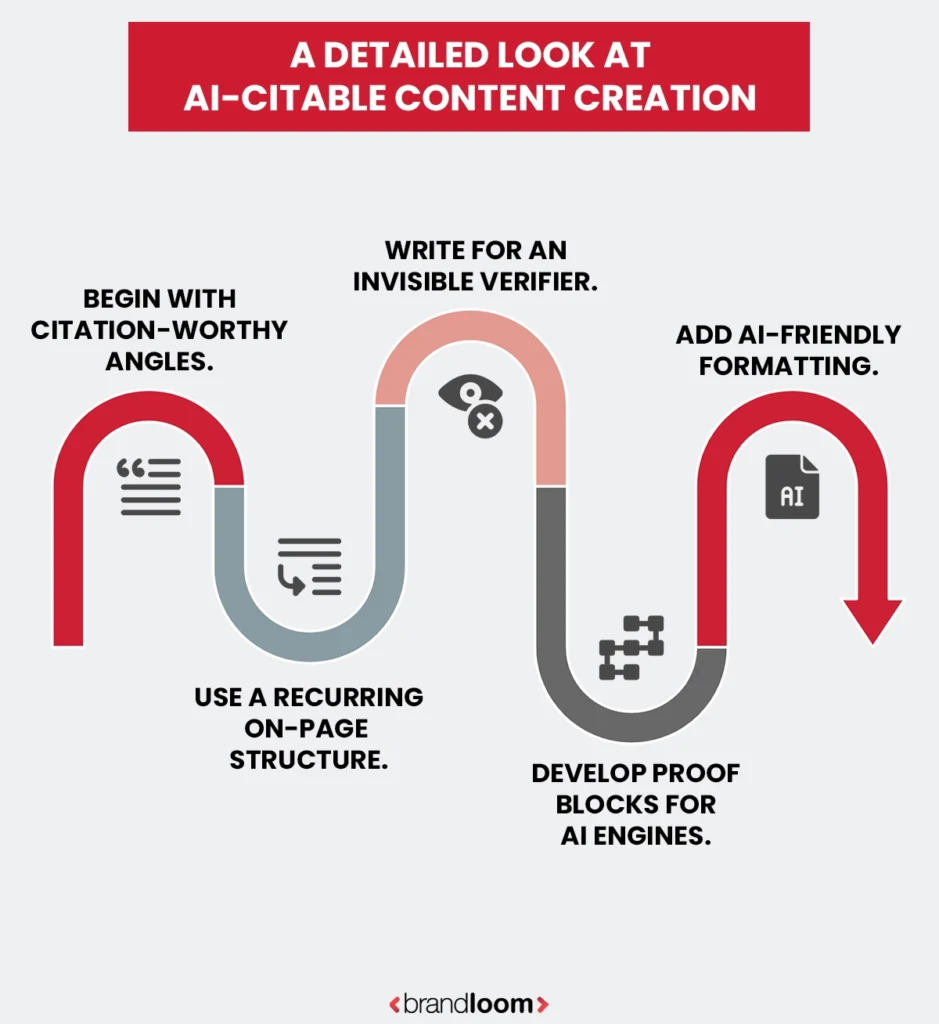
1. Start With Citation-Worthy Angles
To get your content cited by the top AI models, focus on the narrative. It is better to begin with content angles that AI systems can easily access and choose. Examples include:
- A clear and crisp definition (what is an EEAT content strategy)
- A relatable, practical comparison ( Free vs Paid VPN for start-ups)
- A clear method (How to set up your Instagram online store?)
This keeps your brand’s content strategy focused. Your blog posts become easier to cite for AI engines.
2. Use A Repeatable On-Page Structure
Do you want to develop AI-readable content structure? Use the following structure:
- Direct Answer – Keep it short and precise at the top, since both humans and generative systems love clarity.
- Every bullet point – Must cover a claim, qualifier, and proof (source link, example, screenshot/graph).
- Step-by-Step method – To describe any process (registration/renewal, etc.)
- Example – Use real-world examples.
This aligns with Google’s principle that AI-trusted content does not need a special trick. You have to cover the fundamentals well and create genuinely helpful content.
3. Write as if there is a Verifier
Why do you think a lot of brands fail by using AI-generated content? It is not the content that is always at fault. They simply do not verify the claims made. To overcome this issue, you can use this pattern: Claim – Context – Proof.
If you mention a product/service that addresses a specific user need, provide the context. Then, follow it up with a proof, like a screenshot, a user review, or a testimonial, etc. Remember, Google allows AI/automation when it is used to help users, not when you try to manipulate ranking.
4. Create “proof blocks” AI can Cite
In your content, add a few proof blocks. These make it easier for AI search engines to reference confidently. In turn, your content reaches more people, and your ranking improves.
For example, you can use a case study showing how your services/products helped resolve specific client problems and improved their revenue and brand image. Another way to do this is by using a video or infographic showing manufacturing or quality testing in your company, for certification and meeting norms. A worthy example here is the Ashley Stewart Case Study, serving as strong evidence of BrandLoom’s expertise in the AI SEO domain.
This is how content is segregated from content that earns trust.
5. Add AI-system Friendly Signals
For any web content you use, focus on AI SEO optimization. Get the structure right to make things easier for generative systems. Your content must have the right formatting, including proper H2/H3, descriptive internal links, consistent terminology, etc. However, use AI-readable content structure when it’s accurate and relevant.
Don’t feel overwhelmed planning for AI-ready content when you have access to expert insight. Let BrandLoom’s AI strategists and content marketing experts guide you from start to end.
How to Develop an AI-focused Workflow for Marketing Teams?
Your marketing team also needs to use generative engines effectively without relying heavily on AI-generated content. They must learn how to make content AI models cite, and that helps users. The AI trust Stack should be a part of their workflow.
In 2026, the winning workflow is hybrid. Human writers bring their insight and expertise and use generative systems to speed up drafting and execution.
The Content Creation Workflow
The process involves three major steps:
- Human strategy – Creating a draft and detailed guidelines for content creation.
- AI assistance – Using AI tools to generate outline variants, first drafts, rewrites, and formatting quickly.
- Final touches – Fact checking, refinements, and adding trust signals by expert writers and editors.
Your AI content optimization 2026 strategy should be hybrid, where human supervision and inputs make AI content generation better and more accurate.
The Trust Gate
Before publishing any content, it runs through a trust gate.
- Does it genuinely help target users or not?
- Every claim must include a source, a metric, a screenshot, or documented steps.
- Is there a section on real-world insight/case that is unique?
- Does it have an AI-readable content structure?
- Does it contain updated data?
That is how your content becomes well-optimized for AI search engines, effectively. If you feel unsure about creating and testing your content through all such steps for AI readiness, seek expert assistance. Our AI SEO analysts at BrandLoom can show you the nuances of creating an AI-focused workflow.
Measure AI Visibility, Citations, and Revenue Impact
Just creating an AI-ready content strategy does not deliver results. You need to check how effective the strategy is and if it is translating into better AI visibility and conversions.
Checking the Efficacy of Your AI-Focused Content Strategy
To find if your AI Overviews content optimization is bringing results, analyze these carefully:
- AI visibility- Is your brand and its services being cited by top AI tools like Gemini or Perplexity?
- Search discovery – Are new people finding your brand and its offerings?
- Engagement type – Are the new visitors spending enough time on site and taking meaningful actions?
- Revenue effect – Are the new discoveries leading to conversions and revenue growth?
An AI citation Testing Ritual
Make a weekly AI citation testing ritual and follow it consistently:
- Pick 10 queries, including comparisons and best/near me searches.
- Test in AI tools like ChatGPT and Perplexity for citations.
- Check the URLs cited, the competitors that showed up, and the sections quoted.
- Update your pages with sub-answers.
- Re-test next week.
Common Mistakes That Hurt AI-First Content Strategies
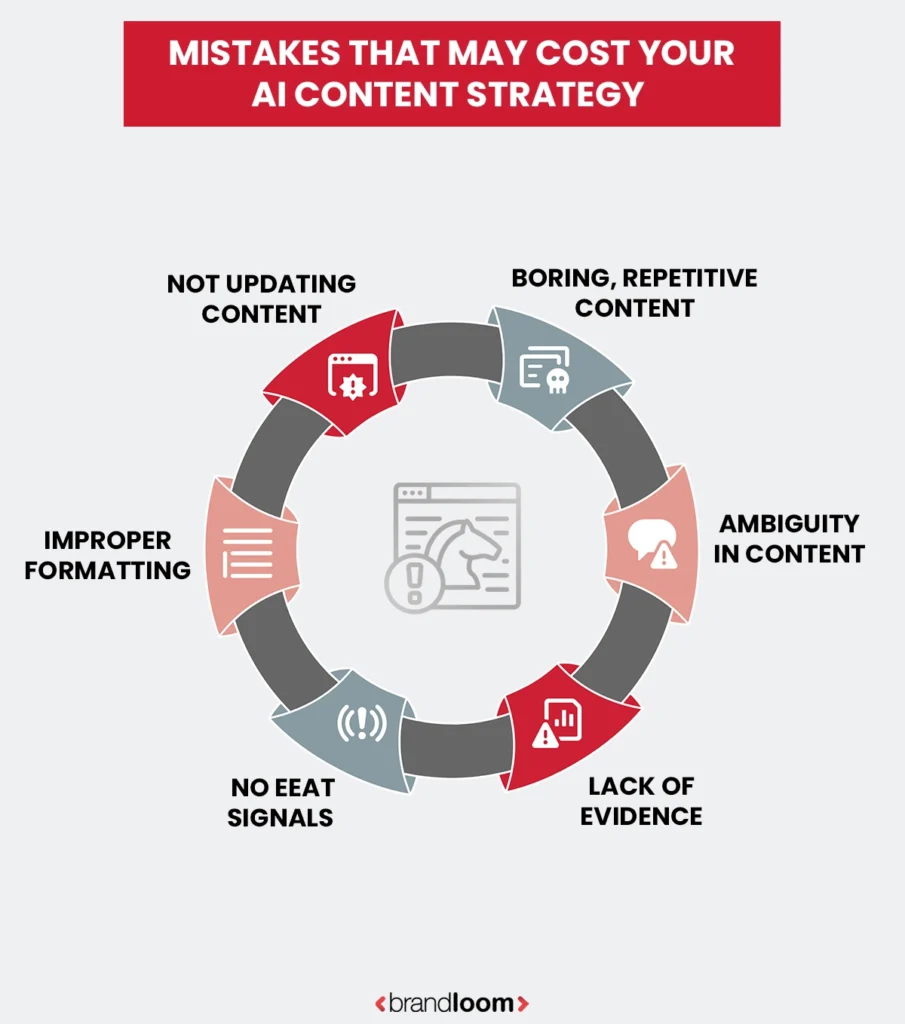
Are you unsure what is holding your AI-first content strategy back from bringing the expected results? Check if your team is making these mistakes:
1. Generic content – Using generative systems to bulk produce content hits the quality, making it uninteresting, both for readers and AI systems.
2. Lack of clarity – Does your content lack clarity on the topic, services, or products covered? Without answer-first content writing, AI tools will overlook your content.
3. Lack of proof – To be cited by top AI systems, your content must include proof and references. Without enough visible proof against claims, AI agents will overlook your pages.
4. Lack of EEAT – Without any clear signs of author/accountability and trust, AI engines will overlook your content.
5. Lack of formatting– If your pages are not structured and lack schema markup for content, they will remain invisible to users.
6. Stale content – If you do not update pages from time to time, they lose reliability.
Resolve these issues, and you will experience a rise in AI visibility. However, spotting and avoiding such AI content strategy mistakes is easier when you have a partner with the required expertise in the niche. Count on BrandLoom, the winner of the MartechAi Awards 2025, for an innovative AI-driven strategy.
Developing an AI-ready Content System with BrandLoom
You cannot rely solely on generative systems or any agency to develop a high-impact AI-ready content framework. You need the expertise of a digital marketing and AI technology analyst like BrandLoom. Our SEO and AI experts will craft the perfect AI-optimized content marketing strategy for you. Here’s how:
1. AI Visibility and Content Audit – Our AI analysts check your brand content for AI visibility and perform a thorough audit. They find out loopholes for the lack of AI visibility.
2. Topic Authority Map – We develop the strategy for AI content clustering for better visibility.
3. Proof Blocks – Our SEO and AI analysts add proof blocks for your content, like case studies, process steps, and benchmarks. These help make content AI-citable.
4. Entity Forming – Our experts focus on internal linking, definitions, headings, and Scalable content so AI systems can find and cite your site easily.
5. Refining and Reporting – We update and refine page content to make it ready for AI search visibility optimization.
Still wondering why AI isn’t citing your brand? It’s time you get an AI Visibility Audit done by the SEO and AI analysts experts at BrandLoom.
Conclusion
In 2026, your content will not compete for ranking; it will be competing for trust. AI-trusted content will overshadow others and appear in search results and overviews. Google’s stance on AI SEO optimization is clear: no hacks for AI features will do. You must focus on the fundamentals better- creating helpful, reliable, people-first content with great clarity and structure.
You will need more than just a few generative systems or methods. Developing an AI-focused content ecosystem is the way to go. Develop high-quality content that helps your users, and present it in a format that AI tools can easily access and cite.
Develop a content strategy with a focus on the following:
- Answer first, and then prove it with real-world examples, proof blocks, and mentions.
- Build content pillars and linked clusters, over isolated blog posts.
- Keep content updated with statistics and a testing loop.
To develop a content strategy fitting your brand best, contact the AI SEO analysts and senior digital strategists at BrandLoom for a custom EEAT content strategy.
FAQs
An AI-first content strategy in 2026 focuses on creating content that top AI models can find, analyze, and trust. Then they will cite such content in their responses to user queries. The days of optimizing content only for top ranking are gone. AI search engines increasingly choose content with clarity, covering user needs, and with proof of trust.
It also looks for strong E-E-A-T signals and answer-first content writing. So, an ideal AI-ready content strategy should combine human insight and experience with the polishing and speed of generative engines for the final effect. For an effective, customised, and AI-ready content marketing strategy, contact our experts at BrandLoom.
Businesses can develop AI-optimized content by focusing on content strategies that showcase credibility and authority in their sectors. They should use content with original statistics and research findings. Including direct quotations from verifiable sources helps, as does using semantic content optimization.
They should optimize content with answer-first formatting, use apt formatting, and put major statistics on top. AI models look for trust signals, and so content with citations from credible studies and sources will be picked first. Such content gets featured in Google’s AI overview and in specific AI tool searches.
AI models prefer content ranking in Google’s top 10, usually. Brand search volume helps get more AI citations than backlinks alone, studies have shown. Brand-building activities now directly affect AI search visibility.
Businesses that succeed in establishing themselves as credible entities in their sectors race ahead. Also, content structure is important, with reports showing that 82.5% of AI citations point to topic-specific pages rather than homepages. Social visibility on platforms like Quora and Reddit indicates credibility and engagement for AI systems.
AI-optimized content pays more importance to answering user queries than driving clicks. This changes the objective of content optimization. AI answers questions without clicks through platforms like ChatGPT, Gemini, or Perplexity. Content optimization is now focused on semantic relevance and topic clusters.
You will see websites with strong topic coverage ranking higher than keyword-infused content. AI-ready content must be well structured, using proper formatting so that generative systems can find and analyze it quickly. Content with clear headings, short summaries, bullet points, and schema markup stands out. Also, AI-optimized content seeks strong trust proofs in the form of case studies, statistics, citations from top sources, etc.
AI tools and systems look for specific types of content in response to user queries. For AI citations, content that includes FAQs, how-to articles, expert commentary, and structured guides works best. Listicles and comparative content are chosen by most generative engines.
Additionally, these tools choose content with original data, statistics, and research findings. Pages with proper optimization get approximately 40% more citations. Overall, well-structured, useful content wins over keyword-stuffed, generic content in the era of large language models (LLMs).
Using structured data can greatly improve the AI visibility for your content. Generative systems can find pages with proper schema markup for content easily and cite them. Pages without proper AI optimization are overlooked.
This is applicable to Google’s AI Overviews as well. Products with comprehensive schema markup appear 3-5 times more in AI-generated shopping recommendations. Article and Blog Schema improve visibility in Google News and search results. You have to be careful about implementation quality, as Google prefers the JSON-LD format.
Topic clusters help you earn topical authority, and they make your content easier for AI tools to understand. Most AI search engines break queries into multiple sub-queries, and they use the query fan-out technique.
Then they combine information from many sources into a single answer. Remember that AI-based search engines don’t look for isolated keywords. They look for content with authority, verifiable sources, and authenticity. AI content clustering shows search engines that your brand understands the subject well. By creating clusters that cover specific topics, your brand earns the trust of AI search engines.
For better AI readability, businesses should structure their content well and optimize it for AI systems. Using H2 and H3 tags to organize content is a must, as is using nested heading hierarchies. Generative systems find content with concise paragraphs and clear headings easier to process.
So, businesses must include content with tables, statistics, and comparisons to enhance their AI visibility. For the same reasons, using lists with bullet points and numbers in content can help. Long and bulk chunks of text make things tough for AI engines. For more nuanced insights on making your brand content AI-friendly, contact our AI SEO analysts at BrandLoom.
Your content may not appear in AI overviews when you overlook some vital aspects of AI search visibility optimization. Google is not totally against using AI tools to generate content. It is more against using such content in a manipulative way to boost ranking. If your content is not relevant, fresh, or fulfils user queries, it will not appear in AI overviews.
Even if your content is technically correct but lacks any verifiable source or citations, generative systems may skip it. These systems look for strong trust signals. The content structure and formatting also matter here. Large text chunks without subsections and heading formatting may be overlooked by AI agents.
To create AI-engine preferred content, you must focus on creating pages that drive leads, sales, or brand visibility. Your focus should be on two main aspects- developing an AI-friendly structure and offering genuinely useful information, with verifiable sources. The first is to focus on the apt schema markup, internal links, and AI-friendly formatting for every page.
Focus on offering answers at the top of the content and later explain. Remember to cite expert sources in your sector, and use strategic internal linking to guide both users and AI search engines. Lastly, update your content regularly to keep it relevant and useful. Contact BrandLoom’s AI analysts and SEO strategists for the best strategy for AI-ready content development in 2026.