The way people discover products, services, and information is changing rapidly. Instead of typing short keywords into search engines, consumers increasingly ask detailed questions to AI assistants and expect direct, personalized answers. This shift is creating a new era of AI-powered discovery, where conversations often replace traditional search journeys.
For marketers, this change goes far beyond a new technology trend. As conversational interfaces become part of everyday decision-making, advertising opportunities are beginning to move closer to the point where users seek recommendations, compare options, and evaluate purchases. This evolution could reshape how brands capture attention and influence buying decisions.
That is why ChatGPT Ads in India has become a topic of growing interest among businesses, agencies, and digital marketers. While the advertising ecosystem around AI assistants continues to evolve, the potential for ChatGPT advertising in India could be significant. Brands that understand conversational discovery early may gain an advantage as consumer behavior continues to shift.
As a leading digital marketing agency, BrandLoom believes businesses should start preparing now by strengthening their visibility across emerging AI-driven channels. Whether through organic presence or future paid opportunities, the rise of the AI advertising platform model signals a major transformation in digital marketing.
Current Status of ChatGPT Ads
With growing discussions around ChatGPT Ads in India, many marketers are asking the same question: Are ChatGPT Ads available in India today?
The short answer is no.
What Is Officially Known?
OpenAI has confirmed that advertising is currently being tested in a limited number of markets, including the United States, Canada, the United Kingdom, Australia, and New Zealand. These ads are being shown only to eligible users on specific plans, while paid plans such as Plus, Pro, Business, and Enterprise remain ad-free. OpenAI has also stated that ads are clearly separated from AI responses and do not influence the answers users receive.
What Remains Unconfirmed?
There has been no official announcement regarding the launch of ChatGPT advertising in India. Details around advertiser access, pricing models, targeting capabilities, ad formats, and rollout timelines for India remain unclear. While industry reports suggest that OpenAI is actively building its advertising business, any specific launch date for India is currently speculative.
What Should Brands Monitor?
Rather than waiting for a formal launch announcement, brands should focus on tracking OpenAI’s advertising expansion, emerging AI advertising platform capabilities, and changes in conversational search behavior. Businesses should also monitor developments in GEO, AI visibility, and conversational commerce, as these areas are likely to influence success regardless of when ChatGPT Ads become available in India.
For now, the opportunity lies less in buying ads and more in preparing for the future of AI-driven discovery.
Why Would OpenAI Introduce Ads?
As discussions around introducing ChatGPT Ads in India continue to grow, many marketers are asking a broader question: why would OpenAI introduce advertising in the first place?
The answer largely comes down to sustainability and scale. Operating advanced AI systems requires significant investment in computing infrastructure, model training, research, and ongoing development. As the number of users continues to grow globally, the cost of delivering fast, reliable AI experiences also increases.
Like many digital platforms before it, OpenAI may explore multiple revenue streams to support long-term growth. Subscription plans already play an important role, but advertising could provide an additional source of revenue while helping keep free access available for a larger user base. This approach has been used successfully by search engines, social media platforms, and streaming services.
Running a platform like ChatGPT is expensive. OpenAI must invest heavily in computing power, data centers, model training, security, and ongoing product development.
Advertising could help support these growing costs in several ways:
- Cover infrastructure costs: Every AI query uses significant computing resources. As usage grows, so does the cost of delivering fast and reliable responses.
- Create a new revenue stream: OpenAI already earns revenue through subscriptions and enterprise products. Ads could add another monetization channel.
- Keep free plans sustainable: Advertising revenue can be a huge help for OpenAI to continue offering free access to a large user base even without moving every useful feature behind a paywall.
- Support long-term growth: Additional revenue could fund research, product improvements, safety systems, and expansion into new markets.
However, the important thing is, monetization should not damage the user experience. People use ChatGPT because they expect useful and trustworthy answers.
OpenAI faces a delicate balancing act. Users trust AI assistants because they provide helpful, unbiased information. Any future AI advertising platform would need to protect that trust by ensuring advertisements remain transparent, relevant, and clearly separated from organic responses.
Any advertising model must keep ads clearly labeled, relevant, and separate from organic responses. The long-term success of ChatGPT Ads will depend on how well OpenAI balances revenue goals with user trust.
For advertisers, this balance is equally important. The success of ChatGPT advertising in India will likely depend on whether OpenAI can create advertising experiences that support monetization goals without compromising the quality of user interactions that made the platform popular in the first place.
The Evolution of Digital Advertising: From Search Engines to AI Conversations
Digital advertising has evolved alongside the way people find information online. In the early days, search engines dominated the discovery process. Users entered keywords, scanned a list of links, and clicked through multiple websites to find answers. Brands competed for visibility through SEO and paid search campaigns.
The rise of social media changed that dynamic. Platforms like Facebook, Instagram, and YouTube introduced discovery through feeds, recommendations, and personalized content. Instead of actively searching, users began discovering products while consuming content.
Today, another shift is underway. People increasingly turn to AI assistants for answers, recommendations, and comparisons. Rather than searching for information, they ask questions in natural language and expect direct responses. This change is driving the growth of AI search advertising, where visibility depends less on ranking for keywords and more on being relevant within a conversation.
The difference is significant. Browsing requires users to navigate multiple sources before making a decision. Asking allows them to receive curated information in a single interaction. As a result, conversational advertising has the potential to influence consumers much earlier in the decision-making process.
This evolution is also reshaping the role of brands. Instead of simply competing for clicks, businesses may need to compete for recommendations inside AI-generated responses. As AI-powered advertising continues to develop, marketers must understand how conversational discovery works and what it means for visibility, engagement, and customer acquisition.
For many businesses, this shift could represent the next major chapter in the future of digital advertising.
What Are ChatGPT Ads?
As AI assistants become a common starting point for research and product discovery, marketers are paying closer attention to how advertising could fit into these environments. While the ecosystem continues to evolve, ChatGPT Ads in India are emerging as a topic of interest for brands looking to understand the future of customer acquisition and digital visibility.
How Sponsored Recommendations Work
Unlike traditional display advertising, which usually relies on banners, pop-ups, as well as promoted search listings, ChatGPT Ads can appear as clearly labeled sponsored placements. Future conversational formats may become more personalized as the advertising model develops.
A possible interaction might look like this:
User: “I need a CRM for a 20-person sales team. My budget is not more than ₹2,000 per user each month. Along with that, it has to support WhatsApp integration and lead scoring as well.”
The AI assistant could recommend several relevant CRM platforms. A provider that matches the user’s team size, budget, and feature requirements could appear in a clearly labeled sponsored placement.
The user could then ask follow-up questions about pricing, integrations, customer support, or implementation time. This would allow the sponsored brand to become part of an active buying conversation rather than appearing beside a broad keyword search.
Contextual Advertising Inside Conversations
One of the defining characteristics of conversational advertising is contextual relevance. Instead of targeting users based solely on keywords, ads may appear based on the intent behind a question. This approach allows brands to engage users at the moment they are actively seeking information, comparing options, or evaluating a purchase.
Many discussions around OpenAI ads in India focus on this ability to align advertising with real-time user intent rather than isolated search terms.
Conversational Product Discovery
Product discovery within AI assistants differs from traditional advertising experiences. Rather than clicking through multiple links and websites, users can ask follow-up questions, compare alternatives, and refine their choices within the same conversation. In this environment, sponsored AI responses could help brands become part of the decision-making journey.
As the conversation around ChatGPT Ads in India continues to grow, businesses are exploring how conversational recommendations could create new opportunities for visibility, engagement, and customer acquisition.
Why the India Opportunity Is Bigger Than Most Marketers Realize
India offers a strong foundation for the next wave of AI-driven advertising. It combines a large digital population, growing AI investment, and a rapidly expanding online advertising market.
India’s artificial intelligence market also continues to grow. According to an article on Statista, the market will reach approximately US$12.02 billion in 2026. This growth reflects the rising interest in AI tools across different fields like business, education, technology, and consumer services, and many more.
AI has already become part of modern marketing workflows. HubSpot found that 86.4% of marketing teams use AI in at least some areas of marketing. Teams use it for content creation, media production, advertising optimization, automation, and strategic planning. Although this figure represents global marketers, it shows how quickly AI is becoming a standard marketing capability.
India’s advertising market creates another strong growth signal as well. As per a research, valued digital media advertising revenue in India is at approximately ₹947 billion in 2025. Digital platforms also generated more advertising revenue than any other media category during the year.
These numbers make the opportunity difficult to ignore. Indian consumers already use digital platforms to learn, compare products, research services, and make purchase decisions.
As these behaviors move from traditional search to AI conversations, ChatGPT advertising in India could become an important discovery channel. Brands that understand conversational search early may gain visibility before competition and advertising costs increase.
How ChatGPT Ads Could Influence the Customer Journey
One of the most interesting aspects of AI-powered advertising is its potential to influence consumers throughout the entire decision-making process. Unlike traditional ads that often target a single touchpoint, conversational interactions can support users from initial research to final purchase. This creates new ChatGPT marketing opportunities for brands looking to engage customers more effectively.
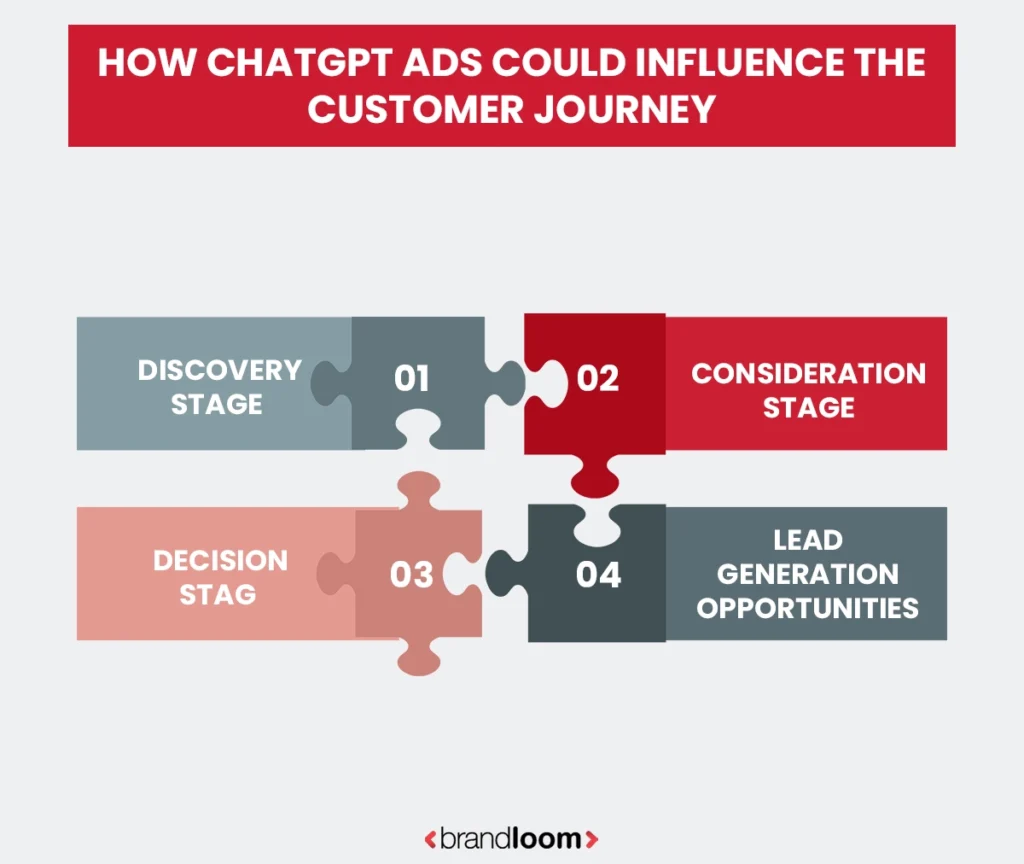
Discovery Stage
The customer journey often begins with a question. Users may ask for product suggestions, industry insights, or solutions to a specific problem. Instead of browsing multiple websites, they can receive curated recommendations within a single conversation. This makes AI assistants a potential discovery channel for both established and emerging brands.
Consideration Stage
Once users identify potential options, they typically start comparing alternatives. They may ask questions about features, pricing, benefits, or customer suitability. During this stage, brands that appear in relevant recommendations can gain valuable visibility while consumers actively evaluate their choices.
Decision Stage
As customers move closer to making a purchase, they often seek reassurance. Questions such as “Which option offers the best value?” or “Which service is right for my business?” create opportunities for more personalized recommendations. This ability to guide decision-making highlights the growing role of conversational commerce in modern marketing.
Lead Generation Opportunities
Beyond product recommendations, AI conversations could support lead generation for service-based businesses. Users researching software, consulting services, healthcare providers, or educational programs may request demos, consultations, or additional information directly from within a conversation. This could make ChatGPT business advertising particularly valuable for businesses with longer sales cycles.
By engaging users during research, comparison, and decision-making, conversational advertising has the potential to become a meaningful part of the customer journey rather than simply another advertising channel.
ChatGPT Ads vs Google Ads vs AI Mode vs Perplexity Ads
As AI-powered search experiences become more common, marketers are no longer evaluating a single advertising channel. Instead, they must understand how different platforms approach discovery, recommendations, and user intent. While each platform serves a similar goal—helping users find information—the customer experience and advertising opportunities vary significantly.
| Feature | ChatGPT Ads | Google Ads | Google AI Mode | Perplexity Ads |
| User Intent | Conversational and question-driven | Keyword-driven | Conversational search queries | Research and answer-focused |
| Placement | Within AI conversations | Search results and display network | AI-generated search experiences | AI-generated answers |
| Discovery Behavior | Recommendation-based | Search-based | Search + AI summaries | Research-oriented discovery |
| Competition | Potentially lower initially | Highly competitive | Growing competition | Emerging ecosystem |
| User Journey | Interactive conversations | Click-through experience | Hybrid experience | Conversational research |
| Brand Visibility | Recommendations within responses | Search rankings and ads | AI-generated overviews | Answer-based visibility |
| Best For | Recommendations and product discovery | Capturing existing demand | Blended search and AI discovery | Detailed research and comparisons |
The biggest difference in the ChatGPT ads vs Google Ads discussion comes down to intent. Traditional search advertising relies heavily on keywords. Users type specific phrases, review multiple results, and decide where to click. AI assistants, on the other hand, focus on understanding the meaning behind a question and delivering a direct response.
This shift changes discovery behavior. Instead of browsing through links, users can ask follow-up questions, compare products, and request recommendations within the same conversation. That creates new possibilities for AI search advertising, where visibility depends not only on keywords but also on relevance, authority, and contextual fit.
Google AI Mode and Perplexity represent another evolution of AI-assisted discovery. Both platforms combine AI-generated responses with source-based information, helping users research topics more efficiently. However, they still differ from ChatGPT’s conversational approach, which encourages longer interactions and deeper exploration.
For brands, the key takeaway is that visibility opportunities are becoming more diverse. Success may no longer depend solely on ranking first in search results. Instead, businesses may need a broader strategy that combines SEO, paid media, AI visibility, and conversational discovery. As the OpenAI advertising model and competing AI advertising ecosystems continue to evolve, marketers who understand these differences will be better positioned to capture attention across emerging channels.
Which Businesses Stand to Benefit the Most?
Not every industry will adopt conversational advertising at the same pace. However, businesses that rely heavily on research, comparisons, recommendations, and trust-building are likely to see the greatest value from emerging ChatGPT marketing opportunities.
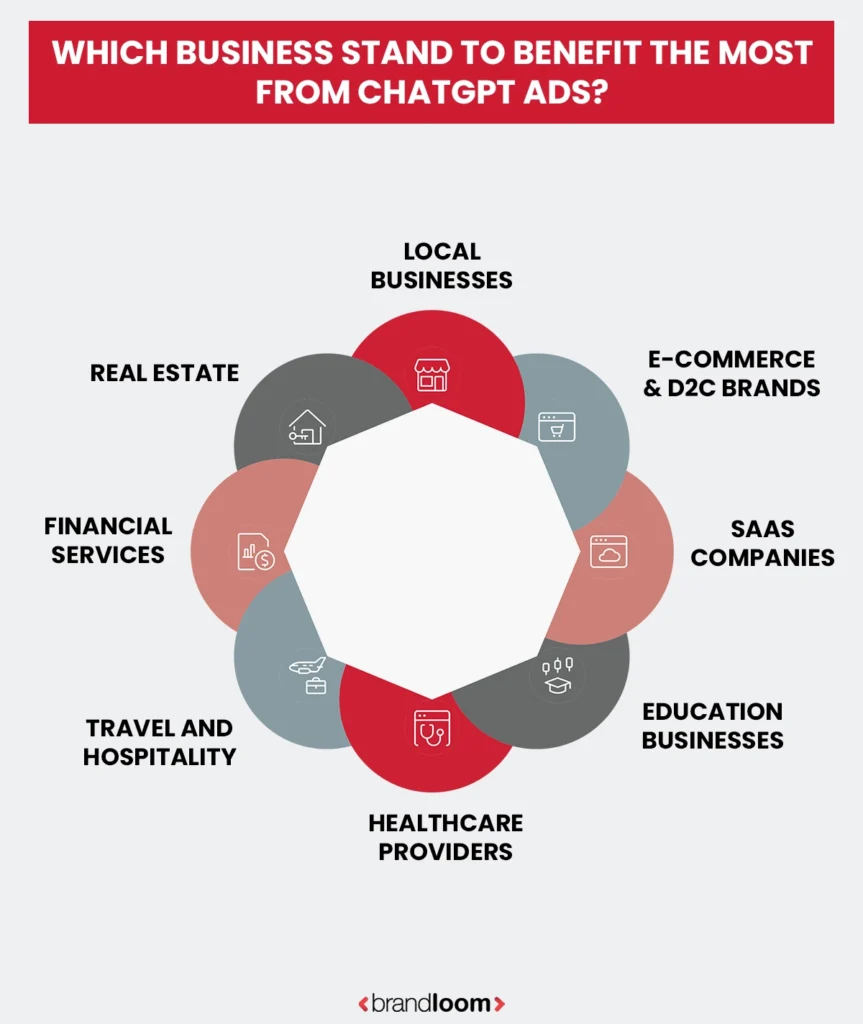
E-commerce & D2C Brands
Consumers frequently ask for product recommendations before making a purchase. An Indian skincare brand, for example, could gain visibility when users ask for the best vitamin C serums for specific skin concerns.
SaaS Companies
Software buyers often spend significant time researching solutions before booking a demo. A CRM provider serving Indian SMEs could appear in conversations where users compare sales and customer management platforms.
Education Businesses
Students and working professionals regularly seek course recommendations. An edtech platform offering AI, coding, or digital marketing certifications could benefit from recommendation-driven discovery.
Healthcare Providers
Patients often research hospitals, clinics, and treatment options before making decisions. Healthcare providers could gain exposure when users seek information about specialists, diagnostic services, or healthcare facilities.
Travel & Hospitality
Travel planning naturally involves multiple questions. Hotels, travel agencies, and tour operators could become more discoverable when users ask for destination recommendations, budget-friendly stays, or holiday itineraries.
Financial Services
Banks, insurance providers, and fintech companies may benefit when users compare credit cards, investment platforms, loans, or financial planning services before making a decision.
Real Estate
Property buyers frequently seek advice on locations, budgets, and investment opportunities. Real estate developers and brokerage firms could gain visibility during these research-driven conversations.
Local Businesses
From restaurants and fitness centers to home service providers, local businesses could reach potential customers at the exact moment they ask for nearby recommendations.
As AI-powered advertising continues to evolve, industries that depend on education, trust, and informed decision-making are likely to benefit the most from conversational discovery and recommendation-based engagement.
Why GEO Matters Even If You Plan to Buy Ads
Many marketers view paid advertising and organic visibility as separate strategies. In the AI era, however, the two are becoming increasingly connected. Even if brands eventually invest in conversational advertising, they still need a strong organic presence to maximize credibility, trust, and discoverability. This is where Generative Engine Optimization (GEO) becomes important.
What Is Generative Engine Optimization (GEO)?
GEO refers to the process of optimizing a brand’s digital presence so AI assistants can identify, understand, and recommend it more effectively. Unlike traditional SEO, which focuses on ranking web pages in search results, Generative Engine Optimization focuses on improving the likelihood of being referenced in AI-generated answers and recommendations.
Paid Visibility vs Organic AI Visibility
Paid placements can help brands gain exposure, but they may not be enough on their own. Users often trust recommendations that appear naturally within AI-generated responses. Strong AI visibility helps brands appear in these organic recommendations, creating additional opportunities beyond paid campaigns.
As AI assistants become a key source of information, brands will need a balance between advertising investment and organic authority.
Why Brand Mentions Matter
AI systems often rely on trusted sources, expert content, reviews, and brand references when generating answers. Consistent mentions across reputable websites can strengthen authority signals and improve the chances of being surfaced in AI recommendations.
This is where entity SEO plays an important role. Rather than focusing only on keywords, brands need to establish a clear digital identity that AI systems can recognize and associate with specific topics, products, or industries.
In a world where AI increasingly influences discovery, strong organic authority can become just as valuable as paid visibility.
Why Brand Authority Will Matter More Than Ad Spend
It is true that Ad spend can buy visibility. But it cannot automatically earn trust.
In AI-led discovery, users often ask for the best option, the most reliable provider, or the right solution for a specific need. AI platforms may consider more than promotional messaging when shaping these recommendations.
They can look at signals, for examples- expert content, credible brand mentions, customer reviews, consistent business information, and trusted third-party references. Brands with stronger authority may appear more relevant and dependable within these conversations.
This means a large advertising budget may not be enough. A lesser-known brand cannot rely only on paid placements if its website lacks depth, proof, or credibility.
Brand authority can strengthen advertising in several ways:
- It builds user trust: People feel a lot more confident while choosing brands that has visible expertise, along with positive proof.
- It improves contextual relevance: Clear positioning helps AI systems understand what your brand offers and who it serves.
- It supports organic AI visibility: Strong authority can help your brand appear in unpaid recommendations and cited responses.
- It makes paid visibility more effective: Users may respond better to an ad when they already recognise or trust the brand.
For most of the Indian businesses, the priority should be clear. Build authority before advertising becomes widely available. Publish useful content, earn credible mentions, improve reviews, and keep your brand information accurate.
The brands that combine ad spend with genuine authority will likely have a stronger advantage than those that rely on media budgets alone.
How Indian Brands Can Prepare for ChatGPT Ads Today
Whether or not conversational advertising becomes widely available in the near future, brands do not need to wait to start preparing. The businesses most likely to succeed in AI-driven discovery will be those that invest in authority, content quality, and customer trust today. For marketers asking, “Can brands advertise on ChatGPT?”, the more important question may be whether their brand is ready for AI-powered discovery when those opportunities expand.
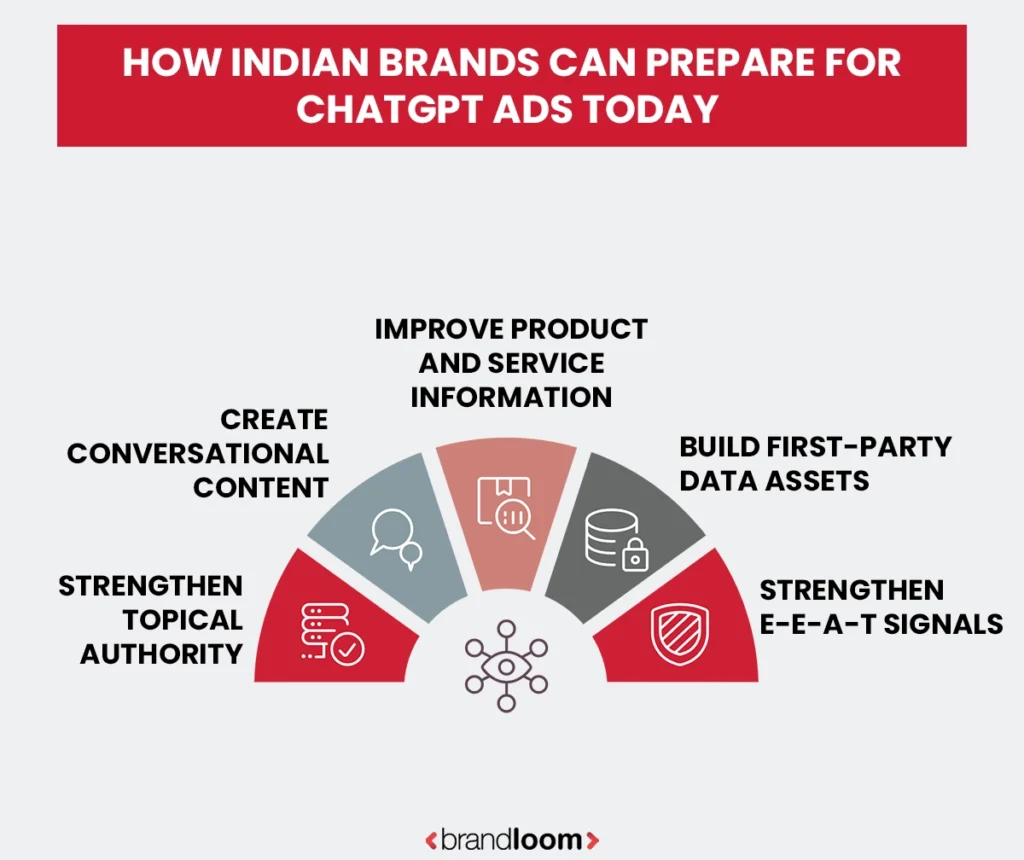
Strengthen Topical Authority
AI systems tend to favor brands that demonstrate expertise within a specific subject area. Instead of publishing scattered content across unrelated topics, focus on building depth around your core products, services, and industry. Consistent, high-quality content can help establish authority and improve visibility across both search engines and AI platforms.
Create Conversational Content
People interact with AI assistants differently than they use traditional search engines. They ask complete questions and expect direct answers. Brands should create content that mirrors natural conversations by addressing common customer questions, concerns, comparisons, and buying considerations. This approach aligns with emerging AI marketing strategies and helps content remain relevant in conversational environments.
Improve Product & Service Information
Accurate product descriptions, service pages, pricing details, FAQs, and business information make it easier for AI systems to understand and surface your offerings. Well-structured information can improve both customer experience and discoverability.
Build First-Party Data Assets
As privacy regulations evolve and third-party tracking becomes less reliable, first-party data becomes increasingly valuable. Brands should focus on building email lists, customer databases, loyalty programs, and direct audience relationships that support long-term marketing effectiveness.
Strengthen E-E-A-T Signals
Experience, Expertise, Authoritativeness, and Trustworthiness remain critical in both traditional search and AI-driven discovery. Showcase expert insights, customer success stories, industry credentials, reviews, and trustworthy business information across your digital presence.
As discussions around How do ChatGPT ads work in India continue to grow, the brands that focus on content readiness, website readiness, and data readiness today will be better positioned to adapt to tomorrow’s advertising opportunities.
Potential Challenges of AI Advertising
While much of the conversation around ChatGPT Ads in India focuses on growth opportunities, brands should also understand the potential challenges that come with any emerging advertising channel. Like search and social advertising before it, conversational advertising will likely face a period of experimentation, uncertainty, and adjustment.
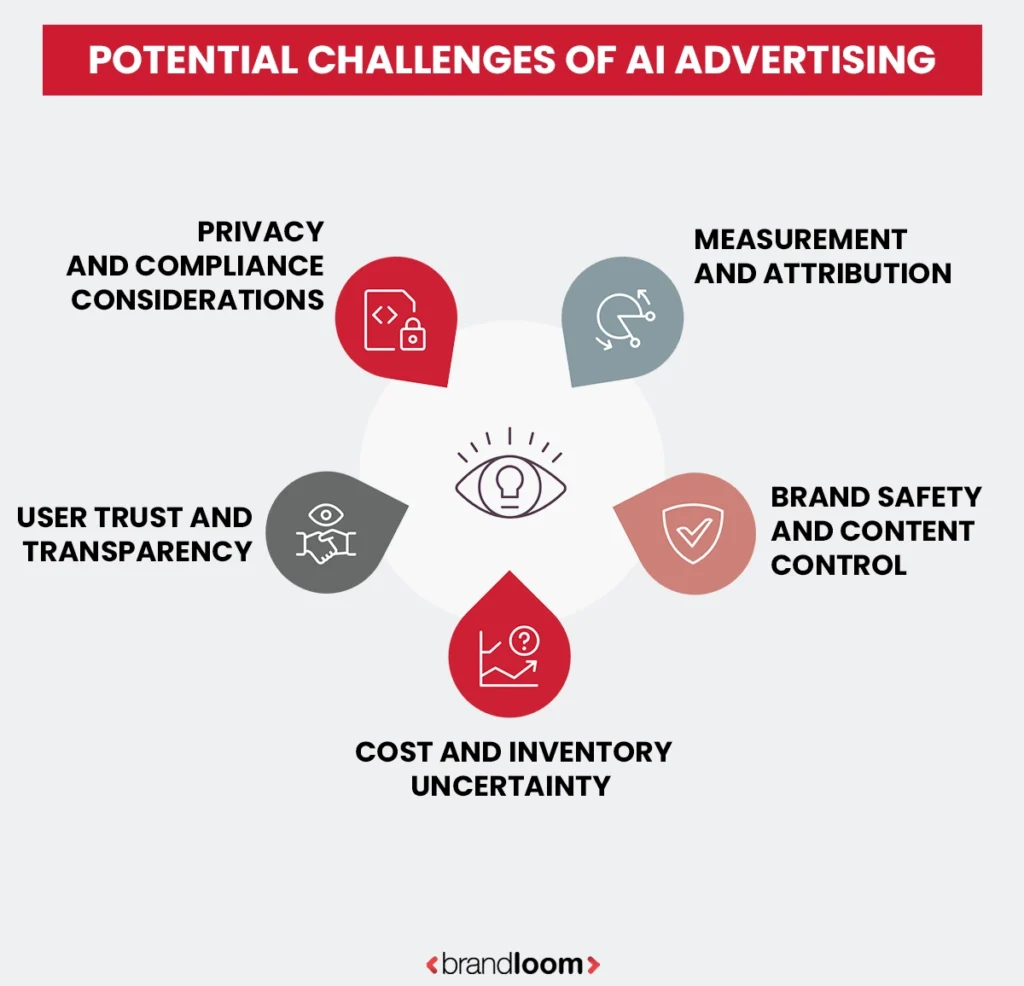
Measurement and Attribution
One of the biggest questions is how marketers will measure success. Traditional channels offer well-established tracking methods, but AI-powered advertising may introduce more complex customer journeys. Users could interact with multiple AI conversations before visiting a website or making a purchase, making attribution more difficult.
Brand Safety and Content Control
Brands will also want clarity on where and how their advertisements appear. Since AI-generated conversations can vary significantly based on user queries, advertisers may seek stronger controls to ensure their messaging aligns with brand guidelines and values.
Cost and Inventory Uncertainty
As ChatGPT advertising India evolves, pricing models and inventory availability remain largely unknown. Early demand could increase competition for limited advertising placements, making budgeting and forecasting more challenging for marketers.
User Trust and Transparency
Trust is another important factor. Users expect AI assistants to provide objective and helpful information. If advertising becomes too intrusive or difficult to distinguish from organic recommendations, it could affect user confidence and engagement.
Privacy and Compliance Considerations
Advertisers must also consider evolving privacy regulations and data protection requirements. As conversational platforms grow, businesses will need to balance personalization with responsible data practices and regulatory compliance.
For most brands, the opportunity is significant. However, understanding these challenges will help marketers build more realistic expectations and develop smarter long-term AI marketing strategies.
Conclusion
The rise of AI-powered discovery is changing how consumers research products, compare options, and make purchasing decisions. As conversational platforms continue to gain adoption, ChatGPT Ads in India could introduce new ways for brands to reach customers during critical moments of the buying journey.
While the advertising landscape is still evolving, preparation should take priority over speculation. Brands that invest in strong content, topical authority, trust signals, and customer-centric experiences today will be better positioned to benefit from future opportunities. Building a solid foundation through SEO, ChatGPT advertising in India readiness, and AI-focused visibility strategies can create a competitive advantage as consumer behavior continues to shift.
The future of digital marketing is unlikely to be defined by paid advertising alone. Success will increasingly depend on a combination of GEO, SEO, brand authority, and AI visibility. If your business is exploring how to prepare for the next phase of AI-driven marketing, BrandLoom can help you develop a strategy that keeps your brand visible, discoverable, and ready for what comes next. The brands that succeed in the AI era won’t simply advertise better. They’ll become easier for both people and AI systems to understand, trust, and recommend.
Frequently Asked Questions
The availability of ChatGPT Ads in India will depend on OpenAI’s advertising rollout plans and eligibility requirements. If advertising expands to additional regions, Indian businesses may gain access in the future. Since developments are evolving quickly, brands should verify the latest information through official sources before making strategic decisions.
ChatGPT Ads are expected to be advertising placements that appear within AI conversations. These may include ChatGPT sponsored recommendations, contextual brand mentions, or promotional suggestions aligned with user intent. Unlike traditional display ads, they could be integrated directly into conversations, creating a more natural discovery experience.
The primary difference between ChatGPT Ads vs Google Ads lies in user behavior. Google Ads respond to keyword-based searches, while ChatGPT Ads may respond to conversational intent and context. This could create a more interactive experience where users ask follow-up questions before making decisions.
Potentially, yes. If self-service options become available, small and medium-sized businesses may be able to participate in ChatGPT business advertising alongside larger brands. However, details regarding eligibility, account requirements, and minimum advertising spend have not yet been officially confirmed.
Industries that depend on recommendations and customer research are likely to gain the most value from ChatGPT marketing opportunities. These include e-commerce, SaaS, healthcare, education, travel, finance, real estate, and local businesses where customers often compare multiple options before making a purchase.
Brands can prepare by strengthening SEO, building topical authority, and creating content that answers customer questions naturally. BrandLoom recommends investing in AI marketing strategies, improving product information, developing first-party data assets, and focusing on E-E-A-T principles to improve future AI visibility.
This appears unlikely. Rather than replacing existing channels, ChatGPT advertising in India would likely complement platforms such as Google and Meta. Businesses may use conversational advertising alongside traditional paid media to engage customers across different stages of the buying journey.
Potentially. AI conversations often occur when users are actively researching products or services. If future advertising formats support consultations, inquiries, bookings, or demo requests, ChatGPT business advertising could become a valuable lead-generation channel for many industries.
OpenAI has not publicly disclosed the full targeting capabilities that will be available across all markets, so advertisers should rely on official announcements as the platform evolves. Pricing models for ChatGPT advertising in India are still evolving, and advertisers should avoid relying on unofficial estimates. BrandLoom recommends monitoring official announcements before planning budgets.
Brands should measure performance using metrics such as impressions, engagement rate, click-through rate, leads, conversion rate, CPA, and ROAS. As AI-powered advertising evolves, new engagement metrics may also emerge to measure user interactions within conversational experiences more effectively.
As consumers increasingly use AI assistants to research products and services, AI advertising platform opportunities are expected to expand. Businesses that strengthen SEO, GEO, and AI visibility today may gain a competitive advantage as conversational discovery becomes a larger part of the customer journey.
SEO will continue to play a critical role in helping brands build authority and visibility. Strong content, trusted backlinks, and Generative Engine Optimization (GEO) can improve the likelihood of appearing in AI-generated recommendations while supporting broader AI search advertising efforts.
Most likely, yes. Paid visibility can increase exposure, but GEO helps brands earn organic recommendations within AI-generated responses. BrandLoom often advises businesses to combine Generative Engine Optimization with paid campaigns to maximize both short-term visibility and long-term authority.
Businesses can improve AI visibility by publishing expert-led content, maintaining accurate business information, earning mentions from trusted websites, and strengthening their entity SEO strategy. BrandLoom also recommends implementing structured data and creating conversational content that addresses real customer questions.